More than 55% of solar proposals in the UK included a battery in 2024 — up from just 18% in 2021. That shift is not driven by installer enthusiasm alone. Time-of-use tariffs like Octopus Agile, rising grid import prices, and persistent grid instability in rural areas have made battery storage a practical necessity for UK homeowners seeking genuine energy independence. But designing a battery solar system in the UK is not simply a matter of adding a box to a PV proposal. DNO connection rules, MCS certification requirements, VAT compliance, Smart Export Guarantee eligibility, and the fundamental engineering task of matching a battery to a real UK load profile all require specific knowledge that generic solar training does not cover.
This guide covers everything an installer or designer needs to produce a compliant, well-sized, financially sound battery solar system for UK clients in 2026: battery sizing methodology using real consumption data, the G98 vs. G99 DNO process, MCS certification requirements, LFP vs. NMC comparison for UK conditions, SEG optimisation strategies, software tools for combined PV and battery design, and real UK project examples with actual costs.
TL;DR — Battery Solar System Design UK 2026
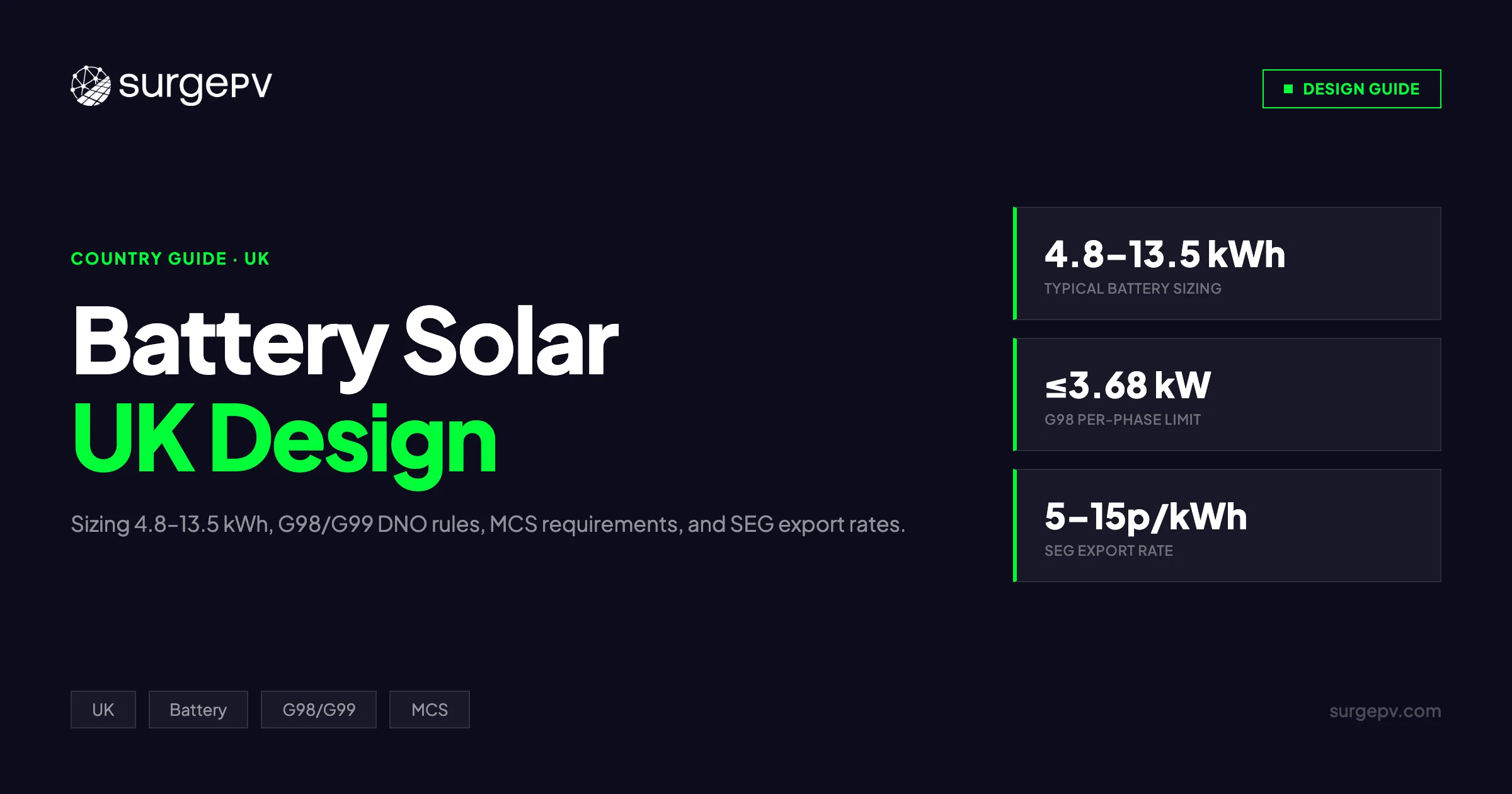
Most UK homes (2–4 beds) need 4.8–13.5 kWh of usable battery capacity. Systems under 3.68 kW AC per phase use G98 fast-track notification; larger systems require a full G99 application taking 30–90 days. VAT 0% applies to residential solar and battery installations through March 2027. LFP chemistry is preferred for UK climate conditions. SEG payments apply to solar-exported energy only — not grid-charged batteries. All-in costs for a 4 kWp PV + 10 kWh battery system run £10,000–£16,000 before any incentives.
In this guide:
- Latest 2026 updates to UK solar battery regulation — DNO rules, SEG rates, VAT deadline
- Battery sizing methodology for UK homes using smart meter data
- G98 vs. G99 DNO application process — what each requires and how long it takes
- MCS certification requirements for battery storage installations
- LFP vs. NMC chemistry comparison for UK climate and warranty implications
- Smart Export Guarantee optimisation — earning more from battery-mediated solar export
- Software tools for accurate battery and PV co-design
- Real UK project examples with itemised costs
Latest Updates: UK Solar Battery Storage 2026
For anyone tracking UK battery solar policy in real time, here is the current status of every regulation, incentive, and scheme change relevant to residential battery storage as of March 2026.
The UK battery storage market shifted considerably between 2023 and 2026. The Smart Export Guarantee replaced the old Feed-in Tariff export component, DNOs updated their G98 and G99 technical standards, and the government’s temporary 0% VAT relief on energy-saving materials — originally time-limited — is now confirmed through at least March 2027.
UK Solar Battery Policy Status — March 2026
| Policy / Scheme | Status | Key Detail |
|---|---|---|
| VAT 0% on residential solar + battery | Active | Through March 31, 2027; domestic use only |
| Smart Export Guarantee (SEG) | Active | Mandatory for licensed suppliers with 150,000+ customers; rates 1–15p/kWh |
| G98 connection standard | Active (updated 2023) | Systems up to 3.68 kW AC per phase; 28-day notification |
| G99 connection standard | Active (updated 2023) | Systems above G98 threshold; full application required |
| ECO4 Scheme | Active (closing 2026) | Battery retrofits in low-income homes; means-tested |
| Home Energy Scotland Loan | Active | Up to £6,000 for battery + renewables |
| Nest Scheme (Wales) | Active | Low-income households; battery + solar eligible |
| MCS certification (battery) | Required | MCS 012 standard for battery storage; mandatory for SEG eligibility |
| Feed-in Tariff (legacy) | Active for enrolled systems | Pre-2019 systems still receiving FIT payments; export tariff 5.24p/kWh |
Key Changes Since 2024
G98 and G99 updated in 2023 — inverter protection settings revised. Energy Networks Association issued updated G98 and G99 editions in late 2023. The key change for battery-hybrid systems: the combined AC output of solar inverter plus battery inverter (or hybrid inverter output) must now be considered when determining whether a system crosses the 16A per phase G98 threshold. Installers who sized systems against the old standard may be under-notifying to DNOs.
SEG minimum rate obligation extended. Ofgem confirmed that licensed electricity suppliers with 150,000 or more customers must offer a Smart Export Guarantee tariff. Minimum rate is 1p/kWh — but competitive premium tariffs from Octopus Energy (Octopus Flux), OVO, and E.ON run 5–15p/kWh during peak export windows. The difference between 1p and 15p on 1,000 kWh/year of battery-mediated export is £140 — worth optimising.
MCS 012 battery standard now mandatory for SEG eligibility. As of 2024, battery storage systems must be installed to MCS 012 standards for the homeowner to qualify for any SEG export payments on the system output. Non-MCS battery retrofits do not disqualify existing solar SEG eligibility, but combined system output requires MCS compliance.
ECO4 scheme accepting battery retrofits. The Energy Company Obligation (ECO4) scheme, which funds energy efficiency upgrades in low-income households, has expanded to include battery storage where it accompanies a solar installation. Eligibility is means-tested and property-rated — installers working in the social housing and low-income sectors should be familiar with the referral and application process.
Key Takeaway — 2026 UK Battery Policy
The most time-sensitive item in 2026 is the VAT 0% deadline. Installations completed after March 31, 2027 are expected to revert to 5% VAT on materials and labor. For a £14,000 system, that is £700 in additional cost. Installers should communicate this deadline clearly in proposals — it is a genuine client-facing incentive to act before end of 2026.
Battery Sizing Methodology for UK Homes
Accurate battery sizing starts with one thing: a real load profile. Generic estimates — “average UK home uses 3,100 kWh/year” — are not sufficient for battery design. What matters is the shape of daily consumption, specifically when the household draws power and at what rate.
Step 1 — Obtain Smart Meter Half-Hourly Data
Every home with a smart meter generates half-hourly consumption data accessible via the n3rgy Consumer API or directly through the homeowner’s energy supplier portal. This data reveals:
- Morning peak (7–9 AM): shower, kettle, toaster, lighting
- Daytime trough (10 AM–3 PM): low base load if occupants are out
- Evening peak (4–9 PM): cooking, TV, EV charging, heating
- Night base load: fridges, standby loads, overnight EV charging
A home with a strong morning peak and absent daytime profile has a very different battery requirement than one with a home office drawing 1–1.5 kW continuously through the day. The former benefits from a smaller battery capturing overnight cheap-rate charge for morning use. The latter needs a larger battery to sustain daytime self-consumption when solar generation is low.
Step 2 — Identify the Dispatch Strategy
UK battery systems typically operate under one of three dispatch strategies, and the optimal battery size depends entirely on which strategy the client wants:
TOU Arbitrage (Time-of-Use): Charge from grid during cheap off-peak periods (Economy 7 overnight, or Octopus Go at 7.5p/kWh from midnight to 5 AM), discharge during expensive peak periods (4–8 PM). Battery must hold enough capacity to cover peak consumption minus any concurrent solar generation.
Solar Self-Consumption: Charge from excess solar generation during the day, discharge in the evening. Battery must hold the full surplus from peak solar hours — typically 1–3 hours of excess generation in UK summer conditions. Winter generation is substantially lower and must be modelled separately.
Backup / Resilience: Reserve a defined battery capacity for use during grid outages. This is increasingly requested by rural clients experiencing regular outages. Backup sizing depends on the critical loads (lighting, refrigeration, sockets) and desired duration (4 hours, 24 hours, 48 hours).
Most UK installations combine solar self-consumption and TOU arbitrage as primary strategy, with backup as a secondary benefit.
Step 3 — Apply UK-Specific Sizing Rules
| Rule | Parameter | UK Application |
|---|---|---|
| Usable capacity | 80–90% DoD for LFP | Size to usable kWh, not nameplate |
| Reserve margin | 10–15% of capacity | Always retained for grid backup events |
| Winter derating | 20–30% less solar input | UK winter irradiance drops sharply; size battery dispatch on winter profile |
| Inverter matching | Battery kW output ≤ inverter AC rating | Hybrid inverter must handle simultaneous solar + battery discharge |
| DNO export limit | System kW output vs. G98/G99 threshold | Battery output adds to solar export rating for DNO purposes |
Battery Size by UK Home Type
| Home Size | Daily Load (kWh) | Evening Peak | Suggested Usable Capacity | Primary Use Case |
|---|---|---|---|---|
| 1-bed flat | 6–8 | 0.8–1.2 kW | 3.6–5 kWh | TOU arbitrage, partial backup |
| 2-bed house | 10–12 | 1.5–2 kW | 4.8–7.2 kWh | Solar self-consumption + TOU |
| 3-bed house | 12–16 | 2–3 kW | 7.2–9.6 kWh | Full evening coverage |
| 4-bed detached | 18–25+ | 3–5 kW | 10–13.5 kWh | Full backup + EV + heat pump |
Usable capacity figures assume 80% depth of discharge. Nameplate battery size is typically 10–25% larger than usable capacity depending on manufacturer and warranty terms.
Pre-Sizing Checklist
Before finalising any battery specification, confirm each of the following:
- Load profile sourced from smart meter data (not generic estimates)
- TOU tariff eligibility confirmed with the client’s supplier
- Dispatch strategy agreed (arbitrage, self-consumption, or backup)
- Depth of discharge warranty limit confirmed for selected battery model
- Reserve margin calculated and documented
- Winter solar input modelled separately from summer
- Inverter compatibility verified (voltage range, communication protocol)
- DNO export rating calculated for combined solar + battery output
Pro Tip — Use Half-Hourly Data, Not Monthly Bills
Monthly electricity bills tell you annual consumption. They do not tell you when the consumption happens. A client using 400 kWh/month but running a dishwasher and oven simultaneously every evening at 6 PM has a 5–7 kW peak load that a 3.6 kWh battery cannot meaningfully support. Always request 12 months of half-hourly smart meter data before sizing. Most UK smart meter suppliers provide this through their app or API at no charge.
DNO and G99 Application Process for UK Battery Systems
Every grid-connected battery installation in the UK must be notified to or approved by the local Distribution Network Operator. The specific route — G98 notification or G99 application — depends on the system’s AC output rating per phase.
G98 vs. G99: Which Applies?
G98 applies to micro-generators operating at low voltage with an output up to 3.68 kW AC per phase (16A single-phase, or 16A per phase on three-phase supplies). G98 uses a simplified self-certification route:
- Installer completes a G98 commissioning checklist
- DNO is notified within 28 days of commissioning
- No pre-approval is required — the system can operate during the 28-day period
- DNO may inspect within 6 months of notification
G99 applies to all generators above the G98 threshold, including:
- Single-phase systems above 3.68 kW AC
- Three-phase systems above 11.04 kW AC total
- Any system connected at high voltage
G99 requires a pre-application submission before commissioning:
- Submit a G99 application to the relevant DNO with technical documentation
- DNO assesses and may request load flow studies, protection relay settings, or modifications
- DNO issues a Connection Offer with any conditions
- Installer commissions the system and submits commissioning notification
- DNO may require witness testing for certain system types and ratings
G99 approval timelines vary by DNO: typically 30–60 days for straightforward residential systems, but 60–90+ days if the local network requires reinforcement or the DNO has a backlog.
Critical Rule for Hybrid Battery Systems
The 2023 G98/G99 revision clarified a point that trips up many installers. For hybrid inverter systems (inverter handles both solar and battery), the combined AC output of the inverter determines the applicable standard — not the solar array size alone.
Example: A 3.5 kWp solar array paired with a 5 kW hybrid inverter technically exports up to 5 kW AC to the grid (battery plus solar discharge simultaneously). This crosses the G98 threshold of 3.68 kW and requires a G99 application — even though the solar array alone would have qualified for G98.
Installers must specify the maximum AC export rating of the complete system — solar plus battery — when determining the connection standard.
DNO Application Documentation (G99)
A complete G99 submission for a residential battery-solar hybrid typically includes:
- G99 Application Form (DNO-specific, available on each DNO’s portal)
- Inverter data sheet with G99 protection settings confirmed
- Battery data sheet with AC/DC ratings, operating voltage range, and safety certifications
- Single-line diagram showing PV array, battery, hybrid inverter, and grid connection point
- Protection relay settings — inverter anti-islanding and over/under voltage/frequency limits
- MCS certificate for the installation
- Commissioning sheet once installed
Some DNOs (notably UK Power Networks and Scottish and Southern Electricity Networks) have online portals for G99 submissions. Others still accept paper applications. Processing times also vary — check your specific DNO’s published SLA before committing client timelines.
DNO Export Limits
Many UK DNOs impose export limits on new connections, particularly in constrained rural networks. A DNO may approve a G99 application subject to a maximum export of, say, 3.5 kW — even on a system capable of 5 kW export. Battery discharge dispatch must be programmed to respect this limit.
Energy Networks Association publishes the current G98 and G99 standards and a directory of all UK DNOs with contact information.
Key Takeaway — G99 Lead Times
Never commit a client to a commissioning date without first checking your DNO’s current G99 processing time. In 2025, several UK DNOs reported backlogs pushing G99 approval to 90+ days. Submit the G99 application as early as possible — ideally at the same time as the system design is finalised, before physical installation begins. Commissioning a G99 system without approval is a regulatory violation and may void the installation’s insurance.
MCS Certification Requirements for Battery Storage UK
MCS (Microgeneration Certification Scheme) certification is the quality standard for small-scale renewable energy installations in the UK. It is not optional for most residential installations — it is required for VAT relief eligibility confirmation, SEG payment eligibility, and access to most DNO fast-track processes.
MCS 012: Battery Storage Standard
Battery storage systems installed in the UK must comply with MCS 012, the specific MCS standard for electrical storage systems. MCS 012 covers:
- Installer certification: The installing company must hold MCS certification for battery storage (separate from PV certification — check that your company holds both MCS 041 for PV and MCS 012 for batteries)
- Product certification: The battery and inverter products must be listed on the MCS Product Directory
- Installation quality: Wiring, earthing, protection, labelling, and commissioning documentation must meet MCS 012 requirements
- Commissioning documentation: A complete MCS Commissioning Checklist must be completed and retained by the installer for 10 years
MCS and SEG Eligibility
Under current Ofgem SEG rules, the installation must be certified under MCS (or an equivalent Ofgem-approved body) for the homeowner to apply to a licensed electricity supplier for SEG payments. Without MCS certification:
- No SEG application can be made
- Existing SEG payments for a solar-only system may be impacted if a non-MCS battery is added
- VAT 0% eligibility becomes harder to demonstrate to HMRC
Installers who retrofit batteries to existing solar systems — particularly legacy systems installed before MCS 012 existed — must ensure the retrofit itself meets current MCS 012 standards, even if the original PV installation predates current requirements.
Checking the MCS Product Directory
Before specifying any battery or hybrid inverter for a UK project, confirm that both the battery and inverter model are listed on the MCS Product Directory. Products are listed by manufacturer and model number. Firmware versions matter — a product may be listed but only for specific firmware releases. Confirm with the manufacturer that the specific firmware version shipped matches the listed certification.
Pro Tip — MCS Installer Certificate Scope
Many UK solar companies hold MCS 041 (solar PV) but not MCS 012 (battery storage). If your company does not currently hold MCS 012 certification, you cannot legally certify a battery installation for SEG eligibility. MCS 012 requires a separate application, relevant product training, and quality management system updates. Budget 3–4 months for the application process if you are adding battery certification for the first time.
LFP vs. NMC Battery Chemistry for UK Installations
Battery chemistry is not a marketing choice — it has direct implications for safety, warranty, cycle life, and performance in the UK climate. Understanding the difference between Lithium Iron Phosphate (LFP) and Lithium Nickel Manganese Cobalt Oxide (NMC) helps installers make technically sound specifications.
Lithium Iron Phosphate (LFP)
LFP is the dominant chemistry in UK residential battery storage and for good reason. The key characteristics:
Cycle life: LFP is rated for 4,000–6,000 cycles at 80–90% depth of discharge. At one full cycle per day, that is 10–16 years of daily cycling before the battery reaches 80% of original capacity. Most UK residential LFP batteries carry 10-year warranties at guaranteed minimum capacity.
Thermal stability: LFP does not go into thermal runaway at high temperatures the way NMC does. The cathode chemistry releases oxygen at much higher temperatures — typically above 270°C vs. 150–200°C for NMC — making it safer for installation in domestic environments including garages, utility rooms, and lofts.
UK climate suitability: UK garages and lofts experience temperatures from near-freezing in winter to 30°C+ in summer heatwaves. LFP operates safely across a wide range: typically -20°C to 60°C for storage, with some manufacturers recommending above 0°C for active charging. In practice, most UK garage installations require no active thermal management. NMC typically requires a narrower operating range and more careful thermal management.
Energy density: LFP has lower energy density than NMC — a given kWh of LFP storage takes up more physical space. This matters in constrained installations (flats, narrow utility rooms) but is rarely a limiting factor in standard UK houses.
Lithium NMC
NMC batteries are more common in EV packs and some commercial storage applications. For UK residential use:
Cycle life: NMC is typically rated for 2,000–4,000 cycles at 80% DoD — lower than LFP. At daily cycling, this represents 5–11 years of service life before degradation.
Energy density: Higher than LFP — a 10 kWh NMC battery is physically smaller and lighter. This is an advantage in space-constrained installations.
Thermal risk: NMC requires more careful installation — adequate ventilation, temperature monitoring, and where applicable, active cooling. UK building regulations require fire-rated enclosures for certain NMC installations. Check BS 8491 and the NFCC Battery Storage Fire Safety Guide for current UK fire safety guidance on battery installations.
Cost: NMC was historically cheaper per kWh than LFP, but the price gap has narrowed significantly. In 2025–2026, LFP is price-competitive or cheaper at most capacity levels.
Chemistry Comparison for UK Residential
| Property | LFP | NMC |
|---|---|---|
| Cycle life (80% DoD) | 4,000–6,000 cycles | 2,000–4,000 cycles |
| UK climate suitability | Excellent — wide temp range | Moderate — requires thermal management |
| Fire risk / thermal runaway | Low | Moderate — stricter installation requirements |
| Energy density | Lower — larger physical footprint | Higher — more compact |
| Warranty (typical) | 10 years / 80% capacity | 5–10 years / 70–80% capacity |
| Current price (kWh installed) | £400–£650/kWh | £380–£620/kWh |
| Common UK brands | GivEnergy, Sungrow, SolarEdge | Some LG RESU, older Tesla Powerwall units |
Recommendation for UK residential: LFP in almost all cases. The cycle life advantage, thermal safety characteristics, and warranty terms make it the better specification for UK homes, particularly those installing in non-climate-controlled spaces.
Key Takeaway — Depth of Discharge and Warranty
Never quote 100% of nameplate battery capacity as the usable amount. LFP batteries are typically warranted at 80–90% depth of discharge — a 10 kWh LFP battery delivers 8–9 kWh usably. Quoting the full 10 kWh to a client and then programming the battery to 90% DoD will result in the client seeing an 18-month-old battery that has already “lost” capacity when it has not — it was never programmed to use 100%. Set the right expectation in the proposal.
Smart Export Guarantee Optimisation for Battery Systems
The Smart Export Guarantee replaced the old Feed-in Tariff export component in 2020. For battery-solar systems, SEG is both an opportunity and a compliance minefield. The key rule: SEG applies to solar-generated electricity exported to the grid. It does not apply to grid-charged battery energy discharged to the grid.
How SEG Works With Battery Storage
Smart export meters record export in 30-minute intervals. Licensed suppliers pay for each half-hourly export slot at the agreed SEG rate. Modern smart meters (SMETS2) can distinguish between solar generation and grid import, but they do not natively identify whether exported energy comes from solar or a grid-charged battery.
Ofgem’s position — confirmed in the SEG guidance for licensed suppliers — is that grid-charged battery export is not eligible for SEG payments and that suppliers are entitled to exclude or reclaim payment if grid-charged export is detected. To avoid compliance issues:
- Programme the battery to charge only from solar surplus during SEG-eligible export hours
- If using Economy 7 or Octopus Go overnight grid charging, ensure the battery reaches charge threshold before export hours begin, then discharges excess through the day for self-consumption rather than grid export
- Document the dispatch programme in the commissioning handover
SEG Rates in 2026
| Supplier | SEG Tariff Name | Rate | Notes |
|---|---|---|---|
| Octopus Energy | Octopus Flux | 5–15p/kWh (variable) | Best during 4–7 PM peak; requires compatible inverter |
| OVO Energy | OVO SEG | 5.5p/kWh (fixed) | Flat rate; simple for clients |
| British Gas | British Gas SEG | 4.1p/kWh (fixed) | Standard offer |
| E.ON Next | E.ON Drive SEG | 5p/kWh | Available to E.ON customers |
| Minimum obligation | Ofgem minimum | 1p/kWh | Guaranteed from all qualifying suppliers |
Rates correct as of March 2026. SEG rates change — always check current supplier published rates.
Maximising SEG Revenue With Battery Dispatch
The most effective SEG strategy for a battery-solar system uses the battery to time-shift solar generation into peak export windows. Rather than exporting all surplus solar energy at 11 AM when the grid is long and SEG rates are low, charge the battery during peak solar hours and export from the battery (charged from solar) during the 4–7 PM peak window when SEG rates are highest.
This approach can increase annual SEG revenue by 30–60% compared to immediate export without battery storage, depending on the tariff structure. It requires a hybrid inverter with export-limited dispatch logic and smart meter integration.
Use solar design software to model this dispatch strategy explicitly — running an hourly simulation against the client’s real load profile and the chosen SEG tariff curve, to quantify the annual SEG revenue before the proposal is submitted.
Pro Tip — Octopus Flux and Battery Arbitrage
Octopus Flux is a combined import and export tariff that charges low rates overnight and pays premium export rates during peak evening hours. For a well-sized battery, the arbitrage between a 7.5p/kWh overnight import rate and a 15p/kWh evening export rate can generate £200–£400/year in additional income on top of self-consumption savings. Run the numbers for every eligible client — it is a compelling differentiator in a proposal.
Regional Incentives for Battery Storage UK
Battery storage incentives in the UK vary by nation and, in some cases, by local authority. The table below covers the active schemes as of March 2026.
| Region | Scheme | Battery-Specific Notes |
|---|---|---|
| England | VAT 0%, SEG, ECO4 | ECO4 covers vulnerable homes + battery retrofits; means-tested |
| Scotland | Home Energy Scotland Loan | Up to £6,000 interest-free; battery must pair with renewables |
| Wales | Nest Scheme | Low-income households; full system upgrade including battery |
| Northern Ireland | NISEP scheme | Renewable heating and generation support; check current battery eligibility |
Grants and loans may stack with VAT relief — a Scottish homeowner installing a 4 kWp + 10 kWh system could benefit from 0% VAT on the full installation cost plus an interest-free loan covering up to £6,000 of the remainder. Application processes vary; always check current scheme availability with the administering body.
Design UK Battery Systems in Hours, Not Days
SurgePV runs hourly dispatch simulations against real UK load profiles and TOU tariff curves — then outputs a compliant proposal with battery ROI, autonomy hours, and payback period built in.
Book a DemoNo commitment required · 20 minutes · Live project walkthrough
Common Design Errors in UK Battery Solar Systems
Even experienced installers make avoidable mistakes when adding battery storage to solar designs. These are the six errors that appear most frequently in UK battery solar installations.
Error 1 — Sizing to Annual Consumption, Not Evening Peak
Annual consumption figures (e.g., 3,800 kWh/year) do not tell you the peak demand the battery must supply. A home consuming 3,800 kWh/year but running a 7 kW oven, 3 kW heat pump, and 3 kW EV charger simultaneously at 6 PM needs a battery and inverter combination that can supply 13 kW — which a single standard hybrid inverter cannot deliver.
Size the battery to the peak discharge rate required, not just the energy capacity. Check the inverter’s continuous output rating (not peak) against worst-case simultaneous loads.
Error 2 — Ignoring Voltage Compatibility
LFP batteries operate at a specific voltage range (typically 48V nominal for most residential units). The hybrid inverter must be rated for the battery’s full voltage range, including during charging (when voltage is higher) and deep discharge (when voltage is lower). Mismatched voltage ranges result in the inverter shutting down before the battery reaches its usable capacity.
Always confirm compatibility using the manufacturer’s verified compatibility list — not just the nominal voltage match.
Error 3 — No Winter Solar Input Modelling
A battery sized to store four hours of surplus solar generation in July will be underutilised in December. UK winter irradiance in Scotland and northern England can be 70–80% lower than summer peak. If the system relies on solar charging as its primary strategy, the winter months will see the battery drawing from the grid instead — changing the economics significantly.
Use solar design software that models seasonal irradiance variation at the installation postcode to validate year-round system performance, not just summer peak.
Error 4 — Failing to Account for DNO Export Limits in Dispatch Design
A DNO may approve a G99 system subject to a 3.5 kW export limit. If the hybrid inverter is not configured to cap export at 3.5 kW, the system will violate the Connection Offer conditions — which can result in the DNO requiring disconnection. Programme the inverter export limit as part of commissioning and document it on the commissioning sheet.
Error 5 — Quoting 100% Capacity Without Warranty Clarification
Clients who read that they are buying a “10 kWh battery” expect 10 kWh of usable energy. When the commissioning engineer programmes the battery to 90% DoD (as required for warranty compliance), the client sees 9 kWh. Over a few years of operation, they see 8.5 kWh. This triggers complaints and warranty calls that are entirely avoidable if the proposal explains usable vs. nameplate capacity clearly.
Always specify usable kWh in the proposal, and document the DoD programming setting in the handover pack.
Error 6 — Omitting Backup Load Separation
Clients requesting backup capability need a dedicated backup circuit separate from the main home distribution. Without a backup circuit, the battery inverter cannot supply the backup load without also backfeeding the main grid connection — which is both dangerous and prohibited. Backup circuits require an Automatic Transfer Switch (ATS) or a hybrid inverter with integrated backup output. This is a separate installation cost (£200–£600 for a basic ATS and backup consumer unit) that must be included in the quote.
Software Tools for Battery and PV Co-Design UK
Designing a battery solar system accurately requires software that can simulate the interaction between solar generation, battery dispatch, load consumption, and tariff structure on an hourly basis. Spreadsheets and rule-of-thumb sizing tools are not adequate for modern UK battery proposals.
The right solar design software for UK battery projects should include:
- UK-specific irradiance data: PVGIS or equivalent dataset at postcode level, including seasonal and hourly variation
- Smart meter data import: Ability to upload real half-hourly consumption data from the client’s meter
- TOU tariff modelling: Integration with UK tariff structures including Economy 7, Octopus Agile, Octopus Go, and Octopus Flux
- Hourly dispatch simulation: Models battery charge and discharge in each hour based on solar generation, load profile, and tariff price signals
- G98/G99 threshold check: Automatically flags when combined system output exceeds the G98 3.68 kW threshold
- Proposal output: Generates a client-facing document with battery ROI, payback period, autonomy hours, annual savings by category (self-consumption, TOU arbitrage, SEG), and expected cycle count over system life
Solar proposal software that integrates battery modelling allows you to present clients with a complete financial picture — showing the incremental value of battery storage over solar-only in concrete pound-per-year terms. This makes the upsell from solar-only to solar-plus-battery a data-driven conversation rather than a pitch.
For systems where shading from trees, chimneys, or adjacent buildings affects solar generation, solar shadow analysis software should be run before battery sizing — because shading losses directly reduce the solar surplus available for battery charging, changing the optimal battery size.
Use the generation and financial modelling tool to validate battery ROI projections, particularly for clients asking about payback periods and long-term returns on the battery-specific investment (above and beyond the solar-only return).
Also read: UK solar design software guide for a full review of design tools suited to the UK market, and solar string design mistakes for common PV design errors that compound battery system issues.
Pro Tip — Run Two Scenarios in Every Battery Proposal
Always present the client with a solar-only scenario and a solar-plus-battery scenario side by side. Show the incremental battery investment (additional cost over solar-only), the incremental annual saving, and the battery-specific payback period. This structure lets clients make an informed decision — and it prevents the all-too-common situation where the client adds a battery 18 months later and asks why you didn’t tell them it was available. Having both scenarios documented also protects you commercially.
Real UK Battery Solar Project Examples with Costs
The following examples are based on typical UK installations in 2025–2026. Costs reflect installer purchase prices at volume; single-unit retail prices may be higher.
Project 1 — 3-Bed Semi-Detached, East Midlands
Site: 3-bedroom semi-detached house, Nottingham. South-facing roof, 30° pitch, no significant shading. Single occupant household, home office.
Daily load profile: 14 kWh/day average; 8 kWh consumed between 5–10 PM. Octopus Go tariff: 7.5p/kWh 00:30–05:30, 28p/kWh at all other times.
System design: 4.4 kWp solar (11 × 400W panels), 9.5 kWh usable LFP battery (GivEnergy 9.5 kWh), 5 kW hybrid inverter. G98 — 3.5 kW AC output registered. Annual solar generation: 4,050 kWh.
Dispatch strategy: Overnight grid charge (00:30–05:30 at 7.5p) to fill battery. Solar charges battery from surplus during day. Battery discharges 5–10 PM at 28p import rate avoided.
Costs:
- Solar panels (4.4 kWp): £2,860
- Hybrid inverter (5 kW): £1,200
- GivEnergy 9.5 kWh battery: £4,100
- Mounting, cabling, consumer unit work: £1,200
- Labour (2 days, 2 engineers): £1,600
- MCS certification and documentation: £300
- Total installed: £11,260 (VAT 0%)
Financial outcome (year 1):
- Self-consumption savings: £860/year
- TOU arbitrage (overnight charge, peak discharge): £420/year
- SEG income (Octopus SEG): £95/year
- Total annual benefit: £1,375/year
- Simple payback: 8.2 years
Project 2 — 4-Bed Detached, South West England
Site: 4-bedroom detached house, Somerset. South-southwest 35° roof, minor chimney shading modelled with shadow analysis software. Family of 4, EV, air source heat pump.
Daily load profile: 24 kWh/day average; significant morning and evening peaks. Octopus Flux tariff used.
System design: 6.2 kWp solar (14 × 440W panels), 13.5 kWh usable LFP battery (Sungrow SBR130), 8 kW hybrid inverter. G99 required — combined AC output 6.8 kW. G99 approved by Western Power Distribution in 47 days.
Dispatch strategy: Solar self-consumption primary. Battery stores afternoon solar surplus and discharges 4–7 PM (Octopus Flux export window at up to 15p/kWh). Overnight fill from grid at Octopus Flux low rate (7p/kWh) for morning peak coverage.
Costs:
- Solar panels (6.2 kWp): £3,720
- 8 kW hybrid inverter: £2,100
- Sungrow SBR130 battery (13.5 kWh usable): £5,800
- Backup consumer unit and ATS: £480
- Mounting, cabling, G99 documentation: £1,800
- Labour (3 days, 2 engineers): £2,400
- MCS certification: £350
- Total installed: £16,650 (VAT 0%)
Financial outcome (year 1):
- Self-consumption savings: £1,450/year
- TOU + Flux export income: £680/year
- SEG income: £140/year
- Total annual benefit: £2,270/year
- Simple payback: 7.3 years
Project 3 — 2-Bed Mid-Terrace, Scotland
Site: 2-bedroom mid-terrace, Edinburgh. East-west split roof (2 kWp east, 2 kWp west). Scottish Power Renewables connection. Home Energy Scotland loan accessed: £5,500.
System design: 4 kWp solar (5 × 400W east, 5 × 400W west), 7.1 kWh usable LFP battery (GivEnergy 7.1), 3.6 kW hybrid inverter. G98 — single phase, 3.6 kW. Annual solar generation: 3,100 kWh (east-west split reduces peak output but extends generation window).
Costs:
- Solar panels and hybrid inverter: £4,200
- GivEnergy 7.1 kWh battery: £3,400
- Cabling, mounting, MCS: £1,950
- Labour: £1,400
- Total installed: £10,950 (VAT 0%)
- Home Energy Scotland loan: -£5,500
- Net upfront cost: £5,450
Financial outcome (year 1):
- Self-consumption savings: £720/year
- TOU arbitrage (Economy 7): £280/year
- SEG income: £65/year
- Total annual benefit: £1,065/year
- Payback on net cost (after loan): 5.1 years
Selecting the Right Battery Products for UK Installation
Not all batteries on the MCS Product Directory are equal. The following criteria should guide product selection for UK residential battery solar installations.
Warranty terms: Look for 10-year capacity warranty at 80% minimum, not 70%. Some manufacturers offer 70% retained capacity guarantees — this means a 10 kWh battery is warranted only to 7 kWh by year 10. A 10-year/80% warranty is the benchmark.
Communication protocol: Battery and inverter must communicate using a compatible protocol. Most UK residential systems use CAN bus or RS485 with manufacturer-specific BMS communication. Confirm compatibility with the specific inverter model — not just the brand.
Enclosure rating: For outdoor installations (garages, outbuildings), check the IP rating. Most residential batteries are rated IP55 (dust and water jet protection). Some are IP65 (full dust protection and water jet). IP55 is adequate for most UK garages.
Operating temperature range: Confirm the minimum charging temperature. LFP batteries typically stop accepting charge below 0°C to protect cell integrity. For installations in unheated spaces in northern UK, consider whether a low-temperature cut-out will cause problems during prolonged cold snaps.
UK-specific certifications: Beyond MCS Product Directory listing, look for IEC 62619 (safety for secondary lithium cells and batteries) and CE/UKCA marking. UKCA has replaced CE marking for UK Great Britain market products post-Brexit.
Frequently Asked Questions
How do I calculate battery size for a UK home?
Start with the smart meter half-hourly data for the past 12 months. Identify the evening peak consumption — the highest sustained load period from approximately 4–9 PM. Size the usable battery capacity to cover 4–6 hours of evening peak load, minus any concurrent solar generation expected during that period. Apply an 80–90% DoD factor to convert usable capacity to required nameplate size. Verify that the combined PV + battery AC output does not exceed your G98 or G99 threshold without the appropriate DNO notification.
What is the payback period for a battery on a UK solar system?
Payback on the battery-specific cost (above solar-only) typically runs 7–12 years for UK residential systems as of 2026, depending on electricity tariff, dispatch strategy, and battery cost. On advantageous TOU tariffs (Octopus Flux), payback can drop to 6–8 years. Battery payback is shorter than it appears when the full 10–16 year service life is considered — a battery that pays back in 8 years and runs for 15 years delivers 7 years of near-pure financial return.
Can I add a battery to an existing solar system?
Yes — battery retrofits are common in the UK. The retrofit method depends on the existing inverter. If the existing solar inverter has no battery communication capability, an AC-coupled battery (such as a GivEnergy AC or SolarEdge AC-coupled unit) is added in parallel — the battery charges from AC solar export rather than DC coupling. DC-coupled retrofits require replacing the existing inverter with a hybrid inverter, which increases cost but improves charging efficiency. Confirm that the retrofitted system’s combined AC output does not push an existing G98 system over the G99 threshold.
Do battery systems require planning permission in the UK?
In most cases, no. Residential battery storage on or within a dwellinghouse is typically permitted development under the Town and Country Planning (General Permitted Development) Order 2015, provided the installation meets dimensional limits and is not in a listed building, conservation area, or Area of Outstanding Natural Beauty where restrictions apply. Commercial and non-domestic installations may require planning permission. Always check with the local planning authority for non-standard cases.
What happens to a battery system if the grid goes down?
Only a system with a dedicated backup circuit and a hybrid inverter or battery inverter with off-grid capability will supply power during a grid outage. Standard grid-tied solar inverters and most older battery inverters shut down during grid outages for safety reasons (anti-islanding protection). If backup capability is a client requirement, specify a hybrid inverter with an integrated backup output (such as GivEnergy Hybrid, SolarEdge Home Hub, or similar) and install a backup consumer unit with an Automatic Transfer Switch. The ATS isolates the backup circuit from the grid and allows the battery to supply connected loads safely.
How much does a full battery solar system cost in the UK in 2026?
All-in costs for a combined solar and battery system in the UK run £8,000–£20,000 depending on system size. Typical benchmarks: a 3 kWp PV + 7 kWh battery in a 2–3 bed house runs £9,000–£12,000 at 0% VAT. A 6 kWp PV + 13.5 kWh battery for a large 4-bed detached home runs £15,000–£20,000. Scotland’s Home Energy Scotland loan (up to £6,000 interest-free) can significantly reduce the net upfront cost. The 0% VAT relief, confirmed through March 2027, saves approximately 5% compared to post-2027 pricing.
Accurate battery solar design is not a solar add-on — it is a distinct engineering discipline with its own sizing methodology, regulatory compliance requirements, and financial modelling needs. The installers who invest in solar software capable of running real UK hourly dispatch simulations will consistently produce proposals that perform as promised, pass DNO scrutiny, and generate the client satisfaction that drives referral business.
Whether you are designing your first battery solar system or reviewing your current design process for the G99 and MCS 012 updates, the foundations are the same: start with real data, model seasonal variation honestly, comply with every DNO and MCS requirement, and present clients with a proposal that shows exactly what they will earn and when.