Spain’s solar market has a single legal anchor: Real Decreto 244/2019. Before April 2019, the so-called “impuesto al sol” (sun tax) made self-consumption financially unviable for most Spanish households. RD 244/2019 eliminated that tax, created a clear two-tier self-consumption framework, and established compensación simplificada — Spain’s version of net metering — as the primary mechanism for crediting surplus solar energy on monthly electricity bills.
The result: Spain went from near-zero residential solar installations in 2018 to over 500,000 self-consumption installations registered by the end of 2024, with cumulative capacity exceeding 7 GW. For any solar installer, EPC, or homeowner operating in Spain, understanding RD 244/2019 is not optional — it is the entire framework within which solar ROI is calculated.
This guide covers every dimension of Royal Decree 244/2019: how compensación simplificada works, who qualifies, the step-by-step registration process, collective self-consumption rules, a real financial model for a 5 kWp Madrid installation, and how Spain’s system compares to Germany and Italy.
TL;DR — Spain Net Metering (RD 244/2019) in 2026
Spain’s net metering equivalent is called compensación simplificada. Surplus solar energy is credited against your monthly electricity bill at the hourly spot price (PVPC) — not paid in cash, and not rolled over to future months. Collective self-consumption allows apartment communities to share one solar installation. Registration is via autonomous community + DSO notification. As of 2026, IDAE Next Generation EU grants cover 15–40% of system costs for qualifying residential and SME installations.
In this guide:
- What Royal Decree 244/2019 is and why it matters
- How compensación simplificada (Spain’s net metering) works — billing mechanics, caps, and limits
- Types of autoconsumo under RD 244: individual vs collective
- Who qualifies — system size, location, metering, and registration requirements
- Step-by-step RD 244/2019 registration process
- Financial impact table: 5 kWp Madrid system with and without surplus compensation
- Virtual net metering for communities (autoconsumo colectivo)
- Spain net metering vs Germany vs Italy — which has the best solar ROI
- 2026 status and changes since 2019
Latest Updates: Spain Net Metering 2026
For anyone tracking Spain’s autoconsumo and net metering rules, here is the current status as of March 2026.
RD 244/2019 Status — March 2026
| Element | Current Status | Notes |
|---|---|---|
| Compensación simplificada | Active | No changes to core mechanism since 2019 |
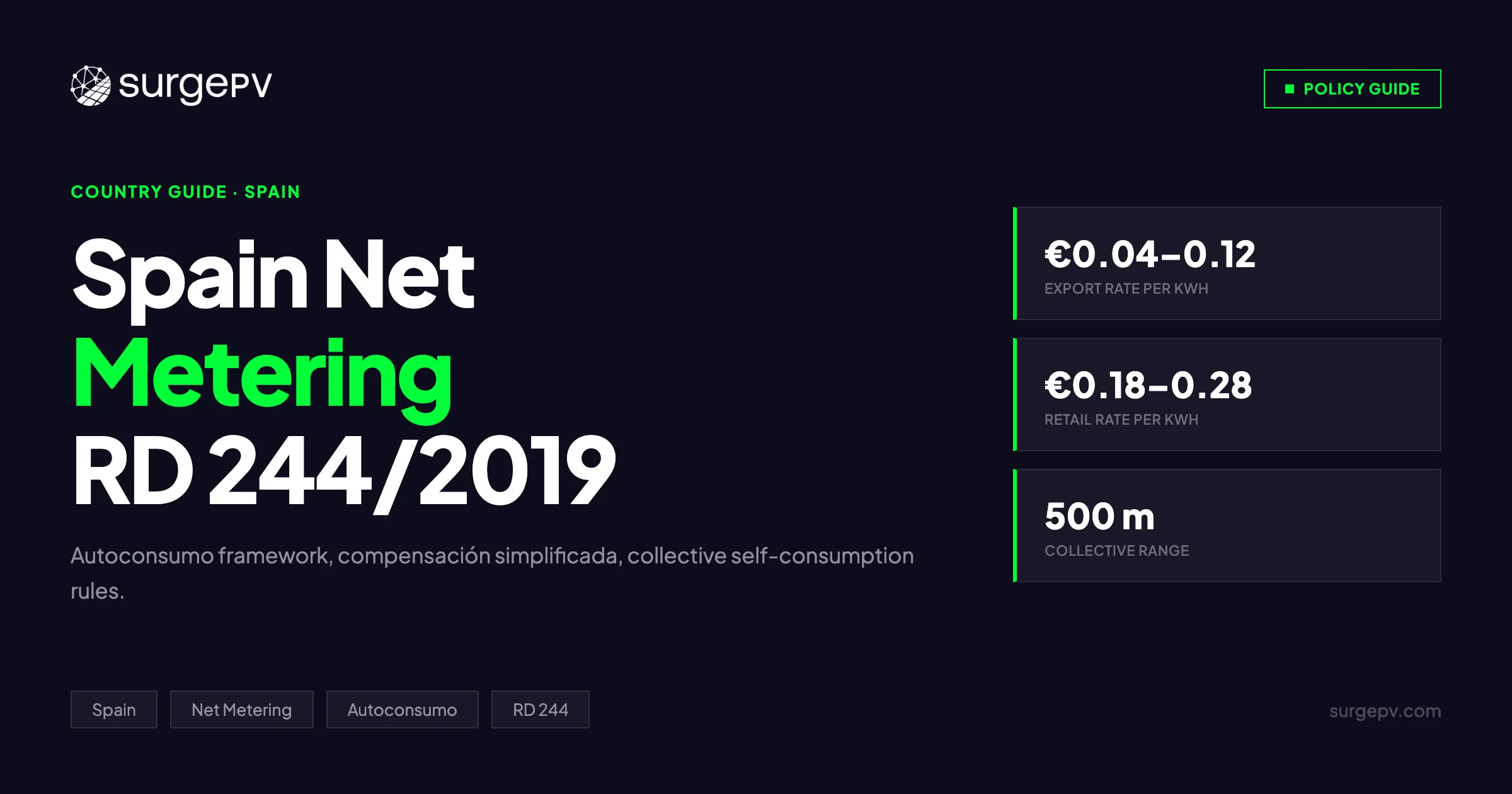
| PVPC export pricing | Active | Hourly spot pricing; avg. €0.06–€0.09/kWh in Q1 2026 |
| Collective self-consumption (≤500 m) | Active | Extended rules apply in some regions |
| IDAE Next Generation EU residential grants | Active | 15–40% of system cost; budget ~60% depleted nationally |
| IDAE SME grants | Active | 30–45% of system cost for SMEs |
| RAIPEE digital registration | Active in 16/17 regions | Navarra still uses paper process |
| Autonomous community processing time | 2–6 weeks | Down from 4–12 weeks in 2022 |
Key Changes Since 2019
2020 — Real Decreto 23/2020: Extended collective self-consumption distances. Originally limited to buildings sharing a single cadastral reference or within 500 metres. Updated to allow connections across any location on the same low-voltage distribution network, which in practice can extend to ~2 km in urban areas.
2021 — Next Generation EU / PRTR: Spain allocated €1.3 billion in IDAE direct grants for residential and SME self-consumption installations under the Recovery, Transformation and Resilience Plan. Grants cover 15–40% of system costs. Applications have been processed on a rolling basis by autonomous community since 2022.
2022 — Emergency energy measures: The energy crisis triggered a temporary simplification of registration processes in Catalonia, Madrid, Andalusia, and Valencia. Many of these fast-track procedures became permanent.
2024 — RAIPEE portal rollout: The national self-consumption registry (RAIPEE) launched a digital portal in 2023–2024 across most autonomous communities, reducing paperwork and accelerating administrative timelines.
2026 — Current regime: No substantive changes to RD 244/2019 are anticipated before 2027. The European Commission’s revised Energy Directive (2023/2413) encourages Spain to move toward a more dynamic export compensation model, but no implementing legislation has been proposed.
Key Takeaway
As of 2026, RD 244/2019 remains the operative framework with no major revisions. The core compensación simplificada mechanism — monthly bill credits at spot prices, capped at consumption, no rollover — is unchanged since 2019. What has changed is the availability of IDAE grants and the speed of administrative registration in most regions.
What Is Royal Decree 244/2019? Spain’s Autoconsumo Framework Explained
Royal Decree 244/2019 — formally “Real Decreto 244/2019, de 5 de abril, por el que se regulan las condiciones administrativas, técnicas y económicas del autoconsumo de energía eléctrica” — is Spain’s primary legal instrument governing self-consumption of solar (and other renewable) energy.
Published in the Official State Gazette (BOE) on April 6, 2019, it replaced the heavily criticised self-consumption regime under Royal Decree 900/2015, which had imposed a “backup charge” on self-generated energy — the infamous impuesto al sol.
What RD 244/2019 Changed
| Before RD 244/2019 (RD 900/2015) | After RD 244/2019 |
|---|---|
| ”Sun tax” (cargo por autoconsumo) applied | Sun tax eliminated entirely |
| Complex administrative requirements | Simplified registration via autonomous communities |
| No mechanism for surplus energy compensation | Compensación simplificada introduced |
| Collective self-consumption prohibited | Collective self-consumption legalised |
| Effectively killed residential solar market | Residential solar installations grew 10x by 2023 |
Two Categories of Self-Consumption
RD 244/2019 established two legal categories:
Category 1 — Autoconsumo sin excedentes (without surplus) The installation includes anti-islanding technology and a power limiter that prevents any surplus energy from being exported to the grid. All generated electricity is consumed on-site. No surplus compensation applies. Registration is simpler and faster. Best for industrial consumers who can absorb all generated power.
Category 2 — Autoconsumo con excedentes (with surplus) Surplus energy not consumed on-site flows to the grid. The consumer can receive compensación simplificada credits on their monthly bill. This is the most common configuration for residential and commercial solar in Spain and is the focus of this guide.
Category 2 further divides into:
- With compensación simplificada — for systems up to 100 kW that qualify for simplified billing credits
- Without compensación simplificada — for larger or non-qualifying systems that must register as energy producers and may access feed-in mechanisms or bilateral contracts
Pro Tip — Which Category to Choose
For the vast majority of residential and SME solar installations in Spain, Category 2 with compensación simplificada is the right choice. Category 1 (no surplus) is only worth considering if your daytime consumption is consistently higher than your system’s peak generation — rare for most households.
Compensación Simplificada: Spain’s Net Metering Equivalent
Compensación simplificada is the economic heart of RD 244/2019. It is Spain’s functional equivalent of net metering, though it operates differently from U.S. or German systems.
How It Works — The Mechanics
When your solar panels generate more electricity than your home or business consumes at any given moment, the surplus flows to the grid. At the end of the billing period (typically monthly), your utility calculates:
- The total volume of surplus kWh you exported
- The hourly spot value of that energy at the time it was exported (based on PVPC prices)
- A financial credit equal to the total export value
- This credit is applied against your energy charges for that billing period
The credit appears on your bill as: “Compensación por excedentes vertidos a red” (compensation for surplus injected into the grid).
The Critical Cap Rule
Article 14 of RD 244/2019 contains a fundamental limitation:
“La energía excedente compensada no podrá superar la energía consumida de la red en el mismo periodo de facturación.”
Translation: The compensated surplus energy cannot exceed the energy consumed from the grid in the same billing period.
In practical terms: if you consume 300 kWh from the grid in a month and export 450 kWh from your solar panels, you receive a credit for the value of only 300 kWh — not 450 kWh. The excess 150 kWh of exports goes to the grid with no compensation.
What the cap means for system sizing: Oversizing your system to maximise exports is counterproductive under Spain’s system. Unlike Germany’s feed-in tariff (which pays for every kWh exported up to the system’s capacity), Spain’s compensación simplificada caps credits at your monthly consumption from the grid.
How Export Energy Is Priced
Surplus energy is valued at the hourly PVPC spot price at the time of export. This is not a fixed rate — it varies by hour, day, and season based on the Iberian electricity market (MIBEL).
| Period | Typical PVPC Rate (2025–2026) |
|---|---|
| Peak hours (8am–10pm weekdays) | €0.07–€0.12/kWh |
| Off-peak (10pm–8am) | €0.04–€0.07/kWh |
| Weekend / holiday | €0.05–€0.09/kWh |
| Annual average (2025) | approx. €0.072/kWh |
Compare this to the retail electricity rate Spanish households pay: €0.18–€0.28/kWh depending on tariff and time of day. The gap is clear — self-consumed solar energy avoids a €0.18–€0.28/kWh cost, while exported solar energy earns only ~€0.07/kWh. The ratio is roughly 3:1 to 4:1 in favour of self-consumption over export.
No Rollover — Monthly Reset
Unlike some U.S. net metering schemes that roll unused credits forward for 12 months, Spain’s compensación simplificada resets at the end of each billing period. Unused credits (if the export value exceeds the bill) are forfeited. This reinforces the priority of maximising self-consumption rather than maximising exports.
What the Credit Does and Does Not Cover
The compensación simplificada credit is applied against the energy component of your electricity bill. It does not reduce:
- Fixed power capacity charges (término de potencia)
- Network access charges
- Electricity taxes (Impuesto sobre la Electricidad, typically 5.1%)
- VAT (IVA, 21%)
This means even a household that exports enough energy to theoretically cover all its electricity consumption will still pay the fixed and tax portions of the bill — typically €20–€40/month depending on contracted power.
Key Takeaway — Compensación Simplificada vs True Net Metering
Spain’s system is not true net metering. True net metering (as in most U.S. states) provides 1:1 kWh credits regardless of time of export, with 12-month rollover. Spain’s compensación simplificada uses spot-price-based financial credits, capped at monthly consumption, with monthly reset. It is more like a monthly-settled bill discount mechanism than a metering offset scheme.
Types of Autoconsumo Under RD 244/2019
Individual Self-Consumption
The standard configuration: one solar installation serves one consumption point (one meter, one property). Most residential rooftop installations in Spain are individual self-consumption with surplus.
Requirements:
- Solar system connected at the same point of supply as the consumption meter
- Smart bidirectional meter (installed by the DSO at no cost since 2019)
- Registration with the autonomous community
- CIE (Certificado de Instalación Eléctrica) from a certified installer
Collective Self-Consumption (Autoconsumo Colectivo)
RD 244/2019 legalised collective self-consumption — allowing multiple consumers to share a single solar installation. This is Spain’s version of virtual net metering.
How it works:
A shared solar installation (typically on a communal rooftop or nearby building) generates electricity that is distributed among participating consumers according to agreed allocation coefficients. Each participant receives compensación simplificada credits on their own bill based on their share of surplus exports.
Key parameters under RD 244/2019:
- Up to 500 metres between the installation and consumption points (extended in some regions under RD 23/2020)
- Participants must share the same low-voltage distribution network
- Allocation coefficients are fixed (or dynamic, if agreed) and registered with the DSO
- Each participant’s bill shows their individual compensation amount
Who uses collective self-consumption:
- Apartment buildings (comunidades de propietarios) sharing rooftop solar
- Office parks with multiple tenants under one building management
- Industrial estates with shared roof access
- Neighbourhood-scale community solar projects
Allocation coefficient example:
A 10-apartment building installs a 20 kWp rooftop system. The 10 apartments agree on equal shares: each apartment holds a 10% coefficient. In a month when the system exports 800 kWh of surplus, each apartment is credited for 80 kWh of exports against their individual bill.
Pro Tip — Designing for Collective Self-Consumption
For collective self-consumption projects, the aggregate daily consumption profile of all participants determines the optimal system size — not any single apartment’s demand. Using solar design software that can model aggregate load curves across multiple consumers is essential for sizing these projects correctly and maximising the collective self-consumption ratio.
Who Qualifies for RD 244/2019 Benefits?
Qualifying Conditions
| Criterion | Requirement |
|---|---|
| System size | No minimum; residential typically ≤100 kWp for simplified regime |
| Connection type | Grid-connected (no off-grid systems) |
| Metering | Smart bidirectional meter (free installation by DSO) |
| Installer certification | System must be installed by a certified electrician |
| Registration | Must be registered with autonomous community (RAIPEE) |
| Location (collective) | Within 500 metres of shared installation (or same LV network) |
Who Cannot Use Compensación Simplificada
- Systems above 100 kW that are not registered under the collective self-consumption simplified regime
- Installations that are not connected to the national grid (off-grid)
- Consumers with non-standard supply contracts (e.g., some industrial bilateral contracts)
- Systems registered under the old RD 900/2015 regime that have not been migrated (the deadline for migration was December 31, 2020 — non-migrated systems lost surplus compensation rights)
Tariff Requirement
To receive compensación simplificada, the consumer must be on a supply contract that includes the PVPC mechanism or a compatible indexed tariff. Standard PVPC tariffs with Comercializadora de Referencia (reference retailer) are automatically compatible. Most regulated-market contracts in Spain qualify. Some fixed-rate contracts from free-market retailers may not include automated surplus compensation — check your supply contract.
Step-by-Step Registration Process Under RD 244/2019
Registering a self-consumption installation under RD 244/2019 involves four main steps. The exact documents and timelines vary by autonomous community, but the framework is consistent nationally.
Step 1 — Install the System (Certified Installer Required)
The installation must be carried out by a certified electrician registered with the relevant autonomous community’s industrial authority. The installer is responsible for:
- System design compliant with RD 244/2019 and the Spanish Low Voltage Electrical Regulations (REBT)
- Preparing the CIE (Certificado de Instalación Eléctrica) — the mandatory electrical safety certificate
- Completing the technical documentation required for registration
Cost of CIE: Typically included in the installer’s quote — approximately €150–€300 for residential systems.
Step 2 — Register with the Autonomous Community (RAIPEE)
The installation must be registered in the RAIPEE (Registro Administrativo de Instalaciones de Producción de Energía Eléctrica) — the national registry of renewable energy installations, managed at the autonomous community level.
Required documents (typical):
- CIE from certified installer
- Technical memory / project documentation (for systems above a threshold, typically 10 kWp)
- Proof of ownership or lease of the installation site
- Identification documents of the owner
- Completed registration form (each autonomous community has its own form or portal)
Timeline: 1–4 weeks in most autonomous communities in 2026. Barcelona, Madrid, Seville, and Valencia have the fastest digital processes.
Step 3 — Notify the DSO (Distribution System Operator)
After obtaining the RAIPEE registration number, the owner or installer must notify the DSO (Red Eléctrica, Endesa Distribución, UFD, or the regional distributor) of the self-consumption installation.
The DSO notification triggers:
- Smart bidirectional meter installation or configuration (DSO cost, not owner cost)
- Assignment of the installation’s CUPS code (Código Unificado de Punto de Suministro) to the self-consumption registry
- Activation of the surplus compensation mechanism on the billing system
Timeline: 2–6 weeks for meter installation/reconfiguration after DSO notification. This is typically the longest step.
Step 4 — Verify Billing Activation
Once the smart meter is installed and the DSO has updated the billing parameters, the next monthly bill should show the “Compensación por excedentes” line item. Verify:
- Export kWh are being recorded correctly
- Compensation value appears as a deduction from energy charges
- The compensation does not exceed the energy consumption charge
If the compensation line does not appear after two billing cycles, contact your DSO’s self-consumption department with your RAIPEE registration number and meter CUPS code.
Registration Timeline by Autonomous Community (2026)
| Autonomous Community | Typical Total Timeline | Portal |
|---|---|---|
| Catalonia | 3–5 weeks | icaen.gencat.cat |
| Madrid | 2–4 weeks | comunidad.madrid (digital) |
| Andalusia | 3–6 weeks | portalweb.aaee.es |
| Valencia | 3–5 weeks | ivace.es |
| Basque Country | 2–4 weeks | eve.eus |
| Galicia | 4–7 weeks | inega.gal |
| Castile and León | 4–7 weeks | jcyl.es |
| Navarra | 5–9 weeks | gobierno.navarra.es (paper process) |
Key Takeaway — The DSO Is the Bottleneck
In most regions, the autonomous community registration is fast (1–3 weeks with digital portals). The DSO notification and meter reconfiguration is the bottleneck — plan for 4–6 weeks from DSO notification to first bill with surplus compensation. File all documents at once to avoid back-and-forth delays.
Financial Impact: 5 kWp Madrid System With and Without Compensación Simplificada
To understand the real financial value of RD 244/2019, let’s model a real installation scenario.
System Assumptions
| Parameter | Value |
|---|---|
| Location | Madrid (Centro) |
| System size | 5 kWp |
| Annual irradiance (Madrid) | ~1,820 kWh/kWp |
| System efficiency (losses) | 80% |
| Annual generation | ~7,280 kWh |
| Household annual consumption | ~5,200 kWh |
| Self-consumption ratio (no battery) | 40% |
| Self-consumption ratio (with 5 kWh battery) | 65% |
| Electricity retail rate | €0.22/kWh (PVPC average) |
| PVPC export rate | €0.07/kWh (annual average) |
| Installation cost (all-in) | €6,800 |
| IDAE grant (30% residential) | −€2,040 |
| Net installation cost | €4,760 |
Annual Financial Model — No Battery
| Item | Without Compensación | With Compensación |
|---|---|---|
| Annual generation | 7,280 kWh | 7,280 kWh |
| Direct self-consumption (40%) | 2,912 kWh | 2,912 kWh |
| Savings from direct consumption | €641 | €641 |
| Surplus exported | 4,368 kWh | 4,368 kWh |
| Export capped at monthly consumption | n/a | ~2,288 kWh effective |
| Compensation value (€0.07 × 2,288 kWh) | €0 | €160 |
| Total annual benefit | €641 | €801 |
| Net investment | €4,760 | €4,760 |
| Simple payback | 7.4 years | 5.9 years |
Annual Financial Model — With 5 kWh Battery
| Item | Without Compensación | With Compensación |
|---|---|---|
| Direct self-consumption (65%) | 4,732 kWh | 4,732 kWh |
| Savings from direct consumption | €1,041 | €1,041 |
| Surplus exported | 2,548 kWh | 2,548 kWh |
| Effective capped export | n/a | ~468 kWh |
| Compensation value | €0 | €33 |
| Total annual benefit | €1,041 | €1,074 |
| Battery add-on cost | €2,800 | €2,800 |
| Total net investment | €7,560 | €7,560 |
| Simple payback | 7.3 years | 7.0 years |
Key Insights From the Model
Observation 1: The compensation value is higher without a battery because more surplus is exported. With a battery, most surplus is self-consumed, leaving little to export. This is the correct economic outcome — self-consumption is worth €0.22/kWh while export earns €0.07/kWh.
Observation 2: For a no-battery system, compensación simplificada shortens payback by 1.5 years on a €4,760 net investment. It is meaningful but not transformative compared to the savings from direct self-consumption.
Observation 3: The IDAE grant (€2,040) shortens payback by nearly 2 years on its own — more impactful than the compensation mechanism for most households.
Observation 4: A Madrid location is near-optimal for Spanish solar. Installations in Seville or Almeria (2,000+ kWh/kWp irradiance) would generate 10–20% more energy, improving payback to 5–6 years for a no-battery system with IDAE grant.
Accurate modelling of self-consumption ratios and hourly export curves is the single most important analytical step for Spanish solar projects. The generation financial tool at SurgePV models hourly consumption-generation overlap to calculate precise self-consumption rates, expected compensation values, and payback periods.
Pro Tip — Sizing for Self-Consumption, Not Export
Under Spain’s compensación simplificada, the ideal system size is the one that maximises self-consumption — not the largest system that fits on the roof. For a 5,200 kWh/year household, a 4–5 kWp system typically achieves the best economic balance. A 10 kWp system would export two-thirds of its generation, most of which earns only €0.07/kWh. Use solar design software with consumption-curve modelling to find the optimal size for each site.
Autoconsumo Colectivo: Virtual Net Metering for Communities
Collective self-consumption under RD 244/2019 introduced a legal framework for shared solar installations in cities where most buildings are multi-unit apartment blocks with limited rooftop space per household.
How Collective Self-Consumption Works
A comunidad de propietarios (apartment owners’ association) or any group of consumers within 500 metres installs a shared solar system. Each participating consumer registers their allocated coefficient (percentage share of the installation’s output) with the DSO.
Three compensation mechanisms under RD 244:
-
Compensación simplificada colectiva — each participant’s allocated share of surplus exports is credited against their individual bill at spot prices, capped at their individual consumption. The most common model for residential communities.
-
Net billing colectivo — similar to compensación simplificada but with metered allocation via a secondary meter at the shared installation. Used in more complex configurations.
-
Direct sharing — in buildings where the internal network allows it, consumed energy from the shared system is metered and deducted from each participant’s bill at the avoided retail rate rather than the export spot price. Financially the most attractive but requires internal network infrastructure.
Case Study: Barceloneta Community Solar Project
A 30-apartment building in Barcelona’s Barceloneta neighbourhood installed a 45 kWp rooftop solar system in 2023 under RD 244/2019 collective self-consumption rules. The project:
- System cost: €46,000 gross; €32,200 net after IDAE grants
- 30 apartments assigned equal 3.33% coefficients
- Each apartment’s average monthly generation share: ~105 kWh
- Average monthly consumption per apartment: ~320 kWh
- Average monthly self-consumption per apartment: 67 kWh (direct) + 22 kWh (compensated surplus)
- Average monthly bill savings per apartment: €22–€28
- Community ROI at shared level: 8–9 years
The project was coordinated by an energy service company (ESCo) that handled the RAIPEE registration, DSO negotiation, and coefficient allocation on behalf of the community.
Designing Collective Self-Consumption Projects
Sizing collective self-consumption systems requires modelling the aggregate load curve of all participating units — not individual household peaks. A building with 20 apartments each using 5 kWh/day does not have a 100 kWh/day coincident demand. Diversity factors typically reduce coincident peak demand to 40–60% of individual-household sum.
For collective projects, solar shadow analysis software is particularly important given the complex shading environments typical of urban rooftops — adjacent buildings, water tanks, elevator shafts, and party walls create multiple shading sources that simple tilt-angle calculations miss.
Further Reading
For the European policy context around community solar, see our guide to community solar projects in Germany. For a broader view of incentive structures across Europe, see European solar incentives.
RD 244/2019 Registration: Common Errors and How to Avoid Them
Top 7 Registration Errors
| Error | Consequence | Prevention |
|---|---|---|
| Using an uncertified installer | Registration rejected; CIE invalid | Verify installer’s certification with autonomous community industrial registry |
| Wrong self-consumption category (1 vs 2) | Cannot receive compensation; difficult to reclassify after installation | Confirm Category 2 con excedentes with installer before equipment purchase |
| Missing RAIPEE registration | Billing system not activated; no compensation received | File RAIPEE registration before contacting DSO |
| Old-style meter not replaced | Bidirectional metering not possible; exports not recorded | DSO is responsible for meter replacement at no cost — follow up if delayed |
| Incorrect CUPS code on notification | DSO cannot identify supply point; processing delayed | Copy CUPS code from existing electricity bill exactly as it appears |
| Not tracking the compensation line on bills | Miss billing errors for months | Check first 2 bills after activation; call DSO if compensation line absent |
| Installing before IDAE grant approval | IDAE grants are retroactive in most cases — but some autonomous communities require pre-approval | Check your autonomous community’s IDAE grant rules before installation |
Documents Checklist
- CIE (Certificado de Instalación Eléctrica) — from certified installer
- Technical memory / proyecto técnico (for systems above threshold, typically ≥10 kWp)
- Instalación form from autonomous community energy authority
- DNI or NIE of the owner
- Proof of ownership or lease
- Grid connection contract or existing supply contract reference
- CUPS code (from your existing electricity bill)
Design and Propose Spanish Autoconsumo Projects in Minutes
SurgePV’s solar proposal software handles Spanish self-consumption modelling — from hourly consumption-generation overlap to compensación simplificada estimates and IDAE grant inclusion. Generate client-ready proposals with accurate ROI calculations.
Book a DemoNo commitment required · 20 minutes · Live project walkthrough
Spain Net Metering vs Germany vs Italy: Which Is Best for Solar ROI?
Spain, Germany, and Italy are Europe’s three largest solar markets. Their net metering or equivalent compensation mechanisms differ significantly.
Mechanism Comparison
| Feature | Spain (RD 244/2019) | Germany (EEG 2023) | Italy (Scambio sul Posto) |
|---|---|---|---|
| Mechanism name | Compensación simplificada | Einspeisevergütung (FiT) | Scambio sul Posto |
| Compensation type | Bill credit (not cash) | Cash payment | Mix of virtual net metering + cash top-up |
| Settlement cycle | Monthly | Monthly (paid as income) | Annual |
| Rollover | No — monthly reset | N/A (cash, not credits) | Annual; excess cash payout |
| Export rate (2026) | PVPC spot (~€0.07/kWh avg) | 8.11 ct/kWh (fixed 20yr) | Zonal market price (SSP) |
| Rate type | Variable (hourly spot) | Fixed (20-year guaranteed) | Variable (annual) |
| Cash payout | No | Yes | Partial (net surplus) |
| Self-consumption savings | ~€0.18–€0.28/kWh avoided | ~€0.35/kWh avoided | ~€0.22–€0.30/kWh avoided |
| System size eligibility | ≤100 kW simplified | All sizes | ≤200 kW |
| Community/collective | Yes (colectivo) | Yes (Mieterstrom) | Limited |
| Annual ROI driver | Self-consumption ratio | Self-consumption + FiT | Self-consumption + SsP credit |
Which Country Has the Best Solar ROI?
Germany offers the most predictable long-term income. The 20-year fixed feed-in tariff guarantees a known cash flow regardless of spot prices. With electricity prices at €0.35/kWh (Germany’s average in 2026), the self-consumption savings are also the highest in Europe. Germany’s payback periods for residential systems with KfW subsidies are 5–8 years.
Italy offers a hybrid system: Scambio sul Posto provides virtual net metering (annual settlement) plus a cash payment for net surplus over the year. Italy’s solar irradiance (especially in the South) is higher than Germany’s, though lower than Spain’s. Payback periods are typically 6–9 years.
Spain offers the best solar resource in continental Europe — 1,600–2,100 kWh/kWp/year across most of the country. However, the compensación simplificada mechanism is the least financially rewarding of the three: export is valued at volatile spot prices (~€0.07/kWh), there is no cash payout, and monthly rollover is prohibited. Spain’s ROI advantage is its irradiance, not its compensation mechanism.
Irradiance-Adjusted Comparison: 5 kWp Residential System
| Location | Annual Generation | Self-Consumption Savings | Export Compensation | Total Annual Benefit |
|---|---|---|---|---|
| Munich, Germany | 4,900 kWh | €855 (65% SC × €0.27/kWh) | €137 (8.11 ct/kWh × 1,715 kWh) | €992 |
| Milan, Italy | 5,800 kWh | €899 (65% SC × €0.24/kWh) | €116 (market rate × 2,030 kWh) | €1,015 |
| Madrid, Spain | 7,280 kWh | €641 (40% SC × €0.22/kWh) | €160 (compensación, capped) | €801 |
| Madrid + battery | 7,280 kWh | €1,041 (65% SC × €0.22/kWh) | €33 (small surplus) | €1,074 |
Note: Germany’s higher electricity price offsets lower irradiance. Spain’s high irradiance is underutilised without battery storage.
The conclusion for Spain: Battery storage is more transformative in Spain than in Germany or Italy because Spain’s self-consumption savings rate is limited by the gap between self-consumption value (€0.22/kWh) and export value (€0.07/kWh). Raising the self-consumption ratio from 40% to 65% nearly doubles the financial benefit.
For solar proposal software serving the Spanish market, this means the economic case for battery storage must be calculated and communicated to every prospect — not treated as an optional upsell.
IDAE Grants: Spain’s RD 244/2019 Companion Incentive
No discussion of RD 244/2019 financials is complete without addressing IDAE grants. The Instituto para la Diversificación y Ahorro de la Energía (IDAE) manages Spain’s EU-funded direct grants for self-consumption installations.
Next Generation EU Residential Grants (2022–2026)
| Category | Grant Rate | Notes |
|---|---|---|
| Residential self-consumption | 15–40% of eligible cost | Rate varies by autonomous community and vulnerability status |
| Residential self-consumption + storage | 15–45% of eligible cost | Higher rate for battery inclusion |
| SME / commercial self-consumption | 30–45% of eligible cost | Applies to businesses with ≤250 employees |
| Community self-consumption | 35–50% of eligible cost | Highest rates for collective projects |
| Low-income / energy poverty households | Up to 60% | Means-tested; varies by region |
These grants are administered by each autonomous community using national IDAE allocations from the Recovery, Transformation and Resilience Plan (PRTR). Budget availability varies by region. As of Q1 2026:
- Extremadura, La Rioja, Cantabria, Asturias: >80% of 2026 allocation still available
- Catalonia, Madrid, Andalusia: ~40–60% depleted (high application volumes)
- Canary Islands: temporarily suspended pending 2026 allocation top-up
How to Apply for IDAE Grants
IDAE grants are administered at the autonomous community level. The process:
- Check your autonomous community’s active grant call (convocatoria) — most regions have 2026 calls open
- Confirm the installation has not yet begun (most grants require pre-approval)
- Submit application to the autonomous community’s energy agency with system design, cost estimate, and installer certification
- Receive pre-approval (typically 4–10 weeks)
- Proceed with installation
- Submit completion documentation and receive grant payment
Important: Unlike KfW grants in Germany, some IDAE grant calls in Spain are retroactive — allowing applications for recently completed installations. Check your region’s specific rules.
IDAE Grant + RD 244/2019 — The Full Stack
The optimal Spanish solar strategy combines: (1) IDAE grant to reduce upfront cost by 30–40%; (2) Category 2 autoconsumo con excedentes under RD 244/2019 to activate compensación simplificada; (3) battery storage to raise self-consumption ratio from ~40% to ~65%; (4) collective self-consumption where applicable to share rooftop cost across multiple units. This full stack can reduce payback from 8–10 years (unassisted) to 4–6 years in most Spanish cities.
Spain’s Self-Consumption Market: Scale and Context
Understanding the market context helps installers and EPCs communicate the credibility of Spain’s framework to sceptical customers.
Market Growth Since RD 244/2019
| Year | Cumulative Self-Consumption Registrations | Cumulative Installed Capacity |
|---|---|---|
| 2018 (under old RD 900) | ~12,000 | ~150 MW |
| 2019 (RD 244 enacted) | ~35,000 | ~300 MW |
| 2020 | ~90,000 | ~600 MW |
| 2021 | ~170,000 | ~1.1 GW |
| 2022 | ~280,000 | ~2.0 GW |
| 2023 | ~420,000 | ~3.8 GW |
| 2024 | ~530,000 | ~5.2 GW |
| 2025 est. | ~650,000 | ~7.0 GW |
Source: IDAE SIPER (Sistema de Información de Proyectos Energéticos), MITERD annual reports.
Spain’s residential solar market grew from essentially zero (under the punitive RD 900/2015) to over half a million installations in five years — a faster adoption curve than any other large European market recorded in the same period.
Regional Distribution
Solar uptake is not evenly distributed. Andalusia, Catalonia, and the Valencia Community account for over 55% of registered self-consumption installations, driven by high irradiance, strong regional IDAE programmes, and active installer networks.
| Autonomous Community | Share of National Self-Consumption (2024) |
|---|---|
| Andalusia | 22% |
| Catalonia | 16% |
| Valencia | 12% |
| Madrid | 10% |
| Castile-La Mancha | 8% |
| Others | 32% |
Grid Operator Perspective
Red Eléctrica de España (REE) — now operating as Red Eléctrica, part of Redeia — publishes annual reports on self-consumption growth and its grid impact. The organisation has noted that distributed self-consumption reduces midday peak demand on the transmission network, a positive system-level effect.
Spain Solar Energy Surplus Compensation: Regional Differences
While RD 244/2019 sets the national framework for surplus compensation, regional factors affect the financial outcome.
Solar Irradiance by Region — Impact on Compensation Volume
| Region | Annual Irradiance (kWh/kWp) | Annual Generation (5 kWp) | Monthly Surplus (no battery) |
|---|---|---|---|
| Seville (Andalusia) | 2,050 | 8,200 kWh | ~400 kWh |
| Madrid (Castile) | 1,820 | 7,280 kWh | ~360 kWh |
| Valencia | 1,780 | 7,120 kWh | ~350 kWh |
| Barcelona (Catalonia) | 1,650 | 6,600 kWh | ~325 kWh |
| Bilbao (Basque Country) | 1,380 | 5,520 kWh | ~270 kWh |
| Santiago (Galicia) | 1,290 | 5,160 kWh | ~250 kWh |
Higher irradiance means more total generation but also more surplus — which under Spain’s capped system is not always fully compensated. This reinforces the battery argument in high-irradiance areas: Seville households that generate 8,200 kWh/year from a 5 kWp system with only 5,200 kWh annual consumption will see a high proportion of uncapped surplus go to zero compensation without storage.
Regional IDAE Grant Rates (2025–2026 Active Calls)
| Autonomous Community | Residential Grant | With Storage | Community |
|---|---|---|---|
| Andalusia | 30% | 35% | 40% |
| Catalonia | 25% | 35% | 45% |
| Madrid | 30% | 40% | 45% |
| Valencia | 30% | 40% | 40% |
| Basque Country | 40% | 45% | 50% |
| Extremadura | 35% | 40% | 50% |
Rates are approximate and subject to change with each annual convocatoria. Always verify with the autonomous community before project planning.
rd 244/2019 Spain Solar: Practical Installer Guide
For solar installers operating in Spain, RD 244/2019 sets clear responsibilities. Here is the practical summary for installation companies.
What Installers Are Responsible For
-
Category selection: Advise the customer on Category 1 vs Category 2 — and for Category 2, whether compensación simplificada applies.
-
CIE preparation: The Certificado de Instalación Eléctrica must be issued by a certified electrician. This is a legal requirement — not a formality.
-
RAIPEE filing assistance: While the owner is technically responsible for RAIPEE registration, most professional installers handle this as part of their service. Streamline your process with a standard document pack.
-
DSO notification: File the DSO notification with the owner’s CUPS code and RAIPEE registration number. DSO forms vary by operator — maintain updated templates for Endesa Distribución, UFD (Union Fenosa), Iberdrola Distribución, and local operators.
-
IDAE grant support: Many customers are unaware of available grants. Document your process for identifying and applying for IDAE grants by autonomous community — this is a significant competitive differentiator.
-
Commissioning documentation: Prepare the informe de puesta en marcha (commissioning report) for all installations. This is required for IDAE grant payment and for some autonomous community registrations.
Competitive Differentiation Through Documentation
In the Spanish solar market, the quality of installer documentation and the speed of RAIPEE + DSO processing is a differentiator that customers notice. Customers increasingly evaluate installers on post-installation service, including billing activation support.
Use solar design software that generates compliant technical documentation outputs — technical memory, single-line diagrams, and production reports that match the format required by different autonomous community portals.
Pro Tip — Batch Processing RAIPEE Applications
If you process high volumes of residential installations in the same autonomous community, consider batching RAIPEE applications with that region’s energy authority. Several autonomous communities (including Andalusia and Valencia) offer expedited processing for certified installers who meet volume thresholds. This can reduce your per-installation processing time by 30–50%.
Conclusion
Royal Decree 244/2019 transformed Spain’s solar market. By eliminating the sun tax and establishing compensación simplificada, it created a workable framework for residential and commercial solar self-consumption — not a perfect one, but a functional one that the market has responded to at scale.
The core facts for anyone working with Spain’s net metering system in 2026:
- Compensación simplificada is a bill credit mechanism, not a cash payment. It is capped at monthly consumption and resets monthly.
- Export value (
€0.07/kWh) is 3–4x lower than self-consumption value (€0.22/kWh). Self-consumption ratio is the dominant financial variable. - Battery storage is financially transformative in Spain precisely because of this gap — raising self-consumption from 40% to 65% can increase annual benefits by 60%.
- Collective self-consumption under RD 244 is a real and scalable option for apartment communities — not just a theoretical mechanism.
- IDAE grants (15–45% of system cost) are the single biggest financial lever and should be factored into every customer proposal.
- Registration takes 2–6 weeks end-to-end in most regions — plan this into project timelines.
Three immediate actions for solar professionals in Spain:
- Verify your IDAE grant knowledge for each autonomous community where you operate — grant rates and active convocatorias change annually
- Build a standard RAIPEE documentation pack for your most common installation type — residential 3–10 kWp — to accelerate the registration step
- Model every project with a battery scenario using solar proposal software — the financial difference is large enough that most customers in high-irradiance regions should be offered the battery option as default
For the broader European policy context, see our guides to European solar incentives and EU solar energy policies.
Frequently Asked Questions
What is Royal Decree 244/2019 in Spain?
Royal Decree 244/2019 (RD 244/2019) is Spain’s legal framework for self-consumption of electrical energy (autoconsumo). Enacted in April 2019, it eliminated the “sun tax,” established two categories of self-consumption (with and without surplus), created the compensación simplificada mechanism for crediting exported solar energy on monthly bills, and introduced collective self-consumption for shared installations in communities. It is the legal foundation for all residential and commercial solar self-consumption in Spain.
How does compensación simplificada work in Spain?
Compensación simplificada is Spain’s net metering equivalent. Excess solar energy exported to the grid is valued at the agreed hourly spot price (PVPC) and credited against that month’s electricity bill. The total credit cannot exceed the value of grid electricity consumed in the same billing period — there is no cash payout and no credit rollover to future months. The balance resets at the end of each billing cycle, typically monthly.
Who qualifies for Spain’s RD 244/2019 net metering benefits?
Any consumer with a grid-connected solar PV system up to 100 kW can use self-consumption with surplus under RD 244/2019. The installation must be registered with the autonomous community, connected via a smart bidirectional meter, and installed by a certified electrician. No minimum system size applies. Collective self-consumption requires participants to be within 500 metres of the shared installation or on the same low-voltage network.
What is autoconsumo colectivo (collective self-consumption) under RD 244?
Collective self-consumption under RD 244/2019 allows multiple consumers in the same building or within 500 metres to share a single solar installation. Each participant is assigned a fixed or variable percentage of the total production. Each consumer receives compensación simplificada credits against their own bill based on their allocated share. This is Spain’s version of virtual net metering and is particularly useful for apartment buildings and urban communities (comunidades de propietarios).
How is surplus solar energy valued in Spain’s net metering system?
Surplus solar energy is valued at the hourly PVPC (Precio Voluntario al Pequeño Consumidor) spot price applicable at the time of export. For 2025–2026, average PVPC export rates have ranged from €0.04–€0.12/kWh depending on the hour and season. This is lower than the retail electricity rate (typically €0.18–€0.28/kWh), which is why maximising self-consumption is more financially valuable than maximising export under Spain’s system.
How do you register for autoconsumo under RD 244/2019?
Registration involves four steps: (1) have the system installed by a certified electrician who prepares the CIE; (2) submit RAIPEE registration to your autonomous community’s energy authority; (3) notify your DSO with your RAIPEE number and CUPS code; (4) wait for smart bidirectional meter installation/activation. Total timeline is 2–8 weeks depending on the autonomous community.
How does Spain’s net metering compare to Germany and Italy?
Spain uses monthly-cycle bill credits (no rollover), valued at hourly spot prices (~€0.07/kWh average). Germany uses a 20-year guaranteed feed-in tariff paid in cash (8.11 ct/kWh). Italy uses the Scambio sul Posto system with annual settlements and partial cash payouts for net surplus. Spain’s system rewards high self-consumption ratios more than export volume. Germany offers the most predictable long-term income; Italy the most flexible annual settlement; Spain the simplest monthly offset — but with the best solar resource in continental Europe, making battery investment particularly worthwhile.
What changes have been made to Spain’s net metering rules since 2019?
Since RD 244/2019 was enacted, the main updates are: Real Decreto 23/2020 extended collective self-consumption distances; the Next Generation EU recovery plan added IDAE direct grants covering 15–45% of system costs; the 2022 energy crisis emergency measures simplified registration in several autonomous communities; and the RAIPEE digital portal is now operational in most regions, reducing registration time to under 4 weeks. The core compensación simplificada mechanism has not changed.