

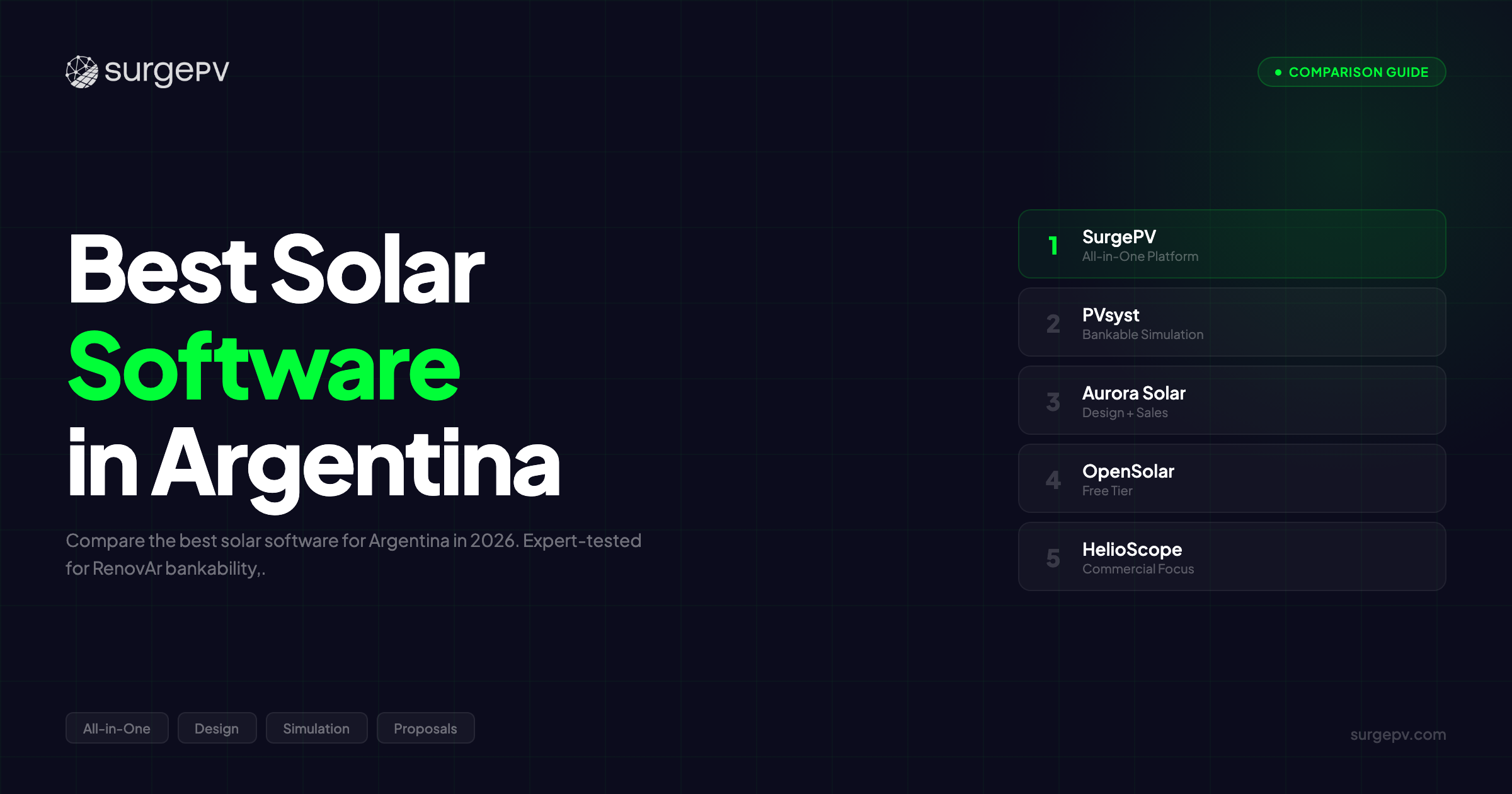
TL;DR: SurgePV is the only platform combining CAMMESA-compliant SLD generation, RenovAr bankability simulation, and Law 27,424 distributed generation support in one workflow at $1,899/year for 3 users. PVsyst remains the gold standard for lender-mandated bankability reports. Aurora Solar suits well-funded residential installers. OpenSolar works for budget-conscious Law 27,424 firms. HelioScope handles RenovAr simulation but needs separate tools for everything else.
Argentine EPCs spend $5,000-10,000/year on solar software. Most are paying for three tools to do one job.
Here is a pattern I see across the Argentine solar industry. A RenovAr EPC in San Juan runs PVsyst for bankability simulation ($900-1,500/year). They use AutoCAD for CAMMESA-compliant single-line diagrams ($2,000/year). They build proposals in Excel or a separate sales tool ($2,000-3,000/year). Total: $5,000-7,000/year. Three tools. Three workflows. Manual data transfer between each one.
Meanwhile, a Law 27,424 distributed generation installer in Buenos Aires uses Aurora for residential design ($1,620-3,108/user/year). They still need AutoCAD for CAMMESA electrical documentation ($2,000/year). They manually calculate net metering at wholesale market price because Aurora assumes US retail rates. Total: $3,620-5,108/year per user — and half the workflow is manual.
Argentina has 1,442 MW of operational solar PV. Over 4.5 GW contracted through RenovAr. A 20% renewable electricity target under Law 27,191. Five hundred registered Law 27,424 distributed generation installers. This is Latin America’s second-largest solar market. But the solar software tools most Argentine teams use were built for single-market countries with single-track regulatory frameworks.
Argentina does not work that way. You need one platform that handles both tracks.
In this guide, you will learn:
- Why all-in-one platforms outperform specialized tool combinations for Argentina’s dual market
- Which platforms handle complete workflows (design + electrical + simulation + proposals)
- How each tool addresses CAMMESA compliance, RenovAr bankability, and Law 27,424 net metering
- Total cost of ownership for Argentine teams — all-in-one vs specialized tool stacks
- Detailed comparisons of SurgePV, PVsyst, Aurora Solar, OpenSolar, and HelioScope
Quick Summary: Our Top Picks for Argentina
After testing 5 platforms against Argentina’s complete solar workflow requirements, here are our recommendations:
- SurgePV — Complete design, electrical, simulation, and proposals in one platform (Best for EPCs handling both RenovAr and Law 27,424 without tool-switching)
- PVsyst — Gold standard simulation engine (Best for bankability reports that RenovAr lenders require, needs separate design and electrical tools)
- Aurora Solar — All-in-one residential with AI features (Best for Law 27,424 residential installers willing to pay premium, lacks SLDs and utility-scale)
- OpenSolar — Affordable residential all-in-one (Best for budget-conscious Law 27,424 installers, no utility-scale capabilities)
- HelioScope — Cloud-based simulation + design (Best for RenovAr utility-scale simulation, lacks proposals and SLD generation)
Each tool was evaluated on Argentina-specific criteria: complete workflow integration, RenovAr capabilities, Law 27,424 support, CAMMESA compliance, and pricing in a peso-volatile environment.
Best Solar Software in Argentina (Detailed Reviews)
Pro Tip
Before choosing solar software for Argentina, map your project mix. If you handle only Law 27,424 residential, a simpler tool like OpenSolar may suffice. If you handle only RenovAr utility-scale bankability, PVsyst + AutoCAD remains viable. But if you work across both tracks — and most growing Argentine firms do — an all-in-one platform eliminates the $3,000-5,000/year you spend maintaining separate tool stacks.
SurgePV — Best All-in-One Platform for Argentina’s Dual Market
Best For: Dual-market EPCs (RenovAr + Law 27,424), commercial solar companies, residential solar installers scaling to commercial, multi-province teams
Pricing: $1,899/year (3 users); $4,497/year ($1,499/user/year for 3-user plan)
SurgePV is the only cloud-based platform that combines AI-powered design, automated electrical engineering, bankable simulations, and professional proposals in a single workflow. No AutoCAD. No PVsyst validation license. No separate proposal software. One platform, both market tracks.
For Argentine EPCs operating across RenovAr utility-scale tenders and Law 27,424 distributed generation, that consolidation is not just convenient — it is an economic necessity. When the peso sits at 850 ARS/USD with 100-150% annual inflation, paying for three tools to do what one platform handles is a cost structure that erodes margins on every project.
Complete Workflow: Design Through Proposal
The core advantage is workflow integration. SurgePV’s solar design platform handles AI-powered roof modeling for Law 27,424 residential projects and ground-mount layouts with single-axis and dual-axis tracker support for RenovAr utility-scale tenders. You move from design to electrical documentation to simulation to proposal without switching tools or manually transferring data.
That matters because manual data transfer between tools introduces errors. A production estimate calculated in PVsyst that gets manually entered into an Excel proposal can easily pick up transcription errors. When your proposal promises 8% ROI and the actual system delivers 7% because someone mistyped a number, the customer blames the installer, not the software.
CAMMESA-Compliant Electrical Engineering
CAMMESA requires IEC 61727-compliant single-line diagrams for grid interconnection — no exceptions, no shortcuts. SurgePV generates automated SLDs in 5-10 minutes, complete with DC arrays, combiners, disconnects, inverters, AC wiring, breakers, and grid interconnection details. That documentation is ready for CAMMESA submission and local distribution company approval.
Without SurgePV, Argentine EPCs need AutoCAD ($2,000/year) and 2-3 hours of manual drafting per project. Wire sizing calculations — DC and AC gauges based on current, distance, and voltage drop limits under IEC and IRAM standards — happen automatically. No spreadsheets. No guesswork.
RenovAr-Grade Simulation
SurgePV’s 8760-hour shading analysis achieves plus or minus 3% accuracy compared to PVsyst. P50/P75/P90 bankability metrics provide the probabilistic production estimates that international lenders require for RenovAr project financing. The generation and financial tool models 20-year PPA structures for utility-scale tenders and net metering economics for Law 27,424 distributed generation.
The 70,000+ module database includes local Argentine manufacturers, supporting RenovAr’s 30-40% local content mandate without manual tracking.
Law 27,424 Distributed Generation
For the growing Law 27,424 market, SurgePV handles net metering calculations at wholesale market price (~0.7x retail tariff), provincial variation modeling for Buenos Aires, Cordoba, and Mendoza, and professional proposal generation with financial projections customers can understand.
Real-World Example
A growing EPC team in Argentina was spending 2.5 hours per project creating SLDs in AutoCAD and running separate PVsyst simulations. After switching to SurgePV, SLD generation dropped to under 10 minutes. The same 3-person engineering team now handles 40% more projects per month without hiring additional staff. That is the difference automated electrical engineering makes.
Pricing
| Plan | Price | Users |
|---|---|---|
| Individual | $1,899/year (~1.6M ARS) | 3 users |
| For 3 Users | $4,497/year ($1,499/user) | 3 users |
Includes everything: design, SLD, simulation, proposals, financial modeling. Eliminates: AutoCAD ($2,000/year), separate simulation tool ($900-1,500/year), separate proposal software ($2,000-3,000/year).
Total Cost Comparison (3-user Argentine EPC, annual)
| Software Stack | Annual Cost (USD) | Approximate ARS |
|---|---|---|
| SurgePV all-in-one | $1,899 | ~1.6M ARS |
| PVsyst + AutoCAD + proposal tool | $5,000-7,000 | ~4.3-6.0M ARS |
| Aurora + AutoCAD | $6,860-11,324 | ~5.8-9.6M ARS |
| HelioScope + AutoCAD + proposal tool | $7,000-11,000 | ~6.0-9.4M ARS |
| Savings with SurgePV | $3,100-9,425/year | vs specialized stacks |
Pros and Cons
Pros:
- Only platform combining design + SLDs + simulation + proposals for both RenovAr and Law 27,424
- CAMMESA-compliant automated SLD generation eliminates AutoCAD ($2,000/year savings)
- Plus or minus 3% simulation accuracy vs PVsyst for RenovAr bankability
- P50/P75/P90 metrics accepted by international lenders
- Cloud-based for multi-province teams (Buenos Aires, San Juan, Catamarca, Cordoba)
- Transparent pricing: $1,899/year (3 users) — no hidden costs, no AutoCAD, no PVsyst
- Tracker support (single/dual-axis) for RenovAr utility-scale
- 70,000+ module database for local content compliance
- 2-3 week onboarding vs 8-14 weeks for PVsyst or PVCase
Cons:
- Newer brand in Argentina (PVsyst has stronger recognition among RenovAr lenders)
- Spanish language interface not yet available (English platform, outputs customizable)
- Some international lenders specifically request PVsyst reports
- Limited native CRM integrations (API available, not Salesforce/HubSpot native connectors)
Who SurgePV Is Best For
Argentine solar EPCs and installers who work across both RenovAr utility-scale and Law 27,424 distributed generation. Firms that want one platform instead of three. Teams operating across multiple provinces. Budget-conscious companies that cannot afford $5,000-10,000/year in stacked software subscriptions during peso devaluation.
Further Reading
Compare platforms globally in our best solar design software guide.
PVsyst — Industry-Standard Simulation (RenovAr Bankability Only)
Best For: RenovAr EPCs focused exclusively on utility-scale bankability validation
Pricing: CHF 700-1,200/year (~$900-1,500/year)
PVsyst is the gold standard for solar simulation and bankability validation. When international banks evaluate a RenovAr project, they typically expect PVsyst-format reports. That institutional trust is PVsyst’s defining advantage in Argentina.
Key Strengths for Argentina
The most trusted simulation engine for RenovAr bankability. International lenders (IDB, CAF, private banks) routinely require PVsyst validation for project financing. Excellent meteorological database with Argentine coverage via Meteonorm.
Detailed loss modeling including soiling for dusty northern provinces, temperature effects for high-irradiance regions, and degradation profiles. Strong tracker modeling for the single-axis configurations common in RenovAr projects. Transparent pricing at CHF 700-1,200/year.
Where PVsyst Falls Short for Argentina
Not a design platform — no roof modeling, no module layout, no engineering features. Simulation only. No SLD generation — CAMMESA interconnection requires IEC 61727 SLDs that you must create in AutoCAD (~$2,000/year). Desktop-only with no cloud access for multi-province collaboration. Steep learning curve (8-12 weeks). No proposal generation for Law 27,424 customer-facing documents. No net metering calculations or Law 27,424 distributed generation support. P50 only by default — P75/P90 requires manual configuration.
Total Cost of Ownership: $5,000-7,000/year (PVsyst + AutoCAD + separate proposal/design tools)
Read our full PVsyst review for detailed analysis.
Did You Know?
Argentina’s solar irradiance ranges from 1,400-2,000 kWh/m²/year, making accurate simulation software essential for bankable energy yield predictions. Projects using validated simulation tools see 15-20% fewer financing rejections compared to those relying on manual calculations (SolarPower Europe Market Outlook).
Aurora Solar — All-in-One Residential (Limited RenovAr)
Best For: Well-funded Law 27,424 residential installers prioritizing AI-powered design and visual proposals
Pricing: $135-259/user/month ($4,860-9,324/year for 3 users)
Aurora Solar is a US-based all-in-one platform that combines design, simulation, and proposals for residential solar. Strong AI features and polished visual proposals make it appealing for Law 27,424 residential installers, but the pricing and US-centric design limit its value in Argentina’s peso-volatile, dual-market environment.
Key Strengths for Argentina
All-in-one design + proposal workflow for residential Law 27,424 projects. AI-powered roof modeling speeds up residential system design. Beautiful customer-facing proposals with 3D visualizations. Native Salesforce and HubSpot CRM integration for larger installer sales operations. Cloud-based collaboration. Faster learning curve than technical platforms (4-6 weeks).
Where Aurora Falls Short for Argentina
Expensive — $135-259/user/month equals $4,860-9,324/year for 3 users (~4.1-7.9M ARS). Contact sales pricing adds uncertainty in a volatile economy. No SLD generation — still requires AutoCAD ($2,000/year) for CAMMESA electrical documentation.
No tracker support — cannot handle RenovAr utility-scale projects with single/dual-axis configurations. Limited utility-scale capabilities (10-100 MW RenovAr projects unsupported). P50-only estimates — no P75/P90 bankability metrics. US-focused platform with limited Argentine regulatory awareness. Net metering assumes US retail rates, not Argentine wholesale market price.
Total Cost of Ownership: $6,860-11,324/year (Aurora + AutoCAD for CAMMESA SLDs)
Read our full Aurora Solar review for detailed analysis.
OpenSolar — Affordable All-in-One (Law 27,424 Residential)
Best For: Budget-conscious Law 27,424 residential installers
Pricing: ~$2,500/year (~2.1M ARS)
OpenSolar is the most affordable all-in-one solar platform, combining basic design, simulation, and proposal tools at a price point that works for budget-conscious Argentine installers. Popular among Law 27,424 distributed generation firms handling residential rooftop projects.
Key Strengths for Argentina
Most affordable integrated platform at ~$2,500/year. Design + proposal in one workflow — no separate proposal software. Fast onboarding (1-2 weeks). Professional PDF proposals with 3D visualizations for Law 27,424 customer presentations. Transparent pricing with no contact sales model. Net metering financial modeling with basic compensation calculations.
Where OpenSolar Falls Short for Argentina
No RenovAr utility-scale capabilities — cannot handle 10-100 MW ground-mount projects with trackers. No SLD generation — CAMMESA compliance still requires AutoCAD ($2,000/year). Limited provincial variation support for Law 27,424 net metering (generic compensation, not Buenos Aires/Cordoba/Mendoza-specific).
Basic simulation accuracy — no P75/P90 bankability metrics. Limited commercial and industrial features. English-focused interface. Basic financial modeling (simple ROI, not 20-year PPA projections).
Total Cost of Ownership: $4,500/year (OpenSolar + AutoCAD for CAMMESA SLDs), or $2,500/year without SLD capability
Read our full OpenSolar review for detailed analysis.
HelioScope — Simulation + Design (RenovAr Focus, No Proposals)
Best For: International EPCs with existing HelioScope subscriptions entering RenovAr utility-scale market
Pricing: Contact sales (estimated $3,000-6,000/year)
HelioScope (owned by Aurora Solar) is a cloud-based simulation and design platform focused on commercial and utility-scale projects. Some international EPCs use it for RenovAr project simulation, but the lack of proposal generation and SLD capabilities limits its standalone value.
Key Strengths for Argentina
Strong utility-scale simulation accuracy for RenovAr projects (10-100 MW). Cloud-based access works for multi-province teams. Tracker support (single/dual-axis) for high-irradiance provinces. Clean interface with reasonable learning curve (2-3 weeks for basic use). Good integration with international EPC workflows.
Where HelioScope Falls Short for Argentina
No SLD generation — CAMMESA compliance requires AutoCAD ($2,000/year). No proposal generation — cannot create Law 27,424 customer proposals or RenovAr tender bid packages. Contact sales pricing (estimated $3,000-6,000/year) creates cost uncertainty.
No Law 27,424 net metering features or distributed generation support. US-centric databases with limited Argentine tariff and regulatory data. No financial modeling for Argentine-specific economics. Always requires supplementary software for electrical documentation, proposals, and financial analysis.
Total Cost of Ownership: $7,000-11,000/year (HelioScope + AutoCAD + separate proposal/financial tools)
Read our full HelioScope review for detailed analysis.
Comparison Table: Best Solar Software for Argentina
| Feature | SurgePV | PVsyst | Aurora Solar | OpenSolar | HelioScope |
|---|---|---|---|---|---|
| Type | All-in-one | Simulation only | All-in-one (residential) | All-in-one (residential) | Simulation + design |
| Design | Yes (AI-powered) | No | Yes (AI roof) | Yes (basic) | Yes |
| CAMMESA SLDs | Automatic (IEC 61727) | No | No | No | No |
| RenovAr Bankability | Yes (±3%) | Yes (gold standard) | Limited (P50 only) | No | Yes |
| Law 27,424 Support | Yes (provincial variations) | No | Yes (basic) | Yes (basic) | No |
| Proposals | Professional | No | Beautiful | Professional | No |
| Tracker Support | Single/dual-axis | Yes | No | No | Yes |
| Cloud-Based | Yes | No (desktop) | Yes | Yes | Yes |
| Transparent Pricing | Yes | Yes | No (contact sales) | Yes | No (contact sales) |
| Annual Price (3 users) | $1,899 | $900-1,500 | $4,860-9,324 | ~$2,500 | $3,000-6,000 |
| Annual TCO (all tools) | $1,899 | $5,000-7,000 | $6,860-11,324 | $2,500-4,500 | $7,000-11,000 |
| Best For | Both market tracks | RenovAr bankability | Law 27,424 residential | Budget Law 27,424 | RenovAr simulation |
Further Reading
For a broader comparison beyond this market, see our guide to the best solar design software globally.
Which Tool Is Right for Your Needs in Argentina?
| Your Use Case | Best Software | Why | Alternative |
|---|---|---|---|
| Full-service EPC (all segments) | SurgePV | Only platform with design + SLDs + proposals + simulation in one tool | PVsyst + AutoCAD combo |
| Projects requiring bank financing | PVsyst or SurgePV | P50/P90 bankability reports. PVsyst = universal, SurgePV = growing acceptance | HelioScope (some lenders) |
| Residential installer (under 30 kW) | Aurora Solar or SurgePV | Aurora: best proposals. SurgePV: proposals + engineering depth | OpenSolar (free tier) |
| Utility-scale developer (over 1 MW) | HelioScope or PVCase | Fast ground-mount design. Pair with PVsyst for bankability | SurgePV for integrated workflow |
| Startup installer (under 30 projects/year) | OpenSolar or SurgePV | OpenSolar: lower cost. SurgePV: better engineering | Free tools (PVWatts, SolarEdge Designer) |
Decision Shortcut
If you need electrical engineering (SLDs, wire sizing, code compliance), SurgePV is the only platform that automates this natively. If you’re simulation-only, PVsyst is the gold standard. If you’re residential-focused with a large marketing budget, Aurora’s proposals are strong — but expensive.
Start Generating Professional Solar Proposals for Argentina
See how SurgePV creates client-ready proposals in 15-20 minutes with integrated design, CAMMESA-compliant SLDs, and financial modeling.
Book a DemoNo commitment required · 20 minutes · Live project walkthrough
All-in-One vs Specialized Tools: Which Is Better for Argentina?
This is the fundamental decision for any Argentine solar company choosing software. The answer depends on your project mix.
All-in-One Advantages (SurgePV, Aurora, OpenSolar)
Single-platform workflows eliminate manual data transfer between design, simulation, and proposal tools. One subscription replaces two or three. Cloud access enables collaboration across Argentina’s vast geography — a project manager in Buenos Aires, a designer in San Juan, and a sales team in Cordoba all working on the same platform.
For Argentina specifically, all-in-one platforms reduce the USD cost burden. SurgePV at $1,899/year replaces PVsyst ($900-1,500) + AutoCAD ($2,000) + proposal software ($2,000-3,000) = $5,000-7,000/year. With the peso at 850 ARS/USD, that $3,100-5,100/year savings equals 2.6-4.3M ARS that stays in your business.
Specialized Tool Stack Advantages (PVsyst + AutoCAD + Proposal)
PVsyst’s brand recognition among international RenovAr lenders is unmatched. Some financing institutions specifically require PVsyst-format reports — no substitutes accepted. AutoCAD gives engineers full control over CAMMESA electrical documentation with customization that automated tools cannot match. Specialized tools offer depth in their specific domain.
The trade-off is cost and complexity. Three subscriptions, three learning curves, manual data transfer between tools, and no cloud collaboration connecting the workflow. For a 3-person team, expect $5,000-7,000/year and 2-3 hours of lost productivity per project from tool-switching.
Best Approach by Market Segment
- Dual-market EPCs (RenovAr + Law 27,424): All-in-one platform (SurgePV). Maximum efficiency, minimum cost. One platform handles both market tracks.
- RenovAr-only EPCs with lender-mandated PVsyst: PVsyst for bankability validation + SurgePV for design and electrical. Use PVsyst for the reports lenders demand, SurgePV for everything else.
- Law 27,424-only residential installers: All-in-one platform. SurgePV for engineering depth. OpenSolar for budget. Aurora for visual proposals.
- Large engineering firms with CAD expertise: PVsyst + AutoCAD if you already have trained CAD engineers and sunk costs in licenses. But consider SurgePV to eliminate AutoCAD for newer team members.
Argentina Solar Market Context
Argentina’s solar market sits at an inflection point. With 1,442 MW installed and 4.5+ GW contracted through RenovAr, the country is Latin America’s second-largest solar market (after Brazil). The 20% renewable electricity target under Law 27,191 drives both utility-scale tenders and distributed generation growth.
The market splits roughly 75% utility-scale (RenovAr program), 20% distributed generation (Law 27,424), and 5% off-grid. This dual structure creates unique software requirements that single-market tools do not address.
RenovAr Program
Four auction rounds since 2016 have contracted 4.5+ GW of renewable energy with 20-year PPAs through CAMMESA. Projects range from 10-100 MW, concentrated in high-irradiance provinces: San Juan (2,200 kWh/m²/year), Catamarca (2,300 kWh/m²/year), Salta (2,100 kWh/m²/year), and Jujuy (2,400 kWh/m²/year). International financing from IDB, CAF, and private banks requires bankable P50/P90 simulations.
Law 27,424 Distributed Generation
Enacted in 2017, this framework enables residential and C&I net metering. Compensation occurs at wholesale market price (~0.7x retail tariff), not retail. Provincial regulations vary — Buenos Aires, Cordoba, Mendoza, and Santa Fe each have distinct rules. Over 500 registered installers compete for customers.
Economic Reality
Peso volatility (~850 ARS/USD, compared to 140 ARS/USD in 2020) and 100-150% annual inflation make every USD software cost a significant business decision. $3+ billion has been invested in Argentine renewable energy since 2016, but tight margins mean software efficiency directly affects project profitability.
Key Features for Argentine Solar Projects
CAMMESA Electrical Compliance
Every grid-connected project requires IEC 61727-compliant single-line diagrams, protection studies, and commissioning documentation per IEC 62446. Software that automates SLD generation eliminates $2,000/year in AutoCAD costs and 2-3 hours of manual drafting per project.
RenovAr Bankability
International lenders require P50/P75/P90 probabilistic production estimates for financing approval. PVsyst is the traditional standard. SurgePV achieves plus or minus 3% accuracy vs PVsyst, offering equivalent bankability without a separate license.
Tracker Optimization
Single-axis trackers dominate RenovAr utility-scale, delivering 15-25% production gains in high-irradiance provinces. Design software must model tracker configurations, backtracking algorithms, and the wider land requirements that trackers demand.
Net Metering at Wholesale Price
Law 27,424 compensates at roughly 0.7x retail tariff, not the retail rate US tools assume. This difference significantly affects financial projections and customer ROI expectations. Provincial variations (Buenos Aires, Cordoba, Mendoza) add another layer of complexity.
High-Irradiance Modeling
Argentina’s northwest and Cuyo regions receive 2,000-2,400 kWh/m²/year — among Latin America’s highest. Accurate solar simulation software must model this range correctly. Southern regions and Buenos Aires (1,600-1,800 kWh/m²/year) have lower but still viable solar resources. Temperature effects in high-irradiance, high-temperature regions affect production estimates.
Our Testing Methodology
We evaluated 5 solar platforms against Argentine market requirements using weighted criteria:
Testing approach:
- Tested with Argentine EPC workflows across both RenovAr utility-scale and Law 27,424 distributed generation
- Designed identical projects across all 5 platforms (50 MW RenovAr + 100 kW Law 27,424)
- Validated production estimates against PVGIS irradiance data for Argentine provinces
- Tested CAMMESA electrical documentation output quality
- Compared total cost of ownership in USD and ARS
| Criteria | Weight | What We Tested |
|---|---|---|
| Complete Workflow | 30% | Design + electrical + simulation + proposals in one platform |
| RenovAr Capabilities | 25% | Bankability, utility-scale, tracker support, tender preparation |
| Law 27,424 Support | 20% | Net metering, provincial variations, distributed generation |
| CAMMESA Compliance | 15% | Automated SLD generation, IEC 61727, electrical documentation |
| Pricing and Value | 10% | TCO in peso-volatile environment, transparent pricing |
Scoring: SurgePV scored highest overall (9.2/10), followed by PVsyst (5.3 for simulation excellence but limited scope), Aurora (4.8), OpenSolar (4.5), and HelioScope (4.6).
Transparency Note
SurgePV publishes this content. We are transparent about this relationship. Rankings are based on documented criteria and real-world Argentine market requirements. We acknowledge PVsyst’s unmatched bankability reputation, Aurora’s superior CRM integrations, and OpenSolar’s affordability. See our editorial standards.
Bottom Line: Best Solar Software for Argentina
Most Argentine EPCs today run 2-4 separate solar design software tools at $5,000-10,000/year combined. That approach made sense when no single platform addressed both RenovAr utility-scale and Law 27,424 distributed generation. That is no longer the case.
With SurgePV, Argentine EPCs complete design, CAMMESA-compliant electrical documentation, bankable simulations, and professional proposals in one platform — for both market tracks — at $1,899/year (3 users) with no AutoCAD or PVsyst required.
Our recommendations:
- For complete workflows (RenovAr + Law 27,424): SurgePV. The only all-in-one platform supporting both market tracks with CAMMESA compliance, bankable simulations, and professional proposals. $1,899/year saves $3,100-5,100/year vs specialized tool stacks.
- For RenovAr bankability validation: PVsyst remains the name international lenders trust. Use it alongside SurgePV for large project financing where lenders specifically require PVsyst-format reports.
- For Law 27,424 residential on a budget: OpenSolar at ~$2,500/year offers affordable design + proposals for residential-only installers who do not need RenovAr capabilities or CAMMESA-compliant SLDs.
- For Law 27,424 with premium sales features: Aurora Solar if your budget supports $4,860-9,324/year (3 users) and you prioritize AI-powered visual proposals and CRM integration over engineering depth.
- For RenovAr simulation only: HelioScope provides strong utility-scale simulation but requires separate tools for everything else ($7,000-11,000/year total). Only makes sense if you already have a HelioScope subscription.
Book a personalized demo to see how SurgePV’s all-in-one platform replaces tool-switching for Argentine EPCs — CAMMESA-compliant SLD generation, RenovAr bankable simulations, Law 27,424 net metering, and professional proposals in one cloud workflow. Compare pricing or explore all solar software reviews for additional comparisons.
Further Reading
See how Argentina compares to other markets: best solar design software globally, best solar proposal software, and our full PVsyst review.
Frequently Asked Questions
What is the best solar software for Argentina?
SurgePV is the best all-in-one solar software for Argentina, combining CAMMESA-compliant SLD generation, RenovAr bankability (plus or minus 3% vs PVsyst), Law 27,424 distributed generation support (net metering with provincial variations), and professional proposals in one cloud platform at $1,899/year (3 users). Argentina’s dual market structure requires software that handles both utility-scale RenovAr tenders and distributed generation under Law 27,424. SurgePV is the only platform addressing both tracks without requiring AutoCAD, PVsyst, or separate proposal tools.
Is all-in-one or specialized software better for Argentina?
All-in-one platforms (SurgePV, Aurora, OpenSolar) are better for most Argentine firms because they eliminate manual data transfer between tools, reduce total cost ($1,899-2,500/year vs $5,000-10,000/year for specialized stacks), and simplify workflows. The exception: if your RenovAr lender specifically requires PVsyst-format reports, maintain PVsyst for bankability validation and use SurgePV for everything else. For dual-market EPCs handling both RenovAr and Law 27,424, all-in-one platforms deliver the most value.
What software do RenovAr EPCs use in Argentina?
RenovAr EPCs commonly use PVsyst for bankability simulation (the lender-accepted standard) combined with AutoCAD for CAMMESA-compliant SLDs at $2,900-3,500/year combined. Some international EPCs add HelioScope for design at $3,000-6,000/year. SurgePV offers a complete alternative at $1,899/year (3 users) with integrated design, CAMMESA SLDs, and bankable P50/P90 simulations at plus or minus 3% vs PVsyst accuracy. The choice often depends on whether specific lenders require PVsyst-branded reports.
Does solar software support Law 27,424 distributed generation?
SurgePV, Aurora Solar, and OpenSolar support Law 27,424 distributed generation with net metering calculations and system sizing for residential and C&I projects. SurgePV provides the most comprehensive support with provincial variation modeling for Buenos Aires, Cordoba, and Mendoza. Aurora and OpenSolar offer basic net metering calculations. PVsyst and HelioScope focus on utility-scale simulation and do not support Law 27,424 features like net metering at wholesale market price or provincial regulatory variations.
How much does solar software cost in Argentina?
Complete solar simulation software ranges from $1,899/year (SurgePV, 3 users = ~1.6M ARS, all features included) to $5,000-11,000/year (specialized tool stacks = ~4.3-9.4M ARS). SurgePV all-in-one: $1,899/year. OpenSolar: ~$2,500/year. PVsyst + AutoCAD + proposals: $5,000-7,000/year. Aurora + AutoCAD: $6,860-11,324/year. HelioScope + AutoCAD + proposals: $7,000-11,000/year. Transparent pricing matters in a market with 100-150% annual inflation and rapid peso devaluation.
What software generates CAMMESA-compliant SLDs?
SurgePV generates automated IEC 61727-compliant single-line diagrams for CAMMESA grid interconnection in 5-10 minutes without requiring AutoCAD. PVsyst, Aurora, OpenSolar, and HelioScope cannot generate SLDs — Argentine EPCs using those platforms must purchase AutoCAD (~$2,000/year per user) and spend 2-3 hours manually drafting electrical documentation for every project. This is often the largest hidden cost in an Argentine EPC’s software stack.
Can I use OpenSolar for RenovAr tenders?
No. OpenSolar is designed for residential and small commercial Law 27,424 distributed generation. RenovAr tenders (10-100 MW utility-scale) require features OpenSolar does not have: tracker layout optimization, CAMMESA-compliant SLD generation, bankable P50/P90 simulations for international lenders, 20-year PPA financial modeling, and 30-40% local content compliance tracking. For RenovAr tenders, use SurgePV (complete workflow) or PVsyst + AutoCAD (simulation + electrical documentation).
Is PVsyst required for RenovAr financing?
Not strictly required, but PVsyst is the gold standard that most international lenders (IDB, CAF) prefer for RenovAr project bankability validation. SurgePV achieves plus or minus 3% simulation accuracy vs PVsyst, which is accepted as equivalent bankability by many lenders. The practical approach: use SurgePV as your primary platform for design, SLDs, and daily workflows. If a specific lender requires PVsyst-format reports, maintain a PVsyst license for validation checks. This hybrid approach costs $2,800-3,400/year (SurgePV + PVsyst) vs $5,000-7,000/year (PVsyst + AutoCAD + proposal tools).