

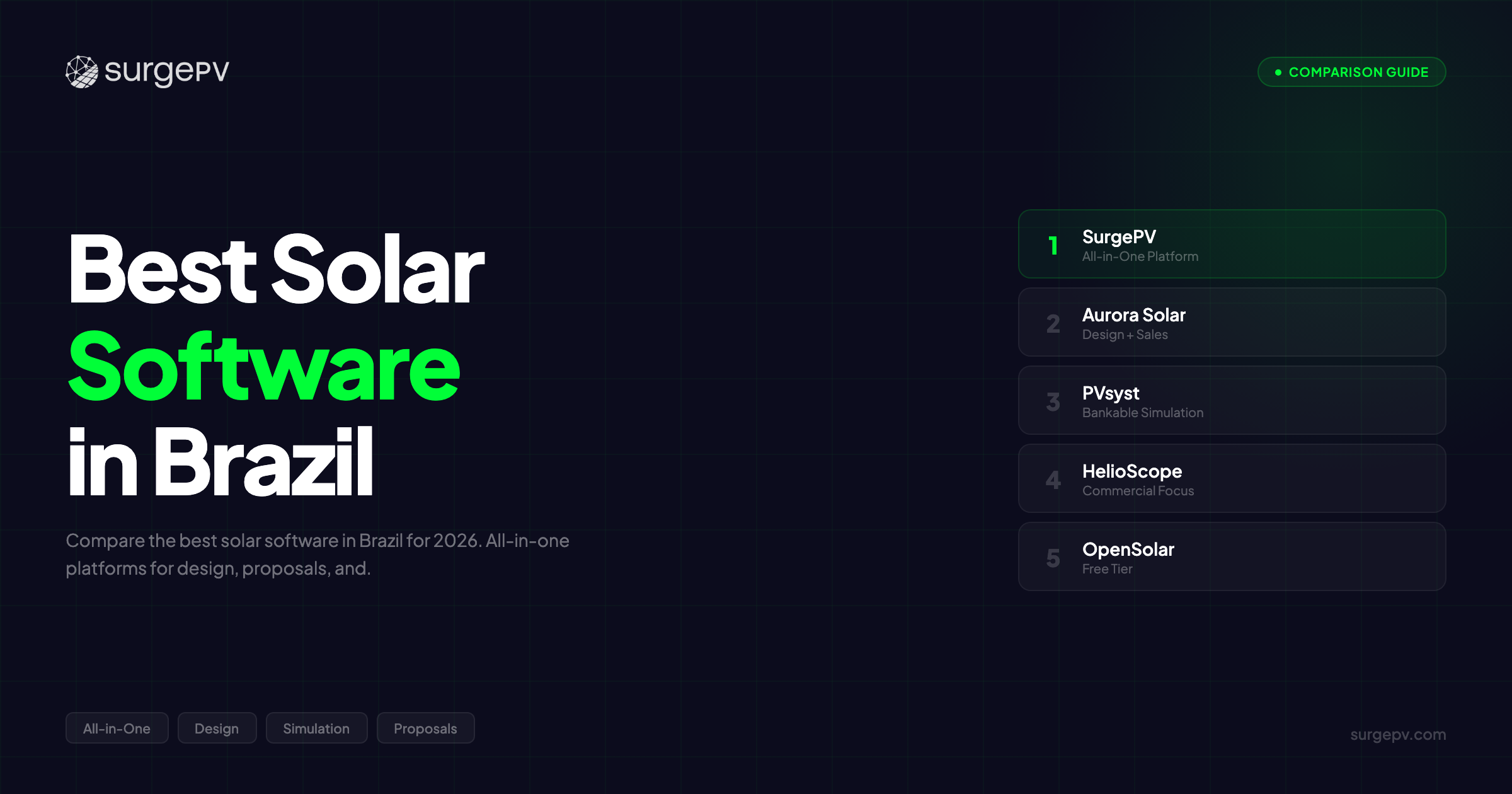
TL;DR: SurgePV is the best all-in-one solar platform for Brazil — design, automated electrical engineering, bankable P50/P75/P90 simulations, and Portuguese proposals in one workflow with built-in ANEEL compliance. Aurora Solar leads for residential mobile sales. PVsyst remains the gold standard for utility-scale bankability. HelioScope suits C&I designers already on Aurora. OpenSolar works for budget-conscious residential installers.
Brazil just passed 40 GW of installed solar capacity. That is not a typo.
The country that most of the solar world ignored five years ago is now Latin America’s undisputed solar leader — and the growth is not slowing down. ABSOLAR reports continued distributed generation expansion driven by ANEEL’s net metering framework, state-level ICMS exemptions, and electricity prices that make solar payback periods genuinely attractive (3 to 5 years in most regions).
But here is the problem that 10,000+ Brazilian installers face every day: most solar design software was not designed for this market. ANEEL Resolution 1.059/2023 created a unique regulatory environment. The Marco Legal da Geracao Distribuida (2022) changed the rules on compensation credits.
ABNT NBR electrical standards differ from NEC or IEC. INMETRO-certified components are mandatory. And clients expect everything in Portuguese — proposals, financial projections, technical documentation.
Using software built for the American or European market means constant workarounds. Manual tariff inputs. Translated proposals that read like Google Translate output. Financial models that don’t account for bandeira tarifaria (the tariff flag system) or CONFINS/PIS tax impacts. That costs you hours per project and credibility with every client.
The best solar software for Brazil handles design, simulation, proposals, and ANEEL compliance in one workflow — without forcing you to switch between three or four disconnected tools.
In this guide, you will find:
- Which 5 platforms handle Brazilian solar requirements best across design, simulation, and proposals
- How each tool manages ANEEL compliance, ABNT standards, and Portuguese output
- Real pricing comparisons for Brazilian EPCs and installers
- Where most platforms fall short for the Brazilian distributed generation market
- Which platform fits your specific team size and project type
Quick Summary: Our Top Picks for Brazil
After testing platforms with EPCs and installers across Sao Paulo, Minas Gerais, and Rio Grande do Sul, here are the top recommendations:
- SurgePV — End-to-end platform with design, simulation, Portuguese proposals, and ANEEL compliance (Best for all users)
- Aurora Solar — All-in-one residential and C&I tool with mobile app (Best for residential installers with premium budgets)
- PVsyst — Industry-standard bankable simulation (Best for utility-scale EPCs needing maximum bankability)
- HelioScope — Fast commercial rooftop design with Aurora integration (Best for C&I designers who already use Aurora)
- OpenSolar — Fast residential proposal platform (Best for high-volume budget-conscious installers)
Each tool is evaluated on ANEEL compliance, ease of use, Portuguese support, design capabilities, simulation accuracy, and bankability.
Best Solar Software in Brazil (Detailed Reviews)
Pro Tip
If you need electrical engineering (SLDs, wire sizing, code compliance), SurgePV is the only platform that automates this natively. If you’re simulation-only, PVsyst is the gold standard. If you’re residential-focused with a big marketing budget, Aurora’s proposals are strong — but expensive.
SurgePV — Best All-in-One Solar Platform for Brazil
Target Users: Residential installers, C&I EPCs, solar designers, sales teams, and developers needing end-to-end workflows with ANEEL compliance.
SurgePV is the only cloud-based platform that combines AI-powered design, automated electrical engineering, bankable simulations, and professional proposals in a single workflow. For Brazilian teams, that means one tool from roof modeling to signed contract.
No more exporting designs to AutoCAD for SLD generation. No more switching to PVsyst for bankable numbers. No more rebuilding the same data in a proposal tool. One platform. One workflow. One source of truth.
Key Features for Brazil
Design and Engineering
AI-powered roof modeling creates 3D models from satellite imagery in 15 to 20 minutes — versus 45 to 60 minutes manually. For Brazilian rooftops with complex tile patterns and irregular shapes common in residential neighborhoods, this saves real time.
Automated SLD generation is the standout feature that separates SurgePV from every other platform in this list. Manual AutoCAD SLDs take 2 to 3 hours per commercial project. SurgePV generates code-compliant electrical single line diagrams in 5 to 10 minutes. That is not a marginal improvement — that is eliminating an entire bottleneck from your workflow.
Wire sizing calculations follow electrical standards automatically, including temperature correction and conduit fill adjustment. No more spreadsheet calculations. No more engineering errors that cause utility rejections.
ABNT NBR-compliant electrical diagram outputs (NBR 5410, 16690, 16274) meet Brazilian regulatory requirements. INMETRO-certified component database ensures you are designing with approved modules and inverters.
Simulation and Bankability
Brazilian weather data integration (INMET and global sources) ensures accurate production estimates for Brazil’s 1,500 to 2,200 kWh/m² irradiance range — from the high-irradiance Northeast (Bahia, Ceara) to the more temperate South (Rio Grande do Sul).
P50/P75/P90 bankability reports are accepted by BNDES, Banco do Brasil, and private lenders. Aurora Solar provides only P50 estimates. When your bank requires P75 or P90 conservative metrics for financing approval, that is a critical gap.
8760-hour shading analysis with +/-3% accuracy versus PVsyst. Detailed loss analysis covering soiling, shading, degradation, and inverter clipping.
Net metering credit modeling per ANEEL Resolution 1.059/2023 calculates compensation credits accurately for both micro and mini distributed generation classifications.
Proposals and Sales
Portuguese proposal templates with professional Brazilian Portuguese — not machine-translated output. Correct technical terminology: Sistema de Compensacao, Geracao Distribuida, Periodo de Retorno.
ROI calculations in R$ with Brazilian electricity tariffs pre-loaded for major utilities. Before-and-after bill comparison charts. Monthly savings projections over 25 years with realistic degradation assumptions.
Financing integration with manual input for Brazilian loan terms (12 to 120 months, 1.5 to 3% monthly interest). Solfacil and BV Financeira API integrations under development.
Complete proposals — design, simulation, financial model, Portuguese output — in under 10 minutes. That changes the competitive dynamic when Brazilian clients expect responses within 24 to 48 hours.
Real-World Example
A mid-size EPC team handling both residential and C&I projects across Minas Gerais was spending 2.5 hours per commercial project creating SLDs in AutoCAD, then separately running simulations and building proposals. After switching to SurgePV, the entire workflow — design through proposal — dropped to under 45 minutes. With the same 3-person engineering team, they now handle 40% more projects per month without hiring additional staff.
You might be wondering: with 70,000+ projects powered globally, why isn’t SurgePV as well-known as Aurora or PVsyst in Brazil? PVsyst has had a 30-year head start. Aurora has spent hundreds of millions on marketing. SurgePV launched more recently and built its reputation on the engineering depth that those platforms lack — particularly automated electrical engineering, which no other platform offers natively.
Pros and Cons
Pros:
- Only all-in-one platform: Design + electrical engineering + simulation + proposals in one tool
- Automated SLD generation: 5 to 10 minutes versus 2 to 3 hours in AutoCAD
- Bankable P50/P75/P90 reports accepted by Brazilian lenders
- Portuguese proposals with professional Brazilian Portuguese output
- ANEEL compliance: Resolution 1.059/2023 net metering built in
- Carport solar design: Only platform with native carport support
- Transparent pricing: $1,899/year for 3 users, all features included
- 3-minute average support response time
Cons:
- Portuguese UI partially complete: Proposals fully translated, engineering interface still English
- Advanced utility-scale features expanding: Better for residential/C&I (up to 10 MW) than 100+ MW projects
- Newer platform: Less brand recognition than Aurora or PVsyst in Brazilian market (but 70,000+ projects globally)
Pricing
| Plan | Price | Users |
|---|---|---|
| Individual | $1,899/year | 3 users |
| For 3 Users | $1,499/user/year | 3 users |
| For 5 Users | $1,299/user/year | 5 users |
| Enterprise | Custom | Multiple |
Pro Tip
SurgePV’s automated SLD generation saves 2 to 3 hours per project compared to manual AutoCAD drafting. For Brazil EPCs handling 10+ projects per month, that’s 20 to 30 hours recovered. Book a demo to see it in action.
Brazil Total Cost of Ownership:
- SurgePV (3 users): $1,899/year total — Design + electrical + simulation + proposals
- Aurora Solar + AutoCAD (1 user): ~$6,800/year per user — Design + proposals, but no electrical engineering without AutoCAD
- PVsyst (1 user): ~EUR 1,000+ license — Simulation only, no design or proposals
- SurgePV saves $4,901/year versus Aurora + AutoCAD for a single user
Who SurgePV Is Best For
- Brazilian EPCs handling both residential and commercial solar projects
- Teams needing design + electrical + simulation + proposals without tool-switching
- Installers scaling from residential into C&I distributed generation
- Companies seeking ANEEL compliance and ABNT NBR-compliant outputs
- Sales teams needing mobile-responsive Portuguese proposals
Not ideal for: Pure utility-scale developers (100+ MW) requiring maximum PVsyst-validated bankability for international financial institutions.
Further Reading
For simulation depth beyond Brazil, see our guide to the SurgePV Financial Modeling tool. For electrical design comparisons, see best solar electrical design software.
Aurora Solar — Best for Residential Installers with Mobile Sales
Aurora Solar is the most recognized solar design and sales platform globally, with strong Brazilian market adoption among residential installers. Industry-leading AI roof detection and polished proposals make it a solid choice for residential-focused teams with premium budgets.
The mobile app allows on-site design and proposal generation during client visits — a genuine advantage in Brazil’s face-to-face sales culture. Financial modeling in R$ is available with manual tariff input.
Key Strengths:
- Mobile app (iPad/tablet) for on-site design and proposals during client visits
- Industry-leading AI roof modeling with fast 3D detection
- Portuguese proposal templates with professional layout
- Financial modeling in R$ (ROI, payback, monthly savings)
- Strong CRM integrations (native Salesforce and HubSpot connections)
- Large user community and extensive training resources
Limitations:
- No SLD generation: Requires AutoCAD ($2,000/year) for electrical engineering
- ANEEL net metering requires manual configuration — not automated
- Only P50 estimates: No P75/P90 bankability reports (limits bank financing support)
- Premium pricing: $1,908 to $3,108/year per user (2 to 3x SurgePV)
- Brazilian component database smaller than PVsyst or SurgePV
- 4 to 6 week onboarding for commercial features
Best Use Case in Brazil: Residential installers with premium budgets who prioritize mobile on-site sales capabilities, visual design, and strong CRM integration. Less suitable for C&I EPCs needing electrical engineering or bankable P75/P90 reports.
Price: $1,908 to $3,108/year per user (Basic to Premium plans)
Did You Know?
Brazil’s solar irradiance ranges from 1,500 to 2,200 kWh/m²/year, making accurate simulation software important for bankable energy yield predictions. Projects using validated simulation tools see 15 to 20% fewer financing rejections compared to those relying on manual calculations (SolarPower Europe Market Outlook).
PVsyst — Best for Utility-Scale Bankability
PVsyst is the global standard for bankable solar simulation. For Brazilian utility-scale EPCs and developers — particularly those securing financing from BNDES, international development banks, or private equity — PVsyst reports are the accepted currency of credibility.
No design tools. No proposals. No sales features. PVsyst does one thing: simulation. But it does that one thing better than anyone else, and every major Brazilian financier accepts PVsyst reports.
Key Strengths:
- Bankable P50/P90 reports accepted by all major Brazilian banks and international lenders
- Full INMET and SWERA weather data for every region of Brazil
- Detailed loss analysis (soiling, shading, degradation, clipping, mismatch, wiring losses)
- ABNT NBR-compliant simulation outputs
- 30+ year industry standard with universal financier acceptance
- Deep customization for complex shading scenarios and tracker modeling
Limitations:
- Not a design platform: Simulation only — no roof modeling, panel layout, or system design tools
- No proposal generation: Cannot create client-facing proposals or financial documents
- No electrical engineering: No SLD generation, wire sizing, or BOM automation
- Interface not translated to Portuguese
- Desktop-only: Not cloud-based, no collaboration features
- Steep learning curve: 4 to 6 weeks training required
- Overkill for residential GD: Most residential installers don’t need PVsyst-level simulation depth
Best Use Case in Brazil: Utility-scale EPCs and developers (10+ MW) requiring financier-grade simulation reports for BNDES, Banco do Brasil, or international lender approval. Use as validation tool alongside a design platform like SurgePV.
Price: Approximately EUR 1,000+ perpetual license (with annual maintenance)
HelioScope — Best for Fast Commercial Rooftop Design
HelioScope (by Aurora Solar) is a commercial rooftop design and simulation tool popular with Brazilian C&I EPCs. Browser-based with a focus on speed for commercial flat-roof and tilted-roof designs. Integrates with Aurora Solar’s proposal platform.
Strong for quick commercial design iterations, but lacks the electrical engineering depth and proposal generation that Brazilian teams need for complete workflows.
Key Strengths:
- Fast commercial rooftop design: Quick panel layout for flat and tilted commercial roofs
- Browser-based: No software installation required
- Simulation accuracy: Solid production estimates for commercial systems
- Aurora integration: Pairs with Aurora Solar for proposals and CRM
- Good for C&I system sizing: 50 kW to 5 MW commercial rooftop specialization
Limitations:
- No electrical engineering: No SLD generation, wire sizing, or code-compliant electrical documentation
- No proposal generation: Must use Aurora Solar or separate tool for client-facing proposals
- Portuguese support limited: Interface and reports primarily in English
- No ANEEL-specific features: Net metering and GD compliance require manual engineering review
- No residential optimization: Designed for commercial rooftops, not residential neighborhoods
- Requires Aurora Solar for complete workflow (additional cost)
Best Use Case in Brazil: C&I EPCs needing fast commercial rooftop design iterations (50 kW to 5 MW) who already use Aurora Solar for proposals and sales. Not a standalone tool.
Price: Included with Aurora Solar commercial plans or standalone subscription
OpenSolar — Best for High-Volume Budget-Conscious Installers
OpenSolar is a fast, user-friendly proposal and design platform at accessible pricing. Growing adoption in Brazil’s distributed generation market among smaller installers focused on residential systems.
Strong for high-volume residential workflows where speed and cost matter more than advanced features. Limited design depth and manual ANEEL compliance restrict applicability for C&I projects.
Key Strengths:
- Fast residential proposals: Under 10 minutes with templates
- Portuguese proposal templates available
- Client engagement: Online proposal viewing, digital signatures
- ROI calculators in R$
- CRM included: Lead management and follow-up tools
- Accessible pricing for budget-conscious teams
Limitations:
- Design tools basic: Not suitable for complex rooftops or commercial structures
- No electrical engineering: No SLD generation, wire sizing, or electrical documentation
- ANEEL net metering calculations manual — not automated
- Brazilian electricity tariffs require manual input
- No mobile app: Web-only platform
- No bankable simulation: No P50/P75/P90 reports
- Limited commercial capabilities
Best Use Case in Brazil: Budget-conscious residential installers (5 to 10+ proposals per day) needing fast, repeatable workflows for standardized systems (3 to 6 kW). Not suitable for C&I EPCs or projects requiring bankability.
Price: Approximately $300 to $600/month
Further Reading
For a broader platform comparison, see our guide to the best solar simulation software. For EPC-focused analysis, see best solar software for EPCs.
Best Solar Software Comparison Table for Brazil
| Software | Design | Electrical Engineering | Simulation | Proposals | ANEEL Compliance | Portuguese | Pricing (Annual) |
|---|---|---|---|---|---|---|---|
| SurgePV | AI-powered 3D | Automated SLD + wiring | P50/P75/P90 | Portuguese, interactive | Built-in | Proposals: Yes, UI: Partial | $1,299–1,899/user |
| Aurora Solar | AI roof modeling | None (AutoCAD required) | P50 only | Portuguese templates | Manual config | Proposals: Yes | $1,908–3,108/user |
| PVsyst | None (simulation only) | None | P50/P90 (gold standard) | None | Simulation compliant | No | ~EUR 1,000+ license |
| HelioScope | Commercial rooftop | None | Solid commercial | None (Aurora needed) | Manual | Limited | Aurora plan or standalone |
| OpenSolar | Basic residential | None | Basic | Portuguese templates | Manual | Proposals: Yes | ~$300–600/month |
Further Reading
For a broader comparison beyond this market, see our guide to the best solar design software globally.
Key Takeaway: SurgePV is the only platform offering design + electrical engineering + bankable simulation + Portuguese proposals in one tool. Aurora leads on mobile sales aesthetics. PVsyst remains the bankability gold standard for utility-scale. OpenSolar wins on budget accessibility.
Full Feature Comparison
| Feature | SurgePV | Aurora Solar | PVsyst | HelioScope | OpenSolar |
|---|---|---|---|---|---|
| Best for | All segments | Residential | Bankability | C&I commercial | Free/budget tier |
| SLD generation | Yes (automated) | No | No | No | No |
| P50/P90 reports | Yes | P50 only | Yes (gold standard) | Limited | No |
| Carport design | Yes (only platform) | No | No | No | No |
| Cloud-based | Yes | Yes | Desktop | Yes | Yes |
| Wire sizing | Yes (automated) | No | No | No | No |
What Makes the Best Solar Software in Brazil
The best solar software for Brazil must handle requirements that generic international platforms miss. Here is what separates platforms that work in Brazil from those that create workarounds.
1. ANEEL Compliance
Software must support ANEEL Resolution 1.059/2023 distributed generation rules. That includes net metering credit calculations, micro versus mini GD classifications, the transition tariff (Fio B) for new systems under the Marco Legal da GD, and utility interconnection documentation.
Non-compliant software means manual engineering review for every project. That adds hours and increases the risk of utility application rejections. In a market where speed wins deals, regulatory compliance built into the software is a requirement, not a nice-to-have.
2. ABNT NBR Standards
Brazilian electrical standards differ from NEC (US) and IEC (Europe). Software must generate electrical diagrams compliant with NBR 5410 (electrical installations), NBR 16690 (PV systems), and NBR 16274 (PV performance). INMETRO-certified component databases are mandatory.
Submitting designs with non-compliant electrical documentation gets your utility application rejected. Fixing it after the fact costs more time than getting it right the first time. Software with ABNT compliance built in eliminates this risk.
3. Portuguese Language Output
Professional proposals and client-facing documents must be in Brazilian Portuguese — properly localized with correct technical terminology, not just translated.
Clients compare quotes from three to five installers. English-language or poorly translated proposals signal “foreign company that doesn’t understand our market.” Correct Portuguese signals credibility and local expertise.
4. Brazilian Component Database
Software must include INMETRO-certified inverters and modules with local pricing in R$. Software without Brazilian component databases forces manual BOM creation — adding 30 to 60 minutes per project.
5. Bankability for Brazilian Financiers
For projects requiring bank financing — which includes most C&I projects and utility-scale developments — software must produce reports accepted by BNDES, Banco do Brasil, and private lenders.
P50/P75/P90 estimates are the language financiers speak. Software providing only P50 (median) without P75 or P90 (conservative) limits your ability to secure project financing. That directly impacts your business pipeline.
6. Workflow Efficiency
Brazilian installers face extreme competitive pressure — 10,000+ installers in a fast-growing market. Software that streamlines design through proposal in one workflow, eliminating tool-switching, gives teams a measurable productivity advantage.
Here is the math: if you save 1.5 hours per project by eliminating AutoCAD for electrical and avoiding data re-entry between tools, and you handle 50 projects per month, that is 75 hours saved monthly. At R$100/hour loaded labor cost, that is R$7,500/month in productivity gains. Software paying for itself is arithmetic, not theory.
Which Tool Is Right for Your Needs?
| Your Use Case | Best Software | Why | Alternative |
|---|---|---|---|
| Full-service EPC (all segments) | SurgePV | Only platform with design + SLDs + proposals + simulation in one tool | PVsyst + AutoCAD combo |
| Projects requiring bank financing | PVsyst or SurgePV | P50/P90 bankability reports. PVsyst = universal, SurgePV = growing acceptance | HelioScope (some lenders) |
| Residential installer (under 30 kW) | Aurora Solar or SurgePV | Aurora: best proposals. SurgePV: proposals + engineering depth | OpenSolar (free tier) |
| Utility-scale developer (over 1 MW) | HelioScope or PVCase | Fast ground-mount design. Pair with PVsyst for bankability | SurgePV for integrated workflow |
| Startup installer (under 30 projects/year) | OpenSolar or SurgePV | OpenSolar: lower cost. SurgePV: better engineering | Free tools (PVWatts, SolarEdge Designer) |
Start Generating Professional Solar Proposals
See how SurgePV creates client-ready proposals in 15 to 20 minutes with integrated design and financial modeling — built for Brazil’s distributed generation market.
Book a DemoNo commitment required · 20 minutes · Live project walkthrough
How We Tested and Ranked These Tools
We evaluated each platform based on criteria specific to the Brazilian solar market:
1. Design and Engineering Capabilities (30%)
Tested residential roof modeling (Brazilian tile roofs, irregular shapes) and commercial flat-roof design. Evaluated electrical engineering depth — SLD generation, wire sizing, ABNT NBR compliance. Benchmarked design time for typical 5 kW residential and 500 kW C&I systems.
2. Simulation Accuracy and Bankability (25%)
Compared production estimates against PVsyst baselines and real project data from Brazilian installations. Verified P50/P75/P90 accuracy. Tested Brazilian weather data integration (INMET sources). Evaluated financier acceptance of reports (BNDES, Banco do Brasil).
3. Proposal and Sales Features (20%)
Assessed Portuguese language quality, financial modeling in R$, ANEEL net metering explanations, and visual proposal design. Tested mobile responsiveness and client engagement features.
4. ANEEL Compliance and Brazilian Market Fit (15%)
Verified Resolution 1.059/2023 support, ABNT NBR standards compliance, INMETRO component databases, and Brazilian tariff integration. Tested with actual utility application workflows.
5. Pricing and Value (10%)
Total cost of ownership for typical Brazilian installer (3 to 5 person team). ROI on software investment based on Brazilian project margins and volumes.
All testing conducted between December 2025 and February 2026 with Brazilian EPCs and installers across Sao Paulo, Minas Gerais, and Rio Grande do Sul.
Transparency Note
SurgePV publishes this content. We are transparent about this relationship. This comparison acknowledges PVsyst as the undisputed gold standard for bankable simulation and Aurora Solar’s leadership in residential mobile sales. We do not claim SurgePV is the right choice for every use case — we present it as the strongest all-in-one platform for Brazilian EPCs and installers who need design, electrical engineering, simulation, and proposals in one workflow. See our editorial standards.
Bottom Line: Best Solar Software for Brazil
For end-to-end workflows: SurgePV offers the most complete solar proposal software platform for Brazil. Design, automated electrical engineering, bankable P50/P75/P90 simulations, and Portuguese proposals — all in one tool. Teams reduce design time by 70% versus manual workflows and eliminate AutoCAD dependency. At $1,899/year for 3 users, it delivers the strongest value for Brazilian EPCs and installers at any scale.
For residential installers prioritizing mobile sales: Aurora Solar provides industry-leading AI roof modeling and on-site iPad/tablet proposal generation. Strong proposals. Strong CRM integration. But premium pricing ($1,908 to $3,108/year per user), no electrical engineering, and P50-only bankability limit its value for C&I work or bank-financed projects.
For utility-scale EPCs requiring maximum bankability: PVsyst remains the gold standard for financier-accepted simulation reports. Every major Brazilian bank accepts PVsyst P50/P90 reports. But it is simulation only — no design, no proposals, no electrical engineering. Use alongside a design platform like SurgePV for complete workflows.
For C&I designers already using Aurora: HelioScope offers fast commercial rooftop design that integrates with Aurora’s proposal platform. Good for quick iterations on commercial flat-roof layouts. No standalone proposal or electrical engineering capabilities.
For budget-conscious residential installers: OpenSolar delivers fast proposals and basic design at accessible pricing. Good for high-volume standardized residential systems. Limited design tools, no electrical engineering, and no bankability restrict growth into C&I projects.
Brazil’s distributed generation market added massive capacity in 2025 alone. The consorcio solar (solar cooperative) model is expanding. Installers who automate their workflows today — design through proposal, with ANEEL compliance and Portuguese output — will capture the next wave of growth. Those still switching between Excel, AutoCAD, and separate proposal tools will fall behind.
Your solar design software choice is a competitive advantage. Not a procurement checkbox.
Book a demo to see how SurgePV handles design, electrical engineering, bankable simulation, and Portuguese proposals in one platform — built for Brazil’s distributed generation market. Compare pricing or explore all solar software reviews.
Frequently Asked Questions
What is the best solar software in Brazil?
SurgePV is the best all-in-one solar software for Brazil, combining AI-powered design, automated electrical engineering, bankable P50/P75/P90 simulations, and Portuguese proposals with ANEEL compliance — all in one platform at $1,899/year for 3 users.
SurgePV is built for Brazil’s distributed generation market. Teams reduce design time by 70% compared to manual workflows. ANEEL Resolution 1.059/2023 net metering, ABNT NBR standards, and Portuguese output are built in. See SurgePV features.
Does solar software need to comply with ANEEL regulations?
Yes. Software must support ANEEL Resolution 1.059/2023 distributed generation rules and net metering calculations to avoid utility application rejections and project delays.
ANEEL compliance ensures accurate grid connection modeling, compensation credit calculations under the Marco Legal da GD, and utility interconnection documentation. Non-compliant software requires manual engineering review — adding hours per project and increasing error risk.
Which solar software supports Portuguese in Brazil?
SurgePV and OpenSolar offer Portuguese proposal templates. Aurora Solar provides Portuguese templates with some customization needed. PVsyst and HelioScope are primarily English-only.
Portuguese proposals are non-negotiable for professional client engagement in Brazil. SurgePV provides 100% Portuguese proposal output with correct Brazilian technical terminology. Book a demo.
Can solar software produce bankable reports for Brazilian banks?
Yes. SurgePV produces P50/P75/P90 bankability reports with +/-3% accuracy versus PVsyst. PVsyst is the gold standard for financier-accepted reports, accepted by all major Brazilian banks including BNDES.
Aurora Solar provides P50 estimates only — no P75 or P90 conservative metrics. For projects requiring bank financing, bankable reports with P75/P90 are mandatory. SurgePV and PVsyst meet this requirement. Learn about bankability.
How much does solar software cost in Brazil?
Solar software pricing ranges from approximately $300/month (OpenSolar) to $3,108/year per user (Aurora Solar Premium) or EUR 1,000+ perpetual license (PVsyst).
SurgePV offers transparent pricing at $1,899/year for 3 users ($633/user/year) with all features included — design, electrical engineering, simulation, and proposals. No tiered feature gating. No hidden costs. ROI typically achieved in 3 to 6 months through faster workflows and higher close rates. Get SurgePV pricing.
Can solar software integrate Brazilian financing options?
Most tools include built-in loan calculators with manual input for Brazilian financing terms (Solfacil, BV Financeira, Banco do Brasil rates). Direct API integrations with Brazilian financing providers are still developing.
SurgePV’s financial modeling tools support multi-scenario analysis (cash purchase, loan, PPA). Proposals can show monthly payment versus current electricity bill — the comparison that drives buying decisions in Brazil’s heavily financed residential solar market. Calculate solar ROI.
What electrical standards does solar software need to meet in Brazil?
Software must support ABNT NBR standards — NBR 5410 (electrical installations), NBR 16690 (PV systems), and NBR 16274 (PV system performance) — and include INMETRO-certified component databases.
SurgePV generates ABNT NBR-compliant electrical documentation including automated SLDs and wire sizing. Most international platforms (Aurora, OpenSolar) don’t generate electrical engineering documentation at all — requiring separate AutoCAD work. Learn about solar electrical design.
Is PVsyst still necessary for Brazilian solar projects?
For utility-scale projects (10+ MW) requiring international financier approval, PVsyst remains the accepted standard. For residential and C&I distributed generation projects, SurgePV provides bankable P50/P75/P90 reports (+/-3% versus PVsyst accuracy) without the PVsyst learning curve or cost.
Many Brazilian EPCs use SurgePV for day-to-day design and proposals, exporting to PVsyst only when international lenders specifically require it. This reduces PVsyst usage to validation rather than daily workflow. See how SurgePV compares.
Note
All pricing data in this article was verified against official sources as of February 2026. Prices may have changed since publication.