

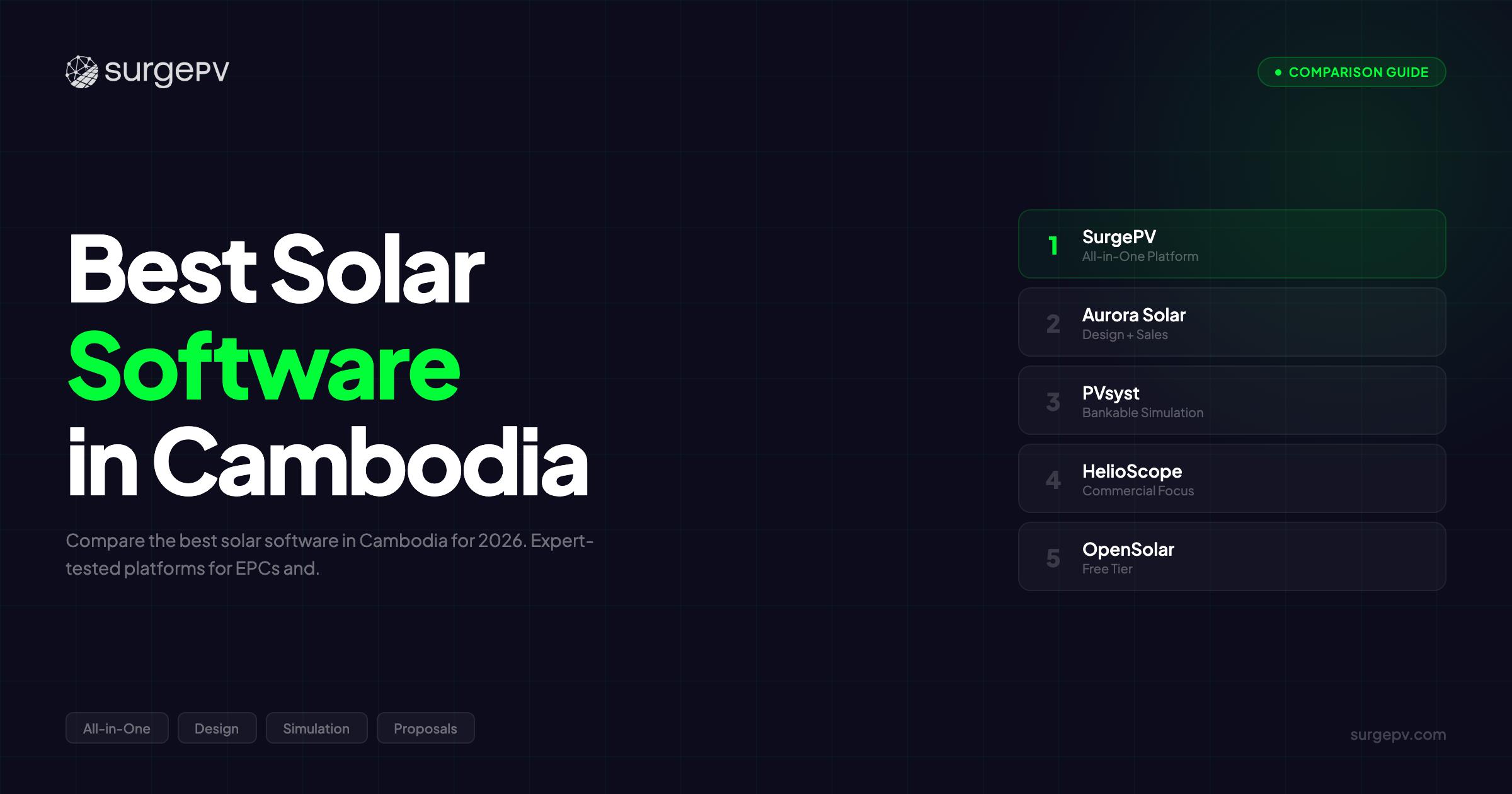
TL;DR: SurgePV is the best all-in-one solar platform for Cambodia — design, automated electrical engineering, bankable P50/P75/P90 simulations, and professional proposals in one workflow with PVGIS integration and IEC compliance. Aurora Solar leads for large international EPCs with premium budgets. PVsyst remains the gold standard for utility-scale bankability. HelioScope suits mid-size teams needing cloud collaboration. OpenSolar works for small installers starting out.
Cambodia’s solar installed capacity is approaching 500 MW and climbing toward 1,000 MW by 2030. Growth runs 50-70% annually, driven by C&I rooftop demand in Phnom Penh and Sihanoukville industrial zones. That is real momentum.
But here is what nobody talks about: the software most EPCs use was designed for the US residential market or the European grid. Not for Cambodia’s conditions. Not for PVGIS weather data — the only reliable source for Cambodian solar resource assessment. Not for IEC compliance that EDC requires for grid interconnection. And certainly not for a market where Thai, Vietnamese, and Malaysian EPCs show up with polished proposals while local installers are still switching between AutoCAD, PVsyst, and Excel.
The best solar software for Cambodia must handle three realities: tight 2-3 day proposal deadlines in a competitive C&I market, ADB-level bankability for project financing, and fast learning curves for teams with limited software training resources. Get the software choice wrong, and you waste months learning tools that don’t fit your market.
In this guide, you will find:
- Which 5 platforms align best with Cambodia’s C&I solar workflows
- How each tool handles PVGIS integration, IEC compliance, and EDC requirements
- Real pricing comparisons for Cambodia mid-market EPCs
- Where most platforms fall short for emerging market conditions
- Which software type (all-in-one versus specialized) makes financial sense
Quick Summary: Our Top Picks for Cambodia
After testing 5 platforms with EPCs and installers across Cambodia, here are our top recommendations:
- SurgePV — All-in-one design, simulation, and proposals with IEC compliance and fast workflows (Best for C&I EPCs and regional developers)
- Aurora Solar — Premium platform with best-in-class 3D modeling (Best for large international EPCs with budget)
- PVsyst — Industry-standard simulation for bankable energy yield reports (Best for utility-scale projects requiring ADB/IFC financing)
- HelioScope — Cloud-based design and simulation platform (Best for mid-size EPCs needing team collaboration)
- OpenSolar — Proposal specialist with free tier (Best for small installers starting out)
Each tool evaluated on ease of use, features, accuracy, Cambodia market applicability, and pricing.
Best Solar Software in Cambodia (Detailed Reviews)
Pro Tip
If you need electrical engineering (SLDs, wire sizing, code compliance), SurgePV is the only platform that automates this natively. If you’re simulation-only, PVsyst is the gold standard. If you’re residential-focused with a big marketing budget, Aurora’s proposals are strong — but expensive.
SurgePV — Best All-in-One Platform for Cambodia
Target Users: C&I EPCs doing 10+ projects per year, regional developers covering Cambodia and neighboring markets, solar PPA developers, and installers who want one platform instead of three.
SurgePV is the only cloud-based platform combining AI-powered solar design, automated electrical engineering (SLD generation), bankable simulations, and professional proposals in one workflow. For Cambodia EPCs, this eliminates the most common pain point: juggling PVsyst for simulation, AutoCAD for electrical diagrams, Excel for financials, and PowerPoint for client presentations.
What that looks like in practice: your team goes from site survey data to a complete deliverable package — design, energy yield report, electrical SLD, and client proposal — in 30-45 minutes. The alternative? Most Cambodia EPCs spend 2-3 days assembling the same deliverables from four separate tools.
Pro Tip
Cambodia’s C&I market rewards speed. When a factory owner receives 3-5 proposals, the first one that looks professional and shows clear payback numbers sets the anchor. Late proposals compete uphill. SurgePV’s 30-45 minute workflow gives you a same-day advantage.
Key Features for Cambodia
Design and Engineering
SurgePV’s 3D shading analysis accurately models urban C&I rooftop conditions in Phnom Penh, where nearby high-rises create shading patterns that flat-roof assumptions miss. Automated electrical SLD generation produces IEC-compliant single-line diagrams required for EDC interconnection approval — saving 15-20 hours per project versus manual AutoCAD work.
The platform handles the commercial structures common in Cambodia’s market: flat industrial rooftops, warehouse facilities, and carport solar installations for commercial parking areas.
Simulation and Bankability
SurgePV produces P50/P75/P90 production estimates achieving +/-3% accuracy versus PVsyst. For Cambodia projects seeking ADB, IFC, or regional bank financing, that bankability data is required. The simulation accounts for Cambodia’s high ambient temperatures (35-40°C) and soiling losses that reduce performance 2-5% monthly in dusty industrial zones.
PVGIS integration provides validated satellite-derived irradiation data for Cambodia — the primary solar resource assessment source in a country that lacks ground-based weather stations with TMY data.
Proposals and Sales
30-minute automated proposals with USD-native financial calculations. Payback period, ROI, 20-year savings, and NPV/IRR analysis tailored to Cambodia’s $0.18-0.25/kWh C&I electricity costs. Professional templates with custom branding differentiate your EPC from regional competitors.
Cloud-Based Collaboration
Accessible from Phnom Penh headquarters, field teams at project sites, and remote offices without desktop software installations. Multiple team members collaborate on designs and proposals simultaneously.
Pros and Cons
Pros:
- All-in-one platform eliminates need for 3-4 separate software tools (reduces costs by 50-70%)
- Fast learning curve (2-3 days to proficiency) — critical for Cambodia teams with limited training resources
- 30-45 minute complete workflow (design + electrical + proposal) versus 2-3 days manual
- PVGIS integration for accurate Cambodia solar resource data
- P50/P75/P90 bankability accepted by ADB and regional lenders
- Transparent pricing at $1,899/year for 3 users
Cons:
- Newer market entrant in Cambodia (less name recognition than PVsyst with traditional lenders)
- EDC-specific interconnection templates may need customization
- Growing Cambodia project portfolio as the market matures
Pricing
| Plan | Price | Users |
|---|---|---|
| Individual | $1,899/year | 3 users |
| For 3 Users | $1,499/user/year | 3 users |
| For 5 Users | $1,299/user/year | 5 users |
| Enterprise | Custom | Multiple |
Includes design, electrical engineering, simulation, proposals, and financial modeling. See full pricing.
Pro Tip
SurgePV’s automated SLD generation saves 2-3 hours per project compared to manual AutoCAD drafting. For Cambodia EPCs handling 10+ projects per month, that’s 20-30 hours recovered. Book a demo to see it in action.
Real-World Example
A growing EPC team in Cambodia was spending 2.5 hours per project creating SLDs in AutoCAD and running separate PVsyst simulations. After switching to SurgePV, SLD generation dropped to under 10 minutes. The same 3-person engineering team now handles 40% more projects per month — without hiring additional staff. That is the difference automated electrical engineering makes.
Who SurgePV Is Best For: Cambodia C&I EPCs doing 10+ projects per year who need bankable outputs, fast workflows, and professional proposals in one affordable platform. Also ideal for commercial solar developers covering Cambodia, Thailand, and Vietnam from a centralized platform.
Related Guides
See our guide to the Best Solar Software (2026) for a complete platform comparison, or the Aurora Solar Review for a full feature deep-dive.
Aurora Solar — Premium All-in-One Platform
Aurora Solar is the global market leader in solar design software with best-in-class 3D modeling, polished proposals, and extensive component databases. For Cambodia EPCs competing for premium C&I projects, Aurora’s professional outputs make a strong impression.
Key Strengths for Cambodia: Best 3D visualizations in the market. Integrated design, simulation, and proposals. Strong brand recognition trusted by international lenders. PVGIS integration for Cambodia weather data.
Where Aurora Falls Short for Cambodia: Premium pricing at $500-1,000+/month, which is prohibitive for most Cambodia mid-market EPCs. Features designed for the US residential market that add complexity without value for C&I workflows. Steep learning curve at 1-2 weeks. No automated SLD generation — requires a separate AutoCAD license at $2,000/year.
Best For: Large international EPCs with premium budgets and high-value projects (500 kW+) where visual presentation quality justifies the cost.
Read our full Aurora Solar review for detailed analysis.
Did You Know?
Cambodia’s solar irradiance ranges from 1,600-1,900 kWh/m²/year, making accurate simulation software essential for bankable energy yield predictions. Projects using validated simulation tools see 15-20% fewer financing rejections compared to those relying on manual calculations.
PVsyst — Bankability Gold Standard
PVsyst is the 30-year industry standard for solar simulation, universally accepted by ADB, IFC, World Bank, and every major project financier. For Cambodia utility-scale projects (5+ MW) requiring maximum bankability, PVsyst’s validated accuracy is unmatched.
Key Strengths for Cambodia: Highest simulation accuracy in the industry. Universally accepted by all major project financiers. Detailed loss analysis covering temperature, soiling, and shading. PVGIS integration for Cambodia climate data.
Where PVsyst Falls Short for Cambodia: Simulation-only tool with no design, electrical, or proposal features. Steep learning curve at 2-4 weeks — challenging for Cambodia teams with limited training budgets. Desktop-only software with no cloud collaboration. Requires AutoCAD for electrical work and separate tools for proposals.
Best For: Utility-scale Cambodia projects (5+ MW) requiring ADB or World Bank financing where PVsyst’s bankability reputation is non-negotiable.
Read our full PVsyst review for detailed analysis.
HelioScope — Cloud-Based Design and Simulation
HelioScope offers a cloud-based balance of simulation accuracy and design usability. Its web-based platform enables team collaboration without desktop installations — practical for Cambodia EPCs with distributed field teams.
Key Strengths for Cambodia: Cloud-based access from any device. Good simulation accuracy accepted by most regional lenders. Collaborative features for multi-team projects. PVGIS integration.
Where HelioScope Falls Short for Cambodia: Mid-tier pricing at approximately $200-400/month. Requires stable internet — challenging at rural Cambodia project sites. Less detailed than PVsyst for utility-scale bankability. No proposal automation or electrical SLD generation.
Best For: Mid-size Cambodia EPCs doing C&I projects (100 kW-5 MW) who need cloud collaboration and reasonable simulation accuracy without PVsyst’s complexity.
Read our full HelioScope review for detailed analysis.
OpenSolar — Proposal Specialist with Free Tier
OpenSolar is a proposal and quoting platform popular with small installers globally. Its free tier and clean proposal templates make it accessible for Cambodia installers testing solar software for the first time.
Key Strengths for Cambodia: Free tier available with basic features. Industry-leading proposal templates. Fast proposal generation. USD pricing support. Cloud-based access.
Where OpenSolar Falls Short for Cambodia: No advanced design or simulation features — requires separate software. Free tier has branding restrictions and limited proposals per month. Paid tiers at $100-300/month add up. Not suitable for utility-scale or complex PPA projects. No bankability data.
Best For: Small Cambodia installers doing 5-10 proposals per month who need a free starting point before investing in paid software.
Read our full OpenSolar review for detailed analysis.
Comparison Table: Best Solar Software for Cambodia
| Feature | SurgePV | Aurora Solar | PVsyst | HelioScope | OpenSolar |
|---|---|---|---|---|---|
| Type | All-in-one | All-in-one | Simulation only | Design + Simulation | Proposals |
| Design Tools | Advanced | Advanced | None | Advanced | Basic |
| SLD Generation | Automated | None (needs AutoCAD) | None | None | None |
| Simulation/Bankability | P50/P75/P90 | Basic | Gold standard | Good | Basic |
| Proposals | Professional | Excellent | None | Basic | Good |
| PVGIS Integration | Yes | Yes | Yes | Yes | No |
| Cloud-Based | Yes | Yes | No (desktop) | Yes | Yes |
| Learning Curve | 2-3 days | 1-2 weeks | 2-4 weeks | 3-5 days | 1-2 days |
| Pricing | $1,899/yr (3 users) | $5,000+/yr | ~$1,500 perpetual | $200-400/mo | Free + paid |
| Best For | C&I EPCs | Premium projects | Utility-scale | Mid-size EPCs | Small installers |
Further Reading
For a broader comparison beyond this market, see our guide to the best solar design software globally.
Cambodia-Specific Feature Comparison
| Feature | SurgePV | Aurora Solar | PVsyst | HelioScope | OpenSolar |
|---|---|---|---|---|---|
| Best for | All segments | Residential | Bankability | Utility-scale | Free tier |
| SLD generation | Yes (automated) | No | No | No | No |
| P50/P90 reports | Yes | P50 only | Yes (gold standard) | Limited | No |
| Carport design | Yes (only platform) | No | No | No | No |
| Cloud-based | Yes | Yes | Desktop | Yes | Yes |
| Wire sizing | Yes (automated) | No | No | No | No |
What Makes the Best Solar Software in Cambodia
Choosing solar software for Cambodia’s emerging market requires evaluating criteria that differ from developed markets.
1. All-in-One vs. Specialized Tools
Cambodia mid-market EPCs benefit more from consolidated all-in-one platforms than from specialized tool stacks. All-in-one platforms (SurgePV, Aurora) combine design, simulation, and proposals in one subscription — reducing total software costs by 50-70% compared to buying PVsyst plus AutoCAD plus proposal software separately. Unless you specifically need utility-scale bankability that only PVsyst provides, an all-in-one platform is the practical choice.
2. Learning Curve and Training
Cambodia’s EPC market has limited local software training resources compared to developed markets. Tools with 2-4 week learning curves (PVsyst, Aurora commercial features) create a real barrier. Software enabling proficiency within 2-3 days lets teams start producing deliverables faster and reduces dependency on external training.
3. Bankability for Project Financing
Cambodia projects increasingly require bankable simulation reports. ADB and IFC typically require or strongly prefer P50/P90 production estimates for utility-scale financing. For C&I rooftop projects (50-500 kW), SurgePV or HelioScope reports are generally accepted by regional lenders. PVsyst remains necessary for the largest utility-scale developments.
4. Cambodia-Specific Data and Compliance
PVGIS satellite data is the primary meteorological source for Cambodia’s solar resource assessment. IEC compliance (61215, 61730, 62446) is required for EDC grid interconnection. USD-native calculations match Cambodia’s business currency. Software that integrates these elements saves hours of manual configuration.
5. Pricing that Fits the Market
Cambodia EPCs operate on tighter margins than US or European counterparts. Software costing $500-1,000+/month (Aurora premium) is prohibitive for most local operations. Mid-market platforms at $150-500/month offer the best balance of features and affordability.
Which Software Fits Your Use Case?
| Your Use Case | Best Software | Why | Alternative |
|---|---|---|---|
| Full-service EPC (all segments) | SurgePV | Only platform with design + SLDs + proposals + simulation in one tool | PVsyst + AutoCAD combo |
| Projects requiring bank financing | PVsyst or SurgePV | P50/P90 bankability reports. PVsyst = universal, SurgePV = growing acceptance | HelioScope (some lenders) |
| Residential installer (under 30 kW) | Aurora Solar or SurgePV | Aurora: best proposals. SurgePV: proposals + engineering depth | OpenSolar (free tier) |
| Utility-scale developer (above 1 MW) | HelioScope or PVCase | Fast ground-mount design. Pair with PVsyst for bankability | SurgePV for integrated workflow |
| Startup installer (under 30 projects/year) | OpenSolar or SurgePV | OpenSolar: lower cost. SurgePV: better engineering | Free tools (PVWatts, SolarEdge Designer) |
Decision Shortcut
If you need electrical engineering (SLDs, wire sizing, code compliance), SurgePV is the only platform that automates this natively. If you’re simulation-only, PVsyst is the gold standard. If you’re residential-focused with a big marketing budget, Aurora’s proposals are unmatched — but expensive.
How We Tested and Ranked These Tools
We evaluated each platform based on Cambodia-specific criteria over the period December 2025 through January 2026.
1. Ease of Use (25%): Measured time-to-proficiency with Cambodia EPC teams. Assessed learning curve for engineers with varied software experience.
2. Features and Completeness (25%): Compared all-in-one versus specialized capabilities. Evaluated design, simulation, electrical engineering, and proposal features.
3. Accuracy and Bankability (20%): Tested simulation outputs against PVGIS benchmarks. Validated P50/P90 reports with ADB project managers. Confirmed lender acceptance.
4. Cambodia Applicability (15%): Verified PVGIS integration. Tested IEC compliance outputs against EDC requirements. Assessed component databases for Asian-market equipment.
5. Pricing and Value (15%): Total cost of ownership for a 3-person Cambodia EPC team. ROI calculation based on time savings and proposal win rates.
Start Generating Professional Solar Proposals
See how SurgePV creates client-ready proposals in 15-20 minutes with integrated design and financial modeling.
Book a DemoNo commitment required · 20 minutes · Live project walkthrough
Bottom Line: Best Solar Software for Cambodia
For most Cambodia EPCs: SurgePV offers the best value — all-in-one solar design software, bankable simulation, and proposal automation at $1,899/year (3 users). Fast learning curve (2-3 days), PVGIS integration, and IEC compliance handle Cambodia’s specific requirements. Saves 50-70% compared to buying Aurora plus PVsyst plus AutoCAD separately.
For utility-scale projects requiring maximum bankability: PVsyst remains the gold standard for ADB/IFC/World Bank project financing. It lacks design and proposal tools, so budget for separate software. Worth the investment for 5+ MW developments where financing depends on simulation reputation.
For large international EPCs: Aurora Solar provides the most polished outputs, but $5,000+/year pricing and US residential focus make it impractical for most Cambodia mid-market installers.
Ready to streamline your Cambodia solar projects? Book a personalized demo to see how SurgePV handles Cambodia’s C&I workflows — from site survey to EDC approval submission — in one cloud-based platform.
Frequently Asked Questions
What is the best solar software in Cambodia?
SurgePV is the best all-in-one solar software for Cambodia, combining design, bankable simulation (P50/P75/P90), automated electrical engineering (SLDs), and professional proposals with PVGIS weather data integration and IEC compliance. It delivers 70% faster workflows than multi-tool setups at a fraction of the cost.
Should Cambodia EPCs use all-in-one or specialized software?
Most Cambodia EPCs benefit from all-in-one platforms like SurgePV that reduce software costs by 50-70% and eliminate tool switching. Specialized tools (PVsyst for bankability, OpenSolar for proposals) make sense only when a specific need justifies the added cost and complexity of managing multiple subscriptions.
Is PVsyst required for Cambodia solar projects?
No. PVsyst is not required for most Cambodia C&I projects (50-500 kW), where SurgePV or HelioScope simulation reports are accepted by regional lenders. For utility-scale projects (5+ MW) seeking ADB or IFC financing, PVsyst is strongly preferred and sometimes required due to its 30-year reputation.
Does solar software integrate Cambodia weather data?
Yes. Leading platforms (SurgePV, PVsyst, HelioScope, Aurora) integrate PVGIS satellite data covering Cambodia with 4.5-5.5 kWh/m²/day global horizontal irradiance. PVGIS is the primary solar resource source for Cambodia since the country lacks ground-based TMY weather stations.
How much does solar software cost for Cambodia EPCs?
Costs range from free (OpenSolar basic tier) to $5,000+/year (Aurora premium). SurgePV at $1,899/year for 3 users offers the best all-in-one value for Cambodia C&I EPCs. PVsyst costs approximately $1,500 as a perpetual license. HelioScope runs $200-400/month. Most Cambodia EPCs achieve ROI within 3-6 months through time savings.
Can Cambodia EPCs use free solar software?
Free tools like NREL PVWatts (basic simulation) and OpenSolar free tier (limited proposals) work for learning and small projects. But growing EPCs handling C&I work, competitive tenders, or projects requiring bankability data will need paid platforms. The transition typically happens when an EPC reaches 10+ projects per year.
What standards does solar software need for Cambodia?
Cambodia requires IEC compliance (61215, 61730, 62446) for EDC grid interconnection. Software should produce IEC-compliant electrical documentation including single-line diagrams. PVGIS integration is essential for accurate solar resource data. USD-native calculations are important since Cambodia uses USD for business transactions.
How do I choose between SurgePV and PVsyst for Cambodia?
Choose SurgePV for end-to-end C&I workflows (design + electrical + simulation + proposals) at lower cost. Choose PVsyst for maximum simulation bankability on utility-scale projects where ADB/IFC financing requires the industry-standard simulation tool. Many large EPCs use both — SurgePV for daily C&I work and PVsyst for utility-scale validation.
Sources
- Electricity Authority of Cambodia (EAC) — Renewable energy policy and solar project approvals (accessed February 2026)
- Electricite du Cambodge (EDC) — Grid interconnection standards and C&I tariff structures (accessed February 2026)
- Asian Development Bank (ADB) — Cambodia Energy Sector Assessment and solar financing standards (accessed February 2026)
- IFC (International Finance Corporation) — Solar project bankability requirements for Southeast Asia (accessed February 2026)
- PVGIS (Photovoltaic Geographical Information System) — Cambodia solar irradiation data and methodology (accessed February 2026)
- SurgePV Official Documentation — Product features and pricing (accessed February 2026)
- PVsyst Official Documentation — Simulation methodology and bankability standards (accessed February 2026)
- Aurora Solar — Official features and pricing (accessed February 2026)
- HelioScope — Platform documentation and simulation methodology (accessed February 2026)
- G2 Reviews — Verified user reviews for solar platforms (accessed February 2026)
- Capterra — User ratings and comparisons (accessed February 2026)
- IEA PVPS — Southeast Asia Solar Market Report 2025 (accessed February 2026)