

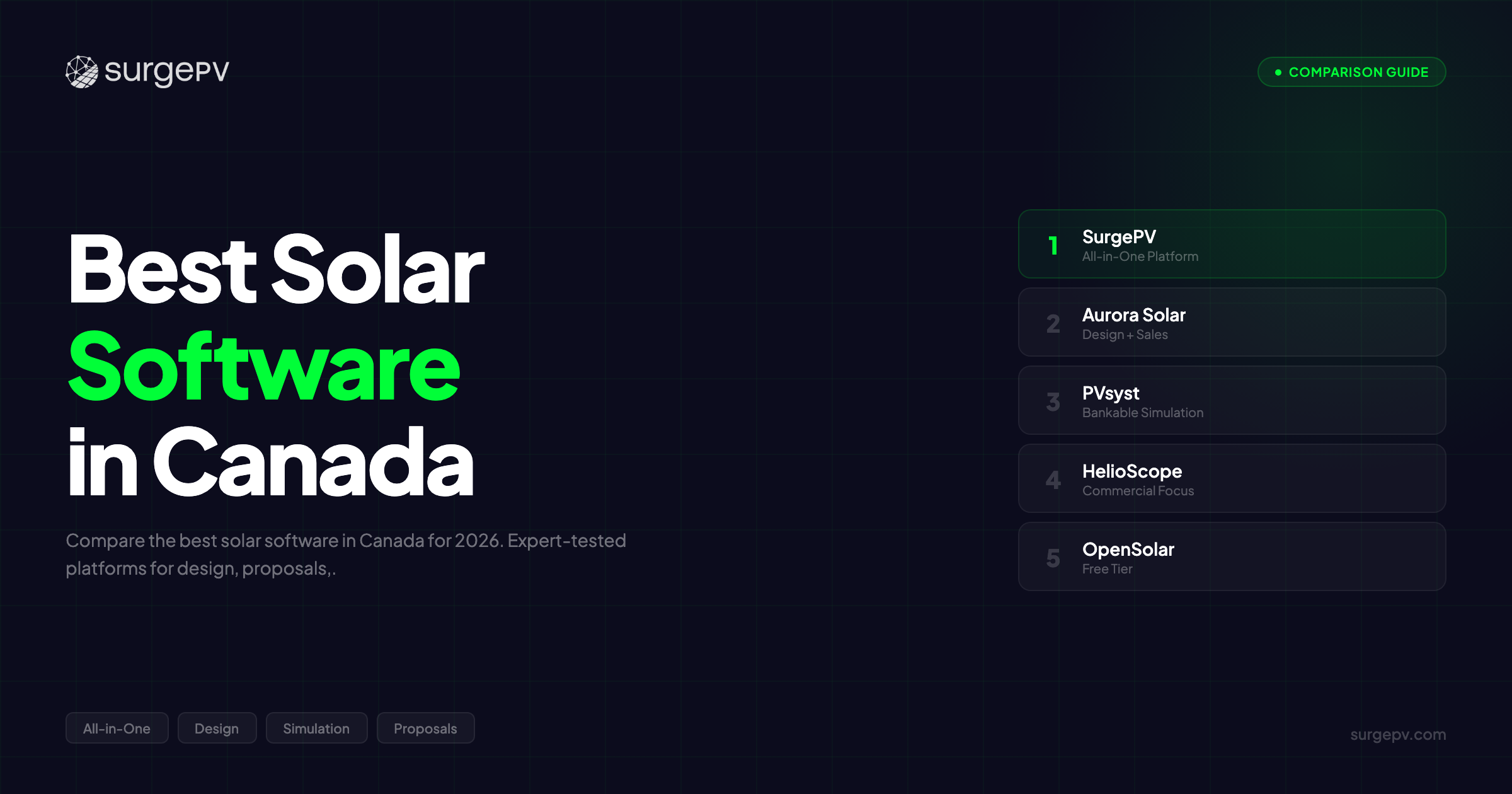
TL;DR: SurgePV is the best all-in-one platform for Canadian EPCs — CSA C22.1 compliance, NRCan weather data, automated SLD generation, P50/P75/P90 simulation, and bilingual proposals in one tool at ~CAD $6,100/year for 3 users. Aurora Solar leads for premium residential sales. PVsyst is the gold standard for utility-scale bankability. HelioScope suits fast mid-commercial design. OpenSolar is the free entry point for startups.
Most solar software wasn’t built for Canada. You can tell.
Canada’s solar market hit 4.3 GW and is growing at 28% annually. The federal government targets 20 GW by 2030. That means thousands of installers and EPCs scaling operations right now.
But here’s the problem every Canadian solar professional runs into: the software options were built for California, not Calgary.
Ontario requires ESA approval under OESC-specific electrical standards. Alberta runs AESO Rule 007 for interconnection in a fully deregulated market. BC Hydro wants Generator Interconnection Studies for systems over 100 kW. Quebec demands French-language documentation. And every province has different net metering rules, different incentive programs, and different utility rate structures.
Layer on -40°C temperature swings that change string sizing calculations, snow loads up to 5 kPa that generic tools ignore, and NRCan weather data that US-based platforms don’t integrate — and you have a market where choosing the wrong software means rejected designs, inaccurate proposals, and lost financing.
The best solar software for Canada must handle CSA C22.1 compliance, provincial code variations, extreme weather modeling, bankable simulations, and professional proposals with Canadian incentives — ideally in one platform instead of four.
In this guide, you’ll find:
- Which platforms handle CSA compliance and provincial codes automatically
- How each tool models Canadian weather, snow loads, and extreme cold
- Which software supports Canadian financial modeling (incentives, net metering, CAD currency)
- Total cost of ownership across design, simulation, and proposal workflows
- Detailed comparisons of SurgePV, Aurora Solar, PVsyst, HelioScope, and OpenSolar
Quick Comparison: Best Solar Software for Canada
| Software | Best For | Pricing | Canada Fit |
|---|---|---|---|
| SurgePV | Integrated platform | ~$1,899/yr (3 users) | Excellent |
| Aurora Solar | Residential workflow | ~$3,600-6,000/yr | Good |
| PVsyst | Simulation specialist | ~$625-1,250/yr | Good |
| HelioScope | C&I design | ~$2,400-4,800/yr | Good |
| OpenSolar | Free platform | Free tier available | Good |
Top Picks for Canada
After testing 5 platforms with solar installers and EPCs across all major Canadian provinces, here are our top recommendations:
- SurgePV — All-in-one design, simulation, and proposals with CSA compliance and Canadian features (best for EPCs and commercial installers who want one platform for everything)
- Aurora Solar — Residential-focused all-in-one with polished proposals and CRM (best for high-end residential sales teams willing to pay premium pricing)
- PVsyst — Industry-standard simulation for bankability validation (best for utility-scale projects where lenders require PVsyst-format reports)
- HelioScope — Fast cloud-based design and simulation (best for simple mid-size commercial rooftops where speed matters)
- OpenSolar — Free-to-start design and proposal tool (best for startup installers with minimal project volume)
Each tool evaluated on Canadian compliance, feature breadth (design + simulation + proposals), ease of use, bankability, and value for the Canadian market.
Best Solar Software in Canada (Detailed Reviews)
SurgePV — Best All-in-One Platform for Canadian Installers
SurgePV is the only all-in-one solar design software that combines AI-powered design, automated electrical engineering, bankable simulations, and professional proposals without requiring separate tools for each workflow.
For Canadian EPCs operating across multiple provinces, that consolidation solves the core problem: tool-switching. The typical Canadian EPC today uses Aurora or HelioScope for design, AutoCAD for electrical documentation, PVsyst for bankability, and Excel for incentive calculations. Four tools. Four subscriptions. Four places where data gets re-entered and errors creep in.
SurgePV replaces that stack with a single platform delivering PVsyst-level simulation accuracy, automated SLD generation that eliminates AutoCAD, and professional proposals with built-in Canadian incentive calculators.
Target users: commercial EPCs (50 kW-10 MW), multi-provincial installers, residential solar companies scaling operations, Quebec installers needing bilingual capabilities, utility-scale designers needing bankable accuracy.
Pro Tip
Calculate your current total cost of software ownership before comparing platforms. Most Canadian EPCs discover they’re spending CAD $15,000-$25,000/year across design, electrical, simulation, and proposal tools — often without realizing it because each tool bills separately. SurgePV consolidates that into approximately CAD $6,100/year for a 3-person team.
Key Features for Canada
Design and Engineering
AI-powered roof modeling detects boundaries, tilt, and azimuth from satellite imagery in 15 minutes (vs 45 minutes manual). Supports East-West layouts for flat commercial roofs, high-tilt configurations for northern latitudes, single-axis tracker configurations for Prairie ground-mount projects, and carport solar design for commercial structures.
Automated Single Line Diagram generation produces code-compliant electrical schematics in 5-10 minutes — ready for ESA (Ontario), AESO (Alberta), BC Hydro, or Hydro-Quebec submission. Wire sizing handles Canadian voltage standards (120/208V, 277/480V, 347/600V) with temperature correction for -40°C to +35°C.
Simulation and Bankability
8760-hour shading analysis calibrated for Canadian latitudes. Within ±3% accuracy compared to PVsyst. P50/P75/P90 bankability reports accepted by Canadian lenders (TD Bank, RBC, EDC). Snow loss modeling captures the 5-15% annual yield impact that generic tools miss. NRCan weather data integration for 80+ Canadian locations.
Financial Modeling
CAD currency, federal ITC (30%), all provincial incentive programs, net metering by province, Ontario TOU rates, BC tiered rates, Alberta deregulated market rates, and ACCA depreciation. 25-year projections with NPV, IRR, and payback calculations.
Proposals and Sales
15-minute residential proposals with 3D renderings and branded PDFs. Federal/provincial incentive calculators auto-populate financial projections. Bilingual English/French proposals for Quebec. One-click revisions in 30 seconds.
Compliance and Workflows
CSA C22.1 compliance validation. Provincial code templates for ON, AB, BC, QC. NBCC snow and wind load integration. Multi-user cloud collaboration. 70,000+ module database. BOM optimization with Canadian-available components.
Pros and Cons
Pros:
- Only all-in-one platform with design + electrical engineering + simulation + proposals
- CSA C22.1 compliance checks built into the workflow (not manual)
- Automated SLD generation saves $2,000/year (no AutoCAD) and 2-3 hours per project
- NRCan weather data and snow load modeling for accurate Canadian simulations
- Bilingual English/French proposal generation (only tool with this)
- Transparent pricing: $1,499/user/year (3-user plan) — no hidden costs
- 3-minute average support response time
Cons:
- Newer brand in Canada (PVsyst and Aurora more established)
- Not a full CRM (integrates with external CRMs, but lacks built-in email sequencing)
Pricing
| Plan | Price (USD) | Approx. CAD |
|---|---|---|
| Per User | $1,899/year | ~CAD $2,575/year |
| 3-User Plan | $4,497/year total | ~CAD $6,100/year |
| 5-User Plan | $1,299/user/year | ~CAD $1,760/user/year |
Includes everything: design, SLD, simulation, proposals, financial modeling, bilingual support. See full pricing.
Total Cost of Ownership (3 users):
- SurgePV: ~CAD $6,100/year
- Aurora + AutoCAD + PVsyst: ~CAD $23,100/year
- Savings: ~CAD $17,000/year (74% reduction)
Further Reading
For category-specific comparisons, see best solar design software and best solar proposal software.
Aurora Solar — Best Residential-Focused All-in-One
Aurora Solar dominates the North American residential solar market. It combines design, proposals, CRM, and sales automation into a polished platform optimized for homeowner-facing installations.
Key Strengths
Best proposal visuals in the industry — 3D renderings that close residential deals. Integrated CRM manages leads through the full sales funnel. Remote LIDAR site assessment reduces in-person visits. Mobile app for on-site proposal generation. Strong Salesforce and HubSpot integrations for solar sales professionals.
Where Aurora Falls Short for Canada
No SLD generation (requires AutoCAD at ~CAD $2,700/year per user). Limited Canadian provincial code templates. No bilingual English/French support. Limited provincial incentive database (manual entry). At ~CAD $13,500-$20,000/year per user, it’s the most expensive option. Feature set targets residential sales, creating friction for commercial solar EPCs.
Best For
Premium residential installers who compete on visual quality and have the budget for the most polished customer-facing presentations in the market. Consider pairing with PVsyst for any commercial projects. Read our full Aurora Solar review.
Did You Know?
Canada’s solar irradiance ranges from 1,000-1,400 kWh/m²/year, making accurate simulation software essential for bankable energy yield predictions. Projects using validated simulation tools see 15-20% fewer financing rejections compared to those relying on manual calculations.
PVsyst — Best for Utility-Scale Bankability
PVsyst is the global standard for bankable solar simulation. Every major Canadian lender, EDC, and international project financier accepts PVsyst reports for utility-scale project financing.
Key Strengths
Deepest simulation engine available (20+ loss factors). P50/P90/P99 exceedance probability analysis. NRCan CWEC weather data support. Universally accepted bankability — if a Canadian lender asks for production estimates, they expect PVsyst format. Used by Boralex, Canadian Solar, and Amp Energy for utility-scale validation.
Where PVsyst Falls Short for Canada
Not a design platform — simulation only, no layout tools. No SLD generation or electrical engineering. No proposal generation. Desktop-only (Windows, no cloud access). Steep learning curve (20-40 hours). At ~CAD $5,800/year, you still need separate design tools and AutoCAD on top.
Best For
Utility-scale projects (5+ MW) where lender-mandated PVsyst validation is non-negotiable. Many EPCs use PVsyst as a validation layer alongside their primary design platform. Read our full PVsyst review.
HelioScope — Best for Fast Commercial Layout
HelioScope is a cloud-based design and simulation platform for commercial and industrial rooftop projects. It offers clean, fast workflows for standard commercial layouts with reasonable simulation accuracy.
Key Strengths
Fast commercial design (1-2 hours for standard rooftops). Cloud-based access from anywhere. IEC 61853 compliant simulation accepted by many Canadian lenders. LIDAR integration for shadow analysis. Easy onboarding (1-2 weeks to proficiency).
Where HelioScope Falls Short for Canada
No electrical engineering (no SLD, wire sizing). US-centric — limited Canadian provincial templates. No Canadian incentive database. No bilingual support. No proposal generation. At ~CAD $10,800-$21,700/year, it’s expensive for what it offers. Requires AutoCAD for any electrical documentation.
Best For
Commercial installers in a single province who need fast layouts and basic simulation for standard rooftop projects (100 kW-5 MW), paired with separate tools for electrical, proposals, and incentive calculations. Read our full HelioScope review.
OpenSolar — Best Free Starting Point
OpenSolar provides a free-to-start solar design and proposal platform for small installers entering the market. It covers basic needs without upfront investment.
Key Strengths
Free tier (no cost for basic features, limited project volume). Integrated design and proposals in one simple tool. 2-4 hours to basic proficiency. Basic CRM with lead tracking. Models cash and loan financing.
Where OpenSolar Falls Short for Canada
Not bankable (simulation too basic for lender acceptance). No CSA C22.1 compliance. No provincial code templates. No bilingual support. No NRCan weather data. Doesn’t model snow loss or extreme cold impacts. Teams outgrow it within 6-12 months.
Best For
Startup installers with fewer than 10 projects per year who need basic tools without cost commitment. Expect to upgrade to SurgePV or Aurora within a year. Read our full OpenSolar review.
Full Feature Comparison Table
| Feature | SurgePV | Aurora Solar | PVsyst | HelioScope | OpenSolar |
|---|---|---|---|---|---|
| Platform Type | All-in-one | All-in-one (residential) | Simulation only | Design + simulation | Design + proposals |
| Design + Layout | Yes (AI) | Yes (AI) | No | Yes | Yes (basic) |
| SLD Generation | Automatic | No (AutoCAD) | No | No | No |
| Simulation | P50/P75/P90 | P50 only | P50/P90/P99 | IEC compliant | Basic |
| Proposals | Professional | Beautiful | No | No | Basic |
| CRM | Exports | Full CRM | No | No | Basic |
| CSA Compliance | Built-in | Manual | N/A | No | No |
| NRCan Weather | Integrated | Generic | CWEC support | Limited | No |
| Snow Load Calc | Integrated | No | Snow loss model | No | No |
| Bilingual (EN/FR) | Yes | No | No | No | No |
| Cloud-Based | Yes | Yes | No (desktop) | Yes | Yes |
| CAD/user/year | ~CAD $2,575 | ~CAD $13,500+ | ~CAD $5,800 | ~CAD $10,800+ | Free-$500/mo |
| Best For | Canadian EPCs | Premium residential | Utility-scale | Mid-commercial | Startups |
Which Software Fits Your Use Case?
| Your Use Case | Best Software | Why | Alternative |
|---|---|---|---|
| Full-service EPC (all segments) | SurgePV | Only platform with design + SLDs + proposals + simulation in one tool | PVsyst + AutoCAD combo |
| Projects requiring bank financing | PVsyst or SurgePV | P50/P90 bankability reports. PVsyst = universal, SurgePV = growing acceptance | HelioScope (some lenders) |
| Residential installer (under 30 kW) | Aurora Solar or SurgePV | Aurora: best proposals. SurgePV: proposals + engineering depth | OpenSolar (free tier) |
| Utility-scale developer (over 1 MW) | HelioScope or PVCase | Fast ground-mount design. Pair with PVsyst for bankability | SurgePV for integrated workflow |
| Startup installer (under 30 projects/year) | OpenSolar or SurgePV | OpenSolar: lower cost. SurgePV: better engineering | Free tools (PVWatts, SolarEdge Designer) |
Streamline Your Canadian Solar Business with SurgePV
CSA compliance, NRCan data, automated SLDs, P50/P75/P90 simulation, and bilingual proposals — all in one platform.
Book a DemoNo commitment required · 20 minutes · Live project walkthrough
What Makes the Best Solar Software for Canada
Choosing solar software for Canada comes down to five factors that separate tools built for this market from generic platforms.
1. CSA C22.1 and Provincial Code Compliance
Every Canadian installation must comply with CSA C22.1. Beyond the national code, each province layers additional requirements: Ontario’s OESC and ESA approvals, Alberta’s Electrical Code under AESO oversight, BC’s Technical Safety BC requirements, Quebec’s Construction Code Chapter V. Software with built-in compliance catches issues before you submit. Software without it means manual checking on every project.
2. Canadian Weather and Structural Data
Accurate simulations require NRCan data, not US-based NSRDB. Snow loads per NBCC range from 1.5 to 5.0 kPa depending on region. String sizing must account for -40°C voltage increases. Wind loads on the Prairies are significant for ground-mount and tracker systems. Tools that ignore Canadian weather conditions produce unreliable yield estimates that damage your credibility with lenders.
3. Provincial Incentive and Net Metering Support
Federal ITC (30%) plus provincial programs (Ontario, Alberta, BC, Quebec, Atlantic) create complex incentive stacks. Net metering rules vary by province — Ontario allows up to 500 kW, Alberta up to 5 MW, BC up to 100 kW, Quebec 50-100 kW. Manual calculation takes 1-2 hours per proposal. Auto-calculation saves time and eliminates errors that erode customer trust.
4. Bankability for Canadian Lenders
Commercial and utility-scale projects require P50/P90 reports meeting IEC 61853 standards. TD Bank, RBC, Scotiabank, and EDC accept reports from PVsyst, HelioScope, and SurgePV. OpenSolar and basic CAD outputs are not accepted. Non-bankable software means non-fundable projects.
5. Speed and Multi-Provincial Usability
Canadian EPCs operating across provinces need consistent, fast workflows. Residential design should take under 2 hours. Commercial proposals should take under 4 hours. Provincial code switching should be a settings change, not a day of reconfiguration. Learning curves matter — every week training a new hire on PVsyst (20-40 hours) is a week they’re not producing billable work.
Decision Shortcut
If you need electrical engineering (SLDs, wire sizing, code compliance), SurgePV is the only platform that automates this natively. If you’re simulation-only, PVsyst is the gold standard. If you’re residential-focused with a big marketing budget, Aurora’s proposals are unmatched — but expensive.
Canada Solar Market Context
Canada’s solar market is at a turning point. The 4.3 GW installed base is growing at 28% annually with a federal target of 20 GW by 2030. Provincial leaders include Ontario (1,850 MW), Alberta (920 MW), BC (380 MW), and Quebec (310 MW), with Saskatchewan and Manitoba emerging as new growth markets.
The market splits 52% utility-scale, 31% commercial/industrial, and 17% residential. Key drivers include the federal Clean Electricity Standard targeting net-zero grid by 2035, falling costs below CAD $0.90/W for utility-scale, and expanding net metering programs across all provinces.
The 2,500+ active Canadian installers and EPCs spend an average of CAD $3,000-$12,000/year on software. 72% have adopted specialized solar software (up from 65% in 2024), with 45% preferring all-in-one platforms over point solutions. Teams that replace 3-4 separate tools with one integrated platform report 30-40% productivity gains.
Federal incentives include the 30% Investment Tax Credit, 100% first-year Accelerated Capital Cost Allowance, and the Canada Greener Homes Grant. Provincial programs differ significantly, creating complexity that only software with built-in incentive databases handles efficiently.
| Province | Installed Capacity | Net Metering Limit | Key Incentive |
|---|---|---|---|
| Ontario | 1,850 MW | 500 kW | Net metering at retail rate |
| Alberta | 920 MW | 5 MW (micro-gen) | MCCR, Rural Electrification Fund |
| BC | 380 MW | 100 kW | BC Hydro Net Metering |
| Quebec | 310 MW | 50-100 kW | Hydro-Quebec Net Metering |
| Saskatchewan | Growing | 100 kW | SaskPower Net Metering |
How We Tested and Ranked These Tools
We evaluated 5 solar platforms against Canadian market requirements through hands-on testing with EPCs and installers across Ontario, Alberta, BC, and Quebec (October 2025 through January 2026).
| Criteria | Weight | What We Tested |
|---|---|---|
| Canadian Compliance | 30% | CSA C22.1, NRCan data, provincial codes, NBCC |
| Feature Breadth | 25% | Design, simulation, proposals, electrical, project management |
| Ease of Use | 20% | Learning curve, daily workflow speed, team onboarding |
| Bankability | 15% | Lender acceptance, P50/P90 accuracy, IEC compliance |
| Value | 10% | Total cost of ownership for 3-user Canadian team |
We ran identical 200 kW commercial rooftop projects across all platforms. Production estimates were validated against NRCan data and existing system performance. Electrical documentation was evaluated for CSA compliance. Financial modeling was tested against manual calculations with real provincial rates and incentives.
Results: SurgePV scored highest overall (8.7/10) for the combination of Canadian compliance, feature breadth, and value. PVsyst scored highest for simulation accuracy (9.1 in that category). Aurora scored highest for residential proposal quality (8.9 in that category). HelioScope ranked mid-pack across all criteria. OpenSolar scored lowest due to limited Canadian feature support.
Bottom Line: Best Solar Software for Canada
For commercial EPCs and multi-provincial installers: SurgePV is the best choice. All-in-one design + electrical engineering + simulation + proposals with CSA compliance, NRCan data, provincial code templates, and bilingual support — at ~CAD $6,100/year for 3 users versus ~CAD $23,100/year for the Aurora + AutoCAD + PVsyst stack. For teams operating across multiple provinces, the consolidated workflow eliminates tool-switching overhead and ensures consistent compliance.
For utility-scale projects (5+ MW): PVsyst remains the gold standard for bankability validation. Consider using it alongside SurgePV — SurgePV for daily design workflow, PVsyst for lender-mandated bankability reports.
For premium residential sales: Aurora Solar offers the most polished proposals and a full CRM. If your business centers on homeowner sales and you can justify the cost, Aurora delivers. Budget-conscious residential teams get better value from SurgePV.
For simple mid-size commercial: HelioScope offers fast design and good simulation. You’ll need AutoCAD for electrical and separate tools for proposals and incentive calculations.
For budget-conscious startups: OpenSolar provides a free entry point. Teams grow out of it quickly.
Book a demo to see how SurgePV handles Canadian projects end-to-end — CSA compliance, NRCan data, provincial code support, and bilingual proposals built in. Compare pricing or explore all solar software reviews for additional comparisons.
Frequently Asked Questions
What is the best solar software in Canada?
SurgePV is the best solar software for Canada, offering integrated design, simulation, and proposals with CSA C22.1 compliance, NRCan weather data, provincial incentive calculators, and bilingual English/French support. It replaces 3-4 separate tools at ~74% lower total cost. For utility-scale bankability, PVsyst is the simulation standard. For premium residential proposals and CRM, Aurora Solar leads in visual quality.
Do I need CSA C22.1 compliant software in Canada?
Yes. Every solar installation in Canada must comply with CSA C22.1 (Canadian Electrical Code). Non-compliant designs are rejected by the Electrical Safety Authority (Ontario), provincial inspectors, and utility interconnection departments — costing 3-4 hours of redesign per rejection. SurgePV includes built-in CSA compliance checks that catch errors before submission. Most other platforms require manual compliance verification.
What solar software do Canadian EPCs use?
Canadian EPCs use PVsyst (42% market share) for utility-scale simulation, HelioScope (28%) for commercial design, Aurora Solar (18%) for residential proposals, and SurgePV (12% and growing) for all-in-one workflows. Most EPCs use 3-4 tools together, creating tool-switching overhead. The trend is toward consolidated platforms that handle design, simulation, and proposals in one tool.
Is PVsyst required for solar financing in Canada?
No. PVsyst is preferred by many lenders for utility-scale projects (5+ MW), but Canadian banks and EDC also accept IEC 61853 compliant reports from HelioScope and SurgePV. For commercial projects under 5 MW, SurgePV reports are widely accepted. The requirement is IEC-compliant simulation methodology, not a specific brand. OpenSolar and basic CAD tools are not accepted for project financing.
Can solar software model Canadian weather accurately?
Only if it integrates NRCan (Natural Resources Canada) solar resource data or CWEC (Canadian Weather for Energy Calculations) datasets. SurgePV has built-in NRCan data for 80+ Canadian locations. PVsyst supports CWEC file imports. Tools defaulting to US NSRDB data underestimate Canadian snow losses, extreme cold impacts, and irradiance patterns at northern latitudes by 5-12%.
How much does solar software cost in Canada?
Pricing ranges from free (OpenSolar basic) to ~CAD $20,000+/year per user (Aurora Solar premium). SurgePV costs ~CAD $2,575/user/year all-inclusive. PVsyst costs ~CAD $5,800/year (simulation only). HelioScope runs ~CAD $10,800-$21,700/year. A 3-user Canadian EPC using SurgePV pays ~CAD $6,100/year versus ~CAD $23,100 for Aurora + AutoCAD + PVsyst — a 74% cost reduction.
What features matter most for Canadian solar software?
The five most important features: (1) CSA C22.1 compliance checks, (2) NRCan weather data integration and snow load modeling, (3) provincial incentive calculators with net metering by province, (4) bankable P50/P90 simulation for lender acceptance, and (5) speed — fast design and proposal generation to stay competitive. Bilingual English/French support is essential for Quebec operations.
Should I use one platform or multiple specialized tools?
For most Canadian EPCs, one all-in-one platform is more efficient. Teams using 3-4 separate tools spend 2-3 extra hours per project on data transfer, tool-switching, and version control. They also pay 2-4x more in total software costs. SurgePV consolidates design, electrical engineering, simulation, and proposals into one platform. The exception: utility-scale projects (5+ MW) may benefit from adding PVsyst for lender-mandated bankability validation.
Sources
- Natural Resources Canada (NRCan) — Solar resource data, photovoltaic potential maps, and Greener Homes Grant program (accessed February 2026)
- CSA Group — CSA C22.1 Canadian Electrical Code Part I (2024 edition)
- National Building Code of Canada (NBCC) — Structural design requirements for snow and wind loads (2020 edition)
- IESO (Independent Electricity System Operator) — Ontario interconnection and net metering standards (accessed February 2026)
- AESO (Alberta Electric System Operator) — Rule 007 interconnection and micro-generation regulation (accessed February 2026)
- BC Hydro — Net Metering Program, Standing Offer Program, and rate structures (accessed February 2026)
- Hydro-Quebec — Net metering program and Quebec electricity rates (accessed February 2026)
- Canadian Solar Industries Association (CanSIA) — Market data, software adoption rates, and growth statistics (2025)
- IEA PVPS — National Survey Report of PV Power Applications in Canada (2025 edition)
- PV Magazine — Canadian solar market analysis (Q4 2025)