

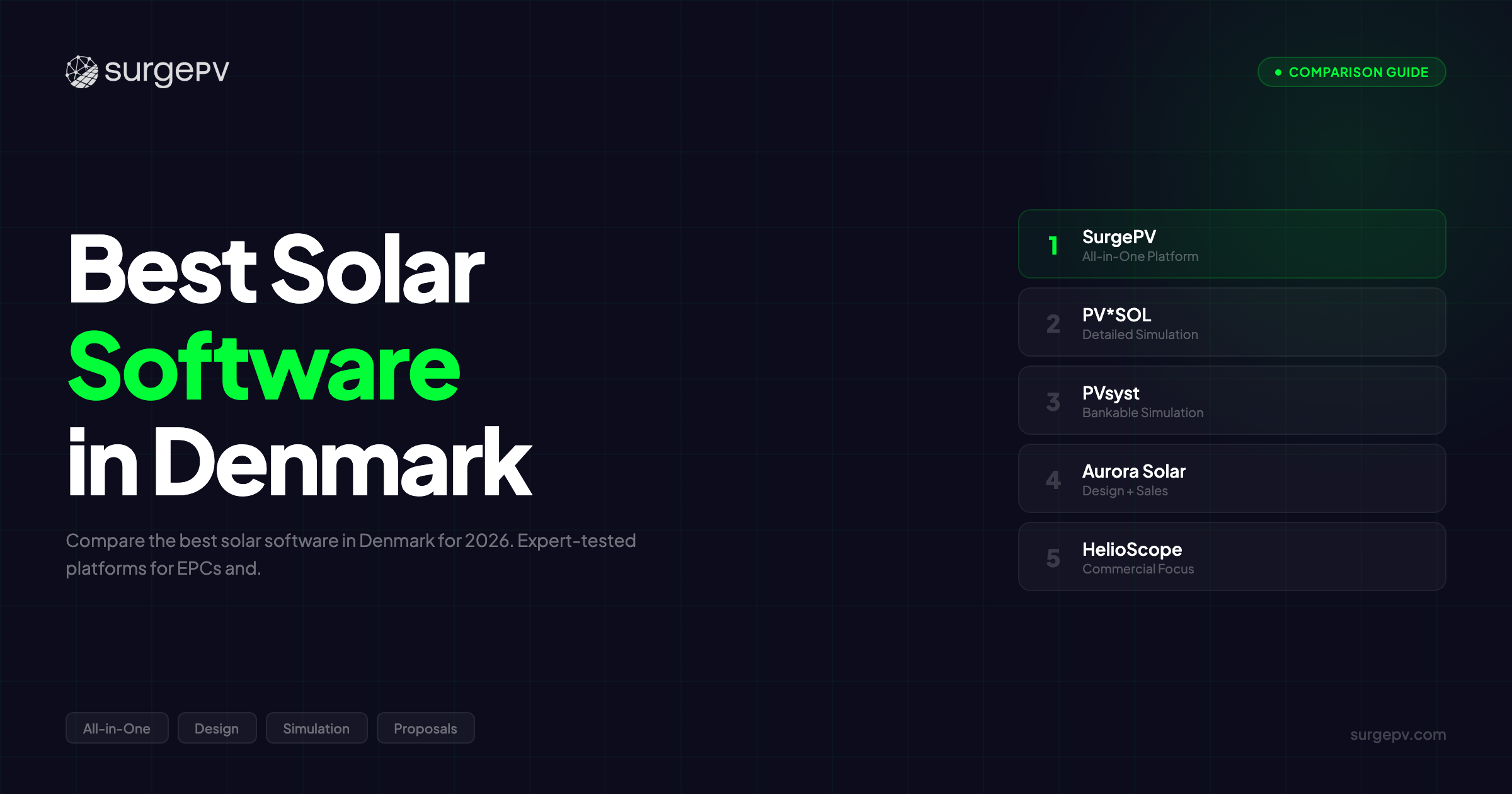
TL;DR: SurgePV is the best all-in-one solar software for Denmark — automated SLD generation for EN 50549 compliance, P50/P75/P90 bankable simulations, native carport design, and professional proposals at $1,899/year for 3 users. PV*SOL leads for Danish-language support and Nordic market presence. PVsyst remains the bankability gold standard for utility-scale projects above 5 MW.
Denmark’s solar market has hit an inflection point. Over 10.8 GW installed and still growing 25-30% annually — with utility-scale and commercial C&I projects leading the charge (IEA PVPS Denmark National Survey). The government’s 2030 target of 8 TWh in solar generation means the pipeline will only get bigger. For EPCs and installers, that means more projects, tighter timelines, and higher stakes on every bid.
Finding the best solar software in Denmark is harder than it should be. Most tools were built for sunnier, simpler markets. They don’t handle Denmark’s EN 50549 grid codes properly, struggle with accurate shading at 55-57 degrees North, and force you to stitch together two or three separate platforms just to get from design to proposal. At $60-80/hour Danish labor costs — the highest in the EU — that tool-switching adds up fast.
Whether you need design software, bankable simulations, proposal tools, or all three in one platform, the right choice depends on your project mix, team size, and budget. A residential installer doing 50 kW rooftops needs a very different tool from a utility-scale developer chasing Danske Bank financing on a 20 MW ground-mount.
We tested 5 leading solar software platforms for the Danish market, evaluating each across design, simulation, electrical engineering, proposals, and pricing.
In this guide, you’ll learn:
- Which platform covers the full Danish workflow — from design through proposals — in one tool
- How pricing compares (from ~$1,500/year to over $6,800/year including required add-ons)
- Which software produces bankable reports accepted by Danske Bank and Nordea
- Our recommendation based on hands-on testing with Danish EPCs and installers
Quick Comparison Table
| Software | Best For | Pricing/Year | SLD Generation | P50/P90 |
|---|---|---|---|---|
| SurgePV | All-in-one (end-to-end) | $1,899 (3 users) | Yes (automated) | Yes |
| PV*SOL | Danish installers (Nordic focus) | ~$1,600-2,100 | No | Yes |
| PVsyst | Utility-scale bankability | ~$1,500 | No | Yes (gold standard) |
| Aurora Solar | Residential proposals | $3,600-6,000 | No | P50 only |
| HelioScope | Commercial C&I portfolios | $2,400-4,800 | No | Limited |
Best Solar Software in Denmark (Detailed Reviews)
SurgePV — Best All-in-One Solar Platform for Denmark
Best For: Commercial EPCs, utility-scale developers, and installers needing one platform for everything
Pricing: $1,899/year (3 users); $1,499/user/year (For 3 Users plan)
Onboarding: 2-3 weeks
SurgePV is an end-to-end solar software that combines layout design, electrical engineering, bankable simulations, and proposal generation in a single cloud-based tool. No bolt-ons. No separate licenses. No tool-switching.
For Danish solar professionals, that matters more than it might seem at first glance.
The typical Danish EPC workflow involves two or three separate tools: design in one platform, export to AutoCAD for single line diagrams, run a separate simulation in PVsyst, then build a proposal in Excel or PowerPoint. That workflow adds 2-3 hours per project. At Danish labor rates of $60-80/hour, that’s $120-240 in avoidable costs on every single job. Over a year of 100+ projects, that’s $12,000-24,000 wasted — plus the $2,000/year AutoCAD license you no longer need.
SurgePV eliminates that entirely.
Key Features for Denmark
- Automated SLD generation — Creates permit-ready electrical schematics in 5-10 minutes, meeting Energinet and DSO documentation requirements for EN 50549 compliance. Manual AutoCAD drafting takes 2-3 hours for the same output. That means you skip the $2,000/year AutoCAD license entirely.
- P50/P75/P90 bankability metrics — Produces the production estimates Danish banks (Danske Bank, Nordea) and Copenhagen Infrastructure Partners require. Accuracy within +/-3% of PVsyst. Your financing applications include the bankability data lenders actually need.
- 8760-hour shading analysis — Hour-by-hour simulation across the full year, critical for Denmark’s northern latitude (55-57 degrees N) where low winter sun angles create shading patterns that simplified tools miss entirely.
- Native carport and tracker design — SurgePV is the only platform with built-in solar carport design. With Denmark’s growing commercial carport installations at supermarkets, shopping centers, and logistics hubs, this is a real competitive advantage other platforms simply don’t offer.
- Financial modeling — Supports custom utility rate input with Danish electricity pricing (DKK 2.5-3.5/kWh), accelerated depreciation modeling, and NPV/IRR calculations for 5-8 year payback analysis. Customize for any of Denmark’s DSO rate structures.
- Wire sizing and voltage drop calculations — Instant automated calculations per IEC standards, eliminating manual spreadsheet work. No more cross-referencing code tables — and zero risk of undersized cables failing inspection.
- Professional web proposals — Mobile-friendly, interactive proposals with Danish currency (DKK), ROI visualization, and 25-year savings projections. Complete project proposals in 30-45 minutes, not 2-3 hours.
Pro Tip
At $60-80/hour Danish labor costs, SurgePV’s all-in-one approach saves $90-200 per project in design time alone. For a 3-person EPC team doing 100 projects/year, that translates to roughly DKK 150,000 in annual labor savings — before counting the eliminated AutoCAD license. Book a demo to see the full workflow.
Pricing
| Plan | Price | Users |
|---|---|---|
| Individual | $1,899/year | 3 users |
| For 3 Users | $1,499/user/year | 3 users |
| For 5 Users | $1,299/user/year | 5 users |
| Enterprise | Custom | Multiple |
All features included on every plan. No hidden fees, no feature gating. See full pricing.
Who SurgePV Is Best For in Denmark
- Commercial EPCs handling 100 kW-10 MW projects needing EN 50549-compliant SLDs
- Utility-scale developers needing bankable P50/P90 reports for Danske Bank or Nordea
- C&I installers who want design, engineering, and proposals in one tool
- Teams looking to eliminate AutoCAD dependency and reduce per-project costs
- EPCs focused on carport solar projects at commercial parking facilities
Limitations
- English interface (no Danish localization yet — though proposals can be customized with DKK)
- Danish DSO utility rates require manual input (not pre-loaded)
- Newer platform with smaller Danish user community compared to PV*SOL
Real-World Example
A mid-size EPC team in Copenhagen was juggling Aurora for design, AutoCAD for SLDs, and PVsyst for simulations — spending 2.5 hours per project and paying for three separate licenses. After switching to SurgePV, complete project documentation dropped to under 45 minutes. With the same 3-person team, they now handle 40% more projects per month without hiring additional staff. At Danish labor rates, that’s roughly DKK 150,000 in annual savings.
Related Guides
For a global all-in-one comparison, see our guide to the best all-in-one solar software. For electrical design depth, see best solar electrical design software.
You might be wondering: if SurgePV does all this, why haven’t I heard of it? Fair question. PVsyst has had a 30-year head start. PV*SOL is deeply embedded in Nordic markets. Aurora Solar has spent hundreds of millions on marketing. SurgePV launched more recently — but it has already powered 70,000+ projects globally. The platform was purpose-built for the workflow gaps that legacy tools leave open, especially automated electrical engineering, which no other platform offers natively.
PV*SOL — European Market Leader with Strong Danish Presence
Best For: Established Danish installers wanting a European tool with local language support
Pricing: EUR 1,500-2,000/year ($1,600-2,100/year)
PV*SOL from Valentin Software (Germany) has been a fixture in European solar markets for over 30 years. It’s widely used by Danish installers and has the strongest brand recognition of any design platform in the Nordic region.
What Works for Denmark
- Detailed 3D shading analysis with accurate modeling for Nordic sun angles (55-57 degrees N)
- Danish language support — a genuine advantage for client proposals and internal workflows
- Component database featuring European and Danish brands (SunPower, Trina Solar, REC Group, Fronius, SMA)
- Bankable simulation reports accepted by Danish lenders
- Large, established Danish user community and local support network
Where It Falls Short in Denmark
- No integrated SLD generation — Commercial projects needing Energinet/DSO electrical documentation require AutoCAD ($2,000/year) as a separate tool
- No native carport or tracker design — Limited for Denmark’s growing commercial carport and utility-scale segments
- Desktop-based — No cloud collaboration, limiting team workflows for multi-site operations
- Design + electrical takes longer — Separate tools mean 1-2 extra hours per project vs integrated platforms
Best for: Danish installers who value European brand recognition, Danish language support, and an established local user community. Strong for teams already familiar with the platform.
Read our full PV*SOL review for a detailed breakdown.
PVsyst — Simulation Gold Standard for Large Danish Projects
Best For: Engineers and developers focused on utility-scale projects (above 5 MW)
Pricing: CHF 1,400/year ($1,500/year) plus AutoCAD ~$2,000/year for complete workflow
PVsyst is the industry reference for bankable energy production estimates. If you’re seeking project financing from Danish banks or international green funds like Copenhagen Infrastructure Partners, PVsyst reports carry unmatched credibility.
What Works for Denmark
- Universally accepted by Danske Bank, Nordea, and all international financiers
- Most detailed loss modeling (temperature, soiling, mismatch, inverter efficiency, snow)
- P50/P90 reports are the gold standard for project financing applications
- Meteonorm and PVGIS integration includes accurate Danish weather data from DMI
Where It Falls Short in Denmark
- Not a design platform — PVsyst is simulation-only. You need a separate tool for layout design
- No SLD generation — Electrical documentation requires external CAD tools
- No proposal generation — Cannot produce client-facing sales documents
- Desktop-only — No cloud collaboration, limiting distributed team workflows
Best for: Engineers and developers focused on utility-scale projects where bankable simulations are the primary requirement. Pair it with SurgePV or AutoCAD for the complete workflow.
Read our full PVsyst review for a detailed breakdown.
Did You Know?
Denmark’s 2030 climate plan targets 8 TWh of annual solar generation — roughly quadrupling today’s output. Utility-scale ground-mount and agrivoltaic projects are expected to account for 60% of new capacity (Danish Energy Agency).
Aurora Solar — Best for Danish Residential Sales Teams
Best For: Residential installers focused on rooftop proposals and sales workflows
Pricing: $3,600-6,000/year
Aurora Solar is the global leader in residential solar software. Its AI-powered roof modeling and polished sales proposals are best-in-class for the rooftop segment. It dominates the US residential market, and its design-to-sales workflow is hard to beat for high-volume small rooftop projects.
What Works for Denmark
- Industry-leading automatic 3D roof detection speeds up residential design
- Beautiful, client-facing proposals help close deals in Denmark’s competitive residential market
- Strong financial modeling with utility bill analysis, ROI visualization, and payback calculations
- CRM integrations (Salesforce, HubSpot) streamline sales workflows
Where It Falls Short in Denmark
- No integrated SLD generation — Danish EPCs needing Energinet/DSO electrical documentation require AutoCAD ($2,000/year)
- No carport or tracker design — Limited for Denmark’s dominant utility-scale and commercial segments
- US-centric pricing — $3,600-6,000/year is steep for Danish budgets, especially when adding AutoCAD
- P50 only — No P75/P90 metrics, which Danish banks typically require for larger project financing
- Limited Nordic market presence — Less common among Danish installers than PV*SOL or PVsyst
Best for: Residential installers focused on high-volume rooftop projects who prioritize polished sales proposals over electrical engineering depth.
For a deeper analysis, read our full Aurora Solar review.
HelioScope — Fast Cloud-Based Design for Danish C&I Projects
Best For: Commercial EPCs managing multi-site portfolios
Pricing: $2,400-4,800/year
HelioScope is a cloud-based design and simulation platform focused on commercial and industrial (C&I) solar projects. Its browser-based interface makes it fast to learn and fast to use for mid-scale rooftop work, and its team collaboration features are useful for multi-site operations.
What Works for Denmark
- Fast commercial rooftop design in a browser-based interface
- Integrated simulation with credible production estimates
- Supports international locations, including Danish weather data from DMI
- Team collaboration through cloud-based project sharing
- Accepted by many international lenders for P50 estimates
Where It Falls Short in Denmark
- No SLD generation — Commercial projects requiring Energinet/DSO electrical documentation need external tools
- Limited residential features — Not optimized for small rooftop proposals
- Contact-for-pricing model — Typically $2,400-4,800/year, but not always transparent upfront
- Limited Nordic market presence — Less common among Danish installers than PV*SOL
Best for: Commercial EPCs managing multiple Danish C&I sites who prioritize speed and cloud collaboration over electrical engineering depth.
See our full HelioScope review for more details.
Full Solar Software Comparison Table for Denmark
| Feature | SurgePV | PV*SOL | PVsyst | Aurora Solar | HelioScope |
|---|---|---|---|---|---|
| Best for | All segments | Nordic installers | Simulation | Residential | Commercial |
| SLD generation | Yes (automated) | No | No | No | No |
| P50/P90 reports | Yes | Yes | Yes (gold standard) | P50 only | Limited |
| Carport design | Yes (only platform) | No | No | No | No |
| Tracker support | Yes | Limited | Simulation only | No | Limited |
| Proposal generation | Yes | Basic | No | Yes (best-in-class) | Basic |
| Cloud-based | Yes | No (desktop) | No (desktop) | Yes | Yes |
| Wire sizing | Yes (automated) | No | No | No | No |
| Danish language | No (English) | Yes | No | No | No |
| Pricing/year | $1,899 (3 users) | ~$1,600-2,100 | ~$1,500 | $3,600-6,000 | $2,400-4,800 |
| Onboarding | 2-3 weeks | 2-4 weeks | 4-6 weeks | 4-6 weeks | 2-3 weeks |
Further Reading
For a design-focused global comparison, see our guide to the best solar design software. For bankable simulation depth, see our best solar simulation software guide.
What Makes the Best Solar Software in Denmark
Accurate Modeling for Nordic Conditions
Denmark’s northern latitude (55-57 degrees N) and low irradiance (1,000-1,100 kWh/m²/year) demand accurate shading analysis and local weather data from DMI. Overestimating production by even 5% can make a project unbankable — and in a market where project margins are already tight, that accuracy gap kills deals. Software with 8760-hour simulation (SurgePV, PVsyst) outperforms tools that rely on simplified monthly models.
EN 50549 Grid Compliance
Every solar installation in Denmark connects through either Energinet (TSO for large-scale) or a regional DSO (Radius, TREFOR, and others). Grid connection applications require technical documentation — including single line diagrams, protection schemes, voltage regulation, and anti-islanding protection specifications. Software that generates SLDs automatically saves 2-3 hours per project compared to manual AutoCAD drafting.
Bankability for Danish Lenders
Danske Bank, Nordea, and international green funds like Copenhagen Infrastructure Partners require P50/P90 production estimates meeting IEC 61853 standards. For projects above 5 MW, third-party verification from DNV or TUV SUD is often mandatory. PVsyst is universally accepted. SurgePV’s simulations achieve +/-3% accuracy compared to PVsyst — increasingly accepted by Danish evaluators as well.
Electrical Engineering Capabilities
Danish projects require IEC-compliant SLDs, wire sizing, and protection specifications for municipal building permits and DSO interconnection approval. Manual electrical work adds 2-3 hours and $120-240 per project at Danish labor rates. SurgePV automates this in 5-10 minutes. Most other platforms require separate AutoCAD licensing ($2,000/year).
Workflow Efficiency at High Labor Costs
At $60-80/hour — the highest labor costs in the EU — every minute of design time matters. Software that reduces the full project workflow (design + electrical + simulation + proposal) from 2.5-3 hours to 30-45 minutes saves $90-200 per project. For EPCs doing 100+ projects/year, that’s $9,000-20,000 in annual labor savings.
East-West Racking and Flat Roof Optimization
Denmark’s latitude makes East-West racking configurations common for maximizing utilization on flat commercial rooftops. Your software should support E-W layouts natively and accurately model the different production profiles compared to south-facing installations. SurgePV and PV*SOL handle this well. Aurora Solar and HelioScope offer more limited E-W optimization.
How We Tested and Ranked These Tools
We evaluated each platform against five weighted criteria specific to the Danish market:
- Accuracy and simulation depth (30%) — P50/P90 capabilities, shading analysis precision at 55-57 degrees N, loss modeling, DMI weather data accuracy
- Features and functionality (25%) — Design tools, SLD generation, wire sizing, proposal quality, financial modeling, carport/tracker support
- Denmark applicability (20%) — EN 50549 compliance, Energinet/DSO documentation, Danish weather data, European component database, East-West racking
- Ease of use and efficiency (15%) — Onboarding time, learning curve, time-to-first-proposal for typical 500 kW project
- Pricing and value (10%) — Annual cost relative to feature set, total cost of ownership (including required add-ons), team size scalability, ROI at Danish labor rates
Testing was conducted between January and February 2026, using real Danish project data and regulatory documentation from Energinet and the Danish Energy Agency.
Complete Danish Solar Projects 70% Faster
Design, electrical engineering, bankable simulations, and professional proposals — all in one platform built for Denmark’s high-efficiency market.
Book a DemoNo commitment required · 20 minutes · Live project walkthrough
Bottom Line: Best Solar Software for Denmark
Denmark’s solar market is on track to quadruple its output by 2030. The combination of EN 50549 grid codes, low-latitude shading challenges, and the highest labor costs in the EU makes software selection more important here than in almost any other European market. The wrong choice costs you time, money, and deals.
For commercial EPCs and multi-segment teams: SurgePV delivers the most complete workflow in one platform. Automated SLD generation for EN 50549 compliance, P50/P90 simulations for Danish lenders, native carport design, professional proposals, and financial modeling — all at $1,899/year for 3 users. The 1.5-2.5 hour time savings per project translates to $90-200 in labor savings at Danish rates.
For installers wanting established European software: PV*SOL offers strong Nordic market support with Danish language, established brand recognition, and 30+ years of European solar expertise. Budget-conscious teams already familiar with the platform will feel at home.
For simulation-only needs: PVsyst remains the bankability gold standard, especially for utility-scale projects above 5 MW requiring maximum lender credibility. Pair it with SurgePV or AutoCAD for the complete workflow.
For residential-focused sales teams: Aurora Solar offers the best proposal design for rooftop projects, though the $3,600-6,000/year cost and lack of electrical engineering are significant limitations in the Danish market.
For commercial portfolio managers: HelioScope provides fast cloud-based design with good team collaboration for multi-site C&I operations.
The Danish EPCs winning projects today produce EN 50549-compliant documentation, bankable simulations, and professional proposals faster than their competitors — not the ones still juggling three separate tools and drafting SLDs by hand in AutoCAD. Your solar design software choice is a competitive advantage, not just a back-office decision.
Want to see how SurgePV handles Danish solar workflows end-to-end? Book a demo and our team will walk you through a project using your actual site data. Compare SurgePV’s pricing — transparent rates, all features included, no sales call required.
Related Guides
For an EPC-focused platform comparison, see our guide to the best solar simulation software. For bankable simulation tools, explore our full solar software reviews.
Frequently Asked Questions
What is the best solar software in Denmark?
SurgePV is the best all-in-one solar software for Denmark in 2026. It combines AI-powered design, automated SLD generation, bankable P50/P90 simulations, and professional proposals in one platform at $1,899/year for 3 users — eliminating the need for AutoCAD and separate simulation tools. For simulation-only needs, PVsyst remains the bankability standard. For Danish language support, PV*SOL is the established European choice.
Do Danish solar projects require specialized software?
Yes — Denmark’s strict EN 50549 grid codes, low irradiance (1,000-1,100 kWh/m²/year), and high labor costs ($60-80/hour) make specialized solar software essential. Generic tools lead to rejected grid applications, overestimated production (making projects unbankable), and excessive labor costs. Danish lenders require P50/P90 reports from accepted software tools.
Which solar software do Danish EPCs use?
Danish EPCs use a mix of tools depending on project scale. SurgePV covers all segments (commercial, utility-scale). PV*SOL has the strongest Nordic market presence with Danish language support. PVsyst is standard for bankable simulations on large projects (above 5 MW). HelioScope is used for commercial C&I design. Aurora Solar serves residential rooftop installers.
Is electrical engineering software required for Danish solar projects?
Yes — Danish projects require IEC-compliant single line diagrams (SLDs), wire sizing calculations, and protection device specifications for municipal building permits and DSO interconnection approval. Most design-only software (Aurora, HelioScope) lacks electrical engineering, forcing EPCs to purchase AutoCAD ($2,000/year). SurgePV automates this in 5-10 minutes.
What software do Danish banks accept for solar financing?
Danish banks (Danske Bank, Nordea) and international financiers typically accept P50/P90 simulation reports from PVsyst, SurgePV, HelioScope, and PV*SOL that meet IEC 61853 standards. For large projects (above 5 MW), banks may require third-party verification from DNV or TUV SUD. SurgePV’s +/-3% accuracy vs PVsyst meets Danish bankability requirements while providing faster workflows.
How much does solar software cost in Denmark?
Costs range from ~$1,500/year (PVsyst standalone) to $6,800/year (Aurora Solar plus AutoCAD). SurgePV starts at $1,899/year for 3 users with all features included. PV*SOL costs approximately EUR 1,500-2,000/year. Consider total cost of ownership — tools without SLD generation often require an additional $2,000/year AutoCAD license. See SurgePV pricing.
Does solar software support Danish weather data?
Yes — all major platforms (SurgePV, PVsyst, PV*SOL, Aurora, HelioScope) include Danish weather data from DMI (Danish Meteorological Institute) and international sources (Meteonorm, PVGIS). Accurate Danish weather data is critical given low irradiance (1,000-1,100 kWh/m²/year) and northern latitude (55-57 degrees N). Using generic or outdated data can skew production estimates by 5-10%.
Can solar software handle Danish grid codes (EN 50549)?
Yes — tools with automated SLD generation produce the electrical documentation Energinet and DSOs require. SurgePV generates permit-ready SLDs in 5-10 minutes meeting EN 50549-1/2 requirements, including voltage regulation, frequency response, and anti-islanding protection documentation. Non-compliant designs are rejected during interconnection approval, causing 3-6 month project delays.
Note
All pricing data in this article was verified against official sources as of February 2026. Prices may have changed since publication.
Sources
- IEA PVPS Denmark National Survey Report — Installed capacity and market data
- Danish Energy Agency — Solar targets and climate policy
- Energinet Grid Connection Guidelines — Technical requirements for grid connection
- Copenhagen Infrastructure Partners — Utility-scale financing requirements
- SolarPower Europe EU Market Outlook 2024-2028 — Market data and growth projections
- Statistics Denmark — Commercial electricity pricing data
- G2 Solar Software Reviews — User reviews and ratings
- Capterra Solar Software Reviews — User ratings and feedback
- SurgePV Product Documentation — Official feature specifications (accessed February 2026)