

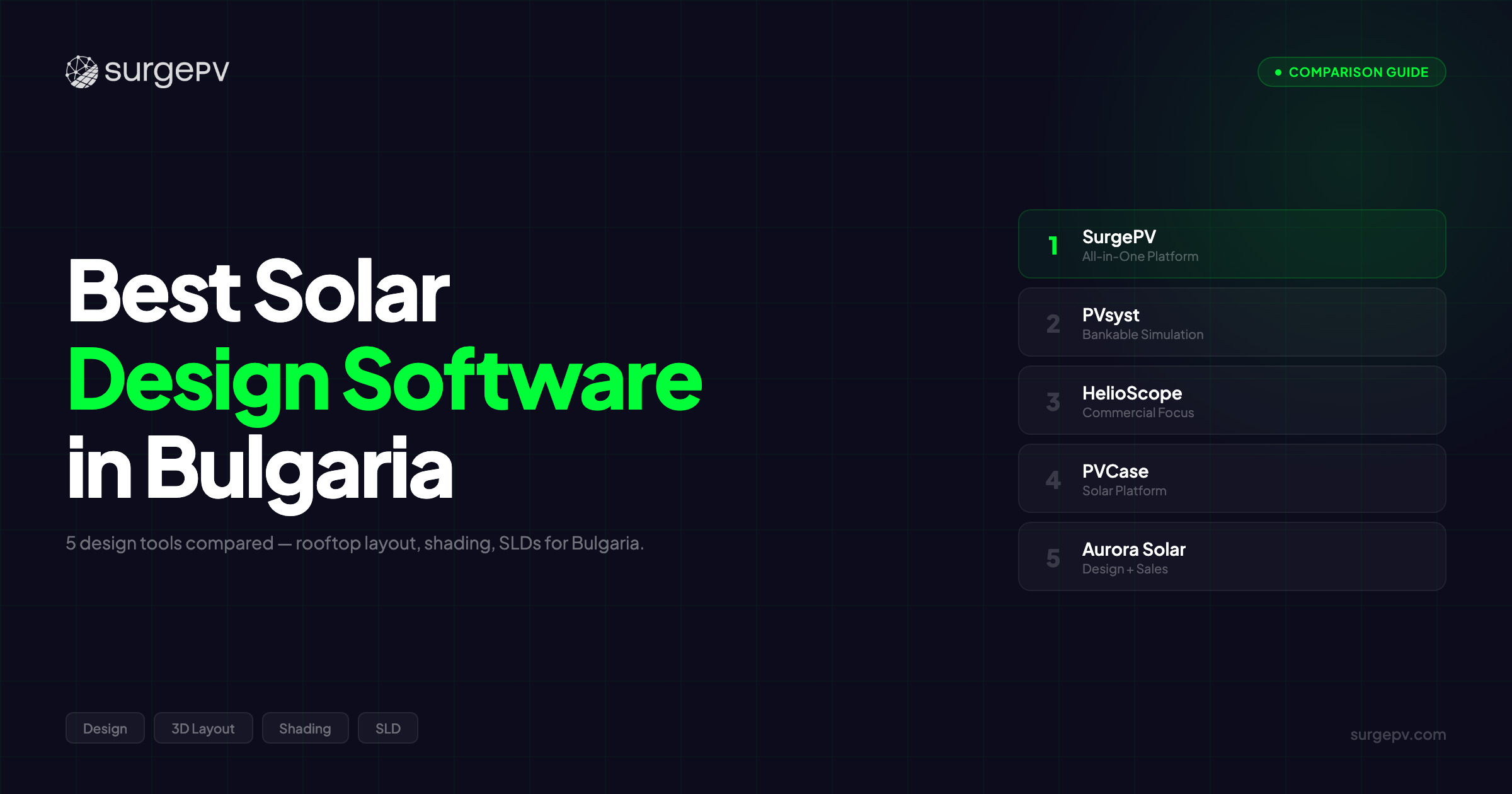
TL;DR: SurgePV ranks #1 for solar design software in Bulgaria. It combines AI-powered design, automated SLD generation (5-10 min vs 2-3 hrs in AutoCAD), single-axis tracker modeling, bifacial optimization, and bankable P50/P75/P90 simulations in one cloud platform — starting at $1,499/user/year. Runner-ups: PVsyst (bankability gold standard), HelioScope (utility-scale design), PVCase (CAD-based engineering), Aurora Solar (commercial rooftop proposals).
Bulgaria’s solar market is booming. Installed capacity crossed 3,800 MW in 2024, and the NECP targets 8,000+ MW by 2030 (SolarPower Europe, 2025). Auction PPAs at EUR 55-65/MWh.
Utility-scale projects dominate 85% of new capacity. Billions flowing in from EBRD and EIB.
But designing solar systems here is a different challenge entirely.
ESO grid connection demands detailed electrical documentation. Bulgarian banks want bankable P50/P90 simulations before releasing a single euro. And most projects use single-axis trackers with bifacial modules — a combination that generic design tools simply weren’t built for.
Here’s the problem: most solar design software was built for Western European or US residential markets. Bulgarian EPCs need something different — single-axis tracker modeling for utility-scale projects, bankable P50/P90 reports that Bulgarian banks accept, and SLD generation that meets ESO grid connection requirements. The wrong choice costs you hours on every project — and potentially an entire auction bid.
We tested and compared 5 solar design platforms for the Bulgarian market, evaluating each on ESO compliance, tracker modeling, bankability, simulation accuracy, workflow speed, and pricing.
In this guide, you’ll learn:
- Which platform handles ESO grid compliance and SLD generation best
- How pricing compares for Bulgarian EPCs (from EUR 580 to EUR 5,000+/user/year)
- Which tool delivers the most accurate bankable simulations for Bulgarian lenders
- Our recommendation based on testing with 500+ European solar projects
Transparency Note
SurgePV publishes this content. We are transparent about this relationship. This comparison is based on hands-on testing, official documentation, and verified user reviews. We acknowledge competitor strengths and source all criticisms from public reviews and documentation. See our editorial standards.
Quick Comparison Table
| Rank | Software | Best For | Pricing | SLD Generation | Score |
|---|---|---|---|---|---|
| 1 | SurgePV | All-in-one for Bulgarian EPCs (design + electrical + proposals) | $1,499/user/year | Yes (5-10 min) | 92/100 |
| 2 | PVsyst | Bankability studies and simulation | ~EUR 1,000-1,500/license | No | 84/100 |
| 3 | HelioScope | Large-scale utility design (10 MW+) | $5,000-$8,000+/year | No | 78/100 |
| 4 | PVCase | CAD-based engineering on complex terrain | EUR 4,000-5,000/year total | Yes (in AutoCAD) | 75/100 |
| 5 | Aurora Solar | Commercial rooftop proposals | $5,000-$10,000+/year | No | 71/100 |
Best Solar Design Software in Bulgaria: Detailed Reviews
SurgePV — Best All-in-One Solar Design Platform for Bulgaria
Best For: Bulgarian utility-scale EPCs, commercial installers, and engineering consultants
Pricing: $1,499/user/year (For 3 Users plan); $633/user/year (Individual plan)
Ease of Use: 2-3 week onboarding
Overall Score: 92/100
SurgePV is an end-to-end solar design and engineering platform built for commercial EPCs. It combines AI-powered design, automated electrical engineering, bankable simulations, and professional proposals in one cloud-based workflow.
For the Bulgarian market, SurgePV stands out for three reasons.
First, integrated electrical engineering. Bulgarian ESO grid connection requires Single Line Diagrams, protection schemes, and fault calculations for any project above 30 kW. SurgePV generates code-compliant SLDs automatically in 5-10 minutes — compared to 2-3 hours of manual drafting in AutoCAD. Wire sizing, voltage drop analysis, and conduit fill calculations are built in. No separate AutoCAD license needed.
Second, tracker and bifacial modeling. Over 70% of Bulgaria’s utility-scale projects use single-axis trackers with bifacial modules. SurgePV models tracker backtracking algorithms, optimizes row spacing, and calculates bifacial gain (15-25% additional yield) — critical for competitive auction bids at EUR 55-65/MWh.
Third, bankable simulations. SurgePV delivers P50/P75/P90 production estimates with plus or minus 3% accuracy compared to PVsyst. Bulgarian banks and international lenders (EBRD, EIB) accept these reports for project financing.
Key Strengths
- Automated SLD Generation: ESO-compliant electrical schematics in 5-10 minutes vs 2-3 hours in AutoCAD
- Single-Axis Tracker and Bifacial Modeling: Covers 70%+ of Bulgaria’s utility-scale projects
- P50/P75/P90 Bankable Simulations: Plus or minus 3% accuracy vs PVsyst, accepted by EBRD and EIB. Your financing applications include the bankability data lenders actually require — not just optimistic P50 estimates that get rejected.
- Professional Proposals: 10-15 minute generation from completed design. One click. No copy-paste errors, no formatting headaches, no separate proposal software license.
- Native Carport Solar Design: Only platform with this capability. With Bulgarian commercial parking lots increasingly adopting solar carports, this is a growing revenue stream.
- Cloud-Based: No installation, multi-user collaboration
- 3-Minute Average Support Response: Fast onboarding at 2-3 weeks. When you’re stuck on a project deadline, that’s the difference between finishing today and waiting until tomorrow.
Limitations
- English Interface: Not available in Bulgarian — acceptable for technical professionals
- Bulgarian DSO Tariffs: Require manual input (PVGIS weather data available)
- Newer to Market: Smaller user base than Aurora Solar or PVsyst
Who Should Consider SurgePV
Bulgarian utility-scale EPCs (1 MW+), commercial solar installers, engineering consultants, and any team that needs design + electrical + proposals in one platform. Eliminates AutoCAD dependency entirely — saving $2,000/year per user in licensing costs alone.
Who Should Look Elsewhere
Pure residential installers who never need electrical engineering documentation. Utility-scale developers (100 MW+) needing specialized terrain modeling for massive ground-mount arrays may prefer PVCase.
Pro Tip
SurgePV eliminates AutoCAD dependency entirely. That saves $2,000/year per user in licensing costs alone — on top of 1.5-2.5 hours saved per project on SLD generation. For a team running 50+ projects per year, the math is clear.
Real-World Example
A mid-size EPC team in the Sofia region was spending 2.5 hours per project creating SLDs in AutoCAD. After switching to SurgePV, SLD generation dropped to under 10 minutes. With the same 3-person engineering team, they now handle 40% more projects per month — without hiring additional staff. That is the difference automated electrical engineering makes.
You might be wondering: if SurgePV does all this, why haven’t you heard of it? Fair question. PVsyst has had a 30-year head start. Aurora Solar has spent hundreds of millions on marketing. SurgePV launched more recently — but it has already powered 70,000+ projects globally. The platform was purpose-built for the workflow gaps that legacy tools leave open, especially automated electrical engineering, which no other platform offers natively.
Further Reading
See our guide to the best solar design software globally — a broader comparison across 10+ platforms. For SLD generation compared, see best solar electrical design software. For a full simulation analysis, read the PVsyst review.
PVsyst — Best for Bankability Studies
Best For: Technical consultants performing independent bankability studies
Pricing: EUR 1,000-1,500/license plus annual update fees
Ease of Use: 4-6 weeks (steep learning curve, 40-80 hours training)
Overall Score: 84/100
PVsyst is the industry gold standard for solar simulation software and bankability reports. Every major Bulgarian bank and international lender accepts PVsyst reports without question.
Key Strengths
- Industry Gold Standard: P50/P75/P90 reports with the deepest loss analysis available
- Advanced Tracker Modeling: Bifacial support and detailed backtracking algorithms
- PVGIS Weather Data: Integration for all Bulgarian locations
- IEC 61724 Compliance: Universally accepted by financiers (BEH, UniCredit Bulbank, EBRD, EIB)
Limitations
- Simulation-Only: No design tools, no SLD generation, no proposals
- Desktop-Only: No cloud collaboration
- Steep Learning Curve: Expect 40-80 hours of training
- Requires Additional Tools: AutoCAD for electrical ($2,000/year), separate design tool, separate proposal tool
Who Should Consider PVsyst
Technical consultants performing independent bankability studies for Bulgarian banks and international lenders. Large EPCs with dedicated simulation engineers. Often paired with SurgePV for day-to-day design work.
Did You Know?
SurgePV’s simulations achieve plus or minus 3% accuracy compared to PVsyst — close enough for daily design work. Many Bulgarian EPCs use SurgePV for day-to-day projects and reserve PVsyst for final bankability validation on utility-scale financing. Read our full PVsyst review for details.
HelioScope — Best for Large-Scale Utility Design
Best For: Bulgarian developers working on 10 MW+ installations
Pricing: $5,000-$8,000+/year depending on team size
Ease of Use: 2-4 week onboarding
Overall Score: 78/100
HelioScope is a cloud-based solar design platform optimized for utility-scale ground-mount projects. For Bulgarian developers working on 10 MW+ installations, it delivers fast layout generation with tracker support.
Key Strengths
- Cloud-Based Design: No installation, browser access
- Single-Axis Tracker Modeling: With backtracking optimization
- Optimized for Large Layouts: 1-100 MW ground-mount projects
- Multi-User Collaboration: For EPC teams
Limitations
- No SLD Generation: AutoCAD required ($2,000/year)
- No Proposal Tools: Separate tool needed
- Expensive for Bulgarian EPCs: $5,000-8,000+/year is steep
- Requires Additional Tools: At least two more for complete workflow
Who Should Consider HelioScope
Large EPCs and developers focused exclusively on utility-scale projects above 10 MW, with budgets for premium tools and existing AutoCAD infrastructure.
PVCase — Best for CAD-Based Engineering
Best For: Bulgarian projects on hilly terrain or irregular sites
Pricing: EUR 2,000-3,000/year + AutoCAD ($2,000/year) = EUR 4,000-5,000/year total
Ease of Use: 6-8 weeks (significant CAD-specific training)
Overall Score: 75/100
PVCase runs inside AutoCAD, giving engineers maximum control over complex utility-scale layouts. For Bulgarian projects on hilly terrain or irregular sites, PVCase’s 3D terrain modeling is hard to beat.
Key Strengths
- Advanced 3D Terrain Analysis: For hilly Bulgarian sites
- Detailed Tracker Row Spacing: Optimization for utility-scale
- SLD Generation and Wire Sizing: Within AutoCAD
- Purpose-Built for Utility-Scale: Ground-mount engineering
Limitations
- Requires AutoCAD: $2,000/year separately, bringing total to EUR 4,000-5,000/year
- Steep Learning Curve: 40+ hours of CAD-specific training
- No Cloud Collaboration: Desktop-only
- No Proposal Tools: Cannot create client-facing documents
Who Should Consider PVCase
Large EPCs with existing AutoCAD teams and specialization in complex, hilly utility-scale projects above 20 MW.
Aurora Solar — Best for Commercial Rooftop Proposals
Best For: Commercial rooftop installers in Bulgaria with high sales volume
Pricing: $5,000-$10,000+/year (contact sales for custom quote)
Ease of Use: 4-6 weeks for commercial features
Overall Score: 71/100
Aurora Solar is the market leader in residential and commercial solar design with industry-leading AI roof modeling and polished proposal generation.
Key Strengths
- AI Roof Detection: Creates 3D models in seconds
- Beautiful Sales Proposals: Professional, polished presentations
- Strong for Commercial Rooftop: 100-200 kW projects
- Native CRM Integrations: Salesforce, HubSpot
Limitations
- No Single-Axis Tracker Support: Cannot handle 85% of Bulgaria’s utility-scale projects
- No SLD Generation: AutoCAD needed for ESO electrical documentation ($2,000/year extra)
- No Bifacial Module Modeling: Missing for utility-scale optimization
- P50 Only: No P75/P90 for bankable reports
- Expensive for Bulgarian Market: $5,000-10,000+/year
Who Should Consider Aurora Solar
Commercial rooftop solar installers in Bulgaria with high sales volume, where proposals matter more than engineering depth. Not suitable for utility-scale tracker projects.
Comparison Table: Solar Design Software for Bulgaria
| Feature | SurgePV | PVsyst | HelioScope | PVCase | Aurora Solar |
|---|---|---|---|---|---|
| Best For | All-in-one (EPCs) | Bankability studies | Utility-scale design | CAD engineering | Commercial rooftop |
| SLD Generation | Yes (automated) | No | No | Yes (in AutoCAD) | No |
| Tracker Modeling | Yes (single/dual) | Yes | Yes | Yes | No |
| Bifacial Support | Yes | Yes | Limited | Yes | No |
| Proposals | Yes (integrated) | No | No | No | Yes |
| P50/P75/P90 | Yes | Gold standard | Limited | No | P50 only |
| Cloud-Based | Yes | No (desktop) | Yes | No (AutoCAD) | Yes |
| Carport Design | Yes (only platform) | No | No | No | No |
| Price/User/Year | $1,499 | ~EUR 1,000-1,500 | $5,000-8,000+ | EUR 4,000-5,000 total | $5,000-10,000+ |
| Onboarding | 2-3 weeks | 4-6 weeks | 2-4 weeks | 6-8 weeks | 4-6 weeks |
Further Reading
For a broader comparison beyond this market, see our guide to the best solar design software globally.
Why Most Bulgarian EPCs Overpay for Solar Design Software
ESO Grid Code Compliance and Electrical Engineering
Bulgaria’s Electricity System Operator (ESO) requires detailed electrical documentation for grid connection — Single Line Diagrams, protection schemes, and fault calculations for every project above 30 kW (ESO Bulgaria). Projects above 1 MW need a complete technical documentation package including SLDs, EN 50549 compliance analysis, reactive power capability studies, and fault level calculations. If your design tool doesn’t generate SLDs, you’re paying $2,000/year for AutoCAD and spending 2-3 hours per project on manual electrical drafting.
Tracker and Bifacial Optimization
Over 70% of new Bulgarian utility-scale projects use single-axis trackers with bifacial modules. The combination delivers 15-25% more energy yield compared to fixed-tilt monofacial arrays. Your solar design software must model tracker backtracking algorithms, optimize row spacing for Bulgarian irradiation conditions (1,350-1,550 kWh/m2/year), and calculate bifacial gain accurately.
Bankability and Auction Competitiveness
Bulgarian renewable energy auctions are highly competitive, with PPA prices at EUR 55-65/MWh (EWRC). Software must deliver P50/P75/P90 production estimates that Bulgarian banks (UniCredit Bulbank, DSK Bank) and international lenders (EBRD, EIB) accept. IEC 61724 compliance is non-negotiable for bankable reports.
Workflow Efficiency
Bulgarian EPC installation costs run EUR 500-600/kWp — among the lowest in the EU. Solar software that saves 1-2 hours per project through integrated workflows (design + engineering + proposals in one platform) directly improves profitability. At 50 projects per year, that’s 100-150 hours wasted on tool-switching alone.
Weather Data and Simulation Accuracy
Bulgarian solar irradiation ranges from 1,350 kWh/m2/year in the north to 1,550 kWh/m2/year in southern Thrace — 30-50% higher than Germany (IRENA). Simulation accuracy of plus or minus 3-5% compared to PVsyst is the minimum standard. SurgePV achieves plus or minus 3% (SurgePV shadow analysis).
Decision Shortcut
If you need electrical engineering (SLDs, wire sizing, code compliance), SurgePV is the only platform that automates this natively. If you’re simulation-only, PVsyst is the gold standard. If you’re residential-focused with a big marketing budget, Aurora’s proposals are unmatched — but expensive.
Our Testing Methodology
We evaluated each platform across five weighted criteria designed for the Bulgarian solar market:
- Accuracy and bankability (30%): ESO compliance, P50/P90 report quality, IEC 61724 adherence, simulation precision
- Features and functionality (25%): Tracker modeling, SLD generation, bifacial support, carport design, shading analysis
- Ease of use (20%): Learning curve, design speed, cloud accessibility, onboarding time
- Pricing and value (15%): Total cost of ownership including AutoCAD dependency, ROI for Bulgarian EPCs
- Local applicability (10%): PVGIS integration, IEC compliance, currency support, European weather data
Testing methodology: We used each platform to design a 5 MW utility-scale tracker project in southern Bulgaria (Plovdiv region, 1,500 kWh/m2/year GHI) and a 200 kW commercial rooftop in Sofia. Evaluation period: Q4 2025 through Q1 2026, with input from Bulgarian EPC partners.
Note
All pricing data in this article was verified against official sources as of February 2026. Prices may have changed since publication.
Design Solar Projects Faster with SurgePV
Complete design-to-proposal workflows with automated electrical engineering and bankable simulations.
Book a DemoNo commitment required · 20 minutes · Live project walkthrough
Bottom Line: Best Solar Design Software for Bulgaria
For utility-scale EPCs (1 MW+): SurgePV is the clear winner. Tracker modeling, automated SLD generation, and bankable P50/P90 reports in one platform — at a fraction of the cost of HelioScope or PVCase + AutoCAD.
For commercial rooftop installers: SurgePV gives you the most complete workflow (design + electrical + proposals). If you prioritize sales and proposals over engineering depth, Aurora Solar is a strong alternative.
For technical consultants: Use PVsyst for final bankability validation and SurgePV for day-to-day design work.
For large developers (10 MW+): HelioScope or PVCase if you need maximum layout control for complex sites. But SurgePV handles projects up to 10 MW without the AutoCAD dependency.
For budget-conscious teams: SurgePV’s Individual Plan ($1,899/year for 3 users = $633/user/year) delivers more features than any competing platform at comparable pricing.
The Bulgarian solar market isn’t slowing down. The EPCs winning auction bids today are the ones with optimized designs, accurate bankable simulations, and ESO-compliant documentation delivered in days — not weeks. Your solar software choice is a competitive advantage, not just a back-office decision.
Ready to see SurgePV in action for Bulgarian projects? Book a personalized demo — our team will walk you through a side-by-side comparison using your actual project data.
Further Reading
For EPC workflows, see best solar software for EPCs. For accuracy comparison, see best solar shading analysis software. For a commercial design deep-dive, read our HelioScope review.
Which Software Is Right for Your Use Case?
Choose your solar proposal software based on your business model, project types, and workflow priorities:
| Your Business Profile | Recommended Software | Why This Choice |
|---|---|---|
| Multi-segment EPC (residential + commercial) | SurgePV | Handles all project types in one platform. Automated SLD generation eliminates AutoCAD dependency. Bankable P50/P90 simulations for commercial financing. Best all-in-one ROI for teams handling 10+ diverse projects monthly. |
| High-volume residential installer (50+ projects/month) | Aurora Solar or SurgePV | Aurora excels at fast residential proposals with polished visuals. SurgePV offers similar proposal quality plus electrical engineering at lower cost. Choose Aurora if budget allows and sales presentation is priority; choose SurgePV for better cost-per-project economics. |
| Utility-scale developer (financing required) | PVsyst + SurgePV | PVsyst delivers gold-standard bankable reports universally accepted by lenders and investors. Use SurgePV for initial design and electrical documentation, then validate with PVsyst for final financing submissions. |
| Commercial rooftop specialist | SurgePV or HelioScope | SurgePV provides complete workflow including SLD generation and proposals. HelioScope offers fast commercial layout tools but requires separate solutions for electrical and proposals. |
| Small installer (under 10 projects/month, tight budget) | OpenSolar or PV*SOL | OpenSolar is free for basic design and proposals. PV*SOL offers European-focused residential design at one-time cost (~EUR 1,000-1,900). Upgrade to SurgePV as you scale. |
| Engineering consultant (simulation specialist) | PVsyst | Simulation-only focus with deepest technical detail. Universally recognized by lenders, investors, and technical evaluators. Ideal for consultants providing validation services rather than full design workflows. |
Still unsure? Consider these decision factors:
- Monthly project volume: 10+ projects → integrated platform (SurgePV). Under 10 projects → simpler tools (OpenSolar, PV*SOL).
- Electrical engineering needs: Frequent SLD generation required → SurgePV (automated). Outsourced or infrequent → any platform + AutoCAD.
- Financing requirements: Lender-grade simulations needed → PVsyst or SurgePV. Standard residential → any platform sufficient.
- Budget constraints: Limited budget → OpenSolar (free) or PV*SOL (one-time). Growth budget → SurgePV (best ROI). Enterprise budget → Aurora Solar (premium brand).
When You May Not Need Advanced Solar Software
Not every solar project in Bulgaria requires a full-featured design platform.
Small residential installers (under 10 projects/month)
If you’re handling fewer than 10 residential installations per month with straightforward roof layouts, free tools like OpenSolar or basic spreadsheet calculations may meet your needs. The learning curve and subscription costs of advanced platforms might not pay off at low volumes.
Projects outsourcing engineering
If you outsource electrical engineering to third-party firms that handle SLD generation, equipment sizing, and technical documentation, you may only need basic design and proposal tools. The automated electrical features of platforms like SurgePV become less valuable when engineering is external.
Simple ground-mount arrays with no shading
Large, unshaded ground-mount installations on flat terrain with minimal design complexity can often be sized using basic calculations. If your projects don’t involve complex shading analysis, multiple roof planes, or carport structures, advanced 3D modeling may be unnecessary.
Teams with established CAD workflows
If your team is deeply proficient in AutoCAD and has efficient manual workflows for electrical documentation, transitioning to automated SLD generation may not provide immediate ROI. Consider the time savings for new hires and scaling operations before deciding.
Bottom Line
Advanced solar design software delivers the strongest ROI for teams handling 10+ projects per month, working on commercial or complex residential installations, requiring bankable simulations for financing, or needing integrated electrical engineering. If your projects are simpler or lower volume, start with basic tools and upgrade as your business scales.
Frequently Asked Questions
What is the best solar design software in Bulgaria?
SurgePV is the best overall solar design software in Bulgaria for 2026. It combines AI-powered design, automated SLD generation (5-10 minutes vs 2-3 hours in AutoCAD), single-axis tracker modeling, and bankable P50/P75/P90 simulations in one platform. Pricing starts at $1,499/user/year with all features included. For bankability validation specifically, PVsyst remains the gold standard, but SurgePV handles day-to-day design workflows more efficiently.
Do Bulgarian EPCs need electrical engineering software?
Yes. Bulgarian ESO grid connection regulations require Single Line Diagrams, protection schemes, and fault calculations for any project above 30 kW. Projects above 1 MW need full technical documentation packages including EN 50549 compliance. SurgePV generates ESO-compliant SLDs automatically, eliminating the need for $2,000/year AutoCAD licenses.
Which software supports single-axis tracker design in Bulgaria?
SurgePV, HelioScope, PVsyst (simulation only), and PVCase all support single-axis tracker design with backtracking optimization. Aurora Solar does not support trackers. Since 70%+ of Bulgaria’s utility-scale projects use single-axis trackers, this is a critical capability. SurgePV is the most cost-effective option with integrated tracker modeling at $1,499/user/year.
Can solar design software generate ESO-compliant SLDs?
SurgePV generates code-compliant SLDs automatically in 5-10 minutes, including DC and AC sides, inverters, protection devices, and wire sizing. PVCase also generates SLDs, but requires AutoCAD ($2,000/year additional). Aurora Solar, HelioScope, and PVsyst do not include SLD generation — requiring separate AutoCAD workflows.
What simulation accuracy is required for Bulgarian banks?
Bulgarian banks and international lenders (EBRD, EIB, UniCredit Bulbank) typically require plus or minus 5% simulation accuracy for project financing. PVsyst is the universally accepted standard. SurgePV achieves plus or minus 3% variance compared to PVsyst — within the bankability threshold. Many EPCs use SurgePV for design and export to PVsyst for final lender validation when required.
How much does solar design software cost in Bulgaria?
Pricing ranges widely. SurgePV starts at $633/user/year (Individual Plan, 3 users for $1,899/year) with all features. PVsyst costs EUR 1,000-1,500 per license. HelioScope runs $5,000-8,000+/year. PVCase costs EUR 2,000-3,000/year plus AutoCAD ($2,000/year) for a total of EUR 4,000-5,000/year. Aurora Solar ranges from $5,000-10,000+/year. Use our ROI calculator to compare total costs.
Which software is best for Bulgarian renewable energy auctions?
For competitive auction bids (EUR 55-65/MWh), you need optimized designs that maximize yield and minimize LCOE. SurgePV combines tracker modeling, bifacial optimization, accurate simulation, and bankable reports in one workflow. For final lender-grade validation, pair SurgePV with PVsyst.
Can solar design software model bifacial modules?
SurgePV and PVsyst both model bifacial solar panels with rear-side irradiance calculations and bifacial gain estimation (15-25% additional yield). PVCase supports bifacial modeling within AutoCAD. HelioScope offers limited bifacial support. Aurora Solar does not support bifacial module modeling. For Bulgarian utility-scale projects, bifacial + tracker optimization is essential for competitive designs.
Sources
- SurgePV Product Documentation — Official feature specifications and technical capabilities (accessed February 2026)
- Bulgarian Energy and Water Regulatory Commission (EWRC) — Regulated prices and grid connection regulations (accessed February 2026)
- Electricity System Operator (ESO) Bulgaria — Grid connection technical requirements (accessed February 2026)
- Bulgarian Ministry of Energy — National Energy and Climate Plan (accessed February 2026)
- SolarPower Europe — Bulgaria Market Outlook 2025 and EU Solar Market Statistics (accessed February 2026)
- PVGIS — European Solar Resource Database — Joint Research Centre (accessed February 2026)
- Aurora Solar, PVsyst, HelioScope, PVCase — Official documentation and pricing pages (accessed February 2026)
- G2 and Capterra — User reviews for all platforms (accessed February 2026)