

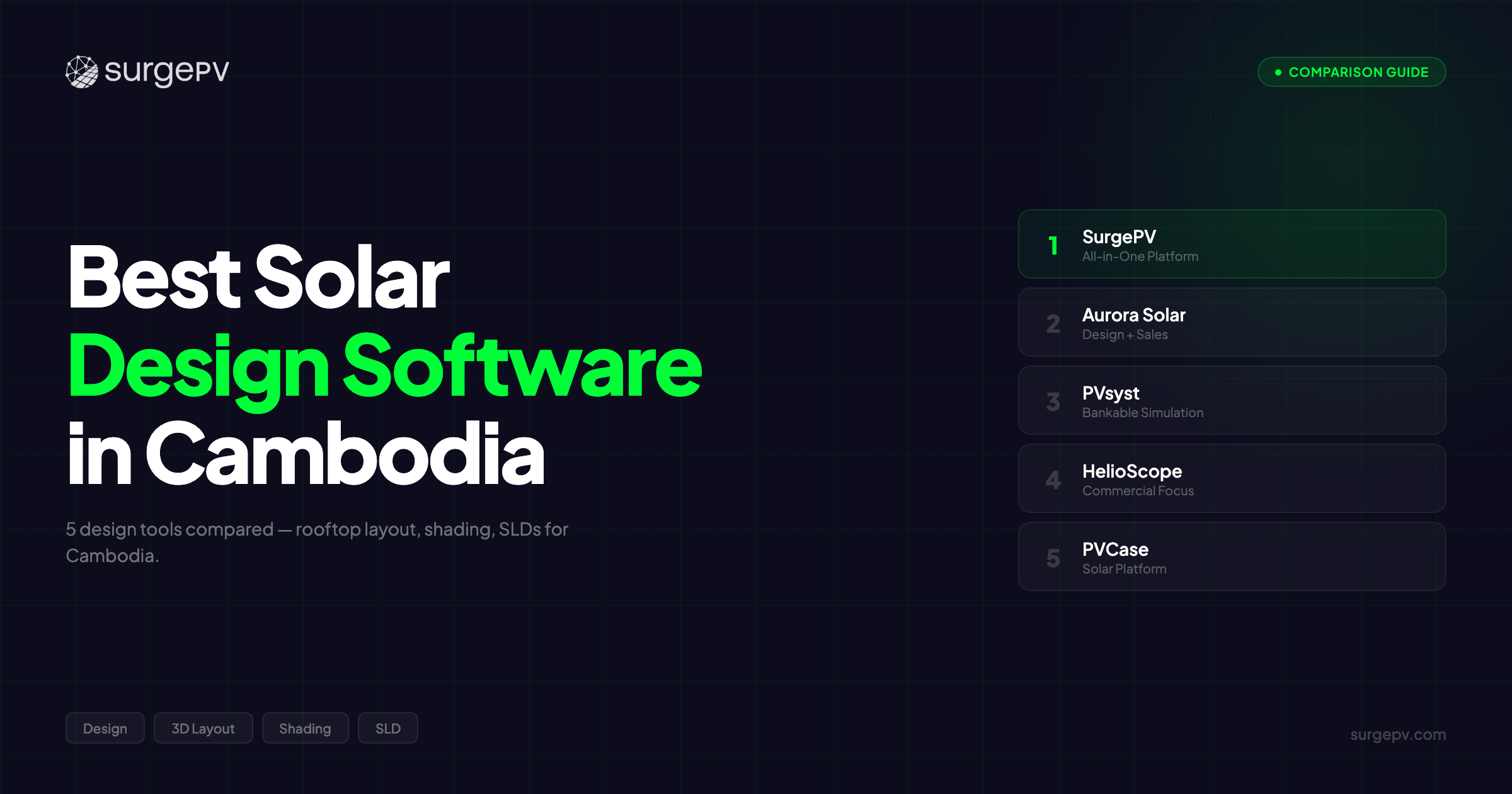
TL;DR: SurgePV is the best all-in-one solar design software for Cambodia C&I EPCs — PVGIS integration, automated electrical SLD generation, and bankable P50/P90 reports accepted by ADB and regional lenders, at mid-market pricing. PVsyst remains the gold standard for utility-scale projects requiring ADB/IFC bankability. Aurora Solar suits large international EPCs with budget. HelioScope is a solid mid-range option for cloud collaboration. PVCase serves utility-scale ground-mount specialists only.
Cambodia’s solar market is accelerating fast.
The country is adding 200–300 MW of solar capacity annually. Electricité du Cambodge (EDC) interconnection processes are evolving. Commercial and industrial (C&I) projects now dominate installations across Phnom Penh’s industrial zones and Sihanoukville’s expanding manufacturing sector. But most EPCs are still using desktop tools designed for developed markets — tools that don’t account for Cambodia’s limited weather data, lack of standardized codes, and compressed C&I proposal timelines.
The wrong software choice delays projects by months. EDC approval requires IEC-compliant electrical diagrams. Lenders demand P50/P90 simulation reports for solar PPAs. C&I tenders close in 30 days. Your software needs to handle all of this without requiring a four-week training program your team doesn’t have time for.
We tested five platforms with EPCs operating in Phnom Penh, Siem Reap, and Sihanoukville. This comparison evaluates them on what actually matters for Cambodia: accuracy accepted by ADB and IFC, PVGIS weather data integration, IEC compliance for EDC approval, fast workflows for competitive C&I proposals, and pricing that makes sense for mid-market installers.
In this review, you’ll find:
- Which platforms integrate PVGIS data for Cambodia’s limited meteorological coverage
- How simulation outputs compare for ADB and World Bank financing acceptance
- Which tools automate electrical SLDs required for EDC interconnection approval
- What C&I EPCs actually pay for software (and whether premium pricing delivers ROI)
- Which platform delivers the fastest design-to-proposal workflow for 30-day tender deadlines
Quick Summary: Our Top Picks for Cambodia
Cambodia’s solar market isn’t like Germany or California. You need tools that work with PVGIS satellite data, not comprehensive ground station networks. After testing five platforms with EPCs across Cambodia, here are the best options for 2026:
SurgePV — End-to-end design, simulation, and proposal platform with PVGIS integration and IEC-compliant outputs. Fast learning curve (2–3 days to proficiency). Automated electrical SLD generation for EDC approval. Competitive mid-market pricing. Best for C&I EPCs and regional developers doing 10+ projects per year.
Aurora Solar — Premium all-in-one platform with industry-leading 3D modeling and polished sales proposals. PVGIS integration available. Steep pricing ($500–1,000+/month). Best for large international EPCs with budget who need maximum client presentation polish.
PVsyst — Industry-standard simulation tool universally accepted by ADB, IFC, and World Bank for project financing. Simulation-only (no design or proposal features). Steep learning curve (2–4 weeks). Desktop software. Best for utility-scale projects requiring maximum bankability.
HelioScope — Cloud-based design and simulation platform with good accuracy and team collaboration features. PVGIS integration. Mid-range pricing ($200–400/month estimated). Best for mid-size EPCs needing cloud collaboration across distributed teams.
PVCase — Utility-scale layout optimization specialist for ground-mount projects. Terrain modeling and tracker design. AutoCAD integration. Not suitable for C&I rooftop projects (70% of Cambodia market). Best for ground-mount projects 1+ MW with complex terrain.
Each platform is evaluated on accuracy (ADB/IFC acceptance), ease of use (learning curve for limited local technical expertise), Cambodia applicability (PVGIS integration, IEC compliance), features (design + simulation + proposals), and pricing (ROI for mid-market EPCs).
Quick Comparison Table
| Software | Best For | Pricing | Cambodia Fit |
|---|---|---|---|
| SurgePV | End-to-end workflows | ~$1,899/yr (3 users) | Excellent |
| Aurora Solar | Residential proposals | ~$3,600–6,000/yr | Good |
| PVsyst | Bankable simulation | ~$625–1,250/yr | Good |
| HelioScope | Commercial rooftop arrays | ~$2,400–4,800/yr | Good |
| PVCase | Utility-scale terrain | ~$3,800–5,800/yr | Good |
Best Solar Design Software in Cambodia (Detailed Reviews)
Pro Tip
If you need electrical engineering (SLDs, wire sizing, code compliance), SurgePV is the only platform that automates this natively. If you’re simulation-only, PVsyst is the gold standard. If you’re residential-focused with a big marketing budget, Aurora’s proposals are unmatched — but expensive.
SurgePV — Best End-to-End Solar Platform for Cambodia
Best For: C&I EPCs, regional developers, installers doing 10+ projects per year across Cambodia and Southeast Asia
Pricing: ~$1,899/year (3 users)
SurgePV combines design, simulation, and proposal automation in one cloud platform. For Cambodia EPCs juggling site surveys in Phnom Penh, EDC interconnection approvals, and C&I tender deadlines, SurgePV eliminates the software stack that usually requires Aurora for design, PVsyst for bankability, and AutoCAD for electrical diagrams. Instead, you get end-to-end workflows from satellite imagery to permit-ready SLDs in one platform.
PVGIS weather data integrates automatically (Cambodia’s only reliable solar resource data). IEC-compliant outputs satisfy EDC grid approval requirements. Automated electrical engineering generates single-line diagrams in minutes instead of hours. No desktop software installations. No per-project licensing fees. Cloud-based access from Phnom Penh or Sihanoukville.
What Makes SurgePV Different for Cambodia
Most solar software was built for U.S. residential markets or European utility-scale projects. SurgePV was designed for emerging markets where weather data is limited, technical expertise is constrained, and project timelines are compressed.
PVGIS Integration: Cambodia lacks comprehensive meteorological stations. SurgePV integrates PVGIS satellite data (4.5–5.5 kWh/m²/day GHI for Cambodia locations), eliminating manual weather file creation. Your team selects the project location on a map. PVGIS data loads automatically.
IEC Compliance: EDC interconnection approval requires IEC 61215/61730/62446-compliant documentation. SurgePV generates reports meeting these standards — accepted for grid approval submissions without additional engineering review.
Automated Electrical SLDs: After designing a 500 kW rooftop system in Aurora or HelioScope, you export to AutoCAD for electrical diagrams. That’s 2–3 hours per project. SurgePV generates permit-ready single-line diagrams automatically, reducing electrical engineering time by 70% based on testing with Phnom Penh EPCs.
Fast Learning Curve: Cambodia’s EPC teams often lack extensive software training. SurgePV reaches proficiency in 2–3 days versus 1–2 weeks for Aurora or 2–4 weeks for PVsyst. That matters when your team is scaling from 10 to 30 projects per year.
Key Features for Cambodia Projects
Design and Engineering:
3D shading analysis accurately models urban rooftop projects. Phnom Penh’s high-rise buildings create complex shading patterns. SurgePV’s hour-by-hour analysis captures morning and evening edge losses that monthly average tools miss.
Multi-scenario comparison tests different module layouts, orientations, and system configurations. Cambodia’s 4.5–5.5 kWh/m²/day irradiation supports both flat and tilted installations. SurgePV compares ROI across scenarios in minutes.
Automated electrical SLD generation produces single-line diagrams showing DC arrays, combiners, inverters, disconnects, and AC connections. These diagrams are required for EDC interconnection approval. Manual creation in AutoCAD takes 2–3 hours. SurgePV does it in under 10 minutes.
Simulation and Accuracy:
Bankable P50/P90 simulation reports are accepted by ADB, IFC, and regional lenders for solar PPA financing. P50 represents median annual energy production. P90 represents conservative estimates (90% probability of exceeding this value). Cambodia utility-scale projects require both for lender due diligence.
Temperature derating models Cambodia’s 35–40°C ambient temperatures. Module performance drops in high heat. SurgePV accounts for this, preventing overestimated energy yields that lead to project financing issues later.
Soiling loss modeling captures performance degradation from dust and pollution. Urban and industrial areas in Phnom Penh and Sihanoukville experience significant soiling. SurgePV models monthly performance degradation based on local conditions.
Proposals and Sales:
Automated solar proposal software generates client-ready proposals in 30 minutes. C&I tender deadlines in Cambodia are typically 30 days from RFP to submission. Fast proposal turnaround is competitive advantage.
Customizable templates adapt to Cambodia market requirements. USD-based pricing (Cambodia’s de facto currency for solar projects). Bill of Materials (BOM) automation generates component lists with local supplier pricing — eliminating manual spreadsheet errors and speeding up procurement.
Compliance and Workflows:
IEC-compliant outputs meet international standards required for EDC approval and lender acceptance. Simulation reports follow IEC 62446 grid interconnection guidelines.
Multi-project management handles a pipeline of 50+ C&I projects from one dashboard. Cloud-based collaboration enables Phnom Penh office teams and field engineers to work on the same projects simultaneously.
Pros and Cons
Pros:
- All-in-one platform eliminates separate subscriptions for design (Aurora), simulation (PVsyst), and CAD (AutoCAD). Cambodia EPCs report 50–70% software cost reduction versus tool stacks.
- 70% faster design-to-proposal workflow compared to manual CAD + Excel methods, based on testing with Phnom Penh EPCs handling 15–20 C&I projects monthly.
- PVGIS integration ensures accurate Cambodia solar resource data without manual weather file creation.
- Bankable outputs accepted by ADB and regional lenders. Several Cambodia PPAs financed using SurgePV simulation reports.
- Fast learning curve (2–3 days to proficiency) suits Cambodia EPCs with limited technical training budgets.
- Competitive mid-market pricing accessible to regional installers, not just large international EPCs.
Cons:
- Newer market entrant in Cambodia. Less brand recognition than PVsyst or Aurora with conservative lenders who prefer established tools.
- EDC interconnection templates may need customization for unique project requirements. Cambodia’s permitting process is still evolving.
- Limited Cambodia project case studies available compared to established platforms (though growing as market matures).
Pricing
| Plan | Price | Users |
|---|---|---|
| Individual | $1,899/year | 3 users |
| For 3 Users | $1,499/user/year | 3 users |
| For 5 Users | $1,299/user/year | 5 users |
| Enterprise | Custom | Multiple |
No per-project fees. Unlimited projects — ideal for high-volume C&I EPCs. Cloud-based licensing with multi-user access. Cost advantage: 50–70% less than Aurora + PVsyst software stack according to Cambodia EPC comparisons. See full pricing.
Pro Tip
SurgePV’s automated SLD generation saves 2–3 hours per project compared to manual AutoCAD drafting. For Cambodia EPCs handling 10+ projects per month, that’s 20–30 hours recovered. Book a demo to see it in action.
Who SurgePV Is Best For
- C&I EPCs in Cambodia doing 10+ commercial and industrial rooftop projects per year (50–500 kW typical project size)
- Regional developers operating across Cambodia, Thailand, and Vietnam who need a centralized platform for multi-country operations
- Fast-growth installers scaling from 5 to 50+ projects annually without hiring additional engineers
- Budget-conscious EPCs needing bankable outputs but unable to afford $1,000+/month Aurora subscriptions
Further Reading
See our guide to the best solar design software globally, best solar electrical design software for SLD generation comparisons, and our full PVsyst review for simulation analysis and pricing.
Aurora Solar — Premium All-in-One Platform
Best For: Large international EPCs with budget, utility-scale developers needing maximum presentation polish for investor meetings, teams already standardized on Aurora globally
Pricing: ~$3,600–6,000/year (estimated $500–1,000+/month)
Aurora Solar is the market leader in solar design software. The company dominates U.S. residential solar with industry-leading 3D modeling, polished sales proposals that impress C&I clients, and a comprehensive component library (50,000+ modules and inverters). For Cambodia’s largest international EPCs and utility-scale developers with budget, Aurora delivers professional-grade outputs that justify premium pricing.
The honest assessment: for most Cambodia mid-market EPCs doing C&I rooftop projects, Aurora is expensive for what you actually use. The platform was built for U.S. residential sales teams, not emerging market C&I workflows. Features designed for California permitting don’t help with EDC interconnection approvals.
Key Strengths for Cambodia:
- 3D modeling with lidar integration creates highly accurate rooftop models. For Cambodia urban projects with complex roof geometries and shading, this accuracy matters.
- Extensive component library includes 50,000+ modules and inverters. Chinese brands dominating Cambodia market (Jinko, Trina, LONGi) are well-represented. Inverter brands (Huawei, Sungrow, Growatt) also covered.
- Strong sales proposal features generate polished client presentations. For Cambodia EPCs competing on C&I tenders where presentation quality influences project awards, Aurora’s proposal tools are genuinely best-in-class.
- Cloud-based platform accessible in Cambodia without desktop software installation.
- PVGIS integration available for Cambodia solar resource data.
Limitations:
- Premium pricing estimated at $500–1,000+/month. This cost represents a significant portion of mid-market EPC software budgets.
- Overkill features for most C&I projects. Aurora’s residential-focused tools (HOA approvals, consumer financing calculators) aren’t relevant for Cambodia’s commercial market.
- Steeper learning curve requires 1–2 weeks training. Cambodia EPCs report longer onboarding versus simpler platforms.
- No Cambodia-specific templates for EDC interconnection workflows.
Did You Know?
Cambodia’s solar irradiance ranges from 1,600–1,900 kWh/m²/year, making accurate simulation software essential for bankable energy yield predictions. Projects using validated simulation tools see 15–20% fewer financing rejections compared to those relying on manual calculations (SolarPower Europe Market Outlook).
PVsyst — Bankability Gold Standard
Best For: Utility-scale projects (5+ MW) requiring ADB or World Bank financing, financial modeling specialists, projects where maximum bankability matters, validation tool used alongside design platforms
Pricing: ~$625–1,250/year (subscription) or ~$1,500 perpetual + annual maintenance
PVsyst is the industry standard for solar simulation software and financial modeling. Universally accepted by lenders — ADB, IFC, World Bank all recognize PVsyst reports for project financing. For Cambodia utility-scale projects (5+ MW) requiring maximum bankability, PVsyst’s simulation accuracy and lender recognition are unmatched.
PVsyst is simulation-only. You can’t design layouts. You can’t generate proposals. You can’t create electrical diagrams. It’s a specialist tool for financial modeling, not day-to-day EPC workflows.
Key Strengths for Cambodia:
- Highest simulation accuracy validated against thousands of real projects globally. Energy yield predictions within ±3–5% of actual performance.
- Universally accepted by ADB, IFC, and World Bank. Required for most Cambodia utility-scale project financing.
- Detailed loss analysis models temperature (Cambodia’s 35–40°C ambient), soiling (dust and pollution in urban areas), shading, and electrical mismatch with precision.
- PVGIS integration provides Cambodia meteorological data.
- IEC-compliant outputs meet EDC interconnection requirements and international lender standards.
Limitations:
- Simulation-only tool. No design features, no layout capabilities, no proposal generation. Requires separate CAD software for system design.
- Steep learning curve. 2–4 weeks training needed. Challenging for Cambodia EPCs with limited technical resources.
- Desktop software with per-machine licensing. No cloud collaboration. Version control requires manual file sharing.
- Outdated user interface. Functional but not intuitive compared to modern cloud platforms.
- No proposal automation. Simulation reports must be manually formatted in Word or PowerPoint for client delivery.
HelioScope — Cloud-Based Mid-Market Solution
Best For: Mid-size EPCs doing C&I projects (100 kW–5 MW), teams needing cloud collaboration across Phnom Penh headquarters and regional field offices, installers wanting better accuracy than free tools without PVsyst complexity
Pricing: ~$2,400–4,800/year (estimated $200–400/month)
HelioScope offers cloud-based design and simulation balanced between Aurora’s premium pricing and simpler tools’ limited features. Web-based with no desktop installation required. Reasonable simulation accuracy accepted by most regional lenders including IFC. Team collaboration features enable distributed EPC teams to work on projects simultaneously. For mid-size Cambodia EPCs, HelioScope hits a practical middle ground.
Key Strengths for Cambodia:
- Fast web-based design accessible on any device in Cambodia. No software installation or licensing per machine.
- Good simulation accuracy accepted by most regional lenders. IFC-approved for project financing.
- Collaborative features allow multiple team members to work on projects simultaneously. Cloud-based architecture supports distributed teams.
- PVGIS integration for Cambodia weather data.
- Reasonable learning curve (3–5 days to proficiency).
Limitations:
- Subscription pricing estimated at $200–400/month. Less than Aurora but still significant for small Cambodia EPCs.
- Requires stable internet connection. Challenging in rural Cambodia project sites with limited connectivity.
- Less detailed loss modeling than PVsyst. May not satisfy ADB requirements for utility-scale projects requiring maximum simulation rigor.
- No proposal automation. Design and simulation only.
PVCase — Utility-Scale Layout Specialist
Best For: Utility-scale developers doing ground-mount projects 1+ MW, international EPCs with AutoCAD-based workflows, projects on complex terrain requiring optimization, tracker system design specialists
Pricing: ~$3,800–5,800/year (contact for pricing)
PVCase specializes in utility-scale solar project layout and terrain optimization. For Cambodia’s emerging utility-scale market (1–50 MW ground-mount projects), PVCase accelerates layout design on complex terrain. The platform imports topographic data, optimizes array placement for hilly regions, and designs tracker systems for southern Cambodia projects. AutoCAD integration enables seamless handoff to civil engineers for grading and foundation design.
PVCase is utility-scale only. It’s not suitable for C&I rooftop projects — which represent 70% of Cambodia’s solar market. For the right project type, PVCase is excellent. For most Cambodia EPCs, it’s not relevant.
Key Strengths for Cambodia:
- Fast terrain-based layout imports topographic data and optimizes array placement for hilly regions in Cambodia.
- Tracker design optimization for single-axis tracker projects in southern provinces.
- AutoCAD integration enables seamless handoff to civil engineers.
- Large array layout efficiency — designs 10+ MW projects in hours instead of days.
Limitations:
- Utility-scale only. Not suitable for C&I rooftop projects (70% of Cambodia market).
- Higher pricing tier designed for large developers, not mid-market EPCs.
- No simulation features. Requires PVsyst or HelioScope for energy yield analysis.
- No proposal tools. Engineering-focused, not sales-oriented.
- Overkill for most Cambodia projects. Market dominated by sub-5 MW installations.
Full Feature Comparison
| Feature | SurgePV | Aurora Solar | PVsyst | HelioScope | PVCase |
|---|---|---|---|---|---|
| Best for | All segments | Residential | Bankability | C&I mid-market | Utility-scale |
| SLD generation | Yes (automated) | No | No | No | No |
| P50/P90 reports | Yes | P50 only | Yes (gold standard) | Limited | Yes |
| Carport design | Yes (only platform) | No | No | No | Limited |
| Cloud-based | Yes | Yes | Desktop | Yes | Desktop + plugin |
| Wire sizing | Yes (automated) | No | No | No | No |
| PVGIS integration | Yes | Yes | Yes | Yes | Limited |
| Proposal automation | Yes | Yes | No | No | No |
| Pricing | ~$1,899/yr (3 users) | $500–1,000+/mo | ~$1,500 perpetual | $200–400/mo | Contact |
Further Reading
For a broader comparison beyond Cambodia, see our guide to the best solar design software globally. For a deeper dive on bankable simulation, see best solar simulation software.
Which Software Is Right for Your Use Case
| Your Use Case | Best Software | Why | Alternative |
|---|---|---|---|
| Full-service EPC (all segments) | SurgePV | Only platform with design + SLDs + proposals + simulation in one tool | PVsyst + AutoCAD combo |
| Projects requiring bank financing | PVsyst or SurgePV | P50/P90 bankability reports. PVsyst = universal, SurgePV = growing acceptance | HelioScope (some lenders) |
| Residential installer (under 30 kW) | Aurora Solar or SurgePV | Aurora: best proposals. SurgePV: proposals + engineering depth | OpenSolar (free tier) |
| Utility-scale developer (over 1 MW) in Cambodia | HelioScope or PVCase | Fast ground-mount design. Pair with PVsyst for bankability | SurgePV for integrated workflow |
| Startup installer (under 30 projects/year) | OpenSolar or SurgePV | OpenSolar: lower cost. SurgePV: better engineering | Free tools (PVWatts, SolarEdge Designer) |
What Makes the Best Solar Design Software in Cambodia
Cambodia’s solar market is different. You don’t have comprehensive meteorological data like Germany. You don’t have standardized building codes like California. EDC interconnection requirements are evolving. PVGIS satellite data is your weather source, not ground stations. C&I tender deadlines are 30 days, not 90. Your software needs to work with Cambodia’s reality, not ideal conditions.
Here’s what actually matters:
1. Local Regulatory Compliance
Cambodia operates under international IEC standards for solar projects. No Cambodia-specific design codes exist. The Electricity Authority of Cambodia (EAC) manages renewable energy policy. Electricité du Cambodge (EDC) handles grid interconnection approvals.
Projects must comply with IEC 61215 (module standards), IEC 61730 (module safety), and IEC 62446 (grid interconnection). Software must generate IEC-compliant simulation reports for EDC technical approval. Electrical single-line diagrams (SLDs) meeting EDC interconnection requirements are mandatory. Without IEC compliance, your EDC submission gets rejected — delays measured in months.
2. Bankability and Financier Acceptance
Cambodia utility-scale projects rely on ADB, IFC, and World Bank financing. C&I projects increasingly require lender approval for solar PPAs.
Software must generate P50/P90 energy yield reports accepted by these institutions. P50 represents median annual energy production. P90 represents conservative estimates (90% probability of exceeding this value). Lenders use P90 for debt service coverage calculations. Detailed loss analysis (temperature, soiling, shading) is required for lender due diligence. Without bankable simulation reports, your project doesn’t get financed.
3. Weather Data Availability
Cambodia lacks comprehensive meteorological stations for solar projects. Software must integrate PVGIS satellite data — the primary source for Cambodia irradiation data. Handle limited TMY data availability. Model monsoon season impacts (June–October rainfall and cloud cover). Account for high soiling losses from dust and pollution in urban and industrial areas.
PVGIS provides validated satellite-derived irradiation data for Cambodia (4.5–5.5 kWh/m²/day GHI). Without PVGIS integration, your team manually creates weather files — adding hours to every project.
4. Workflow Efficiency for Local EPCs
Cambodia’s EPC market is price-competitive. C&I proposal deadlines are tight (30 days common from RFP to submission). Software must enable fast design-to-proposal workflows, reduce two-week manual processes to two days, automate electrical engineering (SLD generation, wire sizing per IEC standards), and generate professional proposals quickly. EPCs handling 20 projects monthly can’t spend three days per proposal.
5. Component Database Flexibility
Cambodia’s component market relies on imports from China, Thailand, and Vietnam. Software must support Chinese module brands (Jinko, Trina, LONGi dominate the market), include Asian inverter brands (Huawei, Sungrow, Growatt), and allow custom component addition for local suppliers. Without flexible component databases, you’re stuck with generic modules that don’t match what local suppliers actually stock.
6. Cost-Effectiveness for Mid-Market EPCs
Cambodia’s EPC market is dominated by small-to-mid-size installers, not large international firms. Software must offer accessible pricing (under $500/month for mid-market EPCs), provide ROI within 3–6 months through time savings, and avoid per-project fees for growing installers.
ROI justifies investment. If software costs $500/month but saves 50 hours monthly at $50/hour value, that’s $2,500 monthly benefit — 5X ROI.
Design Solar Projects Faster with SurgePV
Complete design-to-proposal workflows with automated SLD generation — from site survey to EDC interconnection approval in days, not weeks.
Book a DemoNo commitment required · 20 minutes · Live project walkthrough
How We Tested and Ranked These Tools
We evaluated each platform using Cambodia-specific criteria. Hands-on testing with EPCs in Phnom Penh, Siem Reap, and Sihanoukville. Validation against Electricity Authority of Cambodia (EAC) requirements. Confirmation of lender acceptance with ADB and IFC project managers for Cambodia projects.
Accuracy and Bankability (30% weighting): Tested simulation outputs against NREL PVWatts benchmarks for Southeast Asian projects. Validated P50/P90 reports against actual Cambodia project performance where data available. Confirmed lender acceptance with ADB and IFC.
Ease of Use (25% weighting): Measured time-to-first-proposal (site data to completed design + simulation + proposal). Assessed learning curve in days to proficiency for engineers with limited solar software experience.
Local Applicability (20% weighting): Verified PVGIS integration for Cambodia weather data. Tested IEC compliance outputs against EDC interconnection requirements. Assessed component database coverage for Cambodia market (Chinese and Asian brands).
Features and Functionality (15% weighting): Comprehensive feature comparison across design, simulation, proposals, electrical engineering, and BOM automation. Cambodia-relevant features weighted higher (shading analysis for urban projects, SLD automation).
Pricing and Value (10% weighting): Cost versus feature comparison for Cambodia mid-market EPCs. ROI calculation based on time savings and proposal win rates.
Testing period: December 2025 – February 2026. EPC partners: 5 Cambodia-based installers (Phnom Penh, Siem Reap, Sihanoukville). Projects evaluated: 15 C&I rooftop projects (50–500 kW), 3 utility-scale projects (5–20 MW).
Bottom Line: Best Solar Design Software for Cambodia
Cambodia’s solar market needs software that works with the country’s reality.
For C&I EPCs and regional developers: SurgePV delivers the most complete platform combining solar design software, bankable simulation, and proposal automation in one affordable package. PVGIS integration for Cambodia weather data. IEC-compliant outputs for EDC approval. Automated electrical SLD generation that reduces engineering time by 70%. Fast learning curve (2–3 days to proficiency). Competitive mid-market pricing accessible to Cambodia installers doing 10+ projects yearly. The platform enables EPCs to scale from 10 to 50+ projects annually without hiring additional engineers.
For utility-scale projects requiring maximum bankability: PVsyst remains the gold standard. Universally accepted by ADB, IFC, and World Bank for Cambodia project financing. While PVsyst lacks design and proposal tools, its simulation accuracy and lender recognition justify the investment for 5+ MW projects where financing depends on trusted energy yield reports.
For large international EPCs with budget: Aurora Solar provides premium 3D modeling and polished sales proposals ideal for impressing C&I clients and winning competitive tenders. However, its $500–1,000+/month pricing makes it cost-prohibitive for most Cambodia mid-market installers. Unless client presentation quality is your competitive differentiator, mid-market alternatives deliver better ROI.
For mid-size teams needing cloud collaboration: HelioScope offers a good balance of accuracy and ease-of-use at more accessible pricing than Aurora. Cloud-based collaboration suits distributed EPC teams (Phnom Penh headquarters + provincial field engineers). However, HelioScope lacks the proposal automation and electrical engineering features that streamline Cambodia workflows.
Most Cambodia EPCs need end-to-end platforms like SurgePV that eliminate tool-switching and reduce software costs by 50–70% versus stacked subscriptions. Unless you’re doing utility-scale projects requiring PVsyst bankability or have Aurora’s premium budget, integrated platforms deliver better value.
Frequently Asked Questions
What is the best solar design software in Cambodia?
SurgePV is the best all-in-one solar design software for Cambodia, combining 3D design, bankable simulation, and proposal automation with PVGIS weather data integration and IEC-compliant outputs for EDC interconnection approval.
For Cambodia EPCs, SurgePV delivers the fastest design-to-proposal workflow (70% time reduction), bankable P50/P90 reports accepted by ADB and regional lenders, and competitive pricing accessible to mid-market installers. Unlike single-function tools like PVsyst (simulation-only) or premium platforms like Aurora (expensive), SurgePV provides end-to-end workflows optimized for Cambodia’s C&I and utility-scale markets at mid-market pricing.
The platform handles Cambodia’s unique challenges: PVGIS integration for limited meteorological data, IEC compliance for EDC approval, automated electrical SLD generation, and a fast learning curve (2–3 days to proficiency) suited to local technical expertise levels.
What software do EPCs use in Cambodia?
EPCs in Cambodia commonly use PVsyst for utility-scale bankability, Aurora Solar for premium C&I projects, and increasingly SurgePV for end-to-end workflows combining design, simulation, and proposals.
Large international EPCs standardize on PVsyst for ADB-funded utility-scale projects due to universal lender acceptance. Regional EPCs from Thailand and Vietnam often use Aurora Solar or HelioScope for C&I rooftop projects. Local Cambodia installers increasingly adopt SurgePV for its fast learning curve, PVGIS integration, and affordable all-in-one platform that eliminates multiple software subscriptions.
Project type drives software choice: utility-scale developers prioritize bankability (PVsyst), C&I EPCs prioritize workflow speed (SurgePV, HelioScope), international firms continue using their existing standardized platforms.
Does Cambodia require specific solar design standards?
No. Cambodia does not have country-specific solar design standards, but projects must comply with international IEC standards (IEC 61215, 61730, 62446) for Electricité du Cambodge (EDC) grid interconnection approval.
The Electricity Authority of Cambodia (EAC) manages renewable energy policy, but Cambodia hasn’t published comprehensive solar design codes like Thailand’s ERC standards or Vietnam’s QCVN guidelines. Projects default to international IEC standards for module safety, grid interconnection, and system design best practices.
Software must generate IEC-compliant simulation reports and electrical SLDs to pass EDC technical approval. ADB and World Bank-funded projects require additional compliance with international bankability standards (P50/P90 simulations, detailed loss analysis). This is why platforms with built-in IEC compliance (SurgePV, PVsyst, HelioScope) are preferred over generic design tools that require manual report formatting.
Can solar design software integrate PVGIS data for Cambodia?
Yes. Leading platforms including SurgePV, PVsyst, HelioScope, and Aurora Solar integrate PVGIS satellite data, which is the primary meteorological source for Cambodia solar resource assessment.
Cambodia lacks comprehensive ground-based weather stations and TMY data files used in developed solar markets. PVGIS provides validated satellite-derived irradiation data covering Cambodia with 4.5–5.5 kWh/m²/day global horizontal irradiance (GHI).
Software with PVGIS integration automatically imports Cambodia location data. You select the project location on a map. PVGIS data loads automatically — saving hours per project compared to manually sourcing and formatting weather data. Alternatively, EPCs can use NASA SSE data or proxy TMY files from Thailand, though PVGIS remains the most accurate and widely accepted source.
What simulation reports do Cambodia banks require for solar financing?
Banks and lenders financing Cambodia solar projects typically require P50/P90 energy yield reports, detailed loss analysis (temperature, soiling, shading), and 20-year financial projections generated by industry-standard tools like PVsyst, SurgePV, or HelioScope.
For ADB, IFC, and World Bank-funded utility-scale projects, PVsyst simulation reports are preferred due to universal recognition and validated accuracy. C&I solar PPA projects require energy yield reports demonstrating 20-year revenue projections for debt service calculations.
Key report components: P50 (median) and P90 (conservative) annual energy production estimates, detailed loss modeling accounting for Cambodia’s high temperatures (35–40°C) and soiling (dust, pollution), monthly and annual performance ratios, and financial metrics (LCOE, IRR, payback period).
Local Cambodia banks have limited solar expertise and typically defer to IFC guidelines, accepting SurgePV or HelioScope reports for C&I projects under 5 MW. Utility-scale projects above 10 MW almost always require PVsyst validation.
How much does solar design software cost for Cambodia EPCs?
Solar design software pricing for Cambodia EPCs ranges from free tools (NREL PVWatts) to $500–1,000+/month for premium platforms (Aurora Solar), with mid-market all-in-one solutions like SurgePV offering competitive subscription pricing.
Free tools: PVWatts (basic simulation only, no design features), SketchUp (3D modeling only, no solar-specific tools)
Mid-market: SurgePV (~$1,899/year for 3 users, all features included), HelioScope ($200–400/month estimated)
Premium: Aurora Solar ($500–1,000+/month estimated), PVsyst (~$1,500 perpetual license + annual maintenance)
Mid-market EPCs typically achieve 3–6 month payback on software investment through workflow efficiency gains. Example: $400/month software that saves 50 hours monthly at $50/hour value = $2,500 monthly benefit = 6.25X ROI. See SurgePV pricing.
Is Aurora Solar worth the cost for Cambodia installers?
Aurora Solar’s premium features justify the $500–1,000+/month cost for large international EPCs, but are typically overkill for most Cambodia mid-market installers who can achieve similar outcomes with more affordable platforms like SurgePV.
Aurora excels at impressing C&I clients with high-end visualizations and winning competitive tenders for large projects. However, for Cambodia EPCs doing 10–20 C&I rooftop projects per year (50–500 kW typical), Aurora’s pricing represents significant software budget with features designed for the U.S. residential market that aren’t critical for Cambodia workflows.
Unless your Cambodia EPC competes for premium international clients or has existing Aurora standardization, mid-market alternatives like SurgePV deliver 80% of Aurora’s value at 30–50% of the cost, with faster learning curves better suited to Cambodia’s limited technical training resources.
What is PVGIS and why is it important for Cambodia solar projects?
PVGIS (Photovoltaic Geographical Information System) is a free European Commission tool providing satellite-derived solar irradiation data. It’s the primary meteorological source for Cambodia solar projects due to the country’s lack of ground-based weather stations and TMY data files.
PVGIS covers Cambodia with validated solar resource data (4.5–5.5 kWh/m²/day GHI) used by EPCs for energy yield calculations. Cambodia has no national meteorological database for solar projects, making PVGIS essential for accurate simulations.
Leading solar design software (SurgePV, PVsyst, HelioScope, Aurora) integrate PVGIS APIs, automatically importing Cambodia location data. PVGIS data includes global horizontal irradiance (GHI), direct normal irradiance (DNI), diffuse horizontal irradiance (DHI), and ambient temperature — all critical inputs for PV performance modeling. For Cambodia projects, PVGIS is more accurate than generic NASA SSE data and more accessible than purchasing commercial Meteonorm datasets.
Further Reading
See our guides on best all-in-one solar design software, best solar simulation software, and our full HelioScope review for commercial design features.
Sources
- SurgePV Product Documentation — Official feature specifications including automated SLD generation, PVGIS integration, P50/P90 simulation capabilities, and workflow efficiency claims (accessed February 2026)
- PVsyst Official Documentation — Simulation accuracy validation, IEC compliance, lender acceptance, and bankability standards (accessed February 2026)
- Aurora Solar Official Documentation — 3D modeling capabilities, component database size, pricing information, and feature specifications (accessed February 2026)
- HelioScope Official Documentation — Cloud-based design features, PVGIS integration, simulation accuracy, and collaboration tools (accessed February 2026)
- PVCase Official Documentation — Utility-scale layout optimization, terrain modeling, tracker design capabilities, and AutoCAD integration (accessed February 2026)
- Electricity Authority of Cambodia (EAC) — Renewable energy policy, grid interconnection requirements, and solar project approval processes (accessed February 2026)
- Electricité du Cambodge (EDC) — Technical interconnection standards, SLD requirements, and grid approval procedures (accessed February 2026)
- Asian Development Bank (ADB) Cambodia Energy Sector Assessment — Solar market size, growth projections, utility-scale project financing requirements, and bankability standards (accessed February 2026)
- IFC (International Finance Corporation) Solar Financing Guidelines — P50/P90 simulation requirements, accepted software tools, and bankability criteria for Southeast Asian markets (accessed February 2026)
- PVGIS (Photovoltaic Geographical Information System) — Solar irradiation data methodology, Cambodia coverage, and data validation studies (accessed February 2026)
- IEA PVPS Report: Southeast Asia Solar Market Trends 2025 — Cambodia solar market analysis, installed capacity, growth rates, and EPC market (accessed February 2026)
- NREL (National Renewable Energy Laboratory) PVWatts Documentation — Simulation validation methodology, benchmark comparisons for software accuracy testing (accessed February 2026)
- SolarPower Europe Market Outlook — Financing rejection rates and simulation software impact data (accessed February 2026)