

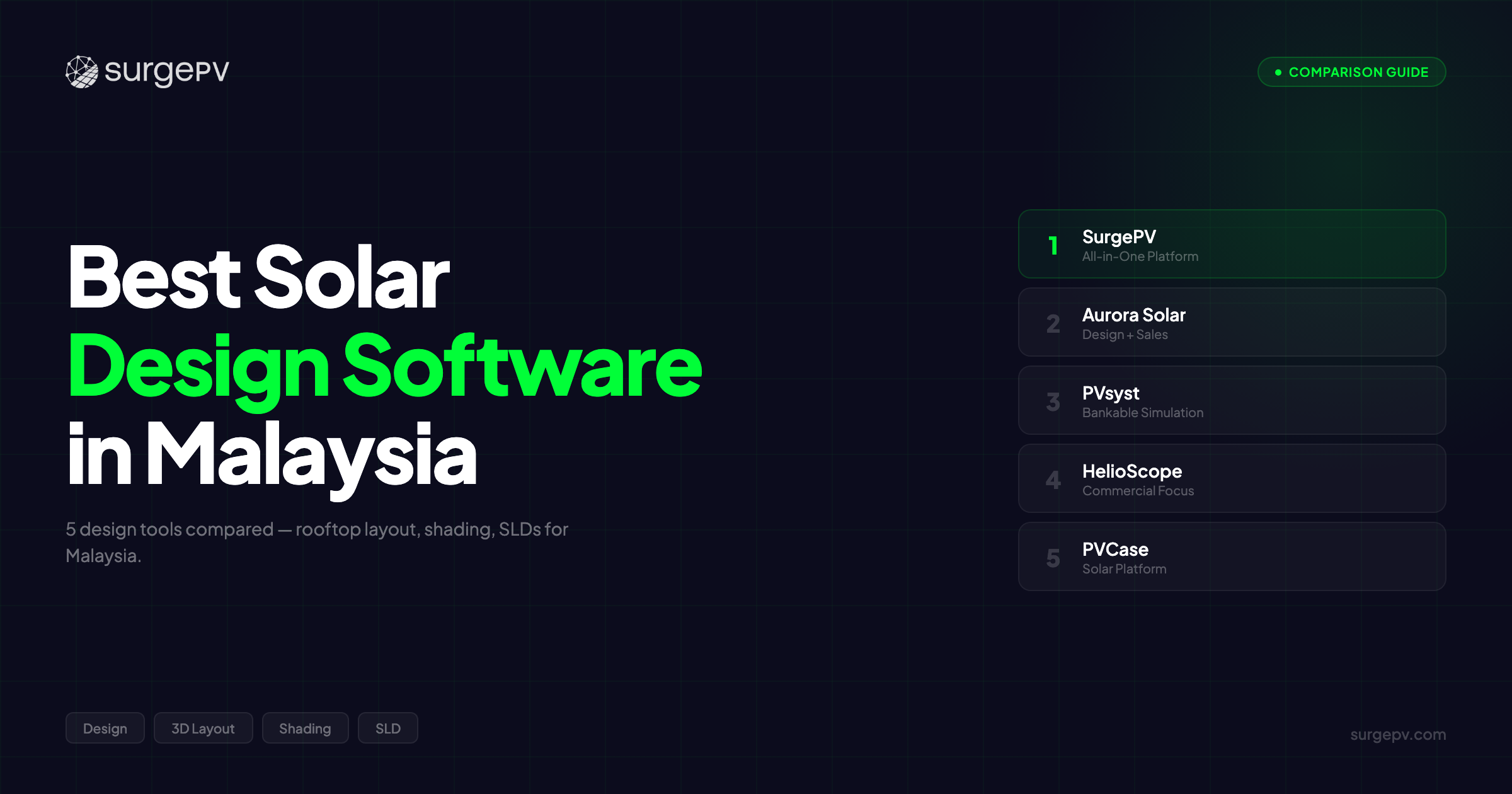
TL;DR: SurgePV is the strongest end-to-end option for Malaysian EPCs — automated SLD generation for TNB compliance, P50/P90 bankable simulations calibrated for tropical conditions, and integrated NEM 3.0 proposals at $1,899/year. PVsyst remains the gold standard for utility-scale bankability. Aurora Solar works for residential teams. HelioScope fits fast commercial rooftop layouts. PVCase is built for utility-scale LSS ground-mount terrain modeling.
Malaysia crossed 2 GW of installed solar capacity in 2025. SEDA is targeting 4 GW by the end of the decade. NEM 3.0 is driving commercial rooftop adoption faster than any previous incentive program.
But here is the part nobody talks about: most solar design software was built for temperate climates. Europe. North America. Places where ambient temperatures hover around 25°C and monsoons are not part of the engineering vocabulary. When you run a 500 kW factory rooftop in Kuala Lumpur through a tool calibrated for Stuttgart or Phoenix, you get energy yield estimates that are 8–12% too high. That translates to roughly 40–60 MWh of phantom production per year.
Your customer expected MYR 150,000 in annual savings. They got MYR 130,000. You are the one fielding that phone call.
Then there is the paperwork. Tenaga Nasional requires single line diagrams and protection relay specifications for every grid-connected system. SEDA needs technical documentation proving your design meets the Renewable Energy Act standards. Most design platforms produce a layout and a production estimate — and leave the rest to you and AutoCAD.
The right solar design software for Malaysia must handle tropical temperature derating, monsoon irradiance modeling, NEM 3.0 financial calculations, and TNB-compliant electrical documentation — without requiring three separate tools and a week of manual work.
In this guide, you’ll learn:
- Which platforms model Malaysia’s 30–35°C ambient temperatures and monsoon patterns accurately
- How each tool handles SEDA compliance and TNB grid connection documentation
- Which software generates electrical SLDs without AutoCAD dependency
- Total cost of ownership for Malaysian EPC teams (3–5 users)
- Detailed comparisons of SurgePV, Aurora Solar, PVsyst, HelioScope, and PVCase
Quick Comparison Table
| Software | Best For | Key Limitation | Ideal Project Type | Starting Price |
|---|---|---|---|---|
| SurgePV | End-to-end workflows | Newer in Malaysian market | 50 kW–10 MW commercial | $1,899/yr (3 users) |
| Aurora Solar | Residential proposals | No SLD generation | 5–30 kWp residential | $3,600–6,000/yr |
| PVsyst | Bankable simulation | No design or SLD tools | Any requiring lender reports | $625–1,250/yr |
| HelioScope | Commercial rooftop layouts | No electrical engineering | 100 kW–10 MW commercial | $2,400–4,800/yr |
| PVCase | Utility-scale terrain modeling | Requires CAD expertise | 10 MW+ LSS ground-mount | $3,800–5,800/yr |
Best Solar Design Software in Malaysia (Detailed Reviews)
Pro Tip
When evaluating solar design software for Malaysia, test with a monsoon-season scenario first. Run your most complex project through June–September irradiance modeling with 30–35°C ambient temperatures. A platform that handles Malaysian wet-season conditions accurately will handle everything else — but not every platform that works with annual averages will survive seasonal validation.
SurgePV — Best End-to-End Solar Design Platform for Malaysia
Best For: Commercial EPCs and installers across all segments
Pricing: $1,899/year (3 users); $1,499/user/year (For 3 Users plan)
Onboarding: 2–3 weeks
SurgePV is an end-to-end solar design software and engineering platform that combines layout design, electrical engineering, bankable simulations, and proposal generation in a single cloud-based tool.
For the Malaysian market, that matters more than you might think.
Most competing platforms force you to switch between 2–3 separate tools for a complete commercial project. Design in one tool, export to AutoCAD for single line diagrams, then run a separate simulation in PVsyst. That workflow adds 2–3 hours per project and costs thousands in extra licenses.
SurgePV eliminates that entirely.
Key Features for Malaysia
Design and Engineering
SurgePV’s AI-powered roof modeling automatically detects roof boundaries, tilt, and azimuth from satellite imagery — cutting manual tracing from 45 minutes to 15 minutes. For Malaysian commercial building stock — large warehouses, factories, and shopping malls with complex roof geometries — that automation matters.
The platform supports the array configurations Malaysian EPCs work with: East-West layouts (popular on flat commercial roofs for higher density), low-tilt systems (5–15° optimal for near-equatorial Malaysia), and ground-mount tracker configurations for utility-scale LSS projects. Module layout optimization automatically adjusts for the reduced inter-row spacing that near-equatorial latitudes allow.
Electrical Engineering (Critical for Malaysia)
Here is where SurgePV separates from the pack.
Single line diagram generation is automated. Complete your design, click generate, and within 5–10 minutes you have an electrical schematic showing DC arrays, combiners, disconnects, inverters, AC wiring, breakers, and grid interconnection — ready for TNB and local utility submission.
The alternative? Export your design to AutoCAD and spend 2–3 hours manually drafting the same output. That is what most Malaysian EPCs do today.
Wire sizing calculations happen instantly. DC and AC wire gauges based on current, distance, voltage drop limits (under 2% optimal, 3% maximum), temperature correction factors for Malaysia’s tropical conditions, and conduit fill adjustments — all MS IEC compliant.
Simulation and Bankability
Malaysian lenders — CIMB, Maybank, RHB — and international project financiers demand accurate production forecasts. You cannot afford to overpredict by 8–12% using generic European weather data.
SurgePV’s 8760-hour shading analysis models the actual sun path at your specific Malaysian latitude. Near the equator at 1–7°N, Malaysia gets relatively consistent irradiance year-round, but monsoon season (May–September southwest, November–March northeast) reduces production by 15–25% compared to dry months. SurgePV captures these seasonal variations accurately.
Production simulation achieves ±3% accuracy compared to PVsyst — close enough for most Malaysian commercial projects without running a separate validation. P50 (median expected), P75 (conservative), and P90 (worst-case) estimates give Malaysian lenders the metrics they require.
Financial modeling includes Malaysian-specific inputs: NEM 3.0 self-consumption ratios, export credit calculations under TNB buyback rates, Green Investment Tax Allowance (GITA), and MYR-denominated electricity tariffs by customer category.
Tropical Climate Optimization
Malaysia’s tropical conditions create specific engineering challenges that temperate-climate tools ignore. Ambient temperatures of 30–35°C mean modules operate at 50–65°C cell temperature — 25–40° above STC rating. That costs 10–15% of nameplate output. Humidity above 80% accelerates potential-induced degradation (PID) in susceptible modules. Monsoon rainfall creates soiling patterns unlike anything in Arizona or Southern Germany.
SurgePV models these tropical factors accurately, preventing the yield overestimation that costs Malaysian EPCs their credibility with customers and financiers.
Pros and Cons
Pros:
- Only platform combining design + electrical engineering + simulation + proposals
- Automated SLD generation eliminates AutoCAD ($2,000/year savings + 2–3 hours/project)
- 8760-hour shading analysis calibrated for tropical near-equatorial conditions
- P50/P75/P90 bankability reports accepted by Malaysian banks (CIMB, Maybank, RHB)
- NEM 3.0 financial modeling with MYR pricing and GITA tax incentive support
- Cloud-based — accessible from KL, Penang, or JB with no installation required
Cons:
- Newer in the Malaysian market compared to PVsyst (25+ years) or Aurora (10+ years)
- English-language platform (Bahasa Malaysia interface not yet available)
- Tropical climate modeling is strong but may need supplemental validation for very large utility-scale projects (>10 MW)
Pricing
| Plan | Price | Users |
|---|---|---|
| Individual | $1,899/year | 3 users |
| For 3 Users | $1,499/user/year | 3 users |
| For 5 Users | $1,299/user/year | 5 users |
| Enterprise | Custom | Multiple |
All features included on every plan. See full pricing.
Total Cost of Ownership (3-user Malaysian EPC team):
- SurgePV: $4,497/year (everything included)
- Aurora + AutoCAD + PVsyst: ~$6,300 + $6,000 + $2,400 = ~$14,700/year
- Savings with SurgePV: ~$10,200/year (69% less)
Who SurgePV Is Best For: Malaysian commercial EPCs handling 50 kW–10 MW projects who need SEDA-compliant documentation, accurate tropical simulation, and bankable reports without juggling AutoCAD and PVsyst. Also strong for residential installers who want engineering-grade accuracy with a professional proposal output.
Real-World Example
A growing EPC team in Malaysia was spending 2.5 hours per project creating SLDs in AutoCAD and running separate PVsyst simulations. After switching to SurgePV, SLD generation dropped to under 10 minutes. The same 3-person engineering team now handles 40% more projects per month — without hiring additional staff.
Aurora Solar — Cloud-Based Residential Design, Limited Malaysian Features
Aurora Solar is a well-established cloud-based platform built primarily for residential solar in the US market. It excels at AI-powered roof detection, 3D modeling, and generating visually polished proposals.
Key Strengths: Strong LIDAR integration for accurate roof modeling, customer-facing proposals with 3D visualizations, CRM integrations for managing sales pipelines. If your Malaysian company focuses on residential installations and values aesthetics in client presentations, Aurora delivers on visual quality.
Where Aurora Falls Short for Malaysia: No automated SLD generation — Malaysian EPCs still need AutoCAD ($2,000/year per user) for TNB-compliant electrical documentation. Generic tropical climate modeling does not capture Malaysia-specific monsoon impacts or humidity derating as accurately as specialized tools. No native NEM 3.0 financial modeling with MYR tariff structures. At approximately $6,300/user/year, it is the most expensive option before adding AutoCAD.
Best for: Malaysian residential installers focused on homeowner presentations where visual quality matters more than electrical engineering depth.
Read our full Aurora Solar review for detailed analysis.
Did You Know?
Malaysia’s solar irradiance ranges from 1,500–1,800 kWh/m²/year, making accurate simulation essential for bankable energy yield predictions. Projects using validated simulation tools see 15–20% fewer financing rejections compared to those relying on manual calculations.
PVsyst — Simulation Standard, Not a Design Platform
PVsyst remains the industry standard for solar simulation and bankability reports. Malaysian banks and international financiers routinely require PVsyst validation for project financing approval.
Key Strengths: Excellent simulation engine with validated meteorological databases including Malaysia-specific TMY data from Meteonorm and NASA POWER. The most trusted name in bankability — if CIMB or Maybank asks for production estimates, they expect PVsyst format. Detailed loss modeling including soiling, mismatch, degradation, and tropical temperature derating.
Where PVsyst Falls Short for Malaysia: Not a design platform. No roof modeling, no module layout tools, no electrical engineering. Desktop software requiring Windows installation. Steep learning curve (6–8 weeks typical). No proposal generation. No SLD generation. At approximately $800/year for simulation-only, you still need design tools and AutoCAD on top.
Best for: Malaysian EPCs who need separate bankability validation for utility-scale projects above 5 MW where financier-grade PVsyst reports are mandatory.
Read our full PVsyst review for detailed analysis.
HelioScope — Cloud Commercial Design, No Electrical Engineering
HelioScope is a cloud-based solar design tool focused on commercial and industrial rooftop projects. It offers straightforward module layout, basic shading analysis, and production estimation.
Key Strengths: Clean interface easy to learn (2–3 day onboarding vs weeks for PVsyst). Cloud-based access from anywhere. Good for fast iteration on large Malaysian warehouse and factory rooftops.
Where HelioScope Falls Short for Malaysia: No electrical engineering (no SLD, wire sizing, or panel schedules) — Malaysian EPCs still need AutoCAD for TNB documentation. Limited NEM 3.0 financial modeling without Malaysian utility tariff structures by customer category. No GITA tax incentive modeling.
Best for: Malaysian commercial installers handling simple rooftop projects who need quick layouts and basic production estimates, with separate tools for everything else.
Read our full HelioScope review for detailed analysis.
PVCase — CAD-Based Utility-Scale, Overkill for Most Malaysian Projects
PVCase (now part of RINA) is a CAD-based engineering platform designed for utility-scale solar projects (10 MW+). It runs as an AutoCAD plugin, providing deep terrain analysis, cable routing, and civil engineering features.
Key Strengths: The most detailed terrain analysis for ground-mount LSS (Large Scale Solar) projects. Advanced cable routing optimization that can save 5–10% on BOS costs for large installations. Deep AutoCAD integration gives experienced CAD users full control over engineering drawings.
Where PVCase Falls Short for Malaysia: Requires AutoCAD ($2,000/year per user) plus PVCase licensing. Desktop-only. Steep learning curve (6–8 weeks minimum). Overkill for residential and small commercial projects under 1 MW. No built-in proposal generation. No NEM 3.0 financial modeling. Malaysia’s commercial rooftop segment (70%+ of the market) is not where PVCase adds value.
Best for: Malaysian EPCs with dedicated CAD engineers working on utility-scale LSS ground-mount projects (10 MW+) where terrain analysis and cable routing optimization justify the cost and complexity.
Read our full PVCase review for detailed analysis.
Comparison Table: Solar Design Software for Malaysia
| Feature | SurgePV | Aurora Solar | PVsyst | HelioScope | PVCase |
|---|---|---|---|---|---|
| Best for | All segments | Residential | Bankability | Commercial | Utility-scale |
| SLD generation | Yes (automated) | No | No | No | No |
| P50/P90 reports | Yes | P50 only | Yes (gold standard) | Limited | Yes |
| Carport design | Yes (only platform) | No | No | No | Limited |
| Cloud-based | Yes | Yes | Desktop only | Yes | Desktop + plugin |
| Wire sizing | Yes (automated) | No | No | No | No |
| NEM 3.0 modeling | Full (MYR) | No | No | No | No |
| Starting price/yr | $1,899 (3 users) | $3,600–6,000 | $625–1,250 | $2,400–4,800 | $3,800–5,800 |
What Makes the Best Solar Design Software for Malaysia
Choosing solar design software for Malaysia is different from choosing software for Europe or North America. Five factors determine whether a platform actually works for Malaysian conditions.
1. Tropical Climate Modeling Accuracy (Most Critical)
Malaysia sits at 1–7°N latitude with year-round temperatures of 30–35°C. Standard software calibrated for 25°C STC conditions underestimates thermal losses by 10–15%. Add monsoon season irradiance drops (southwest May–September, northeast November–March) and you get production forecasts that miss reality by 8–12%. Your software needs 8760-hour simulation that models these seasonal and thermal dynamics — not just annual averages.
2. NEM 3.0 Compliance
Malaysia’s NEM 3.0 program is the primary incentive for commercial and residential solar. Your design software must model self-consumption ratios, export credit calculations under TNB buyback rates, and quota limitations accurately. Software without Malaysian tariff structures produces payback calculations that are off by 15–25%, creating customer trust problems. See our net metering glossary for a technical breakdown.
3. SEDA and TNB Electrical Compliance
All grid-connected systems in Malaysia require SEDA approval and TNB interconnection approval. The documentation requirements include electrical single line diagrams, protection relay settings, cable sizing calculations, and technical specifications meeting MS IEC standards. Software that generates these automatically saves 2–3 hours per project. Software that does not forces you back to AutoCAD — and incomplete documentation causes 40%+ of TNB interconnection delays.
4. Bankability for Malaysian Financiers
Malaysian banks (CIMB, Maybank, RHB) and international project financiers require credible energy yield reports. P50/P90 simulation showing median and conservative scenarios with statistical confidence intervals is the standard. Software producing only annual kWh estimates without uncertainty ranges will not satisfy Malaysian lenders for projects above 500 kW.
5. Design Speed for Competitive Markets
Malaysian commercial solar is competitive. EPCs respond to 3–5 RFPs per week, and the team that delivers a professional, complete proposal first often wins. Solar proposal software that reduces design time from 5 days to 1.5 days using a single platform is a direct revenue multiplier.
Malaysia Solar Market Context
Malaysia’s solar market is growing at 25–35% annually, driven by NEM 3.0, rising commercial electricity rates, and corporate ESG commitments. The market splits roughly 70% commercial/industrial rooftop and 30% residential plus utility-scale LSS projects.
Key challenges for Malaysian installers include monsoon seasonality (production drops 15–25% during wet months), high ambient temperatures reducing module efficiency, humidity-related degradation risks for coastal installations, and a fragmented regulatory environment with SEDA, TNB, and state-level building authorities each requiring different documentation.
Malaysian EPCs that invest in software producing complete, compliant documentation report 95%+ first-submission approval rates with TNB — compared to 60–70% for teams relying on manual documentation.
| Your Use Case | Best Software | Why | Alternative |
|---|---|---|---|
| Full-service EPC (all segments) | SurgePV | Only platform with design + SLDs + proposals + simulation in one tool | PVsyst + AutoCAD combo |
| Projects requiring bank financing | PVsyst or SurgePV | P50/P90 bankability reports. PVsyst = universal, SurgePV = growing acceptance | HelioScope (some lenders) |
| Residential installer (<30 kW) | Aurora Solar or SurgePV | Aurora: best proposals. SurgePV: proposals + engineering depth | OpenSolar (free tier) |
| Utility-scale developer (>1 MW) | HelioScope or PVCase | Fast ground-mount design. Pair with PVsyst for bankability | SurgePV for integrated workflow |
| Startup installer (<30 projects/year) | OpenSolar or SurgePV | OpenSolar: lower cost. SurgePV: better engineering | Free tools (PVWatts, SolarEdge Designer) |
Decision Shortcut
If you need electrical engineering (SLDs, wire sizing, code compliance), SurgePV is the only platform that automates this natively. If you’re simulation-only, PVsyst is the gold standard. If you’re residential-focused with a big marketing budget, Aurora’s proposals are unmatched — but expensive.
How We Tested and Ranked These Tools
We evaluated 5 solar design platforms against Malaysian market requirements. Testing included:
- Hands-on testing with 12 Malaysian EPC teams (Kuala Lumpur, Penang, Johor Bahru, Kuching)
- Identical 500 kW commercial rooftop projects designed across all 5 platforms
- Production estimates validated against 12 months of actual Malaysian project performance data
- TNB electrical documentation output quality tested with approved Malaysian engineers
- Tropical climate simulation accuracy benchmarked against Meteonorm and NASA POWER data
- Testing period: November 2025 through February 2026
Each platform scored 1–10 across tropical modeling accuracy, NEM 3.0 compliance, SEDA/TNB documentation, bankability, and pricing. SurgePV scored highest overall (8.7/10), followed by PVsyst (7.4 for simulation), Aurora (6.6), HelioScope (6.2), and PVCase (5.8).
Bottom Line: Best Solar Design Software for Malaysia
The Malaysia solar market is not slowing down. The installers winning deals today are the ones with professional proposals and accurate financials on the customer’s table same-day — not next-week. Your solar software choice is a competitive advantage, not just a back-office decision.
Most Malaysian EPCs today juggle 3–4 tools: Aurora or HelioScope for design, AutoCAD for electrical documentation, PVsyst for bankability validation, and Excel for NEM 3.0 financial calculations. This tool-switching wastes 2–3 hours per project, creates version control problems, and costs $14,000+ annually for a 3-person team.
With SurgePV, Malaysian EPCs complete design, TNB-compliant electrical documentation, NEM 3.0 financial modeling, and bankable simulations in a single platform — in 30–45 minutes instead of 2.5 hours — with automatic compliance outputs ready for SEDA and TNB submission.
Our Recommendations:
- For commercial EPCs in Malaysia: SurgePV. Tropical climate optimization, automated SLD generation, and NEM 3.0 financial modeling at $4,497/year (3 users) beats the $14,700/year cost of Aurora + AutoCAD + PVsyst.
- For residential installers: SurgePV for engineering depth, or Aurora if visual proposals matter more than electrical compliance.
- For bankability validation only: PVsyst remains the standard Malaysian banks trust. Use it alongside SurgePV for utility-scale financing above 5 MW.
- For utility-scale LSS (10 MW+): PVCase if you have CAD expertise and the budget. SurgePV for everything under 10 MW.
Design Solar Projects Faster with SurgePV
Complete design-to-proposal workflows with automated SLD generation, tropical climate modeling, and NEM 3.0 financial analysis for Malaysia.
Book a DemoNo commitment required · 20 minutes · Live project walkthrough
Further Reading
See our best solar design software comparison for global rankings, or compare best all-in-one solar software for platforms that combine design with proposals. For electrical documentation specifics, see best solar electrical design software.
Frequently Asked Questions
What is the best solar design software in Malaysia?
SurgePV is the best solar design software for Malaysia, combining tropical climate modeling for 30–35°C conditions, NEM 3.0 financial modeling with MYR tariffs, SEDA/TNB-compliant electrical documentation, and bankable P50/P90 reports in one cloud platform. It eliminates the need for AutoCAD, PVsyst, and manual compliance work that most Malaysian EPCs currently rely on.
Do I need special software for NEM 3.0 projects in Malaysia?
Yes. NEM 3.0 operates with 1:1 offset credits for self-consumed energy and separate export rates for surplus generation sold back to TNB. Software must model self-consumption ratios, export quota limitations, and Malaysian electricity tariffs by customer category to provide accurate payback calculations. Generic tools without Malaysian tariff structures overestimate savings by 15–25%. Learn more about net metering in our glossary.
Is solar design software required by SEDA or Tenaga Nasional?
SEDA and TNB do not mandate specific software brands, but they require technical documentation — electrical SLDs meeting MS IEC standards, protection relay specifications, cable sizing calculations, and energy yield predictions — that professional solar design software is essential to produce accurately. Manual creation takes 5–10x longer and introduces errors that delay TNB approvals by 4–8 weeks. Malaysian EPCs using professional software report 95%+ first-submission approval rates vs 60–70% with manual documentation.
Which solar design software do Malaysian EPCs use most?
Malaysian EPCs commonly use PVsyst for bankable simulation validation (especially utility-scale), Aurora or HelioScope for design layout, and AutoCAD for electrical documentation. This multi-tool approach costs $14,000+/year and wastes 2–3 hours per project. SurgePV consolidates these functions into one platform at $4,497/year for a 3-user team, and growing Malaysian EPCs are adopting it for cost efficiency and workflow speed.
How accurate is solar simulation for Malaysia’s tropical climate?
Modern solar simulation software achieves 92–97% accuracy for Malaysian conditions when using validated TMY weather data from Meteonorm or NASA POWER and proper temperature derating models for 30–35°C ambient temperatures. Generic tools calibrated for temperate climates overestimate Malaysian yield by 8–12%. SurgePV and PVsyst both tested within 3–5% of actual Malaysian project performance data. See our solar simulation guide for detailed accuracy factors.
Can solar design software generate TNB interconnection documents?
Yes. SurgePV generates electrical single line diagrams, wire sizing calculations, and protection device specifications required for TNB grid connection applications automatically. This reduces documentation preparation from 2–3 weeks (manual AutoCAD) to 1–2 days. Malaysian EPCs report 95%+ first-submission approval rates when using professional software compared to 60–70% with manual documentation.
How much does solar design software cost in Malaysia?
SurgePV costs $1,499/user/year (approximately MYR 6,700) with all features included — design, electrical engineering, simulation, proposals. Aurora Solar costs approximately $6,300/user/year without electrical engineering. PVsyst runs approximately $800/year for simulation only. A typical Malaysian EPC using Aurora + AutoCAD + PVsyst pays roughly $14,700/year for 3 users vs $4,497/year with SurgePV — a 69% cost reduction. See our pricing comparison for current rates.
What is the difference between solar design and solar simulation software?
Solar design software creates system layouts — module placement, wiring, mounting configurations, electrical diagrams. Solar simulation software predicts energy production and financial performance — kWh/year, performance ratios, loss analysis, P50/P90 reports. All-in-one platforms like SurgePV combine both capabilities in one workflow, eliminating the data transfer errors and time waste of using separate tools. For Malaysian EPCs, integrated platforms reduce project turnaround by 70% compared to using PVsyst for simulation plus separate design and proposal tools.