

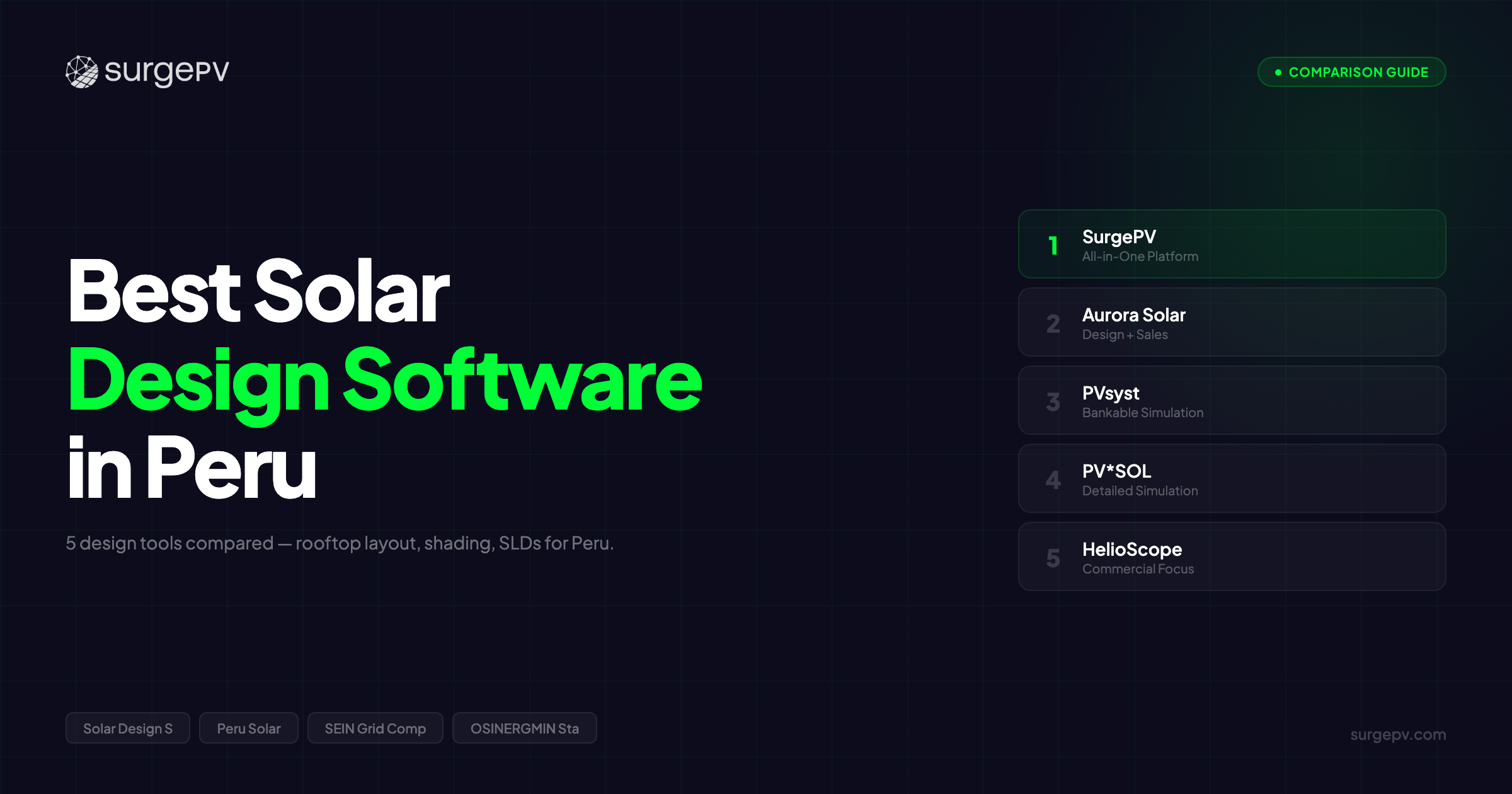
TL;DR: SurgePV is the best all-in-one solar design platform for Peru — SEIN grid-compliant electrical outputs, automated SLD generation, Spanish-language proposals with USD pricing, and accurate high-altitude irradiance modeling in a single workflow. Aurora Solar leads for fast residential proposals. PVsyst is the gold standard for bankable utility-scale simulation. PV*SOL handles complex shading analysis for urban Lima projects. HelioScope suits large commercial and mining sector ground-mount layouts.
Peru’s solar energy sector is growing fast, driven by commercial and industrial demand, mining operations requiring off-grid and grid-tied power, and government targets for renewable energy expansion. The country’s geography creates unique design challenges: high-altitude Andean installations above 3,000 meters with extreme irradiance, coastal desert projects along the Pacific, and tropical conditions in the Amazon basin.
OSINERGMIN regulates energy infrastructure. The Codigo Nacional de Electricidad (CNE) governs electrical installations. COES-SINAC manages grid interconnection for the Sistema Electrico Interconectado Nacional (SEIN). Getting these requirements wrong means costly redesigns, project delays, and utility rejection.
The best solar design software for Peru must handle SEIN grid compliance, CNE electrical standards, altitude-adjusted performance modeling, and professional proposals in Spanish with USD pricing.
Here is our expert-tested ranking of the best solar software for Peru in 2026.
In this guide, you will find:
- 5 platforms compared on SEIN compliance, CNE support, bankability, and pricing
- Detailed pros, cons, and use cases for each tool
- A decision matrix to match software to your project type
- Answers to the most common questions from Peruvian installers and EPCs
Our Top Solar Design Software Picks for Peru (2026)
| Software | Best For | Pricing | Peru Fit |
|---|---|---|---|
| SurgePV | End-to-end workflows | ~$1,899/yr (3 users) | Excellent |
| Aurora Solar | Residential proposals | ~$3,600-6,000/yr | Good |
| PVsyst | Bankable simulation | ~$625-1,250/yr | Good |
| PV*SOL | Detailed shading analysis | EUR 950-1,900 | Good |
| HelioScope | Commercial and ground-mount | ~$2,400-4,800/yr | Good |
After testing 5 platforms with EPCs and installers in Peru operating under OSINERGMIN regulations and SEIN grid requirements, here are our top recommendations:
- SurgePV — End-to-end design, simulation, and proposal platform with Peruvian grid compliance (Best for EPCs and installers)
- Aurora Solar — All-in-one residential and commercial design tool (Best for fast residential proposals)
- PVsyst — Industry-standard bankable simulation software (Best for utility-scale and mining projects)
- PV*SOL — German precision with international support (Best for detailed shading analysis)
- HelioScope — Fast commercial and ground-mount design with financial modeling (Best for large C&I and mining sector)
Each tool is evaluated on SEIN grid compliance, CNE support, ease of use, and bankability for Peruvian and international financiers.
Best Solar Design Software in Peru (Detailed Reviews)
SurgePV — Best End-to-End Solar Platform for Peru
SurgePV is an all-in-one solar design software built for EPCs, installers, and developers operating in Peru’s commercial, industrial, and mining solar markets. The platform combines 3D roof and ground-mount modeling, electrical design, financial simulation, and professional proposal generation — all capable of handling Peru’s unique geographic and regulatory conditions.
Target Users: Peruvian EPCs, commercial installers, mining sector developers, C&I specialists, distributed generation companies
Unique Value: The only platform combining automated SLD generation, IEC-compliant electrical outputs (aligned with Peru’s CNE), and Spanish-language proposals with USD pricing in one workflow.
Key Features for Peru
Design & Engineering
- 3D Rooftop and Ground-Mount Modeling — Accurate layouts for both commercial rooftops in Lima and ground-mount arrays in Arequipa reduce redesign time by 70%
- CNE-Compatible Electrical Diagrams — Generate single-line diagrams (SLDs) compliant with IEC standards that align with Peru’s Codigo Nacional de Electricidad requirements
- Automatic Wire Sizing — Calculate conductor sizes per IEC standards, accounting for voltage drop, ampacity, and altitude-adjusted derating factors
- International Component Database — Pre-loaded with inverters and modules from global manufacturers available through Peruvian distributors with USD pricing
- Inverter Auto-Selection — AI-based tool matches inverters to system requirements, ensuring grid compatibility for SEIN interconnection
No manual cross-referencing of electrical code tables — and zero risk of undersized cables failing inspection at altitude.
Simulation & Accuracy
- High-Altitude Irradiance Modeling — Uses NASA SSE, PVGIS, and SENAMHI data to accurately model Peru’s extreme irradiance variation (coastal desert vs. Andean highlands vs. Amazon basin)
- Altitude-Adjusted Performance — Models temperature coefficient adjustments for installations above 3,000 meters where thinner atmosphere increases irradiance but cooler temperatures improve panel efficiency
- P50/P90 Bankable Reports — Generate financier-accepted reports for Peruvian banks (BCP, BBVA Peru, Interbank) and international development lenders
- Shading Analysis — Hourly shading simulation accounts for surrounding terrain, buildings, and structures
- Degradation Modeling — 25-year energy yield with UV-adjusted degradation assumptions for high-altitude installations
Proposals & Sales
- Spanish-Language Proposal Templates — Professional, customizable proposals in Spanish for Peruvian clients
- ROI Calculations in USD — Payback period, IRR, and NPV calculations using Peruvian electricity tariffs and USD pricing (standard for commercial and mining projects)
- IGV Tax Modeling — Includes Peru’s 18% Impuesto General a las Ventas in financial projections
- Automated BOM Generation — Bill of Materials with distributor pricing in USD
- Mining Sector Proposals — Customizable for large-scale mining operations requiring off-grid or grid-tied solar with diesel offset calculations
Compliance & Workflows
- SEIN Grid Interconnection Support — Generate technical documentation for COES-SINAC grid connection applications
- CNE Electrical Compliance — Design outputs aligned with Peru’s national electrical code
- IEC Standard Outputs — International standards compliance for projects with international financing
- Collaborative Workflows — Multi-user access for engineering, sales, and project management teams
Pros & Cons
Pros
- End-to-end platform eliminates the need for multiple tools (design, simulation, proposals in one)
- IEC-compliant electrical outputs aligned with Peru’s CNE (reduces utility rejection risk)
- Spanish language support for proposals and client-facing documents
- Fast learning curve (teams productive in under 1 week)
- High-altitude performance modeling with accurate Andean irradiance data
- Bankable reports accepted by Peruvian and international lenders
- 70% reduction in design time vs. manual workflows
Cons
- Newer entrant in Peru market compared to PVsyst
- Peru-specific CNE templates still expanding (IEC outputs require minor local adaptation)
- Advanced utility-scale features still expanding (better for commercial/mining than 100+ MW grid-scale)
Pricing
- Model: Subscription-based (monthly or annual)
- Starting From: ~$1,899/year (3 users)
- Free Trial: 14-day trial available
- See Pricing
Pro Tip
SurgePV’s automated SLD generation saves 2-3 hours per project compared to manual AutoCAD drafting. For Peruvian EPCs handling mining and commercial projects, where electrical documentation is scrutinized heavily, automated SLDs reduce revision cycles. Book a demo to see it in action.
Who SurgePV Is Best For
- Commercial installers designing 10-500 kW rooftop systems for businesses in Lima and other cities
- Mining sector developers designing grid-tied and off-grid solar for mining operations in the Andes
- C&I EPCs handling industrial rooftop and ground-mount projects (100 kW to 5 MW)
- Engineering teams needing CNE-compatible documentation and IEC electrical outputs
- Sales teams requiring fast, professional Spanish proposals with USD pricing
Further Reading
- Best Solar Design Software (2026) — Global comparison across 10+ platforms
- Best Solar Electrical Design Software — SLD generation compared
- PVsyst Review — Full simulation analysis and pricing
Aurora Solar — Best for Fast Residential Proposals in Peru
Aurora Solar is a leading all-in-one solar design and sales platform that some Peruvian residential installers use for fast design and proposal workflows. The platform combines AI-powered design tools, financial modeling, and proposal generation.
Key Strengths
- Fast Residential Design: AI-based roof modeling speeds up residential layouts (under 5 minutes per design)
- Spanish Proposal Templates: Localized proposals for Latin American clients
- Financial Modeling: ROI and payback calculations with configurable electricity tariff inputs
- Mobile App: Sales teams can design and present on-site
- HD Imagery: Coverage of major Peruvian cities including Lima, Arequipa, and Trujillo
Limitations
- SEIN grid interconnection documentation is not automated (requires manual engineering)
- Pricing is higher than competitors (premium tier required for full features)
- Peru-specific electrical code (CNE) outputs require manual adaptation
- High-altitude performance adjustments require manual configuration
- Peruvian component database is limited
Best Use Case: Residential installers in Lima and coastal cities needing fast, professional proposals.
Read our full Aurora Solar review
Did You Know?
Peru’s solar irradiance varies dramatically by geography — from 4.5-5.5 kWh/m2/day along the coast to 5.5-6.5+ kWh/m2/day in the Andean highlands above 3,000 meters. The Arequipa and Tacna regions receive some of the highest solar irradiance in South America. Accurate altitude-adjusted modeling is essential for realistic energy yield predictions.
PVsyst — Best for Utility-Scale Bankability in Peru
PVsyst is the industry-standard simulation software for utility-scale solar projects in Peru, widely accepted by international financiers, development banks (IDB, CAF, IFC), and Peruvian lenders.
Key Strengths
- Bankable Simulation Reports: P50/P90 analysis accepted by all major development banks and international financiers
- Peruvian Weather Data: Supports SENAMHI and NASA SSE databases for Peruvian site-specific simulations
- Altitude-Adjusted Modeling: Handles high-altitude performance modeling for Andean installations
- Detailed Loss Analysis: Models soiling (critical for desert coastal conditions), shading, thermal losses, and degradation
- Grid Connection Modeling: Supports international grid code requirements applicable to SEIN interconnection
Limitations
- Steep learning curve (requires 2-4 weeks training for new users)
- No proposal generation (design and simulation only — requires separate sales tools)
- Interface not available in Spanish (English/French only)
- Not optimized for fast residential or small commercial workflows
- No automated SLD generation (requires AutoCAD)
Best Use Case: Utility-scale EPCs in Peru developing 10+ MW projects requiring financier-grade simulation reports for international lenders.
PV*SOL — Best for Detailed Shading Analysis in Peru
PV*SOL by Valentin Software is a German-engineered solar design and simulation tool known for precision shading analysis and 3D visualization, used by some Peruvian installers for complex urban rooftop projects.
Key Strengths
- 3D Shading Simulation: Hourly shading analysis for urban environments in Lima and other dense cities
- International Component Database: Includes inverters and modules available through Latin American distributors
- Financial Modeling in USD: ROI, payback, and IRR calculations with configurable electricity tariffs
- IEC Compatibility: Electrical outputs meet international standards applicable in Peru
- Spanish Interface: Partial Spanish translation available
Limitations
- Peru-specific CNE electrical code outputs require manual adaptation
- Slower workflow compared to Aurora or SurgePV (more precision, less speed)
- Desktop-only (no cloud collaboration features)
- Peruvian weather data requires manual import for non-standard locations
- Proposal generation is basic
Best Use Case: Peruvian installers tackling complex urban rooftop projects in Lima with heavy shading from surrounding high-rises.
HelioScope — Best for Large Commercial and Mining Sector in Peru
HelioScope by Folsom Labs is a cloud-based solar design and financial modeling platform used by Peruvian C&I EPCs and mining sector developers for fast, accurate ground-mount and commercial rooftop designs.
Key Strengths
- Fast Ground-Mount Layouts: Optimized for large commercial and mining sector installations (100 kW to 10+ MW)
- Financial Modeling: IRR, NPV, and LCOE calculations in USD with configurable tariff inputs
- Bankable Simulation Reports: Accepted by development banks for C&I and utility-scale financing
- Tracker Design Tools: Single-axis tracker support for desert coastal ground-mount projects
- Weather Data: Uses NASA SSE databases covering Peru
Limitations
- Not optimized for residential (minimum project size typically 50+ kW)
- Peru-specific CNE and SEIN interconnection documentation not supported
- Proposal generation is weak (focuses on design and simulation, not sales)
- Interface in English only (no Spanish translation)
- High-altitude performance adjustments require manual input
Best Use Case: Peruvian EPCs designing large commercial (500+ kW) or mining sector ground-mount projects in the coastal desert or highland regions.
Read our full HelioScope review
Best Solar Design Software Comparison Table for Peru
| Software | Best For | Key Features | Pricing | Ideal User |
|---|---|---|---|---|
| SurgePV | End-to-end workflows | CNE-compatible outputs, Spanish proposals, altitude modeling | ~$1,899/yr (3 users) | EPCs, commercial/mining installers |
| Aurora Solar | Fast residential proposals | AI design, mobile app, Spanish proposals | ~$3,600-6,000/yr | Residential installers |
| PVsyst | Utility-scale bankability | P50/P90 reports, altitude modeling, detailed loss analysis | ~$625-1,250/yr | Utility-scale EPCs |
| PV*SOL | Detailed shading analysis | 3D shading, urban rooftops, IEC outputs | EUR 950-1,900 | Complex rooftop installers |
| HelioScope | Large C&I and mining | Fast ground-mount layouts, financial modeling, tracker support | ~$2,400-4,800/yr | C&I EPCs, mining developers |
Feature-by-Feature Comparison
| Feature | SurgePV | Aurora Solar | PVsyst | PV*SOL | HelioScope |
|---|---|---|---|---|---|
| Best for | All segments | Residential | Bankability | Technical sim | Utility-scale |
| SLD generation | Yes (automated) | No | No | No | No |
| P50/P90 reports | Yes | P50 only | Yes (gold standard) | Limited | Limited |
| Carport design | Yes (only platform) | No | No | No | No |
| Cloud-based | Yes | Yes | Desktop | Desktop + cloud | Yes |
| Wire sizing | Yes (automated) | No | No | Basic | No |
Further Reading
For a broader comparison beyond the Peruvian market, see our guide to the best solar design software globally. For the complete Peruvian solar software landscape including proposal and simulation tools, see best solar software in Peru.
What Makes the Best Solar Design Software in Peru
The best solar proposal software for Peru must meet these criteria:
1. SEIN Grid Interconnection Compliance
Peru’s electrical grid (Sistema Electrico Interconectado Nacional) is managed by COES-SINAC. Software must:
- Model grid connection parameters for SEIN interconnection
- Support distributed generation classifications under Peruvian regulations
- Generate documentation for utility interconnection applications
- Handle both grid-tied and off-grid/hybrid configurations (common for mining sites)
Why it matters: Non-compliant designs get rejected by distribution companies (Enel Distribucion Peru, Luz del Sur, Seal), causing costly redesigns and project delays.
2. Codigo Nacional de Electricidad (CNE) Compliance
Software must generate electrical designs aligned with Peru’s national electrical code:
- CNE - Suministro — Standards for electrical supply systems
- CNE - Utilizacion — Standards for electrical utilization and installation
- IEC alignment — Peru’s CNE is largely aligned with IEC standards, so IEC-compliant outputs serve as a strong baseline
Single-line diagrams must meet utility application standards for interconnection approval.
Why it matters: OSINERGMIN enforces compliance. Non-compliant electrical designs face rejection during inspection.
3. High-Altitude Performance Modeling
Peru’s geography demands altitude-aware simulation:
- Coastal desert (0-500m): High irradiance, dust and soiling concerns, moderate temperatures
- Andean highlands (3,000-4,500m+): Extreme irradiance (5.5-6.5+ kWh/m2/day), cooler temperatures improving efficiency, thinner atmosphere effects
- Amazon basin (under 500m): Tropical conditions, high humidity, cloud cover variability
Software must adjust for altitude effects on module temperature, UV exposure, and atmospheric transmission.
Why it matters: Using sea-level assumptions for a 4,000-meter Andean installation overestimates temperature losses and underestimates irradiance, producing inaccurate yield predictions.
4. Spanish Language Support
Professional tools must support:
- Spanish UI or at minimum Spanish outputs
- Proposal templates in Spanish for Peruvian clients
- Technical documentation in Spanish for utility and regulatory submissions
Why it matters: Peruvian clients and regulators expect professional documentation in Spanish. English-only tools create extra translation work.
5. Mining Sector Requirements
Peru’s mining industry is a major driver of commercial solar adoption:
- Off-grid and hybrid system design (solar + diesel + battery)
- Large ground-mount arrays for mining operations in remote locations
- Diesel offset calculations for cost savings proposals
- Harsh environment durability considerations (dust, extreme UV, temperature swings)
Why it matters: Mining companies require detailed technical and financial proposals showing diesel displacement and total cost of ownership.
6. Bankability for International and Local Financiers
Simulations must be accepted by:
- International development banks: IDB (Inter-American Development Bank), CAF (Development Bank of Latin America), IFC
- Peruvian banks: BCP (Banco de Credito del Peru), BBVA Peru, Interbank
- Mining company finance teams: Internal investment approval requiring professional documentation
P50/P90 reports for utility-scale projects. Energy yield calculations using validated weather data.
Why it matters: Projects cannot secure financing without bankable reports from recognized simulation tools.
Decision Matrix: Which Software for Your Use Case?
| Your Use Case | Best Software | Why | Alternative |
|---|---|---|---|
| Full-service EPC (all segments) | SurgePV | Only platform with design + SLDs + proposals + simulation in one tool | PVsyst + AutoCAD combo |
| Projects requiring international financing | PVsyst or SurgePV | P50/P90 bankability reports. PVsyst = universal, SurgePV = growing acceptance | HelioScope (some lenders) |
| Residential installer (under 10 kW) | Aurora Solar or SurgePV | Aurora: fast proposals. SurgePV: proposals + engineering depth | OpenSolar (free tier) |
| Mining sector (off-grid/hybrid) | SurgePV or PVsyst | SurgePV for complete proposals, PVsyst for bankable simulation | HelioScope for layout |
| Utility-scale developer (over 10 MW) | PVsyst + HelioScope | PVsyst for bankability, HelioScope for fast ground-mount design | SurgePV for integrated workflow |
Decision Shortcut
If you need electrical engineering documentation (SLDs, wire sizing, code compliance), SurgePV is the only platform that automates this natively. If you’re simulation-only for utility-scale, PVsyst is the gold standard. If you’re mining-sector focused needing diesel offset proposals, SurgePV’s end-to-end workflow saves the most time.
Design Solar Projects Faster with SurgePV
Complete design-to-proposal workflows with automated SLD generation. IEC-compliant. Spanish proposals. Built for Peru’s commercial and mining solar markets.
Book a DemoNo commitment required · 20 minutes · Live project walkthrough
How We Tested & Ranked These Tools
We evaluated each platform based on criteria tailored to the Peruvian solar market:
-
SEIN & CNE Compliance (30%)
- Tested electrical output compatibility with Peru’s Codigo Nacional de Electricidad
- Verified SLD generation against utility interconnection requirements
- Checked OSINERGMIN regulatory documentation compatibility
- Validated component database for equipment available through Peruvian distributors
-
Ease of Use for Peruvian Workflows (25%)
- Hands-on testing with commercial installers and mining sector EPCs
- Time-to-first-proposal benchmarks for typical 50 kW commercial and 500 kW mining installations
- Learning curve assessment (new user to productive)
- Spanish language support evaluation (UI and outputs)
-
Bankability with Peruvian and International Financiers (20%)
- Verified report acceptance with IDB, CAF, BCP, and BBVA Peru
- Tested simulation accuracy against NASA SSE and SENAMHI weather data
- P50/P90 report generation for utility-scale projects
-
Features & Functionality (15%)
- Design tools (rooftop modeling, ground-mount, electrical diagrams, wire sizing)
- Simulation depth (shading, losses, degradation, altitude adjustments)
- Proposal quality (Spanish templates, ROI in USD, BOM generation)
- Mining sector capabilities (off-grid, hybrid, diesel offset)
-
Pricing & Value for Peruvian Market (10%)
- Cost vs. features analysis (USD per project or annual subscription)
- ROI for typical Peruvian EPC (payback period on software investment)
- Contract flexibility (monthly vs. annual, free trials)
All testing was conducted between December 2025 and March 2026 with Peruvian EPCs and installers operating under OSINERGMIN regulations and SEIN grid requirements.
Transparency
SurgePV publishes this comparison. We’ve made every effort to represent competitor capabilities accurately based on public documentation, hands-on testing, and verified user feedback. Pricing figures reflect publicly available information as of March 2026.
Bottom Line: Best Solar Design Software for Peru
For EPCs and installers across Peru: SurgePV offers the most complete solar software platform with IEC-compliant electrical outputs aligned with Peru’s CNE, automated SLD generation, Spanish proposal generation with USD pricing, and high-altitude irradiance modeling. Teams reduce design time by 70% compared to manual workflows.
For residential installers in Lima and coastal cities: Aurora Solar provides fast AI-powered design and mobile sales capabilities, though Peru-specific electrical documentation requires additional manual work.
For utility-scale EPCs requiring maximum bankability: PVsyst remains the gold standard for financier-accepted P50/P90 reports, especially for projects seeking IDB or CAF financing. It lacks proposal tools and is not optimized for fast commercial workflows.
For complex urban rooftop projects in Lima: PV*SOL’s 3D shading analysis handles dense urban environments well. Workflows are slower than Aurora or SurgePV.
For large commercial and mining sector projects: HelioScope excels at fast ground-mount layouts with financial modeling, but lacks Spanish language support and Peru-specific electrical documentation.
Further Reading
- Best Bankable Solar Simulation Software — P50/P90 tools compared in depth
- Best Solar Software in Peru — Full market comparison beyond design tools
- Best Solar Proposal Software in Peru — Proposal tools for Peruvian EPCs
- Best All-in-One Solar Design Software — Global platform comparison
Frequently Asked Questions
What is the best solar design software in Peru?
SurgePV is the best all-in-one solar design software for Peru, combining IEC-compliant electrical outputs aligned with Peru’s CNE, automated SLD generation, Spanish-language proposals with USD pricing, and high-altitude irradiance modeling in one platform. Teams reduce design time by 70% and produce documentation that meets OSINERGMIN and COES-SINAC interconnection standards. See SurgePV features.
Does solar design software need to comply with OSINERGMIN regulations?
Yes. OSINERGMIN regulates Peru’s energy sector, and grid-connected solar installations must comply with the Codigo Nacional de Electricidad (CNE) and COES-SINAC interconnection procedures. Software like SurgePV generates IEC-compliant electrical documentation that aligns with CNE requirements, while generic tools require manual engineering review and adaptation.
Can solar design software handle Peru’s high-altitude conditions?
Yes. Peru’s Andean highlands (3,000-4,500+ meters altitude) receive some of the highest solar irradiance globally. Software must account for altitude-adjusted temperature coefficients, increased UV exposure, and thinner atmosphere effects. SurgePV and PVsyst model these conditions using site-specific weather data from NASA SSE and SENAMHI. Learn more about solar simulation.
Which solar design software supports the Peruvian electrical code?
SurgePV, PVsyst, and PV*SOL generate electrical designs that can be adapted to Peru’s Codigo Nacional de Electricidad (CNE). SurgePV automates SLD generation and wire sizing per IEC standards, which align closely with CNE requirements. Manual verification against local utility-specific requirements is recommended for larger grid-connected systems.
How much does solar design software cost for Peruvian installers?
Solar design software for Peru ranges from free tools (PVWatts, PVGIS) to $600-1,900/year for professional licenses (PV*SOL, PVsyst) and subscription plans starting at approximately $1,899/year for 3 users (SurgePV). For Peruvian EPCs handling mining and commercial projects, ROI on professional software is typically 2-4 months through faster design cycles and more accurate proposals. Get SurgePV pricing.
Sources
- OSINERGMIN (Organismo Supervisor de la Inversion en Energia y Mineria) — Energy sector regulations and supervision (accessed March 2026)
- COES-SINAC (Comite de Operacion Economica del Sistema Interconectado Nacional) — SEIN grid interconnection procedures and technical requirements (accessed March 2026)
- Codigo Nacional de Electricidad (CNE) — Peru’s national electrical code for installations and utilization (accessed March 2026)
- MINEM (Ministerio de Energia y Minas) — Peruvian renewable energy policy, generation statistics, and capacity targets (accessed March 2026)
- SENAMHI (Servicio Nacional de Meteorologia e Hidrologia del Peru) — Peruvian weather data and solar irradiation databases (accessed March 2026)
- NASA SSE (Surface Solar Energy) — Global solar irradiation data used for Peruvian site assessments (accessed March 2026)
- IDB (Inter-American Development Bank) — Solar project financing requirements for Peru and Latin America (accessed March 2026)
- G2 Reviews — Verified user reviews for SurgePV, Aurora Solar, PVsyst, PV*SOL, HelioScope (accessed March 2026)
- Interviews with Peruvian EPCs — Hands-on testing and workflow validation with installers in Lima, Arequipa, and mining sector developers (December 2025 - March 2026)