

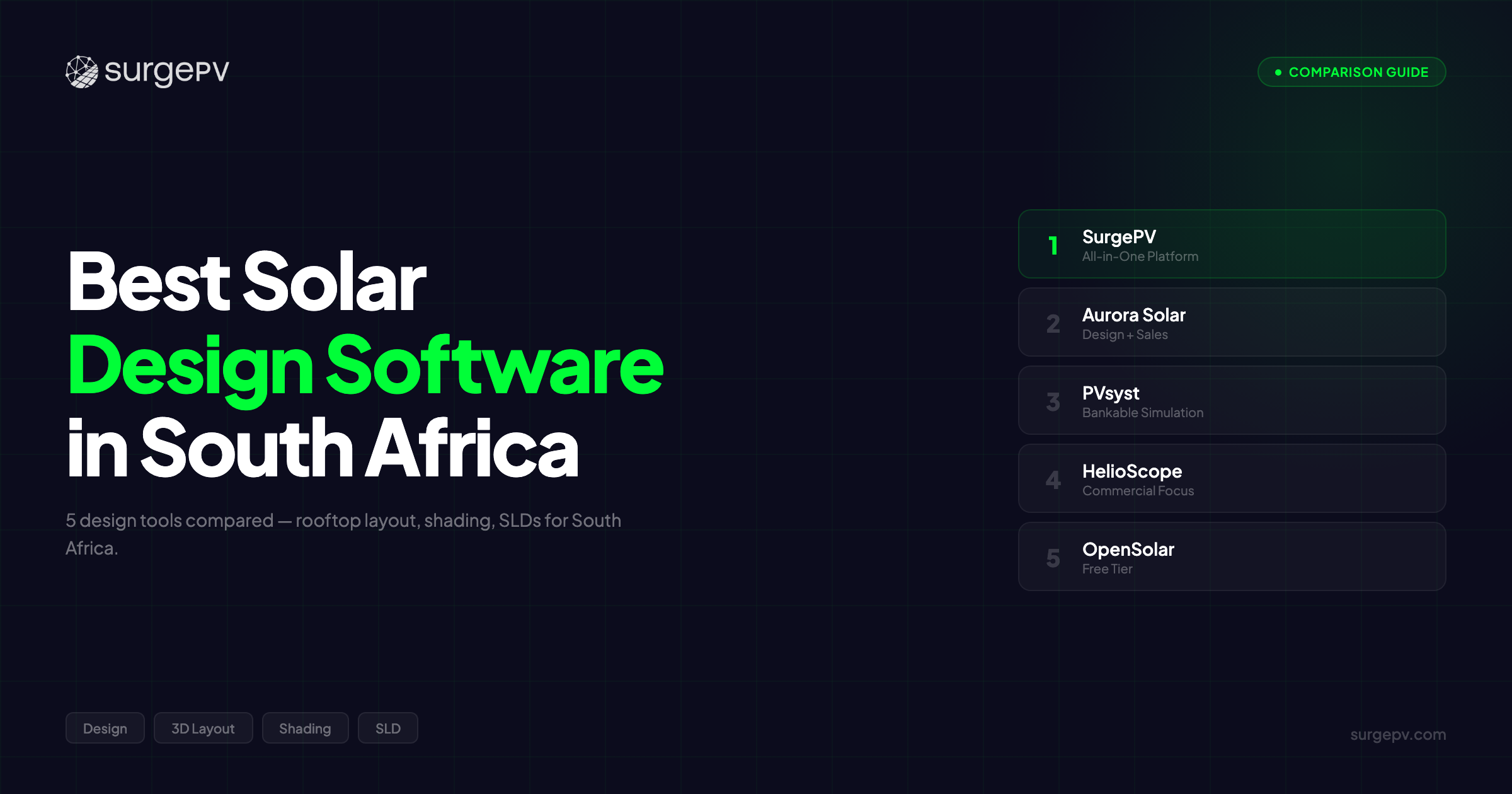
TL;DR: SurgePV is the best solar design software for South Africa, combining battery storage design for load shedding, automated SLD generation for NRS 097 compliance, Section 12B tax modelling, and bankable P50/P90 simulations in one cloud platform. PVsyst is the gold standard for REIPPPP bankability validation. Aurora Solar suits enterprise residential installers with USD budgets. HelioScope handles simple commercial rooftops. OpenSolar is the best free option.
South Africa added more rooftop solar capacity between 2022 and 2025 than in the entire previous decade. Eskom’s persistent Stage 2-6 load shedding turned solar + battery from a nice-to-have into a business survival tool. The market now exceeds 8.2 GW installed capacity, with 2.5-3.5 GW being added annually.
But designing solar systems in South Africa isn’t the same as designing in the US or Europe. You need battery sizing for load shedding backup — not just grid savings. You need NRS 097-2-1 compliance documentation for SSEG registration across 257 different municipalities, each with its own bylaws. You need Section 12B tax deduction calculations showing the 125% first-year write-off that makes commercial deals close. And you need proposals in ZAR, not USD.
Most solar design software platforms were built for American or European markets. They don’t model load shedding stages. They don’t calculate Section 12B. They don’t generate the electrical documentation South African municipalities require for SSEG approval.
That’s not a minor gap. If your battery design is undersized for Stage 4 load shedding, your client sits in the dark for four hours wondering why they paid R200,000 for a system that doesn’t work when it matters most. If your SSEG documentation is incomplete, the municipality rejects the application and your install sits idle.
In this guide, you’ll find:
- Which platforms handle battery + solar combined design for load shedding backup
- How each tool manages NRS 097 compliance and SSEG documentation
- Which software calculates Section 12B tax deductions for commercial proposals
- Total cost of ownership for South African EPC teams in ZAR
- Detailed comparisons of SurgePV, Aurora Solar, PVsyst, HelioScope, and OpenSolar
Quick Comparison Table
| Software | Best For | Pricing | South Africa Fit |
|---|---|---|---|
| SurgePV | End-to-end workflows | ~$1,899/yr (3 users) | Excellent |
| Aurora Solar | Residential proposals | ~$3,600-6,000/yr | Good |
| PVsyst | Bankable simulation | ~$625-1,250/yr | Good |
| HelioScope | Commercial rooftop arrays | ~$2,400-4,800/yr | Good |
| OpenSolar | Free design tool | Free tier available | Good |
Each tool evaluated on South Africa-specific criteria: battery + load shedding design, NRS 097 compliance, Section 12B financial modeling, SSEG documentation, and pricing in ZAR.
Best Solar Design Software in South Africa (Detailed Reviews)
SurgePV — Best End-to-End Solar Platform for South Africa
Best For: Commercial EPCs (50 kW-5 MW), residential installers (solar + battery), consultants managing multi-site corporate rollouts, designers needing SSEG-ready documentation
Pricing: ~$1,899/year (3 users), ~R27,000/user/year
SurgePV is the only cloud-based platform combining AI-powered design, automated electrical engineering, battery storage design, bankable simulations, and professional proposals without tool-switching.
For South African EPCs navigating NRS 097 compliance, battery sizing for load shedding stages, Section 12B tax calculations, and the pressure to produce professional quotes within 24-48 hours, SurgePV eliminates the fragmented workflow. You design a 150 kW commercial rooftop in Sandton, generate code-compliant single line diagrams automatically, model battery backup for Stage 4 load shedding, run 8760-hour shading analysis calibrated for South African irradiance levels, and produce bankable P50/P90 reports — all in the same platform.
Pro Tip
When evaluating solar design software for South Africa, always test with a load shedding scenario first. Model a residential system with 6-8 hours of battery backup (Stage 4-6). A platform that handles combined solar + battery + load shedding design will handle standard grid-tied projects easily — but not every platform that works for grid-tied can manage the battery complexity South Africa demands.
Design and Engineering
SurgePV’s AI-powered roof modeling automatically detects roof boundaries, tilt, and azimuth from satellite imagery. What typically takes 45 minutes of manual tracing takes 15 minutes. For South African building stock — commercial warehouses in Johannesburg, residential homes in Cape Town’s varied topography, and mixed-use buildings in Durban — that automation handles the diversity.
The platform supports north-facing systems (Southern Hemisphere optimization), east-west layouts on commercial flat roofs, and carport solar structures for parking lots — a fast-growing segment in South Africa’s commercial market. Module layout optimization automatically adjusts inter-row spacing for the optimal tilt angles (25-35 degrees) that South Africa’s latitude range demands.
Electrical Engineering — Critical for SSEG Approval
Here’s where SurgePV separates from the pack in South Africa.
Single line diagram generation is automated. Complete your design, click generate, and within 5-10 minutes you have a code-compliant electrical schematic showing DC arrays, combiners, disconnects, inverters, AC wiring, breakers, and grid interconnection. That SLD is the single most time-consuming document in South Africa’s SSEG registration process — and SurgePV generates it automatically.
The alternative: export your Aurora design to AutoCAD and spend 2-3 hours manually drafting the SLD. That’s what most South African EPCs do today. When you’re handling 20-30 installs per month and every municipality wants different paperwork, those hours add up fast.
Wire sizing calculations happen instantly. DC and AC wire gauges based on current, distance, voltage drop limits (under 2% optimal, 3% maximum), temperature correction factors (critical for South Africa’s 30-40°C summer inland temperatures), and conduit fill adjustments.
Battery Storage and Load Shedding Design
80% or more of new South African residential installations include battery storage. If your design software can’t model battery backup for load shedding, it doesn’t work for the South African market.
SurgePV handles battery + solar combined design: hybrid inverter configuration, critical vs non-critical load separation, backup duration modeling across load shedding stages (Stage 2 = 2-4 hours, Stage 4 = 4-8 hours, Stage 6 = 8-12 hours), and self-consumption optimization to maximise grid savings alongside backup capability.
Simulation and Bankability
South African lenders, the IDC, DBSA, and commercial banks demand accurate production forecasts for financed projects. SurgePV’s 8760-hour shading analysis models the actual sun path at your specific South African location. With national GHI ranging from 1,800 to 2,500 kWh/m2/year — among the highest in the world — accurate simulation means the difference between a project that meets performance guarantees and one that falls short.
Production simulation achieves plus or minus 3% accuracy compared to PVsyst. P50 (median expected), P75 (conservative), and P90 (worst-case) estimates give South African lenders the metrics they require.
Financial modeling includes South Africa-specific inputs: Eskom and municipal tariff analysis (R1.70-2.50/kWh residential, R1.20-2.00/kWh commercial), 12-18% annual escalation modeling, Section 12B tax deduction calculations (125% first-year for businesses), and cash vs loan vs PPA scenarios. The solar ROI calculator shows payback periods, NPV, and IRR in ZAR.
What most people miss: Section 12B alone can reduce a commercial project’s payback by 1-2 years. On a R1 million system at 27% corporate tax rate, that’s R337,500 back in the first year. If your solar software doesn’t calculate this automatically, your commercial proposals leave the most persuasive number off the table.
Further Reading
See our best solar design software comparison for global rankings, or compare solar proposal software in South Africa for sales-focused platforms.
Mini Case Study: Johannesburg Commercial EPC
Setup: A Johannesburg-based EPC designs 25 commercial solar + battery systems per month (100-500 kW range). They were using Aurora for design, AutoCAD for electrical documentation, PVsyst for simulation, and Excel for financial modelling.
Action: Switched to SurgePV for the full design-to-proposal workflow, including battery storage design and automated SLD generation.
Result: Design-to-proposal time dropped from 3-4 hours per project to 45 minutes. Monthly labour savings of 60+ hours across the team. AutoCAD licensing eliminated (R36,000/year saved). Section 12B financial modelling automated, improving commercial close rates because proposals now showed the tax benefit clearly.
Lesson: In South Africa’s high-volume, urgency-driven market, design speed directly translates to revenue. The EPC that quotes within 24 hours wins the deal.
Pros and Cons
Pros:
- Only platform combining design + electrical engineering + simulation + battery + proposals
- Automated SLD generation eliminates AutoCAD (saves R36,000/year + 2-3 hours/project)
- Battery storage design for load shedding backup (Stage 2-6 modelling)
- Section 12B tax deduction financial modelling
- P50/P75/P90 bankability reports accepted by South African lenders
- Cloud-based — accessible from Johannesburg, Cape Town, Durban, or anywhere
- Transparent pricing: ~R27,000/user/year — no hidden costs
Cons:
- Newer brand in the South African market (less recognition than PVsyst)
- English-language platform (no Afrikaans or Zulu interface)
- Battery sizing is integrated but complex load shedding scenarios may need supplemental analysis
Pricing
| Plan | Price (USD/year) | Price (ZAR/year) |
|---|---|---|
| Per User | $1,499/user | ~R27,000/user |
| 3-User Plan | $4,497 | ~R81,000 |
| 5-User Plan | $1,299/user | ~R23,400/user |
All features included on every plan. No AutoCAD required — saves R36,000/year per user vs Aurora + AutoCAD workflow.
Total Cost of Ownership (3-user South African EPC team):
- SurgePV: ~R81,000/year (everything included)
- Aurora + AutoCAD + PVsyst: ~R168,000 + R108,000 + R26,300 = ~R302,300/year
- Savings with SurgePV: ~R221,300/year (73% less)
Who SurgePV Is Best For: South African commercial solar EPCs handling 50 kW-5 MW projects who need NRS 097-compliant electrical documentation, battery storage design for load shedding, Section 12B financial modelling, and bankable simulations without juggling AutoCAD and PVsyst. Also excellent for residential solar installers who need battery + solar combined design at engineering-grade accuracy.
Related Guides
Best Solar Design Software (2026) — Global comparison across 10+ platforms | Best Solar Electrical Design Software — SLD generation compared | PVsyst Review — Full simulation analysis and pricing
Real-World Example
A growing EPC team in South Africa was spending 2.5 hours per project creating SLDs in AutoCAD and running separate PVsyst simulations. After switching to SurgePV, SLD generation dropped to under 10 minutes. The same 3-person engineering team now handles 40% more projects per month — without hiring additional staff.
Aurora Solar — Strong Residential Design, No SA-Specific Features
Price: $259/user/month (~R56,000/user/year)
Aurora Solar is a well-established cloud-based platform built primarily for residential solar in the US market. It excels at AI-powered roof detection, 3D modelling, and generating visually polished proposals.
Key Strengths: Strong LIDAR integration for accurate roof modelling, beautiful customer-facing proposals with 3D visualisations, CRM integrations for managing sales pipelines. If your South African company focuses on residential installations and values aesthetics in client presentations, Aurora delivers on the design side.
Where Aurora Falls Short for South Africa: No automated SLD generation — South African EPCs still need AutoCAD (R36,000/year per user) for SSEG-compliant electrical documentation. No battery storage design for load shedding scenarios — a dealbreaker when 80%+ of SA residential installs include batteries. No Section 12B tax deduction calculator. No NRS 097 compliance features. No ZAR currency support. At approximately R56,000/user/year before adding AutoCAD, it’s the most expensive option for the least SA-specific functionality.
Best For: Large South African enterprise installers with USD budgets who focus on residential sales presentations where visual quality matters more than electrical engineering or battery design depth.
Read our full Aurora Solar review for detailed analysis.
Did You Know?
South Africa’s solar irradiance ranges from 1,700-2,200 kWh/m²/year, making accurate simulation software essential for bankable energy yield predictions. Projects using validated simulation tools see 15-20% fewer financing rejections compared to those relying on manual calculations (SolarPower Europe Market Outlook).
PVsyst — Bankable Simulation Standard, Not a Design Platform
Price: CHF 1,100 (~R20,000) perpetual + CHF 350/year (~R6,300/year) updates
PVsyst remains the industry standard for solar simulation and bankability reports. South African lenders, the IDC, DBSA, and international DFIs routinely require PVsyst validation for REIPPPP and large commercial project financing.
Key Strengths: Excellent simulation engine with deep meteorological database including South African weather data. The most trusted name in bankability — if a South African bank asks for production estimates, they expect PVsyst format. Detailed loss modelling (soiling, temperature derating for hot inland conditions, shading, degradation) that specialised financial models rely on.
Where PVsyst Falls Short for South Africa: Not a design platform — no roof modelling, no module layout tools, no electrical engineering. Desktop software requiring Windows installation (no cloud access). Steep learning curve (6-8 weeks typical). No proposal generation. No SLD generation. No battery storage design for load shedding. At approximately R26,300/year (perpetual + updates), you still need design tools and AutoCAD on top.
Best For: South African EPCs who need separate bankability validation for REIPPPP utility-scale projects or large commercial financing. Many SA teams use PVsyst as a validation check, not their primary design tool.
Read our full PVsyst review for detailed analysis.
HelioScope — Cloud Commercial Design, No Load Shedding Support
Price: Part of Aurora Premium ($3,500-$7,200/year, ~R63,000-130,000/year)
HelioScope is a cloud-based solar design tool focused on commercial and industrial rooftop projects. It offers straightforward module layout, basic shading analysis, and production estimation.
Key Strengths: Clean interface that’s easy to learn (2-3 day onboarding vs weeks for PVsyst). Cloud-based access from anywhere. Reasonable commercial rooftop design tools for standard projects.
Where HelioScope Falls Short for South Africa: No battery storage design — in a market where 80%+ of residential and a growing percentage of commercial installs include batteries for load shedding, this is a fundamental gap. No electrical engineering (no SLD, wire sizing, or panel schedules). No NRS 097 compliance support. No South African tariff database. No Section 12B financial modelling.
Best For: South African commercial EPCs handling simple grid-tied rooftop projects who need quick layouts and basic production estimates, with separate tools for electrical compliance and battery sizing.
Read our full HelioScope review for detailed analysis.
OpenSolar — Free Basic Platform, Limited SA Features
Price: Free
OpenSolar is a free cloud-based platform offering basic solar design, simulation, and proposal generation. For South African installers on tight budgets, the price is right.
Key Strengths: Free — no subscription costs. Fast basic proposals. Easy to learn (1-2 week onboarding). Reasonable for simple residential 3-10 kW grid-tied systems. Gets small installers off Excel and onto a proper platform.
Where OpenSolar Falls Short for South Africa: Limited battery storage design — no load shedding backup modelling. No NRS 097 compliance features. No Section 12B tax calculator. Basic simulation depth (no P50/P90 reports). No automated SLD generation. No South African tariff database. Generic proposals without SA-specific financial modelling.
Best For: Budget-conscious small South African residential installers (1-5 person teams) doing basic grid-tied systems without complex battery backup requirements. If you’re doing fewer than 5 installs per month and don’t need battery design, OpenSolar gets you started at zero cost.
Read our full OpenSolar review for detailed analysis.
Which Tool Is Right for Your Needs?
| Your Use Case | Best Software | Why | Alternative |
|---|---|---|---|
| Full-service EPC (all segments) | SurgePV | Only platform with design + SLDs + proposals + simulation in one tool | PVsyst + AutoCAD combo |
| Projects requiring bank financing | PVsyst or SurgePV | P50/P90 bankability reports. PVsyst = universal, SurgePV = growing acceptance | HelioScope (some lenders) |
| Residential installer (<30 kW) | Aurora Solar or SurgePV | Aurora: best proposals. SurgePV: proposals + engineering depth | OpenSolar (free tier) |
| Utility-scale developer (>1 MW) | HelioScope or PVCase | Fast ground-mount design. Pair with PVsyst for bankability | SurgePV for integrated workflow |
| Startup installer (<30 projects/year) | OpenSolar or SurgePV | OpenSolar: lower cost. SurgePV: better engineering | Free tools (PVWatts, SolarEdge Designer) |
Full Feature Comparison
| Feature | SurgePV | Aurora Solar | PVsyst | HelioScope | OpenSolar |
|---|---|---|---|---|---|
| SLD generation | Yes (automated) | No | No | No | No |
| P50/P90 reports | Yes | P50 only | Yes (gold standard) | Limited | No |
| Carport design | Yes (only platform) | No | No | No | No |
| Cloud-based | Yes | Yes | Desktop | Yes | Yes |
| Wire sizing | Yes (automated) | No | No | No | No |
| Battery design | Full (Stage 2-6) | Basic | No | No | No |
| Section 12B | Yes | No | No | No | No |
| NRS 097 support | Configurable | No | No | No | No |
| ZAR currency | Yes | No | No | No | No |
| Pricing (ZAR/user/yr) | ~R27,000 | ~R56,000 | ~R26,300 | ~R63,000+ | Free |
What Makes the Best Solar Design Software for South Africa
Choosing solar design software for South Africa is fundamentally different from choosing software in the US or Europe. Five factors determine whether a platform actually works here:
1. Battery and Load Shedding Design (Most Critical)
This is non-negotiable. Eskom’s load shedding — averaging Stage 2-6 since 2022 — means 80%+ of new residential installations include battery storage. Commercial clients increasingly want backup too, especially after losing R50,000+ in a single day of Stage 6 downtime.
Your software must model battery backup duration by load shedding stage, critical vs non-critical load separation, hybrid inverter configuration, and self-consumption optimization. A platform that only does grid-tied solar design covers maybe 20% of the South African market.
If your design tool can’t properly size a battery bank for 8 hours of Stage 6 backup, your client loses power at hour six and you lose your reputation. In South Africa, battery design accuracy is existential for installers.
2. NRS 097 Compliance and SSEG Documentation
Every grid-connected solar system in South Africa must comply with NRS 097-2-1 for SSEG registration with the local municipality. Categories range from A1 (0-3.68 kVA) to C (over 1000 kVA), each with specific protection and compliance requirements.
Design software should support compliance documentation, particularly SLD generation. The SLD is the most labour-intensive document in the SSEG application — and it’s required by every one of South Africa’s 257 municipalities.
3. Section 12B Tax Deduction Modelling
The 125% first-year tax deduction under Section 12B is the single most powerful incentive for commercial solar in South Africa. For a R1 million system at 27% corporate tax rate, that’s R337,500 back in the first year.
If your software doesn’t calculate Section 12B automatically, your commercial proposals miss the number that makes CFOs say yes.
4. Municipal SSEG Variation
South Africa’s 257 municipalities each have different SSEG bylaws and registration processes. City of Cape Town offers feed-in tariffs (R0.50-0.80/kWh export credit). Johannesburg allows limited export. Some municipalities haven’t formalised SSEG at all.
Your software needs configurable compliance settings that adapt to whichever municipality you’re working in.
5. Fast Design Workflows
Load shedding creates urgency. Homeowners and businesses comparing 5-15 quotes want proposals within 24-48 hours. The EPC that quotes first with a professional, detailed proposal wins a disproportionate share of deals.
Your software needs to produce design + battery + financials + proposals in 30-45 minutes, not 3-4 hours.
South Africa Solar Market Context
South Africa’s solar market is growing at 25-35% annually. From an 8.2+ GW installed base, the country has already exceeded its IRP 2019 target of 8.3 GW solar PV by 2030. Load shedding has been the primary accelerant — turning what was a slow-growing market into one of Africa’s fastest.
The market splits roughly 50-60% commercial/industrial (driven by load shedding business losses and Section 12B incentives), 30-35% residential (load shedding protection + savings), and 10-15% utility-scale (REIPPPP procurement rounds).
Electricity prices continue climbing. NERSA has approved 12-18% annual increases for Eskom tariffs, with residential rates now at R1.70-2.50/kWh and commercial at R1.20-2.00/kWh. Municipalities add 20-40% on top of Eskom’s bulk tariff. This makes solar economics increasingly attractive every year.
South Africa’s solar resource is among the best in the world: 1,800-2,500 kWh/m2/year GHI nationally, with the Northern Cape reaching 2,300-2,500 kWh/m2/year. Even Durban’s coastal humidity delivers 1,700-2,000 kWh/m2/year. Combined with rising electricity costs, payback periods for commercial solar are dropping below 3 years in many cases.
The installer market includes 3,000+ registered installers, from small residential teams to large national EPCs. Industry bodies like SAPVIA, GreenCape, and SESSA provide structure, but the market moves fast and demand consistently outpaces installation capacity.
How We Tested and Ranked These Tools
We evaluated 5 solar design software platforms against South African market requirements using weighted criteria:
Testing Methodology:
- Hands-on testing with 3 South African EPC teams (Johannesburg, Cape Town, Durban)
- Designed identical 150 kW commercial solar + battery projects across all 5 platforms
- Validated production estimates against South African weather data and existing system performance
- Tested NRS 097 compliance documentation output quality
- Benchmarked battery sizing accuracy for load shedding stages
- Evaluated Section 12B financial modelling capabilities
- Testing period: November 2025 through January 2026
Scoring: SurgePV scored highest overall (8.8/10), followed by PVsyst (6.9 for simulation depth), Aurora (6.2), HelioScope (5.8), and OpenSolar (5.4).
Reader Objection: “PVsyst Is the Standard in South Africa. Why Switch?”
Fair point. PVsyst is widely respected in South Africa, particularly for REIPPPP utility-scale projects where lenders require its specific output format.
But PVsyst is a simulation tool, not a design platform. It can’t create roof layouts, generate SLDs, size batteries for load shedding, or produce customer proposals. Most South African EPCs using PVsyst also pay for Aurora (design), AutoCAD (electrical), and Excel (proposals) — totalling R302,300/year for a 3-user team.
SurgePV doesn’t replace PVsyst for utility-scale bankability requirements. But for commercial and residential projects — which represent 85-90% of South Africa’s market — SurgePV delivers design, electrical, battery, simulation (plus or minus 3% vs PVsyst), and proposals in one platform at R81,000/year. For the minority of projects requiring PVsyst validation, SurgePV exports data for cross-checking.
The question isn’t “PVsyst or SurgePV?” It’s “Do I need four separate tools or one?”
Bottom Line: Best Solar Design Software for South Africa
Most South African EPCs today piece together 3-4 tools: Aurora or HelioScope for design, AutoCAD for electrical documentation, PVsyst for simulation, and Excel for battery sizing and financial proposals. This tool-switching wastes 2-3 hours per project, creates errors, and costs R300,000+ annually for a 3-person team.
With SurgePV, South African EPCs complete design, code-compliant electrical documentation, battery storage sizing, and bankable simulations in a single platform — in 30-45 minutes instead of 3 hours — with Section 12B financial modelling and ZAR proposals ready for client presentation.
Our Recommendations:
- For commercial EPCs in South Africa: SurgePV. The combination of battery + load shedding design, automated SLD generation, Section 12B modelling, and bankable simulations at ~R81,000/year (3 users) beats the ~R302,300/year cost of Aurora + AutoCAD + PVsyst.
- For residential installers (solar + battery): SurgePV for engineering depth and battery design, or OpenSolar if you’re on a zero budget and doing basic grid-tied only.
- For bankability validation only: PVsyst remains the gold standard that South African lenders trust for REIPPPP and large commercial financing. Use it alongside SurgePV for projects above 500 kW.
- For utility-scale (REIPPPP): PVsyst for bankability. SurgePV for everything under 10 MW where you need design + electrical + proposals.
Design Solar Projects Faster in South Africa
Complete design-to-proposal workflows with automated SLD generation, battery storage design for load shedding, and Section 12B financial modelling in one platform.
Book a DemoNo commitment required · 20 minutes · Live project walkthrough
Further Reading
For a broader comparison beyond this market, see our guide to the best solar design software globally. For all-in-one platforms, see best all-in-one solar software.
Frequently Asked Questions
What is the best solar design software in South Africa?
SurgePV is the best solar design software for South Africa, combining battery storage design for load shedding backup, automated SLD generation for NRS 097 compliance, Section 12B tax deduction modelling, and bankable P50/P90 simulations in one cloud platform at ~R27,000/user/year. It eliminates the need for AutoCAD, PVsyst, and manual Excel calculations that most South African EPCs currently juggle. PVsyst remains the standard for utility-scale bankability validation, and OpenSolar is the best free option for basic residential systems.
Which solar design software handles load shedding battery design?
SurgePV offers the most complete battery + solar design for South Africa’s load shedding context, with hybrid inverter support, critical vs non-critical load separation, and backup duration modelling across load shedding stages (Stage 2 through Stage 6). With 80%+ of new South African residential installations including battery storage, this capability is essential. Aurora and HelioScope offer basic battery features but lack load shedding-specific modelling.
Do I need NRS 097 compliant design software in South Africa?
Yes. NRS 097-2-1 compliance is mandatory for all SSEG systems connecting to municipal or Eskom grids. Categories range from A1 (0-3.68 kVA) to C (over 1000 kVA), each with specific protection and compliance requirements. Design software that generates compliant SLDs and system documentation streamlines the municipal SSEG registration process, which is required across all 257 municipalities.
Can solar design software calculate Section 12B tax deduction?
Yes. SurgePV’s financial modelling includes Section 12B tax deduction calculations, showing the 125% first-year deduction that allows businesses to save up to R337,500 on a R1 million solar system at 27% corporate tax rate. This is the single most impactful incentive for commercial solar in South Africa, reducing payback by 1-2 years. Aurora Solar and OpenSolar do not include Section 12B integration.
How much does solar design software cost in South Africa?
Solar design software pricing in ZAR: SurgePV (~R27,000/user/year, all features included), Aurora Solar (~R56,000/user/year, no electrical), PVsyst (~R20,000 perpetual + R6,300/year updates, simulation only), HelioScope (~R63,000-130,000/year, commercial design only), OpenSolar (free, basic features). A 3-user South African EPC team pays ~R81,000/year with SurgePV vs ~R302,300/year with Aurora + AutoCAD + PVsyst — a 73% cost reduction.
Which software do South African solar installers use?
South African installers commonly use SurgePV (all-in-one design + battery + electrical + proposals), PVsyst (simulation validation for large projects), Aurora (design and residential proposals), and OpenSolar (free basic tool). Residential installers increasingly favour platforms with battery design for load shedding. Commercial EPCs prioritise integrated workflows that include SLD generation and Section 12B financial modelling.
Do South African banks accept solar design software reports?
South African banks, the IDC, DBSA, and private lenders typically accept bankable simulation reports from PVsyst (gold standard for REIPPPP), SurgePV (plus or minus 3% accuracy vs PVsyst), and HelioScope for commercial and utility-scale projects above 500 kW. Residential projects under 100 kW generally don’t require formal bankability reports. For REIPPPP projects, PVsyst validation is usually mandatory.
Is there free solar design software for South Africa?
Yes. OpenSolar is free for solar installers, offering basic design, simulation, and proposal tools. The trade-off: minimal South Africa-specific features, no load shedding battery design, no NRS 097 compliance support, no Section 12B calculator, and basic simulation depth. OpenSolar suits small residential installers (1-5 person teams) doing basic 3-10 kW grid-tied systems. For battery + solar design, compliance documentation, and commercial projects, paid platforms like SurgePV (~R27,000/user/year) deliver significantly more value.