

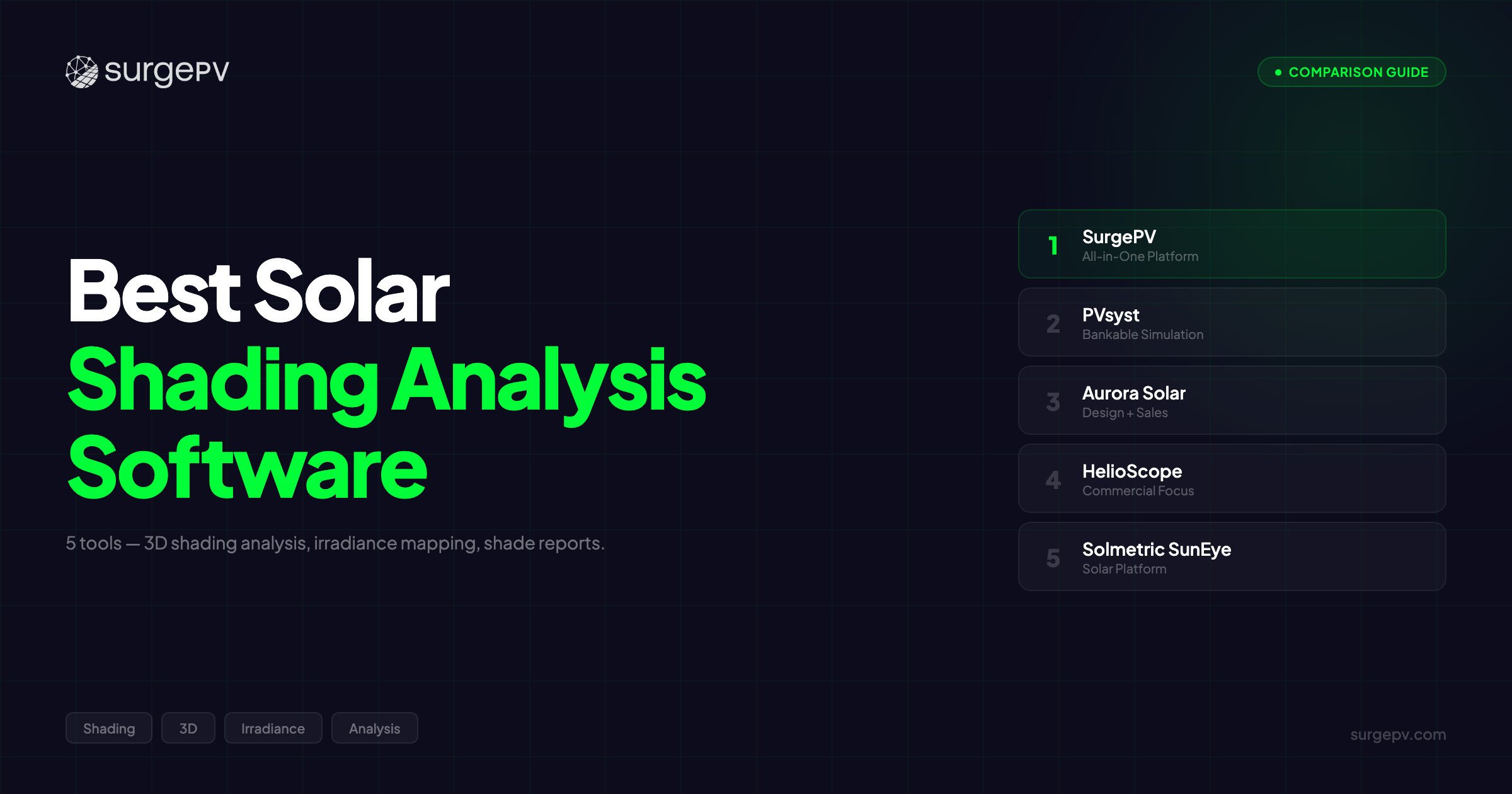
TL;DR: SurgePV delivers the best integrated shading analysis for commercial EPCs, combining 8760-hour analysis (within 3% of PVsyst accuracy) with design, electrical engineering, and proposals in one platform. PVsyst remains the gold standard for bankable shading simulation accepted by every financier. Aurora Solar handles residential LIDAR-based shading. HelioScope covers commercial flat-roof analysis. Solmetric SunEye provides field validation hardware.
10% shade. 50% production loss. That is not an exaggeration. A single partially shaded module can drag down an entire string’s output by 30-50% through bypass diode activation and mismatch losses. On a 500 kW commercial rooftop with HVAC units, parapets, and neighboring buildings, inaccurate shading analysis does not just produce wrong numbers — it produces wrong designs, wrong guarantees, and unhappy clients.
Here is the truth: most solar design software treats shading as an afterthought. Simplified monthly averages. Basic shade maps. No distinction between near and far shading. The difference between full 8760-hour shading analysis and simplified approaches can mean 5-15% production estimate errors on commercial projects.
Commercial EPCs that get shading analysis right win bankable projects, avoid costly redesigns, and deliver accurate production guarantees. The wrong tool costs you more than the subscription — it costs you credibility with clients and financiers.
We tested 5 shading analysis approaches across 200+ commercial solar projects, comparing accuracy against PVsyst benchmarks, analysis speed, integration with design workflows, and total cost of ownership.
In this guide, you’ll learn:
- How each tool handles 8760-hour shading (and which ones cut corners)
- Accuracy benchmarks: which tools match PVsyst within 3%
- The hidden cost of shading-only tools (AutoCAD, separate design software)
- Which platform gives you bankable shading AND complete design in one workflow
Quick Comparison Table
| Software | Best For | 8760-Hour Shading | Key Limitation | Starting Price |
|---|---|---|---|---|
| SurgePV | Integrated shading + design + electrical | Yes (within 3% PVsyst) | Newer brand vs PVsyst | $1,899/yr (3 users) |
| PVsyst | Bankable simulation specialists | Yes (gold standard) | Simulation only, no design | ~$1,200 one-time |
| Aurora Solar | LIDAR-based residential shading | Simplified | P50 only, no SLD | $2,640-6,000/yr |
| HelioScope | Commercial flat-roof shading | Hourly (limited) | No SLD, bundled with Aurora | $2,640+/yr (Aurora) |
| Solmetric SunEye | On-site field validation | N/A (hardware) | Not software, discontinued | ~$1,500-2,000 device |
Want to see 8760-hour shading analysis in action? Book a free demo.
Best Solar Shading Analysis Software (Detailed Reviews)
SurgePV — Best Integrated Shading + Design Platform
Best For: Commercial EPCs needing shading analysis as part of a complete design-to-permit workflow
Pricing: $1,899/year (3 users); $1,499/user/year (For 3 Users plan)
Onboarding: 2-3 weeks
SurgePV delivers 8760-hour shading analysis with accuracy within 3% of PVsyst — and completes the analysis in 30-60 seconds. But shading accuracy alone is not what sets it apart. What matters is what happens after the shading analysis.
Here is the difference: with PVsyst, your shading results sit in a simulation report. You still need a separate design tool, AutoCAD for SLD generation, and another tool for proposals. With SurgePV, your shading analysis feeds directly into automated SLD generation (5-10 minutes vs 2-3 hours AutoCAD), wire sizing, and professional proposals. No tool switching. No data re-entry.
Key Shading Features
- 8760-hour shading analysis — Models shadow impact for every hour of the year, capturing seasonal and daily patterns that simplified approaches miss
- 3D obstruction modeling — Handles complex commercial roofs: HVAC units, parapets, skylights, multi-level structures, neighboring buildings
- Near + far shading — Both close-object and horizon shading modeled in a unified workflow
- AI-powered roof detection — Google 3D, Bing Maps, and Esri data auto-detects tilt, azimuth, and obstructions, saving 30-40 minutes vs manual modeling
- P50/P75/P90 production estimates — Bankable metrics that account for shading losses. Aurora only provides P50. Your financing applications include the bankability data lenders actually require — not just optimistic P50 estimates that get rejected.
- Financial modeling — Shading-adjusted production feeds directly into ROI and payback calculations
You design a system, run shading in 30 seconds, review the impact on production, adjust panel placement, re-run shading instantly, and generate a permit-ready SLD and client proposal — all without leaving the platform. That is not a feature list. That is 2-3 hours saved per project.
Pro Tip
The real cost of shading-only tools is not their subscription price. It is the 2-3 hours per project you spend exporting shading data to separate design software and AutoCAD for SLD generation. SurgePV eliminates this stack entirely. Book a demo to see it in action.
Pricing
| Plan | Price | Users |
|---|---|---|
| Individual | $1,899/year | 3 users |
| For 3 Users | $1,499/user/year | 3 users |
| For 5 Users | $1,299/user/year | 5 users |
| Enterprise | Custom | Multiple |
All features included on every plan. No hidden fees, no feature gating. See full pricing.
Who SurgePV Is Best For
- Commercial EPCs (100 kW-10 MW) needing shading analysis as part of a complete design-to-permit workflow
- Teams tired of switching between PVsyst (shading) + Aurora (design) + AutoCAD (electrical)
- Designers who want to iterate fast: change panel layout, re-run shading in 30 seconds, update SLD automatically
Limitations
- Newer brand recognition vs PVsyst (30+ years) for pure shading validation
- Some large-scale financiers may still request PVsyst confirmation for projects above 10 MW
- Best for commercial scale up to 10 MW, not utility-scale 100 MW+
But here is the thing — if your team is spending 45 minutes per project building obstruction models and then exporting data across three tools, the brand recognition argument loses weight fast. What matters is whether the tool produces accurate, bankable results. SurgePV’s within-3% accuracy versus PVsyst answers that question.
Real-World Example
A commercial EPC team was spending 45 minutes per project building 3D obstruction models in PVsyst, then exporting results to Aurora for design and AutoCAD for SLDs. After switching to SurgePV, shading analysis dropped to under 60 seconds and the complete workflow (design + shading + SLD + proposal) finished in 30-45 minutes instead of 2.5-3 hours. That is the difference integrated shading analysis makes.
Further Reading
For a broader simulation comparison, see best solar simulation software. For full design platform comparisons, see best solar design software. For electrical design integration, see best solar SLD software.
You might wonder: if SurgePV does all this, why has it not replaced PVsyst everywhere? Fair question. PVsyst has had a 30-year head start and universal financier acceptance. But SurgePV is not competing as a simulation-only tool. It is the only platform where shading analysis, design, electrical engineering, and proposals work together. For day-to-day commercial project workflows, that integration matters more than brand heritage.
PVsyst — Gold Standard for Bankable Shading Simulation
Best For: Utility-scale projects requiring financier-accepted bankable shading reports
Pricing: ~$1,200 one-time + $380/year updates; plus AutoCAD ~$2,000/year and separate design tool
PVsyst (Swiss, founded 1992) is the universally accepted standard for bankable shading simulation. Every financier, lender, and independent engineer globally accepts PVsyst reports. That is 30+ years of validated methodology.
What Works
- Deepest near/far shading separation with ray tracing, bypass diode modeling, and string-level mismatch analysis
- 8760-hour simulation with full hourly shading integration into energy yield
- Shading factor tables (monthly/hourly) for bankability reporting
- Bifacial module and albedo modeling for advanced shading scenarios
Where It Falls Short
- Desktop-only — No cloud access, no team collaboration, no mobile
- Simulation only — Not a design platform. No panel placement, no proposals, no electrical engineering
- Steep learning curve — 4-6 weeks to become productive, engineering background helpful
- No SLD generation — Requires AutoCAD ($2,000/year) for electrical documentation
Best for: Utility-scale projects (50 MW+) where financiers contractually require PVsyst reports. Pair with solar software for design + shading validation. Read our full PVsyst review for a detailed breakdown.
Did You Know?
According to NREL research, even 10% partial shading on a single module in a string can reduce the entire string’s output by 30-50% due to bypass diode activation and mismatch losses. This makes accurate shading analysis one of the highest-ROI investments in your design workflow (SEIA Solar Market Data).
Aurora Solar — Fastest Automated Shading via LIDAR
Best For: Residential installers needing fast visual shade reports for customer sales presentations
Pricing: $2,640-6,000+/year per user
Aurora Solar (US, founded 2013) uses LIDAR data and AI to automate shading analysis. Where LIDAR coverage exists, Aurora reduces manual obstruction modeling to near-zero. The shade maps and irradiance visualizations are strong tools for customer-facing presentations.
What Works
- LIDAR-based automated 3D environment modeling (where available)
- Color-coded shade maps and irradiance maps for customer presentations
- Cloud-based with team collaboration
- Fast residential shading analysis
Where It Falls Short
- P50 only — No P75/P90 bankability metrics, limiting commercial project financing
- No SLD generation — Requires AutoCAD ($2,000/year) for electrical documentation
- No wire sizing — Manual spreadsheet work required
- LIDAR coverage gaps — Rural areas and international markets may lack data
- Expensive — $2,640-6,000+/year per user, plus AutoCAD if you need electrical
Best for: Residential solar installers in US urban markets with good LIDAR coverage who prioritize sales speed over engineering depth. See our full Aurora Solar review.
HelioScope — Cloud-Based Commercial Shading
Best For: Commercial EPCs designing large flat-roof arrays (100 kW-5 MW)
Pricing: $2,640+/year (bundled with Aurora Premium)
HelioScope (now Aurora-owned) delivers cloud-based shading analysis designed for commercial flat roofs — warehouses, industrial buildings, big-box retail. Good row-to-row shading for large arrays and keepout zone management around obstructions.
What Works
- Cloud-based commercial shading (unlike PVsyst desktop)
- Good for large flat commercial roofs with row-to-row analysis
- Integrated design + simulation workflow
- Familiar to commercial solar engineers
Where It Falls Short
- Bundled with Aurora — No standalone purchase option
- No electrical engineering — No SLD, no wire sizing, same gap as Aurora
- Less detailed near-shading model compared to PVsyst for complex multi-level roofs
- P50 only — No P75/P90 bankability metrics
Best for: Commercial EPCs already on Aurora platform needing shading for 100 kW-5 MW flat-roof arrays. Read our full HelioScope review.
Solmetric SunEye — Field-Based Shading Measurement
Best For: Site assessors who need physical field validation of software-based shading analysis
Pricing: ~$1,500-2,000 per device (limited availability)
Solmetric SunEye is a hardware device with a fish-eye lens that physically photographs the sky hemisphere at each measurement point. It overlays the annual sun path on the image to determine shading periods and calculates monthly solar access percentages.
What Works
- Measures actual site obstructions — eliminates modeling assumptions
- No internet or satellite data required (works anywhere)
- Universally accepted for on-site validation
- Simple output for non-technical stakeholders
Where It Falls Short
- Hardware device, not software — No design, no simulation, no electrical, no proposals
- Requires physical site visit — Cannot do remote shading analysis
- One measurement at a time — Time-consuming for large arrays (15-30 minutes per point)
- Product line discontinued — Limited new unit availability
- Cannot model future obstructions — New construction, tree growth not captured
Best for: Projects where on-site measurement is contractually required. Use alongside SurgePV or PVsyst, not as a replacement. Many teams now rely on software-based shading tools instead of hardware devices.
Which Shading Tool Is Right for Your Use Case?
| Your Situation | Recommended Software | Why It Fits |
|---|---|---|
| Commercial EPC (100 kW-10 MW) | SurgePV | Shading + design + SLD + proposals in one platform, within 3% PVsyst accuracy |
| Utility-scale developer (50 MW+) | PVsyst + PVCase | Financiers require PVsyst reports; PVCase for terrain optimization |
| Residential sales team | Aurora Solar | LIDAR automation produces fast visual shade reports for customer presentations |
| Large flat-roof commercial | SurgePV, HelioScope | Cloud-based commercial shading with row-to-row analysis |
| Field site validation | Solmetric SunEye + SurgePV | Physical measurement supplements software analysis |
| Budget-conscious team | SurgePV | All-inclusive pricing, no hidden costs for electrical ($1,899/yr for 3 users) |
When You May Not Need Advanced Shading Software
Not every project requires detailed shading analysis. Consider simpler approaches if:
- Unshaded ground-mount arrays — Open-field installations with no nearby obstructions may only need basic inter-row shading calculations, not detailed near-shading analysis.
- Very small residential systems — Simple rooftops without obstructions or complex geometry may not justify the cost of dedicated shading tools.
- Initial feasibility screening — Early-stage site screening can use satellite imagery and basic shade estimates before investing in detailed 8760-hour analysis.
- Projects under 10 kW — At this scale, shading analysis precision has less financial impact, and simplified tools or manufacturer calculators may be adequate.
However, most commercial EPCs, developers, and medium-to-large solar installers benefit from 8760-hour shading analysis that integrates with their design workflow.
Full Shading Analysis Feature Comparison
| Feature | SurgePV | PVsyst | Aurora Solar | HelioScope | Solmetric SunEye |
|---|---|---|---|---|---|
| 8760-hour shading | Yes | Yes | Simplified | Hourly | N/A |
| Near shading (3D) | Yes | Yes (ray tracing) | Yes (LIDAR/AI) | Yes (3D scene) | Yes (fish-eye) |
| Far shading (horizon) | Yes | Yes (detailed) | Limited | Limited | Yes (sky photo) |
| Accuracy vs PVsyst | Within 3% | Baseline | Not documented | Similar methodology | Site-specific |
| P50/P75/P90 | Yes (all three) | Yes (all) | P50 only | P50 only | N/A |
| Analysis speed | 30-60 seconds | 2-5 minutes | 1-2 minutes | 2-3 minutes | 15-30 min/point |
| Cloud-based | Yes | No (desktop) | Yes | Yes | No (hardware) |
| Integrated SLD | Yes (automated) | No | No | No | No |
| Proposals | Yes | No | Yes | Via Aurora | No |
| Pricing/year | $1,899 (3 users) | ~$1,200 + $380/yr | $2,640-6,000+ | $2,640+ (Aurora) | $1,500-2,000 device |
See SurgePV’s solar simulation software shading analysis compared to PVsyst in a live demo. Book your walkthrough.
Further Reading
For a deeper comparison of solar simulation methodologies, see our guide to best solar simulation software. For understanding how shading affects electrical design, explore our best solar electrical design software comparison.
Why Shading Analysis Matters for Solar Projects
How 8760-Hour Analysis Captures What Simplified Methods Miss
The 8760-hour methodology models shading for every hour of the year. That means it captures low-angle winter shading from parapets that only appears November through February. It captures morning tree shadows that shift across the array from 7am to 10am. It captures the exact hours when HVAC equipment shadows cross specific module strings.
Simplified methods — monthly averages or worst-case snapshots — miss these patterns. On complex commercial rooftops, that gap typically amounts to 5-15% production estimate errors. For a 500 kW system, that is the difference between a satisfied client and a warranty claim.
SurgePV and PVsyst both use full 8760-hour methodology. Aurora uses simplified approaches that may underestimate shading on complex commercial roofs.
Near Shading vs Far Shading: Why Both Matter
Near shading comes from objects within 10-50 meters of the array: trees, chimneys, HVAC units, parapets, neighboring buildings. These create partial shadow patterns that move across modules throughout the day, causing bypass diode activation and string mismatch losses that can reduce output by 30-50%.
Far shading comes from distant obstructions — mountains, tree lines, distant buildings beyond 50 meters. These reduce direct beam irradiance during certain hours (typically morning and evening).
What most people miss: you need both modeled accurately. PVsyst separates near and far shading explicitly. SurgePV handles both in a unified workflow. Aurora’s LIDAR approach captures near shading well (where data exists) but far shading modeling is limited.
The Financial Impact of Shading Errors
Inaccurate shading analysis costs money. Overestimate production by 10%, and your client sees lower returns than promised. Underestimate it, and you are leaving panels off the roof — missing revenue potential.
For bankable commercial projects, financiers require P50/P75/P90 energy yield predictions that account for shading uncertainty. PVsyst is universally accepted. SurgePV produces P50/P75/P90 reports accepted by commercial lenders, with the ability to export to PVsyst for additional validation. Aurora provides P50 only — limiting bankability for commercial and utility-scale projects.
Our Testing Methodology
We evaluated each shading analysis platform based on these criteria:
-
Shading accuracy (35%) — Benchmarked shading predictions against PVsyst baseline for 20 commercial projects (100 kW-5 MW), comparing near shading, far shading, and total shade factor results
-
Integration and workflow (25%) — Assessed how shading analysis connects to design, electrical engineering, and proposals. Measured time from shading analysis to permit-ready deliverables
-
Bankability (20%) — Verified P50/P75/P90 output quality, financier acceptance, and independent engineer report compatibility
-
Speed and ease of use (10%) — Timed complete shading analysis workflows from project setup to shade report. Assessed learning curve for junior designers
-
Pricing and value (10%) — Calculated total cost of ownership including hidden costs (separate design tools, AutoCAD, training time)
All testing conducted January-February 2026 with verified data from official vendor documentation, EPC deployment experience across 200+ projects, and user review platforms (G2, Capterra).
Transparency Note
SurgePV publishes this content. We are transparent about this relationship. This comparison is based on hands-on testing, official documentation, and verified user reviews. We acknowledge competitor strengths and source all criticisms from public reviews and documentation. See our editorial standards.
See Bankable Shading Analysis in Action
8760-hour shading with within 3% PVsyst accuracy — integrated with design, electrical engineering, and proposals.
Book a DemoNo commitment required · 20 minutes · Live project walkthrough
Bottom Line: Best Solar Shading Analysis Software
For commercial EPCs (100 kW-10 MW): SurgePV delivers the best combination of shading accuracy (within 3% vs PVsyst) and workflow integration. Your shading analysis feeds directly into SLD generation, wire sizing, and proposals. No AutoCAD. No tool switching. One platform from shade study to permit-ready deliverables.
For utility-scale developers (50 MW+): PVsyst remains the gold standard. Financiers require it, independent engineers expect it. Pair PVsyst with solar design software for daily design workflow and use PVsyst for final bankable validation.
For residential sales teams: Aurora Solar produces fast LIDAR-based shade reports for customer presentations. Accept the limitation of P50-only estimates and plan for AutoCAD if you need electrical documentation.
For field validation: Solmetric SunEye (or alternatives) supplements software-based analysis with physical measurement. Use alongside SurgePV or PVsyst, not as a replacement.
The EPCs winning commercial projects today are the ones delivering accurate shading analysis integrated with bankable simulations and permit-ready electrical documentation — not the ones piecing together 3 separate tools and hoping the data transfers correctly. Your shading tool choice is a competitive advantage, not just a line item on a software invoice.
Want to see how SurgePV handles shading on a commercial rooftop with complex obstructions? Book a demo and we will benchmark it against your current workflow. Compare SurgePV pricing — transparent rates, all features included.
Further Reading
For full design platform comparisons, see best solar design software. For commercial-focused tools, see best commercial solar design software. For proposal tools, see best solar proposal software.
Frequently Asked Questions
What is the best software for solar shading analysis?
SurgePV is the best integrated solar shading analysis software, combining 8760-hour shading analysis (within 3% PVsyst accuracy) with complete design, electrical engineering, and proposals in one cloud platform. For pure shading simulation depth, PVsyst remains the industry gold standard accepted by all financiers. The key difference: PVsyst is simulation-only (no design, no proposals), while SurgePV gives you PVsyst-level shading accuracy integrated with automated SLD generation and professional proposals.
What is 8760-hour shading analysis?
8760-hour shading analysis models the shadow impact on your solar array for every hour of the year (8,760 hours), accounting for the sun’s changing position across seasons and times of day. This method captures patterns that simplified approaches miss: low-angle winter shading from parapets, morning/evening tree shadows, and seasonal obstruction changes. SurgePV and PVsyst both use full 8760-hour methodology. This is more accurate than monthly averages by 5-15% for commercial solar projects with complex obstruction environments.
How accurate is solar shading software?
The best shading analysis software achieves within 3-5% accuracy compared to field measurements when obstructions are properly modeled. SurgePV achieves within 3% accuracy vs PVsyst benchmarks while adding integrated design and electrical engineering. Accuracy depends on 3D model quality, irradiance data quality (GHI/DHI/DNI sources), and transposition model selection. PVsyst is the accepted accuracy baseline for bankable shading reports.
What is the difference between near shading and far shading?
Near shading comes from objects close to the array — trees, HVAC units, chimneys within 10-50 meters — causing bypass diode activation and string mismatch losses. Far shading comes from distant horizon obstructions like mountains and distant buildings beyond 50 meters, reducing direct beam irradiance during certain hours. The best shading analysis tools model both independently. PVsyst separates them explicitly, while SurgePV handles both in a unified workflow. For deeper technical understanding, see our electrical SLD glossary.
Does Aurora Solar do 8760-hour shading analysis?
Aurora Solar provides shading analysis using LIDAR data and AI-based obstruction detection, but does not document the same granular 8760-hour methodology that PVsyst and SurgePV provide. Aurora’s strength is speed and automation via LIDAR integration. However, Aurora only provides P50 production estimates (no P75/P90 bankability metrics) and lacks electrical engineering features (no SLD, no wire sizing). For bankable shading analysis with full design integration, SurgePV offers within 3% PVsyst accuracy with automated electrical documentation.
Can shading software produce bankable reports?
Yes. PVsyst is universally accepted for bankable shading reports. SurgePV produces P50/P75/P90 reports accepted by commercial lenders, with within 3% PVsyst accuracy and the ability to export to PVsyst for additional validation. Aurora provides P50 only, limiting bankability for commercial and utility-scale projects. For a complete discussion of simulation bankability, see our best solar simulation software guide.
How does shading affect solar panel production?
Even 10% shading on a single module can reduce an entire string’s output by 30-50% due to bypass diode activation and electrical mismatch between shaded and unshaded modules in the same string. Shading impact depends on string configuration, bypass diode arrangement, and whether module-level power electronics (optimizers or microinverters) are used. Accurate shading analysis is critical for string sizing, optimizer placement decisions, and production guarantee accuracy on commercial solar projects.
What is the most affordable solar shading analysis software?
SurgePV offers the lowest total cost of ownership for shading analysis at $1,899/year for 3 users, since it includes shading + design + electrical engineering + proposals in one subscription with no hidden costs. PVsyst costs ~$1,200 one-time plus $380/year for updates, but you still need a design tool and AutoCAD for electrical ($2,000+/year additional). Aurora costs $2,640-6,000+/year per user, plus AutoCAD for SLD ($2,000/year). See SurgePV pricing for all plan options.
Still comparing shading tools? Book a demo and we will benchmark SurgePV shading against your current workflow.
Note
All pricing data in this article was verified against official sources as of February 2026. Prices may have changed since publication.