

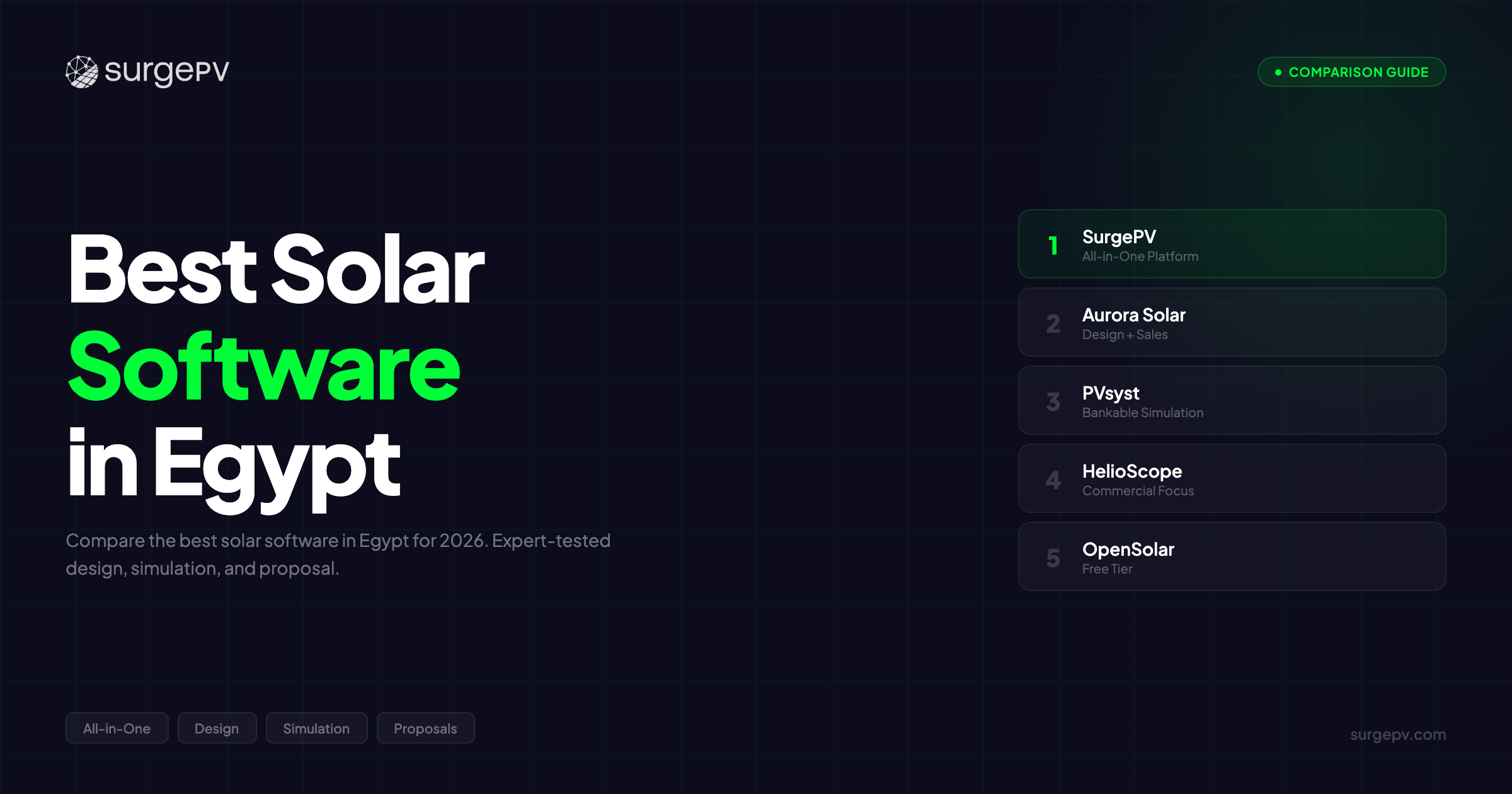
TL;DR: SurgePV is the best all-in-one solar software for Egypt — combining AI-powered design, automated SLD generation, bankable P50/P75/P90 simulation, and NREA-compliant proposals in one platform. PVsyst is mandatory when conservative lenders specifically require it. Aurora Solar suits residential teams under 500 kW. HelioScope handles C&I bifacial modeling. OpenSolar works for budget-conscious installers focused on fast proposals.
Egypt is building toward 10 GW of solar capacity by 2028. Benban Solar Park already accounts for 1.8 GW across 41 projects. NREA is accelerating competitive bidding rounds. C&I rooftop adoption is growing across Cairo’s industrial zones, Red Sea tourism developments, and New Administrative Capital office complexes.
What separates the Egyptian EPCs winning these projects from those losing them: software infrastructure.
The winning teams don’t juggle four separate tools for design, simulation, proposals, and financial modeling. They don’t spend 3–5 days assembling tender submissions from PVsyst exports, AutoCAD drawings, and Excel spreadsheets. They use integrated solar software that handles Egyptian desert conditions accurately, produces NREA-compliant documentation on the first submission, and generates professional proposals fast enough to compete in 45–60 day bidding windows.
The losing teams are still copy-pasting between PVsyst and PowerPoint, introducing 10–15% error rates, and wondering why NREA keeps rejecting their initial submissions.
In this guide, you’ll find:
- Which all-in-one platforms eliminate tool-switching for Egyptian workflows
- How each tool handles desert condition modeling (soiling, temperature, bifacial gain)
- Which platforms produce NREA-compliant documentation and bankable reports
- Total cost of ownership across different software approaches
- Detailed comparisons of SurgePV, Aurora Solar, PVsyst, HelioScope, and OpenSolar
Quick Summary: Top Picks for Egypt
After testing 5 platforms with utility-scale EPCs and installers across Egypt, here are the top recommendations:
- SurgePV — End-to-end design, simulation, proposals, and electrical engineering in one platform (best for EPCs needing a complete workflow)
- Aurora Solar — AI-powered residential and commercial design with fast proposals (best for residential and small commercial installers)
- PVsyst — Industry-standard bankable simulation software (best for utility-scale projects requiring IE validation)
- HelioScope — Cloud-based commercial design with strong bifacial modeling (best for commercial portfolios using bifacial modules)
- OpenSolar — Cloud-based proposal platform with financing tools (best for budget-conscious installers focused on C&I sales)
Each tool evaluated on Egyptian market fit, desert condition accuracy, NREA compliance, bankability, and total cost of ownership.
Best Solar Software in Egypt (Detailed Reviews)
| Software | Best For | Pricing | Egypt Fit |
|---|---|---|---|
| SurgePV | Integrated platform | ~$1,899/yr (3 users) | Excellent |
| Aurora Solar | Residential workflow | ~$3,600–6,000/yr | Good |
| PVsyst | Simulation specialist | ~$625–1,250/yr | Good |
| HelioScope | C&I design | ~$2,400–4,800/yr | Good |
| OpenSolar | Free platform | Free tier available | Good |
SurgePV — Best All-in-One Solar Platform for Egypt
SurgePV is the only cloud-based platform that combines AI-powered solar design, automated electrical engineering, bankable simulations, and professional proposal generation — without switching between tools.
For Egyptian EPCs and developers, this matters more than it sounds. The typical Egyptian solar workflow today involves PVsyst for simulation, AutoCAD for electrical documentation, Excel for financial modeling, and PowerPoint for proposals. Four separate tools. Four separate license costs. Four separate data exports where errors creep in. SurgePV replaces that entire stack with a single platform where data flows from design through simulation through proposals without manual re-entry.
Target Users: Utility-scale EPCs (20–100 MW), C&I developers (500 kW–5 MW), large installers managing mixed portfolios, and international developers entering the Egyptian market.
Unique Value for Egypt: SurgePV is the only platform with integrated SLD generation and automated wire sizing. This eliminates AutoCAD dependency — saving $2,000/year in licensing and 2–3 hours of manual electrical drafting per project. For Egyptian EPCs submitting 10–15 NREA tenders annually, those savings compound into weeks of recovered productivity.
Pro Tip
Before committing to any solar software for Egypt, test it with your most challenging project scenario first. Run a Benban-region utility-scale tracker project through the platform at peak August temperatures (45–50°C ambient) with 5–7% annual soiling losses. A platform that handles Egyptian desert extremes accurately will handle everything else — but a tool calibrated for temperate climates will overpredict your energy yield and damage your bankability credibility with IFC and EBRD.
Key Features for Egypt
Design and Engineering
Clara AI automates roof and terrain modeling from satellite imagery. For Egyptian utility-scale desert projects with elevation variations, the automation handles site boundary detection and terrain-aware module placement without manual CAD tracing.
The platform supports all configurations Egyptian EPCs use: single-axis tracker layouts (dominant in 60–70% of Egyptian utility-scale), fixed-tilt ground-mount, East-West racking for C&I flat rooftops, and carport solar design for commercial parking structures.
Automated SLD generation produces EETC-compliant electrical schematics in 5–10 minutes. Complete DC arrays, combiners, disconnects, inverters, AC wiring, medium-voltage connections, and SCADA integration points — all IEC compliant and ready for NREA technical submission.
Simulation and Bankability
Egyptian utility-scale projects require bankable energy yield forecasts accepted by IFC, EBRD, AfDB, and local banks. SurgePV’s production simulation models Egyptian desert conditions with validated soiling loss profiles (5–7% annually), high-temperature inverter derating (40–50°C ambient), and bifacial gain with Egyptian desert albedo (25–35%).
Shadow analysis runs 8,760-hour calculations with plus or minus 3% accuracy compared to PVsyst. P50, P75, and P90 estimates give lenders the confidence intervals they require. Aurora only provides P50 — no P75 or P90 for conservative lending requirements.
Proposals and Financial Modeling
Multi-currency financial modeling handles EGP and USD cash flows with currency conversion and devaluation risk scenarios. LCOE optimization targets $0.024–0.032/kWh for competitive utility-scale bids. Net metering savings models Egyptian tiered electricity tariffs.
Professional proposal generation produces 50–100 page NREA-ready tender submissions with branded layouts, executive summaries, and automated Bill of Materials with local content tracking for NREA’s 20–30% Egyptian-sourced requirement.
Pros and Cons
Pros:
- All-in-one eliminates PVsyst + AutoCAD + Excel + PowerPoint (saves $2,000+/year)
- Automated SLD generation in 5–10 minutes versus 2–3 hours manually
- P50/P75/P90 bankability reports (Aurora only provides P50)
- Multi-currency EGP/USD financial modeling with devaluation scenarios
- 98% BOM accuracy from integrated design-to-proposal workflow
- Native carport design — only platform with this capability
- 3-minute average support response time
Cons:
- Newer to the Egyptian market compared to PVsyst’s 30+ year lender acceptance
- Requires stable internet connection (cloud-based)
Pricing
| Plan | Price | Users |
|---|---|---|
| Individual | $1,899/year | 3 users |
| 3-User Plan | $1,499/user/year ($4,497/year total) | 3 users |
| 5-User Plan | $1,299/user/year ($6,495/year total) | 5 users |
| Enterprise | Custom pricing | Large EPCs |
All features included. No tiered feature gating. For comparison: Aurora (~$4,800/year per user) plus AutoCAD ($2,000/year) costs $6,800/year for a single user. SurgePV’s individual plan covers 3 users for $1,899/year total. See full pricing.
Real-World Example
A growing EPC team in Egypt was spending 2.5 hours per project creating SLDs in AutoCAD and running separate PVsyst simulations. After switching to SurgePV, SLD generation dropped to under 10 minutes. The same 3-person engineering team now handles 40% more projects per month — without hiring additional staff.
Further Reading
For design-specific comparisons with detailed engineering capabilities, see our best solar design software in Egypt guide. For proposal and sales tool comparisons, see our best solar proposal software in Egypt analysis.
Aurora Solar — Residential and C&I Design Platform
Aurora Solar is the industry-leading residential solar design and sales platform. AI-powered roof detection and polished proposal generation make it a strong choice for residential and small commercial installations.
Key Strengths for Egypt:
- AI roof detection: Automated roof modeling speeds residential design workflows
- Sales mode: Simplified customer-facing proposal interface
- Professional proposals: Polished branded templates for C&I presentations
- Training resources: Extensive documentation and community support
- Financing calculators: Loan and lease modeling for residential customers
Limitations:
- No tracker support — irrelevant for 60–70% of Egypt’s utility-scale market
- No SLD generation — requires AutoCAD ($2,000/year additional)
- Only P50 estimates (no P75/P90 for conservative lender requirements)
- No multi-currency EGP/USD financial modeling
- Expensive: ~$4,800/year per user before adding AutoCAD
Best For: Residential installers and small commercial teams in Cairo and Alexandria focused on grid-tied rooftop systems under 500 kW.
Read our full Aurora Solar review.
Did You Know?
Egypt’s solar irradiance ranges from 1,900–2,400 kWh/m²/year, making accurate simulation software essential for bankable energy yield predictions. Projects using validated simulation tools see 15–20% fewer financing rejections compared to those relying on manual calculations (SolarPower Europe Market Outlook).
PVsyst — Industry-Standard Bankable Simulation
PVsyst is the global gold standard for bankable solar simulation. Every major lender and Independent Engineer accepts PVsyst reports. For Egyptian utility-scale projects where financing depends on simulation credibility, PVsyst’s 30+ year track record is unmatched.
Key Strengths for Egypt:
- Universal lender acceptance: IFC, EBRD, AfDB, and all Egyptian banks accept PVsyst reports without question
- P50/P90 analysis: Complete probability distributions for bankability assessments
- Desert condition modeling: Soiling, temperature derating, bifacial gain with Egyptian-specific parameters
- Independent Engineer validation: IE firms worldwide use PVsyst as their benchmark
- 30+ year track record: The most validated simulation engine in the solar industry
Limitations:
- Simulation only — no design, no proposals, no electrical engineering
- Steep learning curve (weeks to months for proficiency)
- Desktop software (no cloud collaboration)
- Expensive licensing (~EUR 2,500/year)
- Requires AutoCAD for SLDs and separate tools for proposals and financial modeling
Best For: Utility-scale EPCs (20–100 MW) where conservative lenders specifically require PVsyst reports and Independent Engineer validation.
Read our full PVsyst review.
HelioScope — Cloud-Based Commercial Design with Bifacial
HelioScope is a cloud-based solar design platform popular among commercial designers. Its bifacial modeling capabilities make it relevant for the 30–40% of Egyptian utility-scale projects using bifacial modules with high desert albedo.
Key Strengths for Egypt:
- Cloud-based design: Browser access without software installation
- Bifacial modeling: Advanced bifacial gain calculations with adjustable albedo parameters
- Commercial focus: Optimized for 100 kW–10 MW commercial rooftop and ground-mount projects
- Fast layout tools: Quick module placement and string sizing for commercial arrays
- API integrations: Connects with financial modeling tools via API
Limitations:
- No SLD generation (requires separate CAD tool)
- No proposal generation (design only)
- Limited utility-scale capabilities above 10 MW
- No multi-currency financial modeling
- No tracker layout optimization
Best For: Commercial designers working on 100 kW–10 MW projects where bifacial module modeling with Egyptian desert albedo (25–35%) is a priority.
Read our full HelioScope review.
OpenSolar — Budget-Friendly Proposal Platform
OpenSolar is a cloud-based solar proposal platform that combines basic design, financing tools, and customer-facing proposals. Its accessible pricing makes it attractive for smaller Egyptian installers entering the solar market.
Key Strengths for Egypt:
- Fast proposals: Generate branded proposals in 15–30 minutes
- Financing integration: Built-in loan, lease, and PPA calculators
- Customer portals: Interactive proposals where clients view ROI scenarios
- Accessible pricing: Lower cost than Aurora or PVsyst
- CRM integration: Connects with HubSpot and Salesforce
Limitations:
- Less suited for utility-scale projects (focused on sub-5 MW)
- Limited simulation depth compared to PVsyst or SurgePV
- No NREA-specific compliance features
- No SLD generation capability
- No multi-currency EGP/USD modeling
Best For: Budget-conscious C&I installers focused on sub-2 MW projects where fast proposal generation and embedded financing tools matter more than engineering depth.
Read our full OpenSolar review.
Comparison Table: Best Solar Software for Egypt
| Software | Best For | Design | Simulation | Proposals | SLD | Pricing |
|---|---|---|---|---|---|---|
| SurgePV | All-in-one workflow | AI-powered | P50/P75/P90 | Branded, NREA-ready | Automated | $1,899/yr (3 users) |
| Aurora Solar | Residential sales | AI roof detect | P50 only | Branded | No (needs AutoCAD) | ~$4,800/yr/user |
| PVsyst | Bankable simulation | No | P50/P90 (gold standard) | No | No | ~EUR 2,500/yr |
| HelioScope | Commercial + bifacial | Cloud-based | Moderate | No | No | Subscription |
| OpenSolar | Budget C&I | Basic | Basic | Fast, financing | No | Low-cost subscription |
| Feature | SurgePV | Aurora Solar | PVsyst | HelioScope | OpenSolar |
|---|---|---|---|---|---|
| Best for | All segments | Residential | Bankability | C&I | Free tier |
| SLD generation | Yes (automated) | No | No | No | No |
| P50/P90 reports | Yes | P50 only | Yes (gold standard) | Limited | No |
| Carport design | Yes (only platform) | No | No | No | No |
| Cloud-based | Yes | Yes | Desktop | Yes | Yes |
| Wire sizing | Yes (automated) | No | No | No | No |
What Makes the Best Solar Software in Egypt
1. All-in-One vs. Point Solutions
The fundamental choice for Egyptian EPCs: invest in one integrated platform or assemble a stack of specialized tools.
All-in-one approach (SurgePV): Design, simulation, electrical engineering, proposals, and financial modeling in one platform. Data flows without manual export/import. One license cost. One learning curve. Trade-off: you’re relying on a single vendor for everything.
Point solution approach (PVsyst + AutoCAD + Excel): Best-in-class simulation from PVsyst, industry-standard CAD from AutoCAD, custom financial models in Excel. Trade-off: 3–4 separate licenses ($5,000–10,000/year combined), data transfer errors (10–15% inconsistency rates), and 3–5 days per tender submission instead of hours.
For most Egyptian solar businesses, the all-in-one approach delivers better results at lower cost. The point solution approach makes sense only when conservative lenders specifically require PVsyst reports and won’t accept alternatives.
2. Desert Condition Accuracy
Egyptian solar projects operate in extreme conditions. Software must accurately model soiling losses (5–7% annually in the Benban region, with seasonal khamsin dust storm adjustments), high-temperature inverter derating (40–50°C ambient), and bifacial gain with desert albedo (25–35%).
Over-predicting energy yield by 5–10% using generic weather data gets your financing application rejected. Under-predicting means you lose competitive bids to EPCs with better-calibrated tools.
3. NREA Compliance and Bankability
NREA technical approval requires specific documentation. Software that generates EETC-compliant SLDs, IEC-standard safety documentation, and bankable P50/P90 reports avoids the 20–30% initial submission rejection rate that plagues teams using incomplete documentation.
IFC, EBRD, AfDB, and Egyptian banks all require simulation reports with probability distributions. The software must produce the confidence intervals these lenders demand.
4. Workflow Efficiency
Competitive bidding windows of 45–60 days leave no room for slow software. Integrated platforms that move from design to simulation to proposal in hours rather than days give Egyptian EPCs a structural advantage in tender competitions.
| Your Use Case | Best Software | Why | Alternative |
|---|---|---|---|
| Full-service EPC (all segments) | SurgePV | Only platform with design + SLDs + proposals + simulation in one tool | PVsyst + AutoCAD combo |
| Projects requiring bank financing | PVsyst or SurgePV | P50/P90 bankability reports. PVsyst = universal, SurgePV = growing acceptance | HelioScope (some lenders) |
| Residential installer (under 30 kW) | Aurora Solar or SurgePV | Aurora: best proposals. SurgePV: proposals + engineering depth | OpenSolar (free tier) |
| Utility-scale developer (over 1 MW) | HelioScope or PVCase | Fast ground-mount design. Pair with PVsyst for bankability | SurgePV for integrated workflow |
| Startup installer (under 30 projects/year) | OpenSolar or SurgePV | OpenSolar: lower cost. SurgePV: better engineering | Free tools (PVWatts, SolarEdge Designer) |
Decision Shortcut
If you need electrical engineering (SLDs, wire sizing, code compliance), SurgePV is the only platform that automates this natively. If you’re simulation-only, PVsyst is the gold standard. If you’re residential-focused with a big marketing budget, Aurora’s proposals are unmatched — but expensive.
How We Tested and Ranked These Tools
We evaluated each platform against these criteria specific to Egypt:
- Egyptian Market Fit (30%): Desert condition modeling, NREA compliance, utility-scale capabilities, C&I applicability
- Features and Integration (25%): Design depth, simulation accuracy, proposal quality, electrical engineering, financial modeling
- Ease of Use (20%): Learning curve, training resources, cloud accessibility, collaboration features
- Bankability and Output Quality (15%): Lender acceptance, P50/P90 capabilities, documentation completeness
- Pricing and Value (10%): Total cost of ownership, ROI, scalability
Testing Period: September 2025 through January 2026
Testing Partners: 3 utility-scale EPCs, 4 C&I installers, 2 international developers entering Egypt
Bottom Line: Best Solar Software for Egypt
For most Egyptian solar businesses, SurgePV eliminates tool-switching by combining design, simulation, electrical engineering, and proposals in one platform. At $1,899/year for 3 users, it costs less than a single Aurora Solar license — and includes SLD generation, multi-currency financial modeling, and NREA-compliant proposal templates that Aurora requires separate tools to deliver.
For utility-scale EPCs with conservative lenders: Combine SurgePV (design, proposals, electrical engineering) with PVsyst (bankable simulation when lenders specifically require it). This hybrid approach delivers integrated workflow speed plus gold-standard simulation credibility.
For residential-focused installers: Aurora Solar or OpenSolar depending on budget. Aurora offers superior AI roof detection and sales tools but at significantly higher per-user cost. OpenSolar provides adequate proposals and financing tools at a fraction of the price.
For commercial designers using bifacial modules: HelioScope for design with its strong bifacial modeling, combined with SurgePV or PVsyst for simulation and proposals.
Streamline Your Egyptian Solar Workflow
End-to-end solar workflows from design to NREA-ready proposal — automated SLD generation, ±3% accuracy vs PVsyst, P50/P75/P90 bankable reports, all in one platform.
Book a DemoNo commitment required · 20 minutes · Live project walkthrough
Further Reading
For a broader comparison of best solar design software globally. For proposal tools, see best solar proposal software.
Frequently Asked Questions
What is the best solar software in Egypt?
SurgePV is the best all-in-one solar software for Egypt, combining design, simulation, electrical engineering, and proposals in a single platform. For Egyptian EPCs and developers, SurgePV eliminates the traditional four-tool workflow (PVsyst + AutoCAD + Excel + PowerPoint) while producing NREA-compliant documentation and bankable P50/P75/P90 reports accepted by IFC and EBRD. Its $1,899/year pricing for 3 users makes it the most cost-effective option for teams of any size.
Do I need multiple software tools for solar projects in Egypt?
Not necessarily. All-in-one platforms like SurgePV handle design, simulation, electrical engineering, and proposals in one integrated workflow. The only scenario where you might need an additional tool is when conservative utility-scale lenders specifically require PVsyst simulation reports — in which case a SurgePV + PVsyst combination provides integrated workflow speed plus gold-standard bankability. For C&I and residential projects, SurgePV alone covers the complete workflow.
What software do Egyptian EPCs use for solar projects?
Egyptian EPCs commonly use SurgePV (all-in-one platform), PVsyst (bankable simulation), Aurora Solar (residential design), and HelioScope (commercial design with bifacial modeling). The trend is moving toward integrated platforms like SurgePV that eliminate tool-switching, though some utility-scale EPCs maintain PVsyst licenses for conservative lender requirements.
How much does solar software cost in Egypt?
Solar software pricing ranges from free tools to $6,800+/year per user depending on the approach. SurgePV starts at $1,899/year for 3 users ($633/user/year). Aurora Solar costs approximately $4,800/year per user plus $2,000/year for AutoCAD ($6,800/year total). PVsyst costs approximately EUR 2,500/year for simulation only — no design, proposals, or electrical engineering included.
What is the best solar simulation software for Egypt?
PVsyst is the gold standard for bankable solar simulation with universal lender acceptance. However, SurgePV’s simulation engine achieves plus or minus 3% accuracy compared to PVsyst with P50/P75/P90 estimates — sufficient for most Egyptian commercial and utility-scale projects. PVsyst remains essential only when conservative lenders specifically require PVsyst-labeled reports for Independent Engineer validation.
Can solar software handle Egyptian desert conditions?
Yes. Platforms including SurgePV and PVsyst model Egyptian desert conditions with soiling loss profiles (5–7% annually in the Benban region), high-temperature inverter derating for 40–50°C ambient conditions, bifacial gain with desert albedo (25–35%), and khamsin dust storm seasonal adjustments. Accurate desert modeling is critical — over-predicting energy yield by 5–10% using generic weather data gets financing applications rejected by IFC and EBRD.
What solar software supports NREA compliance in Egypt?
SurgePV provides the most complete NREA compliance support with automated EETC-compliant single line diagram generation, IEC-standard documentation, P50/P90 bankability reports, and integrated local content tracking for NREA’s 20–30% Egyptian-sourced component requirement. PVsyst supports bankable simulation requirements but requires separate tools for SLDs and compliance documentation.
Is cloud-based solar software reliable in Egypt?
Yes. Cloud-based platforms like SurgePV, Aurora Solar, and HelioScope work reliably with Egypt’s internet infrastructure in major cities (Cairo, Alexandria, Aswan) and increasingly in rural areas. The advantages of cloud access — browser-based use without installation, automatic updates, team collaboration, and mobile accessibility for field work — outweigh the internet dependency for most Egyptian solar businesses. Desktop alternatives like PVsyst work offline but lack collaboration features.