

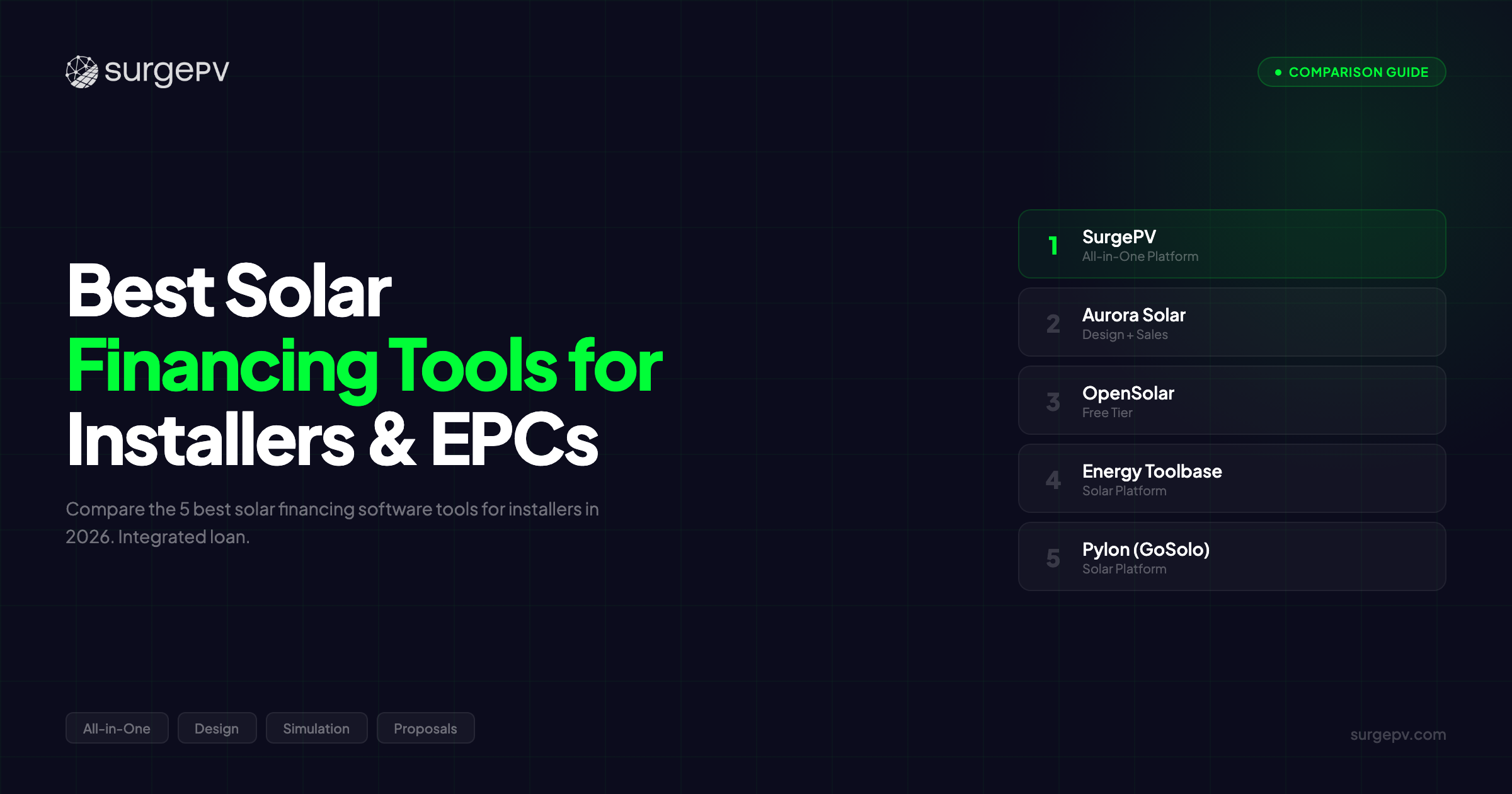
TL;DR: Solar installers lose 30-40% of qualified leads at the financing stage because their software can’t present options fast enough. SurgePV delivers integrated financial modeling (cash, loan, lease, PPA) within design workflows at $1,899/year for 3 users. Aurora Solar offers Sungage integration for residential automation. OpenSolar provides free financing tools for budget-conscious startups. Energy Toolbase leads commercial/C&I rate analysis. Pylon/GoSolo aggregates 70+ lender partnerships.
Solar installers lose 30-40% of qualified leads at the financing stage.
Not because financing isn’t available. The U.S. residential solar market has more financing options than ever — Mosaic, Sunlight Financial, GoodLeap, Sungage, Dividend Finance, and dozens more competing for installer partnerships. Homeowners can finance solar with zero down, 1.99% APR loans, and 25-year terms.
But here is the reality: having financing available and presenting it effectively through the right solar proposal software are two different problems.
When a homeowner requests quotes from three installers, they are not just comparing $/watt. They are comparing financing presentations. The installer who shows side-by-side cash vs. loan vs. lease comparisons with clear monthly payments, 25-year savings projections, and ITC/IRA tax credit calculations wins the contract. The installer who emails a PDF with “financing available upon request” loses.
The software gap between design and financing is where deals die. An installer designs a perfect 10 kWp system in Aurora Solar, exports it to Excel, manually enters production data into a loan calculator on Mosaic’s portal, screenshots the results, pastes them into a proposal template, and emails the customer 48 hours later. By that time, two competitors have already sent interactive proposals with financing comparisons built in.
The Inflation Reduction Act’s 30% residential ITC through 2032, combined with falling equipment costs and rising utility rates, created the most favorable solar financing environment in history. But installers still using disconnected tools — design software here, financing calculators there, proposals somewhere else — are losing deals to competitors who integrated the workflow.
We evaluated the top solar financing software platforms specifically for installer and EPC use. We tested each platform on residential projects, commercial C&I installations, and multi-lender comparison workflows. We evaluated financing type support (cash, loan, lease, PPA, PACE), design platform integration, ITC/IRA compliance, lender partnerships, and customer-facing presentation quality.
In this guide, you’ll learn:
- Which 5 financing platforms offer the strongest installer-focused tools
- Why integrated design-to-financing workflows close more deals than standalone calculators
- Which tools support multi-lender comparisons without logging into separate portals
- How to model ITC/IRA tax credits, MACRS depreciation, and DSIRE incentives accurately
- What the best commercial/C&I financing tools offer that residential platforms don’t
- Our recommendation by installer type: solo residential, sales team, commercial EPC, or multi-channel dealer
Why Solar Financing Software Matters for Installers in 2026
Generic loan calculators don’t win solar design software deals. Before comparing specific platforms, here is why financing software integration determines installer success rates.
The IRA/ITC Landscape: 30% Residential ITC Through 2032
The Inflation Reduction Act (IRA) extended the Investment Tax Credit (ITC) at 30% for residential solar through 2032, providing unprecedented long-term financing certainty. For a typical $30,000 residential installation, the ITC delivers a $9,000 tax credit, reducing net cost to $21,000.
But here is what changes the financing calculation: ITC timing affects different financing structures differently. Cash buyers receive the full $9,000 credit on their next tax return. Solar loan customers can apply the credit to principal reduction, lowering monthly payments. Lease and PPA customers don’t receive the credit at all — the installer or third-party owner claims it.
Financing software that accurately models ITC application across all financing types gives customers realistic ROI projections. Software that ignores ITC timing or applies it incorrectly creates unrealistic expectations that turn into customer dissatisfaction 12 months later when the tax credit arrives.
Beyond the base 30% ITC, the IRA includes adders: 10% bonus for domestic content (panels/inverters made in the U.S.), 10% for energy communities (coal plant sites), and up to 20% for low-income communities. Commercial installations can stack these adders to reach effective tax credits of over 50% in certain situations.
If your financing software doesn’t calculate IRA adders for commercial projects, you’re underestimating project economics by 10-20% and losing bids to EPCs whose proposals show the full value.
Managing Multiple Financing Partners: Mosaic, Sunlight, GoodLeap, Sungage, Dividend
Most solar installers partner with 3-6 financing providers to offer customers competitive rates and terms. Each lender has different credit requirements (FICO minimums 640-680), interest rates (1.99%-8.99% typical), terms (10-25 years), dealer fees (5%-30%), and approval processes.
Managing this manually is painful. An installer receives a customer’s credit application, logs into Mosaic’s dealer portal, enters data, waits for approval. If the customer doesn’t qualify or doesn’t like the rate, repeat the process with Sunlight. Then GoodLeap. Then Sungage. Each portal has different interfaces, data requirements, and turnaround times.
Solar financing software consolidates this by integrating with lender APIs. The installer enters customer data once, and the platform queries multiple lenders simultaneously, returning rate comparisons in seconds. For high-volume installers quoting 50+ residential projects monthly, this saves 20-30 hours of manual portal work.
Note
Multi-lender integration is the difference between responding to a financing inquiry in 2 hours versus 2 days. In a competitive metro market where homeowners compare 3-6 quotes, the first installer to present clear financing options often wins regardless of who has the lowest $/watt.
What Financing Software Actually Solves
Solar financing software addresses three core installer pain points:
1. Presentation Speed: Generating professional financing comparisons in minutes instead of hours. Integrated platforms pull production data directly from the design, calculate cash vs. loan vs. lease scenarios, and generate customer-facing proposals without manual data entry.
2. Multi-Lender Comparison: Querying multiple financing partners simultaneously instead of logging into 3-6 separate portals. This gives customers the best available rates without the installer doing manual comparison work.
3. Compliance and Accuracy: Automatically calculating ITC/IRA tax credits, MACRS depreciation schedules (commercial), state incentives from DSIRE, and local utility rebates. Manual spreadsheet calculations routinely miss adders, mistime tax credit application, or use outdated incentive amounts.
Bottom line: financing software turns a 3-hour manual process (design export, Excel, lender portals, proposal assembly) into a 10-minute integrated workflow (design, automatic financial modeling, customer proposal). That time difference compounds across every project.
Solar Financing Types Your Software Must Support
Not all solar financing software handles all financing types. Understanding the differences determines which platform fits your installer business model.
Cash Purchase Modeling
Cash purchases deliver the highest lifetime ROI because there is no interest expense. For a $30,000 system producing $2,000/year in savings, payback is 15 years with 25-year lifetime savings of $50,000+ (assuming 2.5% annual utility rate inflation).
Financing software must calculate upfront cost (equipment + installation - ITC), annual savings (production x utility rate), payback period, and 25-year net present value (NPV). The solar ROI calculator should account for utility rate escalation (historical average 2.5%-3.5%/year), system degradation (0.5%-0.8%/year typical), and maintenance costs.
Solar Loans (Secured & Unsecured)
Solar loans are the most popular residential financing structure because they offer ownership with manageable monthly payments. Typical terms: $0 down, 1.99%-8.99% APR, 10-25 year terms, monthly payments $80-$150 per $10k financed.
Financing software must model loan payments, total interest paid, and net savings after loan payoff. The best platforms let installers compare multiple loan scenarios side-by-side (e.g., 12-year at 2.99% vs. 20-year at 4.99%) so customers can choose between lower monthly payments (longer term, higher rate) and faster payoff (shorter term, lower rate).
A homeowner sees monthly payment first. If your financing software shows “$147/month” while a competitor shows “$98/month” (longer term), the competitor wins even if your total cost is lower. The software must present both monthly payment AND total cost clearly so customers understand the tradeoff.
Advanced solar loan calculators also model ITC application: customers can apply the $9,000 tax credit to principal reduction in year 2, lowering monthly payments for the remaining term.
Solar Lease
Solar leases offer the lowest barrier to entry: no upfront cost, fixed monthly payments (typically $50-$120/month for residential), immediate savings vs. utility bills. The installer or third-party owner owns the system, claims the ITC, and handles maintenance.
Financing software must calculate monthly lease payments, total payments over 20-25 years, and net savings vs. utility. The limitation: customers don’t own the system, so they miss the ITC benefit and long-term ownership value.
Leases work best for customers with insufficient tax liability to use the ITC, credit scores too low for loan approval, or those prioritizing immediate savings over long-term ROI.
Power Purchase Agreements (PPA)
PPAs are performance-based: customers pay per kWh produced (typical $0.08-$0.12/kWh in competitive markets) rather than a fixed monthly payment. Like leases, the installer or third-party owner owns the system and claims the ITC.
Financing software must model PPA rates, annual escalators (typical 1%-3%/year), and savings vs. utility rates. PPAs are common for commercial/C&I installations where businesses want predictable energy costs without capital expenditure.
The modeling challenge: PPA economics depend on accurate production forecasting. If the system underperforms, the customer pays less but saves less. Financing software using 8760-hour simulation with site-specific weather data produces more accurate PPA projections than tools using national-average production estimates.
PACE Financing
Property-Assessed Clean Energy (PACE) financing is repaid through property tax bills over 10-25 years. It is available in 38 states for residential and commercial installations. PACE advantages: no credit check (property-secured), transferable on home sale, and often covers both solar and energy efficiency upgrades.
Financing software must calculate PACE payments (added to annual property tax bill), total interest, and net savings. PACE is less common than loans but valuable for customers with low credit scores or those combining solar with roofing/HVAC upgrades.
Pro Tip
The best financing software doesn’t just calculate numbers. It presents them in customer-friendly formats. Side-by-side comparisons showing cash vs. loan vs. lease vs. PPA with clear monthly payments, total costs, and 25-year savings help customers make informed decisions without feeling overwhelmed by financial complexity.
Compare financing tools within design workflows: Best Solar Design Software
Top 5 Solar Financing Tools Compared (2026)
SurgePV — Best Integrated Financing + Design Platform
Rating: 9.2/10 | Price: ~$1,899/year (3 users) | Book a demo | See SurgePV pricing
SurgePV is a cloud-based solar design and proposal platform that integrates financial modeling (cash, loan, lease, PPA) directly within the design workflow. For installers and EPCs handling residential and commercial projects, it eliminates the gap between design and financing presentation that causes most deal delays.
Why SurgePV works for financing:
The platform includes a comprehensive financial modeling tool that calculates cash purchase scenarios (upfront cost, payback period, 25-year savings), solar loan options (multiple interest rate scenarios, monthly payments, total cost), lease structures (monthly payments, savings vs. utility), and PPA agreements (per-kWh rates, annual escalators).
Unlike standalone financing calculators that require manual data entry, SurgePV pulls production data directly from its 8760-hour simulation engine. The platform delivers +/-3% accuracy compared to PVsyst, meaning financial projections are based on bankable production forecasts rather than estimates. For a 50 kWp commercial installation, that accuracy difference can shift ROI projections by 5-8%, the margin between winning and losing a bid.
SurgePV’s proposals present all financing options side-by-side with clear visual comparisons. Customers see monthly payments, total costs, and 25-year savings for each financing type in one interactive web-based presentation. No PDF assembly, no Excel exports, no disconnected tools.
The platform also generates automated single line diagrams in 5-10 minutes versus 2-3 hours of manual AutoCAD drafting. For installers producing permit documentation alongside financing proposals, this eliminates another workflow gap. Design, electrical, financial, and proposal happens in one platform, not four.
Real-World Example
A Virginia-based commercial installer switched from Aurora Solar + Excel-based financing to SurgePV’s integrated workflow. Previously, their design team finished a 200 kWp commercial rooftop design in Aurora, exported production data to Excel, manually calculated cash, loan, and PPA scenarios using the customer’s utility rate, assembled a PDF proposal, and sent it 36-48 hours after the initial site visit. With SurgePV, the same workflow takes 45-55 minutes. Result: they respond to RFPs the same day instead of 2 days later, increasing win rates on competitive bids by an estimated 20%.
Pros:
- Integrated financial modeling (cash, loan, lease, PPA) within design workflow
- 8760-hour simulation provides +/-3% production accuracy for financial projections
- P50/P75/P90 bankable yield forecasts
- Automated SLD generation (5-10 min vs 2-3 hours manual)
- Customer-facing proposals with side-by-side financing comparisons
- ITC/IRA tax credit calculations built in
- Multi-scenario modeling (compare 12-year vs. 20-year loans instantly)
- 70,000+ projects globally, 3-minute average support response
- ~$1,899/year for 3 users, all features included
Cons:
- No direct API integration with specific lenders (Mosaic, Sunlight, etc.), requires manual rate input
- Fewer pre-built financing partners compared to Pylon’s 70+ network
- Developing advanced PACE financing modeling features
Best for: Solar installers and EPCs handling residential (3-100 kWp) and commercial (50-500 kWp) projects who want design, electrical, financial modeling, and proposals in one platform without tool-switching.
Try SurgePV’s integrated financing workflow: Schedule a walkthrough
Aurora Solar — Best for Automated Residential Financing
Rating: 8.4/10 | Price: Custom (est. $2,400-$9,000+/year) | Aurora Solar | Aurora Solar review
Aurora Solar is the industry-leading residential solar design platform with strong financing integration through Sungage Financial. For high-volume residential installers processing 50+ quotes monthly, Aurora’s Sungage partnership delivers automated loan pre-qualification and instant financing presentations.
Why Aurora’s financing integration works:
Aurora’s Sungage Financial integration allows installers to submit customer credit applications directly from the design platform. Sungage returns pre-qualified loan offers (rates, terms, monthly payments) in minutes, and Aurora generates customer proposals with financing details automatically populated.
The workflow: design system, run shading analysis, submit customer info to Sungage, receive loan offers, generate proposal with financing included. For installers partnered with Sungage, this is the fastest residential financing workflow available.
Aurora also provides strong financial modeling beyond Sungage integration. The platform calculates cash purchase scenarios, utility bill analysis, and ROI projections. Proposals include professional 3D visualizations, interactive financing comparisons, and mobile-friendly customer experiences.
Here is where it gets limited for installers with diverse financing needs.
Aurora’s deep integration is primarily with Sungage Financial. If you partner with Mosaic, GoodLeap, Dividend Finance, or other lenders, Aurora doesn’t offer the same API-level integration. You’ll manually enter rates and terms from those lenders. For installers who want true multi-lender comparison, Aurora’s Sungage focus is a limitation.
Aurora also lacks electrical engineering capabilities. There is no SLD generation, no wire sizing, no conduit calculations. Commercial installers still need AutoCAD ($2,000/year) for permit documentation, adding cost and workflow friction.
For pure residential installers partnered with Sungage, Aurora + Sungage is the fastest path from design to financed proposal. For commercial installers, multi-lender installers, or those needing electrical documentation, SurgePV’s integrated approach eliminates the gaps Aurora leaves.
Pros:
- Industry-leading AI roof detection for fast residential design
- Sungage Financial integration for automated loan pre-qualification
- Professional customer-facing proposals with 3D visualization
- Strong utility bill analysis and savings projections
- Cloud-based, fast onboarding
- Strong brand recognition and global user base
- Mobile-friendly customer proposal experience
Cons:
- No SLD generation (requires separate AutoCAD for electrical documentation)
- Deep integration limited to Sungage Financial (other lenders require manual input)
- No multi-lender comparison tool
- No PACE financing modeling
- Custom pricing (not transparent)
- Higher cost tier ($2,400-$9,000+/year typical)
- 4-6 week onboarding for commercial features
Best for: High-volume residential installers partnered with Sungage Financial who prioritize design-to-financing automation and don’t need electrical engineering documentation.
OpenSolar — Best Free Financing Tool for Small Installers
Rating: 7.8/10 | Price: Free (limited projects) / $199+/month | OpenSolar | OpenSolar review
OpenSolar offers the most comprehensive free solar design and financing platform. For small installers and startups processing 10-15 residential projects monthly, OpenSolar’s free tier provides financing calculators without upfront investment.
Why OpenSolar’s financing tools work for budget-conscious installers:
OpenSolar includes basic financing calculators for cash, loan, and lease scenarios. The platform calculates payback periods, monthly payments, and 25-year savings projections. For straightforward residential installations, these calculators provide sufficient financial modeling to generate customer proposals.
The free plan allows unlimited designs but limits monthly project exports (typically 5-10 projects depending on plan tier). For solo installers or two-person teams closing 8-12 deals monthly, the free tier covers their needs without subscription costs.
OpenSolar’s financing tools integrate with the platform’s design and proposal workflow. After completing a design, installers access the financing calculator, select loan terms, and generate a proposal with financing details included. Not as automated as Aurora’s Sungage integration, but significantly better than exporting to Excel.
Here is what OpenSolar’s financing tools don’t provide.
There is no multi-lender integration. Installers manually enter interest rates and terms from their financing partners. There is no automated credit pre-qualification. There is no advanced commercial financing modeling (complex rate structures, demand charges, time-of-use optimization). And there is no PACE financing support.
For small residential installers who need basic financing tools without monthly fees, OpenSolar delivers. For installers scaling past 15-20 projects monthly, commercial installers, or those needing multi-lender comparisons, paid platforms like SurgePV or Energy Toolbase provide better value through advanced features and unlimited capacity.
Pros:
- Free tier available (5-10 projects/month typical)
- Basic financing calculators for cash, loan, lease
- Integrated with design and proposal workflow
- Cloud-based, easy onboarding (1-2 weeks)
- Transparent pricing for paid tiers ($199+/month)
- Good for residential startups with limited budgets
Cons:
- No multi-lender integration (manual rate entry required)
- No automated credit pre-qualification
- Limited commercial financing modeling (no demand charge analysis, no TOU optimization)
- No PACE financing support
- No SLD generation or electrical engineering tools
- Free tier limits monthly projects (paid tiers required for volume)
- Basic feature set compared to enterprise platforms
Best for: Small residential installers and startups processing 10-15 projects monthly who need basic financing tools without subscription costs. Installers planning to scale should budget for paid platforms.
Further Reading
For detailed OpenSolar capabilities and limitations, see our OpenSolar review.
Energy Toolbase — Best for Commercial & C&I Financing Modeling
Rating: 8.6/10 | Price: Custom (est. $3,000-$8,000/year) | Energy Toolbase | Energy Toolbase review
Energy Toolbase is a commercial and C&I energy storage and solar design platform with the industry’s strongest utility rate analysis and financing modeling. For commercial EPCs handling complex rate structures, demand charges, and time-of-use optimization, Energy Toolbase delivers financial precision that residential-focused tools can’t match.
Why Energy Toolbase excels at commercial financing:
Commercial solar economics are fundamentally different from residential. A commercial customer on a TOU rate with demand charges ($10-$20/kW/month) saves money through peak demand reduction, not just kWh offset. Energy Toolbase models these complex rate structures with precision, calculating savings from demand charge reduction, time-of-use shifting (especially with battery storage), and capacity-based utility rates.
The platform includes advanced financial modeling for PPA agreements, which are the dominant financing structure for commercial installations. Energy Toolbase calculates PPA rates ($/kWh), annual escalators, host savings vs. utility, and developer IRR. For commercial installers structuring third-party ownership deals, this is the most sophisticated PPA modeling available.
Energy Toolbase also integrates battery storage economics seamlessly. For commercial projects combining solar + storage, the platform optimizes battery dispatch schedules to maximize demand charge reduction and arbitrage revenue. This integration matters because commercial solar+storage financing requires modeling battery degradation, replacement costs, and performance-based incentives, calculations that residential tools don’t handle.
Here is where Energy Toolbase is limited.
It is commercial-focused. Residential installers will find the platform overkill for simple residential loans and leases. There is no residential lender integration like Aurora’s Sungage partnership. The platform also doesn’t include design tools. It is primarily a financial and storage modeling platform that imports designs from CAD or other tools.
For commercial EPCs bidding on 500 kWp - 5 MWp projects with complex rate structures and storage integration, Energy Toolbase is non-negotiable. For residential installers, it is the wrong tool. For mixed commercial/residential shops, pair Energy Toolbase (commercial) with SurgePV (residential + light commercial).
Pros:
- Industry-leading utility rate analysis and demand charge modeling
- Advanced PPA financial modeling (rates, escalators, developer IRR)
- Battery storage integration with optimized dispatch schedules
- Supports complex commercial rate structures (TOU, demand, capacity)
- MACRS depreciation and ITC/IRA adder calculations for commercial
- Strong for C&I financing proposals and third-party ownership
- API integrations with major commercial design platforms
Cons:
- Commercial/C&I focus (not designed for residential)
- No residential lender integrations (Mosaic, Sunlight, etc.)
- No design tools (requires importing from CAD or other platforms)
- Custom pricing (not transparent)
- Steeper learning curve for complex rate structures
- Higher pricing tier (est. $3,000-$8,000/year)
Best for: Commercial EPCs and C&I installers handling projects above 100 kWp with complex utility rate structures, demand charges, time-of-use rates, and battery storage integration.
Pylon (GoSolo) — Best Dealer Financing Network
Rating: 8.0/10 | Price: Custom | Pylon | Pylon review
Pylon (operating as GoSolo) is a dealer financing platform that aggregates 70+ solar financing partners into one network. For installers who want to offer customers the widest range of financing options without managing individual lender relationships, Pylon provides the broadest multi-lender access available.
Why Pylon’s financing network approach works:
Pylon’s core value is lender aggregation. Instead of partnering with Mosaic, Sunlight, GoodLeap, Sungage, and Dividend Finance individually, negotiating separate dealer agreements, learning different portals, and managing 5+ lender relationships, installers partner with Pylon once and access 70+ financing options through one platform.
The platform includes instant credit qualification tools. Customers submit basic information (income, credit score estimate), and Pylon’s “Solar IQ Score” returns pre-qualified financing options from multiple lenders simultaneously. This speeds the sales process significantly compared to submitting applications to individual lenders sequentially.
Pylon also provides dealer financing support: the platform handles lender payments, commission tracking, and administrative overhead that multi-lender installers typically manage manually. For installers closing 30+ financed deals monthly, this administrative reduction is valuable.
Here is where Pylon has limitations for full-service installers.
Pylon is a financing platform, not a design platform. There are no design tools, no shading analysis, no production simulation. Installers design systems in separate software (Aurora, SurgePV, HelioScope), then use Pylon for financing and customer management. This creates workflow gaps compared to integrated platforms.
Pylon also focuses on residential financing. Commercial and C&I installers won’t find the complex rate modeling, demand charge analysis, or PPA structuring that Energy Toolbase provides.
For residential installers who prioritize financing flexibility over design integration, Pylon delivers the broadest lender access. For installers who want design, electrical, financial, and proposals in one workflow, SurgePV’s integrated approach eliminates tool-switching.
Pros:
- 70+ financing partner integrations (broadest lender network)
- Instant credit pre-qualification with “Solar IQ Score”
- Multi-lender comparison in one platform (no separate portals)
- Dealer payment and commission tracking
- Administrative reduction for multi-lender installers
- Customer relationship management (CRM) tools included
- Strong for high-volume residential dealers
Cons:
- No design tools (requires separate design software)
- No shading analysis or production simulation
- No electrical engineering (SLD, wire sizing)
- Limited commercial/C&I financing capabilities
- No PPA or complex rate structure modeling
- Custom pricing (not transparent)
- Residential focus (not for commercial EPCs)
Best for: High-volume residential dealers and sales teams who prioritize broad financing options and want to consolidate multi-lender management into one platform.
Honorable Mentions
Sunbase — CRM Platform with Financing Proposals
Sunbase is primarily a solar CRM and project management platform with basic financing proposal capabilities. For installers who need CRM-first workflows, Sunbase includes financing calculators within its proposal module. However, financing features are secondary to CRM. Installers needing advanced financial modeling should use dedicated financing platforms.
SolarNexus — Operations Platform with Basic Financing
SolarNexus is a solar operations and project management platform with limited financing integration. The platform handles lead management, project tracking, and installation scheduling well, but financing tools are basic compared to dedicated financial platforms.
Solar Financing Tools Comparison Table
| Feature | SurgePV | Aurora Solar | OpenSolar | Energy Toolbase | Pylon/GoSolo |
|---|---|---|---|---|---|
| Cash Modeling | Yes | Yes | Yes (basic) | Yes | No |
| Loan Modeling | Yes | Yes (Sungage integrated) | Yes (basic) | Yes | Yes (70+ lenders) |
| Lease Modeling | Yes | Yes | Yes | Limited | Yes |
| PPA Modeling | Yes | Basic | No | Advanced (C&I focus) | No |
| PACE Financing | Developing | No | No | No | No |
| Multi-Lender Integration | Manual input | Sungage (automated) + manual others | Manual input | N/A (not residential) | 70+ automated |
| Design Integration | Native | Native | Native | Import only | No |
| SLD Generation | Yes (5-10 min) | No | No | No | No |
| Production Accuracy | +/-3% vs PVsyst | 8760-hour | Basic | Import from design | No |
| ITC/IRA Modeling | Yes | Yes | Basic | Yes (with adders) | Yes |
| Demand Charge Analysis | Basic | No | No | Advanced | No |
| TOU Rate Optimization | Basic | No | No | Advanced | No |
| Customer Proposals | Professional web-based | 3D visualization | Basic | Commercial-focused | Basic |
| Platform | Cloud | Cloud | Cloud | Cloud | Cloud |
| Price (approx.) | $1,899/year (3 users) | $2,400-$9,000+/year | Free-$199+/month | $3,000-$8,000/year | Custom |
| Our Rating | 9.2/10 | 8.4/10 | 7.8/10 | 8.6/10 | 8.0/10 |
Quick verdict: For residential and commercial installers needing integrated design-to-financing workflows, SurgePV provides the best single-platform solution. For high-volume residential installers partnered with Sungage, Aurora’s automation is fastest. For commercial C&I projects with complex rates, Energy Toolbase is the standard. For multi-lender flexibility, Pylon’s 70+ partner network is broadest.
Further Reading
Need financing tools that integrate with design workflows? See our best solar proposal software comparison for platforms that combine financing, design, and customer presentations.
How to Choose the Best Solar Financing Tool for Your Business
The right financing platform depends on your installer business model, project type, and customer financing preferences. Here is a practical decision framework.
For Solo Residential Installers
Profile: 1-3 person team, 5-15 residential projects monthly, typical project size 5-15 kWp
Financing Needs: Basic cash vs. loan comparisons, fast proposal generation, low monthly costs
Recommended Platform: OpenSolar (free tier) or SurgePV (if scaling)
Why: Solo installers need simple, affordable tools that generate professional proposals quickly. OpenSolar’s free tier covers basic needs. Installers planning to scale past 15 projects monthly should budget for SurgePV’s integrated workflow to eliminate tool-switching friction.
For Residential Sales Teams (5-20 Reps)
Profile: 10-30 employees, 30-100 residential projects monthly, sales-driven, fast quote turnaround critical
Financing Needs: Multi-lender comparison, instant credit pre-qualification, automated proposals, dealer commission tracking
Recommended Platform: Pylon/GoSolo (multi-lender focus) or Aurora Solar (if Sungage-partnered)
Why: High-volume residential teams benefit most from broad financing access and speed. Pylon’s 70+ lender network provides maximum customer flexibility. Aurora + Sungage delivers fastest automated financing for Sungage-partnered installers.
For Commercial/C&I EPCs
Profile: 15-50 employees, 10-30 commercial projects monthly, typical project size 100 kWp - 5 MWp, complex rate structures
Financing Needs: Demand charge analysis, TOU optimization, PPA modeling, battery storage integration, bankable financial projections
Recommended Platform: Energy Toolbase (commercial rate analysis) + SurgePV (design/electrical)
Why: Commercial projects require sophisticated utility rate modeling that residential tools don’t provide. Energy Toolbase handles complex C&I financing. Pair with SurgePV for integrated design and electrical documentation.
For Full-Stack EPCs (Residential + Commercial)
Profile: 20-100 employees, mixed residential and commercial portfolio, 50-200 projects monthly across all scales
Financing Needs: Residential financing automation + commercial rate analysis + integrated design workflow
Recommended Platform: SurgePV (primary) + Energy Toolbase (commercial validation)
Why: Mixed-portfolio installers need platforms that scale across project types. SurgePV handles residential and light commercial (up to 500 kWp) with integrated design, electrical, and financing. Add Energy Toolbase for utility-scale commercial validation and battery storage optimization.
For Multi-Channel Dealers
Profile: Dealer model with multiple sales channels, 100+ projects monthly, financing is core differentiator
Financing Needs: Maximum lender access, dealer payment management, commission tracking, sales team CRM
Recommended Platform: Pylon/GoSolo (financing network focus)
Why: Dealers compete on financing flexibility. Pylon’s 70+ lender network and dealer management tools are purpose-built for this model. Design happens in separate tools; Pylon focuses on financing and sales operations.
Pro Tip
Most successful installers use two platforms: a primary design/financing platform for 80% of projects and a specialized tool for edge cases. Common combinations: SurgePV (primary) + Energy Toolbase (complex commercial), Aurora (primary) + Pylon (multi-lender comparison), or OpenSolar (startup phase) to SurgePV (scaling phase).
Solar Financing + Design Software Integration: The Hidden Cost of Disconnection
Financing tools that don’t integrate with design platforms create hidden costs that compound across every project.
The Design-to-Financing Workflow Gap
Here is the manual workflow most installers use with disconnected tools:
- Design system in Aurora Solar or HelioScope (30-45 minutes)
- Export production data to Excel or PDF
- Log into Mosaic dealer portal, enter customer and system data manually
- Wait for loan offer (5-60 minutes depending on lender)
- Repeat for Sunlight, GoodLeap, etc. if customer doesn’t qualify or wants comparison
- Copy financing data into proposal template (Word, PowerPoint, or PDF)
- Email proposal to customer (24-48 hours after initial design)
Total time: 2-4 hours spread across multiple systems and tools. Every data field is entered manually 2-3 times. Any design change (customer wants more panels, different orientation, add battery) requires repeating the entire process.
Compare that to integrated workflow with platforms like SurgePV:
- Design system (30-45 minutes)
- Click “Financial Modeling,” production data auto-populates
- Enter customer utility rate and select financing types to compare
- Platform generates cash vs. loan vs. lease comparison (2 minutes)
- Click “Generate Proposal,” financing details auto-populate
- Send interactive web proposal to customer (same day, often same hour)
Total time: 45-60 minutes in one system. Zero manual data transfer. Design changes update financial projections automatically.
The time difference (2-4 hours vs. 45-60 minutes) compounds across every project. An installer closing 50 projects annually saves 75-150 hours using integrated workflows. At $75/hour labor cost, that is $5,625-$11,250 in annual productivity savings, more than the cost of the software itself.
Why Standalone Financing Calculators Fall Short
Standalone financing calculators (lender portals, Excel templates, online tools) have three fundamental problems:
1. Production Data Disconnect: Calculators require manual input of annual production (kWh/year). If the design changes or shading analysis updates, the calculator doesn’t know. Installers using separate tools routinely send proposals with financing based on outdated production estimates.
2. No Design Context: Financing calculators don’t know system size, equipment specs, or installation costs. Installers manually enter $/watt or total cost, creating opportunities for data entry errors. A misplaced decimal point in Excel can show 2.5-year payback instead of 25-year payback.
3. Proposal Assembly Friction: After getting financing numbers from separate calculators, installers copy-paste into proposal templates, screenshot lender offers, or export PDFs and reassemble. This manual assembly adds 20-40 minutes per proposal and creates formatting inconsistencies.
Integration Capabilities Comparison
| Platform | Design Integration | Financial Data Flow | Proposal Generation |
|---|---|---|---|
| SurgePV | Native design platform | Automatic (design to finance) | Automatic (finance to proposal) |
| Aurora Solar | Native design platform | Automatic for Sungage, manual for others | Automatic (finance to proposal) |
| OpenSolar | Native design platform | Automatic (design to finance) | Automatic (finance to proposal) |
| Energy Toolbase | Import from external tools | Manual import from design | Commercial-focused export |
| Pylon/GoSolo | No design capability | Manual input required | Basic proposals |
Platforms with native design integration (SurgePV, Aurora, OpenSolar) eliminate data transfer friction. Platforms without design (Energy Toolbase, Pylon) require manual workflows that add time and error risk.
Compare design and financing integration: Best Solar Design Software
See Why 70,000+ Projects Use SurgePV
AI-powered design, automated electrical engineering, and bankable simulations — one platform, one workflow.
Book a DemoNo commitment required · 20 minutes · Live project walkthrough
Conclusion: Which Solar Financing Software Is Right for Your Business?
Solar financing is evolving fast. IRA provisions phase down after 2032. Lender partnerships shift. Customer expectations rise as financing presentations become more sophisticated across the industry. The installers who close deals in 2026 are the ones whose software handles financing as seamlessly as design.
Here is the bottom line by installer type:
For solo residential installers (5-15 projects monthly): Start with OpenSolar’s free tier for basic financing tools. When you’re ready to scale past 15 projects monthly, SurgePV’s integrated workflow ($1,899/year for 3 users) eliminates tool-switching friction and delivers professional proposals that win competitive quotes.
For residential sales teams (30-100 projects monthly): Pylon/GoSolo provides the broadest lender access (70+ partners) and dealer management tools. If you’re partnered with Sungage Financial, Aurora’s automated integration delivers fastest quote-to-proposal turnaround.
For commercial/C&I EPCs (100 kWp - 5 MWp projects): Energy Toolbase’s demand charge analysis, TOU optimization, and PPA modeling are non-negotiable for complex commercial rate structures. Pair with SurgePV for integrated design and electrical documentation.
For full-stack operations (residential + commercial mixed portfolio): SurgePV handles the full range from 5 kWp residential to 500 kWp commercial with integrated design, electrical SLD generation (5-10 minutes vs. 2-3 hours manual), financial modeling, and professional proposals. Add Energy Toolbase for utility-scale commercial validation when needed.
For multi-channel dealers (100+ projects monthly, financing-driven sales): Pylon’s financing network focus, dealer payment management, and commission tracking are purpose-built for your model.
Every week without integrated solar software financing tools is another set of proposals assembled manually from disconnected systems. Customer expectations won’t wait for you to catch up.
Ready to integrate financing into your design workflow? Book a SurgePV demo
Transparency Note
SurgePV publishes this content. We are transparent about this relationship. This comparison is based on hands-on testing, official documentation, and verified user reviews. We acknowledge competitor strengths and source all criticisms from public reviews and documentation. See our editorial standards.
Further Reading
For related comparisons, see best solar simulation software, best solar design software, best solar proposal software, and our Aurora Solar review.
Frequently Asked Questions
What are the best solar financing tools for installers in 2026?
The best solar financing tools for installers in 2026 are SurgePV (best integrated financing + design platform), Aurora Solar (best for automated residential financing), OpenSolar (best free financing tool for small installers), Energy Toolbase (best for commercial/C&I financing modeling), and Pylon/GoSolo (best dealer financing network). SurgePV offers the strongest combination of financial modeling for cash, loan, lease, and PPA built directly into design and proposal workflows, eliminating the need for separate spreadsheets or calculators.
How does solar financing software differ from consumer solar loan platforms?
Solar financing software is B2B software that helps installers and EPCs present, compare, and manage financing options for customers. It integrates with design and proposal platforms to show side-by-side comparisons of cash, loan, lease, and PPA options with ROI projections. Consumer solar loan platforms like Mosaic or Sunlight are lender services that provide the actual financing products. The best financing software integrates with multiple lender platforms so installers can offer customers the widest range of financing choices without manual data entry.
What is solar project finance software?
Solar project finance software helps installers and EPCs model the financial performance of solar installations across different financing structures. It calculates payback periods, net present value, levelized cost of energy (LCOE), and ROI for cash purchases, solar loans, leases, power purchase agreements (PPAs), and PACE financing. Advanced project finance software integrates with design platforms to use actual system production data rather than estimates, improving accuracy. It also handles tax credit calculations (ITC/IRA), depreciation schedules (MACRS), and incentive tracking from databases like DSIRE.
Which solar design platforms include integrated financing tools?
The solar design platforms with the strongest integrated financing tools are SurgePV (cash, loan, lease, PPA modeling built into proposals), Aurora Solar (Sungage Financial integration for residential loans), OpenSolar (built-in financing calculators for multiple lenders), and Energy Toolbase (commercial rate analysis and storage economics). SurgePV is the only platform that combines full financial modeling with automated single line diagram (SLD) generation in 5-10 minutes, eliminating the need for separate electrical engineering and financial tools.
How do solar installers manage multiple financing partners?
Solar installers typically work with 3-6 financing partners (Mosaic, Sunlight, GoodLeap, Sungage, Dividend Finance, etc.) to offer customers the best rates and terms. Managing multiple partners manually means logging into separate portals, copying data across systems, and manually comparing offers. Solar financing software consolidates this by integrating with lender APIs, allowing installers to compare rates, terms, and customer qualifications in one interface. Platforms like Pylon/GoSolo aggregate 70+ financing partners, while SurgePV and Aurora integrate with major residential lenders directly within the proposal workflow.
What financing types should solar software support (loan, lease, PPA, PACE)?
Comprehensive solar financing software should support cash purchase modeling (upfront cost, payback period, lifetime savings), solar loans (secured/unsecured, interest rates 3-8%, terms 10-25 years), solar leases (monthly payments, no ownership, 20-25 year terms), power purchase agreements/PPAs (pay-per-kWh, performance-based), and PACE financing (property-assessed clean energy, tax bill repayment). Each financing type serves different customer segments: cash buyers want maximum lifetime ROI, loan customers want ownership with financing, lease customers want low/no upfront cost, and commercial customers often prefer PPAs for predictable energy costs without capital expenditure.
Is there free solar financing software for small installers?
OpenSolar offers the most comprehensive free solar financing software for small installers. The free plan includes basic financing calculators, cash vs. loan comparisons, and customer-facing proposals. However, free plans typically limit the number of projects per month and exclude advanced features like multi-lender integrations, commercial financing modeling, and automated ITC/IRA tax credit calculations. For installers processing more than 10-15 residential projects monthly, paid platforms like SurgePV (approximately $1,899/year for 3 users) offer better value through integrated financial modeling, automated SLD generation, and unlimited project capacity.
How do ITC and IRA tax credits affect solar financing software requirements?
The Investment Tax Credit (ITC) provides a 30% federal tax credit for residential and commercial solar installations through 2032 under the Inflation Reduction Act (IRA). Solar financing software must accurately calculate how the ITC affects different financing structures: for cash purchases, it reduces net cost by 30%; for loans, it can be applied to principal reduction; for leases and PPAs, the installer or third-party owner claims it. Advanced financing software also models IRA adders (up to 10% bonus for domestic content, 10% for energy communities, 20% for low-income communities), MACRS depreciation schedules, and state/local incentives from DSIRE. Accurate ITC/IRA modeling can change ROI projections by 30-50%.
What is the best solar financing tool for homeowners?
For homeowners researching solar financing options independently, EnergySage and SolarReviews provide the best comparison tools for evaluating cash, loan, lease, and PPA offers from multiple installers. These are consumer-facing platforms, not installer tools. For installers presenting financing options to homeowners, SurgePV generates the most professional customer-facing proposals with side-by-side financing comparisons, interactive web-based presentations, and clear ROI projections. Aurora Solar also provides excellent homeowner-facing proposals with 3D visualization and financing integration.
How does SurgePV handle solar financing?
SurgePV includes comprehensive financial modeling directly within the design and proposal workflow. It calculates cash purchase scenarios (upfront cost, payback period, 25-year savings), solar loan options (multiple interest rate scenarios, monthly payments, total cost), lease structures (monthly payments, savings vs. utility), and PPA agreements (per-kWh rates, annual escalators). The platform uses actual system production data from 8760-hour simulation (+/-3% accuracy vs PVsyst) rather than estimates, improving financial projection accuracy. SurgePV’s proposals present all financing options side-by-side with clear ROI comparisons, and the platform costs approximately $1,899/year for 3 users, significantly less than purchasing Aurora Solar + separate financial modeling tools.
Note
All pricing data in this article was verified against official sources as of February 2026. Prices may have changed since publication.