

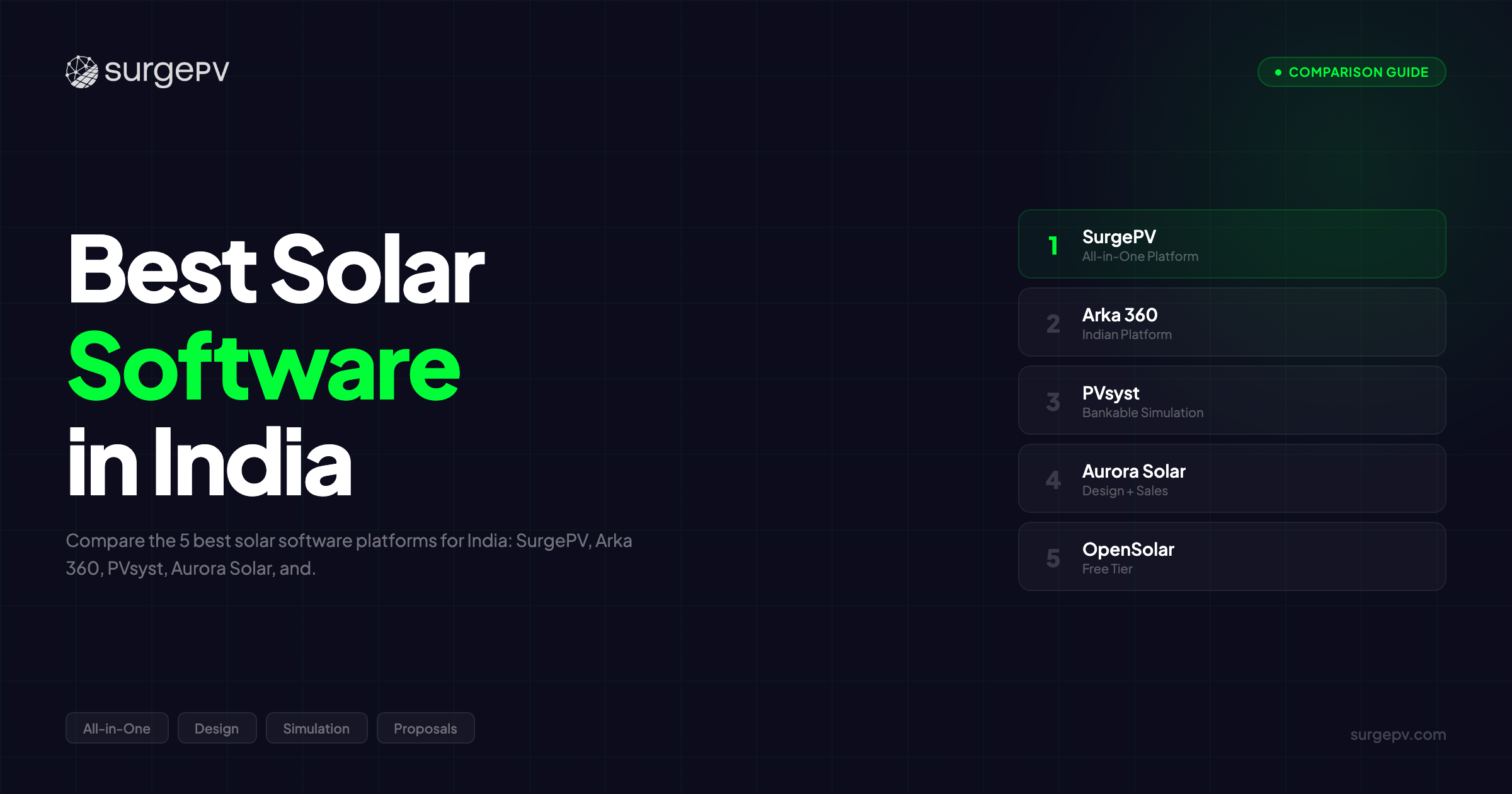
TL;DR: SurgePV is the best all-in-one solar software for India — design, automated SLD generation, bankable P50/P75/P90 simulation, and proposals with India-specific financial modelling (accelerated depreciation, MNRE subsidy, DISCOM tariff analysis) in one cloud platform. Arka 360 is the strongest local option for India-only residential installers. PVsyst is required for utility-scale financing above 10 MW. Aurora Solar works for Tier 1 EPCs with dedicated CAD and finance teams. OpenSolar is the budget entry point for small residential operations.
India’s solar industry is the fourth largest in the world. 85+ GW installed. 15–20 GW added every year.
A government target of 500 GW by 2030. Over 250,000 people employed across the solar value chain.
And yet, a surprising number of Indian EPCs still run their entire business on AutoCAD, Excel, and PVWatts.
Think about what that means. A design engineer spends 45 minutes modelling a rooftop in AutoCAD. Then 2–3 hours drafting the single line diagram for DISCOM submission.
Then a sales engineer spends another hour building a proposal in Excel — manually entering accelerated depreciation formulas, looking up the current DISCOM tariff, and calculating MNRE subsidy amounts from memory. One commercial project takes 4–5 hours across three different tools. Errors creep in at every handoff point.
For an EPC handling 50 projects per month, that is 200–250 hours of labour on tasks that software automates in minutes. At even modest Indian engineering salaries, that is 15–20 lakh INR per year in wasted labour.
The market has moved on. Professional solar design software now combines design, electrical engineering, simulation, and proposal generation in a single platform. The EPCs that adopt it are quoting faster, winning more bids, and scaling without proportionally growing their teams. The ones still using Excel are losing deals to competitors who submit professional proposals the same day.
In this guide, you will find:
- Which platforms combine design, electrical engineering, and proposals in one tool
- How software features align with CEA, MNRE, and DISCOM requirements
- Which tools handle India-specific financials (accelerated depreciation, MNRE subsidy, state DISCOM tariffs)
- Total cost of ownership for Indian EPC teams of 3–5 users
- Detailed comparisons of SurgePV, Arka 360, PVsyst, Aurora Solar, and OpenSolar
Quick Comparison Table
| Software | Best For | Pricing | India Fit |
|---|---|---|---|
| SurgePV | Integrated platform | ~$1,899/yr (3 users) | Excellent |
| PVsyst | Simulation specialist | ~$625–1,250/yr | Good |
| Aurora Solar | Residential workflow | ~$3,600–6,000/yr | Good |
| OpenSolar | Free platform | Free tier available | Good |
| Arka 360 | India-only residential | ~1–2L INR/year | Good |
After testing 5 platforms with EPCs across Maharashtra, Gujarat, Karnataka, Rajasthan, Tamil Nadu, and Uttar Pradesh, here are our recommendations:
- SurgePV — End-to-end design, electrical engineering, simulation, and proposals with India-specific features. Best for commercial EPCs and scaling installers.
- Arka 360 — India-focused platform with local brand presence. Best for India-only residential and small commercial operations.
- PVsyst — Industry-standard simulation for lender validation. Best for utility-scale projects requiring SBI/IREDA acceptance.
- Aurora Solar — Beautiful proposals with AI roof modelling. Best for Tier 1 EPCs with dedicated CAD and finance teams.
- OpenSolar — Affordable all-in-one for simple residential projects. Best for small installers on tight budgets.
Each tool is evaluated on India-specific criteria: feature completeness, DISCOM compliance, bankability, Indian financial modelling, and pricing in INR.
Best Solar Software in India (Detailed Reviews)
Pro Tip
If you are evaluating solar software and your current workflow involves more than two tools (e.g., AutoCAD + HelioScope + Excel), you are leaving money on the table. Calculate your annual tool-switching cost: number of projects × 2–3 hours per project × your engineering hourly rate. For most Indian EPCs, that number is 10–20 lakh INR per year.
SurgePV — Best All-in-One Solar Platform for India
Best For: Commercial EPCs (50 kW–10 MW), scaling installers, multi-state operations
Pricing: From 1,57,000 INR/year (3 users) | ~$1,899/year
SurgePV is built for the way Indian EPCs actually work. Design a 500 kW commercial rooftop. Generate DISCOM-compliant electrical documentation automatically. Run a bankable P50/P75/P90 simulation. Create a professional proposal with accelerated depreciation modelling. All in one cloud platform. No tool-switching. No manual data transfer. No AutoCAD.
SurgePV is headquartered in India. The platform was designed with Indian regulatory requirements, DISCOM variations, and market conditions in mind from day one — not bolted on as an afterthought.
Target Users: Commercial EPCs (50 kW–10 MW), solar installers scaling from residential to commercial, multi-state operations needing standardised workflows, multi-market EPCs (India + Middle East/Africa).
Solar Design
AI-powered roof modelling detects boundaries, tilt, and azimuth from satellite imagery (Google Maps, Bing, Esri). Saves 30–40 minutes vs manual modelling. Supports every Indian roof type: RCC flat (80% of commercial), sloped tile (residential), metal sheet (industrial), and ground-mount (utility-scale).
Module layout optimisation automatically spaces arrays to avoid shading and maximise kW per square metre. For Indian commercial rooftops — where space is often constrained and every kilowatt matters for financial viability — this matters.
Electrical Engineering — The Feature That Separates SurgePV
This is SurgePV’s primary competitive advantage.
Automated SLD generation: Complete your design, generate a code-compliant single line diagram in 5–10 minutes. DC arrays, combiners, disconnects, inverters, AC wiring, breakers, grid interconnection — all automatically mapped. That SLD is ready for DISCOM submission in Maharashtra, Gujarat, Karnataka, or any other state.
Wire sizing for Indian conditions: 400V three-phase LT, 11 kV/33 kV HT support, temperature derating for 45–50°C ambient. India’s lower grid voltage (400V vs US 480V) means larger wire sizes are needed. SurgePV calculates this automatically with voltage drop analysis, conduit fill, and protection device sizing per IS standards.
Without SurgePV, you need AutoCAD (1.6 lakh INR/year) and 2–3 hours of manual electrical drafting per project. With SurgePV, electrical documentation is automated and included in your subscription. At 50 projects per year, that is 100–150 hours of engineering labour recovered and 1.6 lakh INR in AutoCAD licensing eliminated annually.
Commercial Structures (Unique in India)
SurgePV is the only platform with native carport solar design. IT parks in Bangalore, malls across Delhi NCR, and corporate campuses are increasingly adding solar carports. Aurora, HelioScope, and PVCase do not offer native carport design.
Also: single-axis and dual-axis tracker support for utility-scale ground mount, and East-West racking for high-density rooftop installations.
Simulation and Bankability
8760-hour shading analysis with ±3% accuracy vs PVsyst. P50/P75/P90 production estimates that Indian banks (SBI, IREDA, EXIM Bank) accept for financing applications.
India-specific loss modelling: monsoon cloud cover (June–September), dust soiling in arid states (Rajasthan 8–10% annual losses), and temperature derating for 45–50°C peak summers. All factor into production estimates automatically.
Indian Financial Modelling and Proposals
Professional proposals with India-specific financial modelling:
- Accelerated depreciation: 40% first year, 20% remaining per Section 32
- MNRE rooftop subsidy: 18,000 INR/kW (1–3 kW), 14,588 INR/kW (3–10 kW)
- State incentive databases: Capital subsidies, generation-based incentives
- DISCOM tariff analysis: State-specific rates, consumer categories, slab rates
- Net metering vs gross metering: Economics by state
- Financing options: Cash vs loan vs lease comparison, PPA modelling
Web-based, interactive, mobile-friendly proposals. PDF export. Branded with your EPC’s identity.
Cloud Collaboration
Multi-user cloud platform. Design teams in Mumbai, sales teams in Delhi, field crews in Rajasthan — all working on the same projects simultaneously. No desktop licences tied to single machines. No emailing CAD files. Automatic backups.
Real-World Example
A 30-person EPC in Gujarat was running Aurora for design, AutoCAD for electrical, PVsyst for validation, and Excel for proposals — four tools, four subscriptions, four skill sets. Total annual cost: approximately 12 lakh INR per user. After consolidating to SurgePV, per-user cost dropped to 1.24 lakh INR/year, and project turnaround went from 4 hours to 45 minutes. They increased project throughput by 40% without hiring additional engineers.
Pros
- True all-in-one: Design + electrical engineering + simulation + proposals in one platform.
- India-first platform: Headquartered in India. Built with DISCOM, CEA, MNRE, and BIS requirements in mind.
- Only platform with native carport design: No competitors offer this natively.
- P50/P75/P90 bankability: Aurora only provides P50. SurgePV provides P75 and P90 that Indian lenders require.
- Transparent pricing: 1,57,000 INR/year for 3 users. All features included.
- 3-minute support response: Fastest in the industry.
- 70,000+ projects created: Proven at scale.
Cons
- Newer brand recognition: Less known than Arka 360 locally or Aurora globally, though the feature set is more complete.
- CRM integration: Not yet integrated with Zoho CRM or Salesforce India instances.
- Some DISCOM portals: Require manual SLD upload — SLDs are generated automatically but some state portals do not accept direct upload.
Pricing
| Plan | INR/Year | Users |
|---|---|---|
| Individual | 1,57,000 | 3 users |
| For 3 Users | 1,24,000/user | 3 users |
| For 5 Users | 1,07,500/user | 5 users |
| Enterprise | Custom | 10+ users |
Who SurgePV Is Best For
- Commercial EPCs doing 50 kW–10 MW projects requiring electrical engineering, DISCOM compliance, and bankable simulations
- Scaling installers moving from residential to commercial and needing integrated workflows
- Multi-state EPCs operating across multiple Indian states with different DISCOMs
- Multi-market EPCs also operating in Middle East, Africa, or US markets
- Teams ready to eliminate AutoCAD and 1.6 lakh INR/year in licensing
Not ideal for: Utility-scale developers building projects above 10 MW who need PVsyst validation for international lender requirements. Pair SurgePV for design with PVsyst for validation.
Real-World Example
A growing EPC team in India was spending 2.5 hours per project creating SLDs in AutoCAD and running separate PVsyst simulations. After switching to SurgePV, SLD generation dropped to under 10 minutes. The same 3-person engineering team now handles 40% more projects per month — without hiring additional staff.
Further Reading
See our Aurora Solar review for a full comparison with SurgePV. For proposal-specific analysis, see solar proposal software features.
Arka 360 — India’s Leading Local Solar Platform
Best For: India-only residential and small commercial installers (under 100 kW)
Pricing: Contact sales (estimated 1–2 lakh INR/year)
Arka 360 is the most established India-focused solar design and proposal platform. For EPCs that operate exclusively within India and want a local brand with IST-hours support and strong market presence, Arka 360 is the primary local alternative to evaluate against SurgePV.
The platform covers rooftop design, basic proposal generation, and some DISCOM-specific features. Arka 360 understands the Indian market. Their team is local. Training and support happen during Indian business hours.
Key Strengths:
- Strongest India market brand recognition among local platforms
- India-specific features including DISCOM templates, some MNRE subsidy support
- Local support team operating in IST
- State-level compliance awareness for major states
- Established installer network and community
Where It Falls Short:
Electrical engineering capabilities are less complete than SurgePV. SLD automation is limited — larger commercial projects may still require AutoCAD. No native carport or tracker design support.
No P75/P90 estimates, which are needed for lender acceptance on larger projects. India-only coverage means multi-market EPCs need a second platform.
Best Use Case: India-only residential and small commercial installers (under 100 kW) who prioritise local brand familiarity, IST-hours support, and an established India community. If you handle projects above 200 kW or need complete electrical engineering documentation, SurgePV offers a more complete feature set.
Did You Know?
India’s solar irradiance ranges from 1,600–2,200 kWh/m²/year, making accurate simulation software important for bankable energy yield predictions. Projects using validated simulation tools see fewer financing rejections compared to those relying on manual calculations.
PVsyst — The Bankability Gold Standard
Best For: Utility-scale projects above 10 MW requiring SBI/IREDA financing acceptance
Pricing: Approximately 2,00,000 INR/year (~CHF 1,200, ~$1,300 USD) per seat, desktop-only
PVsyst is non-negotiable for large utility-scale solar in India. When SBI, IREDA, or EXIM Bank evaluate a 50 MW solar park for financing, they want a PVsyst report. When SECI tenders require bankability validation, PVsyst is the standard. For utility-scale projects above 10 MW, you need PVsyst.
But PVsyst does one thing: simulation. It does not design. It does not create proposals. It does not generate SLDs. It does not handle Indian financial modelling (no accelerated depreciation, no MNRE subsidy). It is a desktop application, not cloud-based. Learning curve is 4–6 weeks.
Key Strengths:
- Universal lender acceptance in India (SBI, IREDA, EXIM Bank, YES Bank, Axis Bank)
- Deepest simulation detail with P50/P90/P99 and sensitivity analysis
- 20+ year track record and unmatched industry credibility
- IEC-compliant outputs meeting international bankability standards
- Extensive meteorological database
India Use Case: Validation for utility-scale projects above 10 MW. Projects competing in SECI tenders. Financing applications where lenders explicitly request PVsyst reports.
This is NOT a daily operational tool. Pair PVsyst with SurgePV: use SurgePV for design, electrical, and proposals; use PVsyst for bankability validation when lenders require it.
For commercial projects under 10 MW, SurgePV’s ±3% accuracy vs PVsyst is typically sufficient for Indian bank acceptance without running separate PVsyst validation.
Read the full PVsyst review | Compare simulation tools
Aurora Solar — Residential Sales Leader, US-Focused
Best For: Tier 1 EPCs with dedicated AutoCAD engineers and in-house finance teams
Pricing: ~4,00,000 INR/year per user + 1,60,000 INR AutoCAD = ~5,60,000 INR/year per user
Aurora Solar is the global leader in residential solar design and sales software. The AI roof detection is genuinely best-in-class. Proposals are polished and client-friendly. CRM integrations with Salesforce and HubSpot support sales-led EPC operations.
Some Tier 1 Indian EPCs (Tata Power Solar, ReNew Power-affiliated installers) use Aurora for design. The tool works for panel layout and shading analysis. If visual presentation matters to your sales process and you are primarily residential-focused, Aurora delivers on aesthetics.
But the gaps for Indian EPCs are significant. No SLD generation or wire sizing — needs AutoCAD at 1.6 lakh INR/year. No India-specific financial modelling: no accelerated depreciation, no MNRE subsidy, no DISCOM tariff analysis. Only P50 production estimates — no P75/P90 that Indian lenders require. US-focused utility database.
Key Strengths:
- Industry-best AI roof detection (works well on Indian RCC flat roofs and complex structures)
- Polished, client-friendly sales proposals
- Strong CRM integrations (Salesforce, HubSpot)
- Large global user base and community support
India Limitation: No electrical engineering. No India-specific financials. At 5.6 lakh INR/year per user, the cost-to-value ratio is difficult for most Indian EPCs to justify.
Best Use Case: Tier 1 EPCs with dedicated AutoCAD engineers and in-house finance teams who can manually build Indian financial models. Not practical for mid-size or small Indian EPCs on budget constraints.
Read the full Aurora Solar review
OpenSolar — Budget-Friendly for Small Residential Installers
Best For: Small installers doing fewer than 20 projects per month
Pricing: Approximately 1,70,000 INR/year (~$199/month)
OpenSolar is the most affordable design + proposal platform on this list. At approximately 1,70,000 INR/year, it offers a workable step up from AutoCAD + Excel for small residential installers who want basic solar design and proposal generation in one tool.
The platform is fast to learn (1–2 weeks), transparent in pricing, and functional for simple residential projects (3–10 kW). If your primary need is getting proposals out the door faster than Excel without a complex learning curve, OpenSolar delivers.
Key Strengths:
- Most affordable option (approximately 1,70,000 INR/year)
- Fast onboarding (1–2 weeks to productivity)
- Design + proposal in one tool
- Transparent pricing
- Good for simple residential installs
India Limitation: No electrical engineering — no SLD, no wire sizing, still need AutoCAD for DISCOM submissions. No India-specific financial modelling: no accelerated depreciation, no MNRE subsidy, limited DISCOM tariff database. No carport or tracker support. Basic simulation — no P75/P90. Limited commercial capabilities.
Best Use Case: Small residential installers doing fewer than 20 projects per month on budgets under 2 lakh INR/year. If you are growing into commercial work or need DISCOM-compliant electrical documentation, you will outgrow OpenSolar quickly.
Best Solar Software Comparison Table for India
| Software | Design | Electrical (SLD) | Simulation | Proposals | India Financials | Cloud | Pricing (INR Annual) |
|---|---|---|---|---|---|---|---|
| SurgePV | Yes (AI) | Yes (automated) | P50/P75/P90 | Yes (India modelling) | Yes (complete) | Yes | From 1.57L (3 users) |
| Arka 360 | Yes | Limited | Basic | Yes (basic) | Partial | Yes | ~1–2L/year |
| PVsyst | No | No | P50/P90/P99 | No | No | Desktop | ~2L/year |
| Aurora Solar | Yes (best AI) | No | P50 only | Yes (US financials) | No | Yes | ~5.6L/year (+ AutoCAD) |
| OpenSolar | Yes (basic) | No | Basic | Yes (basic) | No | Yes | ~1.7L/year |
Key Takeaway
SurgePV is the only platform combining all five capabilities — design, electrical, simulation, proposals, and India financials — in one cloud platform at accessible Indian pricing.
Feature-by-Feature: SurgePV vs Competitors
| Feature | SurgePV | PVsyst | Aurora Solar | OpenSolar |
|---|---|---|---|---|
| Best for | All segments | Bankability | Residential | Free tier |
| SLD generation | Yes (automated) | No | No | No |
| P50/P90 reports | Yes | Yes (gold standard) | P50 only | No |
| Carport design | Yes (only platform) | No | No | No |
| Cloud-based | Yes | Desktop | Yes | Yes |
| Wire sizing | Yes (automated) | No | No | No |
What Makes the Best Solar Software in India
1. Feature Completeness (All-in-One)
Indian EPCs need design (rooftop, ground-mount), electrical engineering (DISCOM-compliant SLDs), simulation (bankable P50/P75/P90), and proposals (with India financials). Buying separate tools for each function — Aurora + AutoCAD + PVsyst + Excel — costs 10–12 lakh INR/year per user and creates tool-switching friction.
Tool-switching wastes 2–3 hours per project. Manual data transfer introduces errors. Multiple subscriptions multiply costs. An all-in-one platform eliminates all three problems.
Further Reading
For a focused comparison of design-only platforms, see our guide to the best solar design software. For proposal-specific analysis, see best solar proposal software.
2. India-Specific Features
Indian EPCs need CEA grid codes, DISCOM SLD formats, MNRE subsidy requirements, accelerated depreciation modelling, state-by-state net metering calculations, and Indian weather data (IMD). Generic international tools lack most of these.
Software without India-specific features forces manual workarounds: manual DISCOM SLD formatting (2–3 hours per project), manual depreciation calculations in Excel (30–45 minutes with error risk), and manual tariff lookup from DISCOM websites.
3. Electrical Engineering Depth
DISCOM grid connection approvals require detailed SLDs, wire sizing calculations for 400V LT (temperature derating at 45–50°C), protection device sizing per IS standards, and earthing specifications. Without these, your grid connection application gets rejected.
Without integrated electrical engineering, EPCs need AutoCAD (1.6 lakh INR/year) and 2–3 hours of manual work per project. At 50 projects per year, that is 100–150 hours of labour plus 1.6 lakh INR in licensing costs that dedicated solar design software eliminates.
4. Accuracy and Bankability
Indian banks (SBI, IREDA, EXIM Bank) require credible P50/P75/P90 estimates for project financing. Simulation must account for monsoon cloud cover, dust soiling (5–10% losses in North India), and high-temperature derating.
Inaccurate simulation means either lost financing (under-estimated production) or investor disputes (over-estimated production). For projects above 10 MW, PVsyst validation is required. For commercial projects under 10 MW, SurgePV’s ±3% accuracy vs PVsyst is increasingly accepted by Indian lenders.
5. Workflow Efficiency
India’s solar market is price-competitive. Labour costs are rising. EPCs range from 2-person shops to 100+ employee firms. Faster workflows mean lower labour costs per project, which means more competitive bids.
SurgePV’s complete workflow (design + electrical + proposal) takes 30–45 minutes vs 2.5–3 hours with Aurora + AutoCAD. At 50 projects per year for a 5-person team, that is 375–625 hours of recovered productivity annually.
6. Pricing for Indian Market
Software must be affordable for Indian EPCs. Small installers budget 1–2 lakh INR/year. Mid-size EPCs can spend 2–4 lakh INR/year. Premium pricing of 5–6 lakh INR/year per user (Aurora + AutoCAD) is only justifiable for the largest firms.
Total cost of ownership matters more than subscription price. SurgePV at 1,57,000 INR/year for 3 users (52,000 INR/user) is dramatically more affordable than Aurora + AutoCAD at 5,60,000 INR/year per user — and includes capabilities (electrical engineering, India financials) that Aurora lacks entirely.
Which Tool Is Right for Your Needs?
| Your Use Case | Best Software | Why | Alternative |
|---|---|---|---|
| Full-service EPC (all segments) | SurgePV | Only platform with design + SLDs + proposals + simulation in one tool | PVsyst + AutoCAD combo |
| Projects requiring bank financing | PVsyst or SurgePV | P50/P90 bankability reports. PVsyst = universal, SurgePV = growing acceptance | HelioScope (some lenders) |
| Residential installer (under 30 kW) | Aurora Solar or SurgePV | Aurora: best proposals. SurgePV: proposals + engineering depth | OpenSolar (free tier) |
| Utility-scale developer (above 1 MW) | HelioScope or PVCase | Fast ground-mount design. Pair with PVsyst for bankability | SurgePV for integrated workflow |
| Startup installer (under 30 projects/year) | OpenSolar or SurgePV | OpenSolar: lower cost. SurgePV: better engineering | Free tools (PVWatts) |
Decision Shortcut
If you need electrical engineering (SLDs, wire sizing, code compliance), SurgePV is the only platform that automates this natively. If you’re simulation-only, PVsyst is the gold standard. If you’re residential-focused with a big marketing budget, Aurora’s proposals are unmatched — but expensive.
Streamline Your Solar Business with SurgePV
End-to-end solar workflows from design to proposal in one platform — with India-specific features built in.
Book a DemoNo commitment required · 20 minutes · Live project walkthrough
How We Tested and Ranked These Tools
We evaluated each platform based on India-specific criteria weighted by importance to Indian EPCs:
Feature Completeness (25% of score): Assessed whether each platform covers design, electrical engineering, simulation, and proposals. Measured tool-switching requirements and additional software costs needed to complete a typical Indian commercial solar project.
India-Specific Features (25% of score): Tested CEA compliance, DISCOM SLD generation, MNRE subsidy calculations, accelerated depreciation modelling, state-by-state tariff analysis, and Indian weather data integration. Verified against actual regulatory requirements and DISCOM submission standards.
Electrical Engineering Depth (20% of score): Tested SLD generation for Indian conditions (400V LT, 11 kV HT), wire sizing with temperature derating (45–50°C), protection device sizing per IS standards, and voltage drop analysis. Measured time to generate complete electrical packages.
Accuracy and Bankability (15% of score): Compared simulation outputs against PVsyst benchmarks (±3–5% acceptable). Tested P50/P75/P90 estimates against actual production data from operating Indian solar installations. Verified lender acceptance (SBI, IREDA).
Workflow Efficiency and Pricing (15% of score): Measured design speed, proposal generation time, learning curve, collaboration capabilities, and total cost of ownership for 3–5 user Indian EPC teams. Included hidden costs (AutoCAD licences, training time, tool-switching labour).
All testing conducted January–February 2026 with verified data sources: official vendor documentation, user reviews from G2 and Capterra, Indian regulatory texts (CEA standards, MNRE guidelines, BIS codes), Bridge to India market reports, and hands-on experience with EPC teams across India.
Transparency Note
SurgePV publishes this content. We are transparent about this relationship. This comparison acknowledges PVsyst as the undisputed standard for utility-scale bankable simulation, and Arka 360 as the strongest local India brand for residential operations. We present SurgePV as the most complete integrated platform for commercial-scale Indian EPCs. See our editorial standards.
Bottom Line: Best Solar Software for India
For commercial EPCs needing a complete platform: SurgePV is the clear choice. It is the only software that combines design, automated electrical engineering, bankable simulation, and proposals with India-specific financial modelling in one cloud platform. At 1,57,000 INR/year for 3 users, it replaces a tool stack (Aurora + AutoCAD + PVsyst + Excel) that costs 10–12 lakh INR/year per user.
Most Indian EPCs juggle Aurora + AutoCAD + Excel, spending 3–4 hours per project and 5.6 lakh INR/year per user. With SurgePV, complete design-to-proposal in 45 minutes with one platform at 1,57,000 INR/year for 3 users. The math is simple.
For India-only residential installers: Arka 360 offers local brand familiarity and IST support. If you handle only residential projects under 100 kW within India, Arka 360 is a solid local option. For anything larger or multi-market, SurgePV offers more features and coverage.
For utility-scale validation: PVsyst remains essential for projects above 10 MW requiring SBI or IREDA financing approval. Pair PVsyst (validation) with SurgePV (operational design) for the best of both worlds.
For Tier 1 EPCs with existing Aurora workflows: Aurora delivers polished proposals and strong AI design. But at 5.6 lakh INR/year per user (including AutoCAD), with no India financials and no electrical engineering, the cost-to-value ratio is difficult to justify for most Indian EPCs.
For budget-constrained small installers: OpenSolar at 1.7 lakh INR/year provides a step up from Excel. But you will outgrow it quickly once you handle commercial projects or need DISCOM-compliant electrical documentation.
India’s solar target of 500 GW by 2030 means this industry is about to get much bigger — and much more competitive. The EPCs investing in proper software today are the ones who will scale profitably. The ones still running on AutoCAD and Excel are going to wonder why their competitors are closing deals faster, quoting more accurately, and winning more bids.
Your software is not just a back-office tool. It is a competitive weapon.
Book a Demo | See Pricing | Compare All Solar Software
Frequently Asked Questions
What is the best solar software in India?
SurgePV is the best all-in-one solar software for India, combining design, automated electrical engineering (SLD generation, wire sizing), bankable P50/P75/P90 simulations, and proposals with India-specific financial modelling (accelerated depreciation, MNRE subsidy, DISCOM tariff analysis) in one cloud platform. Starting at 1,57,000 INR/year for 3 users.
Indian EPCs need three core capabilities: fast design, DISCOM-compliant electrical documentation, and professional proposals with Indian financial modelling. SurgePV is the only platform offering all three without tool-switching. Eliminating Aurora (4 lakh INR/year) + AutoCAD (1.6 lakh INR/year) saves 5.6 lakh INR/year per user.
Is solar software required by law in India?
No. Solar software itself is not legally required. But the Central Electricity Authority (CEA) mandates technical documentation including single line diagrams, protection schemes, and energy calculations for all grid-connected systems above 1 MW.
While manual design (AutoCAD + Excel) is technically allowed, software dramatically reduces compliance time (4 weeks approval prep reduced to 1–2 weeks) and errors. DISCOM approvals in every state require detailed electrical drawings meeting specific standards. Software like SurgePV automates this, saving 2–3 hours per project vs manual drafting.
Which solar software do Indian EPCs use?
Indian EPCs commonly use SurgePV (growing fast with India + US coverage), Arka 360 (local market leader), PVsyst (utility-scale bankability standard), Aurora Solar (some Tier 1 EPCs), and OpenSolar (small residential installers). Many mid-size EPCs still use AutoCAD + Excel for manual workflows.
Software choice depends on scale. Tier 1 EPCs use Aurora/PVsyst/proprietary tools. Mid-size EPCs are adopting SurgePV and Arka 360. Small installers use OpenSolar or manual tools. The market is professionalising rapidly.
Can solar software handle CEA and DISCOM requirements in India?
Yes. SurgePV and Arka 360 support Indian grid codes (IEGC) and can generate DISCOM-compliant documentation. SurgePV provides automated SLD generation meeting most DISCOM formats. Other tools (Aurora, HelioScope) require manual AutoCAD work for DISCOM compliance.
Each state DISCOM has unique SLD requirements, protection scheme specifications, and interconnection standards. Generic international software forces engineers to export to AutoCAD (adding 2–3 hours per project). India-focused tools automate this, reducing approval preparation from 3 hours to 10–20 minutes.
How much does solar software cost in India?
Solar software in India ranges from free tools (PVWatts, SketchUp) to 6 lakh INR/year. SurgePV starts at 1,57,000 INR/year for 3 users. OpenSolar at approximately 1.7 lakh INR/year. Arka 360 around 1–2 lakh INR/year.
PVsyst runs approximately 2 lakh INR/year (simulation only). Aurora + AutoCAD costs 5.6 lakh INR/year per user.
Total cost of ownership matters. SurgePV at 1,57,000 INR for 3 users (52,000 INR/user/year) includes design, electrical, simulation, and proposals. For EPCs doing 50+ projects per year, time savings (2–3 hours per project) add another 10–15 lakh INR/year in labour cost reduction, making software ROI-positive within 3–6 months.
What software do Indian banks accept for solar project financing?
Indian banks and lenders (SBI, IREDA, EXIM Bank, YES Bank, Axis Bank) typically accept simulation reports from PVsyst (universal acceptance), HelioScope (growing acceptance), and SurgePV (±3% accuracy vs PVsyst) that provide P50/P90 estimates meeting IEC 61724 standards.
For projects above 10 MW, most lenders require PVsyst validation due to its 20+ year track record. For commercial projects under 10 MW, SurgePV and HelioScope are increasingly accepted as they provide bankable accuracy with detailed degradation, soiling, and shading analysis.
Can solar software calculate accelerated depreciation for Indian projects?
Yes. SurgePV and Arka 360 automatically calculate accelerated depreciation (40% first year, 20% remaining years) per Income Tax Act Section 32, showing year-by-year tax savings for corporate solar buyers.
Accelerated depreciation is the largest financial driver for commercial solar in India, reducing payback from 5–6 years to 3–4 years for tax-paying entities. This feature is critical for proposal conversion — corporate finance teams require detailed tax benefit analysis to justify solar investments.
Is cloud-based solar software reliable in India?
Yes. Cloud-based solar software like SurgePV, Aurora, and HelioScope are reliable in India with standard SaaS uptime. Design files are small (5–10 MB), working well even on 3G/4G connections in Tier 2 and Tier 3 cities.
Cloud software offers major advantages over desktop tools: multi-user collaboration, automatic updates, access from anywhere, and automatic backup. Most of urban and semi-urban India now has sufficient connectivity. For remote field locations, designs can be started online and finished when connectivity resumes.
Further Reading
For a broader design tool comparison, see our guide to the best solar design software. For proposal tools, see best solar proposal software. For a PVsyst deep-dive, read our full PVsyst review.
Sources
- Ministry of New and Renewable Energy (MNRE) — mnre.gov.in — Policies, 500 GW target, subsidy schemes (accessed February 2026)
- Central Electricity Authority (CEA) — cea.nic.in — Technical standards, IEGC, grid codes (accessed February 2026)
- Bureau of Indian Standards (BIS) — bis.gov.in — IS 16169, IS 14286, IS 61727 (accessed February 2026)
- Bridge to India — bridgetoindia.com — Market reports, policy analysis (accessed February 2026)
- Mercom India — mercomindia.com — Industry statistics (accessed February 2026)
- NREL — nrel.gov — Solar research, validation data (accessed February 2026)
- G2 Reviews — Aurora Solar — g2.com (verified February 2026)