

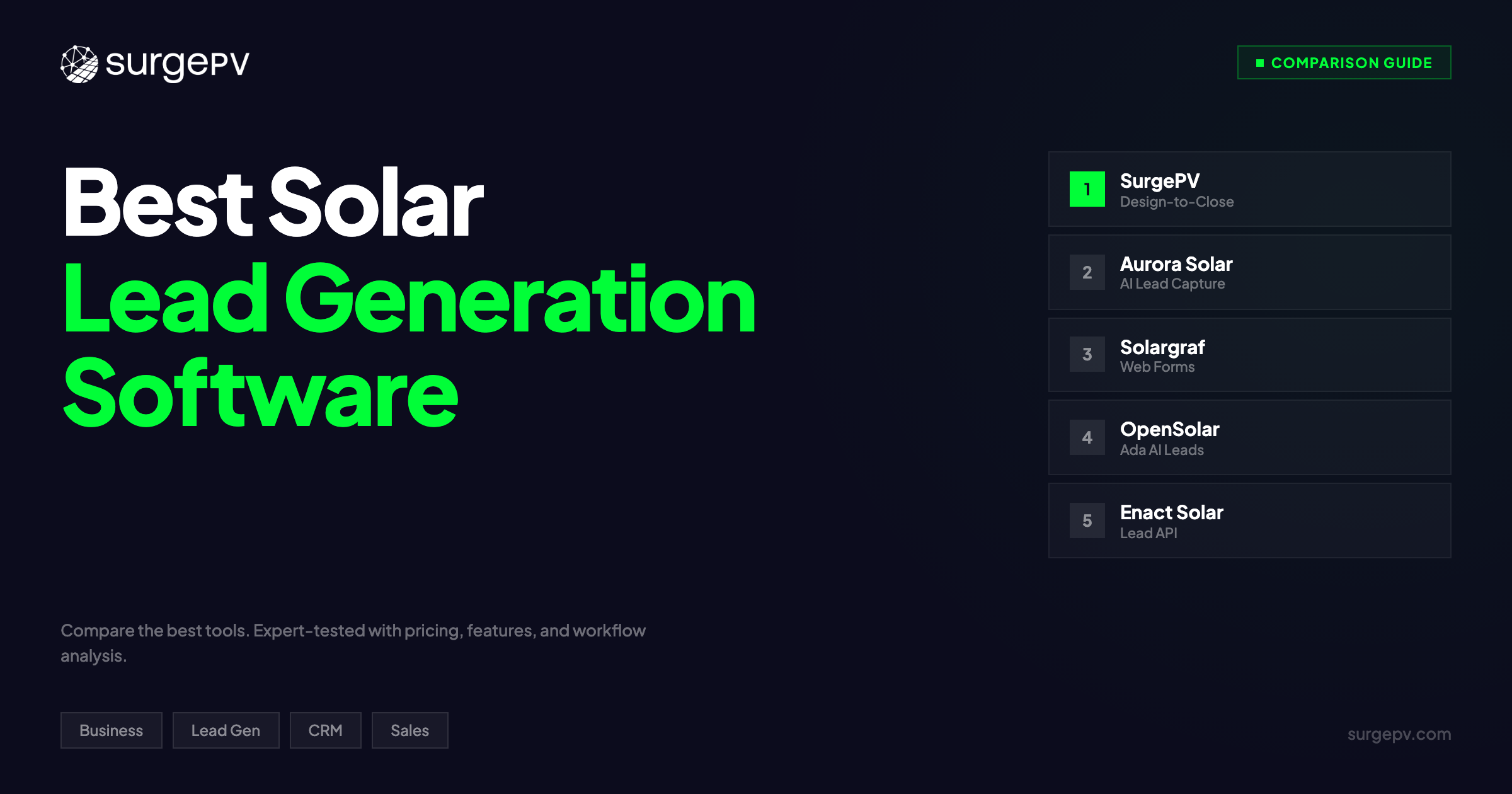
TL;DR: Most solar installers close fewer than 1 in 5 leads. The gap between lead capture and signed contract is where revenue dies. SurgePV shortens that gap with integrated design-to-proposal workflows at $1,899/year for 3 users. Aurora Solar offers AI-powered lead capture and door-to-door tools for enterprise teams. Solargraf bundles Enphase-native proposals with pipeline management. OpenSolar provides free lead generation tools for budget-conscious installers. Enact Solar targets residential installers with CRM-integrated lead workflows.
You Don’t Have a Lead Problem. You Have a Conversion Problem.
Solar leads are expensive. A qualified residential lead from a third-party aggregator costs $50-250 depending on market, credit score, and roof suitability. Premium leads with verified utility bills and homeownership confirmation run $150-300+.
The average solar installer converts 15-20% of qualified leads into signed contracts. That means for every 100 leads at $150 each, you spend $15,000 and close 15-20 deals. The other 80 leads — $12,000 worth — go cold because your follow-up was too slow, your proposal took three days, or the homeowner got a faster quote from a competitor.
Speed kills in solar sales. A Harvard Business Review study found that responding to a lead within 10 seconds increases conversion rates by up to 381% compared to a 10-minute response. In solar, that means the installer who sends a personalized proposal within minutes of a web inquiry wins the deal. The installer who calls back the next morning loses it.
That’s where solar lead generation software changes the math. These platforms don’t just capture leads — they qualify them automatically, route them to the right sales rep, generate instant proposals, and track every touchpoint from first click to signed contract. The best platforms integrate lead capture directly with solar design software and proposal tools, so a homeowner can go from entering their address on your website to reviewing a personalized solar proposal in under 60 seconds.
We tested five solar lead generation platforms for professional installers and EPCs. We evaluated lead capture tools, qualification scoring, automated follow-up, CRM integration, proposal speed, conversion tracking, and cost per closed deal.
In this guide, you’ll learn:
- Which 5 solar lead generation platforms deliver the highest conversion rates
- Why proposal speed is the single biggest factor in lead-to-close conversion
- How AI-powered lead capture eliminates manual qualification
- What lead scoring metrics separate tire-kickers from buyers
- How integrated design-to-proposal workflows cut close cycles from weeks to days
- Our recommendation by company size: solo installer to enterprise EPC
What to Look for in Solar Lead Generation Software (Buyer’s Guide)
Not all lead generation tools are built for solar. Generic CRMs treat a solar lead the same as a plumbing lead. Solar-specific platforms understand that a lead is only as good as their roof, their utility bill, and their credit score.
Here’s what separates general-purpose lead tools from purpose-built solar lead generation software.
Lead Capture and Qualification
The first question: how does the platform capture leads, and how does it separate qualified buyers from tire-kickers?
Basic lead capture is a web form. A homeowner enters their name, email, and address. The form lands in your inbox. You call them back. This works for 10 leads per week. It fails at 100.
Advanced solar lead capture uses satellite imagery and AI to qualify leads instantly. A homeowner enters their address on your website. Within seconds, the platform generates a 3D roof model, calculates solar potential, estimates savings, and presents a preliminary proposal. The homeowner sees real numbers — not a generic “request a quote” confirmation page.
This instant qualification filters out unqualified leads before they hit your sales team. Homes with too much shading, small roofs, or low electricity bills get flagged automatically. Your sales reps spend time on leads that can actually close.
Proposal Speed and Integration
How fast can you go from lead to proposal? This is where solar-specific platforms pull ahead of generic CRMs.
The traditional workflow: lead comes in, sales rep calls, schedules a site visit, sends address to design team, design team creates a system layout, design goes back to sales, sales builds a proposal in a separate tool, emails it to the homeowner. Total time: 3-7 days.
The integrated workflow: lead comes in, platform auto-generates a design from satellite imagery, sales rep reviews and adjusts in 5 minutes, sends a branded interactive proposal with financing options. Total time: under 1 hour.
Installers using integrated solar software that connects lead capture to design to proposal report close cycle reductions of 40-60%. Speed is the competitive advantage. The first installer to deliver a credible proposal usually wins the deal.
Lead Scoring and Prioritization
Not all leads are equal. A homeowner with a $300 monthly electric bill, an unshaded south-facing roof, and a 750 credit score is worth 10x more than a renter with a $80 bill who clicked an ad out of curiosity.
Lead scoring assigns numerical values based on:
- Electricity bill amount: Higher bills mean greater savings potential and faster ROI
- Roof suitability: Size, orientation, shade factor, age, and material
- Homeownership verification: Renters cannot sign solar contracts
- Credit score range: Determines financing eligibility
- Geographic location: Utility rates, net metering policies, state incentives
- Engagement signals: Did they view the proposal? Download the financing breakdown? Click the e-sign link?
Platforms that score leads automatically let sales reps focus on the top 20% of leads that generate 80% of revenue.
Automated Follow-Up
The average solar sale requires 5-8 touchpoints before closing. Most sales reps stop following up after 2.
Automated follow-up sequences send timed emails, texts, and reminders based on lead behavior. If a homeowner opens your proposal but doesn’t sign, the platform sends a follow-up email 24 hours later. If they click the financing calculator, it triggers a text from their assigned sales rep. If they go silent for a week, it sends a reminder with updated savings estimates.
This drip automation keeps leads warm without requiring manual effort from your sales team.
Conversion Tracking and ROI Attribution
Where are your best leads coming from? Google Ads? Referrals? Door-to-door canvassing? Your website?
Conversion tracking maps every closed deal back to its original lead source. If Google Ads generates 200 leads at $50 each but only closes 5%, your cost per acquisition is $1,000. If referrals generate 30 leads at $0 each and close at 30%, your cost per acquisition is $0.
ROI attribution helps you double down on channels that work and cut channels that burn money. Without it, you’re guessing which marketing spend actually drives revenue.
CRM and Pipeline Management
Lead generation doesn’t stop at capture. You need to track every lead through the pipeline: new lead, contacted, proposal sent, negotiating, contract signed, installed.
Solar-specific CRMs integrate pipeline stages with design and proposal tools. When a lead moves from “contacted” to “proposal sent,” the CRM automatically logs which design was sent, which financing option was presented, and how long the homeowner spent reviewing the proposal.
For a detailed comparison of solar CRM platforms, see our best solar CRM software guide.
Further Reading
Lead generation is the front end of your sales process. For the tools that close deals once leads are qualified, see our best solar sales software comparison.
The Real Cost of Slow Lead Response
Speed is not a nice-to-have in solar sales. It is the single biggest predictor of whether a lead converts or goes cold.
Here’s what happens when you’re slow.
A homeowner visits your website at 7:30 PM on a Tuesday. They enter their address and request a quote. Your office is closed. The form sits in your inbox overnight. Your sales rep calls at 9:15 AM Wednesday — 14 hours later.
In that 14 hours, the homeowner also requested quotes from two competitors. One competitor used AI lead capture that generated an instant solar estimate on-screen. The homeowner saw their roof with panels, estimated savings of $1,400/year, and three financing options — all within 30 seconds of entering their address. They booked a consultation for Wednesday evening.
By the time your sales rep calls Wednesday morning, the homeowner already has a proposal from a competitor and a consultation scheduled. Your rep is playing catch-up. The close rate on leads contacted after 24 hours drops below 5%.
The math is straightforward. An installer spending $10,000/month on lead generation who improves response time from 24 hours to under 5 minutes can double close rates. That’s the difference between closing 15 deals and closing 30 deals from the same lead spend.
Solar lead generation software automates this speed. Web leads trigger instant AI-generated estimates. Proposals auto-populate from satellite imagery. Sales reps receive mobile notifications within seconds of a lead submission. The platform does the work that used to take a design team two days.
Top 5 Solar Lead Generation Platforms for Installers (2026)
SurgePV — Best Design-to-Close Platform for Lead Conversion
Rating: 9.1/10 | Price: $1,899/year (3 users) | SurgePV
SurgePV is not a traditional lead generation tool. It is a solar design software platform that accelerates the lead-to-close cycle by eliminating the handoff gaps between lead capture, system design, and proposal delivery.
Why SurgePV wins on lead conversion:
The typical solar sales workflow has three bottleneck handoffs: lead to design team, design team to sales rep, sales rep to proposal tool. Each handoff adds 12-48 hours. SurgePV eliminates all three by integrating design, simulation, financial modeling, and proposal generation into one platform.
A sales rep receives a lead, enters the address into SurgePV, and the platform generates an AI-assisted roof model with accurate panel placement in minutes. The rep adjusts the design, runs a financial simulation using the generation and financial tool, and sends an interactive branded proposal with e-signature capability — all within one session.
This speed compresses the close cycle from the industry average of 5-14 days down to same-day for many installers. When a homeowner receives a detailed, professional proposal within hours of their inquiry, they’re far less likely to shop competitors.
SurgePV’s shadow analysis provides bankable shading data that builds credibility during the sales process. Homeowners see exactly how shade patterns affect their specific roof throughout the year, which builds trust and reduces objections.
Clara AI, SurgePV’s AI co-pilot, assists with design optimization and can generate multiple system configurations for different budget levels. A sales rep can present a “good-better-best” proposal package in a single meeting.
Pros:
- Integrated design-to-proposal workflow eliminates handoff delays
- AI-assisted roof modeling reduces design time by up to 60%
- Interactive proposals with financing options and e-signatures
- Shadow analysis builds credibility during sales presentations
- Bankable energy yield simulations for accurate savings estimates
- Multi-language proposal support (including Spanish)
- $1,899/year for 3 users — lowest per-user cost in this comparison
Cons:
- No standalone lead capture widget for websites (pair with a web form or CRM)
- No built-in door-to-door canvassing tools
- Not a dedicated CRM — best paired with a solar CRM for pipeline management
Best for: Installers and EPCs who want to shorten the time between receiving a lead and delivering a signed proposal. If your conversion bottleneck is proposal speed rather than lead volume, SurgePV delivers the fastest design-to-proposal workflow in the market.
Aurora Solar — Best AI-Powered Lead Capture for Enterprise Teams
Rating: 8.7/10 | Price: From $159/user/month | Aurora Solar | Aurora Solar review
Aurora Solar offers the most comprehensive lead capture toolkit in the solar industry. Its Lead Capture AI product turns your website into an automated lead qualification engine, and its Sales Mode AI gives field reps instant design capabilities at the doorstep.
Why Aurora Solar works for enterprise lead generation:
Lead Capture AI embeds on your website and lets homeowners enter their address to receive a personalized 3D solar estimate within seconds. The AI generates a roof model from satellite imagery, places panels, calculates estimated savings, and presents financing options — all without human intervention. Aurora reports that installers using Lead Capture AI have increased web leads by up to 400%.
For door-to-door teams, Sales Mode AI lets canvassers generate a full 3D roof model on their tablet in under 30 seconds by entering a street address. The rep walks the homeowner through an interactive design with irradiance data and sun path animations right on the doorstep. This turns a cold knock into a personalized presentation.
Aurora’s built-in CRM tracks leads from capture through contract. Lead scoring prioritizes high-value prospects based on roof size, electricity consumption, shading, and engagement behavior. Automated workflows route leads to the appropriate sales rep and trigger follow-up sequences.
The platform integrates with Salesforce, HubSpot, and other enterprise CRMs for companies that need lead data flowing into existing systems.
Pros:
- Lead Capture AI generates instant 3D solar estimates on your website
- Sales Mode AI for door-to-door canvassing with 30-second design generation
- Built-in CRM with lead scoring and automated follow-up
- Enterprise integrations (Salesforce, HubSpot, Zapier)
- Comprehensive design-to-proposal platform
- Route optimization for field sales teams
Cons:
- Pricing starts at $159/user/month ($1,908/year per user) — expensive for small teams
- Premium features (Lead Capture AI, advanced analytics) require higher-tier plans
- Annual contracts with custom enterprise pricing lack transparency
- Learning curve for the full platform is steep
Best for: Mid-to-large solar companies with dedicated sales teams, door-to-door operations, and marketing budgets that justify the per-user pricing. If you generate 100+ leads per month and need automated website lead capture with enterprise CRM integration, Aurora is the strongest option.
Solargraf — Best for Enphase-Native Proposal and Lead Management
Rating: 8.3/10 | Price: From $2,799/year (2 users, 240 projects) | Solargraf
Solargraf is deeply integrated into the Enphase ecosystem, making it the go-to lead management and proposal platform for installers who sell Enphase microinverters and IQ batteries.
Why Solargraf works for Enphase-focused installers:
Solargraf combines lead capture, pipeline management, design, and proposal generation in a single platform. When a lead comes in, the rep creates a design with auto-roofline detection, adds Enphase-specific equipment from a pre-integrated catalog, generates a proposal with real-time pricing, and sends it for e-signature via DocuSign — all without leaving the platform.
The Enphase integration is the differentiator. Solargraf pulls real-time equipment data, compatibility rules, and pricing for Enphase IQ microinverters and batteries. Proposals automatically reflect accurate Enphase configurations, which eliminates the design errors that slow down the approval process.
Pipeline management lets teams track leads from initial contact through installation completion. Managers can view team performance, proposal acceptance rates, and conversion metrics by rep, lead source, or time period.
The 2026 roadmap includes Gen-AI assistance and agentic workflows that aim to automate more of the design-to-proposal process.
Pros:
- Deep Enphase ecosystem integration (microinverters, batteries, pricing)
- Combined lead management and proposal generation
- DocuSign e-signatures built in
- Auto-roofline and obstruction detection
- Battery design tool with 30+ supported models
- NREL-verified shading analysis
Cons:
- Best suited for Enphase-focused installers — less flexible for multi-brand shops
- Starter plan limits to 240 projects/year ($2,799) — overages cost $9-11 per project
- No standalone website lead capture AI (relies on forms and manual entry)
- Limited CRM compared to dedicated solar CRM platforms
Best for: Enphase-focused residential installers who need an all-in-one design, proposal, and lead management tool. If your business runs on Enphase equipment and you need a single platform for pipeline tracking through proposal delivery, Solargraf offers the tightest hardware-software integration.
OpenSolar — Best Free Lead Generation Tools for Small Installers
Rating: 8.0/10 | Price: Free (core platform) | OpenSolar | OpenSolar review
OpenSolar 3.0 is the only solar platform that bundles lead generation, design, and CRM tools at no cost. For small installers and startups watching every dollar, it removes the software cost barrier entirely.
Why OpenSolar works for budget-conscious installers:
OpenSolar’s AI Lead Gen tool (powered by their Ada AI) embeds on your website and lets homeowners visualize the financial benefits of going solar. Qualified leads sync automatically into OpenSolar’s built-in CRM or can be exported to third-party CRMs via API.
The “Sales Machine” feature creates lifestyle-oriented proposals that show homeowners the full picture of electrification — solar panels, EV charging, heat pumps — versus the cost of staying on the grid. This whole-home approach broadens the conversation beyond panels and increases average deal size.
The core platform is free. Design, lead generation, CRM, and proposals cost nothing. OpenSolar charges only for API access and third-party connectors starting April 2026. For small installers who don’t need API integrations, the platform remains entirely free.
The tradeoff is sophistication. OpenSolar’s design engine and shading analysis are adequate for residential projects but lack the engineering-grade accuracy of solar design software platforms built for commercial work. Lead scoring is basic compared to Aurora’s AI-driven qualification.
Pros:
- Free core platform (design, lead gen, CRM, proposals)
- AI-powered website lead capture (Ada)
- Built-in CRM with automated lead syncing
- Whole-home electrification proposals (solar + EV + heat pump)
- No per-project or per-user fees on core features
- Available globally
Cons:
- Design accuracy trails premium platforms for complex roofs
- Lead scoring and qualification are basic
- API access and third-party integrations will cost extra from April 2026
- Limited customer support compared to paid platforms
- Shading analysis is less granular than dedicated tools
Best for: Solo installers, startups, and small teams that need functional lead generation and proposal tools without software costs. If you’re closing fewer than 20 deals per month and don’t need enterprise integrations, OpenSolar provides the best value in the market — free.
Enact Solar — Best Residential Lead Platform with Integrated CRM
Rating: 7.8/10 | Price: $299/month (2 users) | Enact Solar
Enact Solar targets residential installers with an all-in-one platform that combines lead management, CRM, design, proposals, and post-install monitoring. The January 2026 acquisition of PVComplete strengthened its design capabilities.
Why Enact Solar works for residential-focused installers:
Enact’s Lead API lets you push leads from your website or third-party sources directly into the platform’s CRM. From there, leads flow through a managed pipeline with communication logging, task assignment, and team collaboration tools.
The design engine uses Digital Surface Model (DSM) and Google Solar technology to generate 3D roof models with auto height detection for obstacles and surrounding trees. Shading analysis is automated, and proposals generate with integrated financing options and DocuSign e-signatures.
What sets Enact apart is the post-sale continuity. After installation, the same platform monitors system performance, providing production data that validates the savings estimates you presented during the sales process. When a customer calls asking about their system, you pull up their data in the same tool you used to design and sell the project.
The PVComplete acquisition added stronger commercial design tools, including National Electrical Code compliance checking and advanced string sizing. This makes Enact more competitive for installers who handle both residential and light commercial work.
Pros:
- Lead API for website and third-party lead integration
- Built-in CRM with pipeline management and communication logging
- DSM-powered 3D roof modeling with auto obstruction detection
- DocuSign e-signatures for proposals
- Post-install monitoring in the same platform
- Strengthened commercial design after PVComplete acquisition
Cons:
- $299/month ($3,588/year for 2 users) is expensive for what you get compared to alternatives
- Smaller user community means fewer integrations and templates
- Design accuracy trails Aurora and SurgePV for complex roofs
- Limited door-to-door and field sales tools
- No standalone website lead capture AI
Best for: Residential installers who want a single platform from lead capture through post-install monitoring. If you value continuity — seeing the same customer data from first contact through year-five performance monitoring — Enact provides that end-to-end view.
Pro Tip
The fastest way to improve lead conversion is not buying more leads — it’s shortening the time between lead capture and proposal delivery. Pair your lead generation platform with a solar design tool that generates proposals in minutes, not days. Even a 50% reduction in proposal turnaround time can double your close rate from the same lead volume.
Solar Lead Generation Software Comparison Table
| Feature | SurgePV | Aurora Solar | Solargraf | OpenSolar | Enact Solar |
|---|---|---|---|---|---|
| Lead Capture AI | Via web form (pair with CRM) | Yes (website + door-to-door) | Web forms | Yes (Ada AI) | Lead API |
| Lead Scoring | Manual (pair with CRM) | AI-powered | Basic pipeline | Basic | Basic pipeline |
| Automated Follow-Up | Via CRM integration | Yes (built-in sequences) | Basic | Basic CRM | Basic CRM |
| Proposal Speed | Minutes (integrated design) | Minutes (Sales Mode AI) | Minutes | Minutes | Minutes |
| E-Signatures | Yes | Yes | Yes (DocuSign) | Yes | Yes (DocuSign) |
| CRM Built-In | No (pair externally) | Yes | Yes | Yes | Yes |
| Design Integration | Yes (full platform) | Yes (full platform) | Yes | Yes | Yes |
| Door-to-Door Tools | No | Yes (Sales Mode AI) | No | No | No |
| Financing Options | Yes (multiple lenders) | Yes | Yes | Yes | Yes |
| Conversion Tracking | Via CRM integration | Yes (built-in) | Basic | Basic | Basic |
| Pricing | $1,899/year (3 users) | From $159/user/month | $2,799/year (2 users) | Free | $299/month (2 users) |
| Best For | Fast proposal delivery | Enterprise lead capture | Enphase installers | Budget-conscious teams | Residential end-to-end |
Quick verdict: If your bottleneck is proposal speed, SurgePV delivers the fastest design-to-close workflow at the lowest cost per user. If you need AI-powered website lead capture and door-to-door tools, Aurora Solar has the strongest lead acquisition toolkit. If you sell Enphase, Solargraf offers the tightest equipment integration. If budget is the constraint, OpenSolar gives you functional lead tools for free. If you want one platform from lead to monitoring, Enact covers the full lifecycle.
What Most Installers Get Wrong About Solar Lead Generation
Lead generation mistakes cost more than bad leads. They cost the good leads you already paid for. Here are the four errors that drain conversion rates.
Buying More Leads Instead of Converting Existing Ones
The instinct when sales slow down: buy more leads. Increase the Google Ads budget. Sign up for another lead aggregator. Throw more money at the top of the funnel.
The problem: if you’re converting 15% of existing leads, buying more leads at the same conversion rate just scales your waste. 100 leads at 15% close rate = 15 deals. 200 leads at 15% close rate = 30 deals, but you spent twice as much on lead acquisition.
The smarter move: improve your conversion rate on existing leads. Go from 15% to 25% by responding faster, delivering proposals sooner, and automating follow-up. 100 leads at 25% close rate = 25 deals at half the lead cost of buying 200.
Manual Proposal Workflows
If your sales rep takes a lead, sends the address to a design team, waits 2-3 days for a design, builds a proposal in PowerPoint, and emails a PDF — you are losing deals to competitors who deliver proposals in hours.
The fix: use integrated solar software that connects lead intake directly to design and proposal generation. The rep enters the address, the platform generates the design, and the proposal goes out the same day.
No Follow-Up Automation
A homeowner requests a quote on Saturday afternoon. Your sales rep calls Monday morning. The homeowner says they’re “still thinking about it.” The rep makes a note to follow up next week. Next week becomes next month. The lead goes cold.
Automated follow-up sequences prevent this. The platform sends a thank-you email Saturday afternoon with an instant solar estimate. Sunday morning, it sends a savings comparison. Monday, the rep calls a warm lead who has already engaged with two pieces of content. The conversion rate on this lead is 3-4x higher than a cold Monday morning call.
Ignoring Lead Source Attribution
You spend $3,000/month on Google Ads, $2,000/month on a lead aggregator, and $500/month on social media ads. All three generate leads. But which channel produces leads that actually close?
Without source attribution, you treat all leads equally. With attribution, you might discover that Google Ads leads close at 20% ($250 cost per acquisition), aggregator leads close at 8% ($500 CPA), and social leads close at 3% ($2,778 CPA). You’d shift budget from social to Google Ads immediately.
Every lead generation platform in this comparison offers some form of attribution tracking. Use it.
How to Choose the Right Lead Generation Platform for Your Business
The best platform depends on your team size, lead volume, and where your conversion bottleneck sits.
Solo Installer or Small Team (1-3 Reps)
You don’t need enterprise lead capture AI. You need speed. Your leads come from referrals, your website, and maybe one paid channel. The bottleneck is proposal turnaround — you’re designing systems at night after a full day of installations.
Recommendation: SurgePV for proposal speed, or OpenSolar if budget is the primary concern. SurgePV’s integrated design-to-proposal workflow means you can respond to a lead with a professional proposal the same evening. OpenSolar gives you free tools to get started.
Mid-Size Installer (4-15 Reps)
You have a dedicated sales team. Leads come from multiple channels. You need CRM functionality, lead scoring, and pipeline visibility. The bottleneck is lead prioritization — your reps spend too much time on unqualified leads.
Recommendation: Aurora Solar for lead capture and scoring, paired with SurgePV for design and proposal speed. Aurora’s Lead Capture AI qualifies website leads automatically. SurgePV accelerates the design-to-proposal handoff for qualified leads.
Enphase-Focused Installer
Your business is built on Enphase microinverters and batteries. You need a platform that speaks Enphase natively — correct equipment catalogs, compatibility rules, and pricing.
Recommendation: Solargraf. The Enphase integration eliminates equipment configuration errors and speeds up proposal accuracy for Enphase-specific designs.
Enterprise EPC (15+ Reps, Multi-Channel Marketing)
You run Google Ads, door-to-door canvassing, referral programs, and partnerships. You need enterprise CRM integration (Salesforce), AI-powered lead scoring, and detailed conversion attribution across channels.
Recommendation: Aurora Solar as the lead acquisition and CRM backbone. Pair with SurgePV for engineering-grade designs and bankable proposals on high-value commercial projects.
Startup on a Tight Budget
You’re launching a solar business or expanding into a new market. Every dollar matters. You need functional tools that don’t require upfront investment.
Recommendation: OpenSolar. The free platform covers lead generation, design, CRM, and proposals. Upgrade to paid tools once revenue supports the investment.
Shorten Your Lead-to-Close Cycle
See how integrated design-to-proposal workflows convert more leads in less time.
Book a DemoNo commitment required · 20 minutes · Live project walkthrough
Further Reading
For CRM tools that complement lead generation, see best solar CRM software. For sales enablement tools that close deals once leads are qualified, see best solar sales software. For estimating tools that speed up proposal delivery, see best solar estimating software. For a detailed breakdown of Aurora Solar’s design and sales features, read our full Aurora Solar review.
Frequently Asked Questions
What is the best solar lead generation software in 2026?
For proposal speed and design-to-close integration, SurgePV offers the best value at $1,899/year for 3 users. For AI-powered website lead capture and door-to-door tools, Aurora Solar leads the market. For Enphase-focused installers, Solargraf provides the tightest equipment integration. For budget-conscious teams, OpenSolar offers free lead generation, CRM, and proposal tools. For residential end-to-end workflows, Enact Solar covers lead capture through post-install monitoring.
How much does solar lead generation software cost?
Prices range from free (OpenSolar core platform) to enterprise pricing. SurgePV costs $1,899/year for 3 users. Solargraf starts at $2,799/year for 2 users and 240 projects. Enact Solar costs $299/month for 2 users. Aurora Solar starts at $159/user/month with enterprise pricing for Lead Capture AI and advanced features. Most platforms offer annual billing discounts.
What is the average close rate for solar leads?
The average solar installer converts 15-20% of qualified leads into signed contracts. Close rates vary significantly by lead source: referrals convert at nearly 30%, organic website leads convert at 15-20%, and purchased third-party leads convert at 5-10%. Installers using integrated design-to-proposal software report higher close rates because faster proposal delivery reduces lead attrition.
Can solar lead generation software replace a CRM?
Some platforms include built-in CRM functionality (Aurora Solar, OpenSolar, Enact Solar, Solargraf). These built-in CRMs handle basic pipeline management, lead tracking, and communication logging. For enterprise operations with complex sales processes, dedicated solar CRMs or platforms like Salesforce integrated with Aurora Solar provide more advanced workflow automation, reporting, and team management. SurgePV pairs best with an external solar CRM for full pipeline management.
How does AI improve solar lead generation?
AI improves solar lead generation in three ways. First, AI lead capture tools generate instant 3D solar estimates from satellite imagery when a homeowner enters their address, qualifying leads automatically. Second, AI lead scoring analyzes roof suitability, electricity consumption, and engagement behavior to prioritize high-value leads. Third, AI-assisted design tools generate system layouts in seconds instead of hours, enabling same-day proposals that convert at higher rates.
Transparency Note
SurgePV publishes this content. We are transparent about this relationship. This comparison acknowledges Aurora Solar, Solargraf, OpenSolar, and Enact Solar as strong platforms for their respective use cases. SurgePV is positioned as the design-to-proposal speed solution, not a replacement for dedicated lead capture platforms. See our editorial standards.
Note
All pricing data in this article was verified against official sources as of March 2026. Prices may have changed since publication.