

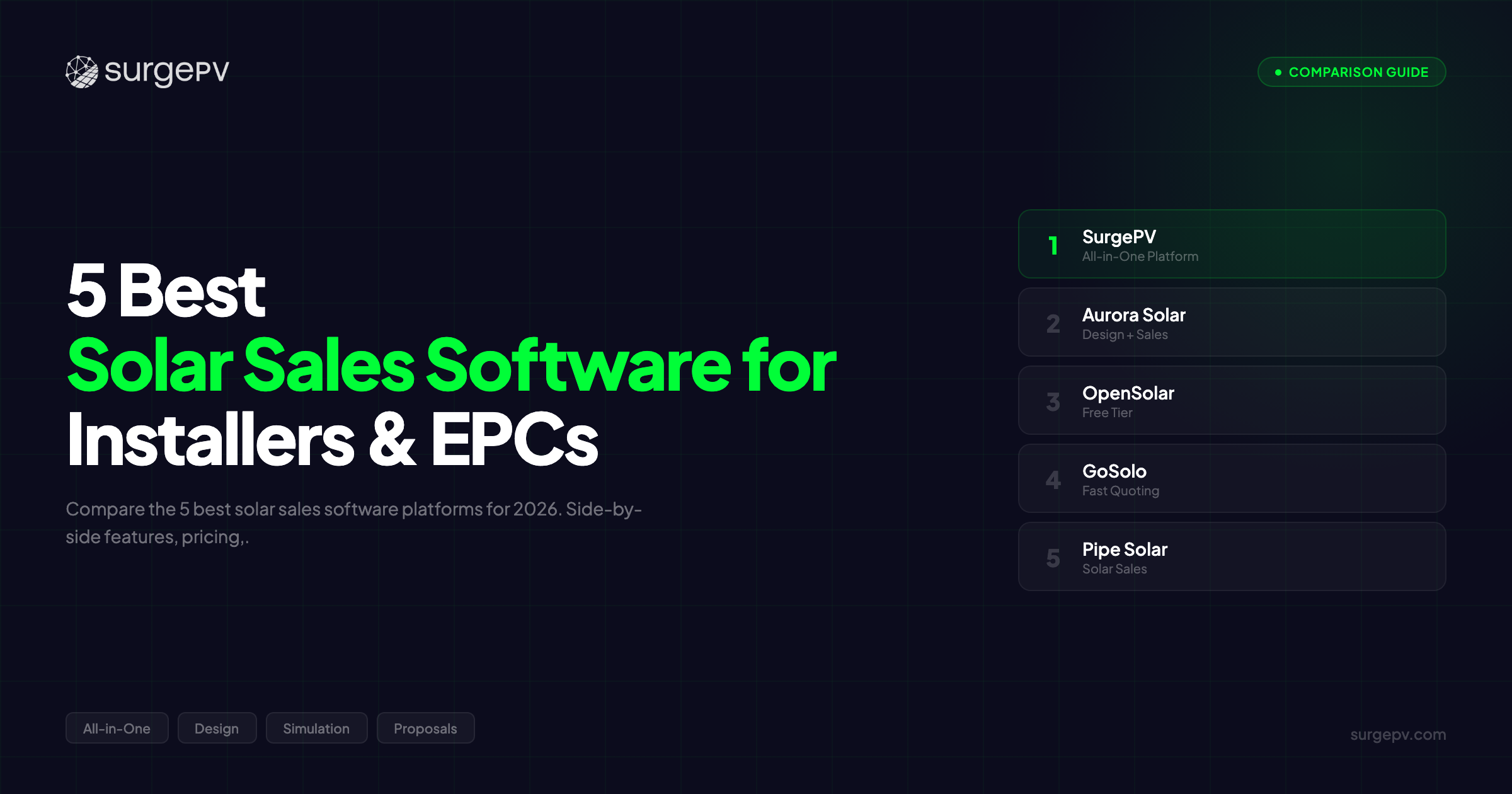
TL;DR: SurgePV is the best all-in-one solar sales software in 2026, combining AI-powered design, automated proposals, and 98% BOM accuracy in one cloud platform at $1,899/year for 3 users. Aurora Solar leads residential sales teams with polished proposals. OpenSolar offers a strong free tier for small installers. GoSolo and Pipe Solar target European markets and pipeline management respectively. Read on for the full comparison, pricing breakdown, and C&I EPC sales workflow analysis.
Most solar installers lose qualified leads because their sales process is too slow.
Here is the truth: a homeowner who requests a solar quote contacts 3-5 companies. The first installer who delivers a professional, accurate proposal wins the deal 60-70% of the time. The same dynamic plays out in commercial and C&I EPC projects, just with higher stakes and longer timelines.
Yet the average solar sales cycle still looks like this: a lead comes in, someone manually enters data into a CRM, a designer creates a system layout in one tool, an engineer builds electrical documentation in another, a salesperson stitches together a proposal in PowerPoint or Excel, and the whole package gets emailed three days later. By then, two competitors have already sent theirs.
That gap between lead capture and proposal delivery is where deals die. And it is exactly the problem that solar sales software was built to solve.
The right solar design software platform eliminates that fragmented workflow. It connects design, proposal generation, financing calculations, and CRM tracking into a single pipeline, so your sales team spends time closing, not copying data between spreadsheets.
But not every platform does this well. Some are glorified proposal generators. Others focus on CRM features but lack the design engine that makes proposals accurate. And most were built for US residential markets, leaving C&I EPCs and international installers underserved.
We tested 30+ solar platforms over the last 12 months, evaluating each on sales pipeline automation, proposal speed, CRM integration, pricing transparency, and real-world close rate impact. We narrowed it down to 5 that actually move the needle on revenue.
In this guide, you will find:
- A side-by-side comparison table of the 5 best solar sales software platforms
- Detailed reviews with pricing, pros, cons, and best-fit use cases
- How sales automation transforms close rates for installers and EPCs
- A dedicated C&I EPC sales workflow breakdown (the segment most platforms ignore)
- CRM integration analysis for connecting your sales stack
- 10 FAQs answered with actionable detail
Whether you run a 3-person residential crew or a 50-person commercial EPC, this guide will help you pick the platform that fits your sales operation, not the one with the biggest marketing budget.
Quick Comparison: 5 Best Solar Sales Software at a Glance
| Feature | SurgePV | Aurora Solar | OpenSolar | GoSolo | Pipe Solar |
|---|---|---|---|---|---|
| Best For | All-in-one design-to-sales | Residential sales teams | Small installers (free tier) | European solar sales | Sales pipeline management |
| Proposal Generation | Professional, interactive | Polished, customer-facing | Template-based | Multi-language | Basic |
| CRM Integration | Yes (API + native) | Salesforce, HubSpot | Built-in CRM | Built-in | Native CRM-first |
| Sales Automation | Lead-to-proposal in under 10 min | AI-assisted proposals | Automated quoting | Pipeline automation | Pipeline + forecasting |
| SLD Generation | Yes (automated, 5-10 min) | No | No | No | No |
| C&I EPC Support | Full commercial workflows | Limited | Basic | Developing | No |
| Pricing | $1,899/year (3 users) | $4,800+/year per user | Free tier available | Contact for pricing | Contact for pricing |
| Our Rating | 9.3/10 | 8.5/10 | 8.0/10 | 7.8/10 | 7.5/10 |
Bottom line: If you need design, engineering, and sales in one platform, SurgePV saves both time and software costs. If your residential sales team needs polished proposals at volume, Aurora Solar is the market leader. If budget is the constraint, OpenSolar gets you started for free.
What Makes Great Solar Sales Software? (Selection Criteria)
Before getting into individual tools, here is what we evaluated. These five criteria separate platforms that actually accelerate sales from ones that just add another login to your workflow.
Proposal-to-Close Speed
The single most important metric for solar sales software is how fast you go from lead intake to delivered proposal. Every hour of delay reduces close probability. We measured time from initial site data to a professional, customer-ready proposal with accurate system design, energy production estimates, and financial projections.
The best platforms get this under 10 minutes for residential and under 30 minutes for commercial. The worst still require manual steps across multiple tools that push delivery to 2-3 days.
CRM Integration and Lead Management
Your solar sales software should either include a built-in CRM or integrate seamlessly with the one you already use. We looked at native Salesforce and HubSpot integrations, API flexibility, lead scoring capabilities, and automated follow-up sequences. A disconnected sales tool creates data silos that kill pipeline visibility.
Sales Automation Features
Manual data entry is the enemy of a fast sales operation. We evaluated automated proposal generation, one-click quoting, financing calculator integration, e-signature workflows, automated follow-up email sequences, and workflow automation capabilities. The goal: eliminate every manual step between “new lead” and “signed contract.”
Pricing Transparency and Financing Tools
Solar customers compare quotes. Your platform needs to deliver accurate, transparent pricing with real-time utility rate analysis, incentive calculations, and financing comparisons (cash, loan, lease, PPA). We also evaluated how transparent the platform’s own pricing is, because hidden software costs eat into margins just like hidden project costs.
Reporting and Sales Analytics
You cannot improve what you do not measure. We looked at pipeline dashboards, conversion rate tracking, rep performance analytics, revenue forecasting, and source attribution. The best platforms tell you exactly where leads come from, where they stall, and what your team needs to fix.
The 5 Best Solar Sales Software Platforms (2026)
SurgePV — Best All-in-One Design-to-Sales Platform
Rating: 9.3/10 | Price: $1,899/year (3 users) | Book a demo
Most solar sales software forces a trade-off: good design tools with weak sales features, or slick proposals with inaccurate engineering. SurgePV eliminates that trade-off entirely.
SurgePV is the only cloud-based platform that integrates AI-powered solar design, automated electrical engineering, bankable simulations, and professional proposal generation into a single sales workflow. For installers and EPCs, this means the entire path from lead intake to delivered proposal happens in one platform, with no tool switching, no manual data transfers, and no copy-paste errors.
Why this matters for your sales operation:
Speed wins deals. SurgePV generates automated single line diagrams in 5-10 minutes, compared to 2-3 hours of manual AutoCAD drafting. That means your sales team can produce a complete, engineering-grade proposal before a competitor even opens their design software.
The platform runs 8760-hour shading analysis with plus or minus 3% accuracy compared to PVsyst. It delivers P50/P75/P90 simulation metrics. The 98% BOM accuracy means your quotes match actual project costs, so you stop losing margin to estimation errors.
Proposals are web-based and interactive. Customers see real-time energy production, financial projections, and ROI calculations on any device. No more emailing static PDFs that get buried in inboxes.
Pro Tip
SurgePV’s generation and financial modeling tool auto-populates financial projections directly from the system design. When a customer asks “What if we add 10 more panels?”, your sales rep adjusts the design and the proposal updates instantly, live, in front of the customer.
Mini Case Study: How a Mid-Size EPC Cut Sales Cycle Time by 65%
A 30-person commercial EPC was running a fragmented sales stack: Aurora for design, AutoCAD for electrical docs, Excel for financial projections, and a separate CRM for pipeline tracking. Average time from lead to delivered proposal: 4.5 days. Close rate: 18%.
After switching to SurgePV, they consolidated the entire workflow into one platform. Proposal delivery dropped to 1.5 days. The engineering team stopped spending 2-3 hours per project on manual SLD drafting. Sales reps began generating accurate proposals during initial customer meetings. Close rate jumped to 29% within 90 days.
The combined software savings, eliminating AutoCAD licenses and reducing the tool stack, paid for the SurgePV subscription twice over.
“But I already have a separate CRM…”
Fair objection. SurgePV integrates with existing CRM platforms through API connections, so you do not have to abandon your Salesforce or HubSpot setup. The platform pushes project data, proposal status, and pipeline updates directly to your CRM. You keep your existing lead management workflow; SurgePV handles the design-to-proposal acceleration that your CRM cannot do.
Pricing: $1,899/year for 3 users (Individual plan). $1,499/user/year for the 3-user plan. All features included, no tiered pricing, no hidden fees. Compare that to Aurora Solar + AutoCAD at $6,800/year per user. See SurgePV pricing.
Pros:
- Complete design-to-sales workflow in one platform
- Automated SLD generation saves 2-3 hours per project
- 98% BOM accuracy for reliable quoting
- Professional interactive proposals (web-based, mobile-ready)
- Plus or minus 3% shading accuracy vs PVsyst (bankable)
- 70,000+ projects delivered, 3-minute average support response
- Only platform with native carport solar design
Cons:
- Smaller brand presence compared to Aurora Solar
- Less suited for pure residential high-volume door-to-door sales
- Newer entrant in some international markets
Best for: Solar installers and C&I EPCs who want design, engineering, and sales automation in one platform without paying for 3-4 separate tools.
Aurora Solar — Best for Residential Sales Teams
Rating: 8.5/10 | Price: ~$4,800+/year per user (contact for pricing)
Aurora Solar is the market leader in residential solar sales software, and for good reason. The platform was built specifically for high-volume residential sales teams that need to produce polished, customer-facing proposals fast.
Aurora’s AI-powered roof detection is the best in the industry. Feed it an address, and it generates a 3D roof model with panel placement in minutes. The proposal engine produces professional, branded documents that homeowners actually enjoy reviewing: clean layouts, interactive energy savings charts, and financing comparisons side by side.
For residential sales teams running 50+ appointments per week, Aurora’s Sales Mode is a standout feature. Reps can build and present proposals on a tablet during in-home consultations, adjust system sizes on the fly, and close deals on the spot with integrated e-signature.
The platform also integrates natively with Salesforce and HubSpot, which is a major advantage for companies that have invested heavily in CRM infrastructure. Lead data flows bidirectionally, so pipeline visibility stays current without manual updates.
Here is where it gets complicated.
Aurora was built for the US residential market. It does not generate single line diagrams or electrical documentation. You will need AutoCAD ($2,000/year extra) and 2-3 hours per project for those. It does not support carport design or solar trackers. And the pricing is steep: expect $4,800+/year per user before you add AutoCAD on top.
For commercial EPCs and C&I projects, Aurora’s limitations become more pronounced. There is no integrated BOM with the engineering precision that commercial projects demand, and the learning curve for commercial features runs 4-6 weeks.
Pros:
- Industry-leading AI roof detection and 3D modeling
- Best-in-class residential proposal design
- Native Salesforce and HubSpot CRM integration
- Sales Mode for in-home tablet presentations
- Strong brand recognition with homeowners
Cons:
- No SLD generation (requires separate AutoCAD license)
- No carport or tracker design support
- Highest pricing tier ($4,800+/year per user + AutoCAD)
- US-centric; limited international compliance features
- 4-6 week onboarding for commercial features
Best for: High-volume residential solar sales teams in the US that prioritize polished proposals and native CRM integration, and have separate engineering teams for electrical documentation.
Further Reading
For a detailed breakdown of Aurora Solar’s features, pricing, and limitations, see our Aurora Solar review.
OpenSolar — Best Free Solar Sales Platform
Rating: 8.0/10 | Price: Free tier available (premium plans vary)
OpenSolar made its name with a bold move: offering a genuinely functional free tier for solar proposal and sales software. For small installers and solo operators who cannot justify $5,000+/year in software costs, OpenSolar is the entry point.
The free tier includes basic design tools, proposal generation, and a built-in CRM. You can create system designs, generate customer-facing proposals with financing comparisons, and track leads through a simple pipeline, all without spending a dollar.
The proposal-to-contract workflow is surprisingly smooth for a free platform. OpenSolar integrates e-signature, so customers can review a proposal and sign a contract without leaving the platform. Financing integrations let you present loan and lease options alongside cash purchases, which helps close rate for price-sensitive residential customers.
OpenSolar’s built-in CRM handles basic lead management: contact records, deal stages, notes, and follow-up reminders. It is not Salesforce. But for a 3-10 person installation company, it covers the fundamentals without adding another subscription.
Where OpenSolar struggles is scale and depth. The design engine lacks the AI precision of Aurora or the engineering depth of SurgePV. There is no SLD generation, no wire sizing, and no advanced shading analysis. As your project volume grows, the free tier’s limitations become constraints, and the premium tier pricing moves closer to competitors.
For small businesses starting out or testing solar sales software for the first time, OpenSolar removes the financial barrier. Use it to prove that software-driven sales works, then graduate to a platform that matches your growth.
Pros:
- Genuinely functional free tier (no credit card required)
- Integrated proposal, e-signature, and financing tools
- Built-in CRM for basic lead management
- Low barrier to entry for small installers
- International support with multi-currency proposals
Cons:
- Limited design accuracy compared to Aurora or SurgePV
- No SLD generation or electrical engineering features
- Free tier has feature limitations at scale
- Fewer CRM integrations than Aurora
- Support response times slower on free tier
Best for: Small solar installers and solo operators who need solar sales tools for small businesses without upfront software costs. Ideal as a starter platform before scaling to more advanced tools.
Further Reading
See our full OpenSolar review for a detailed feature breakdown.
GoSolo — Best for European Solar Sales Teams
Rating: 7.8/10 | Price: Contact for pricing
GoSolo is a dedicated solar sales platform built for European markets, a segment that most US-centric tools overlook. If you sell solar in Germany, the Netherlands, Belgium, or other EU countries, GoSolo speaks your language (literally and operationally).
The platform handles multi-language proposal generation, which matters when your sales team operates across borders. Proposals automatically adjust for local currencies, VAT structures, and country-specific incentive programs. For a German installer selling in both domestic and Dutch markets, that localization eliminates hours of manual customization per proposal.
GoSolo’s sales pipeline management is purpose-built for solar. Deal stages mirror the actual solar sales cycle: qualification, site visit, design, proposal, negotiation, contract, installation. This is not a generic CRM with solar labels slapped on; the workflow matches how solar companies actually sell.
The platform includes automated follow-up sequences and lead nurturing tools. When a proposal goes unanswered for 48 hours, GoSolo triggers a follow-up. When a lead stalls at the design stage, the system flags it for sales management review.
Where GoSolo falls short is on the technical design side. There is no integrated system design, no SLD generation, and no simulation engine. You will need a separate design tool. And because the platform is newer and European-focused, the user community and third-party integration ecosystem are smaller than Aurora’s or SurgePV’s.
For European solar sales teams that need localized proposals and pipeline management, GoSolo fills a gap that US-built platforms do not address.
Pros:
- Multi-language proposal generation for European markets
- Solar-specific pipeline management (not generic CRM)
- Automated follow-up sequences and lead nurturing
- Country-specific incentive and VAT calculation
- Built for EU compliance requirements
Cons:
- No integrated design or simulation tools
- No SLD generation or electrical engineering
- Smaller integration ecosystem
- Limited presence outside European markets
- Newer platform with smaller user community
Best for: European solar installers and sales teams who need localized, multi-language proposals and solar-specific pipeline management across EU markets.
Further Reading
See our full GoSolo review for European market analysis.
Pipe Solar — Best for Sales Pipeline Management
Rating: 7.5/10 | Price: Contact for pricing
Pipe Solar takes a CRM-first approach to solar sales. While most platforms start with design and add sales features later, Pipe Solar started with the sales pipeline and built outward. If your primary pain point is pipeline visibility, knowing where every deal stands, which reps are performing, and where leads are stalling, Pipe Solar delivers.
The pipeline visualization is the standout feature. A visual Kanban board shows every deal at every stage. Drag and drop moves deals forward. Color-coded flags highlight deals that are aging, stalled, or at risk. For a sales manager overseeing 10+ reps and 200+ active leads, this instant visibility replaces the weekly “pipeline review” spreadsheet.
Lead scoring and attribution are baked in. Pipe Solar tracks where each lead originated (website, referral, canvassing, paid ads), assigns a quality score based on engagement behavior, and surfaces the highest-priority leads for your sales team. This is the kind of lead management that most solar-specific tools handle poorly.
Team performance tracking shows individual rep metrics: proposals sent, close rate, average deal size, pipeline velocity. If one rep is closing at 35% and another at 12%, the data makes that visible immediately, along with which deal stages show the biggest drop-off.
The limitation is obvious: Pipe Solar is a sales management tool, not a design platform. There is no system design engine, no proposal generation with energy estimates, no SLD generation. You will pair it with a design tool like SurgePV or Aurora for the technical side of proposals.
Think of Pipe Solar as the operational backbone for sales-driven solar companies where pipeline management and team performance matter more than design capabilities. For the technical side, pairing it with a solar proposal software platform fills the gap.
Pros:
- Best-in-class pipeline visualization and management
- Lead scoring with source attribution
- Team performance analytics and rep tracking
- Solar-specific deal stages (not generic CRM)
- Forecasting and revenue projection tools
Cons:
- No design, simulation, or engineering features
- No proposal generation with energy/savings estimates
- Must be paired with a separate design platform
- Limited brand recognition compared to larger players
- Pricing not publicly available
Best for: Sales-driven solar companies with dedicated design teams who need advanced sales pipeline management, lead scoring, and team performance tracking.
How Solar Sales Automation Transforms Your Pipeline
Solar sales automation is not a nice-to-have feature. It is the difference between a 15% close rate and a 30% close rate. Here is how the best solar sales platforms use automation to accelerate every stage of your pipeline.
From Lead Capture to Qualified Opportunity
Manual lead processing is the first bottleneck. A web form submission sits in an inbox. Someone manually enters it into a CRM. A sales rep gets assigned the next morning. By the time someone calls, 18 hours have passed.
Automated lead management systems eliminate that delay. When a lead submits a form, the platform instantly creates a CRM record, assigns it to the next available rep based on territory or availability, triggers an automated acknowledgment email, and begins pre-qualifying with satellite imagery and utility data.
The fastest platforms can have a preliminary system design ready before the first phone call.
Automated Proposal Generation
This is where solar sales automation delivers the biggest impact. Traditional proposal creation involves 5+ steps across multiple tools. Solar sales automation collapses that into one: enter an address, adjust system parameters, and generate a professional proposal with accurate energy production, financial projections, and financing options.
SurgePV takes this further by including automated SLD generation in the same workflow. That means your proposal includes not just energy and financial estimates, but the engineering documentation that proves your design is real, a trust signal that separates serious companies from door-knockers.
Follow-Up Sequences and Nurture Campaigns
The data is clear: 80% of solar sales require 5+ touchpoints before closing. Manual follow-up is inconsistent. Reps forget. Leads go cold.
Automated follow-up sequences solve this. After a proposal delivery, the platform sends a “Did you have questions?” email at 48 hours. A financing comparison at day 5. A case study at day 10. An urgency reminder at day 14. Each touchpoint is personalized with the customer’s system details and savings estimates.
Close Rate Optimization
The best solar sales platforms track which proposal elements correlate with closed deals. Do customers who view interactive proposals close at higher rates? Do financing comparisons increase conversion? Do proposals with professional SLDs build more trust?
This data feedback loop lets you continuously optimize your sales process, not based on gut feeling, but on actual conversion data from your own pipeline.
Pro Tip
Companies using solar sales automation report 30-50% faster close times and 15-25% improvement in close rates, according to industry benchmarks from SEIA. The ROI payback on sales software typically takes 2-3 months.
See How SurgePV Integrates With Your Sales Workflow
AI-powered design, automated SLDs, and professional proposals, connected to your CRM.
Book a DemoNo commitment required · 20 minutes · Live project walkthrough
Solar Sales Software for C&I and EPC Companies
Here is what most solar sales software guides will not tell you: the majority of platforms on the market were designed for residential door-to-door sales. They work fine when you are quoting a 10 kW rooftop system to a homeowner. They break down completely for a 500 kW C&I project with multiple stakeholders, commercial financing structures, and engineering documentation requirements.
If you run a C&I EPC operation, your sales tools need to handle a fundamentally different sales cycle.
Why C&I Sales Needs Are Different
Residential solar sales are transactional. One homeowner, one decision, one rooftop. The cycle is 2-4 weeks.
C&I solar sales are consultative. You are dealing with a facility manager, a CFO, an operations director, and sometimes a board of directors. The cycle runs 3-12 months. Proposals need commercial-grade engineering documentation, not just pretty renders. Financial models need to address depreciation schedules (MACRS), PPAs, commercial loan structures, and utility demand charges.
Note
C&I solar projects typically involve 3-5x more stakeholders than residential. Your solar sales platform must produce deliverables that satisfy technical, financial, and executive audiences simultaneously.
Multi-Site Portfolio Quoting
C&I EPCs often quote portfolios: 5 warehouses, 12 retail locations, 30 bank branches. Your sales software needs to handle multi-site quoting efficiently, generating individual site designs and a consolidated portfolio proposal with aggregate financial analysis.
SurgePV handles multi-site workflows within the same project. Aurora Solar can do this but requires individual project setup per site.
Commercial Financing Models
Residential financing is straightforward: cash, loan, or lease. C&I financing is more complex. Your platform needs to model PPAs (power purchase agreements), commercial PACE financing, accelerated depreciation (MACRS 5-year), investment tax credits (ITC), and custom commercial loan terms.
Look for platforms that include utility demand charge analysis, because for commercial customers, demand charge reduction is often a larger savings driver than energy offset alone.
Enterprise CRM Integration
At the C&I EPC scale, your CRM is not optional. It is the backbone of your operation. Your solar software must integrate seamlessly with enterprise CRM platforms like Salesforce, Microsoft Dynamics, or HubSpot Enterprise. Bidirectional data sync, custom field mapping, and automated stage progression are table stakes.
See our full guide: Best Solar Software for EPCs.
CRM Integration: Connecting Your Sales Stack
Your solar sales software does not operate in isolation. It needs to talk to your CRM, your accounting system, and your project management tools. Here is how the 5 platforms stack up on integration.
| Platform | Salesforce | HubSpot | Zoho | API Access | Built-in CRM |
|---|---|---|---|---|---|
| SurgePV | Via API | Via API | Via API | Yes | No (integrates) |
| Aurora Solar | Native | Native | No | Yes | No (integrates) |
| OpenSolar | Limited | Limited | No | Limited | Yes (basic) |
| GoSolo | Via API | Via API | Via API | Yes | Yes |
| Pipe Solar | Via API | Via API | Via API | Yes | Yes (advanced) |
Native vs API integrations: Native integrations (Aurora + Salesforce) work out of the box. API integrations require some setup but offer more flexibility. If your CRM is Salesforce or HubSpot and that integration is non-negotiable, Aurora has the edge. If you need API flexibility to connect with custom systems, SurgePV and Pipe Solar offer more options.
Data sync matters: The worst outcome is entering the same lead data in two places. Look for bidirectional sync that pushes proposal status, deal value, and project details from your solar sales platform back to your CRM automatically. This keeps your pipeline dashboard accurate without manual updates.
For a deeper comparison of solar CRM options, see our dedicated CRM guide.
Further Reading
For a full breakdown of how solar quote software connects to your sales workflow, see Choosing the Right Solar Quote Software and our SolarMonkey review for European CRM perspectives.
How to Choose the Right Solar Sales Software
Not every platform fits every operation. Here is a decision framework based on your company profile.
For Solo Installers vs. Sales Teams
Solo installers (1-3 people): Start with OpenSolar’s free tier. You need basic design, proposals, and a simple CRM. You do not need enterprise pipeline analytics or team management. As you grow past 20 projects per month, evaluate SurgePV for its all-in-one efficiency.
Sales teams (5-20 reps): Your bottleneck is pipeline management and proposal consistency. If your team is residential-focused in the US, Aurora Solar’s Sales Mode and native CRM integration are hard to beat. If your team handles commercial and residential, SurgePV’s combined design-to-sales workflow eliminates the tool fragmentation that slows multi-segment teams.
Large operations (20+ reps): Pipeline visibility and team analytics become critical. Consider Pipe Solar for dedicated pipeline management alongside a design platform. Or consolidate on SurgePV or Aurora depending on your residential vs. commercial mix.
Residential vs. Commercial Focus
Pure residential: Aurora Solar is the market leader. Polished proposals, fast AI-driven design, native CRM integration. The premium price is justified by volume.
Pure commercial/C&I: SurgePV. The automated SLD generation, 98% BOM accuracy, and P50/P75/P90 metrics are non-negotiable for commercial proposals that need to satisfy both customers and project financiers.
Mixed residential + commercial: SurgePV handles both segments in one platform. Running Aurora for residential and a separate stack for commercial creates the exact fragmentation that slows sales teams down.
Budget Considerations
| Budget Level | Recommended Platform | Annual Cost |
|---|---|---|
| Under $2,000/year | OpenSolar (free) | $0 |
| $2,000-$5,000/year | SurgePV (3 users) | $1,899/year |
| $5,000-$10,000/year | SurgePV (3-user plan) | $4,497/year |
| $10,000+/year | Aurora Solar or SurgePV + Pipe Solar | Varies |
The total cost of ownership matters more than sticker price. SurgePV at $1,899/year replaces Aurora ($4,800+/year) plus AutoCAD ($2,000/year), a savings of $4,901/year per user. Run those numbers over 3 years with a 5-person team, and the difference funds two full-time hires.
Further Reading
For more guidance on matching tools to your business, see our Solar Proposal Sales Hub and Solar Sales Conversion Tips.
Conclusion: Pick the Platform That Matches Your Sales Operation
Solar sales software is not a technology decision. It is a revenue decision.
Every day your team spends building proposals manually, entering data across disconnected tools, or losing track of leads in spreadsheets is a day your competitors are closing deals faster. The right solar software eliminates that gap entirely. The platforms on this list remove that friction, but only if you pick the one that matches how your company actually sells.
Our recommendations by use case:
- All-in-one design + sales for installers and EPCs: SurgePV — the only platform that combines AI-powered design, automated SLD generation, bankable simulations, and professional proposals at $1,899/year for 3 users
- High-volume residential sales in the US: Aurora Solar — the market leader with polished proposals and native CRM integration
- Budget-conscious small installers: OpenSolar — start free, upgrade as you grow
- European sales teams: GoSolo — localized, multi-language, EU-compliant
- Sales pipeline obsessives: Pipe Solar — the best pipeline visibility and team analytics
The solar industry added over 50 GW of new capacity in 2025 alone, according to IRENA. That market growth means more competition for every lead. The installers and EPCs who close fastest, not cheapest, win.
Stop losing leads to slow proposals. Book your SurgePV demo today and see how design-to-sales automation works in your next real project. Compare pricing or explore all solar software reviews.
Transparency Note
SurgePV publishes this content. We are transparent about this relationship. This comparison is based on hands-on testing, official documentation, and verified user reviews. We acknowledge competitor strengths, particularly Aurora Solar’s market-leading residential proposal design and OpenSolar’s accessible free tier. See our editorial standards.
Frequently Asked Questions
What is solar sales software?
Solar sales software is a platform that helps solar installers and EPCs manage the entire sales cycle from lead capture through proposal delivery to contract signing. Unlike generic CRM tools, solar sales platforms include industry-specific features: system design, energy production estimates, utility rate analysis, financing calculators, and proposal generation. The best platforms integrate these functions so data flows automatically between design and sales stages without manual transfers.
What is the best solar sales software in 2026?
The best solar sales software depends on your business size and market focus. For installers and C&I EPCs who need design-to-sales automation in one platform, SurgePV delivers the most complete workflow at the most competitive price ($1,899/year for 3 users). For high-volume residential sales teams, Aurora Solar leads with polished proposals and native CRM integration. For budget-constrained small installers, OpenSolar’s free tier covers the fundamentals. There is no single “best,” only best for your operation.
How does solar sales automation software save time?
Solar sales automation eliminates the manual steps that create delays between lead intake and proposal delivery. Instead of manually entering lead data, creating designs in one tool, building electrical documentation in another, and assembling proposals in PowerPoint, automation collapses the workflow to minutes. SurgePV generates automated SLDs in 5-10 minutes versus 2-3 hours of manual AutoCAD work. Automated follow-up sequences maintain lead engagement without relying on rep discipline. The net effect is proposals delivered hours after lead intake instead of days.
What features should I look for in solar sales software?
Prioritize these features in order: automated proposal generation with accurate energy and financial projections, CRM integration (native or API), sales pipeline tracking with deal stage visualization, e-signature support for in-platform contract signing, financing calculators with multiple scenario comparisons, and automated follow-up sequences. For C&I EPCs, add SLD generation, commercial financing models (PPA, MACRS depreciation), and BOM accuracy above 95%.
Can solar sales software integrate with my existing CRM?
Yes. Aurora Solar integrates natively with Salesforce and HubSpot. SurgePV, GoSolo, and Pipe Solar offer API-based integrations with major CRM platforms. OpenSolar has limited CRM integration but includes its own built-in CRM. The key is bidirectional data sync: your CRM should receive proposal status, deal values, and project details from your solar platform automatically, and your solar platform should pull lead data from your CRM without manual entry.
What is the difference between solar sales software and solar CRM?
Solar CRM focuses narrowly on customer relationship management: contact databases, communication logs, task assignments, and pipeline dashboards. Solar sales software is broader, covering the full sales cycle including system design, energy modeling, proposal generation, financing analysis, and contract management. Think of CRM as the contact layer and sales software as the execution layer. Many modern platforms (OpenSolar, GoSolo, Pipe Solar) combine both. Others (SurgePV, Aurora) integrate with dedicated CRMs for the best of both worlds.
How much does solar sales software cost?
Pricing ranges widely. OpenSolar offers a functional free tier. SurgePV starts at $1,899/year for 3 users (approximately $633/user/year). Aurora Solar runs $4,800+/year per user (contact for exact pricing). GoSolo and Pipe Solar offer custom pricing upon request. Factor in total cost of ownership: if a platform eliminates your need for AutoCAD ($2,000/year) and reduces proposal creation time by 2 hours per project, the ROI math often favors the more feature-complete platform even at a higher sticker price.
Is there solar sales software specifically for C&I EPCs?
Yes. SurgePV is built for commercial and industrial solar sales workflows, with automated SLD generation, 98% BOM accuracy, P50/P75/P90 bankable simulations, and multi-site portfolio quoting. Aurora Solar has commercial capabilities but lacks integrated electrical engineering and requires separate AutoCAD for SLD creation. For C&I EPCs, look for platforms that handle commercial financing (PPA, MACRS, demand charge analysis), multi-stakeholder proposals, and engineering documentation.
What solar sales tools help with lead management?
For solar lead management, look for platforms with automated lead scoring (qualifying leads based on engagement, property type, and utility data), source attribution (tracking which channels produce the best leads), follow-up automation (timed email sequences after proposal delivery), and pipeline visualization (seeing where leads stall). Pipe Solar offers the most advanced lead management. Aurora Solar and OpenSolar include built-in lead tracking. SurgePV integrates with external CRM platforms for lead management while handling the design-to-proposal workflow.
How do solar sales platforms handle sales enablement?
Solar sales enablement features equip your reps with the tools they need to close on the spot. This includes branded proposal templates (consistent, professional output regardless of which rep creates it), interactive customer-facing presentations (Aurora’s Sales Mode, SurgePV’s web proposals), real-time pricing updates (automatic utility rate and incentive changes), financing comparison tools (cash vs. loan vs. lease side by side), and customer portals where homeowners can review and sign proposals independently.
Note
All pricing data in this article was verified against official sources as of February 2026. Prices may have changed since publication.
Further Reading
For related comparisons, see Best Solar Software for EPCs, our Aurora Solar review, OpenSolar review, and GoSolo review.