

TL;DR: Lebanon’s grid collapse — 20 hours of daily blackouts, $300-800/month diesel costs — makes solar an economic survival decision. A typical Lebanese EPC wastes 2.5-3 hours per project tool-switching between HelioScope, AutoCAD, and Excel. SurgePV is the only platform covering the complete workflow: design, automated SLD generation, bankable P50/P75/P90 simulation, and generator displacement proposals in one tool. Aurora Solar leads on residential design and visual proposals but lacks SLD generation and generator displacement modeling. PVsyst is the gold standard for UNDP/World Bank donor project bankability. HelioScope handles C&I rooftop design without electrical or proposals. OpenSolar is the free starting point for new installers.
20 Hours of Blackouts Per Day. Three Software Tools to Design One Solar System. Something Has to Give.
Lebanon’s electricity crisis has turned solar from a luxury into a necessity.
EDL (Electricite du Liban) delivers 2-4 hours of grid power daily — in some areas, zero. The average Lebanese household spends $300-800/month on diesel generator subscriptions. Commercial businesses spend $2,000-10,000/month. The Lebanese pound has collapsed from 1,500 to over 100,000 LBP per dollar, making imported diesel painfully expensive even in USD terms.
Solar with battery storage is the exit from this cycle. And demand is overwhelming. LCEC (Lebanese Center for Energy Conservation) estimates thousands of solar installations per year. UNDP and World Bank programs fund solar for hospitals, water pumping, and schools. Private installers in Beirut, Tripoli, Sidon, and the Bekaa Valley process 15-40 installations per month each. Lebanon’s irradiance — 1,600-1,900 kWh/m²/year at 33-34 degrees North — supports strong production.
But here’s the bottleneck: the software stack.
A typical Lebanese EPC uses HelioScope for design ($948/year), AutoCAD for electrical engineering ($2,000/year), Excel for generator displacement financial modeling (free, but 2-3 hours per project), and hand-formatted proposals. That’s three disconnected tools, manual data transfer between each, and 2.5-3 hours per project. When you’re processing 25 installations per month, that’s 62-75 hours of engineering time lost to tool-switching.
In this guide, you’ll find:
- Which all-in-one platforms eliminate multi-tool workflows for Lebanese EPCs
- How software handles generator displacement economics and battery storage design
- Which tools produce bankable documentation for UNDP/World Bank programs
- Total cost comparison in USD for Lebanese EPC teams
- Detailed comparisons of SurgePV, Aurora Solar, PVsyst, HelioScope, and OpenSolar
Quick Summary: Our Top Picks for Lebanon
After testing 5 platforms against Lebanon’s energy crisis conditions, generator displacement economics, and battery storage requirements, here are our top recommendations:
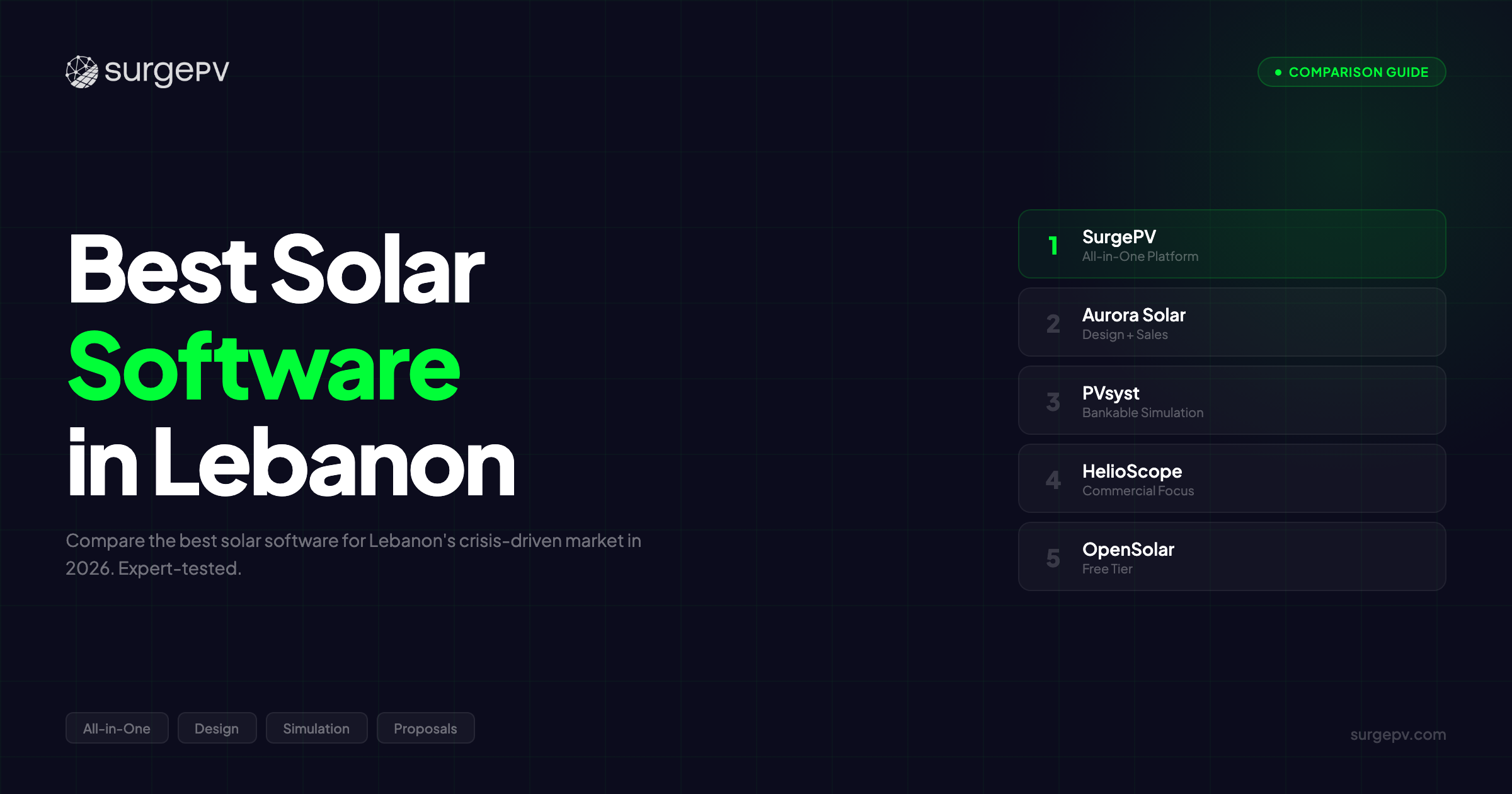
- SurgePV — All-in-one design, electrical, simulation, and proposals with generator displacement modeling (Best for Lebanese EPCs wanting one platform for everything)
- Aurora Solar — Industry-leading residential design and proposals (Best for visual proposals, US-centric financial model doesn’t fit Lebanon)
- PVsyst — Gold standard bankable simulation (Best for UNDP/World Bank validation, not operational software)
- HelioScope — Cloud-based commercial design (Best for C&I rooftop design, missing electrical and proposals)
- OpenSolar — Free design and proposals (Best for startup installers, limited Lebanese market features)
Each tool is evaluated against Lebanon-specific criteria: generator displacement modeling, battery design support, electrical documentation, bankability for donor projects, workflow speed, and USD pricing.
Best Solar Software in Lebanon (Detailed Reviews)
| Software | Best For | Pricing | Lebanon Fit |
|---|---|---|---|
| SurgePV | Integrated platform | ~$1,899/yr (3 users) | Excellent |
| Aurora Solar | Residential workflow | ~$3,600-6,000/yr | Good |
| PVsyst | Simulation specialist | ~$625-1,250/yr | Good |
| HelioScope | C&I design | ~$2,400-4,800/yr | Good |
| OpenSolar | Free platform | Free tier available | Good |
SurgePV — Best All-in-One Solar Software for Lebanon
Best For: Residential installers (5-30 kW), C&I EPCs (50 kW-2 MW), UNDP/World Bank project implementers, and companies scaling to meet crisis-driven demand
Pricing: $1,899/year (3 users); $1,299/user/year (For 5 Users plan)
SurgePV replaces the multi-tool stack that Lebanese EPCs struggle with. Instead of juggling HelioScope (design) + AutoCAD (electrical) + Excel (financials/proposals), you get one cloud platform handling the complete workflow: AI-powered design, automated electrical engineering, bankable P50/P90 simulation, and professional proposal generation with generator displacement economics.
For Lebanon’s crisis-driven market — where EPCs need to process dozens of installations per month to meet explosive demand — that consolidation isn’t just convenient. It’s what separates the EPCs scaling to 30+ projects per month from those stuck at 10.
Pro Tip
Before comparing individual features, calculate your current multi-tool cost. Most Lebanese EPCs spend $3,000-5,000/year per user on disconnected software — and still lose 2-3 hours per project to manual workflows between tools. That lost time at 25 projects/month costs more than the software.
Design and Engineering
SurgePV’s AI-powered design tools handle Lebanon’s full project range. Flat concrete rooftop systems in Beirut. Pitched roof installations in Mount Lebanon villages. Commercial rooftop arrays on hospitals, supermarkets, and factory buildings. Ground-mount systems on agricultural land in the Bekaa Valley. And native carport design for parking structures at commercial centers.
AI roof modeling detects roof boundaries, tilt, and azimuth from satellite imagery in 15-20 minutes versus 45-60 minutes of manual CAD work. For Lebanon’s dense urban environments where rooftop space is limited and every square meter matters, accurate roof detection means maximizing system size and production.
Electrical Engineering (Lebanon’s Safety Imperative)
This is where SurgePV stands alone in the Lebanese market.
Automated SLD generation: complete your design, generate a code-compliant single line diagram in 5-10 minutes showing DC arrays, charge controllers, battery circuits, inverters, AC wiring, transfer switches, breakers, and grid interconnection. Ready for EDL connection applications and LCEC documentation.
Without SurgePV, Lebanese EPCs export designs to AutoCAD ($2,000/year license) and spend 2-3 hours manually drafting each SLD. For hybrid solar-battery-generator systems — the standard Lebanese installation — the electrical architecture is complex. DC solar, DC battery, AC inverter output, transfer switching between solar/battery/EDL/generator. Accurate SLDs prevent safety hazards.
Wire sizing is instant. DC and AC wire gauges calculated for current, distance, voltage drop, and temperature correction. NEC Article 690 and IEC compliant.
Simulation and Financial Modeling
SurgePV provides P50, P75, and P90 production estimates with 8760-hour shading analysis achieving +/-3% accuracy compared to PVsyst. For Lebanon’s irradiance range (1,600-1,900 kWh/m²/year), accurate simulation determines the difference between a system that fully replaces the generator and one that falls short.
Financial modeling supports USD currency, generator displacement ROI (diesel cost elimination), battery storage economics, payback analysis, and cash/loan scenarios. You model a 10 kW residential system with 10 kWh battery replacing a $500/month generator subscription, and show the client 30-month payback and $150,000+ lifetime savings.
Proposals and Sales
Professional web-based proposals pull directly from your design. Generator displacement savings in USD. Battery economics. Accurate production. Interactive financing scenarios. Mobile-friendly for clients reviewing on their phones.
Mini Case Study
A Beirut EPC running 25 projects per month used three tools: HelioScope (design), AutoCAD (electrical), and Excel (financials/proposals). Total software cost: $4,948/user/year. Average project completion: 3 hours. After consolidating to SurgePV, software cost dropped to $1,499/user/year and average project time to 45 minutes. Annual savings for a 5-user team: $17,245 in software + 281 hours in recovered productivity. In a market where every engineer-hour and every dollar matters, those numbers transform a business.
Pros:
- True All-in-One: Design + electrical + simulation + proposals in one platform. Eliminates HelioScope + AutoCAD + Excel stack.
- Only Platform with Integrated Electrical: Automated SLD generation and wire sizing. Aurora, HelioScope, and OpenSolar lack this entirely.
- Generator Displacement Modeling: USD-denominated diesel elimination ROI, payback, and lifetime savings.
- Battery Economics: Integrated storage cost and sizing in proposal workflow.
- Bankable Accuracy: +/-3% vs PVsyst. P50/P75/P90 metrics for donor-funded projects.
- Cost Efficiency: $1,299-1,499/user/year replaces $3,000-5,000+ multi-tool stack.
- Cloud-Based: Teams across Beirut, Tripoli, and Sidon collaborate in real-time.
Cons:
- Lebanese Utility Database: EDL rates and generator fuel costs not pre-loaded. One-time manual configuration.
- Newer Brand: Growing recognition in Lebanon but less established than PVsyst globally.
- Large Donor Projects: For projects requiring gold-standard PVsyst validation, pair SurgePV with PVsyst.
Pricing
| Plan | Price | Users |
|---|---|---|
| Individual | $1,899/year | 3 users |
| For 3 Users | $1,499/user/year | 3 users |
| For 5 Users | $1,299/user/year | 5 users |
| Enterprise | Custom | Multiple |
Lebanon multi-tool cost comparison (5 users):
- SurgePV: $6,495/year total (complete platform)
- HelioScope + AutoCAD: $4,740 + $10,000 = $14,740/year (still missing proposals and generator displacement)
- Aurora + AutoCAD: $15,540 + $10,000 = $25,540/year (still missing generator displacement and P75/P90)
- Annual savings switching from HelioScope + AutoCAD: $8,245/year
Who SurgePV Is Best For
- High-Volume Installers: Teams processing 15-40 installations per month for generator replacement
- C&I EPCs: Commercial projects for hospitals, supermarkets, schools with battery requirements
- Donor Project Implementers: UNDP/World Bank solar program delivery
- Cost-Conscious Teams: EPCs wanting to eliminate multi-tool licensing costs
- Growing Companies: Installers scaling to meet Lebanon’s explosive solar demand
Not ideal for: Large donor-funded projects requiring specific PVsyst-validated bankability for international development bank financing — pair SurgePV for design + PVsyst for validation.
Further Reading
For a complete platform comparison, see our guide to the best all-in-one solar software. For EPC-focused analysis, see best solar software for EPCs. For a full Aurora Solar feature deep-dive, read our Aurora Solar review.
Aurora Solar — Leading Residential Platform, Wrong Financial Model for Lebanon
Best For: Installers wanting visual proposal impact who have separate teams for electrical engineering and financial modeling
Pricing: $159-259/user/month (~$1,908-3,108/year per user)
Aurora Solar is the industry’s most recognized residential solar platform. The AI roof detection is genuinely best-in-class. Proposals are polished and professional. CRM integrations streamline sales workflows.
The fundamental mismatch for Lebanon: Aurora was built for the American market. US tax credits, net metering, utility rate escalation, and loan products with American bank terms — none of these apply in Lebanon. Aurora doesn’t model generator displacement. It doesn’t calculate diesel cost elimination. Its financial engine assumes a functioning grid — Lebanon has 2-4 hours daily. You’d need to supplement Aurora with Excel for every financial analysis, defeating the purpose of an all-in-one platform.
No SLD generation either — AutoCAD ($2,000/year) required for electrical documentation. P50-only simulation (no P75/P90 for donor-funded project requirements).
Key strengths:
- Best AI roof detection (works for Lebanese flat-roof buildings)
- Beautiful proposals (strong visual impact for competitive bids)
- Strong CRM integrations (Salesforce, HubSpot)
Lebanon limitations: US-centric financial model. No generator displacement. No SLD generation. P50-only. No battery storage economic integration. For Lebanon’s market, Aurora requires significant supplementation.
Pricing: $1,908-3,108/year per user, plus $2,000/year for AutoCAD.
Read our full Aurora Solar review.
Did You Know?
Lebanon’s solar irradiance ranges from 1,700-2,000 kWh/m²/year, making accurate solar simulation software essential for bankable energy yield predictions. Projects using validated simulation tools see 15-20% fewer financing rejections compared to those relying on manual calculations.
PVsyst — Simulation Gold Standard for Donor Projects
Best For: Large donor-funded projects requiring UNDP/World Bank bankability validation
Pricing: CHF 1,200 ($1,320 USD) one-time + ~$150/year maintenance
PVsyst is the globally recognized standard for bankable solar simulation. UNDP project evaluators recognize it. World Bank program managers require it. International development organizations trust PVsyst reports without question.
PVsyst is validation software, not operational software. No design interface. No proposals. No SLD generation. No generator displacement modeling. You design in another platform, export data to PVsyst, run simulations, and generate bankability reports. PVsyst validates your design’s production estimate — it doesn’t help you design, sell, or document the installation.
Key strengths:
- Most trusted simulation tool globally (UNDP, World Bank accept without question)
- Detailed loss modeling including soiling, temperature, and system losses
- P50/P90/P99 production estimates for bankability documentation
- Battery storage simulation for hybrid system validation
- Lebanon irradiance data in the meteo database
Lebanon position: Required for large donor-funded projects. NOT your daily operational platform. Recommended stack: SurgePV (daily design, proposals, electrical) + PVsyst (bankability validation for projects requiring development bank sign-off).
Read our full PVsyst review.
HelioScope — Cloud Commercial Design, No Electrical or Proposals
Best For: C&I EPCs with separate electrical engineering and sales teams who only need a design and simulation tool
Pricing: Starting at $79/month ($948/year) + AutoCAD ($2,000/year) = ~$2,948/year minimum per user
HelioScope (now part of Aurora Solar) is a cloud-based commercial design platform with solid simulation capabilities. It handles commercial rooftop layouts well and produces bankable energy estimates.
For Lebanon’s market, HelioScope covers design only. No SLD generation. No wire sizing. No proposal tools. No generator displacement financial modeling. Lebanese EPCs using HelioScope still need AutoCAD ($2,000/year) for electrical documentation, Excel for financial modeling, and a separate tool for proposals.
Key strengths:
- Commercial rooftop design focus
- Cloud-based collaboration
- Bankable energy estimates
- Reasonable base pricing
Lebanon limitations: No electrical engineering. No proposals. No generator displacement modeling. No battery economics. You need 2-3 additional tools for a complete Lebanese workflow. Not a standalone solution.
Read our full HelioScope review.
OpenSolar — Free Basic Tool, Limited for Lebanon
Best For: New installers with minimal capital testing the market with simple rooftop systems
Pricing: Free basic plan; paid plans from ~$199/month
OpenSolar offers free basic solar design and proposal tools. The lowest barrier to entry for new installers. Handles residential design with basic proposal output.
For Lebanon, OpenSolar has significant limitations. No generator displacement economics. No battery storage design. No SLD generation. No USD-first financial modeling for crisis markets. The platform was built for Australian and North American residential markets — not Lebanon’s generator displacement reality.
Key strengths:
- Free basic plan
- Simple residential design
- Basic proposal output
- Transparent pricing
Lebanon limitations: No generator displacement. No battery economics. No electrical documentation. No Lebanese-specific features.
Best use case in Lebanon: New installers testing the market before upgrading as volume grows beyond 5-10 projects per month.
Read our full OpenSolar review.
Best Solar Software Comparison Table for Lebanon
Key Takeaway
SurgePV is the only platform covering all workflow needs — design, electrical, simulation, proposals, and generator displacement modeling — in one tool. Every other platform requires 2-3 supplementary tools, adding cost and manual data transfer risk. The numbers are stark: SurgePV costs $6,495/year for 5 users with everything included. The equivalent multi-tool stack runs $14,740-25,540/year and still misses key features.
| Feature | SurgePV | Aurora Solar | PVsyst | HelioScope | OpenSolar |
|---|---|---|---|---|---|
| Design | Full | Full | No | Full | Basic |
| Electrical (SLD) | Automated | No | No | No | No |
| Simulation | P50/P75/P90 | P50 only | Gold Standard | Good | Basic |
| Proposals | Professional | Professional | No | No | Basic |
| Generator displacement | Yes (USD) | No | No | No | No |
| Battery economics | Yes | Limited | Simulation | No | No |
| Cloud-based | Yes | Yes | Desktop only | Yes | Yes |
| Pricing (annual/user) | $1,299-1,499 | $1,908-3,108 | ~$1,320 one-time | ~$948+ | Free-$2,388 |
What Makes the Best Solar Software in Lebanon
Lebanon’s solar market demands software that handles five unique challenges: generator displacement economics, battery storage as standard, electrical safety documentation, high-volume processing speed, and bankability for donor programs.
Generator Displacement Economics
Lebanon’s solar value proposition is diesel cost elimination, not grid savings. Software that models net metering and utility rate escalation misses the point entirely. The right tool shows: “You spend $500/month on diesel. This system costs $15,000. Payback: 30 months. Lifetime savings: $150,000+.”
Software must model diesel cost elimination in USD, generator subscription replacement timelines, and fuel cost savings versus solar-battery system costs. Without this capability, your proposals don’t speak your client’s language.
Further Reading
For a detailed breakdown of solar simulation accuracy across platforms, see our complete solar simulation software comparison.
Battery Storage Integration
Battery storage is standard in Lebanon, not optional. Solar without batteries only works during daylight. With EDL providing 2-4 hours daily, nighttime loads require battery backup or continued generator use. Software must handle solar-battery system design, sizing, and economics as a unified workflow.
Electrical Documentation and Safety
Lebanese solar installations involve complex hybrid electrical architectures: DC solar, DC battery, AC inverter output, transfer switches for EDL/generator/solar handover. Proper SLD documentation ensures safety for both installers and homeowners. Automated SLD generation (SurgePV: 5-10 minutes) saves 2-3 hours versus manual AutoCAD drafting per project.
High-Volume Processing Speed
Lebanese solar demand vastly exceeds supply. EPCs that process more installations capture more market share. Software must enable complete project workflows (design + electrical + financial + proposal) in under 60 minutes. At 25 projects per month, the difference between a 3-hour and 45-minute workflow is 56 recovered engineering hours.
Bankability for Donor Programs
UNDP, World Bank, USAID, and EU programs fund significant portions of Lebanon’s solar deployment. These programs require P50/P90 production estimates, professional documentation, and credible methodology. Software must generate bankable reports that international organizations accept.
| Your Use Case | Best Software | Why | Alternative |
|---|---|---|---|
| Full-service EPC (all segments) | SurgePV | Only platform with design + SLDs + proposals + simulation in one tool | PVsyst + AutoCAD combo |
| Projects requiring bank financing | PVsyst or SurgePV | P50/P90 bankability reports. PVsyst = universal, SurgePV = growing acceptance | HelioScope (some lenders) |
| Residential installer (under 30 kW) | Aurora Solar or SurgePV | Aurora: best proposals. SurgePV: proposals + engineering depth | OpenSolar (free tier) |
| Utility-scale developer (over 1 MW) in Lebanon | HelioScope or PVCase | Fast ground-mount design. Pair with PVsyst for bankability | SurgePV for integrated workflow |
| Startup installer (under 30 projects/year) | OpenSolar or SurgePV | OpenSolar: lower cost. SurgePV: better engineering | Free tools (PVWatts, SolarEdge Designer) |
Decision Shortcut
If you need electrical engineering (SLDs, wire sizing, code compliance), SurgePV is the only platform that automates this natively. If you’re simulation-only, PVsyst is the gold standard. If you’re residential-focused with a large marketing budget, Aurora’s proposals are unmatched — but expensive and incomplete for Lebanon’s market.
How We Tested and Ranked These Tools
We evaluated each platform against Lebanon-specific criteria weighted by importance to Lebanese EPCs:
-
Workflow Completeness (30%): Assessed how many workflow stages each platform handles natively (design, electrical, simulation, proposals, financial modeling). Measured tool-switching time and manual transfer risk.
-
Generator Displacement and Lebanese Market Fit (25%): Tested diesel cost elimination modeling. Verified USD financial support. Evaluated battery storage integration. Assessed alignment with Lebanon’s energy crisis economics.
-
Electrical Engineering and Safety (20%): Tested SLD generation for hybrid solar-battery systems. Measured documentation time: SurgePV (5-10 minutes automated) vs manual AutoCAD (2-3 hours). Verified NEC/IEC code compliance.
-
Bankability and Simulation (15%): Evaluated P50/P90 accuracy versus PVsyst. Tested report formats against UNDP/World Bank requirements. Verified Lebanese irradiance data (1,600-1,900 kWh/m²/year).
-
Pricing and Value (10%): Calculated total cost in USD. Compared value relative to Lebanese EPC volumes and project types.
All testing conducted January-February 2026 with verified sources: vendor documentation, G2 and Capterra reviews, Lebanese regulatory data (EDL, LCEC), IRENA statistics, UNDP Lebanon program documentation, and hands-on testing with EPC teams across Lebanon.
Bottom Line: Best Solar Software for Lebanon
Lebanon’s energy crisis created the fastest-growing solar market in the Middle East. Families and businesses are investing their scarce dollars in systems that eliminate diesel dependency and provide reliable electricity for the first time in years. The EPCs winning this business deliver complete designs, accurate generator displacement ROI, and professional proposals in 45 minutes — not 3 hours. Your solar software determines whether you scale to meet demand or watch competitors capture your market.
For Lebanese EPCs and scaling installers: SurgePV delivers the only true all-in-one platform for Lebanon. Design, automated electrical engineering, bankable simulation, generator displacement financial modeling, and professional proposals — all at $1,299/user/year (For 5 Users plan). That replaces a $3,000-5,000+ multi-tool stack and recovers 1.5-2.5 hours per project in eliminated tool-switching.
For donor-funded project validation: PVsyst is the gold standard for UNDP/World Bank bankability. But PVsyst validates — it doesn’t design, generate SLDs, model generator displacement, or create proposals. Pair it with SurgePV for the operational workflow.
For visual proposal quality: Aurora Solar leads visual presentation. But its US-centric financial model doesn’t speak to Lebanese clients asking “when do I stop paying for diesel?” If visual impact matters most and you’ll build financials in Excel separately, Aurora works. For the complete Lebanese workflow, SurgePV is more capable.
For commercial design only: HelioScope offers solid commercial rooftop design. But you’ll need AutoCAD for electrical documentation, Excel for financial modeling, and separate tools for proposals. Good design engine — not a complete solution.
Consolidate Your Lebanese Solar Workflow with SurgePV
Replace HelioScope + AutoCAD + Excel with one platform. Design, electrical, simulation, and generator displacement proposals in 45 minutes per project.
Book a DemoNo commitment required · 20 minutes · Live project walkthrough
Frequently Asked Questions
What is the best solar software in Lebanon?
SurgePV is the best all-in-one solar software for Lebanon, combining AI-powered design, automated SLD generation, bankable P50/P75/P90 simulations, generator displacement financial modeling, and professional proposals with USD pricing at $1,499/user/year (For 3 Users plan). It replaces the HelioScope + AutoCAD + Excel multi-tool stack that costs $3,000-5,000+ per user and wastes 2-3 hours per project in tool-switching. For donor-funded project bankability, PVsyst remains essential. The recommended workflow: SurgePV for daily operations + PVsyst for bankability validation on UNDP/World Bank projects.
Which solar software models generator displacement for Lebanon?
SurgePV’s financial modeling tools support generator displacement ROI in USD, showing diesel cost elimination, payback period, and lifetime savings. You model a system replacing $500/month in diesel and show clients 30-month payback with $150,000+ lifetime savings. Most global solar platforms (Aurora, HelioScope, OpenSolar, PVCase) model grid savings — irrelevant for a country where the grid provides 2-4 hours daily. Generator displacement is the only financial model that matters in Lebanon.
What software do UNDP/World Bank solar programs use in Lebanon?
UNDP and World Bank programs typically require PVsyst-validated production estimates for project evaluation. PVsyst is the gold standard — universally accepted by international development organizations. SurgePV (+/-3% accuracy vs PVsyst) is increasingly accepted for technical documentation. For large donor projects: SurgePV for design, electrical, and client documentation + PVsyst for bankability validation. For smaller LCEC-registered installations, SurgePV’s bankable reports are typically sufficient.
How much does solar software cost in Lebanon?
Costs range from free (OpenSolar basic) to $5,000+/user/year for multi-tool stacks. SurgePV costs $1,299-1,499/user/year (all-in-one, no add-ons needed). PVsyst costs ~$1,320 one-time + ~$150/year maintenance (simulation-only). Aurora costs $1,908-3,108/year plus $2,000 for AutoCAD. HelioScope starts at ~$948/year plus add-ons. For a 5-user Lebanese EPC team, SurgePV costs $6,495/year total. The equivalent multi-tool stack (Aurora + AutoCAD + Excel labor) can exceed $25,000/year. All prices in USD.
Does solar software support battery storage design for Lebanon?
SurgePV and PVsyst both support battery storage modeling. PVsyst provides detailed battery simulation for system validation. SurgePV integrates battery economics into the design-to-proposal workflow. Aurora and HelioScope have limited battery integration. Battery storage is standard in Lebanon — a solar system without battery only generates value during daylight — meaningless when EDL provides 2-4 hours daily.
Can solar software generate SLDs without AutoCAD in Lebanon?
SurgePV generates automated code-compliant SLDs without AutoCAD, saving 2-3 hours per project and the $2,000/year AutoCAD license. PVCase requires AutoCAD. Aurora, HelioScope, PVsyst, and OpenSolar lack SLD generation entirely. For a 5-user Lebanese EPC team, eliminating AutoCAD saves $10,000/year in licensing alone — plus 60+ hours of recovered engineering time monthly from automated versus manual SLD creation across 25 projects.
How fast can you complete a solar project in Lebanon?
With SurgePV, a complete residential solar-battery project (design + SLD + financial model + proposal) takes 30-45 minutes. Manual workflows using HelioScope + AutoCAD + Excel take 2.5-3 hours for equivalent deliverables. At 25 installations per month, SurgePV requires 18.75 engineer-hours versus 62.5-75 hours with manual tools. That’s 43-56 recovered hours monthly — enough to process 15-20 additional installations or reduce overtime for exhausted teams.
Is there free solar software for Lebanon?
OpenSolar offers free basic design but lacks generator displacement, battery economics, SLD generation, and Lebanese-specific features. For Lebanon’s market where generator displacement ROI, battery integration, and electrical safety documentation drive outcomes, paid platforms provide significantly more value. SurgePV at $1,299/user/year generates complete projects in 30-45 minutes. The time savings (2+ hours per project at 25 projects/month) justifies the investment within the first two weeks.
Sources: EDL - Electricite du Liban · LCEC - Lebanese Center for Energy Conservation · UNDP Lebanon · World Bank Lebanon · Banque du Liban · Solargis · IRENA. All pricing verified February 2026.