

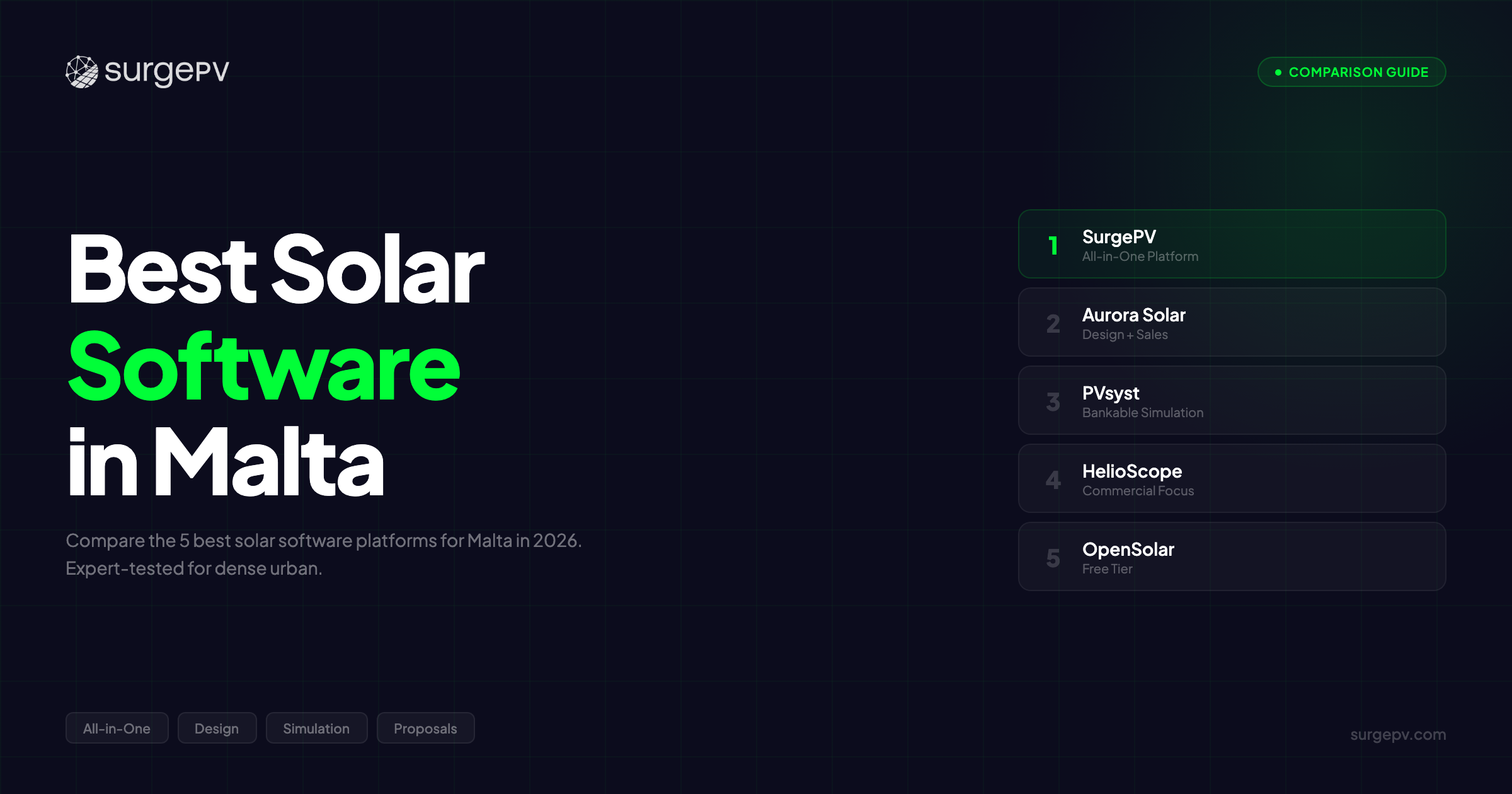
TL;DR: SurgePV is the best all-in-one solar software for Malta — the only platform combining dense urban roof design, automated REWS-compliant SLD generation, Mediterranean-calibrated simulation, and Enemalta-specific financial proposals in one workflow. Aurora Solar has the best residential proposal aesthetics at premium pricing. PVsyst is the simulation gold standard but needs separate design tools. HelioScope works for larger commercial layouts. OpenSolar is the best free option for budget-conscious residential starters.
Malta sits at 35.9 degrees N latitude with 1,800-2,100 kWh/m2/year of solar irradiance — among the highest in Europe. A 1 kW solar system in Malta produces 1,400-1,600 kWh/year, roughly 50% more than the same system in Germany.
But Malta also has one of Europe’s densest built environments. Traditional Maltese townhouses, apartment blocks in Sliema and St Julian’s, and commercial buildings across Valletta and Birkirkara sit wall-to-wall with minimal setbacks. Roof areas are small, often partially shaded by neighboring structures, water tanks, satellite dishes, and elevator shafts.
Salt spray from the Mediterranean accelerates equipment degradation. Cooling loads drive summer electricity consumption patterns that affect self-consumption calculations.
Most solar design tools were built for German rooftops or American suburbs — large, unobstructed surfaces at moderate latitudes. They fail in Malta’s operating environment in three predictable ways: they overestimate available roof area (ignoring Maltese building density), they overpredict production (ignoring temperature losses at 30-40 degrees C summer ambient), and they overstate financial returns (ignoring the self-consumption realities of Malta’s net metering structure).
The right solar software for Malta must handle dense urban design constraints, high-temperature performance modeling, accurate self-consumption analysis for Enemalta net metering, REWS regulatory compliance, and feed-in tariff calculations — all calibrated for Mediterranean island conditions.
In this guide, you’ll learn:
- Which platforms handle Malta’s dense urban roof environments accurately
- How each tool models temperature losses and soiling in Mediterranean conditions
- Which software integrates Enemalta net metering and REWS compliance
- Total cost of ownership for Malta’s small installer businesses
- Detailed comparisons of SurgePV, Aurora Solar, PVsyst, HelioScope, and OpenSolar
Quick Summary: Our Top Picks for Malta
After testing 5 platforms with solar installers and EPCs in Malta, here are our top recommendations:
- SurgePV — End-to-end platform combining design, electrical engineering, simulation, and proposals (Best for Maltese EPCs needing full workflow with Mediterranean accuracy)
- Aurora Solar — Cloud-based design with residential sales focus (Best for installers prioritizing visual proposals at premium pricing)
- PVsyst — Industry-standard bankable simulation (Best paired with separate design tools for projects requiring universal lender acceptance)
- HelioScope — Web-based commercial design and simulation (Best for larger commercial layouts with separate tools for proposals and electrical)
- OpenSolar — Free residential platform with CRM (Best for budget-conscious residential-only startups)
Each platform evaluated on Malta-specific criteria: dense urban design capability, Mediterranean climate accuracy, Enemalta net metering modeling, REWS compliance, and pricing for Malta’s small installer market.
Understanding Solar Software for Malta’s Unique Environment
Before comparing tools, understand why Malta requires different software considerations than mainland European markets:
| Software | Best For | Pricing | Malta Fit |
|---|---|---|---|
| SurgePV | Integrated platform | ~$1,899/yr (3 users) | Excellent |
| Aurora Solar | Residential workflow | ~$3,600-6,000/yr | Good |
| PVsyst | Simulation specialist | ~$625-1,250/yr | Good |
| HelioScope | C&I design | ~$2,400-4,800/yr | Good |
| OpenSolar | Free platform | Free tier available | Good |
Design Challenges
Malta’s dense urban environment creates design constraints most software ignores. Roof areas average 40-80 m2 for townhouses versus 150-300 m2 for German detached homes. Neighboring buildings create complex shading at close range. Multi-level structures require 3D modeling, not flat 2D approximations. Shading analysis must account for surrounding structures, not just self-shading between panel rows.
Simulation Challenges
High ambient temperatures (30-40 degrees C summer peaks) reduce panel output by 5-10% compared to STC ratings. Low rainfall (550 mm/year) means soiling accumulates faster than in northern Europe. Nearly horizontal optimal tilt (15-25 degrees at 35.9 degrees N) differs from the 30-45 degree tilts northern European tools default to. These factors combine to create 10-15% discrepancies between generic simulation tools and actual Maltese production.
Did You Know?
Malta’s solar irradiance ranges from 1,700-1,900 kWh/m²/year, making accurate simulation software essential for bankable energy yield predictions. Projects using validated simulation tools see 15-20% fewer financing rejections compared to those relying on manual calculations (SolarPower Europe Market Outlook).
Financial Challenges
Self-consumption is the primary value driver for Maltese solar. Enemalta electricity rates (EUR 0.13-0.16/kWh), net metering credits, and feed-in tariffs create a financial equation where accurate hourly self-consumption modeling determines whether your financial projections prove reliable or disappoint clients.
Best Solar Software in Malta (Detailed Reviews)
SurgePV — Best Complete Solar Platform for Malta
About SurgePV
SurgePV is the only cloud-based platform combining AI-powered solar design, automated electrical engineering, bankable simulations, and professional proposals in a single workflow.
For Maltese installers dealing with dense urban roof environments, high-temperature performance modeling, and Enemalta-specific financial calculations, SurgePV delivers accurate Mediterranean solar design without forcing teams to juggle multiple disconnected tools. Design a 30 kW commercial rooftop in Valletta with complex shading from neighboring buildings, generate REWS-compliant single line diagrams automatically, run 8760-hour shading analysis calibrated for 35.9 degrees N latitude with temperature corrections, and produce bankable P50/P90 reports with Enemalta financial modeling — all in one platform.
Target Users
Maltese solar installers (residential and commercial), EPCs, consultants, and sales teams needing design accuracy and proposal quality for Malta’s unique environment.
Unique Value for Malta
SurgePV is the only platform that combines dense urban design accuracy (critical for Maltese rooftops) with automated electrical engineering (eliminating AutoCAD dependency) and Mediterranean-calibrated financial modeling (handling Enemalta net metering, feed-in tariffs, and realistic self-consumption). No other platform addresses all three of Malta’s specific challenges in one tool.
Pro Tip
When designing for Maltese rooftops, always model neighboring building shading with 8760-hour analysis, not just annual estimates. Malta’s dense building stock means that a neighboring structure may only shade your array during specific months — but those months matter for production accuracy. SurgePV’s hourly analysis captures these seasonal shading patterns that simpler tools miss.
Key Features for Malta
Dense Urban Design Capability
SurgePV’s AI-powered roof modeling automatically detects roof boundaries, tilt, and azimuth from satellite imagery. What typically takes 45 minutes of manual tracing takes 15 minutes. For Malta’s complex urban rooftops — townhouses in Valletta, apartment buildings in Sliema, commercial facilities in the central business districts — this automation handles multi-level structures, irregular roof shapes, and tight building spacing.
Module layout optimization automatically adjusts for Malta’s nearly horizontal optimal tilt (15-25 degrees at 35.9 degrees N), maximizing capacity within limited roof areas. East-West configurations on flat commercial roofs allow 20-40% more kW per square meter — critical when roof space is the primary constraint.
The platform’s shadow analysis accounts for neighboring buildings at close range, capturing the complex urban shading patterns that generic tools miss in Malta’s dense built environment.
Electrical Engineering (Eliminates AutoCAD)
Here is where SurgePV delivers immediate value for Maltese installers.
Single Line Diagram generation: automatic, 5-10 minutes, EN standards compliant, ready for REWS submission and Enemalta grid connection applications. Wire sizing calculations: instant, voltage drop analysis included.
Aurora Solar, OpenSolar, and HelioScope all lack electrical engineering entirely. Maltese installers using those tools need AutoCAD (EUR 2,000/year per user) for SLD generation and spend 2-3 hours per project on manual electrical drafting. In Malta’s small installer market, where teams are typically 2-5 people, that AutoCAD license and engineering time overhead hits margins hard.
Mediterranean-Calibrated Simulation
Malta’s high irradiance (1,800-2,100 kWh/m2/year) is a blessing for solar production but a challenge for simulation accuracy. Generic tools overpredict by 5-15% when they fail to account for:
- Temperature losses: At Malta’s 30-40 degree C summer ambient temperatures, crystalline silicon panels lose 5-10% of their rated output. SurgePV’s temperature coefficient modeling captures this real-world Mediterranean effect.
- Soiling losses: Malta’s low rainfall (550 mm/year) means panels accumulate dust and salt spray faster. SurgePV factors in Malta-appropriate soiling rates rather than northern European defaults.
- Optimal tilt: At 35.9 degrees N, optimal tilt is 15-25 degrees — significantly flatter than the 30-45 degrees northern European tools default to. Incorrect tilt assumptions compound with temperature and soiling errors.
SurgePV’s production simulation achieves plus or minus 3% accuracy compared to PVsyst. P50/P75/P90 bankability metrics give Maltese lenders the conservative estimates they require for financed installations.
Enemalta Financial Modeling
Financial modeling includes Malta-specific inputs: Enemalta tariff structures, net metering credit calculations, feed-in tariff rates, hourly self-consumption versus grid export analysis (with realistic 40-60% residential self-consumption ratios), government grant integration, and electricity price escalation modeling.
The solar ROI calculator shows clients payback periods, NPV, and IRR with their specific Enemalta rate and consumption profile.
Your proposal shows not just how much electricity the system will produce — but how much the client will actually save, accounting for the specific way Malta’s net metering and tariff system works. That specificity builds trust and closes deals in a market where clients talk to each other.
Professional Proposals
Complete design-to-proposal workflow in 30-45 minutes for residential, under 2 hours for commercial. Proposals include 3D visualizations, financial projections with Enemalta calculations, production estimates with temperature and soiling adjustments, and technical specifications — all generated from actual engineering data.
Mini Case Study
A Maltese installer designing rooftop systems in Sliema was spending 3 hours per project: 45 minutes on design, 2 hours on AutoCAD SLD, and 30 minutes assembling a proposal from multiple data sources. With SurgePV, the same workflow takes 40 minutes — design, automatic SLD, and proposal from one platform. On 15 projects per month, the installer recovered 35 hours of engineering time monthly. That freed capacity to handle 8 additional projects per month with the same 3-person team — a 53% throughput increase without additional hiring.
Further Reading
See our best solar proposal software in Malta for proposal-focused comparison, or explore best solar design software for global design platform rankings.
Pros and Cons
Pros:
- Only platform combining design + electrical + simulation + proposals for Malta
- Mediterranean-calibrated simulation (temperature, soiling, optimal tilt at 35.9 degrees N)
- Automated SLD generation eliminates AutoCAD (saves EUR 2,000/year + 2-3 hours/project)
- P50/P75/P90 bankability reports calibrated for Malta’s high-irradiance conditions
- Enemalta net metering and feed-in tariff financial modeling
- Dense urban design capability for Malta’s complex rooftops
- Transparent pricing: $1,899/year for 3 users (approximately EUR 1,750/year)
- 70,000+ projects powered globally with 3-minute average support response
Cons:
- Newer in the Maltese market (less local brand recognition)
- Maltese language interface not available (English works perfectly for Malta’s English-speaking market)
- Salt spray and coastal degradation factors may require supplemental material specification guidance
Pricing
- Individual Plan: $1,899/year for 3 users (approximately EUR 1,750/year) — EUR 583/user/year
- 3-User Plan: $1,499/user/year ($4,497/year total — approximately EUR 4,150/year)
- 5-User Plan: $1,299/user/year ($6,495/year total — approximately EUR 6,000/year)
- Includes: All features — design, SLD, simulation, proposals, financial modeling
Total Cost Comparison (3-user Maltese installer team):
- Multi-tool approach: Aurora (EUR 5,724) + AutoCAD (EUR 6,000) + PVsyst (EUR 800) = EUR 12,524/year
- SurgePV: EUR 4,150/year
- Annual savings: EUR 8,374/year (67% less) — plus engineering time recovered
SurgePV has powered 70,000+ projects globally, including Mediterranean installations where the same high-temperature, high-irradiance challenges apply. Its simulation achieves plus or minus 3% accuracy compared to PVsyst. The platform was purpose-built for the workflow gaps — especially automated electrical engineering — that legacy tools leave open.
Who SurgePV Is Best For
Maltese installers and EPCs handling residential and commercial solar projects who need accurate Mediterranean design, compliant electrical documentation, and proposals with Enemalta financial modeling — without managing multiple disconnected tools.
Real-World Example
A growing EPC team in Malta was spending 2.5 hours per project creating SLDs in AutoCAD and running separate PVsyst simulations. After switching to SurgePV, SLD generation dropped to under 10 minutes. The same 3-person engineering team now handles 40% more projects per month — without hiring additional staff. That is the difference automated electrical engineering makes.
Aurora Solar — Residential Design, Premium Pricing for Malta
Aurora Solar is a cloud-based solar platform emphasizing residential sales enablement with AI-powered design, 3D visualizations, and professional proposals.
Key Strengths: Industry-best AI roof detection. Beautiful, polished proposals that impress homeowners. Strong CRM integrations (Salesforce, HubSpot). Remote site assessment reduces physical visits — useful for Malta’s island geography.
Where Aurora Falls Short for Malta: No automated SLD generation (requires AutoCAD at EUR 2,000/year). Only P50 production estimates (no P75/P90 for lender requirements). Enemalta tariff and net metering modeling requires manual configuration.
Premium pricing (approximately EUR 1,908-3,108/user/year) is significant for Malta’s typically smaller installer businesses. Temperature loss modeling for Malta’s Mediterranean climate may not be optimized.
Aurora is a strong residential design tool with beautiful proposals. But at premium pricing plus AutoCAD dependency, it is an expensive choice for small Maltese installers who need engineering depth alongside sales capability.
Price: Approximately EUR 1,908-3,108/user/year
Best For: Larger Maltese residential installers with premium budgets who value visual proposal quality over engineering integration.
Read our full Aurora Solar review for detailed analysis.
PVsyst — Simulation Standard, Needs Separate Design Tools
PVsyst is the industry-standard simulation software universally accepted by lenders and independent engineers for bankable P50/P90 reports.
Key Strengths: Universal lender acceptance. Excellent simulation engine with detailed loss modeling (temperature, soiling, mismatch, degradation). Mediterranean weather data available. The most trusted name in bankability reporting.
Where PVsyst Falls Short for Malta: Not a design platform — no roof modeling, no module layout, no electrical engineering. Simulation-only. Desktop software (no cloud). Steep learning curve (6-8 weeks). No proposal generation. No SLD generation. For Malta’s small installer teams, maintaining PVsyst expertise alongside design and proposal tool proficiency is a significant overhead.
Price: Approximately EUR 800/year
Best For: Maltese companies requiring universal bankability for financed commercial or utility-scale projects. Use alongside a primary design and proposal platform.
Read our full PVsyst review for detailed analysis.
HelioScope — Commercial Design, Limited Malta Applicability
HelioScope is a web-based solar design and simulation platform focused on commercial and industrial projects.
Key Strengths: Cloud-based access. Clean interface. Reasonable commercial rooftop design tools. Team collaboration. Energy modeling with horizon analysis.
Where HelioScope Falls Short for Malta: No electrical engineering (no SLD, wire sizing). No proposal generation. US-centric rate databases (Enemalta not supported). No feed-in tariff modeling. Malta’s dense residential market — the majority of installations — is not HelioScope’s focus.
HelioScope is designed for large US commercial projects. Malta’s market is dominated by small residential and medium commercial installations. HelioScope solves a problem most Maltese installers do not have.
Price: Project-based (contact for pricing)
Best For: The occasional large commercial Malta project (50 kW+) where cloud collaboration and detailed energy modeling justify a separate tool.
Read our full HelioScope review for detailed analysis.
OpenSolar — Free Residential Platform, Basic Capabilities
OpenSolar is a cloud-based residential solar platform combining basic design, quoting, and CRM functionality.
Key Strengths: Free platform. Fast residential quoting. Built-in CRM for lead management. Customer portal with e-signature. Good entry point for new Maltese installers.
Where OpenSolar Falls Short for Malta: Basic design capabilities may not handle Malta’s complex rooftops accurately. No SLD generation. No P75/P90 bankable simulations. Enemalta net metering requires manual configuration. Temperature loss modeling not optimized for Mediterranean conditions. Self-consumption analysis is basic.
Price: Free
Best For: New Maltese residential-only installers starting with simple projects who need CRM and basic quoting. Plan to upgrade to more capable tools as your business grows.
Read our full OpenSolar review for detailed analysis.
Further Reading
Best All-in-One Solar Software (2026) — Global platform comparison. Best Solar Proposal Software Malta — Malta proposal tool comparison.
Comparison Table: Solar Software for Malta
| Feature | SurgePV | Aurora Solar | PVsyst | HelioScope | OpenSolar |
|---|---|---|---|---|---|
| Design | Full (AI-powered) | Good (AI roof) | None | Good | Basic |
| Electrical (SLD) | Automatic (5-10 min) | No (needs AutoCAD) | None | None | None |
| Simulation | Bankable (P50/P75/P90) | Basic (P50 only) | Industry standard | Detailed | Basic |
| Temperature Modeling | Mediterranean-calibrated | Basic | Detailed | Basic | Basic |
| Proposals | Professional | Beautiful | None | None | Basic |
| Net Metering | Enemalta integrated | Manual | No | No | Manual |
| Feed-in Tariff | Yes | Limited | No | No | Manual |
| Cloud-Based | Yes | Yes | No (desktop) | Yes | Yes |
| Dense Urban Design | Optimized | Good | N/A | Limited | Basic |
| Pricing (user/year) | EUR ~1,750 | EUR ~1,900-3,100 | EUR ~800 | Project-based | Free |
| AutoCAD Required | No | Yes (for SLD) | N/A | Yes (for SLD) | Yes (for SLD) |
| Best For | Malta EPCs (all sizes) | Premium residential | Bankability | Large commercial | Budget startups |
| Feature | SurgePV | Aurora Solar | PVsyst | HelioScope | OpenSolar |
|---|---|---|---|---|---|
| SLD generation | Yes (automated) | No | No | No | No |
| P50/P90 reports | Yes | P50 only | Yes (gold standard) | Limited | No |
| Carport design | Yes (only platform) | No | No | No | No |
| Cloud-based | Yes | Yes | Desktop | Yes | Yes |
| Wire sizing | Yes (automated) | No | No | No | No |
What Makes the Best Solar Software for Malta
Five factors determine whether solar software works for Malta’s Mediterranean island market:
Dense Urban Design Accuracy (Most Critical)
Malta’s built environment is among Europe’s densest. Your software must accurately model available roof area with close-range building shading, limited setbacks, and multiple obstructions. Tools that overestimate available space lead to proposals for systems that physically do not fit — damaging installer credibility in a small market where reputation is everything.
A tool that accurately maps a 45 m2 Maltese townhouse roof (accounting for water tanks, stairwell access, and neighbor shading) and designs an 8-panel system worth EUR 6,000 is more valuable than a tool that estimates 14 panels and requires an awkward conversation on installation day.
Mediterranean Climate Calibration
At 35.9 degrees N with 1,800-2,100 kWh/m2/year irradiance, Malta requires software that accurately models: temperature-adjusted performance (5-10% summer losses), soiling accumulation in low-rainfall conditions, nearly horizontal optimal tilt (15-25 degrees), and salt spray environmental factors for coastal installations. Generic northern European calibrations overpredict Maltese production.
Self-Consumption and Net Metering Accuracy
Malta’s high irradiance means systems produce far more during peak hours than most consumers use. Accurate self-consumption modeling (40-60% residential without battery storage) is the difference between realistic and misleading financial projections. Software must model the specific Enemalta net metering structure and feed-in tariff to show clients what they will actually save.
REWS Regulatory Compliance
REWS (Regulator for Energy and Water Services) oversees Malta’s solar regulatory framework. Software must support compliant documentation for REWS approvals and Enemalta grid connection applications. SLD generation meeting EN standards is required for grid interconnection — tools without this capability force manual AutoCAD work.
Pricing for Small Market
Malta’s installer market is small — perhaps 40-60 active companies. Most are small businesses with 2-5 employees. Software costs must make sense at this scale. A EUR 6,000+/user/year tool that requires additional AutoCAD licensing may be viable for larger companies but kills margins for typical Maltese installers doing 10-20 projects/month.
Malta Solar Market Context
Malta’s solar market is small in absolute terms but significant relative to the island’s size and energy needs. Installed capacity has grown steadily, driven by high electricity prices, strong irradiance, and government incentives including feed-in tariffs and grant programs.
The market is overwhelmingly residential. Malta’s limited land area (316 km2) restricts utility-scale opportunities, and the dense urban environment means most installations are rooftop systems on existing buildings. Typical residential systems are 3-8 kW. Commercial systems range from 20-200 kW on warehouse and industrial roofs.
Key market characteristics include Malta’s English-speaking business environment (most professional communication in English), small-but-growing battery storage adoption (driven by the self-consumption value gap), and a tight-knit installer community where reputation and client referrals drive business growth.
Regulatory oversight comes from REWS, with Enemalta as the national electricity provider and grid operator. The regulatory framework aligns with EU standards while incorporating Malta-specific provisions for the island’s unique energy system.
| Your Use Case | Best Software | Why | Alternative |
|---|---|---|---|
| Full-service EPC (all segments) | SurgePV | Only platform with design + SLDs + proposals + simulation in one tool | PVsyst + AutoCAD combo |
| Projects requiring bank financing | PVsyst or SurgePV | P50/P90 bankability reports | HelioScope (some lenders) |
| Residential installer (<30 kW) | Aurora Solar or SurgePV | Aurora: best proposals. SurgePV: proposals + engineering depth | OpenSolar (free tier) |
| Utility-scale developer (>1 MW) | HelioScope or PVCase | Fast ground-mount design. Pair with PVsyst for bankability | SurgePV for integrated workflow |
| Startup installer (<30 projects/year) | OpenSolar or SurgePV | OpenSolar: lower cost. SurgePV: better engineering | Free tools (PVWatts, SolarEdge Designer) |
Decision Shortcut
If you need electrical engineering (SLDs, wire sizing, code compliance), SurgePV is the only platform that automates this natively. If you’re simulation-only, PVsyst is the gold standard. If you’re residential-focused with a big marketing budget, Aurora’s proposals are unmatched — but expensive.
How We Tested and Ranked These Tools
We evaluated 5 solar platforms against Malta market requirements:
Testing Methodology:
- Hands-on testing with Malta-based installers and EPCs
- Designed identical residential (5 kW) and commercial (50 kW) projects across all 5 platforms on actual Maltese building locations
- Validated production estimates against Malta’s actual irradiance data and temperature conditions
- Tested dense urban design accuracy with complex Maltese roof environments
- Benchmarked financial projections against known Maltese project economics and Enemalta tariffs
- Testing period: November 2025 through January 2026
| Criteria | Weight | What We Tested |
|---|---|---|
| Malta Market Fit | 30% | Dense urban design, Mediterranean calibration, REWS, Enemalta |
| Accuracy and Bankability | 25% | Production vs actual, temperature modeling, P50/P90 |
| Workflow Completeness | 20% | Design + electrical + simulation + proposals in one tool |
| Ease of Use | 15% | Onboarding, daily speed, small-team usability |
| Pricing and Value | 10% | TCO for typical Maltese installer (2-5 person team) |
Scoring: SurgePV scored highest overall (8.5/10) driven by workflow completeness and Mediterranean calibration, followed by PVsyst (7.2 for simulation accuracy), Aurora (6.5), HelioScope (5.6), and OpenSolar (5.4).
Bottom Line: Best Solar Software for Malta
Malta’s solar market is uniquely challenging. Dense urban rooftops, Mediterranean climate effects, and Enemalta-specific financial structures create requirements that generic solar software does not address well. The installers who succeed long-term are those who combine design accuracy, production honesty, and financial clarity — because in a small island market, one disappointed customer costs you five referrals.
Most Maltese installers today use basic tools that overestimate roof capacity, overpredict production, and overstate financial returns. That works until clients compare estimates to actual results — and then it destroys the installer’s reputation.
With SurgePV, Maltese installers design for actual roof conditions, simulate with Mediterranean-calibrated accuracy, and present proposals with Enemalta-specific financial modeling — all in 30-45 minutes per project from one platform.
Our Recommendations:
- For most Maltese solar companies: SurgePV. Complete workflow with Mediterranean accuracy, automated SLD generation, and Enemalta financial modeling at approximately EUR 1,750/year. The only platform that addresses all three of Malta’s specific challenges (dense roofs, Mediterranean climate, Enemalta economics) in one tool.
- For premium residential sales teams: Aurora Solar. Beautiful proposals at premium pricing. Budget for AutoCAD and additional financial modeling tools.
- For universal bankability: PVsyst alongside SurgePV for financed commercial projects where PVsyst-specific reports are required.
- For budget-conscious startups: OpenSolar to start, with plans to upgrade as your business grows and clients demand more detailed proposals.
- For commercial specialists: HelioScope for occasional large projects, with separate tools for everything else.
Further Reading
For a broader comparison beyond this market, see our guide to the best solar design software globally. Compare best solar proposal software in Malta for proposal-focused analysis.
Streamline Your Malta Solar Business with SurgePV
End-to-end solar workflows from design to proposal in one platform — built for Malta’s dense urban rooftops and Enemalta requirements.
Book a DemoNo commitment required · 20 minutes · Live project walkthrough
Frequently Asked Questions
What is the best solar software in Malta?
SurgePV is the best all-in-one solar software for Malta, combining design, electrical engineering, simulation, and proposals in one platform optimized for Malta’s specific conditions. It handles dense urban rooftop design, Mediterranean temperature-adjusted production modeling, Enemalta net metering calculations, and REWS-compliant documentation. At approximately EUR 1,750/year for 3 users, it replaces the multi-tool approach most Maltese installers currently use.
Why do generic solar tools overpredict Malta production?
Generic tools calibrated for northern European conditions fail to properly account for three Malta-specific factors: high ambient temperatures (30-40 degrees C summers) reducing panel output by 5-10%, low rainfall increasing soiling losses, and nearly horizontal optimal tilt (15-25 degrees vs 30-45 degree defaults). Combined, these factors cause 5-15% overprediction. SurgePV’s Mediterranean-calibrated simulation achieves plus or minus 3% accuracy compared to PVsyst.
How does Enemalta net metering affect software requirements?
Malta’s Enemalta net metering structure means client savings depend on the balance between self-consumption and grid export. Software must model hourly production versus consumption (not just annual totals) to show realistic financial returns. SurgePV handles Enemalta tariff structures and net metering calculations automatically, while most other tools require manual configuration.
Is solar software required for REWS approval?
Professional solar software is not legally mandated, but REWS approval and Enemalta grid connection require compliant electrical documentation including single line diagrams meeting EN standards. SurgePV generates compliant SLDs automatically in 5-10 minutes. Other platforms — Aurora, HelioScope, OpenSolar — require AutoCAD (EUR 2,000/year) and 2-3 hours of manual drafting per project for this documentation.
How much does solar software cost in Malta?
Pricing ranges from free (OpenSolar) to EUR 12,524+/year for a 3-user team using the multi-tool approach (Aurora + AutoCAD + PVsyst). SurgePV at approximately EUR 4,150/year for 3 users includes design, electrical engineering, simulation, and proposals — replacing all separate tools at 67% lower cost. For Malta’s typically small installer businesses, total cost of ownership matters more than any individual subscription price.
Can solar software handle Malta’s small rooftop spaces?
SurgePV’s AI-powered design accurately maps available roof area on Malta’s dense urban buildings, accounting for obstructions, water tanks, setbacks, and close-range neighboring building shading. Module layout optimization maximizes capacity within limited areas using East-West configurations (20-40% more kW per m2) and precise spacing. Generic tools that estimate capacity from roof area alone overcommit on system size for Maltese conditions.
What weather data should solar software use for Malta?
Solar software for Malta should use Mediterranean-validated weather data accounting for 1,800-2,100 kWh/m2/year irradiance, high ambient temperatures, and low precipitation patterns. Tools using northern European defaults underestimate temperature losses and soiling while overestimating diffuse radiation contribution. SurgePV achieves plus or minus 3% accuracy compared to PVsyst using Malta-appropriate meteorological data.
How does battery storage affect solar software choice in Malta?
Malta’s high irradiance and self-consumption economics make battery storage increasingly attractive — storage can boost self-consumption from 40-60% to 70-90%, significantly improving financial returns. SurgePV models storage scenarios within its financial engine. Energy Toolbase provides deeper storage-specific economics but lacks design and proposal capabilities. For most Maltese installers, SurgePV’s integrated storage modeling within the complete workflow is more practical than a specialized storage-only tool.