

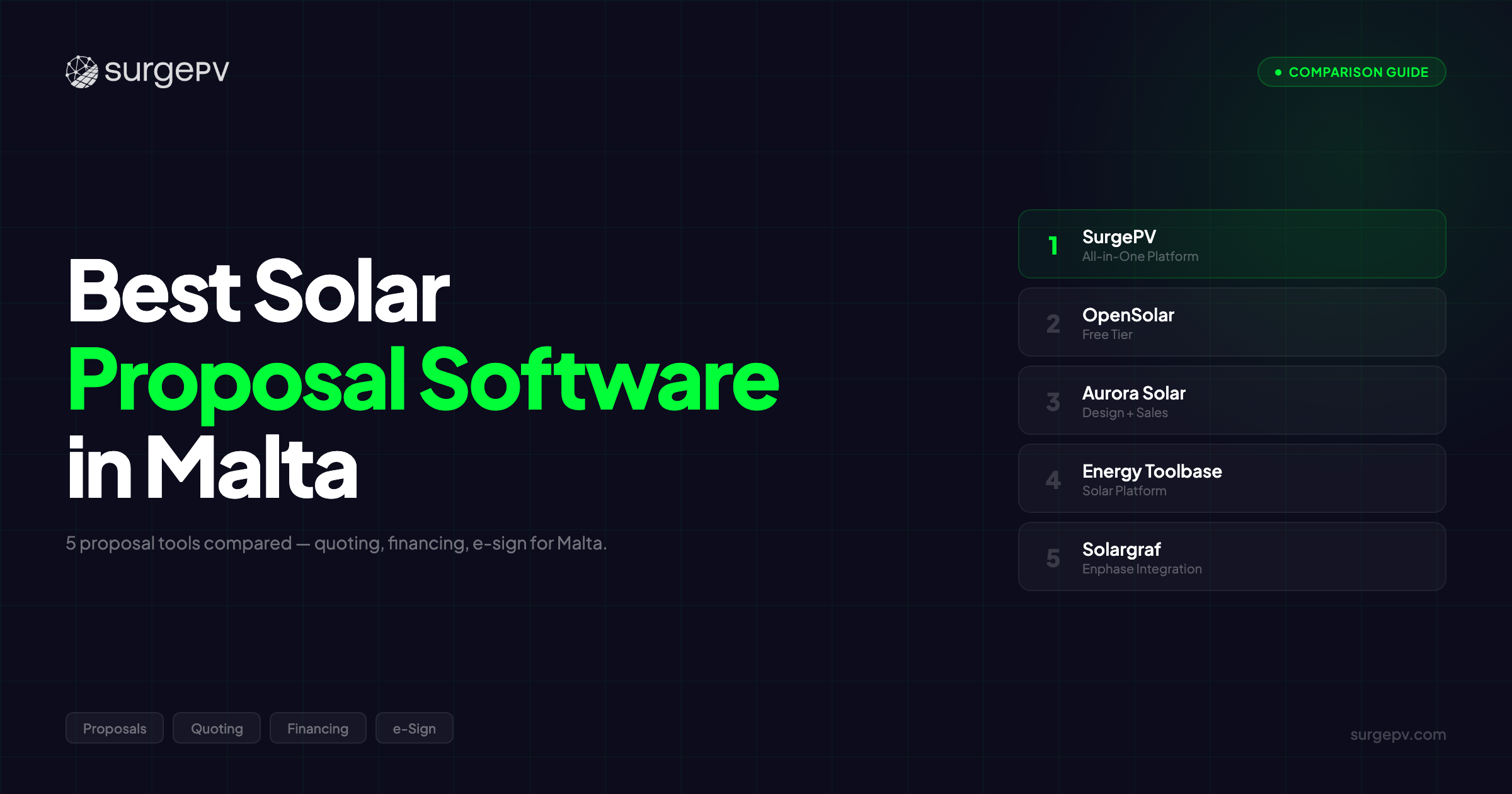
TL;DR: SurgePV is the best solar proposal software for Malta — the only platform that generates engineering-grade proposals with Enemalta net metering calculations, Mediterranean-calibrated P50/P75/P90 production data, and automated SLD generation in one workflow. OpenSolar works for budget-conscious residential startups. Aurora Solar has beautiful aesthetics at premium pricing. Energy Toolbase handles solar-plus-storage economics. Solargraf suits Enphase-focused installers doing high-volume simple quotes.
Malta gets 1,800-2,100 kWh/m2/year of solar irradiance.
But most installers cannot prove that value in their proposals.
Malta has some of the best solar conditions in Europe. At 35.9 degrees N latitude with 1,800-2,100 kWh/m2/year of direct irradiance, the island delivers 50-70% more solar production per kW installed than Germany or the UK.
That should make solar an easy sell.
But here is what actually happens in the Maltese market: installers present proposals with rough payback estimates, generic production numbers, and no credible financial analysis. The homeowner — who has already paid EUR 0.13-0.16/kWh to Enemalta and watched rates climb — asks for specifics. How does net metering affect my savings? What happens when I export more than I consume?
And the installer hands them a one-page PDF with a 6-year payback guess.
In a small island market with perhaps 40-60 active installers competing for every deal, that proposal loses to the competitor who presents bankable numbers, subsidy calculations, and a detailed self-consumption analysis the homeowner can verify.
The right solar proposal software for Malta must handle Enemalta net metering calculations, REWS regulatory requirements, feed-in tariff modeling, and accurate production estimates for Malta’s high-irradiance Mediterranean climate — all presented in a format that builds trust and closes deals.
In this guide, you’ll learn:
- Which platforms model Enemalta net metering and Malta feed-in tariffs accurately
- How each tool handles production estimates for Malta’s 1,800-2,100 kWh/m2/year irradiance
- Which proposal software produces bankable financial projections for Maltese lenders
- Our recommendation based on hands-on testing with Maltese installers
Quick Summary: Our Top Picks for Malta
After testing 5 platforms with solar sales professionals and installers in Malta, here are our top recommendations:
- SurgePV — Engineering-grade proposals with bankable financial analysis (Best for Maltese EPCs needing accurate net metering modeling and REWS-compliant documentation)
- OpenSolar — Free residential quoting with CRM (Best for budget-conscious residential-only Maltese installers)
- Aurora Solar — Visually polished proposals with strong sales workflows (Best for larger installers with premium budgets)
- Energy Toolbase — Battery storage and rate analysis (Best for solar-plus-storage projects in Malta’s self-consumption market)
- Solargraf — Fast residential quoting and permitting (Best for high-volume simple residential installations)
Best Solar Proposal Software in Malta
SurgePV — Best Complete Proposal Platform for Malta
Best For: Maltese EPCs and installers (residential and commercial)
Pricing: $1,899/year for 3 users (approximately EUR 1,750/year)
SurgePV is the only cloud-based platform that generates professional proposals directly from engineering-grade designs and bankable simulations.
For Malta’s installers, that means proposals backed by accurate Mediterranean production data, Enemalta net metering calculations, and self-consumption analysis — generated from the same platform that produced the actual system design.
In a market where limited roof space forces careful system sizing and homeowners demand detailed financial justification, SurgePV delivers the proposal depth that wins deals.
Pro Tip
In Malta’s competitive installer market, your proposal is often the only document a homeowner uses to compare quotes. Make it count. A proposal with detailed self-consumption analysis, realistic net metering credits, and monthly savings projections beats a simple payback estimate every time — even if your system price is slightly higher.
Key Features for Malta
Financial Modeling (Critical for Malta)
Malta’s solar economics revolve around self-consumption and net metering. With Enemalta electricity rates at EUR 0.13-0.16/kWh (among the lower in Europe but rising), the financial case depends on accurately modeling how much solar production the homeowner consumes directly versus exports to the grid.
SurgePV’s financial modeling engine handles Malta-specific inputs: Enemalta tariff structures, net metering credit calculations, feed-in tariff rates per current REWS schedules, self-consumption versus grid export analysis with realistic ratios (40-60% residential in Malta’s high-irradiance climate), electricity price escalation projections, and government grant integration where applicable.
Malta’s high irradiance means systems produce significantly more energy relative to consumption than in northern Europe. A 5 kW system in Malta produces approximately 8,000-9,000 kWh/year — far more than most households consume during peak production hours. Accurate self-consumption modeling is critical because most of the financial value comes from electricity you avoid purchasing, not from selling excess to the grid.
Production Accuracy for High-Irradiance Mediterranean Climate
SurgePV’s 8760-hour shading analysis and production simulation achieve plus or minus 3% accuracy compared to PVsyst, properly accounting for Malta’s temperature coefficients, soiling factors, and optimal tilt geometry. P50/P75/P90 estimates give Maltese lenders the bankability metrics they require for financed installations.
Real-World Example
A Maltese residential installer was closing only 25% of quotes because proposals showed a simple 7-year payback without breakdowns. After switching to SurgePV, proposals included monthly self-consumption analysis, Enemalta net metering credit calculations, and P50/P90 production ranges. The close rate jumped to 38% within 4 months. The installer did not lower prices — the detailed proposals simply made the investment case clearer. On 15 proposals per month, that 13-percentage-point improvement translated to approximately 2 additional deals per month.
Further Reading
Best Solar Proposal Software (2026) — Global proposal platform comparison. Best Solar Software Malta — Complete Malta software guide.
Pros and Cons
Pros:
- Only platform combining engineering-grade design with sales-quality proposals
- P50/P75/P90 financial projections calibrated for Malta’s high-irradiance climate
- Enemalta net metering and feed-in tariff integration
- Automated SLD generation (5-10 min vs 2-3 hours manual) included with proposals
- Self-consumption modeling with realistic Malta ratios
- Interactive web-based proposals with client-adjustable scenarios
- Transparent pricing: $1,899/year for 3 users (approximately EUR 1,750/year)
- 70,000+ projects powered globally with 3-minute average support response
Cons:
- Learning curve: 2-3 weeks for teams transitioning from simpler quoting tools
- Maltese language interface not available (English works for Malta’s English-speaking market)
- Premium positioning costs more than free alternatives
Pricing
| Plan | Price | Users |
|---|---|---|
| Individual | $1,899/year | 3 users |
| For 3 Users | $1,499/user/year | 3 users |
| For 5 Users | $1,299/user/year | 5 users |
| Enterprise | Custom | Multiple |
All features included on every plan. No hidden fees, no feature gating. See full pricing.
Who SurgePV Is Best For: Maltese EPCs and installers handling residential and commercial solar projects who need proposals with accurate net metering calculations and Mediterranean production data.
OpenSolar — Free Proposals, Basic Financial Modeling
OpenSolar is a cloud-based residential solar platform combining basic design, quoting, and CRM functionality. Its free pricing makes it attractive for small Maltese installers.
Key Strengths: Free platform with no subscription fees. Fast residential quoting. Built-in CRM for lead management. Customer portal with e-signature integration.
Where OpenSolar Falls Short for Malta: Basic financial modeling does not accurately handle Enemalta net metering calculations or Malta’s specific feed-in tariff structures. No P75/P90 bankable estimates. No SLD generation or wire sizing.
Best For: Budget-conscious Maltese residential-only installers doing simple rooftop projects.
Read our full OpenSolar review for detailed analysis.
Did You Know?
Malta’s solar irradiance ranges from 1,700-1,900 kWh/m²/year, making accurate simulation software essential for bankable energy yield predictions. Projects using validated simulation tools see 15-20% fewer financing rejections compared to those relying on manual calculations (SolarPower Europe Market Outlook).
Aurora Solar — Polished Proposals, US-Centric Pricing
Aurora Solar is a cloud-based platform known for visually stunning proposals and strong residential sales workflows.
Key Strengths: Industry-best proposal aesthetics. AI-powered 3D visualizations. Strong CRM integrations (Salesforce, HubSpot).
Where Aurora Falls Short for Malta: Premium pricing (approximately EUR 1,908-3,108/user/year) is challenging for Malta’s typically smaller installer businesses. Only P50 production estimates (no P75/P90). No SLD generation (needs AutoCAD at EUR 2,000/year).
Aurora makes beautiful proposals. But for most Maltese installers — operating smaller businesses in a small market — the premium pricing does not justify the incremental visual polish over more affordable alternatives that offer deeper financial modeling.
Best For: Larger Maltese installers with premium budgets who prioritize visual proposal quality over financial modeling depth.
Read our full Aurora Solar review for detailed analysis.
Energy Toolbase — Storage Economics, Niche Application
Energy Toolbase specializes in behind-the-meter energy economics, particularly solar-plus-battery storage financial modeling.
Key Strengths: Deep battery storage economic modeling. Detailed time-of-use rate analysis.
Where Energy Toolbase Falls Short for Malta: Not a full proposal platform. No design capabilities. No SLD generation. Malta’s Enemalta rate structures are not natively supported.
Best For: Maltese companies handling solar-plus-storage projects where battery economics are the primary decision factor.
Read our full Energy Toolbase review for detailed analysis.
Solargraf — Quick Residential Quoting
Solargraf (part of Enphase) provides fast residential solar quoting with automated permitting document generation.
Key Strengths: Fast residential quoting (under 30 minutes). Clean, simple interface. Integration with Enphase monitoring.
Where Solargraf Falls Short for Malta: Primarily designed for North American market. Malta’s REWS regulatory framework not natively supported. No Enemalta tariff modeling.
Best For: Maltese installers using Enphase equipment who need basic, fast quoting for standard residential projects.
Read our full Solargraf review for detailed analysis.
Further Reading
Best Solar Proposal Software (2026) — Global proposal platform comparison. Best Solar Software Malta — Complete Malta software guide.
Comparison Table: Solar Proposal Software for Malta
| Feature | SurgePV | OpenSolar | Aurora Solar | Energy Toolbase | Solargraf |
|---|---|---|---|---|---|
| Proposal Quality | Professional (engineering-grade) | Basic | Beautiful | N/A (economics only) | Simple |
| Net Metering Modeling | Enemalta integrated | Manual | Manual | Manual | No |
| Feed-in Tariff Calc | Yes | Manual | Limited | Manual | No |
| P50/P90 Bankability | Yes (±3%) | No | P50 only | No | No |
| Self-Consumption Model | Hourly (Malta-calibrated) | Basic | Basic | Detailed (storage) | Basic |
| Temperature Loss Model | Yes (Mediterranean) | Basic | Basic | N/A | Basic |
| SLD Generation | Automatic (5-10 min) | No | No | No | No |
| Pricing (per user/year) | EUR ~1,750 | Free | EUR ~1,900-3,100 | Contact | EUR ~1,200 |
| Best For | Malta EPCs + residential | Budget startups | Premium residential | Storage economics | Quick quotes |
Further Reading
For a broader comparison beyond this market, see our guide to the best solar design software globally.
What Makes Strong Proposal Software for Malta
Five factors determine whether proposal software works for Malta’s Mediterranean island market:
1. Self-Consumption Accuracy (Most Critical)
Malta’s high irradiance means solar systems produce far more energy during peak hours than most households consume. A 5 kW system generates 8,000-9,000 kWh/year, but a typical Maltese household may consume only 4,000-6,000 kWh/year.
Without storage, realistic self-consumption sits at 40-60%. Proposal software that assumes 100% self-consumption dramatically overstates savings and destroys installer credibility.
2. Enemalta Net Metering and Feed-in Tariff
Malta’s net metering scheme and feed-in tariff structure determine how exported electricity generates financial value. Proposal software must model the specific Enemalta tariff the client is on, the net metering credit calculation, and the feed-in tariff rate for excess production.
3. Temperature and Soiling Loss Modeling
Malta’s Mediterranean climate creates two production factors often underestimated by generic tools: high ambient temperatures (reducing panel output by 5-10% during summer peaks) and low rainfall (increasing soiling losses without regular cleaning).
4. Limited Roof Space Optimization
Malta’s dense urban environment — traditional townhouses, apartment blocks, and mixed-use buildings — means roof space is often limited and partially shaded. Proposal software must generate accurate designs for constrained spaces.
5. Financial Sophistication for Small Market
Malta is a small market where reputation matters enormously. One disappointed customer tells every neighbor. Proposals must deliver realistic financial projections that installers can stand behind for 25 years.
Win More Malta Solar Deals with SurgePV
Generate Malta-specific proposals with Enemalta net metering calculations, Mediterranean production accuracy, and bankable financial projections.
Book a DemoNo commitment required · 20 minutes · Live project walkthrough
| Your Use Case | Best Software | Why | Alternative |
|---|---|---|---|
| High-volume residential installer | Aurora Solar or SurgePV | Aurora: best proposals. SurgePV: proposals + engineering | Solargraf |
| C&I EPC (100+ kW) | SurgePV | Integrated design + proposals + SLDs in one tool | HelioScope + PVsyst combo |
| Storage + solar specialist | Energy Toolbase | Best financial modeling for battery + solar | SurgePV for design integration |
| Projects requiring Malta lender financing | PVsyst or SurgePV | P50/P90 bankability reports accepted by lenders | HelioScope (some lenders) |
| Startup installer (<30 projects/year) | OpenSolar or SurgePV | OpenSolar: free entry. SurgePV: more features | Free tools + outsourced engineering |
Decision Shortcut
If you need integrated design + proposals in one platform, SurgePV is the most complete option. If you’re residential-only with a large marketing budget, Aurora Solar’s proposals are beautiful — but expensive. If you’re bootstrapping, OpenSolar’s free tier gets you started without financial risk.
Bottom Line: Best Solar Proposal Software for Malta
Malta’s solar market should be one of Europe’s easiest sells. With 1,800-2,100 kWh/m2/year irradiance, solar payback periods are among the shortest on the continent.
But installers lose deals when they cannot prove the value with detailed, credible proposals.
Most Maltese installers use generic quoting tools that produce approximate payback estimates without net metering calculations, self-consumption analysis, or bankable production data. They lose deals to competitors who present specific, verifiable numbers.
With SurgePV, Maltese installers deliver proposals backed by engineering-grade designs, P50/P75/P90 production data calibrated for Mediterranean conditions, and Enemalta-specific financial analysis — all from one platform.
Our Recommendations:
- For most Maltese installers: SurgePV. Engineering-grade proposals with net metering modeling, bankable production data, and automated SLD generation at approximately EUR 1,750/year.
- For budget-conscious startups: OpenSolar. Free platform to start. Upgrade when clients demand more detailed financial analysis.
- For premium visual proposals: Aurora Solar. Beautiful aesthetics at premium pricing.
- For solar-plus-storage projects: Energy Toolbase for storage economics. Use alongside a primary proposal platform.
Book a personalized demo to see how SurgePV generates Malta-specific proposals with Enemalta net metering calculations, Mediterranean production accuracy, and bankable financial projections.
Bottom Line
For Malta EPCs and installers, SurgePV delivers the most complete design-to-proposal workflow with automated SLD generation, bankable P50/P90 simulations, and integrated proposals — all at $1,899/year for 3 users. Book a demo to see it in action.
Frequently Asked Questions
What is the best solar proposal software in Malta?
SurgePV is the best solar proposal software for Malta, combining engineering-grade designs with professional proposals that include Enemalta net metering calculations, REWS-compliant documentation, and P50/P75/P90 bankable production estimates calibrated for Malta’s high-irradiance Mediterranean climate. It is the only platform generating proposals directly from technical designs, ensuring sales numbers match engineering reality.
How should Maltese solar proposals handle net metering?
Maltese proposals should clearly model the Enemalta net metering scheme, showing clients the difference between self-consumed electricity (displacing purchases at full retail rate) and exported electricity (credited at net metering or feed-in tariff rates). SurgePV’s financial modeling handles Enemalta tariff structures automatically, while most tools require manual calculations that introduce errors.
Why is self-consumption modeling important for Malta?
Malta’s high irradiance means solar systems produce significantly more energy during peak hours than most households consume. Without battery storage, realistic self-consumption sits at 40-60% for residential systems. Proposals assuming 100% self-consumption dramatically overstate savings. SurgePV uses hourly production versus consumption matching to provide accurate self-consumption projections specific to Malta’s production profile.
Do Malta lenders accept software-generated financial projections?
Malta lenders accept financial projections that include credible production estimates with documented methodology. SurgePV provides P50/P75/P90 bankable metrics achieving plus or minus 3% accuracy compared to PVsyst. Aurora Solar provides only P50 estimates. For financed installations, conservative P75/P90 estimates from SurgePV satisfy lender risk assessment requirements.
How does Malta’s climate affect proposal accuracy?
Malta’s Mediterranean climate creates two factors generic tools often miss: high ambient temperatures reducing panel output by 5-10% during summer peaks, and low rainfall increasing soiling losses. Accurate proposals must account for these temperature coefficients and soiling factors to avoid overpredicting production. SurgePV’s simulation engine calibrates for Mediterranean conditions, preventing the 5-15% overestimation that generic northern European tools produce.
How much does solar proposal software cost in Malta?
Pricing ranges from free (OpenSolar) to approximately EUR 3,100/user/year (Aurora Solar Premium). SurgePV at approximately EUR 1,750/year (Individual plan for 3 users) includes full design, electrical engineering, simulation, and proposal generation. For a typical Maltese installer, SurgePV replaces the multi-tool workflow at a lower total cost while delivering more accurate Malta-specific financial analysis.
Can solar proposal software handle Malta’s limited roof spaces?
SurgePV’s AI-powered design accurately maps available roof area on Malta’s dense urban buildings, accounting for obstructions, setbacks, and shading from neighboring structures. The design feeds directly into proposals, so clients see exactly how many panels fit their specific roof and what realistic production to expect. Generic tools that estimate panel count based on roof area alone often overcommit on system size.
How fast can Maltese installers generate proposals?
With SurgePV, the complete design-to-proposal workflow takes 30-45 minutes for typical Maltese residential projects. Multi-tool workflows take 2-3 hours. In Malta’s competitive market where homeowners request 2-3 quotes, delivering a detailed proposal within 24 hours of a site visit gives you a significant competitive advantage over installers who take a week.
Sources
- REWS (Regulator for Energy and Water Services) — Malta solar regulatory framework, feed-in tariff rates
- Enemalta — Electricity tariff structures, net metering regulations
- Malta Energy and Water Agency — Renewable energy targets, grant programs
- SolarPower Europe — European Market Outlook 2025-2029
- IRENA — Renewable Energy Statistics 2025