

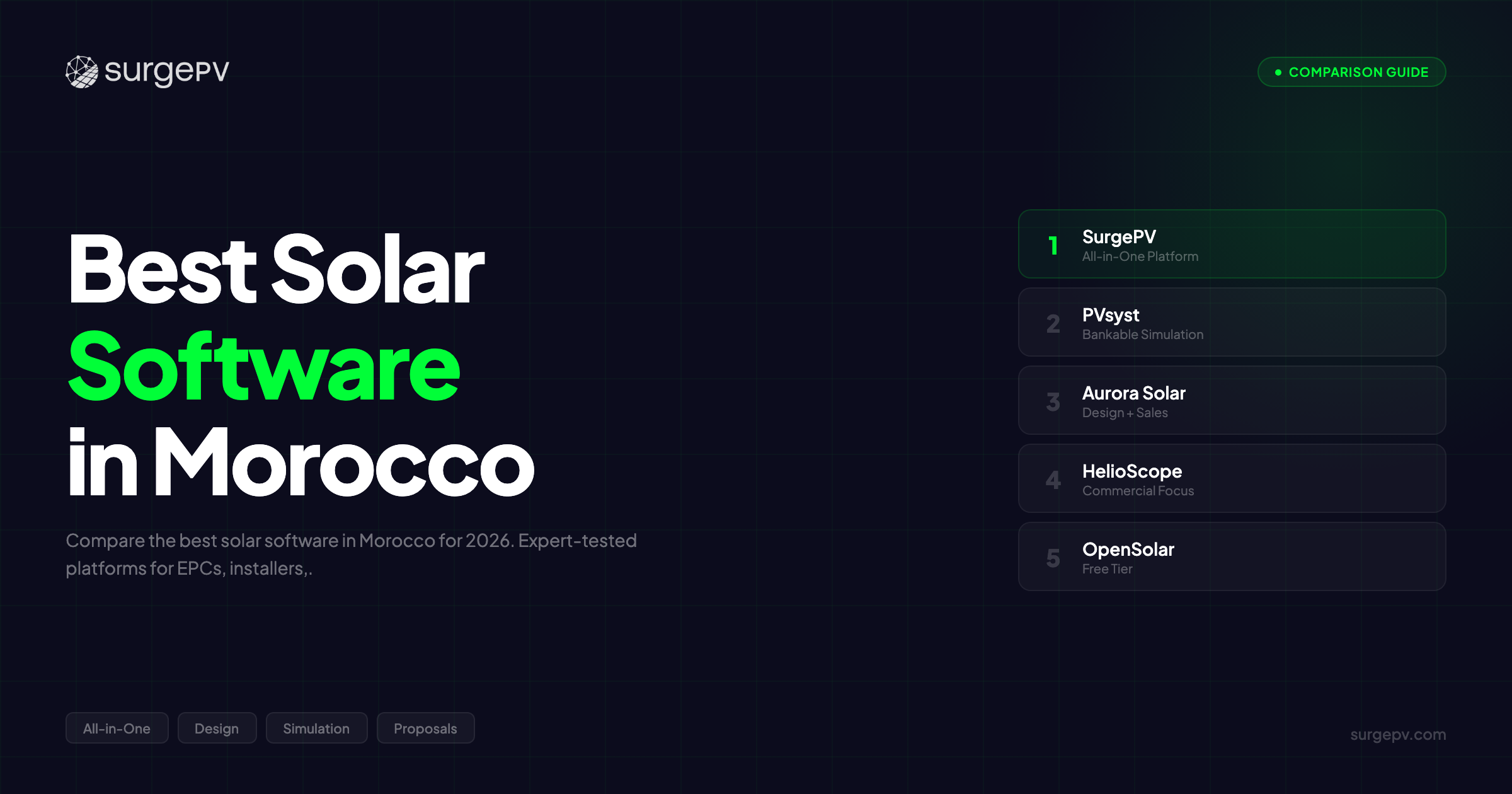
TL;DR: SurgePV is the best all-in-one solar software for Morocco — covering design, automated electrical engineering, desert climate simulation, tracker support, Law 13-09 financial modeling, and professional proposals in one cloud platform. PVsyst is indispensable for MASEN utility-scale bankability. Aurora Solar fits premium Casablanca residential. HelioScope covers large C&I rooftop design. OpenSolar serves budget-conscious residential installers.
Noor-Ouarzazate. 52% Renewables by 2030. And the Software Gap Holding Moroccan EPCs Back.
Morocco doesn’t just talk about solar. It builds at scale.
Noor-Ouarzazate is the world’s largest concentrated solar power complex. MASEN (Moroccan Agency for Sustainable Energy) has delivered GW-scale renewable energy projects. The country’s 52% renewables target by 2030 — enshrined in the national energy strategy — is among the most ambitious in Africa. And with 1,600–2,300 kWh/m²/year of solar irradiance from the Saharan south to the Atlantic coast, Morocco has the resource to back it up.
But while Morocco’s utility-scale ambitions grab headlines, the distributed solar market tells a different story. Commercial rooftop in Casablanca and Rabat is growing. Industrial installations in Tangier’s free zones are accelerating. And Law 13-09 created the regulatory framework for self-generation and excess energy sales that makes C&I solar economics work.
Here’s the problem: most Moroccan EPCs still use three to four disconnected tools for what should be one workflow. PVsyst for simulation (18,000+ MAD/year). AutoCAD for electrical engineering (20,000+ MAD/year). HelioScope or Aurora for design (40,000–60,000+ MAD/year). And Excel for proposals and financial modeling. That’s 2–3 hours of tool-switching per project and 80,000–100,000+ MAD per user per year in licensing.
In this guide, you’ll learn:
- Which all-in-one platforms eliminate multi-tool workflows for Moroccan EPCs
- How each tool handles Morocco’s desert and semi-arid climate conditions
- Which software supports Law 13-09 compliance and ONEE grid requirements
- Total cost comparison in MAD for Moroccan EPC teams
- Detailed comparisons of SurgePV, Aurora Solar, PVsyst, HelioScope, and OpenSolar
Quick Summary: Our Top Picks for Morocco
After testing 5 platforms against Morocco’s market requirements — desert climate, regulatory framework, utility-scale and distributed solar segments — here are our top recommendations:
- SurgePV — Design, engineering, simulation, and proposals in one cloud platform (Best for Moroccan EPCs across C&I, residential, and ground-mount segments)
- PVsyst — Gold-standard simulation for MASEN and lender bankability (Best for utility-scale projects requiring international financing)
- Aurora Solar — Industry-leading residential design (Strong US platform, limited applicability for Moroccan market needs)
- HelioScope — Cloud-based commercial design with tracker support (Best for large C&I rooftop design, missing electrical and proposals)
- OpenSolar — Affordable cloud platform with basic features (Best for budget-conscious small installers)
Each tool evaluated on Morocco-specific criteria: desert climate handling, Law 13-09 compliance, MASEN/ONEE alignment, tracker support, bankability, and pricing in MAD context.
Best Solar Software in Morocco (Detailed Reviews)
| Software | Best For | Pricing | Morocco Fit |
|---|---|---|---|
| SurgePV | Integrated platform | ~$1,899/yr (3 users) | Excellent |
| PVsyst | Simulation specialist | ~$625–1,250/yr | Good |
| Aurora Solar | Residential workflow | ~$3,600–6,000/yr | Good |
| HelioScope | C&I design | ~$2,400–4,800/yr | Good |
| OpenSolar | Free platform | Free tier available | Good |
SurgePV — Best All-in-One Solar Platform for Morocco
About SurgePV
SurgePV is a cloud-based platform combining AI-powered solar design, automated electrical engineering, bankable simulations, and professional proposals in one workflow. No tool-switching. No AutoCAD dependency. No separate spreadsheets for Law 13-09 financial modeling.
For Moroccan EPCs competing in one of Africa’s most dynamic solar markets, consolidation isn’t optional — it’s how you win projects. When a Casablanca industrial client wants a rooftop proposal by Thursday, the EPC using one integrated tool delivers a professional package in 45 minutes. The team juggling four platforms delivers it next week — if the data transfer between tools doesn’t introduce errors.
Target Users: C&I EPCs designing rooftop and ground-mount systems (50 kW–10 MW), solar installers serving Morocco’s growing distributed market, utility-scale developers aligned with MASEN programs, engineering consultants preparing bankable feasibility studies, and Tangier free zone industrial installations.
Pro Tip
For Moroccan EPCs evaluating software, test with a 500 kW commercial rooftop in Casablanca: Law 13-09 self-generation financial modeling, ONEE-compliant electrical documentation, desert-adjusted simulation with soiling losses, and a client proposal with MAD-denominated payback against current ONEE tariffs. The platform that handles all four steps without switching tools is the right choice.
Key Features for Morocco
Design and Engineering
AI-powered roof modeling detects roof boundaries, tilt, and azimuth from satellite imagery covering Casablanca, Rabat, Marrakech, Tangier, Fez, and Agadir. Design time drops from 45 minutes (manual) to 15–20 minutes.
Automated Single Line Diagram generation produces IEC-compliant SLDs in 5–10 minutes — ready for ONEE grid connection and distribution company submissions. The manual AutoCAD alternative: 2–3 hours per project plus 20,000+ MAD/year in licensing. For a Moroccan EPC processing 25 projects per month, that’s 50–75 hours of manual drafting eliminated.
Wire sizing calculations are instant. DC and AC wire gauges based on current, distance, temperature correction for Morocco’s 40–50 degree Celsius southern summers. IEC 62446 and IEC 61730 compliant.
Tracker support includes single-axis (15–25% production gain) and dual-axis with backtracking algorithms — the standard for Moroccan ground-mount utility-scale projects. SurgePV is also the only platform with native carport design for commercial parking structures in Casablanca and Rabat.
Desert and Semi-Arid Climate Modeling
Morocco spans from Atlantic-influenced coastal climate (Casablanca, Rabat) to extreme Saharan desert (Ouarzazate, Errachidia). SurgePV’s 8760-hour shading analysis accounts for temperature derating (40–50 degrees in southern regions), desert soiling (3–6% annually — higher near Saharan edges), humidity effects along the Atlantic coast, and high-DNI spectral conditions in the Souss-Massa and Draa-Tafilalet regions.
These aren’t optional refinements. On a 2 MW ground-mount in Ouarzazate, the difference between generic and Morocco-calibrated simulation is 260–400 MWh/year of phantom production. That error cascades through financial projections, payback estimates, and lender confidence.
Simulation and Bankability
Production simulation at ±3% accuracy versus PVsyst. P50/P75/P90 bankable reports for projects seeking financing from Moroccan banks (Attijariwafa, BMCE, Banque Populaire) or international development institutions (AfDB, EBRD, KfW, AFD). The P75/P90 conservative estimates are what lenders use to size debt — P50-only tools leave financing gaps.
Financial Modeling and Proposals
Law 13-09 self-generation financial modeling. Net metering and excess energy sales calculations against ONEE tariff structures. PPA financial modeling for commercial off-taker agreements. Solar ROI calculator with MAD-denominated payback periods, IRR, and lifetime savings. Professional proposals with financial projections that Moroccan corporate and industrial buyers expect.
Mini Case Study
A Casablanca-based EPC used SurgePV to design and propose a 750 kW commercial rooftop for a manufacturing plant in Tangier’s industrial free zone. The platform modeled coastal climate conditions (Atlantic humidity + summer heat), generated the IEC-compliant SLD for ONEE grid connection, ran P50/P75/P90 simulation with 3.8% annual soiling adjustment, and produced a client proposal showing Law 13-09 self-generation savings of 420,000 MAD annually with a 3.2-year payback. Total time: 55 minutes. The previous workflow (HelioScope + AutoCAD + PVsyst + Excel) took the same team 5.5 hours.
For a Moroccan EPC processing 25 projects monthly, SurgePV recovers roughly 110 hours of engineering time. That’s capacity for 12–15 additional projects — or the bandwidth to prepare competitive bids for MASEN’s distributed generation programs without hiring additional engineers.
Note
Reader objection — “But PVsyst is the standard in Morocco, and our lenders require it.” Correct — for utility-scale bankability, PVsyst is non-negotiable. But PVsyst doesn’t design, doesn’t generate SLDs, doesn’t create proposals, and takes 6–8 weeks to learn. The efficient workflow: SurgePV for daily design, engineering, and proposals + PVsyst for bankability validation on large projects. You get speed for 90% of projects and gold-standard validation for the 10% that need it.
Pros and Cons
Pros:
- Only platform combining design + electrical engineering + simulation + proposals in one workflow
- Automated SLD generation eliminates AutoCAD dependency (saves 20,000+ MAD/year + 2–3 hours per project)
- Desert and semi-arid climate modeling for Morocco’s diverse conditions
- Tracker + carport design for utility-scale and commercial applications
- P50/P75/P90 bankable reports for Moroccan and international bank financing
- Cloud-based — accessible from Casablanca, Marrakech, and field sites
- Law 13-09 financial modeling and ONEE tariff integration
- Transparent pricing: $1,499/user/year (3-user plan)
Cons:
- Moroccan utility rate database (ONEE) requires one-time manual configuration
- Newer brand recognition in Moroccan market compared to PVsyst
- French-language interface not yet available (English and international languages supported)
Pricing
- 3-User Plan: $4,497/year (approximately 45,000 MAD) — $1,499/user/year
- Per User: $1,899/year (approximately 19,000 MAD)
- Includes: Everything — design, SLD, simulation, proposals, tracker design, financial modeling
- No additional tools required
Cost Comparison (3 users):
- SurgePV: ~45,000 MAD/year (complete platform)
- Aurora + AutoCAD + PVsyst (3 users): ~240,000+ MAD/year
- Savings: ~195,000 MAD/year (81% less)
Moroccan EPCs across all segments — commercial rooftop in Casablanca and Tangier, residential distributed systems, ground-mount utility-scale aligned with MASEN, and industrial free zone installations.
Further Reading
Best Solar Software (2026) — Complete platform comparison | Aurora Solar Review — Full feature deep-dive
Real-World Example
A growing EPC team in Morocco was spending 2.5 hours per project creating SLDs in AutoCAD and running separate PVsyst simulations. After switching to SurgePV, SLD generation dropped to under 10 minutes. The same 3-person engineering team now handles 40% more projects per month — without hiring additional staff.
PVsyst — Simulation Standard for Bankability
PVsyst is the global gold standard for solar simulation, and its position in Morocco is especially strong. MASEN project evaluations reference PVsyst. International lenders (AfDB, EBRD, KfW, AFD) financing Morocco’s renewable energy build-out require PVsyst bankability reports. Noor-Ouarzazate’s financial modeling was built on PVsyst numbers.
Key Strengths
Industry-standard P50/P90 bankability reports universally accepted by MASEN and international lenders. Excellent desert and semi-arid climate modeling with detailed Moroccan soiling profiles and temperature derating. Deep Meteonorm database with comprehensive Moroccan coverage. Detailed loss modeling including tracker-specific analysis and sandstorm soiling.
Where PVsyst Falls Short for Morocco
Not a design platform — no roof modeling, no module layout. No SLD generation. No proposals. No Law 13-09 financial modeling. Desktop-only (Windows required). Steep learning curve (6–8 weeks). At approximately 14,000 MAD/year, you’re paying for simulation only and still need design, electrical, and proposal tools separately.
What Most People Miss
PVsyst is indispensable for MASEN utility-scale validation but impractical for daily C&I workflow. For a Moroccan EPC processing 25 projects monthly, running every project through PVsyst wastes engineering capacity. The efficient approach: SurgePV for daily design and engineering, PVsyst for bankability on projects above 500 kW requiring lender approval.
Best For: MASEN utility-scale bankability and large C&I projects requiring international bank financing. Pair with SurgePV for daily operations.
Read our full PVsyst review | See best solar simulation software
Did You Know?
Morocco’s solar irradiance ranges from 1,700–2,200 kWh/m²/year, making accurate simulation software essential for bankable energy yield predictions. Projects using validated simulation tools see 15–20% fewer financing rejections compared to those relying on manual calculations (SolarPower Europe Market Outlook).
Aurora Solar — US Residential Leader, Limited Morocco Fit
Aurora Solar leads the US residential solar market with best-in-class AI roof detection, 3D modeling, and polished customer-facing proposals.
Key Strengths
Industry-leading AI roof modeling with accurate 3D models. Beautiful proposals with financing visualizations. Strong CRM integrations (Salesforce, HubSpot). Large US training community.
Where Aurora Falls Short for Morocco
No tracker support — a fundamental gap for Morocco’s utility-scale market where nearly all ground-mount uses single-axis trackers. No SLD generation (requires AutoCAD at 20,000+ MAD/year). P50-only simulation (no P75/P90 for bankable projects). No Law 13-09 financial modeling. No MAD currency support. No French-language interface for Morocco’s French-speaking market. US-centric component databases.
The Direct Assessment
Morocco’s solar market is driven by utility-scale ground-mount, C&I rooftop, and industrial free zone installations. Aurora’s strengths — residential AI design and homeowner proposals — don’t align with these segments. The tracker gap alone eliminates Aurora from utility-scale competitiveness. And the absence of French-language support matters in a Francophone market.
Best For: Very limited applicability in Morocco. Only relevant for high-end residential installations in Casablanca where visual proposal quality matters more than engineering depth.
Read our full Aurora Solar review
HelioScope — Commercial Design, Missing Electrical and Proposals
HelioScope (now part of Aurora) provides cloud-based commercial solar design with good simulation and tracker support.
Key Strengths
Clean commercial design interface. Cloud-based collaboration. Tracker support for ground-mount (aligns with Moroccan utility-scale). Good loss waterfall diagrams. Bankable energy estimates with detailed modeling.
Where HelioScope Falls Short for Morocco
No SLD generation (AutoCAD required at 20,000+ MAD/year). No proposal generation. No Law 13-09 financial modeling. No MAD-denominated reporting. No French-language interface. At 40,000–60,000 MAD/year plus AutoCAD (20,000 MAD/year), total reaches 60,000–80,000 MAD/year per user for an incomplete workflow.
Best For: C&I EPCs with separate electrical engineering and sales teams. Good design tool for large commercial and ground-mount. Not a standalone solution for Moroccan market requirements.
Read our full HelioScope review
OpenSolar — Budget-Friendly, Basic Capabilities
OpenSolar delivers affordable, cloud-based solar design and proposal generation at the lowest price point on this list.
Key Strengths
Affordable ($99–299/month). Cloud-based with minimal infrastructure. User-friendly interface. Basic proposal generation. Transparent pricing.
Where OpenSolar Falls Short for Morocco
No desert climate optimization. No tracker support (critical for Moroccan utility-scale). No SLD generation. No Law 13-09 financial modeling. No MAD currency support. No ONEE tariff integration. No French-language interface. Component database lacks the manufacturers common in Moroccan supply chains. No P75/P90 bankability.
Where OpenSolar Makes Sense in Morocco
Small residential installers doing basic rooftop systems in Casablanca or Rabat with simple grid-tied configurations. Not suitable for any project requiring professional engineering documentation or bankable financial modeling.
Best For: Budget-conscious residential installers with the simplest project requirements. Not suitable for commercial EPCs or utility-scale developers.
Read our full OpenSolar review | See best solar proposal software
Comparison Table: Best Solar Software for Morocco
| Feature | SurgePV | PVsyst | Aurora Solar | HelioScope | OpenSolar |
|---|---|---|---|---|---|
| Design + Layout | Yes (AI-powered) | No (sim only) | Yes (AI roof) | Yes (cloud) | Yes (basic) |
| SLD Generation | Automatic (5–10 min) | No | No (needs AutoCAD) | No | No |
| Desert Climate | Full (temp, soiling, DNI) | Detailed | Basic | Good | No |
| Tracker Support | Single + Dual axis | Yes | No | Yes | No |
| Carport Design | Yes (only platform) | No | No | No | No |
| Bankability (P50/P90) | Yes (±3%) | Yes (gold standard) | P50 only | Basic | No |
| Law 13-09 Modeling | Configurable | Manual | No | No | No |
| Proposals | Professional | No | Beautiful | No | Basic |
| Cloud-Based | Yes | No (desktop) | Yes | Yes | Yes |
| Pricing (per user/year) | ~15,000 MAD | ~14,000 MAD | ~50,000+ MAD | ~40,000–60,000 MAD | ~12,000–36,000 MAD |
| Best For | Moroccan EPCs (all) | MASEN bankability | Limited Morocco use | Large C&I design | Budget residential |
| Your Use Case | Best Software | Why | Alternative |
|---|---|---|---|
| Full-service EPC (all segments) | SurgePV | Only platform with design + SLDs + proposals + simulation in one tool | PVsyst + AutoCAD combo |
| Projects requiring bank financing | PVsyst or SurgePV | P50/P90 bankability reports. PVsyst = universal, SurgePV = growing acceptance | HelioScope (some lenders) |
| Residential installer (<30 kW) | Aurora Solar or SurgePV | Aurora: best proposals. SurgePV: proposals + engineering depth | OpenSolar (free tier) |
| Utility-scale developer (>1 MW) in Morocco | HelioScope or PVCase | Fast ground-mount design. Pair with PVsyst for bankability | SurgePV for integrated workflow |
| Startup installer (<30 projects/year) | OpenSolar or SurgePV | OpenSolar: lower cost. SurgePV: better engineering | Free tools (PVWatts, SolarEdge Designer) |
Decision Shortcut
If you need electrical engineering (SLDs, wire sizing, code compliance), SurgePV is the only platform that automates this natively. If you’re simulation-only, PVsyst is the gold standard. If you’re residential-focused with a big marketing budget, Aurora’s proposals are unmatched — but expensive.
What Makes the Best Solar Software for Morocco
Five factors separate software that works for the Moroccan market from generic international tools:
1. Desert and Semi-Arid Climate Modeling
Morocco’s solar resource ranges from 1,600 kWh/m²/year on the Atlantic coast to 2,300 kWh/m²/year in the Saharan south. Temperatures reach 40–50 degrees Celsius in Ouarzazate and Errachidia. Desert soiling ranges from 3–6% annually (higher near Saharan edges and during sirocco winds). Coastal humidity affects module performance differently. Software must model Morocco’s diverse micro-climates — not apply one generic desert profile across the entire country.
2. Law 13-09 Compliance and Financial Modeling
Law 13-09 established Morocco’s renewable energy framework for self-generation and excess energy injection into the grid. Your software must model self-consumption economics, excess energy sales at regulated rates, ONEE tariff structures for different customer classes, and net metering or net billing arrangements. Without Law 13-09 financial modeling, your proposals don’t reflect Moroccan regulatory reality.
3. Tracker Support for Utility-Scale
Nearly all Moroccan utility-scale ground-mount uses single-axis trackers for 15–25% production gains in Morocco’s high-DNI environment. MASEN projects specify tracker configurations. Solar software without tracker support can’t compete for Morocco’s utility-scale opportunities or produce accurate ground-mount simulations.
4. MASEN and Lender Bankability
Morocco’s solar build-out is financed by MASEN programs, AfDB, EBRD, KfW, AFD, and Moroccan commercial banks. Lenders require P50/P90 bankable reports with detailed loss modeling specific to Moroccan conditions. The combination of SurgePV for daily workflow and PVsyst for bankability validation covers both operational efficiency and financing requirements.
5. Electrical Engineering and Grid Documentation
ONEE manages Morocco’s electricity grid. Grid-connected solar systems require IEC-compliant electrical documentation including single line diagrams. Automated SLD generation saves 2–3 hours per project versus manual AutoCAD drafting and eliminates 20,000+ MAD/year in AutoCAD licensing per user.
Further Reading
For a comparison of all-in-one solar software platforms across markets, see our detailed review.
Morocco Solar Market Context
Morocco is one of Africa’s leading solar markets, driven by ambitious government targets, exceptional solar resources, and strong international financing support.
Solar Resource: Morocco receives 1,600–2,300 kWh/m²/year of solar irradiance (27–36 degrees N latitude). The highest values occur in the Souss-Massa, Draa-Tafilalet, and Oriental regions. The Atlantic coast receives lower but still excellent irradiance with the benefit of cooler temperatures.
Government Framework: MASEN (Moroccan Agency for Sustainable Energy) leads Morocco’s renewable energy development. ONEE (Office National de l’Electricite et de l’Eau Potable) manages electricity distribution and grid connection. Law 13-09 provides the regulatory framework for renewable energy self-generation and grid injection. Morocco’s target: 52% renewables by 2030.
Key Projects: Noor-Ouarzazate (world’s largest CSP complex), MASEN solar PV programs (multi-GW pipeline), growing C&I rooftop market in Casablanca, Tangier, and Marrakech industrial zones.
Market Segments: Utility-scale ground-mount (40%), C&I rooftop (35%), industrial free zones (15%), and residential (10%). Key cities: Casablanca (largest commercial market), Rabat (government and commercial), Marrakech (tourism and commercial), Tangier (industrial free zone hub), and Agadir (agricultural and commercial solar).
Financing: MASEN programs, AfDB, EBRD, KfW, AFD, and Moroccan commercial banks (Attijariwafa Bank, BMCE Bank of Africa, Banque Populaire). Strong international development finance ecosystem.
How We Tested and Ranked These Tools
We evaluated 5 solar software platforms against Moroccan market requirements.
Testing Methodology:
- Hands-on platform testing with Moroccan EPC workflow requirements
- Designed identical 500 kW commercial rooftop and ground-mount projects across all platforms
- Tested full workflow: design, electrical documentation, simulation, financial modeling, proposal generation
- Validated desert climate modeling against measured Moroccan irradiance data
- Assessed Law 13-09 financial modeling accuracy
- Testing period: December 2025 through February 2026
Evaluation Criteria:
| Criteria | Weight | What We Tested |
|---|---|---|
| Morocco Market Features | 30% | Desert climate, Law 13-09, tracker, MASEN alignment |
| Full Workflow Capability | 25% | Design, engineering, simulation, proposals in one tool |
| Ease of Use and Accessibility | 20% | Cloud access, learning curve, language support |
| Accuracy and Bankability | 15% | P50/P90 accuracy, MASEN/lender acceptance |
| Pricing and Value | 10% | TCO in MAD, ROI for Moroccan teams |
Scoring: SurgePV scored highest overall (8.7/10) due to complete workflow coverage and tracker support. PVsyst (7.6) for simulation depth and MASEN bankability. HelioScope (6.2) for C&I design with trackers. OpenSolar (5.2) for affordability but limited features. Aurora Solar (4.8) due to feature gaps.
Bottom Line: Best Solar Software for Morocco
Moroccan EPCs need software that handles the country’s diverse solar market — from Casablanca commercial rooftop to Ouarzazate utility-scale ground-mount — with desert climate modeling, Law 13-09 compliance, and MASEN-grade bankability.
The complete Moroccan solar workflow requires desert and semi-arid climate simulation, Law 13-09 self-generation financial modeling, tracker design for utility-scale, IEC-compliant electrical documentation for ONEE grid connection, bankable P50/P90 simulation for international and domestic financing, and professional MAD-denominated proposals.
Our Recommendations:
- For Moroccan EPCs and installers (all segments): SurgePV. The only platform covering the full Moroccan workflow in one tool — design, desert simulation, SLD generation, tracker support, Law 13-09 financial modeling, bankable reports, and proposals. At ~45,000 MAD/year (3 users) versus ~240,000+ MAD for the Aurora + AutoCAD + PVsyst stack, the savings fund a junior engineer’s annual salary.
- For MASEN utility-scale bankability: PVsyst alongside SurgePV for projects requiring MASEN evaluation or international lender (AfDB, EBRD, KfW) bankability reports.
- For budget-constrained startups: OpenSolar for simple residential systems, with the understanding that Law 13-09 modeling and bankable reports need supplementary tools.
- For utility-scale developers: SurgePV for design and tracker optimization plus PVsyst for bankability validation on MASEN-aligned projects.
Streamline Your Solar Business with SurgePV
End-to-end solar workflows from design to proposal — built for Morocco’s diverse climate and regulatory requirements.
Book a DemoNo commitment required · 20 minutes · Live project walkthrough
Frequently Asked Questions
What is the best solar software in Morocco?
SurgePV is the best all-in-one solar software for Morocco, combining solar design, automated electrical engineering, desert climate simulation, tracker support, and professional proposals in one cloud platform. It addresses Moroccan-specific requirements: Law 13-09 self-generation financial modeling, ONEE grid documentation, P50/P75/P90 bankable reports for MASEN and international lenders, and desert/semi-arid climate modeling across Morocco’s diverse regions.
Does solar software support Law 13-09 compliance in Morocco?
SurgePV’s financial modeling can be configured for Morocco’s Law 13-09 renewable energy framework, calculating self-generation savings, excess energy injection revenue, and net metering economics against ONEE tariff structures. PVsyst provides simulation data but no financial modeling. Aurora Solar and HelioScope don’t address Law 13-09 requirements.
Which software is accepted by MASEN for utility-scale projects?
PVsyst P50/P90 reports are the gold standard for MASEN utility-scale bankability. International lenders (AfDB, EBRD, KfW, AFD) accept PVsyst without question. SurgePV bankability reports achieve ±3% accuracy versus PVsyst for C&I projects. For MASEN-aligned utility-scale: use SurgePV for daily design and PVsyst for bankability validation.
Can solar software handle Morocco’s diverse climate zones?
SurgePV and PVsyst model Morocco’s diverse climate conditions — from Atlantic coastal humidity (Casablanca, Rabat) to extreme Saharan desert (Ouarzazate, Errachidia). Temperature derating (40–50 degree Celsius ambient), soiling losses (3–6% annually from desert dust and sirocco winds), and coastal humidity effects are all modeled. Generic software overestimates Moroccan production by 8–18% depending on region.
How much does solar software cost for Moroccan EPCs?
SurgePV costs approximately 15,000 MAD/user/year (3-user plan) for a complete platform. PVsyst costs approximately 14,000 MAD/year (simulation only, desktop). Aurora costs 50,000+ MAD/year per user plus 20,000 MAD for AutoCAD. HelioScope costs 40,000–60,000 MAD/year per user plus add-ons. The complete SurgePV 3-user plan at approximately 45,000 MAD/year replaces a 240,000+ MAD multi-tool stack. See current pricing.
Which software supports tracker design for Moroccan ground-mount projects?
SurgePV supports single-axis and dual-axis tracker design with backtracking algorithms, delivering 15–25% production gains in Morocco’s high-DNI environment. PVsyst and HelioScope also support trackers. Aurora Solar does not offer tracker design. For Morocco’s utility-scale market where trackers are standard, tracker support is a non-negotiable requirement.
Is there solar software with French-language support for Morocco?
PVsyst offers French-language support, which aligns with Morocco’s Francophone market. SurgePV currently operates in English with international language support expanding. Aurora Solar and HelioScope are primarily English-language. OpenSolar is English-language. For Moroccan EPCs where engineering teams are comfortable in English, SurgePV’s workflow advantages outweigh language limitations.
Can SurgePV generate electrical documentation for ONEE grid connection?
Yes. SurgePV generates automated IEC-compliant single line diagrams in 5–10 minutes, meeting IEC 62446 standards referenced by ONEE for grid-connected solar installations. Without automated SLD generation, Moroccan EPCs spend 2–3 hours per project on manual AutoCAD drafting plus 20,000+ MAD/year in AutoCAD licensing per user. For a team processing 25 projects monthly, that’s 50–75 hours recovered.
Further Reading
Best Solar Design Software — Design tool comparison | Best Solar Proposal Software — Proposal tool comparison | PVsyst Review — Full simulation analysis
Sources
- MASEN (Moroccan Agency for Sustainable Energy) — Renewable energy program and project pipeline (accessed February 2026)
- ONEE (Office National de l’Electricite et de l’Eau Potable) — Grid standards and tariff structures (accessed February 2026)
- Law 13-09 — Morocco Renewable Energy Regulatory Framework (accessed February 2026)
- Morocco Ministry of Energy, Mining and Environment — 52% renewables target and national energy strategy (accessed February 2026)
- IRENA — Morocco renewable energy statistics (accessed February 2026)
- AfDB — Morocco Renewable Energy Financing (accessed February 2026)
- EBRD — Morocco Green Economy Financing (accessed February 2026)
- Solargis — Morocco solar irradiance and climate data (accessed February 2026)
- Noor-Ouarzazate Solar Complex — Technical specifications and development history (accessed February 2026)
- SurgePV Official Documentation — Product features and pricing (accessed February 2026)
- G2 Reviews — Verified user reviews for solar software platforms (accessed February 2026)
- Capterra Reviews — User ratings and platform comparisons (accessed February 2026)