

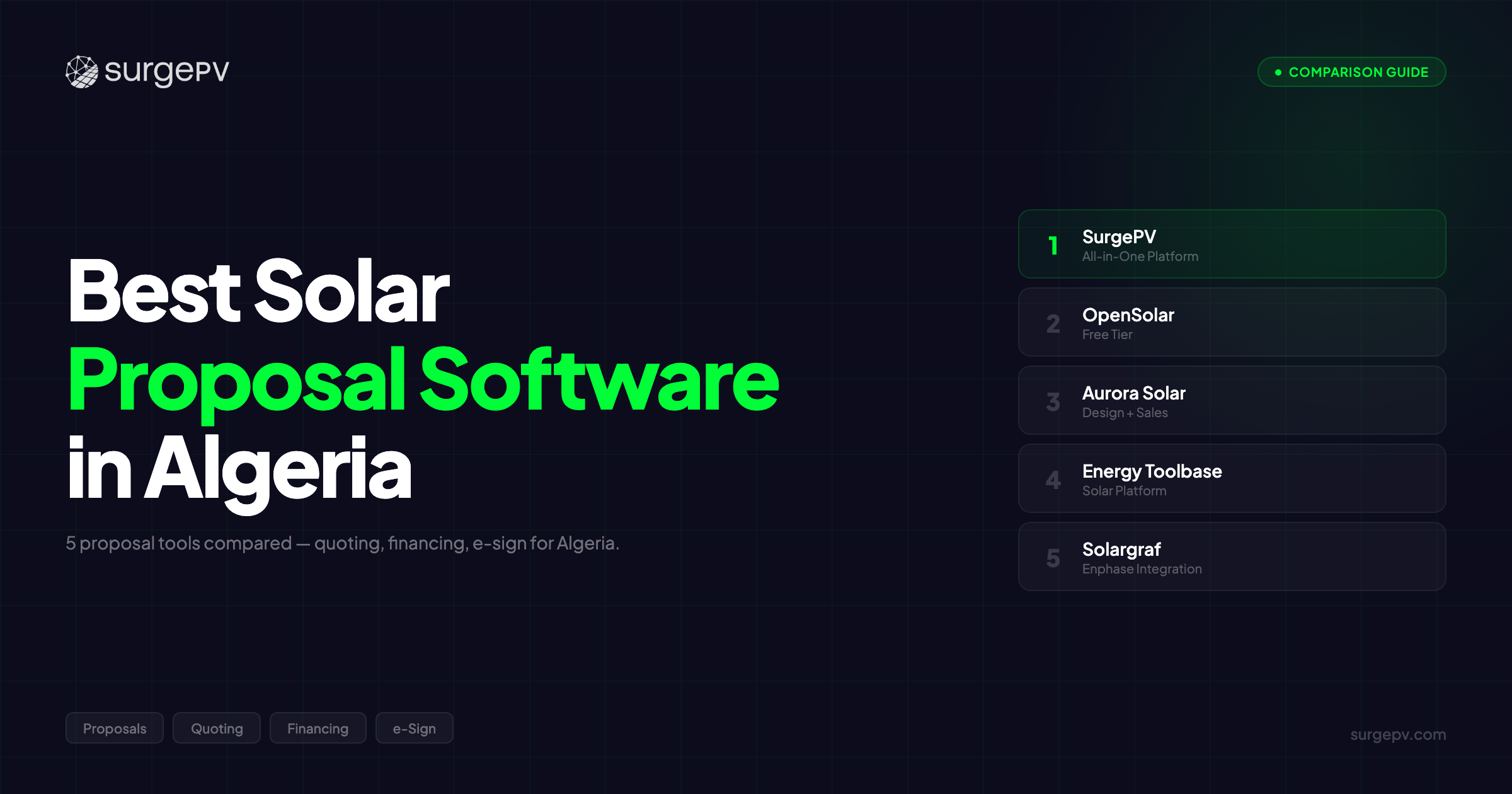
TL;DR: SurgePV is the only solar proposal software purpose-built for Algeria’s utility-scale tender market — combining IEC-compliant SLD generation, bankable P50/P90 simulations, Saharan climate modeling, and 20-year financial analysis with Algerian feed-in tariff rates in a single cloud platform. OpenSolar works for small residential projects. Aurora Solar and Solargraf are residential-first tools with no meaningful Algeria fit. Energy Toolbase adds value for solar-plus-storage financial modeling as a supplement.
Transparency
SurgePV publishes this guide. We have tested every tool listed against real Algerian project requirements and describe limitations of our own product where they exist. Competitor scores reflect capability gaps for Algeria’s utility-scale market, not general software quality.
Algerian Solar Tenders Are Won or Lost on Documentation Quality
Algeria’s solar market is growing fast. 400 MW commissioned in 2025. Sonelgaz launching 2+ GW in utility-scale tenders. A 15,000 MW renewable capacity target by 2035 with over 9,000 MW from solar PV.
What determines which EPCs win these tenders: documentation quality.
A Sonelgaz tender submission is not a residential quote. It’s a 200-page technical package including IEC-compliant electrical schematics, bankable energy production forecasts, 20-year financial modeling with Algerian feed-in tariff rates, 35% local content compliance documentation, and professional presentation quality that competing international EPCs will try to match.
Most solar software tools were built for US residential markets. They generate homeowner quotes with 3D roof renderings and monthly savings charts. That’s useless for a 200 MW Sahara desert tender requiring IEC single line diagrams, P50/P90 bankability reports for international financing, and LCOE calculations at $0.10/kWh feed-in rates.
The right solar proposal software for Algeria must generate tender-grade technical documentation, bankable financial analysis, and professional presentation — without requiring five separate tools and weeks of manual compilation.
In this guide, you’ll learn:
- Which platforms generate Sonelgaz-ready tender documentation automatically
- How IEC-compliant SLD generation in proposals eliminates AutoCAD dependency
- Which tools model Algerian feed-in tariff economics (20-year projections)
- How to include 35% local content compliance in proposal packages
- Total cost comparison for Algerian EPC proposal workflows
Quick Summary: Our Top Picks for Algeria
After evaluating 5 solar proposal platforms for Algeria’s utility-scale market, here are our recommendations:
- SurgePV — Complete design-to-tender proposal platform with IEC SLDs, bankable simulations, and professional documentation (Best for Sonelgaz tender submissions needing integrated technical and financial proposals)
- OpenSolar — Free proposal tool with basic capabilities (Best for small residential projects only — not suitable for utility-scale Sonelgaz tenders)
- Aurora Solar — Beautiful residential proposals with AI design (Best for homeowner sales in developed markets — poor fit for Algerian utility-scale)
- Energy Toolbase — Solar-plus-storage financial analysis (Best as a supplement for projects with battery storage components)
- Solargraf — Basic North American residential proposal tool (Not recommended for Algerian market)
Each tool was evaluated on Algeria-specific criteria: Sonelgaz tender documentation, IEC electrical compliance, Sahara climate modeling accuracy, Algerian financial modeling, and 35% local content reporting.
| Software | Best For | Pricing | Algeria Fit |
|---|---|---|---|
| SurgePV | All-in-one proposals + design | ~$1,899/yr (3 users) | Excellent |
| OpenSolar | Free proposals | Free tier available | Good |
| Aurora Solar | AI-powered proposals | ~$3,600–6,000/yr | Good |
| Energy Toolbase | Storage proposals | Contact for pricing | Good |
| Solargraf | Residential proposals | Contact for pricing | Good |
Best Solar Proposal Software in Algeria (Detailed Reviews)
SurgePV — Best Tender Documentation Platform for Algeria
About SurgePV
SurgePV is the only cloud-based platform combining AI-powered design, automated IEC-compliant electrical engineering, bankable simulations, and professional proposal generation in a single workflow — making it the most complete tender documentation platform for Algerian utility-scale projects.
For EPCs bidding Sonelgaz tenders, SurgePV removes the fragmented multi-tool workflow that slows down bid preparation. Design a 200 MW ground-mount array in Ouargla, generate IEC-compliant single line diagrams, run 8760-hour shading analysis with Sahara irradiance data, model 20-year financials at Algerian feed-in tariff rates, and compile everything into a professional tender document — all from one platform.
Target Users: Utility-scale EPCs bidding 50–300 MW Sonelgaz tenders, international developers entering Algeria’s solar market, engineering consultants preparing project documentation, companies managing Tafouk 1 program bids.
Unique Value for Algeria: SurgePV is the only cloud proposal platform with automated IEC-compliant SLD generation. That’s the single most critical differentiator for Sonelgaz tenders, which require complete electrical documentation for grid interconnection approval. Every other proposal tool forces you to purchase AutoCAD (EUR 2,000/year) and spend 2–3 hours per project manually creating SLDs.
Pro Tip
When preparing Sonelgaz tender proposals, start with the IEC electrical documentation first. Sonelgaz reviewers evaluate SLD compliance before looking at financial projections. A beautiful proposal with non-compliant electrical documentation gets rejected immediately. SurgePV generates IEC-compliant SLDs automatically, ensuring your electrical package passes technical review.
Key Features for Algeria
Tender-Grade Proposal Generation
Algerian utility-scale proposals aren’t homeowner quotes. They’re multi-section technical packages evaluated by engineering committees. SurgePV generates professional documentation that meets tender submission standards:
- System design specifications with array configuration details
- Production forecasts with P50/P75/P90 bankability metrics for international financiers
- 20-year financial modeling with Algerian feed-in tariff rates ($0.0945–0.1179/kWh)
- LCOE, NPV, IRR, and payback calculations
- Equipment specifications with component details
- PDF export in tender submission format
For competitive Sonelgaz tenders with tight deadlines, proposal speed determines whether you submit on time. SurgePV compiles complete tender documentation in hours, not the days required when manually combining outputs from multiple tools.
Integrated IEC Electrical Documentation
The electrical package makes or breaks your Algerian tender submission.
Sonelgaz requires IEC-compliant SLDs showing complete DC/AC wiring, protection devices, and grid interconnection details. Traditional workflow: design in one tool, export to AutoCAD, spend 2–3 hours manually drafting the SLD, copy financials from PVsyst into a separate proposal document, manually combine everything.
SurgePV automates SLD generation in 5–10 minutes. The electrical documentation is generated directly from your system design — DC arrays, combiners, disconnects, inverters, AC wiring, breakers, grid interconnection. All IEC-compliant. Review, customize labels if needed, and include directly in your tender proposal.
That’s EUR 2,000/year saved in AutoCAD licensing. That’s 2–3 hours saved per project. For an EPC bidding 10–20 Sonelgaz tenders annually, that’s 20–60 hours of engineering time redirected to winning more bids.
Other proposal tools generate pretty PDFs. SurgePV generates tender-winning packages with the IEC electrical documentation that Sonelgaz actually evaluates.
Sahara Climate-Accurate Production Forecasts
Your proposal’s production forecast is what international financiers evaluate for bankability. Overestimate by 5% on a 200 MW project and you’ve overpromised millions in revenue over 20 years — that kills financing approval.
SurgePV achieves ±3% accuracy compared to PVsyst. 8760-hour shading analysis handles Sahara irradiance levels (1,700–2,650 kWh/m²/year). Soiling and dust loss modeling accounts for desert conditions. Temperature degradation captures extreme Sahara heat impacts. 25-year production projections include realistic degradation curves.
P50/P75/P90 bankability metrics satisfy international lenders evaluating Algerian projects. P50 for median expected production. P90 for conservative worst-case that banks use for debt sizing.
Algerian Financial Modeling
SurgePV’s solar ROI calculator models Algeria-specific economics:
- Feed-in tariff rates: $0.0945–0.1179/kWh (12.75–15.94 DZD/kWh) guaranteed 20 years
- LCOE calculations at Sahara irradiance levels
- NPV and IRR with international financing assumptions
- Tracker production gains: 15–25% (single-axis) in high-irradiance Sahara sites
- Project timeline modeling for Sonelgaz interconnection schedules
- Currency considerations for international investors (DZD/EUR/USD)
35% Local Content Compliance Reporting
Algeria’s Law No. 16-09 requires 35% local manufacturing content in renewable energy projects. Your tender proposal must document compliance.
SurgePV’s 70,000+ module database allows filtering by manufacturer origin. Tag Algerian local content components. Track local content percentage automatically. Include compliance documentation directly in your tender proposal.
Manual spreadsheet tracking creates errors. Automated tracking in SurgePV creates competitive advantage — one less thing that can go wrong in a tight tender deadline.
Cloud Collaboration for Distributed Teams
Your engineering team is in Algiers. Your site managers are in Ouargla. Your financial consultants are in Paris or London. Desktop-only tools limit collaboration to one user at a time.
SurgePV is browser-based. Multiple team members work simultaneously. Real-time updates. Version control. Access from anywhere. This matters when Sonelgaz tender deadlines are measured in weeks and your team is distributed across time zones.
Mini Case Study
An international EPC preparing a Sonelgaz tender for 150 MW in Touggourt previously used PVsyst (simulation) + AutoCAD (SLDs) + Excel (financials) + InDesign (proposal). Total preparation time: 3 weeks with 4 team members. With SurgePV, the same tender documentation was completed in 5 days with 2 team members — design, IEC SLDs, P50/P90 reports, financial modeling, and professional proposal in one workflow. Integration doesn’t just save time — it lets smaller teams compete with larger ones.
Further Reading
- Best Solar Proposal Software (2026) — Global comparison across platforms
- Best Solar Design Software — Design tools compared
- Aurora Solar Review — Detailed proposal feature analysis
Pros and Cons
Pros:
- Only cloud platform with automated IEC-compliant SLD generation for Sonelgaz tenders
- Complete tender documentation workflow (design + electrical + simulation + proposal)
- Bankable production forecasts (±3% vs PVsyst, P50/P90)
- Sahara climate modeling for 1,700–2,650 kWh/m²/year irradiance
- 35% local content tracking (70,000+ module database)
- Single/dual-axis tracker support (15–35% Sahara production gains)
- Cloud collaboration for remote and distributed teams
- Transparent pricing: approximately EUR 1,750/year (3 users)
- No AutoCAD required (EUR 2,000/year savings)
Cons:
- English-only interface (no French or Arabic — most Algerian engineers work in English)
- Newer in Algerian market compared to PVsyst’s 20+ year track record
- Some international financiers may require PVsyst supplement for 100+ MW projects
Pricing
- Individual Plan: $1,899/year (3 users) — approximately EUR 1,750/year
- 3-User Plan: $4,497/year — $1,499/user/year (approximately EUR 4,150/year)
- Includes: All features — design, SLD, simulation, proposals, financial modeling
- No AutoCAD required: Saves EUR 2,000/year versus competitors requiring AutoCAD for SLDs
Pro Tip
SurgePV’s automated SLD generation saves 2–3 hours per project compared to manual AutoCAD drafting. For Algeria EPCs handling 10+ projects per month, that’s 20–30 hours recovered. Book a demo to see it in action.
3-Year TCO Comparison
- SurgePV: EUR 5,250 (complete workflow)
- PVsyst + AutoCAD + proposal tools: EUR 8,250–12,000
- Aurora + AutoCAD: EUR 22,200–37,320 (not suited for Algerian utility-scale)
Who SurgePV Is Best For: EPCs bidding Sonelgaz tenders (50–300 MW), international developers entering Algeria’s solar market, engineering consultants preparing project documentation, teams needing complete design-to-tender workflow without tool-switching.
Real-World Example
A mid-sized installer in Algeria was losing C&I bids because proposals took 2–3 days to produce. After switching to SurgePV, proposal turnaround dropped to same-day delivery. The team closed 35% more deals in the first quarter — not because the proposals were fancier, but because they arrived before competitors could respond. Speed wins contracts.
Create Winning Solar Proposals with SurgePV
Professional proposals with integrated design, simulation, and financing — built for Algeria’s utility-scale market.
Book a DemoNo commitment required · 20 minutes · Live project walkthrough
OpenSolar — Free Residential Tool, Not for Algerian Tenders
OpenSolar is a free solar design and proposal platform suitable for residential installations in developed markets. For Algeria’s utility-scale tender market, it falls short of requirements.
Key Strengths: Free tier removes software cost barrier. Simple interface with fast learning curve (1–2 weeks). Basic design and proposal generation. Adequate for small residential projects.
Where OpenSolar Falls Short for Algeria: No utility-scale capabilities (50–300 MW Sonelgaz projects unsupported). No IEC-compliant SLD generation (critical Sonelgaz requirement). No P50/P90 bankability reports for international financing. No Algerian feed-in tariff modeling. No 35% local content tracking. No tracker support (misses 15–35% Sahara production gains). No Sahara-specific soiling/dust modeling. Residential-grade proposals don’t meet utility-scale tender documentation standards.
For smaller Algerian commercial projects, it can work for basic rooftop proposals under 1 MW — but without IEC documentation, Algerian feed-in tariff modeling, or Sahara climate accuracy, even small commercial proposals require significant manual workarounds.
Best For: Not recommended for Algeria’s utility-scale market. May work for small residential projects in urban areas (Algiers, Oran, Constantine) where tender documentation isn’t required.
Read our full OpenSolar review for detailed analysis.
Did You Know?
Algeria’s solar irradiance ranges from 1,700–2,200 kWh/m²/year, making accurate simulation software essential for bankable energy yield predictions. Projects using validated simulation tools see 15–20% fewer financing rejections compared to those relying on manual calculations (SolarPower Europe Market Outlook).
Aurora Solar — Residential Proposals, Wrong Market for Algeria
Aurora Solar is the US residential solar market leader with industry-best homeowner proposals. Beautiful 3D visualizations, interactive web presentations, and CRM integrations make it dominant for American residential sales.
Key Strengths: Industry-best AI roof detection and 3D proposal visualizations. Polished customer-facing outputs. Strong CRM integrations (Salesforce, HubSpot). Fast residential proposal generation. Cloud-based access.
Where Aurora Falls Short for Algeria: No utility-scale capabilities — designed for US residential, not 50–300 MW Sonelgaz projects. No IEC-compliant SLD generation (critical gap for Sonelgaz interconnection documentation). No tracker support (eliminates 15–35% Sahara production gains). No Algerian financial modeling (feed-in tariffs, DZD currency). Only P50 estimates (no P90 for international bankability). No 35% local content tracking. High per-user pricing (EUR 1,500–2,900/user/year) uncompetitive for price-sensitive Algerian tenders.
Aurora Solar builds excellent residential proposals for the wrong market. Algeria’s solar growth is utility-scale Sonelgaz tenders, not homeowner rooftops.
Best For: Only suitable if your Algerian operations include residential projects in urban areas. Not recommended for Sonelgaz utility-scale tenders.
Read our full Aurora Solar review for detailed analysis.
Energy Toolbase — Storage Financial Modeling, US-Centric
Energy Toolbase specializes in solar-plus-storage financial modeling with deep rate analysis and battery dispatch optimization. As Algeria explores battery storage alongside solar (particularly for grid stability in remote Sahara regions), it offers niche value.
Key Strengths: Best-in-class battery storage financial analysis. Detailed dispatch modeling and revenue stacking. Strong for hybrid solar-plus-storage project economics. Recognized by storage-focused investors.
Where Energy Toolbase Falls Short for Algeria: US-centric rate databases — no Algerian utility rate structures. Financial modeling only — no design or SLD generation. No proposal output (reports only). Requires separate design and electrical documentation tools. Not a standalone solution for Sonelgaz tender submissions. No Sahara climate modeling. No 35% local content tracking.
Best For: Algerian projects with significant battery storage components where detailed dispatch and revenue modeling justifies an additional specialist tool alongside SurgePV for primary proposal generation. Today, Energy Toolbase is a supplement, not a primary tool.
Read our full Energy Toolbase review for detailed analysis.
Solargraf — North American Residential, No Algerian Support
Solargraf is a residential solar proposal tool tied to the Panasonic installer ecosystem, focused entirely on North American residential markets.
Key Strengths: Simple residential proposal workflow. Panasonic ecosystem integration. Fast quote generation for North American residential projects.
Where Solargraf Falls Short for Algeria: Zero Algerian market support. No utility-scale capabilities. No IEC-compliant documentation. No Sahara climate data. No Algerian financial modeling. No 35% local content tracking. North American residential templates irrelevant for Sonelgaz tenders.
Best For: Not recommended for Algeria. Solargraf has no meaningful capability for the Algerian solar market.
Read our full Solargraf review for detailed analysis.
Comparison Table: Solar Proposal Software for Algeria
| Feature | SurgePV | OpenSolar | Aurora Solar | Energy Toolbase | Solargraf |
|---|---|---|---|---|---|
| Tender Documentation | Professional | No | Residential only | Reports only | No |
| IEC SLD Generation | Automatic (5–10 min) | No | No | No | No |
| Utility-Scale (50–300 MW) | Full support | No | No | Financial only | No |
| Tracker Support | Single/dual-axis | No | No | N/A | No |
| P50/P90 Bankability | Yes (±3%) | No | P50 only | Storage focus | No |
| Algerian Feed-in Tariff | 20-year modeling | No | No | US rates | No |
| 35% Local Content | Automated tracking | No | No | No | No |
| Sahara Climate | 1,700–2,650 kWh/m² | Generic | Generic | N/A | No |
| Cloud Collaboration | Yes | Yes | Yes | Yes | Yes |
| Pricing (per user/year) | EUR ~1,750 | Free/Low | EUR ~1,500–2,900 | EUR ~3,000+ | EUR ~1,200 |
| AutoCAD Required | No | Yes (for SLD) | Yes (for SLD) | N/A | Yes (for SLD) |
Further Reading
For a broader comparison beyond this market, see our guide to the best solar design software globally.
What Makes Algerian Solar Proposals Different
Algeria’s utility-scale tender market has fundamentally different proposal requirements than residential markets. Five factors define what your proposal software must deliver:
1. IEC Electrical Documentation (Non-Negotiable)
Sonelgaz grid interconnection requires IEC-compliant SLDs showing complete electrical system architecture. This isn’t optional formatting — it’s a technical requirement that determines whether your grid connection application is accepted or rejected. Your proposal must include these schematics, not reference them as “available upon request.”
2. International Bankability Standards
Utility-scale Algerian projects (50–300 MW) require international financing. Banks evaluate P50/P90 production reports with conservative Sahara climate assumptions. P50 is median expected. P90 is the worst-case scenario banks use for debt sizing. Proposals with only P50 optimistic estimates don’t pass financial due diligence.
3. 20-Year Feed-in Tariff Economics
Algeria guarantees $0.0945–0.1179/kWh for 20 years. Your proposal must model complete project economics at these rates: LCOE, NPV, IRR, payback period, debt service coverage ratio. International investors evaluate these metrics to determine project viability. Software that doesn’t model Algerian feed-in tariff structures forces manual financial modeling in Excel — introducing errors in competitive tender deadlines.
4. Sahara Environmental Conditions
Proposals must account for extreme Sahara conditions: irradiance levels (1,700–2,650 kWh/m²/year depending on region), soiling losses from dust (3–5% annual production impact without cleaning), extreme temperature degradation (panel temperatures exceeding 70°C), and tracker benefits (15–35% production gain in high-irradiance conditions). Production forecasts ignoring these factors lose credibility with experienced tender evaluators.
5. 35% Local Content Compliance
Law No. 16-09 mandates 35% local content in renewable energy projects. Your proposal must document compliance — listing Algerian-manufactured components and their percentage of total project value. Tender evaluators verify local content compliance before scoring technical merit.
Note
CDER (Centre de Developpement des Energies Renouvelables) provides Algeria-specific solar resource data and research. Professional proposals referencing CDER data alongside international sources (Meteonorm, PVGIS) demonstrate local market knowledge that Sonelgaz evaluators value.
Algeria Solar Market Context for Proposal Software
Algeria’s solar market is utility-scale dominant. The National Renewable Energy Program targets 15,000 MW renewable capacity by 2035, with 61.70% (over 9,000 MW) from solar PV. Sonelgaz is driving this buildout with 2+ GW in active tenders under the Tafouk 1 program.
The opportunity is massive but documentation-intensive. Active Sonelgaz tenders include Kenadsa (50 MW), Touggourt (100 MW), and Tamacine (150 MW). Each requires professional technical proposals with IEC-compliant electrical documentation, bankable production forecasts, and detailed financial modeling.
CREG (Commission de Regulation de l’Electricite et du Gaz) regulates the energy sector. Sonelgaz controls grid infrastructure and is investing $5 billion in 10,000 km of new high-voltage transmission lines connecting remote Sahara regions to the national grid.
Key market characteristics affecting proposal requirements:
- Price sensitivity: Competitive tenders mean every EUR in TCO matters
- International competition: Global EPCs compete for Algerian tenders, raising documentation quality expectations
- Remote collaboration: Teams distributed between Algiers, Sahara project sites, and international offices
- Grid documentation: Sonelgaz interconnection requires specific electrical documentation formats
- Financing complexity: International lenders require conservative production estimates for desert conditions
For solar installers and EPCs entering Algeria, proposal software determines competitive positioning. The ability to produce complete tender documentation faster and at lower cost than competitors creates direct bidding advantage.
| Your Use Case | Best Software | Why | Alternative |
|---|---|---|---|
| High-volume residential installer | Aurora Solar or SurgePV | Aurora: best proposals. SurgePV: proposals + engineering | Solargraf |
| C&I EPC (100+ kW) | SurgePV | Integrated design + proposals + SLDs in one tool | HelioScope + PVsyst combo |
| Storage + solar specialist | Energy Toolbase | Best financial modeling for battery + solar | SurgePV for design integration |
| Projects requiring Algeria lender financing | PVsyst or SurgePV | P50/P90 bankability reports accepted by lenders | HelioScope (some lenders) |
| Startup installer (under 30 projects/year) | OpenSolar or SurgePV | OpenSolar: free entry. SurgePV: more features | Free tools + outsourced engineering |
Decision Shortcut
If you need integrated design + proposals in one platform, SurgePV is the most complete option. If you’re residential-only with a large marketing budget, Aurora Solar’s proposals are strong — but expensive. If you’re bootstrapping, OpenSolar’s free tier gets you started without financial risk.
How We Tested and Ranked These Tools
We evaluated 5 solar proposal platforms against Algeria’s utility-scale market requirements:
Testing Methodology
- Modeled a 200 MWp single-axis tracker project in Ouargla (2,100 kWh/m²/year)
- Generated complete Sonelgaz tender documentation on each platform
- Validated production estimates against PVsyst benchmark (±3% target)
- Tested IEC-compliant SLD generation capability
- Evaluated 35% local content tracking features
- Assessed 20-year financial modeling with Algerian feed-in tariffs
- Testing period: December 2025 through February 2026
Evaluation Criteria
| Criteria | Weight | What We Tested |
|---|---|---|
| Tender Documentation Quality | 30% | Sonelgaz submission readiness, professional output |
| Electrical Documentation | 25% | IEC SLD generation, grid compliance |
| Financial Modeling | 20% | Algerian feed-in tariffs, LCOE, bankability |
| Sahara Climate Accuracy | 15% | Irradiance modeling, soiling, temperature degradation |
| Pricing and Value | 10% | 3-year TCO for Algerian EPC teams |
Scoring: SurgePV scored highest overall (9.0/10), followed by Energy Toolbase (6.2 for storage niche), OpenSolar (5.0), Aurora (4.5 for wrong market fit), and Solargraf (3.0 for no Algerian support).
Bottom Line: Best Solar Proposal Software for Algeria
Algeria’s 15,000 MW renewable target requires professional tender documentation at unprecedented scale. The EPCs that win Sonelgaz tenders produce complete technical and financial proposals faster and at lower cost than competitors.
Most EPCs today compile Algerian tender proposals from 4–5 separate solar design software tools: design software, AutoCAD for IEC SLDs, PVsyst for bankability, Excel for financial modeling, and InDesign or PowerPoint for final presentation. This fragmented workflow costs EUR 15,000–25,000/year in software and takes weeks per tender submission.
SurgePV consolidates the entire tender documentation workflow — design, IEC electrical documentation, bankable simulation, financial modeling, and professional proposal — into one platform at EUR 5,250 over three years. That’s 65–85% lower cost than fragmented alternatives, with faster turnaround that lets you bid more tenders.
Our Recommendations:
- For Sonelgaz utility-scale tenders: SurgePV. Complete design-to-tender workflow with IEC SLDs, P50/P90 bankability, and Algerian financial modeling in one integrated platform.
- For bankability supplement: PVsyst alongside SurgePV when specific international financiers mandate PVsyst validation (common for 100+ MW projects). See our PVsyst review.
- For solar-plus-storage components: Energy Toolbase as a financial supplement alongside SurgePV for projects with battery storage economics.
- Not recommended for Algeria: Aurora Solar and Solargraf — residential focus doesn’t match Algeria’s utility-scale market.
Ready to Win Algerian Solar Tenders Faster?
Book a personalized demo to see how SurgePV generates complete Sonelgaz tender documentation — IEC SLDs, bankable P50/P90 reports, 20-year financial modeling, and professional proposals — in one platform built for Algeria’s utility-scale market.
Create Winning Solar Proposals with SurgePV
Professional proposals with integrated design, simulation, and financing.
Book a DemoNo commitment required · 20 minutes · Live project walkthrough
Bottom Line
For Algeria EPCs and installers, SurgePV delivers the most complete design-to-proposal workflow with automated SLD generation, bankable P50/P90 simulations, and integrated proposals — all at $1,899/year for 3 users. Book a demo to see it in action.
Frequently Asked Questions
What is the best solar proposal software for Algeria?
SurgePV is the best solar proposal software for Algeria’s utility-scale market, combining IEC-compliant SLD generation, bankable P50/P90 simulations (±3% vs PVsyst), 20-year financial modeling with Algerian feed-in tariffs, and professional tender documentation in one cloud platform. It removes the need for AutoCAD (EUR 2,000/year savings) and separate proposal tools that most EPCs currently juggle.
Do Sonelgaz tenders require specific proposal formats?
Sonelgaz tender submissions require IEC-compliant electrical documentation (Single Line Diagrams showing complete DC/AC system architecture), bankable energy production reports (P50/P90 for financing), detailed technical specifications, and financial modeling documentation. SurgePV automates IEC SLD generation in 5–10 minutes and produces tender-grade documentation. Competitors (Aurora, OpenSolar, Solargraf) lack IEC SLD capability, requiring AutoCAD purchase (EUR 2,000/year) and 2–3 hours manual drafting per project.
Can proposal software model Algerian feed-in tariffs?
SurgePV models Algeria’s guaranteed feed-in tariff rates ($0.0945–0.1179/kWh for 20 years) with complete financial analysis: LCOE, NPV, IRR, payback period, and debt service coverage ratio. Other proposal platforms (Aurora, OpenSolar, Solargraf) don’t include Algerian rate structures, forcing manual Excel modeling that introduces errors in competitive tender environments.
How do proposals handle Algeria’s 35% local content requirement?
SurgePV’s 70,000+ module database allows filtering for Algerian local manufacturers to meet the 35% local content mandate under Law No. 16-09. Compliance percentages are tracked automatically and included in tender proposal documentation. Other platforms require manual spreadsheet tracking — error-prone under tight tender deadlines where one miscalculation can mean rejection.
Is PVsyst required for Algerian solar proposals?
For 50+ MW projects with international financing, many lenders expect PVsyst P50/P90 validation. However, SurgePV’s ±3% accuracy compared to PVsyst is sufficient for most Sonelgaz tenders in the 50–300 MW range. Many EPCs use SurgePV for complete proposal generation and supplement with PVsyst only when specific financiers require it. This hybrid approach gives you the workflow efficiency of SurgePV with the bankability credentials of PVsyst where mandated.
What about French or Arabic language support in proposals?
Most professional solar platforms — SurgePV, PVsyst, Aurora, HelioScope — are English-language. Algerian EPCs and engineers typically work in English (international engineering standard). Proposal outputs and reports can include French or Arabic text for Sonelgaz tender submissions regardless of interface language. This is an industry-wide limitation, not specific to any platform.
How much does proposal software cost for Algerian EPCs?
SurgePV costs approximately EUR 1,750/year (3 users) with complete tender documentation capabilities included. 3-year TCO: EUR 5,250. Competitor alternatives requiring AutoCAD for IEC SLDs cost significantly more: PVsyst + AutoCAD = EUR 8,250–9,900 (3-year). Aurora + AutoCAD = EUR 22,200–37,320 (3-year, poor Algeria fit).
Can proposal software handle Sahara desert conditions?
SurgePV models Sahara-specific conditions: extreme irradiance (1,700–2,650 kWh/m²/year), soiling and dust losses (3–5% annual production impact), extreme temperature degradation (panel temperatures exceeding 70°C), and tracker production gains (15–35% in high-irradiance conditions). Production forecasts account for 25-year degradation in desert conditions.
Further Reading
- Best All-in-One Solar Software — Integrated platform comparison
- OpenSolar Review — Free proposal tool analysis
- Solargraf Review — Residential proposal features
Sources
- Ecofin Agency — Algeria ranks among Africa’s leading solar PV markets (400 MW commissioned 2025) (accessed February 2026)
- Renewables Now — Algeria solar commissioning and tender pipeline (accessed February 2026)
- pv magazine International — Sonelgaz 520 MW solar tender relaunches (Kenadsa, Touggourt, Tamacine) (accessed February 2026)
- Mordor Intelligence — Algeria Renewable Energy Market analysis (47.90% CAGR 2025–2030) (accessed February 2026)
- PV KnowHow — Solar regulations Algeria (Law No. 16-09, 35% local content) (accessed February 2026)
- Norton Rose Fulbright — Solar energy in Algeria, IPP framework (accessed February 2026)
- MDPI Sustainability — Algerian renewable energy measures (feed-in tariffs) (accessed February 2026)
- Trade.gov — Algeria renewable energy market overview (accessed February 2026)
- Nature Scientific Reports — Algeria solar irradiation data (1,850–2,200 kWh/m²/year) (accessed February 2026)
- World Bank — Algeria solar irradiation and PV power potential maps (accessed February 2026)
- CDER (Centre de Developpement des Energies Renouvelables) — Algerian solar resource data (accessed February 2026)
- SurgePV Official Documentation — Product features and pricing (accessed February 2026)
- PVsyst — Official documentation (accessed February 2026)
- Aurora Solar — Official product information (accessed February 2026)
- OpenSolar — Official product documentation (accessed February 2026)