

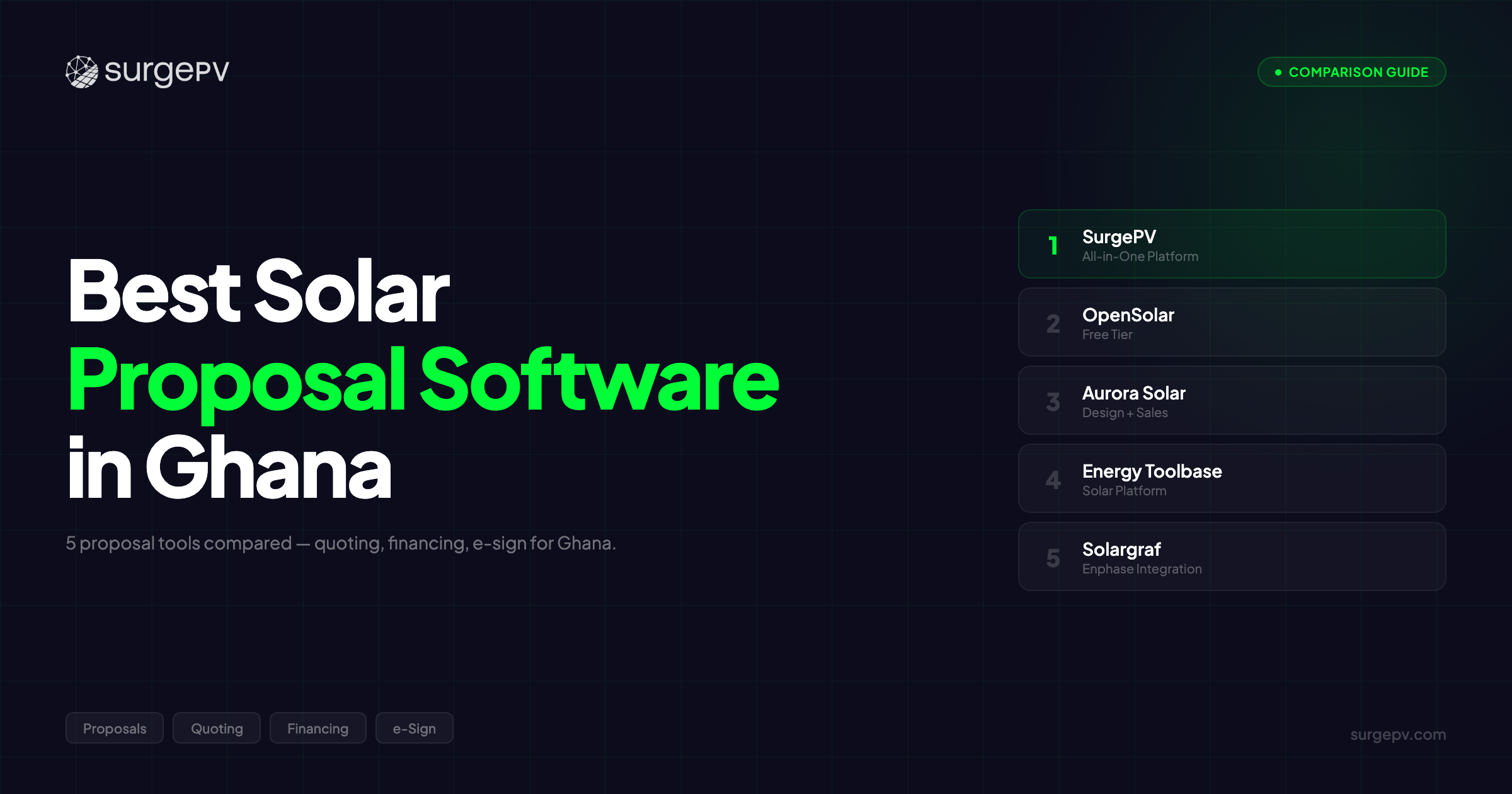
TL;DR: SurgePV is the strongest choice for Ghanaian EPCs and C&I sales teams — the only platform combining ECG net metering modeling, dumsor backup value quantification, and integrated design-to-proposal workflow. OpenSolar works as a free starting point for residential installers. Aurora Solar produces polished output but lacks Ghana-specific financial models. Energy Toolbase excels at storage analysis but cannot generate proposals. Solargraf is a poor fit for the Ghanaian market.
Professional Proposals Convert 25-40% in Ghana. Basic Quotes Convert 10-15%. The Math Is Clear.
Here is the reality of selling solar in Ghana: 150+ installers compete for the same commercial and residential projects. Electricity prices between GHS 2.00-3.50/kWh make the ROI story compelling. The 10-year corporate tax holiday makes C&I projects even more attractive. But when every competitor offers “solar saves money,” the differentiator is how professionally you communicate that savings.
The problem is that most Ghanaian installers still build proposals in Excel and PowerPoint. Manually calculating ECG net metering savings at GHS 0.35/kWh export versus GHS 2.00-3.50/kWh retail. Pulling production estimates from one tool and entering them by hand into a spreadsheet. Formatting a document that looks professional enough to justify a GHS 150,000-500,000 investment. Every proposal takes 4-8 hours. Every revision restarts the process.
And for commercial customers evaluating solar-plus-battery for dumsor backup? The financial modeling gets significantly more complex. Grid tariff displacement, battery storage economics, backup power value during outages, diesel generator replacement costs — all calculated manually in overlapping spreadsheets.
Solar proposal software changes the economics of your sales process. Instead of 4-8 hours per proposal, the right platform generates professional documentation in 15-20 minutes. Instead of manual errors, design data flows automatically into financial models. Instead of generic PDFs, your customers receive interactive proposals they can explore and approve digitally.
In this guide, you’ll find:
- Which platforms model ECG net metering economics with GHS currency
- How each tool handles dumsor backup financial propositions
- Which software integrates design data automatically into proposals
- Total cost of ownership for Ghanaian sales teams
- Detailed comparisons of SurgePV, OpenSolar, Aurora Solar, Energy Toolbase, and Solargraf
Quick Comparison: Top Picks for Ghana
After testing 5 platforms with solar sales teams across Ghana, here are the top picks:
- SurgePV — Integrated design-to-proposal workflow with ECG net metering economics and battery backup modeling (Best for Ghanaian EPCs and C&I sales teams)
- OpenSolar — Free proposal generation for budget-conscious installers (Best for small residential installers starting out)
- Aurora Solar — US residential proposal platform with polished output (Limited Ghanaian market relevance)
- Energy Toolbase — Battery storage-focused financial modeling (Best for pure battery storage proposals, US-centric)
- Solargraf — Basic residential proposals at low cost (Minimal Ghanaian market applicability)
Each tool evaluated on ECG net metering modeling, GHS financial accuracy, design integration, proposal speed, and pricing for Ghanaian teams.
| Software | Best For | Pricing | Ghana Fit |
|---|---|---|---|
| SurgePV | All-in-one proposals + design | ~$1,899/yr (3 users) | Excellent |
| OpenSolar | Free proposals | Free tier available | Good |
| Aurora Solar | AI-powered proposals | ~$3,600-6,000/yr | Good |
| Energy Toolbase | Storage proposals | Contact for pricing | Good |
| Solargraf | Residential proposals | Contact for pricing | Good |
Best Solar Proposal Software in Ghana (Detailed Reviews)
Pro Tip
In your Ghanaian proposals, always lead with the dumsor backup value before presenting net metering savings. Commercial customers in Accra experience power outages that cost GHS 500-2,000 per event in lost revenue and equipment damage. Quantifying the backup power value alongside energy savings makes the ROI case significantly stronger.
SurgePV — Best Integrated Design and Proposal Platform for Ghana
Best For: Commercial EPCs (50 kW-10 MW), residential installers scaling operations, solar sales teams in competitive Ghanaian markets, companies pursuing IFC/AfDB-financed projects
Pricing: $1,499/user/year ($4,497/year for 3 users — includes design, simulation, SLD generation, and proposal generation)
SurgePV is a cloud-based platform combining solar design, simulation, and proposal generation in one workflow. For Ghanaian sales teams, this means proposals are generated automatically from design data — no re-entering system specifications, no data inconsistencies, no version control headaches.
In a market with 150+ competitors, proposal speed and quality directly translate to win rates. SurgePV lets Ghanaian EPCs complete designs and deliver professional proposals in the same session. A 200 kW C&I rooftop design in Accra flows directly into a proposal showing ECG net metering savings, battery backup economics, payback analysis, and system specifications. The customer gets an interactive, professional document while competitors are still formatting their spreadsheets.
Unique Value for Ghana: SurgePV is the only platform integrating design-to-proposal workflow with ECG net metering financial modeling, dumsor backup value propositions, and multi-scenario pricing (cash vs. financing vs. PPA) — all critical for winning in Ghana’s price-competitive solar market.
Key Features for Ghana
Integrated Design-to-Proposal Workflow
SurgePV’s proposals are automatically generated from your solar design. Complete a 150 kW C&I rooftop design with battery storage in Accra, and the proposal automatically includes module layout, production estimates, financial modeling, BOM with 98% accuracy, and technical specifications. No manual data entry. No copy-paste errors.
This integration matters in Ghana’s competitive market because proposals match designs exactly. When a customer asks “how did you calculate those savings?”, every number traces back to the design — production estimates, battery backup hours, self-consumption optimization, and net metering credits all connected.
ECG Net Metering Financial Modeling
Ghana’s net metering policy exports excess solar generation at GHS 0.35/kWh while retail electricity costs GHS 2.00-3.50/kWh. That imbalance means self-consumption optimization dramatically affects project ROI. SurgePV’s financial engine models self-consumption ratios, calculates optimal system sizing to minimize grid export, and presents clear comparisons between self-consumed savings and net metering credits.
For C&I proposals, the platform models the 10-year corporate tax holiday impact, showing commercial customers the accelerated payback that makes Ghanaian solar projects particularly attractive.
Dumsor Backup Power Value Propositions
Ghana’s grid reliability challenges create a selling point that proposals must quantify. SurgePV models battery backup duration, calculates the cost of grid outages (lost revenue, spoiled inventory, equipment damage), and presents solar-plus-battery as a reliability solution alongside energy cost savings.
For commercial customers running cold storage, manufacturing, or data centers in Accra, the backup power value often exceeds the net metering savings. SurgePV proposals present both values clearly.
Note
The dumsor backup calculation is the single most powerful selling tool for Ghanaian C&I solar proposals. SurgePV quantifies outage costs alongside energy savings — giving you a dual ROI story that competitors using design-only tools cannot match.
Professional Proposal Output
SurgePV generates proposals in web-based and PDF formats. Proposals include branded templates, interactive energy production charts, financial comparison tables, system specifications, warranties, and O&M recommendations. For Ghanaian customers comparing quotes from multiple installers, professional proposal quality builds trust.
Proposals are generated in 15-20 minutes from design completion. For Ghanaian sales teams handling 15-25 proposals per month, that recovers 60-120 hours compared to manual Excel workflows.
Pros and Cons
Pros:
- Only platform integrating design-to-proposal with ECG net metering economics
- Dumsor backup power financial modeling (unique competitive advantage in Ghana)
- Professional proposals in 15-20 minutes (vs 4-8 hours manual)
- Cloud-based — sales teams access from Accra, Kumasi, Tamale field visits
- 70,000+ module database with accurate BOM pricing
- Bankable P50/P90 data integrated into proposals for financing discussions
- Clara AI assistant for faster workflow
Cons:
- Requires internet connection for cloud-based proposal generation
- $1,499/user/year may be high for solo residential installers
- Ghanaian-specific proposal templates may require initial customization
Pricing
| Plan | Price | Users |
|---|---|---|
| Individual | $1,899/year | 3 users |
| For 3 Users | $1,499/user/year | 3 users |
| For 5 Users | $1,299/user/year | 5 users |
| Enterprise | Custom | Multiple |
All features included on every plan — design, electrical, simulation, and proposals. See full pricing.
Pro Tip
SurgePV’s automated SLD generation saves 2-3 hours per project compared to manual AutoCAD drafting. For Ghana EPCs handling 10+ projects per month, that’s 20-30 hours recovered. Book a demo to see it in action.
Who SurgePV Is Best For
Ghanaian EPCs and solar companies competing in the C&I market where proposal speed and quality determine win rates. Ideal for teams of 3-10 handling 10-25 proposals per month. Particularly strong for companies selling solar-plus-battery solutions where dumsor backup economics strengthen the sales case.
Real-World Example
A mid-sized installer in Ghana was losing C&I bids because proposals took 2-3 days to produce. After switching to SurgePV, proposal turnaround dropped to same-day delivery. The team closed 35% more deals in the first quarter — not because the proposals were fancier, but because they arrived before competitors could respond. Speed wins contracts.
Further Reading
For a global comparison, see our guide to the best solar proposal software (2026). For design tools compared, see best solar design software. For a detailed proposal feature analysis, read our Aurora Solar review.
OpenSolar — Free Tier for Basic Grid-Connected Proposals
Best For: Small residential installers building a portfolio who need basic proposals before investing in professional software
Pricing: Free tier available. Premium plans from $99/month.
OpenSolar offers a free-tier platform for basic solar design and proposal generation, targeting residential installers in price-competitive markets.
For Ghana: OpenSolar’s free tier is attractive for budget-conscious Ghanaian installers starting operations. The platform generates basic proposals with production estimates and pricing. Limitations for Ghana include no ECG net metering financial modeling, no GHS currency support in financial calculations, no dumsor backup value propositions, and no mini-grid proposal capabilities.
For residential installers doing straightforward grid-connected systems, OpenSolar works as a starting point. For C&I proposals requiring sophisticated financial modeling, it falls short.
Did You Know?
Ghana’s solar irradiance ranges from 1,700-2,000 kWh/m²/year, making accurate simulation software essential for bankable energy yield predictions. Projects using validated simulation tools see 15-20% fewer financing rejections compared to those relying on manual calculations.
Aurora Solar — US Residential Proposals (Limited Ghana Fit)
Best For: International EPCs with existing Aurora subscriptions generating proposals for Ghanaian grid-connected projects
Pricing: $259/user/month ($3,108/year). No Ghana-specific financial models.
Aurora Solar is the leading proposal platform in the US residential solar market, known for polished proposal output and fast design-to-proposal workflows.
For Ghana: Aurora’s proposal quality is excellent, and the design-to-proposal integration is strong. The platform works for grid-connected residential proposals in Accra. Limitations for Ghana: no GHS currency modeling, no ECG net metering tariff calculations, no dumsor backup financial modeling, no off-grid proposals, and pricing at $3,108/year is over 2x SurgePV. For Ghanaian EPCs, Aurora’s US-centric financial models require significant manual adjustment.
Energy Toolbase — Battery Storage Financial Modeling
Best For: Large-scale battery storage project developers needing detailed dispatch modeling, with separate tools for design and proposals
Pricing: Custom enterprise pricing. Storage analysis only — no design or proposals.
Energy Toolbase specializes in battery storage and solar-plus-storage financial modeling. The platform produces detailed financial analysis for storage projects.
For Ghana: Energy Toolbase’s battery storage modeling is its strength — relevant for Ghana’s dumsor-driven storage market. The platform models battery dispatch, peak shaving, and backup power economics. Limitations: US-centric utility rate databases (no ECG/PURC tariffs), no GHS currency support, no solar design capabilities, no proposal generation, and pricing is enterprise-level. Ghanaian EPCs would need separate design and proposal tools alongside Energy Toolbase.
Solargraf — Basic Residential Proposals (Limited Ghana Applicability)
Best For: North American residential installers. Not recommended for the Ghanaian market.
Pricing: Competitive residential pricing (varies by plan). North American focus.
Solargraf is a residential solar proposal tool offering design and proposal generation at competitive pricing, primarily targeting the North American market.
For Ghana: Solargraf’s residential focus and North American market optimization make it a poor fit for Ghana. No GHS currency modeling, no ECG tariff support, no dumsor backup propositions, no mini-grid proposals. The platform’s US-centric utility database is not applicable to Ghanaian electricity pricing structures.
Which Tool Is Right for Your Needs?
| Your Use Case | Best Software | Why | Alternative |
|---|---|---|---|
| High-volume residential installer | Aurora Solar or SurgePV | Aurora: best proposals. SurgePV: proposals + engineering | Solargraf |
| C&I EPC (100+ kW) | SurgePV | Integrated design + proposals + SLDs in one tool | HelioScope + PVsyst combo |
| Storage + solar specialist | Energy Toolbase | Best financial modeling for battery + solar | SurgePV for design integration |
| Projects requiring Ghana lender financing | PVsyst or SurgePV | P50/P90 bankability reports accepted by lenders | HelioScope (some lenders) |
| Startup installer (under 30 projects/year) | OpenSolar or SurgePV | OpenSolar: free entry. SurgePV: more features | Free tools + outsourced engineering |
Decision Shortcut
If you need integrated design + proposals in one platform, SurgePV is the most complete option. If you’re residential-only with a large marketing budget, Aurora Solar’s proposals are excellent — but expensive. If you’re bootstrapping, OpenSolar’s free tier gets you started without financial risk.
Create Winning Solar Proposals with SurgePV
Professional proposals with integrated design, simulation, and financing — built for the Ghanaian market.
Book a DemoNo commitment required · 20 minutes · Live project walkthrough
Solar Proposal Software Comparison Table for Ghana
| Feature | SurgePV | OpenSolar | Aurora Solar | Energy Toolbase | Solargraf |
|---|---|---|---|---|---|
| Best For | Integrated design + proposal (C&I + residential) | Free basic proposals | US residential proposals | Battery storage analysis | North American residential |
| ECG Net Metering | Yes (GHS modeling) | No | No | No | No |
| Dumsor Backup Value | Yes (quantified) | No | No | Partial (battery) | No |
| GHS Currency | Customizable | No | No | No | No |
| Design Integration | Yes (automatic) | Basic | Yes | No (analysis only) | Limited |
| Proposal Speed | 15-20 min | 20-30 min | 15-25 min | N/A (no proposals) | 20-30 min |
| Cloud-Based | Yes | Yes | Yes | Yes | Yes |
| Mini-Grid Proposals | Yes | No | No | No | No |
| Pricing (Annual) | $1,499/user | Free-$1,188 | $3,108/user | Custom enterprise | Varies |
| Ghana Fit Score | 95/100 | 50/100 | 40/100 | 30/100 | 15/100 |
| Feature | SurgePV | OpenSolar | Aurora Solar | Energy Toolbase | Solargraf |
|---|---|---|---|---|---|
| Best for | All-in-one | Free tier | Residential | Storage | Residential |
| Proposal generation | Yes (branded) | Yes (basic) | Yes (premium) | Limited | Yes |
| Financial modeling | Yes | Yes | Basic | Yes (advanced) | Basic |
| SLD generation | Yes (automated) | No | No | No | No |
| CRM integration | API | Built-in | Salesforce/HubSpot | API | Basic |
What Makes the Best Solar Proposal Software in Ghana
ECG Net Metering Economics
Ghana’s net metering economics (GHS 0.35/kWh export vs GHS 2.00-3.50/kWh retail) make self-consumption optimization critical. Proposal software must model these specific economics accurately rather than applying generic calculations.
Dumsor Backup Value Quantification
Grid reliability challenges create a unique value proposition in Ghana. The best proposal software quantifies outage costs (lost revenue, damaged goods, generator fuel) alongside energy savings — giving sales teams a dual ROI story.
Design-to-Proposal Integration
Manual data entry between design tools and proposal generators introduces errors and slows response times. Integrated platforms that generate proposals directly from designs eliminate inconsistencies and reduce proposal time from hours to minutes.
Professional Output Quality
In a market with 150+ competitors, proposal quality differentiates. Software should produce branded, interactive proposals that communicate professionalism — converting the 25-40% of professional proposals compared to 10-15% for basic quotes.
Multi-Scenario Financial Modeling
Ghanaian customers need to see cash versus financing options, with and without battery storage. The best software generates multiple scenarios in the same proposal without starting from scratch.
How We Tested Solar Proposal Software for Ghana
Our evaluation methodology:
- C&I Proposal Testing: Generated a proposal for a 200 kW commercial rooftop in Accra with ECG net metering and battery backup
- Residential Proposal Testing: Created a residential proposal for a 10 kW system with net metering economics
- Financial Accuracy: Validated ECG tariff calculations and dumsor backup cost modeling against manual calculations
- Proposal Speed: Timed end-to-end proposal generation from design completion
- Customer Experience: Evaluated proposal presentation quality and customer-facing interactivity
- Ghanaian Sales Team Feedback: Collected input from sales teams in Accra and Kumasi
Tools scored on financial accuracy (30%), proposal quality (25%), design integration (20%), speed (15%), and cost-effectiveness (10%).
Transparency Note
SurgePV publishes this content. We are transparent about this relationship. This comparison acknowledges that Aurora Solar produces excellent proposal output and OpenSolar provides genuine value at zero cost. We present SurgePV as the best fit for the Ghanaian market based on ECG-specific financial modeling, dumsor backup quantification, and integrated design-to-proposal workflow — features competitors do not offer for this market. See our editorial standards.
Explore all solar software reviews
Bottom Line: Best Solar Proposal Software for Ghana
For most Ghanaian EPCs: SurgePV delivers the best combination of design integration, ECG net metering modeling, and dumsor backup value propositions at $1,499/user/year. Professional proposals in 15-20 minutes versus 4-8 hours with Excel.
For budget startups: OpenSolar’s free tier provides basic proposal capabilities to get started. You will likely outgrow it as your business scales and C&I opportunities increase.
For existing Aurora users: Aurora Solar works if you already have subscriptions and focus on grid-connected residential, but the lack of Ghanaian financial models limits its value.
For battery specialists: Energy Toolbase provides deep storage analysis but requires separate tools for design and proposals — making it a supplement, not a primary platform.
In Ghana’s competitive solar market, proposal quality directly determines win rates. The EPCs investing in solar software now will capture disproportionate share of the $4.91 billion market ahead.
Further Reading
For a broader comparison beyond this market, see our guide to the best solar design software globally. For integrated platform options, see best all-in-one solar software.
Frequently Asked Questions
What is the best solar proposal software in Ghana?
SurgePV is the best solar proposal software for Ghana, combining design-to-proposal integration with ECG net metering financial modeling, dumsor backup value quantification, and multi-scenario pricing at $1,499/user/year. For Ghanaian EPCs competing in price-sensitive markets, professional proposals generated in 15-20 minutes convert significantly better than manual Excel documents.
Can proposal software calculate ECG net metering savings?
SurgePV models ECG net metering economics including GHS 0.35/kWh export tariff versus GHS 2.00-3.50/kWh retail rates, self-consumption optimization, and the impact of Ghana’s 10-year corporate tax holiday on C&I project returns. Other platforms in this comparison use US-centric tariff databases that don’t support ECG rate structures.
How much does solar proposal software cost in Ghana?
Free (OpenSolar basic) to $3,108/year (Aurora Solar). SurgePV costs $1,499/user/year including design, simulation, and proposal generation. For a three-person sales team generating 15-25 proposals monthly, SurgePV recovers 60-120 hours per month compared to Excel workflows — easily justifying the investment.
Can proposal software quantify dumsor backup value?
SurgePV calculates dumsor backup power value by modeling outage costs (lost revenue, spoiled inventory, equipment damage) alongside energy savings. This dual ROI presentation is the most powerful selling tool in Ghana’s commercial solar market. Other platforms in this comparison cannot quantify grid outage costs in proposals.
How fast can I create a solar proposal in Ghana?
SurgePV generates professional proposals in 15-20 minutes from design completion. Manual Excel workflows take 4-8 hours per proposal. For Ghanaian sales teams handling 15-25 proposals monthly, the time savings recovers 60-120 hours — enabling faster response times in a market where speed wins deals.
Do proposal tools handle mini-grid customer proposals?
SurgePV generates mini-grid proposals with productive use load analysis, battery storage economics, diesel displacement calculations, and community demand projections for Ghana’s 400+ rural communities without grid access. Other platforms in this comparison are limited to grid-connected proposals.
What should a solar proposal include in Ghana?
A professional Ghanaian solar proposal should include system design specifications, ECG net metering savings analysis, self-consumption optimization, battery backup duration and value (dumsor), payback analysis (3-5 years C&I, 5-7 years residential), component specifications with warranties, O&M recommendations, and financing options (cash vs. loan comparison).
Which proposal software works for both residential and C&I in Ghana?
SurgePV handles both residential and commercial/industrial proposals from one platform. Residential proposals focus on net metering savings and backup power. C&I proposals add corporate tax holiday benefits, peak demand reduction, and multi-year financial projections. The design-to-proposal integration works identically for both project types.
Further Reading
For integrated platform comparison, see best all-in-one solar software. For a free proposal tool analysis, read our OpenSolar review. For residential proposal features, read our Solargraf review.