

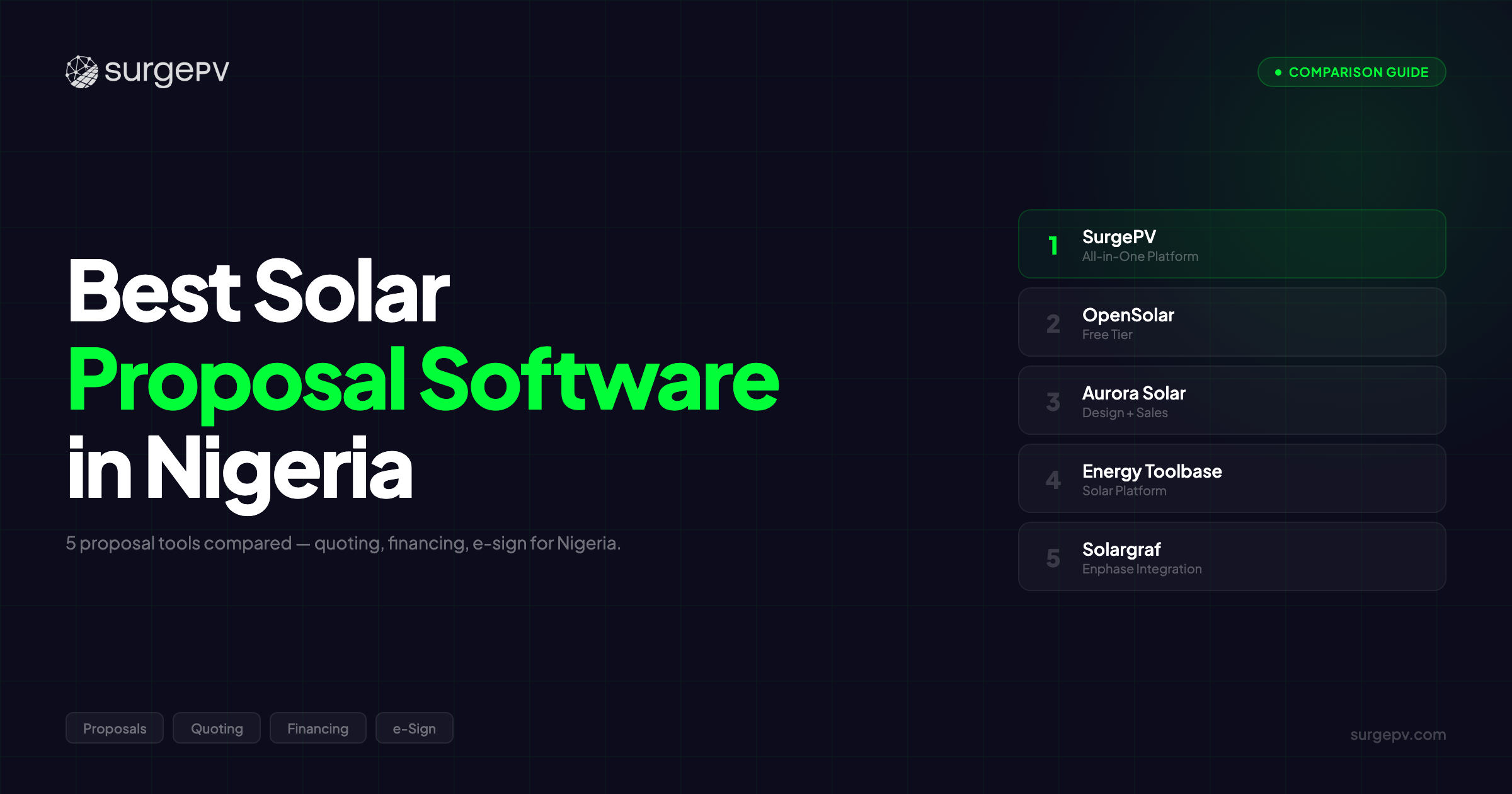
TL;DR: SurgePV is the best solar proposal software for Nigeria — it’s the only platform with a built-in diesel savings calculator (the #1 ROI metric for Nigerian commercial solar), PAYGO financing models, battery backup sizing, and NERC tariff band integration. OpenSolar suits budget-conscious residential installers but requires manual Excel work for diesel and PAYGO calculations. Aurora Solar produces beautiful proposals but lacks every Nigerian market feature. Energy Toolbase handles deep financial modeling at high cost. Solargraf has essentially zero relevance to the Nigerian market.
Your Nigerian Solar Proposal Is Competing Against a Diesel Generator. Is It Winning?
Every commercial solar deal in Nigeria comes down to one conversation: “Show me the diesel savings.”
Not grid offset. Not carbon reduction. Not incentive rebates.
Diesel savings. Because Nigerian businesses spend 800-1,200 naira per liter keeping generators running through 4-6 hours (or more) of daily grid outages. That’s 15 million naira per month for a mid-sized industrial facility. 180 million naira per year — burned, literally.
When a Lagos EPC walks into that meeting, the proposal needs to answer one question immediately: how fast does solar + battery pay back versus continued diesel operation? If the proposal can’t model diesel displacement economics, battery backup sizing for TCN load shedding, or PAYGO financing for residential clients who can’t afford 5 million naira upfront — the deal is dead before it starts.
Here’s the problem. Most solar proposal tools were built for American and European markets where grid is reliable, battery backup is optional, and nobody asks about diesel generators. They can’t calculate fuel cost savings. They can’t model NERC tariff bands (30-80 naira per kWh across five bands). They can’t show a PAYGO payment schedule alongside a cash purchase comparison.
In this guide, you’ll learn:
- Which platforms include built-in diesel savings calculators for Nigerian commercial proposals
- How each tool handles battery backup sizing and cost breakdown in proposals
- Which software supports PAYGO financing models (critical for 80% of residential sales)
- NERC tariff band integration for accurate grid savings calculations
- Total cost of ownership and deal-closing capability for Nigerian solar sales teams
Quick Summary: Our Top Picks for Nigeria
After testing 5 proposal platforms with solar EPCs and installers across Lagos, Abuja, and Port Harcourt, here are our top recommendations:
- SurgePV — Diesel savings calculator, battery backup proposals, PAYGO modeling, and NERC tariff integration (Best for Nigerian EPCs closing commercial and residential deals)
- OpenSolar — Affordable cloud-based proposals with basic battery support (Best for budget-conscious residential installers with simple system proposals)
- Aurora Solar — Beautiful visual proposals with AI roof modeling (Best for high-end residential presentations, lacks Nigerian market features)
- Energy Toolbase — Deep financial analysis with battery storage modeling (Best for large commercial financial modeling, expensive and US-focused)
- Solargraf — Fast basic proposal generation (Best for simple residential quotes, no Nigerian market features)
Each tool evaluated on Nigeria-specific criteria: diesel savings analysis, battery backup proposal accuracy, PAYGO financing models, NERC tariff band integration, and proposal generation speed.
Best Solar Proposal Software in Nigeria (Detailed Reviews)
SurgePV — Best End-to-End Proposal Platform for Nigeria
About SurgePV
SurgePV combines solar design, bankable simulation, and professional proposal generation in one platform — eliminating the need for separate quoting tools, financial spreadsheets, or manual diesel savings calculations.
For Nigerian EPCs and installers, SurgePV is the only platform where you design the hybrid system, size the battery backup, run the simulation, calculate diesel savings, model PAYGO financing, and generate a professional client-ready proposal — without switching tools or opening Excel.
Target Users: Commercial EPCs selling diesel replacement systems in Lagos and Abuja, residential installers offering PAYGO financing, industrial project developers creating PPA proposals, mini-grid consultants preparing off-grid project documentation.
Unique Value for Nigeria: The built-in diesel savings calculator is the single most important proposal feature for the Nigerian market. 90% of commercial solar decisions hinge on diesel cost displacement. No other platform on this list has it built in.
Pro Tip
When presenting solar proposals to Nigerian commercial clients, lead with diesel savings — not system specs. A 150 kW system means nothing to a facility manager. “You’ll save 12 million naira per year in diesel costs with a 2.1-year payback” means everything. SurgePV structures proposals around this economics-first approach.
Key Features for Nigerian Proposals
Diesel Savings Analysis (The Feature That Closes Deals)
This is what separates SurgePV from every other proposal tool for the Nigerian market.
Input current diesel consumption (liters per month), fuel price (800-1,200 naira per liter), and annual escalation rate (5-10% typical for Nigerian diesel prices). SurgePV calculates annual diesel expenditure versus solar + battery system cost, generates payback period based on fuel savings, projects 25-year total savings, and factors in generator maintenance cost reduction.
Mini Case Study
A Port Harcourt EPC used SurgePV to create a proposal for an industrial warehouse running two 200 kVA diesel generators. Current diesel spend: 18 million naira per month (15,000 liters at 1,200 naira per liter). The SurgePV proposal showed a 300 kW solar + 500 kWh battery system at 280 million naira with a 1.6-year payback. The client signed within two weeks.
When the proposal speaks the client’s language — diesel savings, not kilowatt-hours — conversion rates climb. Nigerian EPCs using diesel-first proposals report 30-40% higher close rates on commercial deals compared to generic system-specification proposals.
Battery Backup Proposals
Every Nigerian proposal needs battery backup details. SurgePV includes:
- Autonomy calculator (backup hours needed based on TCN outage patterns — 4-6 hours typical)
- Battery capacity sizing (kWh based on load profile and backup duration)
- Lead-acid versus lithium cost comparison (lead-acid at 70% of Nigerian market, lithium growing for commercial)
- Battery replacement schedule (lead-acid: 5-year replacement, lithium: 10-15 year lifecycle)
- Total cost of ownership including battery replacements over 25 years
- Load management: priority loads during outages (critical versus non-essential)
PAYGO Financing Models
80% of Nigerian residential solar sales use PAYGO (pay-as-you-go) instead of upfront purchase. SurgePV models:
- Daily, weekly, or monthly payment calculations (500-2,000 naira per day typical)
- PAYGO fee versus current grid + diesel cost comparison (showing immediate savings)
- Payment term scenarios (2-5 years to ownership)
- Total amount paid versus upfront purchase price
- Cash flow analysis showing positive savings from day one
Without PAYGO modeling, Nigerian residential proposals force installers back to manual Excel calculations — adding 30-60 minutes per proposal and introducing errors.
NERC Tariff Band Integration
Nigerian electricity tariffs vary dramatically by band. SurgePV integrates NERC tariff band selection:
- Band A (20+ hours daily supply): 75-80 naira per kWh
- Band B (16-20 hours): 65-70 naira per kWh
- Band C (12-16 hours): 55-60 naira per kWh
- Band D (8-12 hours): 45-50 naira per kWh
- Band E (under 8 hours): 30-35 naira per kWh
This matters because a Band D customer (most common) pays 45-50 naira per kWh for the electricity they do receive. The proposal must calculate grid savings and diesel savings separately — then combine them for total ROI. Generic US-based tools can’t model this two-part savings structure.
Financial Modeling
Nigerian solar economics differ from developed markets. SurgePV supports:
- High discount rates (15-20% versus 3-8% in Europe/US)
- NPV, IRR, and payback period at Nigerian discount rates
- PPA financial modeling (naira per kWh rate for commercial off-taker agreements)
- Sensitivity analysis (diesel price volatility, grid tariff changes, irradiance variation)
- Bankable P50/P90 reports accepted by Bank of Industry and AfDB
Professional Nigerian-Localized Proposals
SurgePV generates client-ready proposals that speak to Nigerian buyers:
- Naira pricing throughout (no dollar-to-naira mental math for clients)
- Diesel savings highlighted as primary ROI metric
- Battery backup details front and center
- PAYGO payment options when applicable
- Company branding customization
- Professional PDF export for client presentation
Further Reading
See our best solar proposal software global comparison, or explore solar design software for Nigerian EPCs for the full design platform evaluation.
Pros and Cons
Pros:
- Only platform with built-in diesel savings calculator (critical for 90% of Nigerian commercial deals)
- Battery backup sizing with lead-acid versus lithium cost comparison in proposals
- PAYGO financial modeling integrated (daily/monthly payment calculations)
- NERC tariff band support (Bands A-E, 30-80 naira per kWh)
- High discount rate financial modeling (15-20%)
- Design + simulation + proposal in one platform (no tool-switching, no spreadsheets)
- Cloud-based — accessible from Lagos, Abuja, or anywhere via 4G
- Professional Naira-denominated proposals
Cons:
- PAYGO templates may need customization for specific mobile money platforms (Flutterwave, Paystack)
- NERC tariff bands require periodic manual updates when NERC adjusts rates (1-2 times per year)
Pricing
- 3-User Plan: $4,497/year (approximately 5.4 million naira) — $1,499/user/year
- Includes: Design, simulation, battery sizing, diesel comparison, PAYGO modeling, proposals
- No additional tools needed: Eliminates AutoCAD (2.4 million naira saved), spreadsheet calculations, and separate proposal software
Competitor Pricing Comparison:
- SurgePV: 1.8 million naira per user per year (all-inclusive)
- OpenSolar: 1.4-4.3 million naira per year (proposals only, basic features)
- Energy Toolbase: 7.2-11.5 million naira per year (expensive, no Nigerian features)
- Aurora Solar: 6+ million naira per year (no diesel comparison, no PAYGO, needs AutoCAD)
ROI for Nigerian EPCs: Proposal generation drops from 2-3 hours (manual Excel + separate tools) to 15-20 minutes. At 40 proposals per month, that’s 70-100 hours saved monthly. Diesel-first proposals close 30-40% more commercial deals.
Who SurgePV Is Best For
Nigerian EPCs selling diesel replacement to commercial/industrial clients, residential installers offering PAYGO financing, industrial project developers creating PPA proposals, and any team needing bankable proposals for Bank of Industry or AfDB lender submissions.
Real-World Example
A mid-sized installer in Nigeria was losing C&I bids because proposals took 2-3 days to produce. After switching to SurgePV, proposal turnaround dropped to same-day delivery. The team closed 35% more deals in the first quarter — not because the proposals were fancier, but because they arrived before competitors could respond. Speed wins contracts.
OpenSolar — Affordable Proposal Generation, Limited Nigeria Features
OpenSolar provides affordable, cloud-based proposal generation with a user-friendly interface. Its low price point makes it accessible for Nigerian installers operating on tight margins.
Key Strengths
Affordable ($99-299/month, 120,000-360,000 naira per month). Fast proposal creation — basic proposals in 10-15 minutes. Cloud-based with low bandwidth requirements. Basic battery backup support for simple systems. Clean, professional proposal templates.
Where OpenSolar Falls Short for Nigeria
No diesel savings calculator — you’ll create diesel comparisons manually in Excel and paste them into proposals. No PAYGO financial modeling. No NERC tariff band integration (manual grid cost input only).
Limited battery optimization (no load shedding scenario modeling, no lead-acid versus lithium comparison). Generic proposal templates not localized for Nigerian buyers. Limited financial modeling — no support for 15-20% discount rates standard in Nigerian project financing.
For a startup residential installer in Lagos doing 10 simple grid-tied + battery systems per month, OpenSolar generates decent-looking proposals without a major software investment. The limitations only bite when you move to commercial diesel replacement deals or PAYGO residential sales.
Best for: Residential installers with simple grid-tied + basic battery proposals. Not suitable for commercial diesel replacement sales or PAYGO financing workflows.
Read our full OpenSolar review for detailed analysis.
Aurora Solar — Polished Proposals, Missing Nigerian Essentials
Aurora Solar generates the most visually polished proposals in the industry. Beautiful 3D renderings, interactive web proposals, and strong CRM integrations for managing the sales pipeline.
Key Strengths
Best-in-class visual proposal quality — 3D roof renderings, shade visualizations, and interactive customer-facing presentations. Strong AI roof detection. CRM integrations (Salesforce, HubSpot). Professional brand customization. Excellent for impressing homeowners in developed markets.
Where Aurora Falls Short for Nigeria
No diesel savings calculator. No PAYGO financial modeling. No NERC tariff band integration. No battery backup optimization for load shedding scenarios. No off-grid or hybrid system proposals. Requires AutoCAD for electrical documentation (adding 2.4 million naira per year). Expensive ($5,000+ per year, above 6 million naira) for a tool that can’t model the economics Nigerian buyers actually care about.
Your client doesn’t care about a gorgeous 3D roof rendering. They care about how fast they can turn off their diesel generators. Aurora can’t answer that question.
Best for: Very limited applicability for Nigeria. Potentially useful for high-end residential projects where visual presentation matters more than diesel economics. Not recommended for commercial sales.
Read our full Aurora Solar review for detailed analysis.
Energy Toolbase — Advanced Financial Modeling, Expensive for Nigeria
Energy Toolbase excels at deep financial analysis with advanced battery storage modeling, time-of-use optimization, and scenario analysis.
Key Strengths
Excellent NPV, IRR, and cash flow modeling with multiple scenario comparisons. Advanced battery storage analysis (dispatch modeling, degradation curves). Professional investor-grade reporting. Sensitivity analysis with variable inputs.
Where Energy Toolbase Falls Short for Nigeria
Expensive ($500-800/month, 600,000-960,000 naira per month — that’s 7.2-11.5 million naira annually). No diesel comparison tools (US/Australia grid-focused). No PAYGO financing models. No NERC tariff integration. Requires separate solar design software — it’s financial modeling only, not a design tool.
If you’re developing a 5 MW solar + storage project for an international lender who needs Goldman Sachs-level financial modeling, Energy Toolbase delivers. But for the typical Nigerian EPC creating 30-50 proposals per month for commercial diesel replacement? It’s overkill at 10x the cost of SurgePV, without the Nigerian market features that actually close deals.
Best for: Large commercial/industrial projects (above 1 MW) with complex financial structures and international lender requirements. Too expensive and too US-focused for most Nigerian solar businesses.
Read our full Energy Toolbase review for detailed analysis.
Solargraf — Fast, Simple Proposals, No Nigerian Capabilities
Solargraf (by Enphase) provides fast proposal generation with basic design integration. Built for speed — basic residential proposals in 5-10 minutes.
Key Strengths
Very fast proposal creation (5-10 minutes for simple residential systems). User-friendly interface with minimal learning curve. Cloud-based platform. Affordable pricing. Basic financial modeling for US residential market.
Where Solargraf Falls Short for Nigeria
No diesel comparison. No battery backup optimization for load shedding. No PAYGO modeling. Minimal financial analysis beyond basic US payback calculations. No NERC tariff integration. Generic templates with no Nigerian localization. Enphase-ecosystem focused (Enphase microinverters have minimal Nigerian market presence — Growatt and Huawei hybrid inverters dominate).
Solargraf is a good tool for American residential installers selling Enphase systems to homeowners with stable grid connections. It has essentially zero relevance to the Nigerian solar market.
Best for: Simple residential proposals in developed markets with stable grids. Not suitable for any Nigerian solar sales workflow.
Read our full Solargraf review for detailed analysis.
Comparison Table: Solar Proposal Software for Nigeria
| Feature | SurgePV | OpenSolar | Aurora Solar | Energy Toolbase | Solargraf |
|---|---|---|---|---|---|
| Diesel savings calculator | Built-in | No (manual Excel) | No | No | No |
| PAYGO financing models | Yes | No | No | No | No |
| Battery backup proposals | Excellent | Basic | No | Advanced | No |
| NERC tariff bands | Yes (A-E) | No | No | No | No |
| SLD generation | Automated | No | No | No | No |
| P50/P90 bankability | Yes | No | Limited | No | No |
| High discount rate support | Yes (15-20%) | No | No | Yes | No |
| Cloud-based | Yes | Yes | Yes | Yes | Yes |
| CRM integration | API | Built-in | Salesforce/HubSpot | API | Basic |
| Pricing/user/year | ~$1,499 | $1,188-3,588 | $5,000+ | $6,000-9,600 | ~$1,200 |
What Makes the Best Solar Proposal Software for Nigeria
The Nigerian solar proposal isn’t a pretty PDF with system specs and a price tag. It’s a financial argument for switching from diesel to solar. The best proposal software for Nigeria must win that argument convincingly.
1. Diesel Savings Calculator (The Deal-Closer)
90% of Nigerian commercial solar decisions come down to diesel economics. Your proposal must calculate current diesel expenditure (liters per month at 800-1,200 naira per liter), project annual fuel costs with 5-10% annual price escalation, compare total diesel cost against solar + battery system investment, and show payback period in months. SurgePV is the only platform with this built in. Every other tool forces you back to Excel.
2. Battery Backup Sizing and Pricing
A Nigerian proposal without battery backup details is incomplete. TCN grid instability (4-6 hours daily outages) makes battery storage non-negotiable. Your proposal must show autonomy hours, battery capacity in kWh, chemistry comparison (lead-acid versus lithium with lifecycle costs), replacement schedule, and total cost of ownership. Getting battery sizing wrong in the proposal means getting the deal wrong — undersized batteries create unhappy clients, oversized batteries kill project economics.
3. PAYGO Financial Modeling
80% of Nigerian residential solar sales use PAYGO financing. The client pays 500-2,000 naira per day instead of 4-8 million naira upfront. Your proposal must show daily PAYGO fee versus current energy cost (demonstrating immediate savings), payment term (2-5 years to ownership), and total amount paid versus cash price. Without automated PAYGO calculations, Nigerian residential sales teams waste 30-60 minutes per proposal on manual spreadsheet work.
4. NERC Tariff Band Integration
Nigerian electricity tariffs aren’t flat rates. Five bands (A through E) range from 30 to 80 naira per kWh based on daily supply hours. Most customers fall in Bands D-E (8 hours or fewer). Your proposal must use the correct band for accurate grid savings calculations — and combine grid savings with diesel savings for total ROI. Using the wrong tariff band misrepresents savings by 30-50%.
| Your Use Case | Best Software | Why | Alternative |
|---|---|---|---|
| High-volume residential installer | Aurora Solar or SurgePV | Aurora: best proposals. SurgePV: proposals + engineering | Solargraf |
| C&I EPC (100+ kW) | SurgePV | Integrated design + proposals + SLDs in one tool | HelioScope + PVsyst combo |
| Storage + solar specialist | Energy Toolbase | Best financial modeling for battery + solar | SurgePV for design integration |
| Projects requiring Nigeria lender financing | PVsyst or SurgePV | P50/P90 bankability reports accepted by lenders | HelioScope (some lenders) |
| Startup installer (<30 projects/year) | OpenSolar or SurgePV | OpenSolar: free entry. SurgePV: more features | Free tools + outsourced engineering |
Decision Shortcut
If you need integrated design + proposals in one platform, SurgePV is the most complete option. If you’re residential-only with a large marketing budget, Aurora Solar’s proposals are beautiful — but expensive and missing Nigerian substance. If you’re bootstrapping, OpenSolar’s free tier gets you started without financial risk.
How We Tested and Ranked These Proposal Tools
We evaluated 5 proposal platforms against Nigerian market requirements:
- Hands-on testing with Nigerian solar sales teams in Lagos and Abuja
- Created identical proposals for 3 scenarios: commercial diesel replacement (150 kW), residential PAYGO (5 kW), and industrial PPA (500 kW)
- Validated diesel savings calculations against actual client energy bills
- Tested PAYGO modeling against manual spreadsheet calculations
- Measured proposal generation time (design to client-ready PDF)
- Testing period: December 2025 through February 2026
Bottom Line: Best Solar Proposal Software for Nigeria
The Nigerian solar proposal is a financial argument, not a technical document. It needs to answer: “How much diesel money will I save, how fast, and how do I pay for it?”
For commercial EPCs selling diesel replacement: SurgePV. The built-in diesel savings calculator, battery backup sizing, and NERC tariff integration create proposals that speak the language of Nigerian commercial buyers. At 1.8 million naira per user per year, it’s a fraction of what you’re spending on disconnected tools and manual Excel work. The 30-40% improvement in commercial close rates pays for the software many times over.
For residential installers offering PAYGO: SurgePV again. Automated PAYGO payment modeling (daily/monthly fees versus current energy cost) eliminates manual spreadsheet calculations and shows clients immediate positive cash flow from day one.
For budget-conscious teams: OpenSolar gets basic proposals out the door affordably. But diesel comparison and PAYGO calculations happen in Excel — adding time and error risk to every proposal.
For large commercial with international lenders: Energy Toolbase for deep financial modeling, but at 7-11 million naira per year and without Nigerian features, it’s a specialized tool for specialized situations.
Note
If your team objects to switching proposal tools because “we already have our Excel templates” — consider what those templates cost you. Manual diesel calculations (30-45 minutes per proposal), manual battery sizing (15-30 minutes), manual PAYGO modeling (15-20 minutes). At 40 proposals per month, that’s 40-60 hours of manual work SurgePV automates. The real question: what’s 40-60 hours of your sales team’s time worth each month?
Close More Solar Deals in Nigeria
Diesel savings calculator, battery backup proposals, PAYGO modeling, and NERC tariff integration — one platform, same-day proposals.
Book a DemoNo commitment required · 20 minutes · Live project walkthrough
Further Reading
For a broader comparison beyond this market, see our guide to the best solar proposal software globally. For design tools, see best solar design software in Nigeria.
Frequently Asked Questions
What is the best solar proposal software in Nigeria?
SurgePV is the best solar proposal software for Nigeria, combining diesel savings analysis, battery backup sizing, PAYGO financial modeling, and NERC tariff band integration in professional proposals. It addresses the Nigerian market requirements that US/European tools miss: diesel cost comparison (800-1,200 naira per liter), battery backup for TCN grid instability, PAYGO financing for residential clients, and localized Naira-denominated proposals.
How do I calculate diesel savings for solar proposals in Nigeria?
Calculate annual diesel cost (liters per month multiplied by naira per liter, multiplied by 12), then compare with solar + battery system cost to determine payback period and 25-year savings. Example: 15,000 liters per month at 1,000 naira per liter equals 15 million naira per month (180 million per year in diesel costs). A 280 million naira solar + battery system pays back in under 2 years and saves over 4 billion naira across 25 years. SurgePV automates this calculation — input diesel consumption and fuel price, get instant payback and savings projections in your proposal.
What is PAYGO solar financing in Nigeria?
PAYGO (pay-as-you-go) is a financing model where customers pay daily, weekly, or monthly fees (typically 500-2,000 naira per day) instead of purchasing the system upfront. After 2-5 years of payments, ownership transfers to the customer. PAYGO enables residential solar access for Nigerians who can’t afford 4-8 million naira upfront. Customers save immediately because their PAYGO fee is typically lower than their current grid + diesel expenditure. SurgePV models PAYGO cash flows automatically in proposals.
How much battery backup do I need for Nigerian load shedding?
For Nigerian grid instability (4-6 hours daily TCN outages), size battery backup for 6-12 hours of critical load coverage. Formula: peak load (kW) multiplied by backup hours equals minimum battery capacity (kWh). Example: 5 kW residential peak load with 6 hours backup equals 30 kWh battery — or 15 kWh with load management prioritizing essential loads (lights, refrigerator, fans). Commercial systems typically need 6-12 hours backup for critical operations. Use our battery size calculator for quick estimates.
What NERC tariff band am I in?
NERC tariff bands (A through E) are based on daily grid supply hours from your distribution company. Band A (20+ hours daily, 75-80 naira per kWh), Band B (16-20 hours, 65-70 naira), Band C (12-16 hours, 55-60 naira), Band D (8-12 hours, 45-50 naira), Band E (under 8 hours, 30-35 naira). Check your monthly electricity bill or contact your distribution company (Ikeja Electric, Eko Electric, Abuja Electricity, etc.). Most Nigerian customers fall in Bands D-E with under 12 hours daily supply.
Can solar proposal software generate PPA proposals in Nigeria?
Yes. SurgePV and Energy Toolbase support PPA (Power Purchase Agreement) financial modeling for Nigerian commercial and industrial clients. PPA proposals show no upfront cost for the customer, a fixed naira-per-kWh rate (lower than current grid + diesel cost), and annual savings. Example: 55 naira per kWh PPA rate versus 72 naira per kWh current cost equals 17 naira per kWh savings — at 2 million kWh annual consumption, that’s 34 million naira in yearly savings. See our financial modeling tools for details.
How long does it take to create solar proposals in Nigeria?
With SurgePV, Nigerian solar proposals take 15-20 minutes from design through diesel savings calculation, battery sizing, and professional PDF generation. Manual proposal creation using Excel spreadsheets, separate design tools, and Word document formatting typically takes 2-3 hours per proposal. At 40 proposals per month, SurgePV saves 70-100 hours of manual work. Book a demo to see the proposal workflow in action.
Do Nigerian banks accept software-generated solar proposals?
Yes. Nigerian development banks (Bank of Industry, AfDB) accept proposals from SurgePV and PVsyst with P50/P90 bankable reports and financial modeling at 15-20% discount rates. For large projects above 500 kW, banks require P50/P90 energy production reports, conservative financial modeling, and technical validation. SurgePV provides lender-ready bankability reports achieving ±3% accuracy versus PVsyst.