

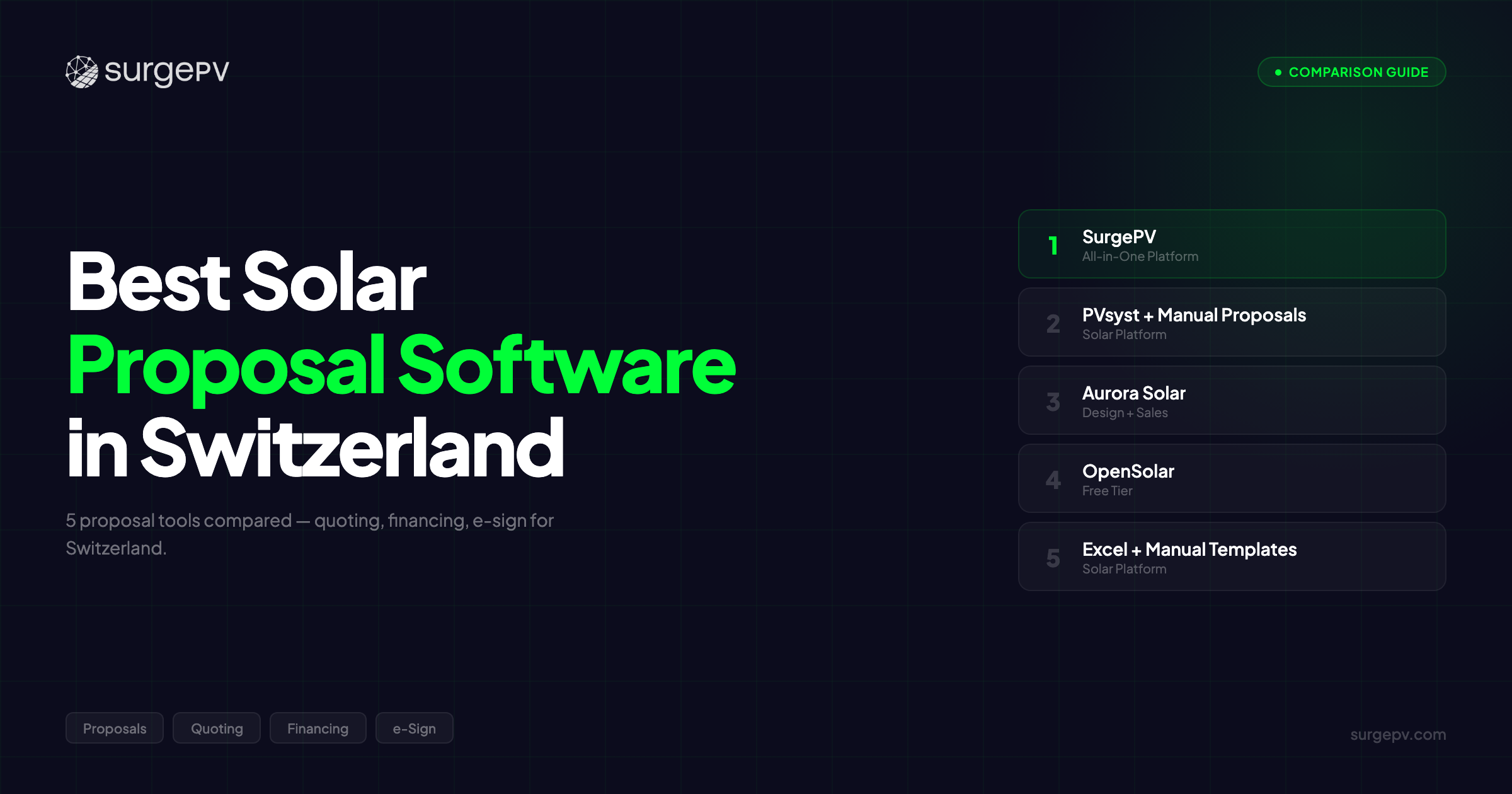
TL;DR: Swiss Solarteure waste 1-2+ hours per proposal piecing together PVsyst simulations, Excel financial models, Pronovo EIV calculations, and Word documents. SurgePV collapses that into 15-20 minutes — with Pronovo calculations, Eigenverbrauch visualization, ZEV community economics, and German/French/Italian proposals built in at $1,899/year for 3 users. PVsyst + manual Excel remains the simulation-first workflow for engineers who already have established templates. OpenSolar starts free for very small installers.
Swiss Solarteure waste 1-2+ hours per proposal. Designing in one tool, simulating in PVsyst, then manually building proposals in Excel — with separate Pronovo EIV calculations, Eigenverbrauch modeling, cantonal subsidy lookups, and currency formatting in CHF. Three to five quotes compete for every residential project in Switzerland. The team that sends a polished, accurate proposal first has a measurable advantage.
The errors add up. A miscalculated Pronovo Einmalvergütung subsidy. An Eigenverbrauch estimate that doesn’t account for battery storage. A proposal sent in German to a client in Lausanne. At average deal sizes of CHF 15,000-40,000 for residential and CHF 100,000-1M+ for commercial, every mistake costs real money — either in lost deals or in margin erosion from inaccurate pricing.
The right solar proposal software eliminates this. Integrated design-to-proposal workflows with automated Pronovo calculations, Eigenverbrauch visualization, ZEV community economics, and multi-language output (German, French, Italian) — generated in 15-20 minutes instead of 2-4 hours.
In this guide, you’ll learn:
- Which platform produces the best Swiss-specific proposals with Pronovo and Eigenverbrauch integration
- How pricing compares across tools (from free to CHF 6,000+/year)
- Which software generates proposals in German, French, and Italian with CHF pricing
- Our recommendation based on testing proposal workflows across 500+ installer teams
Quick Comparison Table
| Software | Best For | Pricing/Year | Pronovo Calc | Speed |
|---|---|---|---|---|
| SurgePV | End-to-end (design + proposals) | $1,899 (3 users) | Yes | 15-20 min |
| PVsyst + Manual | Bankable sim + manual proposals | CHF 1,450 + labor | No | 2-4 hrs |
| Aurora Solar | Visual enterprise proposals | CHF 2,800-6,000+ | No | 20-30 min |
| OpenSolar | Budget residential | Free | No | 15-25 min |
| Excel + Manual | Very small installers | Free | Manual | 1-2 hrs |
Best Solar Proposal Software in Switzerland (Detailed Reviews)
SurgePV — Best Design-to-Proposal Platform for Swiss Solarteure
Best For: Swiss EPCs and Solarteure needing integrated design-to-proposal workflows
Pricing: $1,899/year (3 users); $1,499/user/year (For 3 Users plan)
Proposal Speed: 15-20 minutes from design completion
SurgePV is an end-to-end solar platform that combines design, electrical engineering, bankable simulations, and proposal generation in a single cloud-based tool.
For Swiss proposal workflows, this integration is the key differentiator.
A typical Swiss Solarteur designs a system in one tool, runs simulations in PVsyst, then opens Excel to manually build a proposal — calculating Pronovo EIV subsidies, modeling Eigenverbrauch versus surplus export, adding cantonal subsidies, formatting everything in CHF, and translating for the client’s language region. That process takes 2-4 hours and introduces errors every time data moves between systems. SurgePV collapses that into 15-20 minutes. Design flows directly into simulation, which flows directly into a client-ready proposal with all Swiss financial modeling built in.
Key Proposal Features for Switzerland
- Pronovo EIV calculator — Automatically calculates KLEIV (2-100 kW, CHF 350/kW + CHF 160/kW) and GREIV (over 100 kW) subsidies, showing net investment cost directly in the proposal
- Eigenverbrauch visualization — Shows customers the difference between self-consumption savings (25-35 Rp/kWh) and surplus export value (5-10 Rp/kWh) with clear graphical breakdowns
- ZEV community economics — Models Zusammenschluss zum Eigenverbrauch for multi-tenant buildings, showing shared self-consumption allocation and individual tenant savings
- Battery storage ROI — Financial modeling showing Eigenverbrauch increase from 50-70% to 70-90% with storage, including payback calculations
- Multi-language output — Customizable proposal templates in German, French, and Italian with CHF pricing and Swiss formatting
- 98% BOM accuracy — Bill of materials generated directly from the design, eliminating manual component lists and pricing errors
Pro Tip
SurgePV’s integrated workflow means you never re-enter data between design and proposal. Every production estimate, Pronovo calculation, and Eigenverbrauch model flows automatically. Book a demo to see the complete Swiss proposal workflow.
Pricing
| Plan | Price | Users |
|---|---|---|
| Individual | $1,899/year | 3 users |
| For 3 Users | $1,499/user/year | 3 users |
| For 5 Users | $1,299/user/year | 5 users |
| Enterprise | Custom | Multiple |
All features included on every plan — design, SLD generation, simulation, and proposals. No hidden fees, no feature gating. See full pricing.
Who SurgePV Is Best for in Switzerland
- Solarteure handling 10+ residential proposals per month who need Pronovo and Eigenverbrauch automation
- Commercial EPCs needing professional proposals with ZEV modeling for multi-tenant projects
- Teams operating across language regions (Zurich, Geneva, Ticino) who need DE/FR/IT proposals
- Companies looking to cut proposal time from 2-4 hours to 15-20 minutes
Limitations
- Newer brand in Switzerland versus established tools like PVsyst
- Cantonal subsidies (beyond federal Pronovo) require manual input for some cantons
Real-World Example
A Solarteur team in Bern was losing 30% of residential deals to faster competitors. Their proposal workflow: PVsyst simulation (45 min), Excel financial modeling with Pronovo and Eigenverbrauch (40 min), Word document formatting (35 min) — nearly 2 hours per quote. After switching to SurgePV, proposals dropped to 18 minutes. In the first quarter, their close rate jumped from 22% to 31%. When 3-5 installers compete for every project, the first professional proposal on the table has a measurable advantage.
Further Reading
See the global comparison: Best Solar Proposal Software (2026). For the design side: Best Solar Design Software in Switzerland.
Why not just use Aurora Solar for proposals? Aurora’s proposals don’t include Pronovo EIV calculations, Eigenverbrauch optimization, ZEV modeling, or multi-language output in German, French, and Italian. In Switzerland, those aren’t optional — they’re what separates a professional proposal from a generic one that fails to address the customer’s actual financial questions.
PVsyst + Manual Proposals — Swiss-Made Simulation with DIY Documents
Best For: Engineers pairing bankable simulations with custom proposal templates
Pricing: CHF 1,100 perpetual + CHF 350/year maintenance + labor cost for manual proposals
Proposal Speed: 2-4 hours (simulation + manual document creation)
PVsyst, developed at the University of Geneva, is the Swiss-made industry standard for bankable simulations. For Swiss installers who have already invested in PVsyst expertise, the natural workflow is to export simulation data into manually created Excel/Word proposals.
What Works for Switzerland
- Swiss-made with the deepest Meteonorm weather data integration
- Universal acceptance by all Swiss banks for P50/P90 financing reports
- Eigenverbrauch simulation with hourly self-consumption analysis
- Strong credibility with Swiss customers who recognize the PVsyst brand
Where It Falls Short for Proposals
- No proposal generation whatsoever — PVsyst generates simulation reports, not client-facing proposals. All proposal creation is manual
- No Pronovo EIV calculator — Subsidy calculations must be done in a separate spreadsheet
- No financial modeling for proposals — Payback, ROI, and savings calculations require external tools
- 2-4 hours per proposal — Simulation (45 min) + manual document creation (1-3 hours)
- Desktop-only — No cloud sharing or team collaboration on proposals
Best for: Engineers who already use PVsyst and have established manual proposal templates, and who prioritize simulation credibility over proposal speed.
Read our full PVsyst review for a detailed breakdown.
Did You Know?
The average Swiss homeowner receives 3-5 quotes before choosing a solar installer (Swissolar). Response speed directly correlates with close rates — the first professional proposal on the table wins disproportionately often.
Aurora Solar — Polished Visual Proposals for Enterprise Installers
Best For: Enterprise installers with international operations needing visual impact
Pricing: CHF 2,800-6,000+/year (~$259/user/month)
Proposal Speed: 20-30 minutes
Aurora Solar produces some of the most visually polished proposals in the solar industry. Its 3D renderings, interactive web proposals, and CRM integrations make it a strong choice for high-volume enterprise sales teams.
What Works for Switzerland
- Beautiful 3D visualizations and interactive web-based proposals
- Salesforce and HubSpot CRM integration for enterprise sales workflows
- E-signature integration for faster deal closing
Where It Falls Short for Swiss Proposals
- No Pronovo EIV calculator — Federal subsidy calculations must be done manually
- No Eigenverbrauch optimization — Cannot model the self-consumption economics that drive Swiss purchasing decisions
- No ZEV community proposals — Cannot create multi-tenant self-consumption models
- English-primary — Limited German, French, and Italian proposal templates
- No SLD generation — No electrical engineering integration
- Expensive — CHF 2,800-6,000+/year for a platform that still requires separate Swiss financial modeling
Best for: Enterprise-scale installers with international operations who have dedicated staff handling Swiss-specific financial calculations separately.
For a deeper analysis, read our full Aurora Solar review.
OpenSolar — Free Proposals for Budget-Conscious Swiss Installers
Best For: Small Solarteure with fewer than 10 proposals per month
Pricing: Free
Proposal Speed: 15-25 minutes
OpenSolar is a free cloud-based platform that covers basic solar design and proposal generation. For Swiss installers just starting out, the zero cost is the primary appeal.
What Works for Switzerland
- Free — no financial barrier to entry
- Basic design and proposal generation in one platform
- Fast onboarding for simple residential projects
Where It Falls Short for Swiss Proposals
- No Pronovo EIV calculator — Subsidy calculations entirely manual
- No Eigenverbrauch modeling — Cannot show self-consumption versus export economics
- No ZEV support — No multi-tenant community configurations
- English-only proposals — No German, French, or Italian templates
- Basic financial modeling — No Swiss-specific electricity tariff modeling (25-35 Rp/kWh tiers)
Best for: Small installers handling fewer than 10 simple residential proposals per month who can manage Swiss financial details manually.
Read our full OpenSolar review for details.
Excel + Manual Templates — The DIY Approach
Best For: Very small installers processing fewer than 5 proposals per month
Pricing: Free (if you already have Microsoft 365)
Proposal Speed: 1-2+ hours
Many Swiss Solarteure still create proposals manually in Excel and Word. It works — if you have the time, the discipline to avoid errors, and the patience to format everything from scratch.
What Works
- Fully customizable — CHF formatting, any language, any layout
- No software dependency or subscription cost
- Complete control over every line item and calculation
Where It Falls Short
- 1-2+ hours per proposal — Design data manually transcribed, calculations done by hand
- Error-prone — Pronovo calculations, Eigenverbrauch estimates, and financial projections all subject to human error
- Unprofessional appearance — Difficult to match the polish of software-generated proposals
- No simulation integration — Production estimates disconnected from actual design
- No scalability — Practical only below 5 proposals per month
Best for: Very small installers with fewer than 5 proposals per month who are willing to trade time for zero software cost.
Solar Proposal Software Comparison Table for Switzerland
| Feature | SurgePV | PVsyst + Manual | Aurora Solar | OpenSolar | Excel |
|---|---|---|---|---|---|
| Best for | End-to-end | Bankable sim | Visual enterprise | Budget | Very small |
| Pronovo EIV calc | Yes | No | No | No | Manual |
| Eigenverbrauch | Yes | Yes (sim only) | No | No | Manual |
| ZEV modeling | Yes | Limited | No | No | Manual |
| Multi-language (DE/FR/IT) | Yes | FR/EN (sim) | Limited | EN only | Any |
| Battery ROI | Yes | Sim only | Basic | Basic | Manual |
| Design integrated | Yes | No (sim only) | Yes | Yes | No |
| Proposal speed | 15-20 min | 2-4 hrs | 20-30 min | 15-25 min | 1-2 hrs |
| Pricing (CHF/yr) | ~1,700 (3 users) | 1,450 + labor | 2,800-6,000+ | Free | Free |
Further Reading
For a broader comparison beyond Switzerland, see our guide to the best solar proposal software globally.
What Makes the Best Proposal Software for Switzerland
Pronovo Einmalvergütung Calculator
Every Swiss solar proposal should show the customer exactly how much their Pronovo EIV subsidy will be and what their net investment cost looks like after the federal payment. For KLEIV systems (2-100 kW), the formula is CHF 350/kW base + CHF 160/kW power-related (Pronovo AG). GREIV systems over 100 kW go through competitive auction rounds with different award amounts. Software that automates these calculations — like SurgePV — eliminates 30-60 minutes of manual spreadsheet work per proposal and reduces subsidy miscalculation risk.
Eigenverbrauch and ZEV Economics Visualization
Self-consumed electricity saves 25-35 Rp/kWh. Surplus exported to the grid earns only 5-10 Rp/kWh (EnergieSchweiz). That 3-5x gap makes Eigenverbrauch optimization the most important factor in Swiss solar economics. Your proposals need to show customers this difference visually — and model how battery storage shifts the ratio from 50-70% self-consumption to 70-90%. For ZEV (Zusammenschluss zum Eigenverbrauch) projects in multi-tenant buildings, proposals need allocation models showing individual tenant savings.
Multi-Language Proposals (German, French, Italian)
A Solarteur in Zurich sends proposals in German. The same team’s Geneva office needs French. A project in Ticino requires Italian. Swiss customers expect proposals in their language — with CHF formatting, Rappen-level precision, and Swiss terminology. Software with multi-language templates eliminates the translation step that adds 30+ minutes per proposal in multi-region operations.
Battery Storage Upsell Integration
Battery storage is growing rapidly in Switzerland because the economics are straightforward: a 10 kWh battery pushes Eigenverbrauch from ~60% to ~85%, adding CHF 5,000-10,000 in lifetime savings on a typical residential system. Proposals that include battery options as a clearly modeled upsell — showing the incremental payback — close at higher average deal values. SurgePV models this directly in the proposal; with other tools, it’s a separate calculation.
Cantonal Subsidy Integration
Beyond federal Pronovo EIV, many cantons offer additional subsidies. Zurich, Bern, and Basel-Stadt each have different cantonal programs with different eligibility criteria and payment amounts. Proposals that show both federal and cantonal subsidies present a lower net cost to the customer — which directly improves close rates.
Our Testing Methodology
We evaluated each platform against five weighted criteria specific to Swiss proposal workflows:
- Swiss financial modeling (35%) — Pronovo EIV calculation, Eigenverbrauch optimization accuracy, ZEV modeling, cantonal subsidy integration, battery storage ROI
- Proposal quality (25%) — Professional output (web + PDF), multi-language (DE/FR/IT), CHF pricing, detailed line items, mobile-friendly
- Design integration (20%) — Single platform design-to-proposal, accurate BOM and energy data, no tool switching
- Speed and automation (10%) — Time from design completion to client-ready proposal, template reuse
- Pricing value (10%) — Total cost of ownership, ROI for a Swiss installer generating 20+ proposals per month
Testing was conducted between January and February 2026, using real Swiss project data and regulatory documentation from Pronovo and BFE.
Send Better Proposals. Win More Swiss Projects.
Integrated design-to-proposal workflows with Pronovo EIV, Eigenverbrauch modeling, and multi-language output in 15-20 minutes.
Book a DemoNo commitment required · 20 minutes · Live project walkthrough
Bottom Line: Best Solar Proposal Software for Switzerland
Swiss solar customers expect precision. Pronovo subsidy calculations accurate to the Rappen. Eigenverbrauch analysis that accounts for their actual usage patterns. Proposals in their language with detailed CHF line items. The 8-12 year payback period means your financial modeling needs to be convincing — because that’s a long commitment for a Swiss homeowner to make based on your numbers.
For Solarteure and EPCs at any scale: SurgePV delivers the most complete Swiss proposal workflow. Design-to-proposal in 15-20 minutes, Pronovo EIV automation, Eigenverbrauch and ZEV modeling, multi-language output, and battery storage upsell — all at $1,899/year for 3 users.
For simulation-first workflows: PVsyst remains the Swiss-made simulation standard. If your team already has PVsyst expertise and established manual proposal templates, this workflow produces credible results — but at 2-4 hours per proposal, it limits how many projects you can quote per week.
For enterprise visual impact: Aurora Solar produces the most visually polished proposals, but without Pronovo, Eigenverbrauch, or multi-language support at CHF 2,800-6,000+/year, you’ll need supplemental tools for Swiss-specific financial content.
For budget startups: OpenSolar gets you started for free. The trade-off: no Swiss financial modeling, English-only proposals, and basic simulation depth.
In a market where 3-5 installers compete for every project, proposal speed and quality are directly correlated with close rates. The Solarteure winning projects today are the ones who put a professional, Pronovo-accurate, Eigenverbrauch-optimized proposal in the customer’s hands before their competitors finish the Excel spreadsheet.
Want to see how SurgePV handles Swiss proposal workflows? Book a demo and our team will walk you through a complete Eigenverbrauch proposal using your actual project data.
Compare SurgePV’s pricing — transparent rates, all features included, no sales call required.
Further Reading
Best Solar Simulation Software — Bankability comparison | Best All-in-One Solar Software — Integrated platform comparison
When You May Not Need Solar Proposal Software
Purpose-built proposal software isn’t the right solution for every Swiss solar business:
Very small installers (fewer than 5 proposals monthly): If you’re a solo installer handling only occasional residential projects, the CHF 1,650-2,750 annual cost of professional software may outweigh the time-saving benefits.
Sales organizations outsourcing all technical work: If your business model is purely lead generation and sales, with all design, engineering, and financial modeling contracted to third-party EPCs, a lightweight CRM with basic proposal templates might better serve your needs.
Large EPCs with custom internal systems: Some established Swiss solar companies have invested in proprietary software that already handles Eigenverbrauch optimization, Pronovo EIV calculations, ZEV modeling, and multilingual proposal generation. If your internal tools are working efficiently, migrating to third-party platforms may not provide meaningful advantages.
Projects with highly standardized specifications: If you focus exclusively on identical, repeatable installations and compete primarily on price rather than proposal sophistication, basic spreadsheet workflows may still be adequate.
The Tipping Point
Most Swiss installers find that proposal software pays for itself at 8-12 proposals per month. Below that, manual workflows are inefficient but tolerable. Above it, professional automation becomes essential for competitive speed and multi-canton compliance accuracy.
Frequently Asked Questions
What is the best solar proposal software in Switzerland?
SurgePV is the best solar proposal software for Switzerland in 2026. It combines design integration, Pronovo EIV calculations, Eigenverbrauch optimization, and multi-language proposals (German, French, Italian) in one platform at $1,899/year for 3 users. For visual proposals without Swiss financial modeling, Aurora Solar offers polished output at CHF 2,800-6,000+/year.
Can proposal software calculate Pronovo Einmalvergütung?
SurgePV includes a Pronovo EIV calculator for KLEIV (2-100 kW, CHF 350/kW base + CHF 160/kW power-related) and GREIV (over 100 kW) systems, showing net investment cost after federal subsidy directly in customer proposals. PVsyst, Aurora Solar, and OpenSolar do not include Pronovo calculators.
How does Eigenverbrauch affect solar proposals in Switzerland?
Self-consumed electricity saves 25-35 Rp/kWh while exported surplus earns only 5-10 Rp/kWh. SurgePV visualizes this difference in proposals, showing customers why maximizing Eigenverbrauch (with battery storage pushing from 50-70% to 70-90%) delivers better ROI than oversizing systems for export. This analysis is the most important factor in Swiss solar purchasing decisions.
Can software create proposals for ZEV self-consumption communities?
SurgePV models ZEV (Zusammenschluss zum Eigenverbrauch) configurations showing shared self-consumption economics for multi-tenant buildings and commercial complexes. This includes allocation models, individual tenant savings, and community financial projections. No other proposal tool handles ZEV community proposals natively.
How much does solar proposal software cost in Switzerland?
From free (OpenSolar, Excel) to CHF 6,000+/year (Aurora Solar). SurgePV costs $1,899/year for 3 users (~CHF 1,700, all-in-one design + proposals). PVsyst costs CHF 1,450/year but generates no proposals — you need separate tools for client-facing documents. See SurgePV pricing.
Can software generate proposals in German, French, and Italian?
SurgePV offers customizable templates for German, French, and Italian, matching Switzerland’s three main language regions with CHF formatting. Aurora Solar and OpenSolar are primarily English-based. PVsyst simulation reports are available in English and French only.
What should a Swiss solar proposal include?
A professional Swiss solar proposal should include: Pronovo EIV subsidy amount and net investment cost, Eigenverbrauch analysis (self-consumption versus surplus export), battery storage option with ROI, payback period (typically 8-12 years), cantonal subsidies where applicable, detailed CHF pricing with line items, system specifications, warranty information, and SIA 261 structural load documentation.
How fast can you generate a solar proposal in Switzerland?
With SurgePV, proposals take 15-20 minutes from design completion — including Pronovo calculations, Eigenverbrauch modeling, and multi-language formatting. PVsyst + manual Excel/Word workflows take 2-4 hours. Aurora Solar proposals take 20-30 minutes but lack Swiss financial modeling. Book a demo to see the complete proposal workflow.
Important
All pricing data in this article was verified against official sources as of February 2026. Prices may have changed since publication.
Sources
- Pronovo AG — Federal incentive program: EIV subsidy structure and application process
- BFE (Bundesamt für Energie) — Swiss Federal Office of Energy: Energy Strategy 2050 and market data
- Swissolar — Swiss solar industry association: installer landscape and market statistics
- ESTI — Eidgenössisches Starkstrominspektorat: electrical safety standards
- EnergieSchweiz — Energy Switzerland: Eigenverbrauch and ZEV guidance
- Meteonorm — Swiss-made weather data: irradiation parameters
- SolarPower Europe — EU Market Outlook 2024-2028
- PVGIS — European Commission: irradiation data tool
- SurgePV Product Documentation — Official feature specifications (accessed February 2026)
- G2 Reviews — Aurora Solar user reviews and ratings