

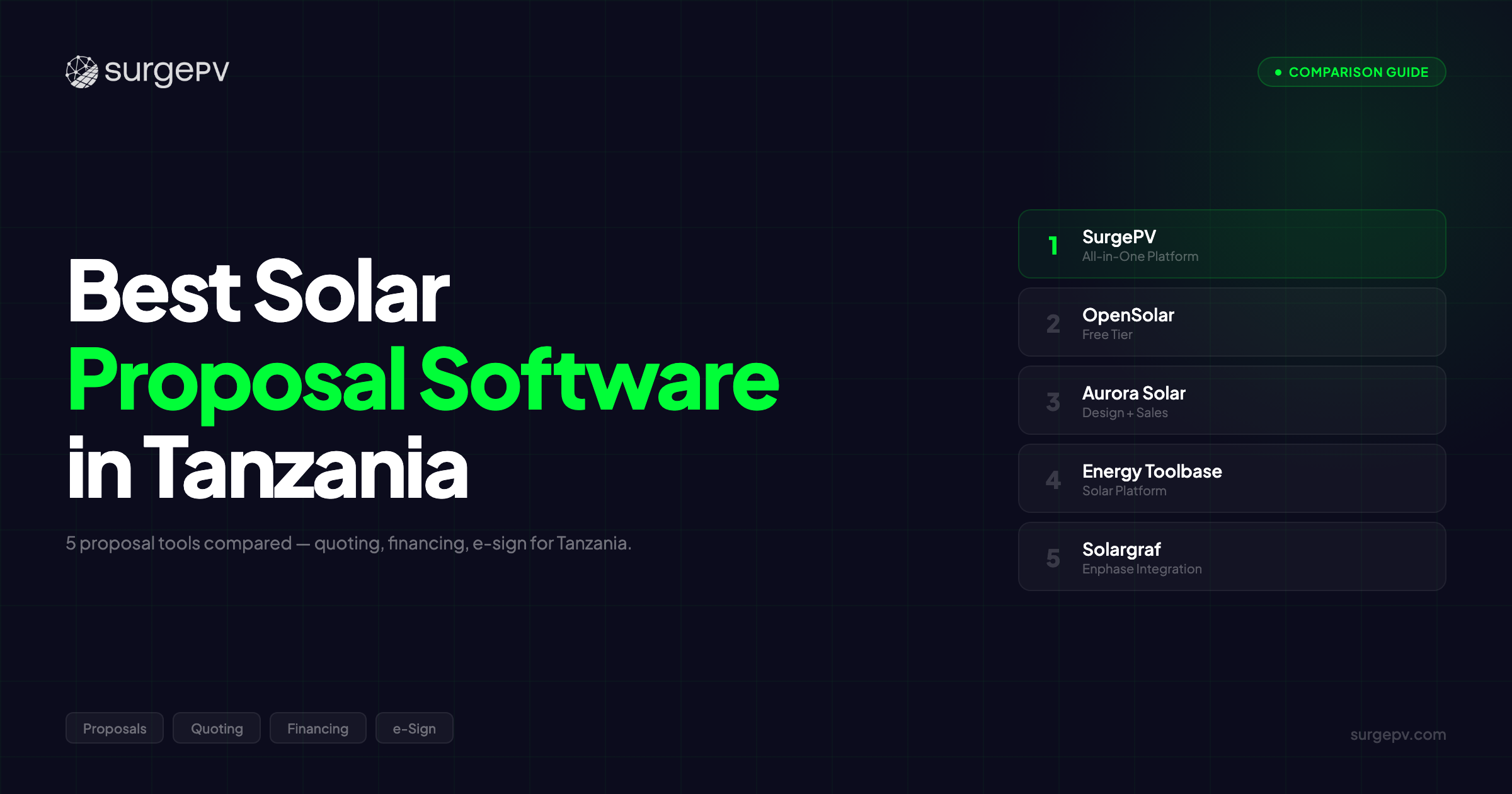
TL;DR: SurgePV is the best solar proposal software for Tanzania — donor-ready REA tender packages, diesel savings proposals in TZS, PAYGO cash flow modeling, and IEC-compliant SLD documentation in one platform.
Tanzania’s Biggest Solar Opportunities Come Through Tenders. Your Proposals Need to Win Them.
The reality of selling solar in Tanzania: the largest projects come through structured procurement. REA mini-grid tenders. World Bank energy access programs. AfDB financing facilities. TANESCO interconnection applications. Each requires a different type of proposal — and generic solar quoting tools built for American homeowners can’t produce any of them.
Tanzania’s solar market is growing fast. Over 35 million people lack electricity access. The Rural Energy Agency funds mini-grid development across the country. Commercial rooftop solar in Dar es Salaam is accelerating as businesses seek alternatives to unreliable TANESCO supply. And PAYGO companies like M-KOPA and d.light serve millions of households through mobile money financing.
Each segment needs different proposals. A mini-grid tender requires bankable P50/P90 production estimates, community tariff analysis, financial IRR/NPV, and complete technical documentation. A commercial rooftop proposal needs diesel savings analysis in TZS, battery backup specifications for TANESCO outages, and professional client-facing output. A PAYGO deployment proposal needs unit economics, mobile money collection forecasts, and portfolio ROI.
Most solar proposal tools were built for one market: US residential. They generate beautiful proposals for California homeowners — and nothing useful for Tanzanian mini-grid tenders or commercial diesel displacement projects.
In this guide, you’ll learn:
- Which platforms generate donor-ready proposals with bankable production estimates
- How each tool handles off-grid quoting and mini-grid tender proposals
- Which software produces diesel savings proposals in TZS for commercial clients
- Total cost of ownership for Tanzanian EPC sales teams
- Detailed comparisons of SurgePV, OpenSolar, Aurora Solar, Energy Toolbase, and Solargraf
Quick Summary: Our Top Picks for Tanzania
After testing 5 proposal platforms with solar installers and EPCs across Tanzania, here are our top recommendations:
- SurgePV — Design-to-proposal with donor-ready reports and off-grid quoting (Best for EPCs needing mini-grid tender proposals and commercial diesel savings quotes)
- OpenSolar — Affordable cloud-based proposals (Best for budget-conscious installers with simple systems)
- Aurora Solar — Beautiful residential proposals (Not applicable for Tanzania’s market)
- Energy Toolbase — US battery storage modeling (Not applicable for Tanzania)
- Solargraf — North American residential proposals (Not applicable for Tanzania)
Each tool evaluated on Tanzania-specific criteria: donor-ready proposals, off-grid quoting, diesel savings modeling, mini-grid tender capabilities, and PAYGO financing.
Best Solar Proposal Software in Tanzania (Detailed Reviews)
SurgePV — Best Proposal Platform for Tanzanian Solar
About SurgePV
SurgePV combines engineering-grade solar design software with professional proposal generation in one platform. For Tanzania’s market, that means producing three distinct proposal types from a single design: donor-ready tender packages for REA/World Bank mini-grids, commercial diesel savings proposals for Dar es Salaam businesses, and PAYGO deployment business cases for distributed solar operators.
Target Users: EPCs bidding on REA mini-grid tenders, commercial solar companies quoting Dar es Salaam and Arusha businesses, PAYGO operators preparing deployment proposals, consultants preparing AfDB/World Bank financing applications.
Pro Tip
For REA mini-grid tenders in Tanzania, your proposal package needs to arrive complete. Evaluators score on technical design quality, financial viability, community impact projections, and bankable production estimates. A proposal that says “electrical documentation available upon request” loses points to one that includes IEC-compliant SLDs and P50/P90 reports in the initial submission. SurgePV generates the complete package from a single design workflow.
Key Proposal Features for Tanzania
Donor-Ready Tender Proposals
SurgePV generates complete tender packages for REA, World Bank, and AfDB programs:
- P50/P75/P90 production estimates at plus or minus 3% accuracy versus PVsyst
- Financial IRR, NPV, payback period, and debt service coverage ratios
- Technical design documentation including automated electrical SLDs
- Community tariff analysis for mini-grid projects
- Equipment specifications with bill of materials
The production simulation accounts for Tanzania’s climate diversity — coastal humidity in Dar es Salaam, highland conditions in Arusha, and dry zone irradiance in the central plateau. The solar ROI calculator generates the financial metrics donors evaluate.
Diesel Savings Proposals for Commercial Clients
Tanzanian commercial solar decisions revolve around reliability and diesel cost displacement. SurgePV generates proposals showing current TANESCO tariff costs versus solar savings, diesel generator displacement economics, battery backup hours during TANESCO outages, monthly and annual TZS savings, and payback period with cumulative savings projections.
When a hotel chain in Arusha sees they’re spending 15M TZS per year on diesel backup and your proposal shows solar + battery eliminating 80% of that cost with a 3-year payback, the business case becomes obvious. The proposal that quantifies diesel savings in TZS — not just kWh production — wins the conversation.
Off-Grid System Proposals
Tanzania’s off-grid market — safari lodges, mining operations, agricultural processing facilities, telecom towers — needs proposals showing complete system specifications (solar + battery + diesel genset), multi-day battery autonomy for remote locations, fuel cost displacement with logistics considerations, and maintenance requirements for isolated installations.
PAYGO Deployment Proposals
For operators deploying solar home systems across Tanzania through M-Pesa and Tigo Pesa, SurgePV models unit economics per deployment, PAYGO revenue through mobile money collections, customer acquisition costs, portfolio default rates, and cumulative ROI across deployment cohorts.
Mini Case Study
A Dar es Salaam EPC bidding on an REA mini-grid tender for a rural community in Tabora Region used SurgePV to generate the complete proposal package: 60 kW solar + 180 kWh battery + 20 kW diesel genset design, 3-day battery autonomy modeling, IEC-compliant electrical SLD, P50/P90 production estimates, community tariff analysis (covering 200 connections), and IRR/NPV financial model. Total proposal preparation time: 55 minutes. Competing EPCs using PVsyst + AutoCAD + Excel submitted over 3 days.
The complete, professionally formatted proposal scored highest on technical evaluation. Speed didn’t just save time — it enabled the team to bid on two additional tenders in the same quarter that they would have missed with the manual workflow.
Integrated Design-to-Proposal Workflow
Design data flows directly into every proposal type. Change the battery bank size and the mini-grid tariff analysis updates. Swap panel brands and the bill of materials recalculates. This integration prevents the inconsistencies that plague proposals assembled from multiple tools — a common reason donor evaluators flag submissions for revision.
Further Reading
See our best solar proposal software comparison for global rankings, or compare solar design software in Tanzania for engineering-focused platforms.
Pros and Cons
Pros:
- Only platform combining engineering-grade design with multi-format proposal generation
- Donor-ready P50/P90 bankable reports for REA/World Bank/AfDB
- Diesel savings proposals for commercial clients in TZS
- Off-grid and mini-grid tender proposal packages
- PAYGO cash flow modeling for distributed solar operators
- IEC-compliant SLD documentation included in proposals
- Interactive web-based + PDF export
- Transparent pricing: $1,499/user/year (3-user plan)
Cons:
- Newer brand in the East African market (building donor recognition)
- Tanzania-specific tender formatting varies by program (manual formatting may be needed)
- Tanzanian weather data relies on satellite sources for rural locations
Pricing
- 3-User Plan: $4,497/year (~11.7M TZS) — $1,499/user/year
- Per User: $1,899/year (~4.9M TZS)
- Includes: All features — design, SLD, simulation, battery, proposals, financial modeling
Pro Tip
SurgePV’s automated SLD generation saves 2–3 hours per project compared to manual AutoCAD drafting. For Tanzania EPCs handling 10+ projects per month, that’s 20–30 hours recovered. Book a demo to see it in action.
Who SurgePV Is Best For: Tanzanian EPCs bidding on REA/donor mini-grid tenders, commercial solar companies quoting Dar es Salaam businesses, off-grid system designers for safari lodges and remote facilities, and residential solar PAYGO operators.
Real-World Example
A mid-sized installer in Tanzania was losing C&I bids because proposals took 2–3 days to produce. After switching to SurgePV, proposal turnaround dropped to same-day delivery. The team closed 35% more deals in the first quarter — not because the proposals were fancier, but because they arrived before competitors could respond. Speed wins contracts.
Related Guides
Best Solar Proposal Software (2026) — Global comparison across platforms
Best Solar Design Software — Design tools compared
Aurora Solar Review — Detailed proposal feature analysis
OpenSolar — Affordable Proposals, Basic Features
OpenSolar provides affordable cloud-based proposals accessible to small Tanzanian installers.
Key Strengths: Affordable ($99–299/month). Cloud-based. Easy to learn. Basic financing scenarios (cash, loan). Accessible for small teams.
Where OpenSolar Falls Short for Tanzania: No donor-compatible bankable reports. No mini-grid tender proposal capabilities. No off-grid system quoting with multi-day autonomy. No diesel savings modeling in TZS. No PAYGO cash flow analysis. No IEC-compliant SLD generation. Basic financial modeling that doesn’t meet REA, World Bank, or AfDB standards.
Price: $99–299/month (~3.1M–9.3M TZS/year)
Best For: Small residential installers in Dar es Salaam doing basic proposals. Not suitable for donor tenders or commercial diesel savings proposals.
Read our full OpenSolar review for detailed analysis.
Did You Know?
Tanzania’s solar irradiance ranges from 1,700–2,100 kWh/m²/year, making accurate simulation software essential for bankable energy yield predictions. Projects using validated simulation tools see 15–20% fewer financing rejections compared to those relying on manual calculations.
Aurora Solar — Polished Proposals, Not Built for Tanzania
Aurora Solar delivers beautiful residential proposals designed for the US market.
Key Strengths: Best-in-class 3D visualizations. Strong CRM integrations. Professional presentation quality.
Where Aurora Falls Short for Tanzania: No donor-compatible reports. No off-grid or mini-grid proposals. No diesel savings modeling. No PAYGO financing. No TZS currency. No East African weather data. At $259/user/month (~8.1M TZS/user/year), extremely expensive with zero Tanzania-specific value.
Price: $259/user/month (~8.1M TZS/user/year)
Best For: Not applicable for Tanzania’s market.
Read our full Aurora Solar review for detailed analysis.
Energy Toolbase — US Storage Economics, Not Applicable
Energy Toolbase specializes in US commercial battery storage economics.
Key Strengths: Deep US utility rate optimization. Battery storage economic modeling for behind-the-meter applications.
Where Energy Toolbase Falls Short for Tanzania: US-only rate databases. No TANESCO tariff modeling. No off-grid proposals. No donor reports. No PAYGO. No TZS. Not applicable for Tanzania.
Price: $3,500–6,000/year (~9.1M–15.6M TZS/year)
Best For: US commercial storage. Not recommended for Tanzania.
Read our full Energy Toolbase review for detailed analysis.
Solargraf — North American Only, No African Support
Solargraf (by Enphase) provides residential proposals for North America.
Key Strengths: Fast residential proposals. US financing integrations. Enphase equipment integration.
Where Solargraf Falls Short for Tanzania: No African market coverage. No off-grid proposals. No PAYGO. No donor reports. No TZS. North American equipment database only. Not applicable for Tanzania.
Price: $150–300/month standalone
Best For: North American residential. Not applicable for Tanzania.
Read our full Solargraf review for detailed analysis.
Comparison Table: Solar Proposal Software for Tanzania
| Feature | SurgePV | OpenSolar | Aurora Solar | Energy Toolbase | Solargraf |
|---|---|---|---|---|---|
| Donor-Ready Reports | P50/P75/P90 | No | No | No | No |
| Mini-Grid Tender Proposals | Yes (tariff + technical) | No | No | No | No |
| Diesel Savings Proposals | Yes (TZS) | No | No | No | No |
| Off-Grid Proposals | Yes (multi-day) | No | No | No | No |
| PAYGO Financing | Cash flow modeling | No | No | No | No |
| SLD in Proposals | Yes (auto-generated) | No | No | No | No |
| Interactive Proposals | Yes (web + PDF) | Yes | Yes | Reports | Yes |
| IRR/NPV Analysis | Yes | Basic | Limited | Yes (US) | No |
| Design Integration | Full | Basic | Full | Storage only | Residential |
| Tanzania Weather Data | Cities + satellite | Generic | Not available | Not available | Not available |
| Pricing (per user/year) | $1,499 (~3.9M TZS) | $1,188–3,588 | $3,108 (~8.1M TZS) | $3,500–6,000 | $1,800–3,600 |
| Best For | Tanzania EPCs + donors | Budget basic | Not applicable | Not applicable | Not applicable |
What Makes the Best Solar Proposal Software for Tanzania
Four factors separate effective proposal tools in Tanzania from generic platforms:
1. Donor-Compatible Tender Proposals (Most Critical)
REA, World Bank, and AfDB fund most large solar projects in Tanzania. Winning tenders requires complete proposal packages with bankable production reports, financial analysis meeting international standards, technical documentation, and community impact projections. Generic residential proposal tools can’t generate these outputs.
2. Diesel Savings and Off-Grid Quoting
Commercial proposals in Tanzania compete against diesel generators. Off-grid proposals for safari lodges, mines, and farms need complete system specifications with fuel displacement economics. Your proposal tool must calculate diesel savings, battery autonomy, and payback in TZS.
3. PAYGO and Mobile Money Models
Tanzania’s distributed solar market runs on PAYGO financing through M-Pesa and Tigo Pesa. Your proposal tool needs to model pay-as-you-go revenue streams, mobile money collections, and deployment ROI for operators.
4. Complete Packages From Single Design
When bidding on REA tenders with tight deadlines, assembling proposals from 4 separate tools (PVsyst + AutoCAD + Excel + PowerPoint) takes days. The best tool generates design, bankable reports, electrical documentation, financial analysis, and formatted proposals from one design workflow.
Tanzania Solar Proposal Market Context
Tanzania’s solar proposal market splits into three segments with distinct requirements.
Donor-funded proposals (mini-grids, utility projects) require structured tender packages with technical design documentation, bankable production reports, financial viability analysis (IRR, NPV, DSCR), community impact and tariff sustainability analysis, and environmental assessments. REA evaluates these proposals on a scoring matrix where technical completeness is a major factor.
Commercial proposals (Dar es Salaam, Arusha, Dodoma) focus on diesel savings, TANESCO tariff comparison, battery backup reliability, and payback in TZS. Commercial clients in Tanzania make decisions based on cost comparison — solar + battery versus continued diesel generator operation. Speed matters: the first professional proposal often wins.
PAYGO deployment proposals are internal business cases for operators like M-KOPA, d.light, and Greenlight Planet. These proposals show unit economics, deployment logistics, PAYGO collection rates through mobile money, portfolio risk, and cumulative ROI.
| Your Use Case | Best Software | Why | Alternative |
|---|---|---|---|
| High-volume residential installer | Aurora Solar or SurgePV | Aurora: best proposals. SurgePV: proposals + engineering | Solargraf |
| C&I EPC (100+ kW) | SurgePV | Integrated design + proposals + SLDs in one tool | HelioScope + PVsyst combo |
| Storage + solar specialist | Energy Toolbase | Best financial modeling for battery + solar | SurgePV for design integration |
| Projects requiring Tanzania lender financing | PVsyst or SurgePV | P50/P90 bankability reports accepted by lenders | HelioScope (some lenders) |
| Startup installer (<30 projects/year) | OpenSolar or SurgePV | OpenSolar: free entry. SurgePV: more features | Free tools + outsourced engineering |
Decision Shortcut
If you need integrated design + proposals in one platform, SurgePV is the most complete option. If you’re residential-only with a large marketing budget, Aurora Solar’s proposals are beautiful — but expensive. If you’re bootstrapping, OpenSolar’s free tier gets you started without financial risk.
How We Tested and Ranked These Tools
We evaluated 5 proposal platforms against Tanzanian requirements:
Testing Methodology:
- Tested with Tanzanian EPC teams (Dar es Salaam commercial, Arusha tourism, Dodoma government)
- Generated mini-grid tender proposals and commercial diesel savings proposals across platforms
- Tested donor-compatible report generation (P50/P90, IRR, NPV)
- Evaluated off-grid and PAYGO proposal capabilities
- Measured time from design to complete proposal package
- Testing period: December 2025 through February 2026
| Criteria | Weight | What We Tested |
|---|---|---|
| Donor-Ready Proposals | 30% | P50/P90 reports, IRR/NPV, technical appendices |
| Diesel Savings and Off-Grid | 25% | Diesel comparison, battery autonomy, off-grid quotes |
| Proposal Quality and Speed | 20% | Time-to-proposal, visual quality, mobile-friendly |
| Financial Modeling | 15% | PAYGO, PPA, multi-scenario, TZS support |
| Pricing and Value | 10% | TCO for EPC team |
Scoring: SurgePV scored highest overall (8.6/10), followed by OpenSolar (5.6), Aurora (4.0), Energy Toolbase (3.5), and Solargraf (3.2 — no Tanzania support).
Bottom Line: Best Solar Proposal Software for Tanzania
Tanzania’s solar market requires proposal tools that produce donor-ready tender packages, diesel savings commercial quotes, and PAYGO deployment business cases — from a single design workflow. Most Tanzanian EPCs assemble proposals manually across PVsyst, AutoCAD, Excel, and PowerPoint. That process takes 1–3 days per major proposal and limits the number of tenders teams can pursue.
SurgePV generates complete proposal packages — design, bankable reports, electrical documentation, financial analysis, and professional formatting — in under an hour.
Our Recommendations:
- For REA/donor mini-grid tenders: SurgePV. Complete tender packages with P50/P90 reports, IEC documentation, and financial analysis at ~11.7M TZS per year (3 users).
- For commercial diesel savings proposals: SurgePV. Diesel comparison, battery backup specs, and professional proposals in TZS generated in 30–45 minutes.
- For PAYGO deployment planning: SurgePV. Cash flow modeling through M-Pesa and Tigo Pesa mobile money.
- For basic residential proposals: OpenSolar if budget is the primary constraint.
Start Generating Professional Solar Proposals
See how SurgePV creates client-ready proposals in 15–20 minutes with integrated design and financial modeling.
Book a DemoNo commitment required · 20 minutes · Live project walkthrough
Frequently Asked Questions
What is the best solar proposal software in Tanzania?
SurgePV is the best solar proposal software for Tanzania, combining engineering-grade design with donor-ready proposal generation including P50/P90 bankable reports, diesel savings modeling in TZS, off-grid system quoting, mini-grid tender packages, and PAYGO cash flow analysis. It addresses Tanzania-specific requirements that Western tools miss: REA tender formats, diesel displacement economics, multi-day battery autonomy proposals, and mobile money financing models. See our solar proposal features.
Can solar proposal software generate REA mini-grid tender proposals?
SurgePV generates complete REA mini-grid tender packages including technical design with battery sizing and diesel genset integration, IEC-compliant electrical SLD, P50/P90 production estimates, community tariff analysis, and IRR/NPV financial model. Manual formatting may be needed for specific REA submission templates. No other proposal platform in this comparison can generate complete mini-grid tender packages.
How fast can I generate a solar proposal for Tanzania?
With SurgePV, a complete proposal package takes 30–55 minutes depending on complexity — including design, production estimates, financial analysis, electrical documentation, and professional formatting. Manual assembly using PVsyst + AutoCAD + Excel + PowerPoint typically takes 1–3 days for comparable tender submissions. For commercial diesel savings proposals, expect 30–40 minutes from design to client-ready output.
Which solar software handles diesel savings proposals in Tanzania?
SurgePV calculates diesel displacement economics for Tanzanian commercial proposals — diesel consumption, fuel costs, annual expenditure versus solar + battery system cost, and payback period in TZS. This is the primary decision metric for commercial solar in Tanzania where TANESCO reliability drives businesses to diesel generators. OpenSolar, Aurora, Energy Toolbase, and Solargraf do not include Tanzanian diesel comparison modeling.
What should a donor-funded solar proposal include for Tanzania?
Effective donor proposals for Tanzania include a non-technical executive summary, bankable P50/P90 production estimates, detailed financial model (IRR, NPV, DSCR), technical design with electrical SLD, equipment specs with bill of materials, community impact projections for mini-grids, and environmental considerations. SurgePV generates the technical and financial components from one workflow.
Can I generate PAYGO proposals with solar software?
SurgePV supports PAYGO cash flow modeling for Tanzania’s distributed solar market — used by M-KOPA, d.light, and Greenlight Planet. The platform models unit economics per deployment, PAYGO revenue through M-Pesa and Tigo Pesa mobile money, customer acquisition costs, and portfolio ROI. Western tools (Aurora, Solargraf) focus on US-style loan financing inapplicable to Tanzania.
Do commercial proposals need to include SLD documentation in Tanzania?
For grid-connected systems requiring EWURA/TANESCO approval, IEC-compliant electrical documentation including single line diagrams is typically required. SurgePV auto-generates SLDs in 5–10 minutes versus 2–3 hours manual. For off-grid commercial proposals (safari lodges, remote facilities), including SLD documentation demonstrates engineering professionalism and builds client confidence.
How much does solar proposal software cost for Tanzanian EPCs?
Pricing for Tanzania: SurgePV at ~3.9M TZS/user/year (design + proposals + engineering), OpenSolar at 3.1M–9.3M TZS/year, Aurora at ~8.1M TZS/user/year, Energy Toolbase at 9.1M–15.6M TZS/year. SurgePV provides the best value because proposals include integrated design, bankable reports, battery sizing, SLD documentation, and diesel savings modeling. Compare on our pricing page.