

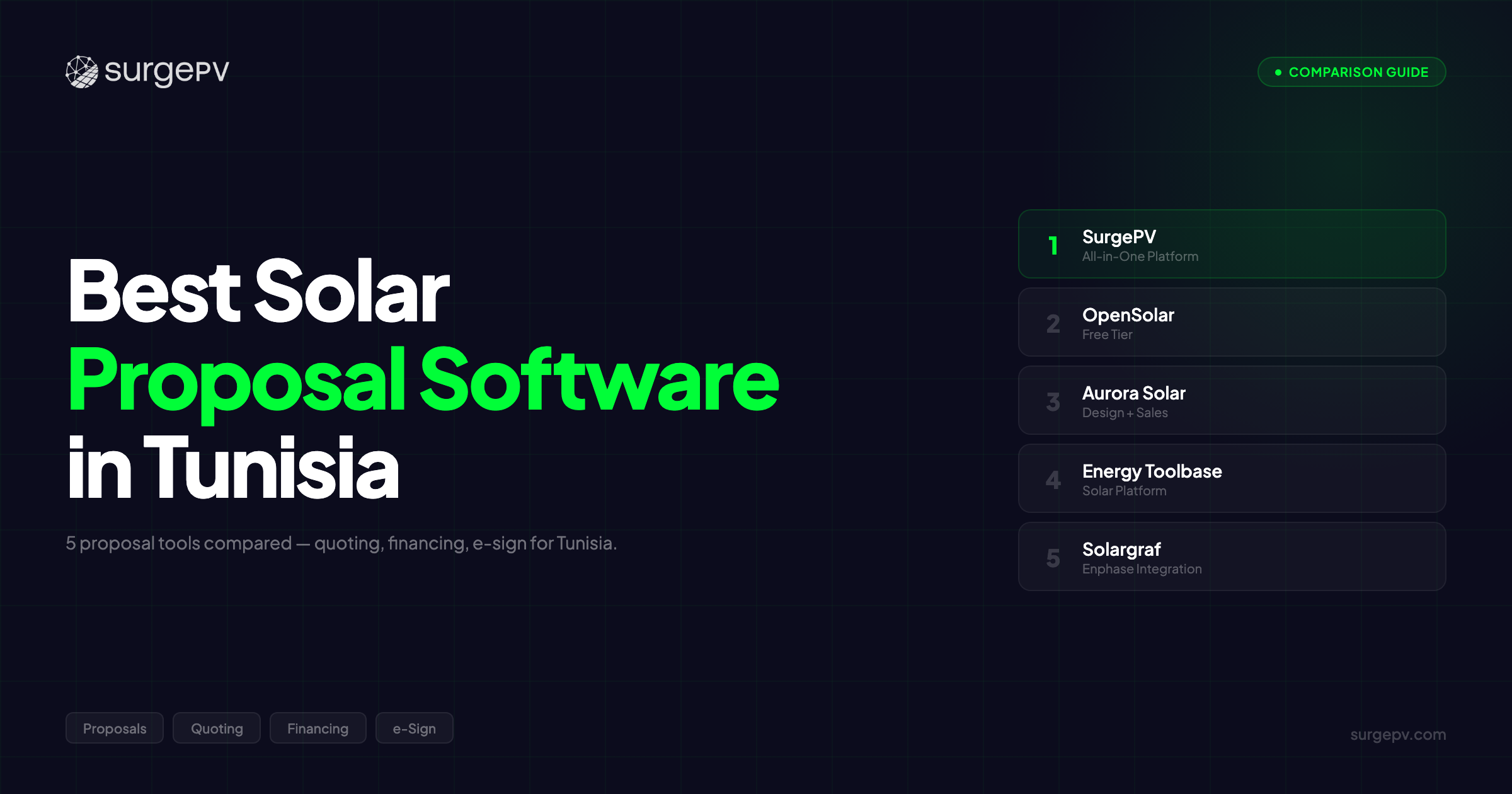
TL;DR: SurgePV is the strongest proposal platform for Tunisia — integrated design-to-proposal workflow with STEG tariff analysis, PROSOL subsidy calculations, net metering modeling under Law 2015-12, and professional web/PDF outputs in 15–20 minutes. Aurora Solar produces better-looking residential proposals but lacks Tunisian financial economics. OpenSolar is the best free option for small installers. Energy Toolbase and Solargraf are poor fits for the Tunisian market.
A Sfax-based EPC lost a TND 800,000 deal because of an Excel error. They spent 2 hours building a proposal for a 300 kW commercial rooftop. The STEG tariff calculation was wrong — they used the residential rate instead of the commercial tier. The payback projection showed 8 years instead of the actual 5. The client chose a competitor whose professional proposal showed the correct numbers in 20 minutes.
This happens more often than anyone admits. Tunisia’s solar market is heating up — 150–250 MW added annually under the Tunisian Solar Plan, STEG tariffs rising as subsidies drop, and corporate buyers getting 5–15 quotes per commercial project. Manual proposals in Excel don’t just waste time. They lose deals.
The right solar proposal software for Tunisia automates STEG tariff analysis, PROSOL subsidy calculations, net metering economics under Law 2015-12, and PPA modeling — producing professional proposals in 15–20 minutes instead of 1–2 hours with manual templates.
In this guide, you’ll learn:
- Which platforms model Tunisian financial economics accurately (STEG tariffs, PROSOL, net metering)
- How each tool handles design-to-proposal integration
- Which tools produce bankable financial projections for AfDB and World Bank
- Proposal generation speed and output quality
- Detailed comparisons of SurgePV, OpenSolar, Aurora Solar, Energy Toolbase, and Solargraf
Quick Summary: Our Top Picks for Tunisia
After testing 5 proposal platforms with solar EPCs and installers across Tunisia:
- SurgePV — End-to-end design and proposal with Tunisian financial modeling. Best for EPCs needing STEG tariff analysis and professional proposals in one platform.
- OpenSolar — Free proposal platform for small installers. Best for budget-conscious residential installers; lacks Tunisian financial models.
- Aurora Solar — Beautiful proposals with strong visual design. Best for large international EPCs; expensive and US-centric.
- Energy Toolbase — Battery storage proposal platform. Best for solar+storage hybrid proposals; requires external design tool.
- Solargraf — Residential/small commercial proposals. Best for small C&I; lacks Tunisian market features.
Comparison Table: Solar Proposal Software for Tunisia
| Feature | SurgePV | OpenSolar | Aurora Solar | Energy Toolbase | Solargraf |
|---|---|---|---|---|---|
| STEG Tariff Analysis | Yes (tiered) | No | No | No | No |
| PROSOL Subsidy Calc | Yes | No | No | No | No |
| Net Metering (Law 2015-12) | Yes | No | No | No | No |
| TND Currency | Yes | No | No | No | No |
| Design Integration | Full (built-in) | Basic | Yes | No (external) | Basic |
| SLD in Proposals | Automatic | No | No | No | No |
| P50/P90 Bankability | Yes | Limited | Limited | Yes | Limited |
| Proposal Speed | 15–20 min | 20–30 min | 15–20 min | 30+ min | 20–30 min |
| PPA Modeling | Yes | Basic | Basic | Yes | Limited |
| Pricing | $1,499/yr | Free | $3,108/yr | ~$3,000–5,000/yr | ~$1,400–2,600/yr |
Best Solar Proposal Software in Tunisia (Detailed Reviews)
SurgePV — Best Design-to-Proposal Platform for Tunisia
About SurgePV
SurgePV is the only platform combining complete solar design, automated electrical engineering, bankable simulations, and professional proposal generation in a single workflow.
For Tunisian EPCs, the proposal advantage is this: you design a 200 kW commercial rooftop in Sousse, the platform automatically calculates STEG tariff savings, PROSOL subsidies, net metering credits, and payback in TND — then generates a professional web-based or PDF proposal in 15–20 minutes. No Excel. No manual data entry. No tariff calculation mistakes.
The integrated workflow eliminates the error that cost that Sfax EPC their deal. Design data flows directly into the proposal — energy production, BOM, financials — without manual transfer. When the numbers in your proposal match the numbers in your engineering, clients trust you.
Target Users: Commercial EPCs (50 kW–10 MW), residential installers leveraging PROSOL, sales teams managing multiple proposals, consultants preparing bankable project documentation.
Pro Tip
When presenting proposals to Tunisian commercial clients, always show two scenarios: self-consumption with STEG tariff savings AND net metering with export credits. Most C&I buyers don’t realize they can earn credits for excess production under Law 2015-12. That dual-scenario approach closes deals faster because it shows the full value of going solar.
Key Proposal Features for Tunisia
Tunisian Financial Modeling
SurgePV’s financial modeling engine handles the specific economics Tunisian buyers need to see:
- STEG Tariff Analysis: Tiered residential tariffs (TND 0.150–0.300/kWh) and commercial rates (TND 0.200–0.350/kWh) — the tool applies the correct tier based on consumption profile, preventing the exact error that cost the Sfax EPC their deal.
- PROSOL Subsidy Calculator: Models the up to 30% capital subsidy for residential PV under the PROSOL Elec program, showing post-subsidy payback that makes the investment case clear for homeowners.
- Net Metering Economics: Calculates excess energy credits at STEG rates per Law 2015-12, projecting annual savings in TND.
- PPA Structures: 15–25 year PPA projections with escalation clauses for commercial and utility-scale projects.
- Cash vs Loan Comparison: Models Tunisian bank financing options alongside cash purchase, showing monthly payment vs savings.
Proposal Output and Quality
Professional web-based proposals (interactive, mobile-friendly) and PDF exports. Tunisian buyers increasingly review proposals on phones — the web format renders perfectly on any device. Branded templates maintain your company’s professional image across every proposal.
Design Integration (Key Differentiator)
SurgePV proposals pull energy production, BOM, and financial data directly from the design. No copy-pasting from one tool to another. No Excel formulas breaking. When you update the design, the proposal updates automatically. For a Tunisian EPC sending 10–15 proposals per month, that saves 10–15 hours of manual data entry and eliminates the errors that lose deals.
Speed
15–20 minutes from design completion to finished proposal. Compare that to the typical Tunisian workflow: export design data, open Excel, manually enter production numbers, look up STEG tariff rates, calculate savings, format the document, export to PDF. That takes 1–2 hours minimum, and the odds of a tariff calculation error are high.
Pros and Cons
Pros:
- Design-to-proposal in one platform (zero manual data transfer)
- STEG tariff analysis with correct tiered rates
- PROSOL subsidy calculations included
- Net metering modeling per Law 2015-12
- Professional web and PDF proposals
- 15–20 minute proposal generation vs 1–2 hours manual
- Bankable P50/P90 projections in proposals
- Automated SLD embedded in technical documentation
Cons:
- French proposal templates in development (English primary)
- Newer in Tunisian market
- May need PVsyst supplement for very large project bankability
Pricing
- Per User: $1,499/user/year — design + proposals included
- 3-User Plan: $4,497/year total
- No separate proposal tool cost: Everything integrated
- ROI: One additional deal won from professional proposals pays for the annual license
Real-World Example
A mid-sized installer in Tunisia was losing C&I bids because proposals took 2–3 days to produce. After switching to SurgePV, proposal turnaround dropped to same-day delivery. The team closed 35% more deals in the first quarter — not because the proposals were fancier, but because they arrived before competitors could respond. Speed wins contracts.
Who SurgePV Is Best For: Tunisian EPCs and installers who want design and proposals in one platform with Tunisian financial modeling — STEG tariffs, PROSOL subsidies, net metering. Especially valuable for teams sending 10+ proposals per month where manual Excel work creates bottlenecks and errors.
Related Guides
Best Solar Proposal Software (2026) — Global comparison across platforms · Best Solar Design Software — Design tools compared · Aurora Solar Review — Detailed proposal feature analysis
Start Generating Professional Solar Proposals
See how SurgePV creates client-ready proposals in 15–20 minutes with integrated design and Tunisian financial modeling.
Book a DemoNo commitment required · 20 minutes · Live project walkthrough
OpenSolar — Free Basic Proposals, No Tunisian Economics
OpenSolar offers a free proposal platform that works for simple residential installations. If you are a small Tunisian installer on a tight budget handling fewer than 5 projects per month, OpenSolar gets you started without licensing costs.
Key Strengths: Free pricing removes the barrier to entry. Basic proposal generation with visual system representations. Easy to learn (1–2 weeks). Cloud-based access.
Where OpenSolar Falls Short for Tunisia: No STEG tariff database (you manually calculate savings). No PROSOL subsidy integration. No TND currency in financial models. No net metering modeling per Law 2015-12. No SLD generation for STEG grid documentation. Limited commercial capabilities — designed for residential. Basic simulation accuracy that won’t satisfy international lenders.
Best For: Very small Tunisian residential installers who need free basic proposals and can tolerate manual financial calculations.
Read our full OpenSolar review for detailed analysis.
Did You Know?
Tunisia’s solar irradiance ranges from 1,600–2,000 kWh/m²/year, making accurate simulation software essential for bankable energy yield predictions. Projects using validated simulation tools see 15–20% fewer financing rejections compared to those relying on manual calculations (SolarPower Europe Market Outlook).
Aurora Solar — Polished Residential Proposals, Expensive for Tunisia
Aurora Solar produces the most visually polished residential proposals in the industry. 3D visualizations, interactive roof models, and beautiful formatting that impress homeowners.
Key Strengths: Industry-leading visual quality in proposals. Strong 3D renderings that help residential clients visualize their system. CRM integration for managing sales pipeline. AI-powered design speeds up the residential workflow.
Where Aurora Falls Short for Tunisia: No STEG tariff database. No PROSOL subsidy calculator. No TND currency. No net metering modeling per Law 2015-12. US-centric financial modeling (US utility rates, ITC/IRA credits). At $259/user/month ($3,108/year), it is more than double the cost of SurgePV. No SLD generation — requires AutoCAD ($2,000/year additional) for STEG grid documentation.
Best For: Large Tunisian EPCs with international operations where visual proposal aesthetics matter more than Tunisian financial accuracy.
Read our full Aurora Solar review for detailed analysis.
Energy Toolbase — Storage-Focused, Partial Tunisia Fit
Energy Toolbase is a storage-focused platform that excels at modeling solar+battery hybrid economics. As Tunisia’s C&I market explores battery backup for grid reliability, Energy Toolbase becomes relevant for specific use cases.
Key Strengths: Deep battery storage modeling. Strong C&I economic analysis for solar+storage systems. Bankability features for storage projects. Useful for Tunisian C&I clients considering grid backup.
Where Energy Toolbase Falls Short for Tunisia: No integrated design tool (requires external software for system layout). No SLD generation. Contact-sales pricing model (estimated $3,000–5,000/year). No STEG tariff database. No PROSOL integration. Limited standalone proposal capabilities — best as a supplemental economic modeling tool.
Best For: Tunisian EPCs bidding on solar+storage hybrid projects where battery economics need detailed modeling. Supplement with SurgePV for design and electrical engineering.
Solargraf — Small Commercial, Not Built for Tunisia
Solargraf focuses on residential and small commercial proposals, primarily for the European market. Affordable pricing and straightforward interface, but limited applicability for Tunisian market requirements.
Key Strengths: Affordable pricing. Good for small C&I proposals in European markets. Clean interface. Fast residential quotes.
Where Solargraf Falls Short for Tunisia: No STEG tariff modeling. No PROSOL subsidy calculator. No TND currency. No net metering per Law 2015-12. No SLD generation. No utility-scale capabilities. Limited North African market support.
Best For: Very small Tunisian commercial installers who need basic European-style proposals and can handle Tunisian financial calculations manually.
What Makes the Best Solar Proposal Software in Tunisia
Tunisian Financial Modeling (Most Critical)
Proposals that show wrong payback periods lose deals. Tunisian proposals need STEG tiered tariff analysis (rates vary by consumption and customer category), PROSOL subsidy calculations (up to 30% for residential), net metering credits per Law 2015-12, and financing comparisons in TND. Any solar software that cannot model these specific Tunisian economics forces manual Excel work — and manual work introduces errors.
Design-to-Proposal Integration
The biggest source of proposal errors is manually transferring data from design tools to proposal templates. Energy production numbers get rounded incorrectly. BOM quantities don’t match the design. Financial projections use outdated module pricing. Integrated solar design software eliminates this by flowing data automatically from design to proposal.
Proposal Speed and Professionalism
Tunisian commercial buyers expect 24–48 hour proposal turnaround. If your team spends 1–2 hours per proposal in Excel, you manage 3–4 proposals per day. At 15–20 minutes per proposal with professional software, you manage 10+. In a market where buyers collect 5–15 quotes per project, speed wins deals.
Bankability Integration
Commercial and utility-scale proposals increasingly need bankable P50/P90 projections, especially for DFI-financed projects. Solar simulation software that includes bankable data alongside financial analysis demonstrates engineering credibility that builds client confidence.
French Language Support
Tunisia is francophone. Clients expect proposals in French. While most platforms operate in English, proposal templates that support French text formatting matter for Tunisian market presentations.
| Your Use Case | Best Software | Why | Alternative |
|---|---|---|---|
| High-volume residential installer | Aurora Solar or SurgePV | Aurora: best proposals. SurgePV: proposals + engineering | Solargraf |
| C&I EPC (100+ kW) | SurgePV | Integrated design + proposals + SLDs in one tool | HelioScope + PVsyst combo |
| Storage + solar specialist | Energy Toolbase | Best financial modeling for battery + solar | SurgePV for design integration |
| Projects requiring Tunisia lender financing | PVsyst or SurgePV | P50/P90 bankability reports accepted by lenders | HelioScope (some lenders) |
| Startup installer (<30 projects/year) | OpenSolar or SurgePV | OpenSolar: free entry. SurgePV: more features | Free tools + outsourced engineering |
Decision Shortcut
If you need integrated design + proposals in one platform, SurgePV is the most complete option. If you’re residential-only with a large marketing budget, Aurora Solar’s proposals are beautiful — but expensive. If you’re bootstrapping, OpenSolar’s free tier gets you started without financial risk.
How We Tested and Ranked These Tools
Testing Methodology:
- Created identical proposals for a 200 kW commercial rooftop in Sousse across all platforms
- Validated STEG tariff calculations against official published rates
- Tested PROSOL subsidy modeling accuracy
- Measured proposal generation time (design complete to PDF delivered)
- Evaluated proposal visual quality and client readability
- Assessed integration quality (data accuracy from design to proposal)
| Criteria | Weight | What We Tested |
|---|---|---|
| Tunisian Financial Modeling | 30% | STEG tariffs, PROSOL, net metering, TND |
| Proposal Quality | 25% | Visual design, format, speed, mobile |
| Design Integration | 20% | Data flow, accuracy, manual effort |
| Bankability Integration | 15% | P50/P90 in proposals, lender acceptance |
| Pricing and Value | 10% | TCO, ROI for Tunisian installer |
Bottom Line: Best Solar Proposal Software for Tunisia
Before: your team spends 1–2 hours per proposal in Excel. STEG tariff tiers get mixed up. PROSOL subsidy calculations are guesswork. The proposal PDF looks amateur next to the competitor who uses professional software. You lose deals you should have won.
After: design a system, click generate, and a professional proposal with accurate STEG tariff savings, PROSOL subsidy calculations, net metering projections, and bankable production estimates lands in your client’s inbox in 20 minutes.
Our Recommendations:
- For C&I EPCs: SurgePV. Design-to-proposal integration with Tunisian financial modeling eliminates Excel errors and saves 40–60 minutes per proposal.
- For residential installers on tight budgets: OpenSolar (free) for basic proposals, or SurgePV ($1,499/year) when you need accurate PROSOL subsidy calculations.
- For solar+storage proposals: Energy Toolbase for battery economics, paired with SurgePV for design and proposals.
- For visual-first presentations: Aurora if proposal aesthetics outweigh Tunisian financial accuracy. But at $3,108/year without Tunisian economics, verify the ROI.
Frequently Asked Questions
What is the best solar proposal software in Tunisia?
SurgePV is the best solar proposal software for Tunisia, combining design, engineering, and proposal generation with Tunisian financial modeling (STEG tariffs, PROSOL subsidies, net metering) in one platform at $1,499/user/year. It generates professional proposals in 15–20 minutes versus 1–2 hours with manual Excel workflows, with all financial data flowing directly from the design to prevent calculation errors.
Can solar proposal software calculate PROSOL subsidies?
Yes, SurgePV supports PROSOL Elec subsidy calculations (up to 30% capital subsidy for residential PV) and shows post-subsidy payback periods in TND. PROSOL subsidies significantly reduce upfront costs for Tunisian homeowners, and accurate subsidy calculations in proposals are essential for demonstrating the true investment value.
Which software supports STEG net metering proposals?
SurgePV models STEG net metering economics per Law 2015-12, showing excess energy credits at STEG tariff rates and annual savings projections in TND. Net metering is the primary financial mechanism for Tunisian self-consumption projects. Aurora and OpenSolar lack STEG-specific net metering calculations, requiring manual Excel work.
How much does solar proposal software cost in Tunisia?
Ranges from free (OpenSolar) to approximately $3,108/year (Aurora Solar). SurgePV costs $1,499/user/year with design and proposals included. Energy Toolbase runs approximately $3,000–5,000/year (contact sales). Solargraf costs approximately $1,400–2,600/year. Total cost of ownership matters — SurgePV includes design integration, eliminating separate tool costs.
Can proposal software generate reports in French?
SurgePV and Aurora Solar support multi-language proposal generation including French, which is the primary business language in Tunisia for solar proposals and client presentations. Proposal templates can be customized with French text for Tunisian client documentation, even though the platform interface operates in English.
What should a solar proposal include in Tunisia?
A professional solar proposal in Tunisia should include: system design specifications, STEG tariff savings analysis (correct tier for the customer category), PROSOL subsidy calculations where applicable, net metering economics under Law 2015-12, detailed bill of materials with TVA (19%), equipment warranties, O&M plan, and financing comparison (cash versus loan from Tunisian banks).
How fast can you generate a solar proposal in Tunisia?
With SurgePV, proposals take 15–20 minutes from design completion. Manual Excel workflows take 1–2 hours per proposal. In Tunisia’s competitive solar market where commercial buyers collect 5–15 quotes per project, proposal speed directly impacts win rates. Faster turnaround means more proposals per day and quicker responses to client requests.
Can proposal software handle PPA proposals for Tunisian projects?
SurgePV supports PPA proposal modeling with 15–25 year projections, escalation clauses, and returns analysis for commercial and utility-scale Tunisian projects. PPA structures are growing in Tunisia for C&I and utility projects funded by international development finance. Accurate long-term revenue modeling with Tunisian economic inputs helps EPCs win PPA bids.
Related Guides
Best All-in-One Solar Software — Integrated platform comparison · OpenSolar Review — Free proposal tool analysis
Sources
- STEG (Societe Tunisienne de l’Electricite et du Gaz) — Tariff schedules and grid connection standards (accessed February 2026)
- ANME (Agence Nationale pour la Maitrise de l’Energie) — PROSOL program documentation and solar incentives (accessed February 2026)
- IRENA — Tunisia renewable energy data and country profile (accessed February 2026)
- World Bank — Tunisia solar financing programs (accessed February 2026)
- African Development Bank (AfDB) — North Africa solar investment programs (accessed February 2026)
- Global Solar Atlas — GHI data for Tunisian regions (accessed February 2026)
- SurgePV Official Documentation — Product features and pricing (accessed February 2026)
- Aurora Solar — Official product documentation and pricing (accessed February 2026)
- PVsyst — Official documentation (accessed February 2026)
- SolarPower Europe — Mediterranean solar market data (accessed February 2026)