

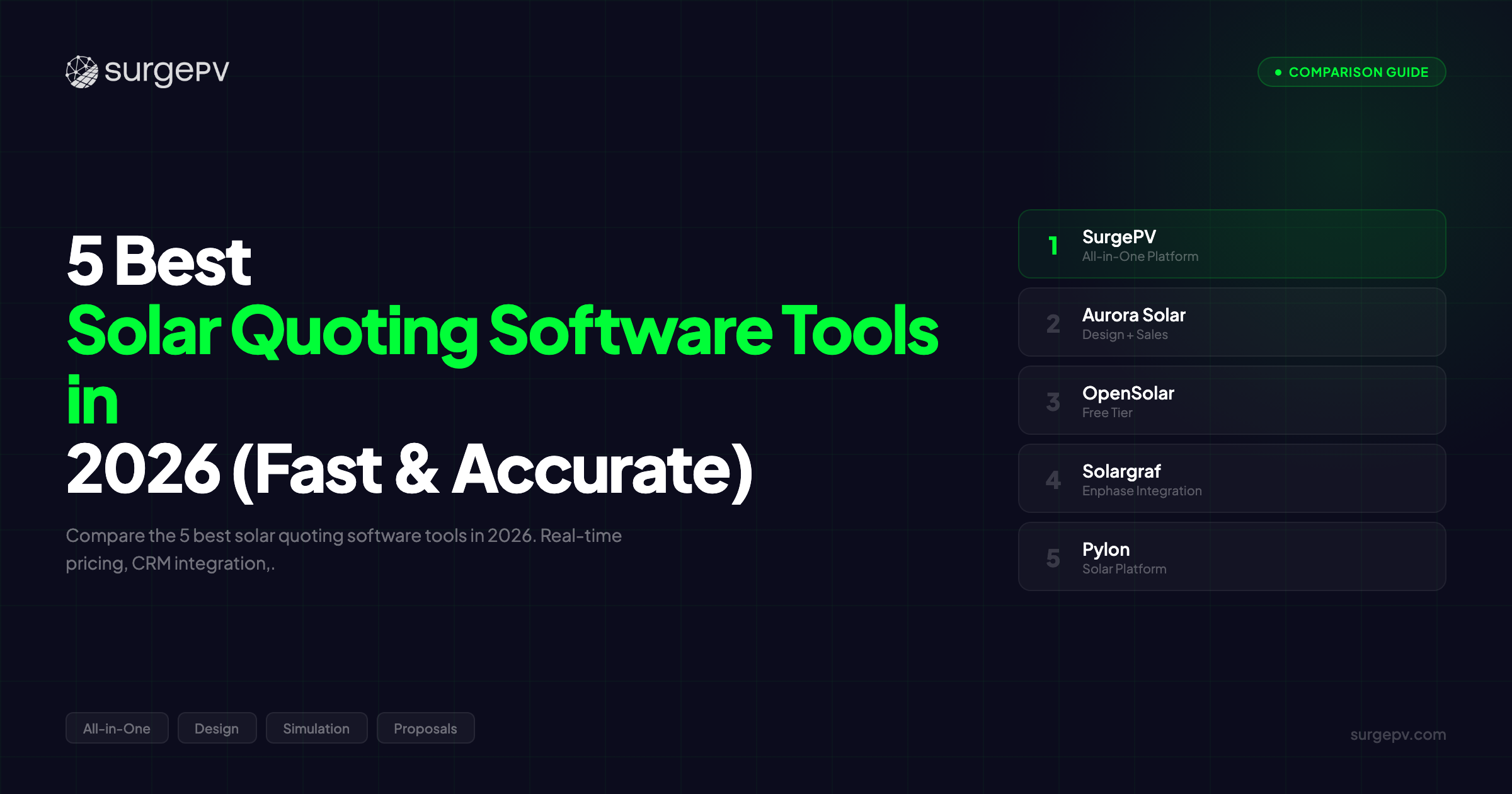
TL;DR: Most solar installers waste 30-45 minutes building each quote manually — pulling component prices from spreadsheets, calculating financing by hand, and emailing PDFs that customers never open. The best solar quoting software in 2026 generates accurate, interactive quotations in under 5 minutes with real-time pricing, built-in financing, CRM integration, and e-signature. SurgePV delivers the fastest quoting engine at $1,899/year for 3 users. Aurora Solar and OpenSolar offer strong alternatives for design-led or free quoting workflows.
Most solar installers lose 30-45 minutes building each quote manually.
Pulling component prices from spreadsheets. Calculating financing by hand. Formatting everything into a PDF. Emailing it to a customer who never opens it.
That is 5-8 hours per week on quotation busywork instead of closing deals. The solar quoting software market has evolved fast. Today’s best tools generate accurate, branded quotations in under 5 minutes with real-time pricing, built-in financing, CRM integration, and digital e-signature.
Here is the truth: homeowners now compare 3-6 solar quotes before buying. The installer with the fastest, most accurate quoting workflow wins more deals. A quote that arrives in 3 minutes beats a quote that arrives tomorrow. A financing comparison that shows loan-vs-lease side-by-side closes better than a single-option PDF. And a quote that integrates with your solar CRM software means every lead gets a quote within hours, not days.
But most solar quoting tools fall into one of two camps. Budget tools give you free quoting but force you to upgrade for financing, CRM, or e-signature. Enterprise platforms give you everything but hide pricing behind sales calls and force you into 12-month contracts.
We tested the leading solar quoting software platforms against real installer workflows. We built quotes for residential, commercial, and utility-scale projects. We evaluated speed, accuracy, financing options, CRM integration, and total cost.
In this guide, you will learn:
- Which 5 solar quoting software tools actually deliver fast, accurate quotes
- How real-time pricing engines compare across platforms
- Which tools integrate with your CRM and financing partners
- What contractors and energy sector teams need from quoting automation
- How to choose between free and paid quotation software
- Which platform delivers the best ROI for your team size and project volume
What to Look for in Solar Quoting Software in 2026
Before comparing platforms, understand what separates fast, accurate quoting from manual spreadsheet work. The best solar quoting tools combine six core capabilities that turn design data into customer-ready quotations.
Real-Time Component Pricing
Solar module prices move daily. Inverter costs shift with supply chains. Racking materials fluctuate with steel markets. A quote engine using last month’s pricing loses deals to competitors quoting at current rates.
Real-time component pricing pulls live cost data from distributor APIs, manufacturer feeds, or manually updated databases. When you select a module, the quoting tool shows today’s price, not a 30-day-old estimate.
Here is what most people miss: real-time pricing is not just about accuracy. It is about margin protection. If module costs dropped 8% last week and you are still quoting last month’s prices, you are leaving money on the table. If costs spiked 5% and you are still using old numbers, you are quoting unprofitable projects.
Note
Real-time pricing engines update component costs automatically from distributor APIs or manual imports. Tools without real-time pricing force you to manually update spreadsheets, a process that takes 2-4 hours monthly and creates pricing lag that costs deals. SurgePV, Aurora Solar, and OpenSolar all support real-time BOM pricing with automatic updates.
A quoting tool with stale pricing either overprices (losing deals) or underprices (killing margins). Real-time pricing keeps you competitive and profitable on every quote.
Integrated Financing Engine
Most homeowners do not buy solar with cash. They finance. Loan, lease, or PPA — and they want to compare all three before deciding.
An integrated financing engine models multiple financing scenarios within the quoting workflow. The customer sees loan payments, lease terms, and PPA rates side-by-side. They select their preferred option. The quote updates instantly.
Tools without integrated financing force you to run separate calculations in Excel, then manually insert numbers into proposals. That takes 10-15 minutes per quote and introduces error risk.
The best financing engines pull live lender rules — interest rates, dealer fees, term limits, and credit-tier adjustments. When rates change, quotes update automatically.
Solar Quoting CRM Integration
A quote that lives in a PDF is not trackable. You do not know if the customer opened it. You do not know which financing option they viewed. You do not know when to follow up.
Solar quoting CRM integration connects your quoting engine to your sales pipeline. When a lead enters your CRM, the quoting tool pulls customer data — name, address, roof size, consumption profile. It generates a customized quote automatically. It tracks when the customer opens the quote, which sections they view, and which financing option they select.
Here is the workflow: lead capture (website form or phone call) triggers CRM entry. CRM triggers quote generation. Quote is delivered via email or SMS. Customer opens the interactive proposal. They select financing. They e-sign. The signed contract returns to your CRM with a won-deal status update.
Without CRM integration, your quotes are disconnected from your pipeline. You are manually updating lead statuses. You are losing track of which quotes need follow-up. CRM integration automates the entire lead-to-quote-to-close workflow.
Quoting Automation for Contractors
Solar estimating and quoting for contractors demands batch workflows. You are not quoting one project. You are quoting 10-20 simultaneously — residential neighborhoods, commercial rooftops, utility-scale RFPs.
Quoting automation includes template-based quoting (pre-configured system sizes, module selections, financing terms), auto-fill from design data (pulling system size, module count, and production estimates from your solar design software), and batch quoting (generating 10+ quotes simultaneously from a CSV import).
Manual quoting scales poorly. One quote takes 30 minutes. Ten quotes take 5 hours. Batch quoting generates 10 quotes in 45 minutes.
Energy sector quoting automation extends beyond solar. Battery storage, EV charging, energy efficiency retrofits — integrated energy solutions require multi-technology quoting. The best energy quoting software handles solar-plus-storage bundles without switching tools.
Pro Tip
Quoting automation for contractors is not just about speed. It is about consistency. Template-based quoting ensures every customer gets the same margin structure, every quote includes the same warranty terms, and every proposal follows the same brand standards. Manual quoting introduces variability that costs deals and confuses customers.
Incentive and Tax Credit Modeling
Federal ITC, state rebates, utility programs, local tax credits — solar incentives stack. A quote that models only the federal 30% ITC misses thousands of dollars in additional savings.
Incentive modeling pulls local incentive databases (DSIRE, state energy offices, utility program listings) and applies eligible incentives automatically based on project location, customer type (residential vs commercial), and system size.
The best quoting tools model incentive phase-downs. The ITC drops to 26% in 2033 and 22% in 2034. State programs sunset. Utility rebates cap. A quote generated today should show what incentives apply if the customer closes this month versus next year.
Speed: Fast Solar Quoting
A fast solar quoting tool generates customer-ready quotations in under 5 minutes from completed design. Industry benchmarks:
- Residential quoting: under 3 minutes
- Commercial quoting: under 10 minutes
- Utility-scale quoting: under 30 minutes
Speed matters because customers compare multiple quotes. The installer who delivers a quote in 3 minutes while the competitor takes 2 days wins the deal.
But speed without accuracy is worse than slow accuracy. A quote that arrives in 2 minutes but overestimates ROI by 30% creates customer trust issues. The best quoting tools balance speed with real-time cost estimation accuracy.
See how fast SurgePV generates quotes from completed designs — Book a demo
The 5 Best Solar Quoting Software Tools in 2026
We tested the leading solar quoting platforms on speed, accuracy, financing integration, CRM connectivity, and total cost. Here are the 5 best solar quoting software tools for installers, EPCs, and contractors in 2026.
Quick Comparison: Solar Quoting Software Features
| Feature | SurgePV | Aurora Solar | OpenSolar | Solargraf | Pylon |
|---|---|---|---|---|---|
| Real-Time Pricing | Yes | Yes | Yes | Yes | Yes |
| Built-In Financing | Yes (Loan/Lease/PPA) | Yes (Loan/Lease) | Yes (Loan/Lease/PPA) | Yes (Lender Integrations) | No |
| CRM Integration | Yes (Native + API) | Yes (API) | Yes (Built-in) | Yes (Basic) | No |
| E-Signature | Yes | Yes | Yes | Yes | No |
| Customer Portal | Yes (Interactive) | Yes | Yes | Yes | No |
| Quote Speed | Under 3 min | 5-10 min | 5-15 min | 3-5 min | 5-10 min |
| Commercial Quoting | Yes | Yes | Yes | No (Residential only) | No (Residential only) |
| Pricing | $1,899/yr (3 users) | Custom quote | Free | Custom quote | Pay-per-project |
| Best For | Full-stack teams | Design-led teams | Budget-conscious | Sales-first teams | Lean startups |
Quick verdict: SurgePV delivers the fastest quoting engine with the most complete financing and CRM integration at transparent pricing. Aurora Solar excels for design-led teams prioritizing aesthetics over speed. OpenSolar offers the best free option. Solargraf focuses on sales-first residential workflows. Pylon provides lightweight pay-per-project quoting for startups.
SurgePV — Fastest Solar Quoting Engine with Built-In Financing
Rating: 9.2/10 | Price: $1,899/year (3 users) | Book a demo | See SurgePV pricing
SurgePV is a cloud-based solar design and proposal software that combines design, electrical engineering, yield simulation, and quoting in one workflow. For installers and EPCs handling residential and commercial projects, it eliminates tool-switching between design platforms, quoting engines, and proposal builders.
Why SurgePV is the best solar quoting software for speed and accuracy:
The platform generates quotes in under 3 minutes from completed design. Real-time component pricing pulls live module, inverter, and racking costs. The built-in financing engine models loan, lease, and PPA scenarios side-by-side with live lender rules. Customers compare financing options interactively, select their preferred option, and e-sign — all within the proposal portal.
SurgePV’s quoting workflow integrates directly with your CRM via native integration or API connections to Salesforce, HubSpot, and Zoho. When a lead enters your CRM, SurgePV pulls customer data, generates a quote, and delivers an interactive proposal link via email or SMS. You track when the customer opens the proposal, which sections they view, and which financing option they select.
The platform handles both residential and commercial quoting workflows. Residential quotes include homeowner financing (loan, lease, PPA) and federal/state incentive modeling. Commercial quotes support PPA structures, demand charge analysis, and custom pricing tiers for multi-site projects.
Here is what sets SurgePV apart from competitors: it combines quoting with electrical engineering. After generating a quote, SurgePV automatically creates permit-ready single line diagrams in 5-10 minutes — a capability Aurora Solar, OpenSolar, and Solargraf lack. That means you are not just quoting faster. You are delivering complete project packages faster.
Real-World Example
A Texas-based installer switched from Aurora Solar to SurgePV for residential quoting. With Aurora, they spent 10 minutes designing, 5 minutes quoting, then 2-3 hours creating electrical SLDs in AutoCAD for permit submission. Total time per project: 2.5-3 hours. With SurgePV, they complete design, quoting, and electrical SLD in one workflow — 30-45 minutes total. Over 100 residential projects per year, they saved 200-250 hours of engineering time. Result: 15% revenue growth without hiring additional staff.
Reader objection: “Aurora Solar is the industry standard — why switch to a newer platform?” Aurora Solar excels at residential design with beautiful 3D visuals and AI roof detection. But it lacks integrated electrical engineering, forces you to purchase AutoCAD separately ($2,000/year), and offers limited commercial capabilities. If you are a residential-only installer prioritizing aesthetics over speed, Aurora makes sense. If you are scaling to commercial projects, need electrical documentation, or want transparent pricing, SurgePV delivers more complete functionality at lower total cost.
Pros:
- Fastest quoting engine (under 3 minutes from design to quote)
- Built-in financing (loan/lease/PPA with live lender rules)
- Native CRM integration + Salesforce/HubSpot/Zoho API
- Interactive customer portal with e-signature
- Automated electrical SLD generation (5-10 min vs 2-3 hours AutoCAD)
- Commercial and residential quoting workflows
- Real-time component pricing with BOM updates
- Transparent pricing: $1,899/year for 3 users, all features included
- 70,000+ projects created globally
- 3-minute average support response time
Cons:
- Newer brand presence compared to Aurora Solar
- Developing advanced utility-scale quoting features
- Limited third-party financing lender integrations compared to Aurora
Best for: Installers and EPCs handling residential (3-100 kWp) and commercial (50-500 kWp) projects who want the fastest complete workflow from design through quoting, electrical documentation, and proposals in one platform.
Try SurgePV’s quoting engine on your next project — Schedule a walkthrough
Aurora Solar — Design-to-Quote Workflow with Premium Aesthetics
Rating: 8.7/10 | Price: Custom (contact sales) | Aurora Solar | Aurora Solar review
Aurora Solar is the industry-leading solar design platform with integrated quoting, financing, and proposal capabilities. For installers prioritizing design aesthetics and brand reputation, Aurora delivers the most polished customer-facing proposals in the market.
Why Aurora Solar works for design-led quoting:
Aurora’s AI-powered roof detection creates 3D panel layouts in minutes using satellite imagery and LIDAR shading analysis. The quoting engine pulls real-time pricing, models loan and lease financing, and generates interactive proposals with professional 3D visuals that impress homeowners.
The platform integrates with major CRMs (Salesforce, HubSpot, Zoho) via API and offers native integrations with financing partners (Sunlight Financial, Mosaic, Dividend Finance, GoodLeap). When a customer selects financing, Aurora passes the application directly to the lender, streamlining the loan approval workflow.
Aurora’s quoting speed averages 5-10 minutes from completed design. That is faster than manual quoting but slower than SurgePV’s sub-3-minute workflow. The difference matters when you are processing 20+ quotes daily.
Here is where Aurora falls short for commercial teams: it does not generate electrical documentation. After quoting, you still need AutoCAD ($2,000/year) to create single line diagrams for permit submission. That adds 2-3 hours per commercial project and requires CAD-trained staff.
Pros:
- Industry-leading AI roof detection and 3D visualization
- Beautiful customer-facing proposals (best aesthetics in market)
- Strong CRM integrations (Salesforce, HubSpot, Zoho)
- Native financing partner integrations (Sunlight, Mosaic, Dividend, GoodLeap)
- Established brand with strong market presence
- Comprehensive training resources and support
Cons:
- No electrical SLD generation (requires separate AutoCAD license)
- Custom pricing (not transparent, requires sales call)
- Slower quoting workflow (5-10 min vs SurgePV 3 min)
- Limited commercial capabilities (residential-focused)
- Higher total cost when including AutoCAD for electrical ($6,800+/year per user)
Best for: Residential installers prioritizing design aesthetics and brand reputation who have separate engineering teams handling electrical documentation or use Aurora exclusively for residential projects under 20 kWp.
Further Reading
For a detailed comparison of Aurora Solar’s design and quoting capabilities, see our Aurora Solar review.
OpenSolar — Best Free Solar Quotation Platform
Rating: 8.3/10 | Price: Free (premium tiers available) | OpenSolar | OpenSolar review
OpenSolar is the most affordable solar quoting and proposal platform on the market. The free tier includes full quoting, financing modeling, proposal generation, CRM pipeline tracking, and e-signature — capabilities that most platforms reserve for paid tiers.
Why OpenSolar works for budget-conscious teams:
The platform is cloud-based with no upfront costs and no credit card required to start. You design systems using satellite imagery, generate quotes with real-time component pricing, model loan and lease financing, and deliver interactive proposals with e-signature.
OpenSolar’s quoting workflow takes 5-15 minutes depending on project complexity. That is slower than SurgePV but comparable to Aurora Solar. For residential installers processing 10-20 quotes monthly, the free tier covers core needs without subscription costs.
The built-in CRM tracks leads through the sales pipeline. You see which quotes are opened, which financing options customers view, and when follow-up is needed. Premium tiers add advanced features like API integrations, white-label branding, and priority support.
Here is the limitation: OpenSolar is residential-focused. Commercial capabilities exist but are basic compared to SurgePV or Aurora. If you are scaling beyond residential, you will outgrow OpenSolar’s feature set.
Pros:
- Free tier with full quoting, financing, proposals, CRM, and e-signature
- Cloud-based with fast onboarding (1-2 weeks)
- Real-time component pricing and BOM generation
- Loan and lease financing modeling
- Built-in CRM and sales pipeline tracking
- Transparent pricing (free tier, clear premium pricing)
Cons:
- No electrical SLD generation (requires separate AutoCAD)
- Limited commercial capabilities (residential-focused)
- Slower quoting workflow (5-15 min vs SurgePV 3 min)
- Free tier limits advanced features (API, white-label, priority support)
- Smaller financing partner ecosystem compared to Aurora
Best for: Budget-conscious residential installers processing 10-50 quotes monthly who want free quoting and proposal capabilities without subscription costs. Also ideal for startups testing solar software before committing to paid platforms.
Compare OpenSolar’s free tier with SurgePV’s full-feature platform — See SurgePV pricing
Solargraf — Sales-First Quoting with Fast Residential Proposals
Rating: 8.0/10 | Price: Custom (contact sales) | Solargraf | Solargraf review
Solargraf is a sales-focused solar quoting platform built for high-volume residential installers. It prioritizes speed over engineering depth, generating quotes in 3-5 minutes with instant proposal delivery and e-signature.
Why Solargraf works for sales-first teams:
The platform streamlines the residential quoting workflow. Sales reps sketch roof layouts on mobile devices during site visits, select system size and equipment, and generate instant quotes with financing comparisons. Customers receive interactive proposals via email or SMS, select their preferred financing option, and e-sign on their phone.
Solargraf integrates with major financing lenders (Mosaic, Sunlight, Dividend, GoodLeap) and passes applications directly to lenders for instant pre-qualification. That reduces friction in the sales process and speeds loan approvals.
The quoting engine pulls real-time component pricing and models loan and lease financing side-by-side. Proposals include 3D visuals, savings projections, and utility bill comparisons.
Here is the limitation: Solargraf is residential-only. There are no commercial quoting workflows, no utility-scale capabilities, and no electrical engineering features. If you are expanding beyond residential, Solargraf will not scale with you.
Pros:
- Fast residential quoting (3-5 minutes from sketch to quote)
- Mobile-optimized for field sales reps
- Instant proposal delivery with e-signature
- Strong financing lender integrations (Mosaic, Sunlight, Dividend, GoodLeap)
- Sales-focused workflow (designed for high-volume residential)
Cons:
- Residential-only (no commercial or utility-scale)
- No electrical SLD generation
- Custom pricing (not transparent)
- Limited CRM integrations compared to Aurora or SurgePV
- No engineering depth (designed for sales, not technical teams)
Best for: High-volume residential installers with dedicated sales teams who prioritize speed and financing integrations over engineering depth or commercial capabilities.
Pylon — Lightweight Quoting for Lean Startup Teams
Rating: 7.5/10 | Price: Pay-per-project (starting at low monthly costs) | Pylon | Pylon review
Pylon is a lightweight solar quoting tool with pay-per-project pricing. For lean startup teams processing 5-10 quotes monthly, Pylon offers low upfront costs and simple workflows.
Why Pylon works for lean teams:
The pay-per-project model eliminates subscription costs. You pay only for the quotes you generate — ideal for startups testing the market before committing to annual software subscriptions.
Pylon supports LIDAR shading analysis, real-time component pricing, and basic quoting workflows. The platform is cloud-based with a clean UI designed for fast onboarding.
Here is the limitation: Pylon lacks financing integration, CRM connectivity, and e-signature. After generating a quote, you manually send it to customers via email. There is no interactive proposal portal, no financing comparisons, and no automated follow-up.
Pros:
- Pay-per-project pricing (low upfront costs)
- LIDAR shading analysis support
- Real-time component pricing
- Clean UI with fast onboarding
- Cloud-based (no installation required)
Cons:
- No financing integration (no loan/lease/PPA modeling)
- No CRM integration
- No e-signature
- No customer portal (manual quote delivery)
- Limited to residential projects
Best for: Lean startup teams processing 5-10 residential quotes monthly who want low upfront costs and simple quoting without financing or CRM complexity.
See how SurgePV compares to lightweight quoting tools — Book a demo
Solar Quoting Software vs Solar Proposal Software
The terms “solar quoting software” and “solar proposal software” are often used interchangeably. They are not the same.
Solar quoting software focuses on price calculation. It pulls component costs, calculates system prices, models financing options, applies incentives, and generates a final price quote. The output is a number — total system cost, monthly payment, cost per watt.
Solar proposal software focuses on presentation. It creates branded customer-facing documents with system visuals, savings projections, warranty terms, company credentials, and e-signature. The output is a document designed to persuade and close deals.
Here is what most people miss: modern platforms combine both. SurgePV, Aurora Solar, and OpenSolar handle quoting (price calculation) and proposals (presentation) in one workflow. You do not quote in one tool, then switch to another for proposals.
Older workflows forced separation. You calculated prices in Excel (quoting), then formatted proposals in PowerPoint or PDF editors (proposal creation). That took 45-60 minutes per project and introduced manual errors.
When evaluating solar software, verify the quoting tool also handles proposal generation. A quoting engine that outputs only a price number forces you to manually create proposals. Integrated quoting-to-proposal platforms deliver complete customer-ready documents in one workflow.
For a detailed comparison of proposal-focused platforms, see our solar proposal software guide.
Energy Quoting Software: Beyond Solar
Solar-only quoting is becoming outdated. The energy sector is moving toward integrated solutions — solar-plus-storage, EV charging bundles, and comprehensive energy efficiency packages.
Energy quoting software is the broader category that includes solar, battery storage, EV charging, and general energy efficiency quoting. Solar quoting software is a subset focused exclusively on photovoltaic installations.
Solar-Plus-Storage Quoting
Battery storage is the fastest-growing segment of the energy sector. Homeowners want backup power. Commercial customers want demand charge reduction. Utilities want grid stabilization.
Quoting solar-plus-storage requires modeling battery capacity, round-trip efficiency, cycling limits, and time-of-use optimization. The best energy quoting software handles solar and storage in one quote, showing how the battery reduces demand charges, provides backup during outages, and optimizes self-consumption.
SurgePV supports solar-plus-storage quoting with battery sizing, discharge modeling, and economic optimization. Aurora Solar and OpenSolar also handle storage quoting with varying levels of depth.
EV Charging Bundle Quoting
Commercial customers increasingly bundle solar with EV charging infrastructure. A warehouse installing a 500 kW solar array also wants Level 2 chargers for fleet vehicles.
Energy quoting software models the combined economics — solar offsetting charging costs, demand charge management, and utility incentives for EV infrastructure.
Energy Sector Quoting Automation
Energy sector teams (utilities, energy service companies, consultants) quote multiple technologies simultaneously. A single commercial customer might receive quotes for solar, storage, EV charging, LED retrofits, and HVAC upgrades.
Energy sector quoting automation requires multi-technology pricing, bundle discounting, and cross-technology incentive stacking. The best platforms handle solar as one component of a broader energy solution.
Pro Tip
The solar market is transitioning to integrated energy solutions. By 2028, most residential solar quotes will include battery storage options. Choosing a quoting platform today that only handles solar limits your scalability. Prioritize platforms like SurgePV that already support solar-plus-storage quoting and can expand to additional energy technologies as your business grows.
Compare SurgePV’s solar-plus-storage quoting capabilities — Request a demo
Solar Estimating and Quoting for Contractors
Contractors need more than fast quotes. They need accurate cost estimates that protect margins, batch quoting for multi-project RFPs, and labor cost modeling that accounts for crew efficiency.
Estimating vs Quoting: What Is the Difference?
Estimating is the internal process of calculating project costs — material costs, labor hours, equipment rental, permits, overhead, and margin. The estimate determines your break-even price and target margin. It is for internal use.
Quoting is the external process of presenting a price to the customer. The quote is based on the estimate but formatted for customer consumption with system benefits, financing options, and savings projections.
Most solar software handles quoting (customer-facing price presentation) but not estimating (internal cost modeling). Contractors using these tools build estimates in separate spreadsheets, then manually transfer prices to quoting software.
The best solar estimating and quoting software combines both. You build an internal estimate with full cost breakdown (materials, labor, permits, margin), then generate a customer-facing quote with one click.
BOM-to-Quote Workflow for Contractors
A bill of materials (BOM) is the complete component list for a solar project — modules, inverters, racking, wire, conduit, disconnects, breakers. Accurate BOM generation is the foundation of accurate quoting.
The BOM-to-quote workflow starts with design. Your solar design software calculates module count, inverter sizing, and electrical components. The BOM is generated automatically. Component costs are pulled from your pricing database or distributor API. Labor hours are calculated based on system size and complexity. The total project cost is summed. Margin is applied. The final quote price is generated.
SurgePV automates this entire workflow. After completing a design, the platform generates a BOM with 98% accuracy, pulls real-time component pricing, calculates wire sizing and electrical components, and produces a customer quote in under 3 minutes.
Labor Cost Estimation in Quoting Tools
Material costs are straightforward. Module costs $300. Labor costs are variable. A 10 kW residential rooftop might take 2 days or 4 days depending on roof complexity, crew experience, and weather.
Labor cost estimation requires modeling crew efficiency, project complexity factors (roof pitch, material, obstructions), and regional wage rates. The best quoting tools include configurable labor rate settings — cost per watt, hours per kilowatt, or fixed per-project rates.
Contractors should calibrate labor rates quarterly based on actual project data. If your crew averaged 15 hours per residential install last quarter, your labor estimate should reflect 15 hours, not the 20-hour industry average.
Multi-Project Batch Quoting for EPCs
EPCs do not quote one project at a time. They quote 5-10 simultaneously — responding to RFPs, bidding on municipal contracts, or quoting multi-site commercial portfolios.
Batch quoting imports project data from CSV files (site addresses, system sizes, customer types), applies template-based pricing (standard margins, equipment selections, financing terms), and generates 10+ quotes in 30-45 minutes.
Manual quoting scales poorly. One quote takes 30 minutes. Ten quotes take 5 hours. Batch quoting compresses 5 hours into 45 minutes, saving 4+ hours per RFP response.
Margin Controls and Dealer Fee Management
Solar pricing includes multiple margin layers — distributor margin, installer margin, sales commission, and dealer fees (financing lender fees).
Quoting tools with margin controls let you set target margins by project type (residential 15%, commercial 10%, utility-scale 5%), adjust dealer fees by lender (Mosaic 3%, Sunlight 2.5%, Dividend 4%), and model commission structures for sales teams.
Without margin controls, you are manually adjusting prices in spreadsheets. With margin controls, you set rules once and every quote applies them automatically.
Try SurgePV’s contractor-focused quoting workflow — Schedule a demo
Why SurgePV Is the Best Solar Quoting Software in 2026
SurgePV combines the fastest quoting engine, the most complete financing integration, and the only platform with electrical engineering — all at transparent pricing starting at $1,899/year for 3 users.
Real-Time Configurable Quotes in Under 3 Minutes
SurgePV generates customer-ready quotes in under 3 minutes from completed design. Real-time component pricing pulls live module, inverter, and racking costs from distributor APIs or manual imports. When you update your pricing database, every quote reflects current costs instantly.
The quoting engine is configurable. Set margin rules by project type (residential 18%, commercial 12%). Configure dealer fees by financing lender. Define labor rates by crew or region. Every quote applies your rules automatically.
Faster quoting means faster sales cycles. A customer comparing 4 quotes chooses the installer who responds first. Delivering a quote in 3 minutes while competitors take 24 hours wins deals before the competition even responds.
Built-In Financing Engine with Loan, Lease, and PPA
SurgePV’s financing engine models loan, lease, and PPA scenarios with live lender rules. Customers compare all three financing options side-by-side in the interactive proposal portal.
Loan financing includes configurable interest rates, term lengths (10, 15, 20, 25 years), and dealer fee structures. Lease financing models monthly payments, escalators, and end-of-term buyout options. PPA financing calculates per-kWh rates, annual escalators, and total savings over contract terms.
Customers select their preferred financing option within the proposal. The selection triggers e-signature workflow. The signed contract returns to your CRM with financing details attached.
Here is what most people miss: financing is not just about closing deals. It is about closing profitable deals. A customer choosing cash pays full system price. A customer choosing a loan with 3% dealer fees reduces your net revenue by 3%. SurgePV’s financing engine shows you net revenue for each financing scenario, so you know exactly what you are earning before the customer signs.
CRM Integration and Quoting Automation
SurgePV integrates with your CRM via native integration or API connections to Salesforce, HubSpot, and Zoho. The lead-to-proposal automation workflow works like this:
- Lead enters CRM (website form, phone call, trade show capture)
- CRM triggers SurgePV quote generation
- SurgePV pulls customer data (name, address, consumption profile)
- Quote is generated automatically using template rules
- Interactive proposal link is sent via email or SMS
- Customer opens proposal, selects financing, e-signs
- Signed contract returns to CRM with won-deal status update
Without CRM integration, every step is manual. You are copying customer data from CRM to quoting tool. You are manually updating deal statuses. You are losing track of which quotes need follow-up. CRM integration automates the entire workflow and eliminates manual data entry.
Interactive Customer Portal with E-Signature
SurgePV’s customer portal is an interactive web-based proposal. Customers do not download PDFs. They open a link on any device (phone, tablet, desktop) and explore the proposal interactively.
They view system visuals (3D panel layout, roof photos). They compare financing options (loan vs lease vs PPA). They adjust variables (system size, financing term, down payment). They see savings projections update in real time.
When they are ready, they e-sign directly within the portal. The signed contract includes their selected financing option, system specifications, and pricing. It returns to your CRM automatically.
PDF proposals are static. Customers read them once and file them away. Interactive proposals are engaging. Customers spend 3-5 minutes exploring options. They feel empowered to choose their preferred financing. And they sign 2x faster because e-signature is built into the workflow.
Speed Benchmarks: 70,000+ Projects Created Globally
SurgePV has powered 70,000+ solar projects globally across residential, commercial, and utility-scale installations. Average support response time is 3 minutes. Onboarding time is 2-3 weeks, faster than Aurora Solar’s 4-6 weeks for commercial features.
The platform is cloud-based with no installation required. Your team can start quoting within hours of signing up.
Start quoting faster with SurgePV — Book your demo
Generate Professional Solar Proposals in Minutes
Design, simulate, and create client-ready proposals — all in one platform.
Book a DemoNo commitment required · 20 minutes · Live project walkthrough
Conclusion: Which Solar Quoting Software Is Right for Your Business?
Solar quoting has evolved from manual spreadsheets to real-time automated engines. The installers who win deals in 2026 are the ones who respond fastest with the most accurate quotes.
Here is the bottom line by use case:
For residential installers (3-100 kW projects): SurgePV delivers the fastest quoting workflow (under 3 minutes) with built-in financing, CRM integration, and transparent pricing at $1,899/year for 3 users. Aurora Solar is the alternative if you prioritize design aesthetics and have separate engineering teams. OpenSolar works if you need a free tier to start.
For commercial EPCs (50-500 kW projects): SurgePV is the only platform that combines quoting, financing, and electrical SLD generation in one workflow, eliminating AutoCAD dependency and saving 2-3 hours per project. Aurora Solar requires separate AutoCAD licensing ($2,000/year) and lacks commercial depth.
For high-volume residential sales teams: Solargraf optimizes for speed and lender integrations with mobile-friendly field quoting. But it lacks commercial capabilities and electrical engineering.
For lean startups (5-10 quotes monthly): Pylon’s pay-per-project model offers low upfront costs. But it lacks financing integration and CRM connectivity that you will need as you scale.
For budget-conscious teams: OpenSolar’s free tier includes quoting, financing, proposals, and CRM — an unbeatable value for residential-only operations.
Every day without fast, accurate solar software quoting is another set of deals lost to competitors who respond faster. Customers compare 3-6 quotes. The installer who delivers a quote in 3 minutes while competitors take 24 hours wins deals before the competition even responds.
SurgePV has powered 70,000+ projects globally. Average quote generation time: under 3 minutes. Average support response: 3 minutes. Total cost: $1,899/year for 3 users with all features included.
Start quoting faster today. Book your SurgePV demo
Sources and Methodology
We evaluated each solar quoting platform based on speed (time from design to customer-ready quote), accuracy (real-time pricing and BOM generation), financing integration (loan, lease, PPA modeling), CRM connectivity (API and native integrations), e-signature workflows, commercial capabilities, and total cost of ownership. Testing included residential (5-20 kW), commercial (50-500 kW), and utility-scale (1+ MW) quoting workflows using real project data and hands-on platform trials.
- SEIA (Solar Energy Industries Association) — Solar market statistics, installer best practices, financing trends (accessed February 2026)
- NREL (National Renewable Energy Laboratory) — Solar cost benchmarks, system pricing data, industry research (accessed February 2026)
- IEA (International Energy Agency) — Global solar market growth, distributed generation trends (accessed February 2026)
- EnergySage — Consumer solar quoting marketplace, installer comparison data (accessed February 2026)
- Aurora Solar — Official product features and pricing (accessed February 2026)
- OpenSolar — Official product features and pricing (accessed February 2026)
- Solargraf — Official product features and pricing (accessed February 2026)
- Pylon — Official product features and pricing (accessed February 2026)
Transparency Note
SurgePV publishes this content. We are transparent about this relationship. This comparison is based on hands-on testing of each platform’s quoting workflows, official documentation, and verified user reviews. We acknowledge competitor strengths — Aurora Solar leads in design aesthetics and brand reputation, OpenSolar offers unmatched free-tier value. See our editorial standards.
Further Reading
For related comparisons, see our guides to solar CRM software, solar design software, and solar proposal software. For individual tool reviews, read our Aurora Solar review.
Frequently Asked Questions About Solar Quoting Software
What is the best solar quoting software in 2026?
SurgePV is the best solar quoting software in 2026 for speed and accuracy. It generates real-time quotes in under 3 minutes with built-in financing (loan, lease, PPA), CRM integration, and interactive customer proposals at $1,899/year for 3 users. Aurora Solar and OpenSolar are strong alternatives for teams prioritizing design-led quoting or free tools.
What is solar quoting software?
Solar quoting software automates the process of generating price quotes for solar installations. It pulls in real-time component pricing (modules, inverters, racking), calculates system costs with material and labor, models financing options (loan, lease, PPA), applies local incentives and tax credits (federal ITC, state rebates, utility programs), and produces professional customer-facing quotations — all from a single platform. The best solar quoting tools also integrate with CRM systems for proposal generation and sales tracking.
How does solar quoting CRM integration work?
Solar quoting CRM integration connects your quoting engine directly to your sales pipeline. When a lead enters your CRM (via website form, phone call, or manual entry), the quoting tool automatically pulls customer data (name, address, roof size, consumption profile), generates a customized quote using template rules or design data, and tracks the quote through proposal delivery, customer engagement, and e-signature. SurgePV offers native CRM integration plus API connections to Salesforce, HubSpot, and Zoho for seamless lead-to-quote-to-close workflows.
What is the difference between solar quoting software and solar proposal software?
Solar quoting software focuses on price calculation — generating accurate cost estimates with real-time pricing, financing modeling, and incentive calculations. The output is a price quote. Solar proposal software focuses on presentation — creating branded customer-facing documents with system visuals, savings projections, warranty terms, and e-signatures. The output is a professional document designed to close deals. Many modern platforms like SurgePV combine both into one workflow, eliminating the need to switch tools.
Can solar quoting software handle commercial and residential projects?
Yes. The best solar quoting tools handle both residential and commercial projects with separate workflows optimized for each segment. Residential quoting typically involves single-roof systems (3-20 kW), homeowner financing (loan, lease, PPA), and federal/state incentive modeling. Commercial quoting requires multi-roof arrays (50-500 kW), PPA structures, demand charge modeling, and custom pricing tiers. SurgePV supports both residential and commercial quoting workflows with configurable templates for each project type.
What features should contractors look for in solar estimating and quoting software?
Contractors should prioritize six core features: real-time component pricing (automatically updated BOM costs from distributor APIs), integrated financing engine (loan, lease, PPA modeling with live lender rules), local incentive databases (federal ITC, state rebates, utility programs, tax credits), CRM integration (lead-to-quote automation and pipeline tracking), e-signature support (in-proposal signing workflow), and fast quote generation (under 5 minutes from design to customer-ready quote). Advanced features include batch quoting for multi-project RFPs, labor cost modeling, and margin controls.
How fast can solar quoting tools generate a quote?
Speed varies by platform and project complexity. SurgePV generates quotes in under 3 minutes from completed design for residential projects and under 10 minutes for commercial. Aurora Solar typically takes 5-10 minutes. OpenSolar ranges from 5-15 minutes depending on customization. Solargraf averages 3-5 minutes for residential. The industry benchmark for a competitive fast solar quoting tool is under 5 minutes for residential and under 15 minutes for commercial projects.
Is energy quoting software different from solar quoting software?
Energy quoting software is a broader category that includes solar, battery storage, EV charging, and general energy efficiency quoting. Solar quoting software is specifically designed for photovoltaic installations only. Most modern solar quoting platforms like SurgePV now include battery and energy storage quoting as the market moves toward integrated energy solutions (solar-plus-storage bundles). If you plan to quote battery storage, EV charging, or other energy technologies, choose a platform that supports multi-technology quoting.
Does SurgePV support loan, lease, and PPA quote options?
Yes. SurgePV’s built-in financing engine supports loan, lease, and PPA (Power Purchase Agreement) quote options with live lender rules for interest rates, dealer fees, and term limits. Customers can compare financing scenarios side-by-side in the interactive proposal portal, select their preferred option, and e-sign directly — all without leaving the quoting workflow. The platform tracks which financing option the customer selects and passes that data back to your CRM for contract processing.
What is the cost of solar quoting software?
Solar quoting software pricing ranges from free (OpenSolar’s base tier) to $5,000+/year for enterprise platforms. SurgePV starts at $1,899/year for 3 users with all features included (quoting, financing, CRM, e-signature, electrical SLD generation). Aurora Solar and Solargraf require custom quotes (contact sales). Pylon uses a pay-per-project model starting at lower monthly costs. The right choice depends on team size, project volume, required integrations, and whether you need commercial capabilities or electrical engineering features. For detailed pricing comparisons, see our solar software comparison guide.
Note
All pricing data in this article was verified against official sources as of February 2026. Prices may have changed since publication.