Italy’s rooftop solar market is experiencing its strongest growth in over a decade. In 2024, more than 2 GW of new rooftop capacity was installed, a 30% increase year-on-year, driven by elevated energy prices, ARERA-regulated luce e gas tariff volatility, and renewed government interest in distributed solar generation.
Yet Italy’s incentive system confuses even experienced solar professionals. Scambio sul posto and Ritiro Dedicato serve different needs. The luce e gas tariff structure directly affects solar ROI in ways that aren’t obvious from headline incentive rates. Off-grid solar rules vary by region and island status. And for German-speaking clients or investors evaluating Italian projects, the Einspeisevergütung comparison requires specific data.
This guide covers every active Italian solar incentive mechanism in 2026, explains how luce e gas tariffs interact with solar economics, examines the off-grid market, and provides GSE application guidance, including a dedicated section for German-speaking audiences. Whether you are an Italian solar installer, a northern European investor, or a homeowner evaluating a rooftop system in Rome or Palermo, this is the complete reference.
TL;DR — Italy Solar Feed-in Tariffs 2026
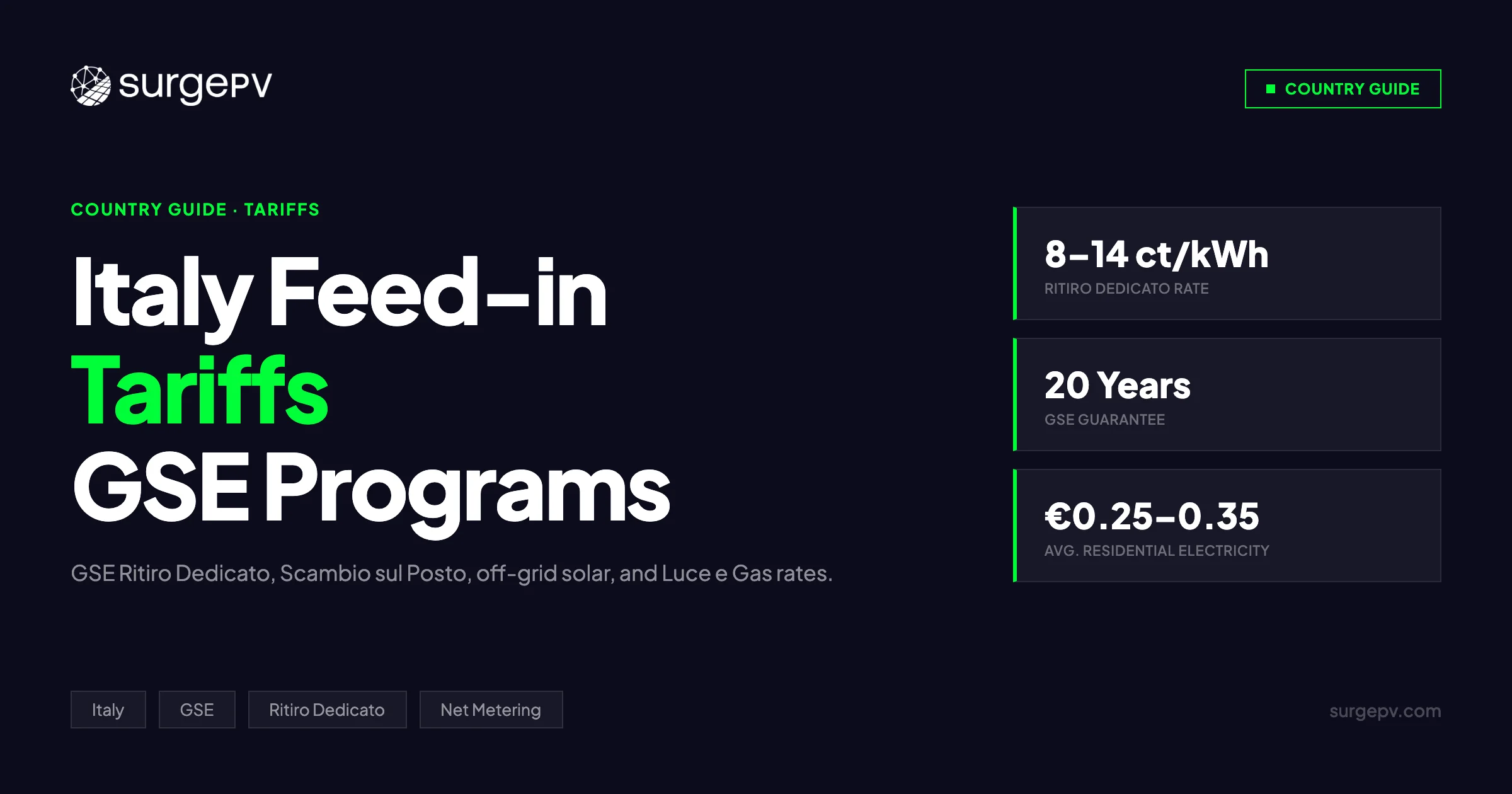
Italy’s main solar incentive mechanisms are Scambio sul posto (virtual net metering, up to 500 kWp) and Ritiro Dedicato (GSE buyback, up to 1 MWp), both managed by GSE. Current buyback rates range from 8–14 ct/kWh guaranteed for 20 years. Elevated luce e gas electricity prices (€0.25–0.35/kWh residential) make self-consumption more valuable than export. Off-grid systems are permitted where grid connection is impractical. Apply to GSE within 60 days of commissioning.
In this guide:
- Latest updates on Italy energy tariffs for 2025 and 2026
- How Scambio sul posto and Ritiro Dedicato work — side-by-side comparison
- Current GSE feed-in tariff rates by system size (table)
- How luce e gas tariffs affect solar ROI
- Italy off-grid solar market — regulations, islands, rural systems
- Einspeisevergütung in Italien — section for German-speaking readers
- GSE application process — step by step
- Payback examples for residential and commercial systems
- Frequently asked questions
Latest Updates: Italy Energy Tariffs 2026
For anyone tracking energy tariffs italy 2025 and 2026, here is the current status of all active solar incentive mechanisms and ARERA tariff changes as of March 2026.
ARERA Electricity Tariff Changes — 2025 to 2026
Italy’s ARERA (Autorità di Regolazione per Energia Reti e Ambiente) regulates the electricity and gas tariff structure that all residential and small business consumers pay. ARERA adjusts the “tutela graduale” and “mercato libero” reference prices quarterly.
Key changes since January 2025:
- Tutela graduale phase-out completed — As of January 2024, the protected tariff (tutela) was replaced by the “servizio a tutele graduali” (STG) for residential and small business consumers. Prices remain regulated but adjusted quarterly.
- Q1 2026 reference electricity price: approximately €0.27–0.31/kWh for residential (including all charges). This compares to €0.18/kWh pre-energy crisis (2020).
- Gas prices: The ARERA gas reference tariff for 2026 is approximately €0.90–1.10/Sm3, down from peaks above €2.00/Sm3 in 2022 but still elevated relative to 2019–2020 levels.
- Oneri di sistema (system charges): These non-avoidable charges are included in luce e gas bills and are partially offsettable through Scambio sul posto settlements.
Italy Solar Incentive Status — March 2026
| Program | Status | System Eligibility | Guarantee Period |
|---|---|---|---|
| Scambio sul posto (SSP) | Active | Up to 500 kWp | Rolling annual settlement |
| Ritiro Dedicato (RID) | Active | Up to 1 MWp | 20 years (minimum guaranteed prices) |
| Superbonus 110% (legacy) | Closed to new applicants | — | Legacy projects only |
| Bonus Casa 50% deduction | Active | Residential, up to 96% deduction | 10-year deduction |
| Comunità Energetiche Rinnovabili (CER) | Active (expanding) | Groups of producers + consumers | 20 years |
| GSE Agri-PV pilot | Active | Agricultural land systems | 20 years |
Key 2025–2026 Regulatory Developments
Comunità Energetiche Rinnovabili (Energy Communities) — Italy’s implementation of the EU Clean Energy Package through Legislative Decree 199/2021 created a framework for Renewable Energy Communities (CERs). Members share virtual net metering benefits, with GSE providing additional incentive payments of 8–11 ct/kWh for shared energy. This is one of the most impactful policy changes of 2025.
Agri-PV expansion — Italy’s PNRR (National Recovery and Resilience Plan) included funding for agri-voltaic installations combining solar generation with agricultural production. GSE manages dedicated incentive programs for qualifying systems.
GSE portal upgrade — The GSE digital portal was upgraded in late 2024 to enable real-time application tracking and digital contract signing. Processing times improved from 90–120 days to 30–60 days for standard SSP and RID applications.
Key Takeaway — Energy Price Context Matters
Italy’s luce e gas electricity prices in 2026 remain approximately 50% above 2020 levels. Every kWh self-consumed from rooftop solar avoids €0.27–0.31/kWh in grid purchases. This makes self-consumption the primary financial driver of Italian solar — not export tariffs. Design systems to maximise self-consumption first.
Italy’s Solar Incentive Landscape: Conto Energia to GSE Programs
Italy was a European solar leader before Germany. The Conto Energia programs (2005–2013) drove rapid deployment by offering generous fixed tariffs directly on all generated electricity. By 2012, Italy had the highest installed solar capacity per capita in Europe.
The Conto Energia Legacy
Five Conto Energia iterations ran from 2005 to 2013:
| Program | Period | Typical Residential Rate |
|---|---|---|
| Conto Energia I | 2005–2007 | €0.44–0.49/kWh |
| Conto Energia II | 2007–2010 | €0.36–0.49/kWh |
| Conto Energia III | 2010–2011 | €0.22–0.34/kWh |
| Conto Energia IV | 2011–2012 | €0.17–0.27/kWh |
| Conto Energia V | 2012–2013 | €0.10–0.22/kWh |
The Conto Energia programs were closed when cumulative subsidy obligations reached the government-set cap of approximately €6.7 billion per year. Systems already admitted continue to receive their contracted rates for the full 20-year guarantee period, meaning systems installed in 2012–2013 still receive payments through 2032–2033.
The Transition to GSE Programs
After 2013, Italy shifted from generation-based tariffs to two mechanisms that remain active today:
- Scambio sul posto — virtual net metering, managed by GSE
- Ritiro Dedicato — dedicated buyback at regulated minimum prices, managed by GSE
Both are supplemented by tax deductions (Bonus Casa 50% or 65%) and, for qualifying groups, the Comunità Energetiche Rinnovabili framework.
Scambio sul Posto: Italy’s Net Metering System
Scambio sul posto (SSP), literally “exchange in place,” is Italy’s primary solar incentive mechanism for residential and small commercial installations. It is managed by GSE (Gestore dei Servizi Energetici), the state-owned energy services operator.
How Scambio sul Posto Works
SSP is a virtual net metering mechanism, not a direct tariff on exported electricity. The mechanism works as follows:
- Your PV system generates electricity. When you consume it directly, you avoid a grid purchase.
- Surplus electricity you do not consume is injected into the grid. Your meter records this as “energia immessa.”
- When your system is not generating (night, cloudy periods), you draw from the grid. Your meter records this as “energia prelevata.”
- GSE calculates the difference in economic value between energia immessa and energia prelevata. If injection value exceeds withdrawal value, GSE pays the difference as “controvalore,” an annual cash settlement.
The critical point: SSP does not pay you for every kWh exported. It pays the net economic difference. If injection value is lower than withdrawal value (which happens when injection occurs at low-tariff periods), the controvalore is zero, you receive no payment, but you also pay nothing to GSE.
Scambio sul Posto Eligibility
| Parameter | Requirement |
|---|---|
| Maximum system size | 500 kWp |
| Grid connection type | Low or medium voltage |
| System type | Any renewable (PV, micro-wind, micro-hydro) |
| Self-consumption | Not restricted |
| Multiple meters | Permitted under certain conditions |
| Application deadline | Within 60 days of grid connection |
What Scambio sul Posto Pays
The SSP controvalore is calculated annually by GSE using the actual zonal electricity prices for the periods when energy was injected. For most residential systems in Southern Italy (higher solar irradiance, more midday production):
| System Scenario | Typical Annual Controvalore |
|---|---|
| 3 kWp residential, Rome | €100–€180/year |
| 6 kWp residential, Sicily | €180–€320/year |
| 10 kWp residential, Milan | €90–€160/year |
| 50 kWp commercial, Naples | €600–€1,100/year |
Note: These controvalore figures are supplementary to the primary saving from self-consumed electricity. A 6 kWp system in Sicily producing 9,000 kWh/year at 60% self-consumption generates approximately €1,350–1,620 in avoided electricity costs (at €0.25–0.30/kWh) plus €180–320 in SSP controvalore, a total annual benefit of €1,530–1,940.
Pro Tip — SSP vs Direct Self-Consumption
The SSP controvalore is valuable but secondary. The primary financial lever is self-consumption. Every kWh consumed directly from your panels saves €0.27–0.31/kWh (avoided luce e gas grid cost), while the SSP credit for injected kWh typically values the same energy at €0.08–0.14/kWh (zonal wholesale price). Design systems with battery storage to shift generation to consumption windows rather than exporting at low wholesale prices.
Ritiro Dedicato: GSE Buyback Tariff
Ritiro Dedicato (RID) is the Italian feed-in mechanism under which GSE purchases exported electricity at regulated minimum guaranteed prices (prezzi minimi garantiti, PMG). Unlike SSP, Ritiro Dedicato provides a direct cash payment for each kWh delivered to the grid.
How Ritiro Dedicato Works
Under RID, you sign a multi-year contract with GSE to sell your exported electricity at regulated minimum prices. Key features:
- GSE pays monthly based on meter readings from your grid operator
- Minimum guaranteed prices are set by ARERA and published quarterly
- If the hourly zonal market price exceeds the PMG, GSE pays the higher market price (riconoscimento del ricavo orario)
- 20-year guarantee on the PMG floor price
Ritiro Dedicato Minimum Guaranteed Prices (2026)
Minimum guaranteed prices (prezzi minimi garantiti) apply to systems up to 1 MWp. These are ARERA-set floor prices, effective 2026:
| System Size | Minimum Guaranteed Price |
|---|---|
| Up to 100 kW | ~8.0 ct/kWh (floor, actual market often higher) |
| 100 kW to 500 kW | ~7.0 ct/kWh |
| 500 kW to 1 MWp | ~6.0 ct/kWh |
Note: When zonal market prices exceed PMG, GSE pays the market rate. In periods of high energy prices (2021–2022), RID recipients received significantly above the PMG floor. Current market conditions in 2026 have stabilized, with zonal prices closer to PMG floors for residential-scale systems.
Key Takeaway — When to Choose RID vs SSP
Choose Ritiro Dedicato if your system exports a large fraction of generation (low on-site consumption, unoccupied building during daylight hours, no battery storage). Choose Scambio sul posto if you have significant on-site consumption loads or battery storage to shift consumption. Systems with 50%+ self-consumption rates almost always benefit more from SSP than RID.
Scambio sul Posto vs Ritiro Dedicato — Side-by-Side
| Factor | Scambio sul Posto (SSP) | Ritiro Dedicato (RID) |
|---|---|---|
| Mechanism | Virtual net metering (value settlement) | Direct buyback at regulated prices |
| Max system size | 500 kWp | 1 MWp |
| Payment timing | Annual settlement by GSE | Monthly payments from GSE |
| Rate guarantee | No fixed rate — market-based value | 20-year PMG floor guarantee |
| Best for | High self-consumption, residential | High export ratio, commercial |
| Application | GSE online portal | GSE online portal |
| Self-consumption impact | Maximises financial return | Less sensitive to self-consumption |
| Battery storage synergy | Excellent | Moderate |
Current GSE Feed-in Tariff Rates by System Size
The following table consolidates the incentive rates available to Italian solar systems in 2026. “GSE FiT” here refers to the combination of SSP controvalore rates and RID minimum guaranteed prices.
Italy Solar Incentive Rates 2026
| System Size | Mechanism | Base Rate | Self-Consumption Value | Total Effective Return |
|---|---|---|---|---|
| < 6 kWp residential | SSP | 8–12 ct/kWh (controvalore) | 27–31 ct/kWh avoided | 35–43 ct/kWh blended |
| 6–20 kWp residential/small commercial | SSP or RID | 8–11 ct/kWh | 27–31 ct/kWh avoided | 35–42 ct/kWh blended |
| 20–100 kWp commercial | SSP or RID | 7–10 ct/kWh | 20–27 ct/kWh avoided | 27–37 ct/kWh blended |
| 100–500 kWp commercial | SSP or RID | 6–8 ct/kWh (RID PMG) | 15–22 ct/kWh avoided | 21–30 ct/kWh blended |
| 500 kWp–1 MWp | RID only | 5–7 ct/kWh (RID PMG) | 12–18 ct/kWh avoided | 17–25 ct/kWh blended |
Blended effective return = weighted average across self-consumed and exported kWh assuming 50–60% self-consumption for residential, 30–40% for commercial. Avoided cost assumes 2026 ARERA reference retail tariff. Source: GSE, ARERA 2026 Q1.
Conto Energia Legacy Rates Still Active
For systems commissioned during the Conto Energia programs, previously contracted rates remain in force for the full 20-year guarantee:
| Program | Typical Rate Still Receiving | Expiry |
|---|---|---|
| Conto Energia III (commissioned 2010–2011) | €0.22–0.34/kWh | 2030–2031 |
| Conto Energia IV (commissioned 2011–2012) | €0.17–0.27/kWh | 2031–2032 |
| Conto Energia V (commissioned 2012–2013) | €0.10–0.22/kWh | 2032–2033 |
These legacy systems represent approximately 18 GW of installed Italian capacity and continue to generate significant cash flows for their owners. The 20-year guarantee structures show how durable long-term tariff commitments can be.
Luce e Gas Tariffs Italy: How Electricity and Gas Pricing Affects Solar Economics
“Luce e gas” is the everyday Italian term for combined electricity (luce, “light”) and gas household utility services. Understanding the luce e gas tariff structure is important for calculating rooftop solar ROI accurately.
The ARERA Regulatory Framework
ARERA (Autorità di Regolazione per Energia Reti e Ambiente) is Italy’s independent energy regulator. It sets:
- Reference tariffs for the protected market (servizio a tutele graduali, STG)
- Network access charges (tariffe di trasporto) — paid by all consumers regardless of energy source
- System charges (oneri di sistema) — levied to fund renewable energy incentives, grid upgrades, and social programs
- Tax components — excise duties (accise) and VAT (22% for most households)
The Luce e Gas Bill Structure
A typical Italian residential electricity bill breaks down as follows:
| Component | Share of Total Bill | Notes |
|---|---|---|
| Energy cost (materia energia) | 40–50% | Wholesale price + retail margin. Solar directly avoids this. |
| Network charges (trasporto) | 25–35% | Fixed and variable components. Partially offsettable via SSP. |
| System charges (oneri di sistema) | 15–20% | Includes renewable energy levies (A3 component). GSE partly offsets via SSP. |
| Taxes (accise + VAT) | 10–15% | VAT 22%. Excise duties are fixed per kWh consumed. |
Critical point for solar economics: Self-consumed solar electricity avoids 100% of the energy cost component, avoids a portion of variable network charges, and avoids tax on avoided kWh. The effective avoided cost per kWh is typically higher than the headline ARERA reference price because you are avoiding the entire bill stacked charges.
Current Luce e Gas Reference Prices (2026 Q1)
| Tariff Component | 2026 Q1 Rate | Notes |
|---|---|---|
| Energy reference price (PUN average) | ~€0.11–0.14/kWh | Wholesale market. Basis for SSP controvalore. |
| Total retail residential price (all-in) | €0.27–0.31/kWh | Including network, system charges, VAT. |
| Gas reference tariff | €0.90–1.10/Sm3 | For residential heating and cooking. |
| F1 peak rate (weekday 8am–7pm) | ~€0.30–0.35/kWh | Higher rate — ideal self-consumption window |
| F2 mid-peak rate | ~€0.27–0.30/kWh | |
| F3 off-peak rate (nights, weekends) | ~€0.24–0.27/kWh |
Source: ARERA, Q1 2026. Rates vary by supplier and contract type in the free market.
How Solar Interacts with Your Luce e Gas Bill
A 6 kWp rooftop system in Rome produces approximately 8,400 kWh/year. Assume 60% self-consumption (5,040 kWh used directly) and 40% export (3,360 kWh injected into the grid):
| Revenue/Saving Category | Calculation | Annual Value |
|---|---|---|
| Avoided luce e gas energy cost | 5,040 kWh × €0.29/kWh | €1,462 |
| SSP controvalore (export credit) | ~€0.09/kWh × 3,360 kWh | €302 |
| Avoided variable network charges | ~€0.04/kWh × 5,040 kWh | €202 |
| Avoided excise and VAT on self-consumed kWh | ~€0.03/kWh × 5,040 kWh | €151 |
| Total annual benefit | €2,117 |
A 6 kWp system in Rome installed for approximately €7,800–9,000 all-in achieves payback in 3.7–4.3 years — without any additional Conto Energia or Superbonus incentive — purely from luce e gas bill savings.
Pro Tip — F1 Self-Consumption Matters
Italian time-of-use tariffs charge the most during F1 periods (weekday 8am–7pm) — the same hours when solar production peaks. This alignment means residential solar self-consumption avoids the most expensive kWh on your luce e gas bill. Systems with east-west panel configurations extend the self-consumption window, capturing F2 and F3 hours as well.
Using accurate solar design software to model Italian time-of-use tariff structures and local irradiance is the difference between a generic financial projection and a bankable one. The generation and financial tool applies these tariff structures directly to projected system output, producing payback and ROI figures grounded in real Italian utility pricing.
Rooftop Solar Italy Incentives Beyond the Feed-in Tariff
Bonus Casa — 50% Tax Deduction
The Bonus Casa (also called Detrazione IRPEF 50%) allows Italian taxpayers to deduct 50% of the cost of installing a residential PV system over 10 years. Key parameters:
| Parameter | Detail |
|---|---|
| Deduction rate | 50% of installation cost |
| Maximum eligible expense | €96,000 per property unit |
| Maximum deduction | €48,000 |
| Deduction period | 10 equal annual installments |
| Applicability | IRPEF taxpayers only |
| Property requirement | Existing residential buildings |
| Income documentation | Certified installer invoice (bonifico parlante) |
For a €8,000 residential system, the Bonus Casa deduction is worth €4,000 over 10 years (€400/year). This is not a cash grant — it reduces tax owed. Taxpayers with low IRPEF liability may not benefit fully.
Comunità Energetiche Rinnovabili (CER) — Energy Communities
Italy’s Comunità Energetiche Rinnovabili program is one of the most impactful post-Conto Energia developments for installer economics. Established under Legislative Decree 199/2021, CERs allow groups of prosumers (producers + consumers) to share virtual energy and receive premium GSE incentives.
| CER Parameter | Detail |
|---|---|
| GSE incentive on shared energy | 8–11 ct/kWh (depending on GSE tariff zone) |
| Maximum combined system size | Unlimited (individual systems up to 1 MWp each) |
| Membership | Any combination of residential, commercial, public bodies |
| Grid connection requirement | Same primary substation (cabina primaria) |
| Application | Via GSE portal |
| Guarantee period | 20 years |
CERs effectively add 8–11 ct/kWh on top of the SSP controvalore for energy shared between members. For apartment buildings, commercial districts, and municipal projects, CERs substantially improve project economics.
Agri-PV Incentives
Italy’s PNRR allocated funding for agri-voltaic systems, where solar panels are installed above or between agricultural crops. GSE manages competitive tenders for qualifying installations:
- Incentive rates: 10–14 ct/kWh on generated electricity for approved agri-PV projects
- Duration: 20 years
- Eligibility: Systems must maintain agricultural production on the land (minimum productivity thresholds set by MiTE)
- Priority for systems under 1 MWp on agricultural land
Further Reading
For the broader European context, see our guide to EU solar energy policies and European solar incentives. For Italy-specific ROI analysis, see our solar panel ROI in Italy guide.
GSE Net Metering Italy: Application Process
Applying to GSE for Scambio sul posto or Ritiro Dedicato is time-sensitive. Errors in documentation or delays in submission after commissioning can cost you months of incentive payments.
Step-by-Step GSE Application
Step 1 — Install and commission your PV system
Engage a certified installer (installatore abilitato) who holds appropriate SOA or CIG qualifications. Your system must meet CEI 0-21 (low voltage connection) or CEI 0-16 (medium voltage) standards. The installer issues a Declaration of Conformity (Dichiarazione di Conformità, DdC) upon completion.
Step 2 — Obtain grid connection from your DSO
Your Distribution System Operator (DSO, typically Enel Distribuzione, Areti, or your local grid operator) must approve and activate the grid connection. They install a bidirectional meter (contatore bidirezionale) capable of recording both injection and withdrawal. This meter is required for SSP and RID — without it, no incentive payment is possible.
Step 3 — Register on the GSE portal within 60 days of grid connection
Create or log in to your account at gse.it. Register your system in the GSE information system (GAUDÌ, the national PV register). Late registration beyond 60 days may result in rejection or delayed payment start.
Step 4 — Submit SSP or RID application
Complete the online application form selecting either Scambio sul posto or Ritiro Dedicato. Required documentation:
- System commissioning certificate
- Installer Declaration of Conformity (DdC)
- Grid connection confirmation from DSO
- Bidirectional meter serial number
- Technical specification sheet for panels and inverter
- Property ownership or lease documentation
- IBAN for payment
Step 5 — GSE review and contract offer
GSE reviews your application and issues a contract offer (proposta contrattuale). Current processing time is 30–60 days. For SSP: the contract defines the settlement calculation methodology. For RID: the contract includes the minimum guaranteed price schedule.
Step 6 — Sign the contract and activate
Sign the contract digitally through the GSE portal. Payments begin from the date of successful grid connection — GSE backdates settlement to the connection date if documentation is complete.
Step 7 — Receive payments
SSP: Annual settlement payment (controvalore) paid by June of the following year for the previous calendar year. RID: Monthly payments based on metering data from your DSO.
Common GSE Application Errors
| Error | Consequence | Prevention |
|---|---|---|
| Missing bidirectional meter installation | Application rejected | Confirm with DSO before submitting application |
| Submitting after 60-day window | Risk of rejection or delayed start date | Mark calendar from connection date |
| Incorrect installer qualification documentation | Processing delay | Verify installer holds SOA/CIG certification upfront |
| Missing DdC (Declaration of Conformity) | Application blocked | Request DdC from installer on day of commissioning |
| Wrong IBAN format | Payment failure | Use Italian IBAN format — 27 characters |
| System size discrepancy vs technical specs | Automatic review escalation | Cross-check kWp in application vs DdC |
Key Takeaway — 60-Day Rule Is Critical
The 60-day window from grid connection to GSE application is strictly enforced for some program variants. Document the exact date your DSO activates the grid connection. Start the GSE portal application within the first week — do not wait for all documents to be “perfect.” You can supplement documentation during the review period.
Model Italian Solar Incentives in Your Client Proposals
SurgePV’s generation and financial tool incorporates GSE SSP controvalore rates, Italian luce e gas tariff structures, and regional irradiance data — so your solar proposals show accurate Italian ROI without manual calculations.
Book a DemoNo commitment required · 20 minutes · Live project walkthrough
Italy Off-Grid Solar Market
Italy’s off-grid solar market is small relative to the grid-connected segment but growing, particularly on minor islands, in rural mountain zones, and among agricultural operations far from grid infrastructure.
Legal Framework for Off-Grid Solar in Italy
Italy’s regulatory framework for off-grid (isola, standalone) solar systems is set by:
- DM 19 maggio 2015 (Ministerial Decree on Energy Systems) — defines requirements for standalone PV systems not connected to the national grid
- CEI EN 62109 — safety standards for inverters in standalone systems
- Municipal planning regulations — apply to panel mounting structures
- AEEG and ARERA guidance — clarify when off-grid systems are permissible versus when grid extension is required
In Italy, full off-grid solar is legally permitted where:
- The property is not currently connected to the national electricity grid (rete nazionale), AND
- Grid extension to the property is not technically or economically feasible (a distance or cost threshold assessment by your local DSO)
Properties already connected to the grid cannot legally disconnect from it entirely to operate a standalone system. Partial off-grid operation with battery backup is permitted (this is effectively a self-consumption system with grid backup, not true off-grid).
Off-Grid Solar on Italian Islands
Italy’s minor islands, particularly those in the Sicilian and Sardinian archipelagos, have been a key proving ground for off-grid and island-mode solar:
| Island / Zone | Off-Grid Solar Context |
|---|---|
| Pantelleria | EU-funded hybrid renewable microgrid; off-grid solar-wind-battery systems operational |
| Lampedusa | Isolated grid with diesel backup; large-scale solar + battery replacing diesel generation |
| Egadi Islands (Favignana, Levanzo, Marettimo) | Microgrid projects with renewable integration |
| Ustica | Solar-diesel hybrid for isolated grid |
| Sardinian agritourism | Many rural properties operate standalone solar due to grid distance |
| Alpine refuges | Completely off-grid solar-battery systems standard at high altitude |
The Italian Ministry of Environment (MITE/MASE) and EU Horizon funding have supported island energy autonomy projects. On Pantelleria specifically, the Isole Zero Petrolio (Oil-Free Islands) initiative has made it a reference model for southern Mediterranean off-grid solar integration.
Rural and Agricultural Off-Grid Applications
Beyond islands, off-grid solar is economically attractive for:
- Agritourism properties in Tuscany, Umbria, Sicily, and Sardinia — where grid extension costs can exceed €20,000–50,000 per km
- Mountain refuges (rifugi alpini) — the Club Alpino Italiano mandates energy independence for many high-altitude huts
- Olive, vineyard, and orchard irrigation systems — solar-powered pumps without grid connection
- Remote livestock operations — off-grid solar + battery for electric fencing, water pumping, and lighting
Off-Grid Solar System Design for Italy
A typical rural Italian off-grid system for a weekend/holiday property:
| Component | Specification | Estimated Cost |
|---|---|---|
| Solar panels | 4–8 kWp | €2,800–5,600 |
| Battery storage | 10–20 kWh lithium | €4,000–10,000 |
| Off-grid inverter/charger | 3–5 kW | €1,500–3,000 |
| Mounting and cabling | — | €800–2,000 |
| Backup diesel or propane generator | 3–5 kVA | €1,200–2,500 |
| Installation and commissioning | — | €1,500–3,000 |
| Total system cost | €11,800–26,100 |
Compare this to a typical grid extension cost estimate of €15,000–60,000+ for a rural Italian property more than 500 metres from the nearest grid connection point. For many properties, off-grid solar with battery storage is significantly cheaper than paying for grid extension.
Incentives for Off-Grid Solar Italy
Off-grid solar systems do not qualify for SSP or RID (which require grid connection). However:
- Bonus Casa 50% deduction applies to off-grid systems on residential properties
- PNRR island energy autonomy funding — specifically for island and isolated community systems; accessed through municipal or regional applications
- Regional agricultural grants — Sicily, Sardinia, Calabria, and Basilicata have active FEASR (European Agricultural Fund for Rural Development) programs supporting on-farm renewable energy systems
- Tax depreciation — commercial off-grid systems (agritourism, farms) benefit from standard Italian business depreciation rules
Accurate shading and irradiance analysis is even more important for off-grid system sizing. An undersized battery or overestimated solar yield leads to power shortages. Our solar shadow analysis software models Italian irradiance conditions by location, orientation, and horizon shading — important for off-grid design in hilly and mountainous terrain.
Einspeisevergütung in Italien
Dieser Abschnitt richtet sich an deutschsprachige Leser und Investoren, die die italienische Einspeisevergütung mit dem deutschen EEG-System vergleichen möchten.
For German-speaking readers searching for information about the Einspeisevergütung in Italien (feed-in tariff in Italy), this section provides a direct comparison between the Italian and German systems.
Was ist die italienische Einspeisevergütung?
Italy does not use the term “Einspeisevergütung” — the equivalent concept is implemented through:
- Ritiro Dedicato (RID) — the closest equivalent to Germany’s Einspeisevergütung. GSE purchases exported electricity at regulated minimum prices for 20 years.
- Scambio sul posto (SSP) — comparable to Germany’s Eigenverbrauch + net metering combination, but implemented as virtual settlement rather than bidirectional metering credits.
Einspeisevergütung Vergleich: Deutschland vs. Italien (2026)
| Parameter | Deutschland (EEG 2026) | Italien (GSE 2026) |
|---|---|---|
| Regulierungsbehörde | Bundesnetzagentur | GSE + ARERA |
| Tarif ≤ 10 kWp (Teileinspeisung) | 8,11 ct/kWh | 8–12 ct/kWh (SSP controvalore) |
| Tarif ≤ 10 kWp (Volleinspeisung) | 12,87 ct/kWh | n/a (RID PMG ~8 ct/kWh) |
| Garantiedauer | 20 Jahre (ab MaStR-Anmeldung) | 20 Jahre (RID) / jährlich (SSP) |
| Selbstverbrauchswert | ~€0,35/kWh | ~€0,27–0,31/kWh |
| Netzanmeldung | MaStR (innerhalb 1 Monat) | GSE GAUDÌ (innerhalb 60 Tage) |
| Förderprogramm | EEG — gesetzlich verankert | GSE SSP / RID — regulatorisch |
| Degression | Monatlich automatisch | Keine automatische Degression |
| Batterieförderung | KfW 442 (bis €3.200) | Bonus Casa 50% (Detraktion) |
Wichtigste Unterschiede für deutsche Investoren
1. Italiens Einspeisevergütung ist marktbasierter
Während die deutsche Einspeisevergütung (EEG) feste gesetzlich garantierte Tarife bietet, ist Italiens SSP-Controvalore an die tatsächlichen Zonenmarkpreise (PUN) gekoppelt. In Stunden mit hohen Strompreisen erhalten Systeme mehr — in Stunden mit niedrigen Preisen weniger. RID bietet einen Mindestpreisboden (PMG), der dem deutschen System ähnlicher ist.
2. Selbstverbrauchswert ist in beiden Märkten der wichtigste Treiber
In Deutschland beträgt der Netzstrompreis ~€0,35/kWh, in Italien ~€0,27–0,31/kWh. In beiden Ländern übertrifft der Eigenverbrauchswert die Einspeisevergütung um einen Faktor von 3–4x, was Eigenverbrauchsoptimierung zur wichtigsten finanziellen Strategie macht.
3. Keine monatliche Degression in Italien
Germany’s EEG automatically reduces tariffs by approximately 1% every 6 months. Italy’s GSE programs do not have automatic degression — but programs can be closed or restructured at any time (as with Conto Energia in 2013). This means there is no urgency to lock in before a degression date, but there is also no statutory guarantee of program continuity for new applicants.
4. Förderrahmen ist weniger kodifiziert
The EEG is a federal law with statutory guarantees. Italy’s GSE programs operate under ministerial decrees that can be modified more easily. For large commercial or industrial investments in Italy, bankability analysis should account for this regulatory risk.
Investitionsrendite: Vergleich Deutschland–Italien
For a comparable 8 kWp residential system:
| Deutschland | Italien (Rom) | Italien (Mailand) | |
|---|---|---|---|
| Jährlicher Ertrag | 6.500–7.600 kWh | 9.600 kWh | 7.200 kWh |
| Systemkosten (all-in) | €10.000–13.600 | €8.500–11.000 | €8.500–11.000 |
| Eigenverbrauchswert (60% SC) | €1.365–1.596 | €1.555–1.728 | €1.166–1.296 |
| Einspeisevergütung/SSP | €272–312 | €307–384 | €230–288 |
| Jährlicher Gesamtnutzen | €1.637–1.908 | €1.862–2.112 | €1.396–1.584 |
| Amortisationszeit | 5,7–7,6 Jahre | 4,0–5,5 Jahre | 5,4–7,3 Jahre |
Italy, particularly the South, offers materially shorter payback periods than Germany for comparable residential systems, primarily due to higher solar irradiance. German subsidies (KfW 442) close some of the gap but do not eliminate Italy’s irradiance advantage.
For German solar companies considering Italian market expansion, solar software with multi-market irradiance and tariff modeling provides the financial analysis quality needed for cross-border project decisions.
Regional Solar Performance: Italy by Zone
Italy’s solar irradiance varies significantly from north to south, a key factor in system economics.
Annual Irradiance by Region (kWh/m²/year)
| Region | Annual Irradiance | 8 kWp Annual Yield |
|---|---|---|
| Sicily (Palermo, Catania) | 1,750–1,900 | 12,000–13,200 kWh |
| Calabria (Reggio Calabria) | 1,700–1,850 | 11,600–12,800 kWh |
| Apulia (Bari, Lecce) | 1,650–1,800 | 11,200–12,400 kWh |
| Campania (Naples) | 1,600–1,750 | 10,900–12,000 kWh |
| Lazio (Rome) | 1,550–1,700 | 10,600–11,600 kWh |
| Tuscany (Florence) | 1,450–1,600 | 9,900–10,900 kWh |
| Emilia-Romagna (Bologna) | 1,350–1,500 | 9,200–10,200 kWh |
| Lombardy (Milan) | 1,200–1,350 | 8,200–9,200 kWh |
| Trentino-Alto Adige (Bolzano) | 1,300–1,450 | 8,900–9,900 kWh |
| Veneto (Venice) | 1,250–1,400 | 8,500–9,500 kWh |
Source: PVGIS (Photovoltaic Geographical Information System), EU Commission JRC. Based on optimal inclination, south-facing installation.
Regional Installation Leaders
Sicily and Apulia — Highest solar irradiance in Italy. Shortest payback periods. Strong agri-PV activity. Active energy community (CER) development. Apulia was a European leader in ground-mount solar during the Conto Energia era and continues to lead in new rooftop additions.
Lombardy — Highest installed base by absolute capacity. Strong BIPV (building-integrated PV) market. Milan municipality runs solar rebate programs. Lower irradiance is partially offset by high electricity prices and strong self-consumption alignment (industrial zones, commercial buildings).
Emilia-Romagna — Active BIPV incentives. Regional law on sustainable building drives solar integration in new construction. Strong CER development in agricultural districts.
Trentino-Alto Adige — High penetration of small agricultural off-grid and island-mode systems. The German-speaking majority in Alto Adige (Südtirol) makes this region specifically relevant for the Einspeisevergütung in Italien discussion above.
Pro Tip — Tilt and Orientation for Maximum Yield
For maximum annual yield in Italy, optimal panel tilt is 30–35° for southern regions and 28–32° for northern regions, facing south. East-west configurations reduce peak output but increase daily production hours, improving self-consumption rates — which is usually more financially valuable than chasing peak yield. Use irradiance modelling to compare both configurations before committing to a design.
ROI and Payback Examples for Italian Rooftop Solar
Example 1: 6 kWp Residential — Rome (Lazio)
System parameters:
- System size: 6 kWp
- Annual production: 8,400 kWh (1,400 kWh/kWp)
- Self-consumption: 60% (5,040 kWh)
- Export: 40% (3,360 kWh)
- Mechanism: SSP
Financial analysis:
| Category | Annual Value |
|---|---|
| Avoided luce e gas cost (€0.29/kWh × 5,040 kWh) | €1,462 |
| SSP controvalore (est. €0.09/kWh × 3,360 kWh) | €302 |
| Bonus Casa 50% deduction (amortized over 10 years) | €440/year |
| Total annual benefit | €2,204 |
| System cost (all-in, inc. installation) | €8,200 |
| Net investment after 10-year Bonus Casa | €4,200 effective |
| Simple payback | 3.7 years (gross) / 1.9 years (after deduction) |
Example 2: 20 kWp Commercial Rooftop — Naples (Campania)
System parameters:
- System size: 20 kWp
- Annual production: 26,000 kWh (1,300 kWh/kWp)
- Self-consumption: 45% (11,700 kWh) — daytime business operation
- Export: 55% (14,300 kWh)
- Mechanism: RID (higher export ratio favours RID over SSP)
Financial analysis:
| Category | Annual Value |
|---|---|
| Avoided business electricity cost (€0.24/kWh × 11,700 kWh) | €2,808 |
| RID minimum guaranteed price (€0.08/kWh × 14,300 kWh) | €1,144 |
| VAT recovery on system purchase | €3,960 (one-time) |
| Accelerated depreciation (Italian tax, year 1) | ~€2,500 equivalent |
| Total year-1 benefit (incl. one-time) | €10,412 |
| Annual benefit (years 2+) | €3,952 |
| System cost (all-in) | €19,500 |
| Net after VAT recovery | €15,540 |
| Simple payback | 3.9 years |
Example 3: 8 kWp Off-Grid — Rural Sicilian Property
System parameters:
- 8 kWp solar panels + 20 kWh lithium battery + off-grid inverter
- Annual production: 11,200 kWh
- Self-consumption: 95% (off-grid)
- Alternative: grid extension cost quoted at €38,000
Financial analysis:
| Category | Value |
|---|---|
| Off-grid system total cost | €22,000 |
| Grid extension cost avoided | €38,000 |
| Net saving vs grid extension | €16,000 |
| Annual diesel generator cost saved | €800–1,200/year |
| Bonus Casa deduction (50% over 10 years) | €11,000 |
| Effective payback vs grid extension alternative | Immediate net positive |
For rural Sicilian properties more than 400 metres from the grid, off-grid solar is often the only economically rational choice. Solar proposal software that can model both grid-connected and off-grid scenarios enables Italian solar installers to present clients with a complete cost comparison.
The Rooftop Solar Installation Process in Italy
Five-Stage Implementation
Stage 1 — Site assessment and design
Engage a certified solar designer or installer for a professional site assessment covering roof structure, orientation, shading analysis, and electrical system compatibility. Use solar shadow analysis software to quantify the impact of nearby buildings, trees, or chimneys on annual yield.
Stage 2 — Permitting (CILA or PAS)
Most rooftop PV installations in Italy proceed via CILA (Comunicazione Inizio Lavori Asseverata), a simplified permit communication with your municipality. Systems on listed historic buildings or in protected landscape zones may require a full building permit (PdC). Your installer handles this as part of the service in most cases.
Stage 3 — Grid connection request to DSO
Submit a grid connection request (Richiesta di Connessione) to your local DSO (Enel Distribuzione, Areti, or regional operator). The DSO evaluates capacity and issues a grid connection offer (preventivo di connessione). For residential systems under 6 kWp, this process is typically 30–60 days. Medium-voltage commercial connections take 60–180 days.
Stage 4 — Installation and commissioning
Installation typically takes 1–3 days for residential, 3–7 days for commercial. Installer issues the Declaration of Conformity (Dichiarazione di Conformità, DdC) after commissioning. DSO activates the bidirectional meter.
Stage 5 — GSE application (SSP or RID)
As detailed in the GSE application section above: register on gse.it within 60 days of grid connection, submit all documentation, await contract and activate payments.
Conclusion
Italy’s solar incentive mix in 2026 rewards those who understand the mechanism differences. Scambio sul posto and Ritiro Dedicato serve distinct financial profiles: self-consumption-dominant systems benefit most from SSP, while high-export commercial systems favour RID’s guaranteed minimum prices. The luce e gas tariff context amplifies both — with residential electricity at €0.27–0.31/kWh, Italy’s solar self-consumption economics are among the strongest in Europe.
For German-speaking investors and installers evaluating Italy, the Einspeisevergütung in Italien numbers hold up: similar guarantee structures to the EEG, significantly higher irradiance in the South, and shorter payback periods for comparable systems — partially offset by less codified regulatory certainty than the German statutory framework.
Off-grid solar in Italy has real economic substance, particularly on southern islands, rural properties in Sicily and Sardinia, and mountain agricultural operations where grid extension costs are prohibitive.
The three most important actions for solar professionals working in Italy:
- Choose the right mechanism for each project — SSP for high self-consumption, RID for high export, CER for groups of prosumers sharing generation
- Submit to GSE within 60 days of grid connection — the most common and costly application error is missing this window
- Model luce e gas tariff interaction accurately — headline feed-in rates undersell Italian solar economics; the avoided electricity cost is 3–4x more valuable than the export tariff
For a complete European solar policy comparison, see our guides to EU solar energy policies and European solar incentives.
Frequently Asked Questions
What is the current feed-in tariff rate for solar in Italy in 2026?
Italy’s current feed-in tariff rates under the GSE Ritiro Dedicato program range from approximately 8–14 ct/kWh depending on system size and technology. Small rooftop systems under 20 kWp typically receive 10–14 ct/kWh, while larger commercial systems receive lower rates. Rates are guaranteed for 20 years. The Scambio sul posto (net metering) mechanism provides an additional virtual credit for energy self-consumed versus exported.
How does Scambio sul posto work in Italy?
Scambio sul posto (SSP) is Italy’s virtual net metering scheme managed by GSE. Rather than paying a direct cash tariff for exported energy, SSP calculates the difference in value between energy injected into the grid and energy withdrawn at different times. If injection value exceeds withdrawal value, GSE pays the net difference as an annual settlement (controvalore). SSP is available for systems up to 500 kWp and is the most popular mechanism for residential and small commercial solar.
What is Ritiro Dedicato in Italy?
Ritiro Dedicato (RID) is an incentive mechanism under which GSE purchases all electricity exported by a PV system at regulated minimum guaranteed prices (prezzi minimi garantiti). This is the Italian equivalent of Germany’s Einspeisevergütung — a direct feed-in payment at regulated prices. GSE guarantees the minimum price floor for 20 years. Systems up to 1 MWp can apply for RID.
How do Italy energy tariffs (luce e gas) affect rooftop solar economics in 2026?
Italy’s ARERA-regulated luce e gas electricity prices of €0.27–0.31/kWh for residential consumers make self-consumed solar electricity significantly more valuable than exported electricity (which earns 8–12 ct/kWh via GSE programs). Every kWh self-consumed from a rooftop system avoids €0.27–0.31 in grid charges, making self-consumption the primary financial driver of Italian solar economics.
Can I go off-grid with solar in Italy?
Full off-grid solar systems in Italy are permitted on properties not connected to the national grid where grid connection is not technically or economically feasible. Islands like Pantelleria, Lampedusa, and rural Sicilian and Sardinian properties are common off-grid solar applications. Properties already connected to the grid cannot legally disconnect entirely, but can operate with battery backup and minimal grid draw.
What is Einspeisevergütung in Italy compared to Germany?
The Italian Einspeisevergütung equivalent is the GSE Ritiro Dedicato program, offering 8–14 ct/kWh guaranteed for 20 years — comparable to Germany’s EEG rate of 8.11 ct/kWh for systems up to 10 kWp. Italy’s irradiance is significantly higher (especially in the South), making Italian systems financially superior in most residential scenarios despite lower individual tariff rates.
How do I apply to GSE for Scambio sul posto or Ritiro Dedicato?
Apply via the GSE online portal (gse.it) within 60 days of grid connection. Required documents: commissioning certificate, installer Declaration of Conformity (DdC), bidirectional meter confirmation from your DSO, technical specs for panels and inverter, property documentation, and IBAN. Processing takes 30–60 days. GSE backdates payments to your grid connection date if the application is complete.
What is luce e gas in Italy?
Luce e gas (light and gas) is the standard Italian term for combined electricity and gas household utility services, regulated by ARERA. The electricity component of luce e gas bills includes the energy cost (materia energia), network charges (trasporto), system charges (oneri di sistema), and VAT. Rooftop solar directly reduces the energy component and variable network charges; Scambio sul posto offsets a further portion of system charges through the annual controvalore settlement.