
Most solar installers spend money on marketing that does not work. They buy lead lists. They run generic Facebook ads. They sponsor local events and wait. Meanwhile, the installer down the road is closing deals at 28% because their Google reviews are impeccable, their proposals look like they came from a Fortune 500 company, and they send every happy customer a referral check.
Marketing for solar installers in 2026 is not complicated — but it is specific. The channels that work are different from what worked in 2020. The expectations customers bring to the table are higher. And the installers who understand that marketing does not end at lead generation — it extends through the proposal, the site visit, and the post-install follow-up — are the ones pulling away from the pack.
This guide covers every channel worth your time and money, with real cost-per-lead data, conversion benchmarks, and practical implementation steps you can act on this week.
TL;DR — Solar Installer Marketing 2026
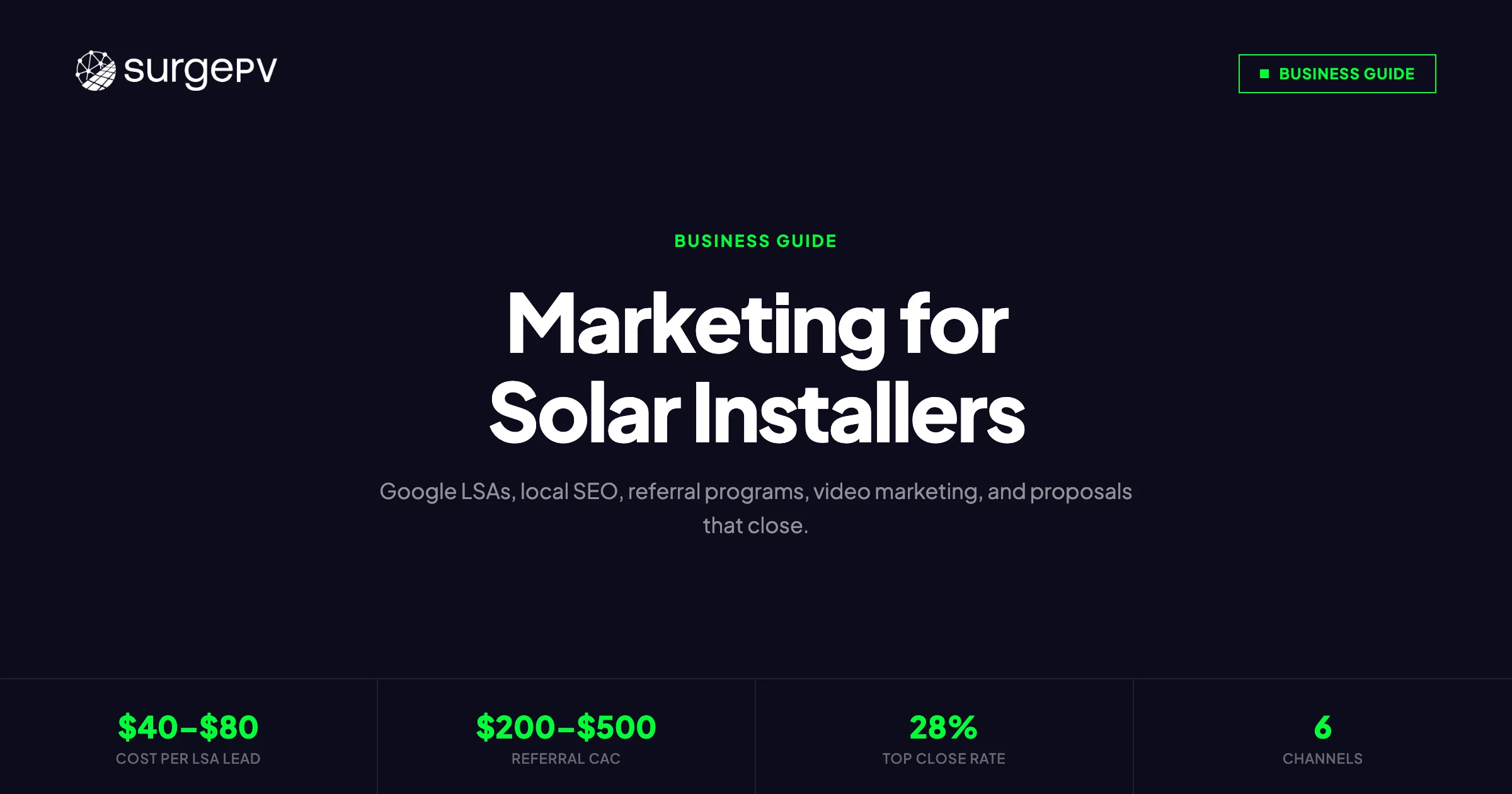
The top-performing solar marketing channels in 2026 are Google Local Services Ads ($40–$80/verified lead), referral programs ($200–$500 CAC vs. $150–$400 for digital), local SEO for city-level terms, and professional proposals that double as sales tools. Review management on Google and EnergySage is table stakes. Door-to-door is declining but still viable in high-density suburban markets. Video and YouTube are underused and high-ROI for installers who commit to them.
In this guide:
- Why most solar marketing fails and what to fix first
- Latest 2026 solar marketing trends and channel data
- Google Local Services Ads: setup, cost, and optimization
- Local SEO for solar: how to rank in your city
- Review management on Google, Trustpilot, and EnergySage
- Referral programs: data on CAC vs. referral cost
- Door-to-door vs. digital: honest comparison
- Your solar proposal as a marketing tool
- Video marketing and YouTube for solar installers
- Social proof, case studies, and portfolio content
- Paid social vs. Google Ads for solar
- How solar design software supports every marketing channel
Latest Updates: Solar Marketing Trends 2026
The solar marketing space shifted meaningfully between 2023 and 2026. Here is what changed and what it means for your acquisition strategy.
Google’s Local Services Ads expanded solar coverage. In 2025, Google added enhanced verification tiers for solar installers — including license verification, insurance confirmation, and background check status — displayed directly on the ad unit. Installers with verified badges see 22–31% higher click-through rates than unverified competitors. If you have not completed the Google Guarantee verification for solar, it is now non-negotiable.
EnergySage introduced price transparency scoring. The platform began surfacing installers who provide itemized quotes more prominently. Installers using professional solar proposal software who can generate clean, itemized proposals quickly are winning more EnergySage quote requests because speed and presentation quality both affect platform ranking.
AI-generated reviews are triggering Google suppression. Google’s spam detection tightened significantly in 2025. Installers using review generation services that solicit bulk reviews in short windows are seeing profiles demoted or suppressed. Organic, steady review velocity — one to five per week over time — outperforms burst campaigns.
Short-form video is the fastest-growing lead source for under-50-employee installers. According to the Solar Energy Industries Association 2025 installer survey, 34% of installers under 50 employees cited YouTube Shorts and Instagram Reels as a “significant” or “primary” lead source — up from 11% in 2022. The content is cheap to produce and has a long tail.
Referral programs are formalizing. The informal “tell your neighbor” approach has given way to structured programs with automatic trigger emails, gift cards, and CRM-tracked referral attribution. Installers with formal programs report referral CAC 40–60% below their paid channel CAC.
Solar Marketing Channel Performance — 2026 Benchmark Table
| Channel | Avg. Cost Per Lead | Avg. Close Rate | Notes |
|---|---|---|---|
| Google Local Services Ads | $40–$80 | 18–26% | Verified leads; quality is high |
| Referral Program | $50–$120 | 35–50% | Includes reward + overhead |
| Local SEO / Organic | $15–$40 (cost per lead equivalent) | 20–28% | Requires 6–12 month ramp |
| EnergySage Listing | $60–$100 | 14–22% | Price-competitive; quote speed matters |
| Google Search Ads (non-LSA) | $80–$160 | 12–18% | Competitive; requires tight geo-targeting |
| Facebook / Instagram Ads | $45–$90 | 10–16% | Top-of-funnel; longer sales cycle |
| Door-to-Door | $30–$70 | 8–14% | Higher volume, lower quality on average |
| YouTube / Video | $20–$55 (mature channel) | 22–32% | 6–12 month ramp; high close rate |
Pro Tip
Track cost per closed deal — not just cost per lead. A channel with $45 leads and a 10% close rate costs $450 per customer. A referral channel with $100 leads and a 45% close rate costs $222 per customer. Always calculate through to acquisition cost.
Google Local Services Ads for Solar: Setup, Cost, and Optimization
Google Local Services Ads (LSAs) are the closest thing solar installers have to a guaranteed lead channel in 2026. Unlike standard Google Ads, you pay per lead — not per click — and Google pre-screens the lead before billing you. The “Google Screened” or “Google Guaranteed” badge displayed on your ad unit builds immediate trust.
What LSAs Actually Cost
In major US metro markets (California, Texas, Florida, New York, New Jersey), solar LSA leads run $55–$80 per verified lead in 2025–2026 data. In smaller markets and the Midwest, $35–$55 is typical. You only pay when a customer contacts you directly through the ad — calls and message leads both count. Disputed leads (wrong service area, wrong type of project) can be flagged within 30 days for a credit.
The average installer spending $3,000–$5,000/month on LSAs generates 40–80 verified leads, of which 20–40% typically convert to appointments and 15–25% close to signed contracts. At $65 per lead and a 20% close rate, that is $325 per customer acquired — which is competitive with most digital channels.
Getting the Google Guarantee Badge for Solar
- Create or claim your Google Business Profile and ensure all information is accurate and consistent with your website.
- Apply for Local Services Ads at ads.google.com/local-services-ads.
- Complete business verification: license number, insurance certificate, background check consent for business owners and technicians.
- Select your service area (city + radius, or hand-drawn polygon — the polygon option gives tighter geo-control).
- Set your weekly lead budget, not a daily ad budget. Google will pace spend across the week.
The verification process takes 2–6 weeks for most solar installers. License requirements vary by state — California (C-46 or C-10), Texas (TECL), Florida (EC), and New York (Master Electrician) are the most common checks.
LSA Optimization: What Actually Moves the Needle
Review count and recency. Google LSA ranking is heavily influenced by your review count and average rating. Installers with 100+ reviews and a 4.8+ average consistently outrank competitors with fewer reviews even when they bid more. Every closed job should trigger an immediate review request — text message with a direct link converts at 3–5x email.
Response time. Google measures how quickly you respond to LSA leads. Sub-30-minute response rates improve your ranking. Set up notifications on your phone and assign one person as the first-responder during business hours.
Dispute junk leads. Many installers do not realize they can dispute leads that do not match their service type or area. A systematic monthly review of all billed leads — disputing the ones that are clearly mismatched — recovers 8–15% of spend for the average installer.
Do not run LSAs in your weakest review period. If you just had a string of difficult jobs and your review velocity dropped, pause LSAs until you rebuild your rating. LSAs amplify your reputation — they do not create it.
Key Takeaway
Google Local Services Ads work best as part of a reputation flywheel: strong reviews drive LSA ranking, LSA leads become jobs, jobs become reviews. Installers who treat LSAs as a standalone channel without managing reviews see performance degrade within 60–90 days.
SEO for Local Solar Search Terms
Search engine optimization for solar installers is a long-game channel. It takes 6–12 months to build meaningful organic rankings, but the economics at maturity are better than any paid channel: cost per lead equivalent of $15–$40, close rates of 20–28%, and no cost-per-click volatility.
The Right Keyword Targets
Most solar installer SEO fails because installers target terms that are too broad and too competitive. “Solar panels” and “solar installation” are fought over by national brands with domain authority you cannot match in a reasonable timeframe.
The keywords that work are city-level and intent-specific:
- “solar installers [city name]”
- “solar panel installation [city] [state]”
- “home solar panels [suburb name]”
- “commercial solar installation [city]”
- “solar company near me” (captured by Google Business Profile)
- “solar panel cost [city]”
A single city-focused page targeting “[city] solar installation” + “[city] solar panels” + “[city] solar company” can rank top-3 organically within 8–14 months for a well-executed campaign. Most installers serve 5–15 geographic markets — a landing page per city, each with 800–1,200 words of genuinely useful local content, is the foundation.
Google Business Profile: Your Local SEO Engine
Your Google Business Profile (GBP) is the most powerful local SEO asset you have, and it is free. A fully optimized GBP shows up in the map pack — the three-business listing that appears above organic results for local searches — which drives 40–60% of clicks for most local search queries.
GBP optimization checklist:
- Business name matches your legal name exactly (no keyword stuffing)
- Primary category: “Solar Energy Contractor” or “Solar Energy Equipment Supplier”
- Secondary categories: “Electrician,” “Energy Auditor” if applicable
- Service area defined by city, not just radius
- Complete services list with descriptions
- 20+ photos including team photos, completed installations, before/after
- Weekly Google Posts (offers, project spotlights, tips)
- Q&A section populated with your most common customer questions
- Minimum 50 reviews with responses to all reviews (including negative ones)
On-Page Content That Ranks
City pages and blog content both contribute. Blog content that earns organic traffic for solar installers typically covers:
- “How much do solar panels cost in [city]?” — very high commercial intent
- “Best solar companies in [city]” — intercepting comparison searches
- “Solar panel payback period in [state]” — educational, links to your calculator
- “Solar incentives in [state] 2026” — timely, gets links from local media
- “How to choose a solar installer” — trust-building, positions your company
Each piece should include your company name, your service area, and a clear call to action — whether that is a form fill, a phone call, or a link to your solar proposal software-powered quote request.
Technical SEO Basics
Most solar installer websites have fixable technical problems that limit rankings:
- Pages loading above 3 seconds on mobile (Core Web Vitals failure)
- No schema markup for LocalBusiness and Service
- Duplicate content across city pages (clone pages with only the city name changed)
- Missing meta descriptions on service pages
- No HTTPS or mixed content warnings
A technical SEO audit — which any competent web developer can complete in a day — often uncovers quick wins that improve rankings within 4–8 weeks.
Solar Review Management: Google, Trustpilot, and EnergySage
Sixty percent of solar prospects check an installer’s online reputation before responding to a proposal or quote request. In markets with multiple installers competing for the same customer, reviews are often the deciding factor — not price.
The Review Platforms That Matter Most
Google Reviews are the most important. They appear in Google Search, Google Maps, and Google Local Services Ads. A minimum of 50 reviews with a 4.7+ average should be your baseline target. Below 4.5, your conversion rate from online visibility to contact drops sharply.
EnergySage is the largest solar comparison marketplace in the US and has its own review system. Installers listed on EnergySage are evaluated on quote responsiveness, price competitiveness, and customer reviews. A strong EnergySage profile generates inbound quote requests without additional ad spend — effectively a second lead channel.
Trustpilot is more relevant for larger installers doing commercial or multi-state work. It carries more weight with B2B buyers and procurement teams. For residential-focused installers, prioritize Google and EnergySage.
Yelp has declined in relevance for solar specifically but still matters in California, Arizona, and the Pacific Northwest where Yelp’s overall market share is higher.
How to Generate Reviews Consistently
The most effective review generation system is simple: send a text message with a direct review link within 24 hours of a successful installation.
Template that converts:
“Hi [Name], it was great completing your solar installation today. If you have 90 seconds, a Google review would mean a lot to our small team — here’s the direct link: [link]. No pressure at all. Thank you for choosing us.”
This text format, sent from a personal number (not a mass SMS system), converts at 18–28% according to installer data. Compare that to email review requests, which average 4–8%.
For negative reviews: respond within 24 hours, acknowledge the issue, offer a resolution path, and take the conversation offline. Never argue publicly. A thoughtful response to a 2-star review often converts fence-sitters better than additional 5-star reviews, because it demonstrates how you handle problems.
EnergySage Profile Optimization
EnergySage’s ranking algorithm rewards:
- Quote response time under 48 hours (ideally under 24)
- Itemized, professionally presented quotes
- Review count and recency
- Completed project volume
Installers using solar design software who can generate accurate, itemized proposals quickly have a structural advantage on EnergySage. The platform’s data shows that quote requests receiving a detailed response within 24 hours close at 2.1x the rate of those receiving generic responses after 48+ hours.
Pro Tip
Set up a Google Alerts notification for your company name. You will catch reviews, mentions, and complaints on forums and local community groups that you would otherwise miss. Responding to a complaint on Nextdoor or a local Facebook group within a few hours shows prospects that you are attentive and professional.
Referral Programs: The Highest-ROI Channel Most Installers Ignore
Word-of-mouth has always driven solar sales. The difference in 2026 is that the best installers have systematized it — turning informal recommendations into a measurable, automated channel with tracked attribution and consistent incentives.
The Data on Referral vs. Paid CAC
A 2025 study of 400+ US solar installers found:
- Average paid digital CAC (Google Ads + Facebook): $380–$650 per closed customer
- Average referral program CAC (reward + overhead): $180–$320 per closed customer
- Referral close rate: 38–52% (vs. 12–22% for most paid channels)
- Referral customer LTV: 18% higher on average (referred customers are more likely to add battery storage, refer others)
The math is straightforward: referral programs cost 40–60% less per customer acquired and generate higher-quality customers. Yet fewer than 35% of solar installers have a formal, tracked referral program.
What a High-Converting Referral Program Looks Like
Incentive structure: $300–$500 cash or gift card for the referrer, triggered when the referred customer signs a contract (not at installation). Some installers offer dual incentives — $250 for the referrer and $250 off for the new customer. The dual incentive structure typically increases referral participation by 30–40%.
Trigger timing: The best time to ask for a referral is immediately after the installation is complete and the customer expresses satisfaction — not weeks later via email. Train your install crews to verbally mention the referral program as part of the post-install walkthrough.
Automation: Use your CRM (HubSpot, Zoho, Salesforce) to trigger a referral invite email 3–5 days after installation close. The email includes a unique referral link so you can track attribution. Send a follow-up 30 days later if no referral has been submitted.
Referral portal: A simple landing page where customers can submit a referral (name, contact info, address) takes the friction out of the process. Tools like ReferralHero or Friendbuy handle tracking and reward fulfillment for $50–$200/month.
Referral Program Launch Checklist
- Define your incentive amount and trigger event (contract signed vs. installation complete)
- Create a referral landing page or form
- Set up CRM automation for post-install trigger emails
- Train install crews to mention the program verbally
- Add a referral ask to your post-installation satisfaction survey
- Create a “Refer a Friend” section in your customer portal or app
- Set up monthly reporting to track referral volume, CAC, and close rate
For installers just starting out, a simple approach works: a manual tracking spreadsheet, a personal thank-you call to referrers, and a physical gift card sent in the mail. The personal touch often outperforms automated systems at low volume.
Key Takeaway
If you implement only one thing from this guide, implement a referral program. It is the single channel with the best combination of low CAC, high close rate, and customer quality. Most installers have a pipeline of satisfied customers who would refer others — they just need a clear, easy path to do so.
Door-to-Door vs. Digital: An Honest Comparison
Door-to-door (D2D) canvassing has been a solar industry staple for 15 years. It generates volume. It can be cost-effective in high-density suburban markets. It is also widely hated by homeowners, faces increasing regulatory restrictions, and has declining effectiveness in markets where homeowners have been saturated with solar knocks.
Where D2D Still Works
Door-to-door canvassing delivers positive ROI in specific conditions:
- Newer suburban subdivisions where solar adoption is low and neighbors can see each other’s roofs
- Markets with less digital competition — smaller metros where Google Ads and LSAs are not heavily contested
- Post-installation canvassing — knocking the neighborhood of a recent install, with a photo of the completed system and a referral offer, converts at 3–5x the rate of cold canvassing
- Commercial prospecting — walking commercial/industrial parks to identify decision-makers is still effective for commercial solar lead generation
Where D2D Fails
D2D underperforms in:
- Markets with strong “No Soliciting” ordinance enforcement
- High-density urban areas where solar is already well-penetrated
- Commercial B2B sales with long procurement cycles (you need digital and account-based approaches)
- Any market where your reviews are below 4.5 — prospects will Google you immediately after the door interaction
D2D Cost Structure
A typical D2D solar canvassing operation:
- Canvassers: $15–$20/hour base + commission ($50–$150 per appointment set)
- Team lead: $25–$35/hour + override
- Vehicle and fuel: $800–$1,500/month per team
- Tablet software (Spotio, SolarBidder): $50–$150/month
- Average cost per set appointment: $35–$75
- Average appointment-to-close rate: 8–14%
- Average cost per closed deal: $250–$900 (wide range based on close rate)
The economics work when close rates are above 10% and average deal size is above $25,000. They break down when canvassing teams are hitting unfocused geography or when the sales team cannot follow up within 24 hours.
Digital vs. D2D Decision Framework
Choose digital (LSAs, SEO, paid social) when:
- You are in a competitive metro with established digital infrastructure
- Your average customer value is $20,000+
- You have strong reviews (4.7+) to support digital visibility
- You want predictable, scalable lead volume without headcount
Choose D2D (or D2D + digital) when:
- You are entering a new geographic market quickly
- You want to saturate a specific ZIP code or subdivision
- You have high-quality canvassing talent available
- You are following up on a cluster of recent installations
Most mid-size installers (10–50 employees) run both, allocating 40–60% of their acquisition budget to digital and 40–60% to D2D depending on seasonality and market maturity.
Your Solar Proposal as a Marketing Tool
Most installers think of the proposal as the end of the sales process. The best installers treat it as a marketing asset — one that generates referrals, justifies premium pricing, and builds the kind of trust that closes deals without a second site visit.
Why Proposal Quality Matters More Than You Think
A 2024 survey of residential solar buyers found that proposal presentation quality ranked second only to reviews as a trust signal — ahead of brand recognition, price, and salesperson rapport. Buyers who received a polished, detailed proposal were 2.4x more likely to sign without requesting competing quotes.
The psychology is straightforward: a professional proposal signals that the company behind it is organized, detail-oriented, and unlikely to cut corners on installation. A hand-typed quote emailed as a PDF signals the opposite.
What a High-Converting Solar Proposal Includes
Cover page: Company logo, customer name, property address, date. This sounds basic, but personalization matters. Proposals addressed specifically to the customer convert at higher rates than generic templates.
System summary: Panel count, total kW capacity, estimated annual production in kWh, projected first-year savings, and payback period. Customers want to see these numbers on page one — not buried in appendices.
Financial analysis: Year-by-year cash flow projection, net present value, internal rate of return, and break-even year. Show both pre- and post-incentive scenarios. Include state and federal incentives explicitly — many customers do not know what they qualify for, and this information directly influences their decision.
Shading and production simulation: A satellite image of the roof with panel placement and shading analysis builds enormous credibility. Customers who see a simulation of their actual roof understand that you have done real engineering work, not just provided a generic quote.
Equipment details: Panel model, efficiency rating, warranty terms. Inverter model and warranty. Mounting system. Battery storage if applicable.
Company credentials: License number, insurance, certifications (NABCEP, state-specific), years in business, installation count, and customer reviews with names and photos.
Next steps: A clear, friction-free path to signing — whether that is a DocuSign link, a phone number to call, or a meeting invitation.
Solar proposal software handles all of this automatically and generates proposals in minutes rather than hours. This matters for marketing in two ways: you can respond to quote requests faster (critical for EnergySage and LSA follow-up), and every proposal reflects the same quality standard regardless of which salesperson created it.
Proposals as Referral Engines
A well-designed proposal gets shared. Homeowners show their proposals to spouses, neighbors, and friends considering solar. Commercial buyers circulate proposals to colleagues on the procurement team. If your proposal looks like a premium document — with clean design, your brand on every page, and real engineering data — it becomes a passive marketing piece that extends your reach beyond the original prospect.
This is one of the underrated arguments for investing in professional solar design software: every proposal you send is a branded document that may be seen by 3–8 additional potential customers. A proposal that looks like a spreadsheet printout does not generate referrals. A proposal that looks like it came from an engineering firm does.
Pro Tip
Include a one-page “How we designed your system” insert in your proposals showing the irradiance map, shading analysis, and panel placement rationale. Customers rarely understand how much engineering goes into a rooftop system. Showing them builds trust and justifies your pricing over discount competitors.
Video Marketing and YouTube for Solar Installers
Video is the most underused high-ROI channel in solar installer marketing. The barrier to entry is low, the content has a long shelf life, and the close rates from video-warmed leads are among the highest of any channel — 22–32% by benchmark data.
Why Video Works for Solar
Solar is a considered purchase. Customers research for weeks or months before contacting an installer. Video content — especially content that shows real installations, explains the process, and introduces the team — builds the trust and familiarity that converts a curious researcher into a warm lead.
A homeowner who has watched three of your YouTube videos before calling already knows your team, understands your process, and has pre-sold themselves. The sales call is shorter. Objections are fewer. Close rate is higher.
Content Types That Perform
Installation walkthroughs. Film every major installation — from permit submission through final inspection. A 4–8 minute walkthrough showing what happens at each stage of a residential install is the highest-performing content type for solar installers. It demystifies the process and answers the question every prospect has: “What is this actually going to be like?”
Customer testimonial videos. Ask your best customers if you can film a 2–3 minute testimonial at their home, standing in front of the installed panels. These convert because they show a real person, in a real neighborhood similar to the viewer’s own, talking about their actual results.
“How much did my solar cost?” videos. Create a video series analyzing completed projects: system size, total cost, incentives applied, first-year savings, projected payback period. Use your solar software output as the visual — it is already well-formatted and credible-looking on screen. These videos rank well on YouTube for “solar cost [city]” searches.
Objection-handling videos. Address the top 5 objections you hear on sales calls — “it’s too expensive,” “I’m renting,” “my roof isn’t right,” “I’ve heard solar companies go out of business.” Each objection gets its own 2–3 minute video. These videos are also useful to send to prospects who raise those objections in the sales process.
Industry news and incentive updates. Monthly or quarterly videos covering changes to state incentives, utility rate changes, and federal tax credit updates establish you as the local expert. Journalists and bloggers sometimes embed these videos or link to them — generating backlinks that help your SEO.
YouTube Channel Setup
- Create a channel named “[Company Name] Solar” with your service area in the description.
- Optimize each video’s title, description, and tags for local search terms (“solar installation [city]”, “home solar [state]”).
- Add your phone number and website in the first two lines of every video description — YouTube shows those lines before “Show More.”
- Create playlists: “Customer Stories,” “How Solar Works,” “Our Installations,” “Solar Costs and Savings.”
- Publish consistently — two videos per month is more valuable than a burst of ten followed by silence.
Short-Form Video: YouTube Shorts, Instagram Reels, TikTok
Short-form (15–90 second) content is the fastest path to reach. A 60-second Shorts clip of a time-lapse installation can earn 50,000–500,000 views organically. Most of those viewers will not become leads immediately, but your brand recognition in the local market grows.
Short-form content that consistently performs for solar installers:
- Time-lapse of a full residential installation (6–8 hours condensed to 60 seconds)
- “Satisfying” panel alignment and mounting sequences
- Before/after roof views with the system installed
- Quick utility bill savings comparisons
- “Day in the life of a solar installer” content — surprisingly popular
The production requirement is a smartphone. A team member filming with a phone on a selfie stick generates content that is more authentic and better-performing than professionally produced video for short-form platforms.
Social Proof, Case Studies, and Portfolio Content
Prospects do not buy solar from companies. They buy from companies they trust. Social proof — reviews, case studies, portfolio images, certifications, and third-party endorsements — is the evidence that trust is warranted.
Building a Case Study Library
A solar case study does not need to be a 2,000-word white paper. The most effective case studies for residential solar are one page and include:
- Customer name (first name + suburb is sufficient for privacy)
- Property type and roof characteristics
- System size and equipment
- Total installed cost (before and after incentives)
- First-year production vs. estimate
- Monthly bill before and after
- Customer quote (1–3 sentences)
- Photo of the installation
For commercial projects, add: project timeline, financing structure, expected ROI, and any unique engineering challenges. Commercial buyers, who tend to be more analytically minded than residential customers, respond well to detailed financial analysis. Use your solar design software outputs as exhibits — they provide professionally formatted production estimates, shading analysis, and financial projections.
Portfolio: Show the Work
Maintain a project portfolio on your website with high-quality photos of completed installations. Organize by system type (residential, commercial, ground mount), by location (helps SEO), and by system size.
Aerial drone photos of completed residential installations are remarkably effective marketing assets. They show the scale of the project, the quality of the panel layout, and the professionalism of the install team. A single drone photo session after installation adds $150–$300 of cost but generates content used across your website, social media, proposals, and Google Business Profile for years.
Third-Party Certifications as Social Proof
NABCEP (North American Board of Certified Energy Practitioners) certification is the gold standard installer credential. Display it prominently on your website, proposals, and marketing materials. Customers familiar with solar know what it means. Customers unfamiliar with solar see “certified” and respond to the credibility signal.
State contractor licenses, insurance certificates, and manufacturer certifications (Tesla Powerwall installer, SunPower dealer, Enphase installer) all function as trust signals. List all of them — not just the one you are proudest of.
See How SurgePV Supports Your Marketing at Every Stage
From instant quotes at trade shows to professional proposals that close deals — SurgePV gives your sales and marketing team a competitive edge.
Book a DemoNo commitment required · 20 minutes · Live project walkthrough
Paid Social vs. Google Ads for Solar: Where to Put Your Budget
Both channels work. Neither is universally better. The right answer depends on your market, your average deal size, your sales cycle length, and your internal capacity to work leads.
Google Ads (Non-LSA)
Standard Google Search Ads for solar terms are competitive and expensive — cost per click for “solar installation [major city]” ranges from $8 to $22. At a 5–8% landing page conversion rate, that is $100–$440 per lead. Close rates of 12–18% mean $550–$3,600 per customer acquired — which only works if your average deal size is above $30,000 and your margins support it.
Google Ads works best for solar when:
- You are targeting specific high-intent terms (“solar panel financing [city]”, “commercial solar installation [county]”)
- You have a dedicated landing page per campaign with strong social proof
- You are running remarketing ads to website visitors (much lower CPL)
- You are in a market where LSAs are not yet available or heavily competitive
Remarketing is underused. Install the Google Ads remarketing pixel on your website, then run display ads to everyone who visited your site in the last 30–90 days. The cost per impression is very low, the audience is warm, and it keeps your brand visible during the customer’s consideration period.
Facebook and Instagram Ads
Meta’s platforms are better for top-of-funnel and brand building than for direct lead generation. The exception is lead form ads — Facebook’s native lead forms (which pre-fill the customer’s contact information from their profile) generate lower friction and more submissions than external landing pages.
Meta ads work for solar when:
- Targeting homeowner demographics (age 35–65, home ownership, income $75K+)
- Using before/after creative (strong visual contrast performs well)
- Running retargeting to website visitors or customer email list lookalikes
- Advertising in markets where homeowners are familiar with solar but have not yet requested quotes
Meta lead form ads average $45–$90 per lead for solar in 2025–2026 data, but lead quality tends to be lower than Google — more browsing-intent, fewer immediate-purchase-intent. Build in a nurture sequence (3–5 emails over 2–4 weeks) for Meta leads rather than expecting immediate close rates comparable to LSA leads.
Budget Allocation Recommendation
For an installer spending $10,000/month on paid acquisition:
| Channel | Budget | Rationale |
|---|---|---|
| Google LSAs | $4,000 (40%) | Highest-quality verified leads |
| Local SEO / Content | $2,000 (20%) | Long-term compounding channel |
| Google Ads Remarketing | $1,000 (10%) | Low-cost brand visibility to warm audience |
| Meta Lead Form Ads | $2,000 (20%) | Top-of-funnel volume; nurture sequence required |
| EnergySage / Platform Fees | $1,000 (10%) | Inbound marketplace leads |
Adjust based on your market’s competitive dynamics. In markets where LSAs are extremely competitive, shift budget toward SEO and Meta. In markets where SEO is already strong, shift more to LSAs for immediate volume.
How Solar Design Software Supports Marketing
Solar design software is typically categorized as a sales or operations tool. But its marketing impact is significant — and most installers are not fully leveraging it.
Instant Quotes at Trade Shows and Events
Trade shows, home expos, and community events are lead-generation opportunities that most solar installers underutilize because they cannot provide accurate quotes on the spot. When a homeowner at a home show says “I’d love to know what solar would cost for my house,” the typical installer response is “give us your contact information and we’ll follow up.” Most of those leads go cold.
With cloud-based solar design software, your sales rep can pull up a satellite image of the homeowner’s roof, run a shading analysis, size the system, and produce a preliminary cost and savings estimate in under five minutes — at the show, in real time, in front of the customer. The close rate on these immediate demonstrations is dramatically higher than on follow-up calls made days later.
Professional Proposals That Win Deals
As discussed in the proposal section above, the quality of your proposal is a marketing signal. Solar proposal software generates proposals with:
- Branded cover pages and consistent design
- Integrated shading analysis and roof imagery
- System production estimates with year-by-year projections
- Financial analysis including incentive calculations
- Equipment data sheets embedded automatically
- Digital signature capability
The consistency matters as much as the quality. When every proposal your team produces looks the same — professional, detailed, and branded — you present a unified company identity. That consistency signals operational maturity to prospects who are evaluating whether to trust you with a $20,000+ project.
Speed as a Competitive Advantage
Response time is one of the most important factors in solar sales conversion. Data from the solar sales conversion research consistently shows that leads contacted within 5 minutes of inquiry convert at 3–5x the rate of leads contacted after 24 hours. The same applies to proposals: quotes delivered within 24 hours of a site visit close at significantly higher rates than quotes delivered 3–5 days later.
Solar proposal software compresses proposal generation from 3–4 hours (for a manually assembled quote) to 15–30 minutes. For a sales team handling 20–40 quotes per month, that time saving allows faster delivery and more capacity to work leads — directly impacting revenue without adding headcount.
Handling Objections with Data
Professional solar design software generates objection-handling tools built into the proposal:
- Shading analysis: When a customer says “my roof has too much shade,” show them the shading analysis that proves or quantifies the concern.
- Financial projections: When a customer raises the solar sales objection “I’m not sure it pencils out,” walk them through the year-by-year cash flow model.
- Production guarantees: Show customers the simulation-based production estimate and how it compares to your guaranteed production figure.
Data wins objections where persuasion fails. A customer who can see their own roof’s shading analysis and a year-by-year financial projection is in a fundamentally different mental state than one relying on a salesperson’s verbal claims.
Building a Sustainable Solar Marketing System
Sustainable solar business growth is not about finding one channel that works and exhausting it. It is about building a system where channels reinforce each other. This is what that system looks like when it is fully operational:
The reputation foundation. Your Google Business Profile has 100+ reviews at 4.8+. Your EnergySage profile is active and responsive. Your team requests reviews from every satisfied customer within 24 hours of installation.
The inbound engine. Google LSAs drive verified leads at $50–$75 each. Local SEO generates organic leads at a lower cost. Your YouTube channel produces content that pre-educates prospects, shortening the sales cycle.
The referral flywheel. Every closed customer enters an automated referral sequence. Your install crews verbally invite every satisfied customer to refer. You track referral volume monthly and optimize the incentive structure based on data.
The conversion layer. Every lead receives a professional proposal within 24 hours of a site assessment. The proposal is branded, detailed, and includes real engineering analysis. Customers who receive it trust you more than your competitors before the second conversation.
The follow-up system. Leads that do not close immediately enter a 90-day nurture sequence. You email insights about solar incentives, share customer stories, and provide data relevant to their property. You track open rates and re-engage warm contacts with targeted calls.
For more on scaling this system into a full growth strategy, see our guide on solar business growth strategies.
Key Takeaway
The installers growing fastest in 2026 are not spending more on marketing — they are connecting their channels. Every new customer becomes a review, a referral source, and a portfolio case study. Every proposal is a branded marketing asset. Every YouTube video pre-sells the next customer. Build the system, not just the campaigns.
Frequently Asked Questions
What is the best marketing strategy for solar installers?
The highest-ROI strategy combines Google Local Services Ads (for immediate verified leads), a strong Google Business Profile with consistent 5-star reviews, and a referral program offering $300–$500 per referred customer. These three channels together typically account for 60–70% of qualified leads at the lowest cost per acquisition for residential and small commercial installers.
How do solar installers generate leads online?
Solar installers generate online leads through Google Local Services Ads (pay-per-verified-lead, averaging $40–$80 per lead), local SEO targeting city-level search terms, paid social ads on Facebook and Instagram targeting homeowner demographics, and listing profiles on EnergySage and Google Business Profile. Professional solar proposal software also drives referrals by giving customers a polished document they share with neighbors and colleagues.
How much should a solar installer spend on marketing?
Most residential solar installers allocate 8–15% of revenue to marketing. A company doing $3M in annual revenue typically spends $240,000–$450,000/year on all marketing and sales activities combined, including salaries for marketing staff. The right number depends on your growth targets — if you are in acquisition mode, you may run 15–20% to buy market share; if you are optimizing margin in a mature market, 6–10% is typical.
Is door-to-door still effective for solar sales in 2026?
Door-to-door remains viable in specific conditions: newer suburban subdivisions, post-installation neighborhood canvassing, and markets with less digital competition. However, its cost-per-closed-deal has risen as homeowner resistance has grown and local solicitation ordinances have expanded. Most installers run D2D alongside digital rather than as a primary channel.
What makes a solar proposal convert better?
Personalization, speed, and professional design are the three biggest factors. A proposal with the customer’s name, property address, and a satellite image of their actual roof converts better than a generic quote. Proposals delivered within 24 hours of a site visit close at significantly higher rates than those delivered after 3–5 days. And proposals generated with professional solar design software — with branded design, integrated financial analysis, and digital signature capability — convert better than manually assembled PDFs.
How important are solar reviews for lead generation?
Reviews are critical. Sixty percent of solar prospects check an installer’s reputation before making contact. Google Reviews directly influence Local Services Ads ranking, Google Maps placement, and organic click-through rates. On EnergySage, review count and rating affect how prominently your profile is displayed. A systematic review generation process — text message requests within 24 hours of installation — should be a standard operating procedure for every installer.