Germany’s solar subsidy programs shifted again in 2025–2026. Solarpaket I is now fully in effect, KfW restructured its battery grant program, and feed-in tariffs continue their scheduled monthly decline — which makes locking in current rates time-sensitive for homeowners and solar professionals.
Germany offers more subsidy channels for solar than any other European market. A homeowner who correctly stacks national and state programs can cut net system costs by 35–50%. The challenge is that programs are time-limited, application-sequenced, and spread across national, state, and utility-level providers — including Vattenfall.
This guide covers every active Germany solar subsidy channel in 2026: KfW 442 grants, EEG feed-in tariffs, the Vattenfall PV system financing application process, PV installation costs per kWp, average payback periods by region, and Bundesländer-specific bonuses.
TL;DR — Germany Solar Subsidies 2026
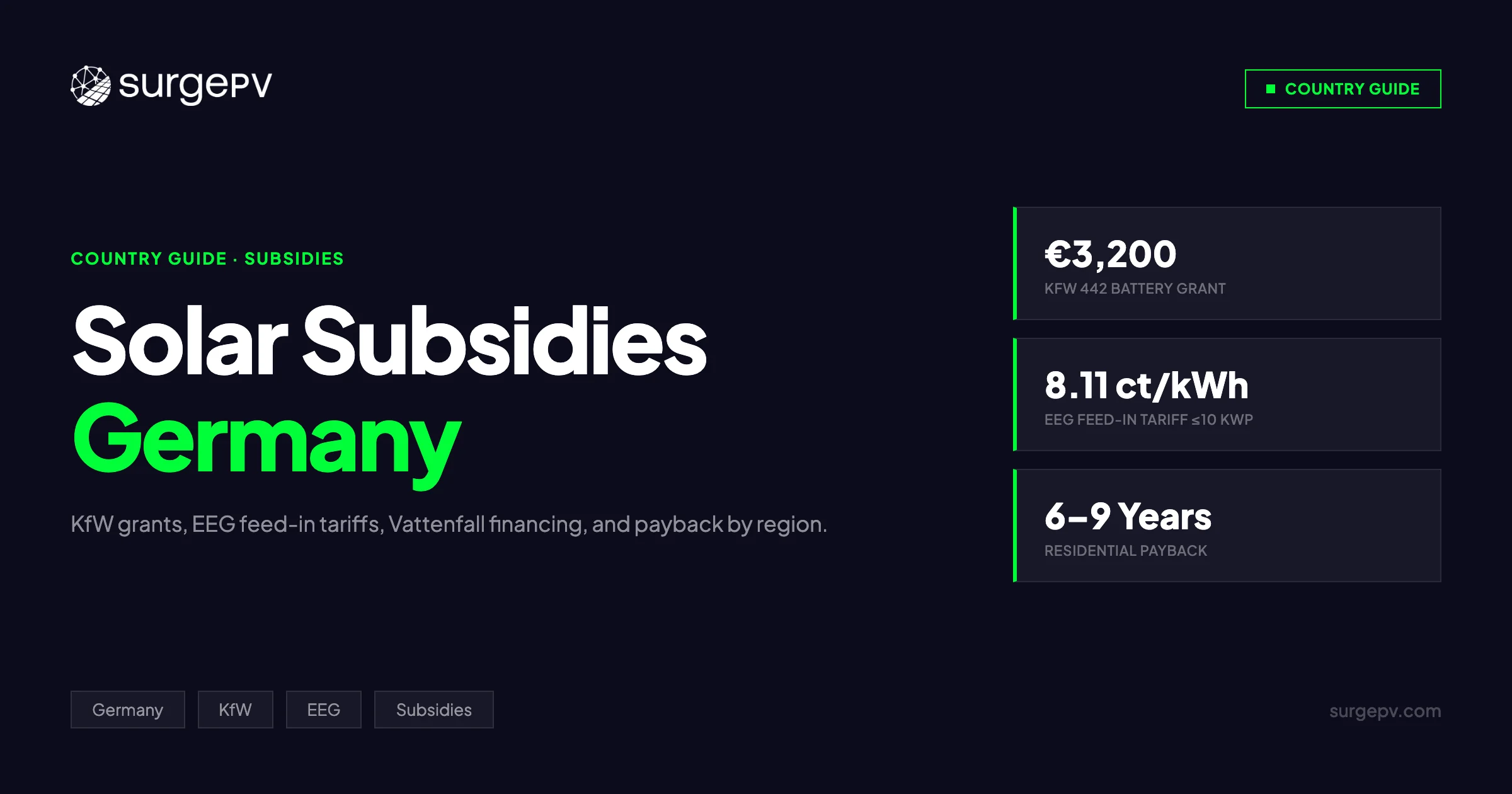
Active programs as of March 2026: EEG feed-in tariffs (8.11 ct/kWh for ≤10 kWp, 20-year fixed), KfW 442 battery grant (up to €3,200), Bundesländer bonuses (€300–€5,000 by state), Vattenfall PV financing (open enrollment), and commercial Marktprämie premiums via quarterly auctions. Apply before installation — retroactive KfW applications are automatically voided.
In this guide:
- The latest 2026 updates to KfW programs, EEG feed-in tariffs, and Solarpaket I
- PV installation cost per kWp in Germany — 2026 market prices
- Vattenfall PV system financing application process — step by step
- Average payback period for residential solar in Germany by region
- Bundesländer programs: Bavaria, Berlin, NRW, and more
- Complete application checklist and common error table
- How often German solar incentives change — and how to track them
Germany Solar Subsidy News Today: Latest Updates (2025–2026)
For anyone tracking germany solar subsidy news today, here is the current status of every active program as of March 2026.
KfW 442 Battery Grant — 2026 Changes
KfW restructured its 442 battery storage grant in Q2 2025. Changes still in effect:
- Maximum grant: €3,200 (raised from previous program cycles)
- Minimum battery capacity raised from 4 kWh to 5 kWh usable
- Smart inverter now mandatory — system must support grid communication signals
- Processing time: 4–6 weeks after the 2024 KfW digital portal upgrade
- Real-time tracking available via the KfW digital dashboard
Key Takeaway — Apply Early in the Year
KfW 442 operates on annual budget caps, not rolling funding. In 2024, the program was suspended in September after funds were exhausted. In 2025, caps were raised but still depleted by Q3. Apply between January and May — do not wait until your installation is scheduled.
EEG Feed-in Tariff Current Rates (Q1 2026)
| System Size | Partial Export Rate | Full Export Rate |
|---|---|---|
| Up to 10 kWp | 8.11 ct/kWh | 12.87 ct/kWh |
| 10–40 kWp | 7.03 ct/kWh | 10.79 ct/kWh |
| 40–100 kWp | 5.74 ct/kWh | — |
Rates locked in for 20 years at time of MaStR registration. Adjusted quarterly. Source: Bundesnetzagentur, Q1 2026.
These rates decline approximately 1% every 6 months as Germany’s deployment targets are met. Systems registered today lock in current rates — waiting 12 months means locking in rates roughly 2% lower over a 20-year contract.
Solarpaket I — Ongoing Market Effects in 2026
Germany’s Solarpaket I (enacted May 2024) continues reshaping the market:
- 800W balcony solar — plug-in systems now permitted up to 800W inverter output (up from 600W), dramatically lowering the entry point for renters
- Simplified Mieterstrom — building owners no longer need full electricity supplier licenses
- VAT exemption confirmed — residential systems under 30 kWp remain VAT-exempt on purchase and installation
- Ground-mount expansion — additional land areas approved for open-space solar under revised zoning
Germany Solar PV Subsidy Status — March 2026
| Program | Status | Notes |
|---|---|---|
| KfW 442 Battery Grant | Active | ~55% of 2026 budget remaining (Q1) |
| EEG Feed-in Tariffs | Active (statutory) | No budget cap — legally guaranteed |
| Bavaria Solar Storage Bonus | Active | Spring window open |
| Berlin Solar PLUS | Active | Limited allocation remaining |
| NRW Battery Voucher (Progress.NRW) | Active | Full 2026 allocation available |
| Vattenfall PV Financing | Active | Open enrollment |
| Marktprämie Auctions | Active | Q2 2026 tender open |
PV Installation Cost Per kWp in Germany (2025–2026)
Before calculating subsidy impact, you need accurate baseline costs. Here are current market rates across system sizes.
Residential PV Cost Per kWp — Germany 2026
| System Size | Total Installed Cost | Cost Per kWp |
|---|---|---|
| 3 kWp | €4,500 – €5,400 | €1,500 – €1,800 |
| 5 kWp | €6,500 – €8,500 | €1,300 – €1,700 |
| 8 kWp | €9,600 – €13,600 | €1,200 – €1,700 |
| 10 kWp | €11,000 – €16,000 | €1,100 – €1,600 |
| 15–30 kWp | €15,000 – €39,000 | €1,000 – €1,300 |
All-in cost: panels, inverter, mounting, cabling, permits, MaStR registration, and labor. Source: BSW Solar installer survey, 2025.
What You Are Paying For — 8 kWp System Cost Breakdown
| Component | Share of Total | Typical Cost |
|---|---|---|
| Solar panels | 20–30% | €2,200 – €4,100 |
| Inverter (string or hybrid) | 12–18% | €1,100 – €2,400 |
| Mounting and racking | 10–15% | €960 – €2,000 |
| Electrical work and cabling | 15–20% | €1,440 – €2,700 |
| Labor (2–3 days) | 15–20% | €1,440 – €2,700 |
| Permits, MaStR, scaffolding | 8–13% | €770 – €1,800 |
Battery storage add-on (10 kWh lithium): adds €4,000–€7,000 to total cost, or €400–€700 per kWh of usable capacity.
Why costs fell 12–18% since 2022: Module prices now represent only 20–30% of total system cost, down from 40% in 2020. Global oversupply — driven by Chinese manufacturing scale — has pushed panel prices to historic lows. The dominant costs today are labor, electrical installation, and permitting — not hardware.
Commercial PV Cost Per kWp Germany 2026
| System Size | Cost Per kWp |
|---|---|
| 50 kWp | €900 – €1,100 |
| 100 kWp | €820 – €1,000 |
| 250 kWp | €750 – €900 |
| 500+ kWp | €680 – €850 |
At commercial scale, precise system sizing using solar design software directly affects project economics. A 10% overbuild on a 250 kWp project represents €19,000–€23,000 in unnecessary capital cost.
Average Payback Period for Residential Solar in Germany (2025–2026)
The average payback period for residential solar in Germany is 7–9 years without battery storage and 5–8 years with battery storage and KfW subsidies — depending on region, self-consumption rate, and subsidy capture.
Payback Period by Region — Germany 2026
| Region | Annual Yield (8 kWp) | Annual Savings | Payback (No Battery) | Payback (With Battery + KfW) |
|---|---|---|---|---|
| Bavaria (Munich) | 7,600 kWh | €1,760 | 6.2 yr | 5.3 yr |
| Baden-Württemberg | 7,200 kWh | €1,670 | 6.6 yr | 5.6 yr |
| Hesse (Frankfurt) | 6,800 kWh | €1,580 | 7.0 yr | 6.0 yr |
| NRW (Cologne) | 6,500 kWh | €1,510 | 7.3 yr | 6.3 yr |
| Lower Saxony | 6,200 kWh | €1,440 | 7.6 yr | 6.5 yr |
| Hamburg / Schleswig-Holstein | 5,800 kWh | €1,350 | 8.1 yr | 7.0 yr |
Assumptions: 8 kWp system. Net cost without battery: €10,900. With battery: €16,200 gross → €11,750 net after KfW 442 + Bavaria Storage Bonus. Electricity rate: €0.35/kWh. Self-consumption: 65%. Feed-in rate: 8.11 ct/kWh.
The Self-Consumption Lever
The self-consumption ratio is the single most powerful variable. In Germany, grid electricity costs ~€0.35/kWh while the feed-in tariff pays only 8.11 ct/kWh — a 4:1 ratio in favor of self-consumption.
Every 10% increase in self-consumption shortens payback by approximately 0.4–0.6 years.
| Configuration | Typical Self-Consumption Rate |
|---|---|
| PV only, no battery | 30–45% |
| PV + 10 kWh battery | 60–75% |
| PV + battery + EV smart charging | 75–85% |
Pro Tip — Payback Optimization
The fastest payback in Germany doesn’t come from the largest system — it comes from the highest self-consumption ratio. A 6 kWp system at 80% self-consumption outperforms a 12 kWp system at 40% in most German residential scenarios. Model consumption patterns before sizing.
Accurately modeling irradiance by postcode, self-consumption curves, and subsidy stacking is exactly what the generation financial tool at SurgePV is built for.
Germany’s Solar Policy Framework
Germany’s solar energy subsidies are legally mandated, not discretionary. Understanding the framework helps you predict which programs will persist and which carry funding risk.
The EEG (Erneuerbare-Energien-Gesetz)
The Renewable Energy Sources Act (EEG) is the primary vehicle for Germany’s solar energy subsidies. First enacted in 2000, it has been revised six times — the most significant recent changes came through EEG 2023 and Solarpaket I (2024).
The EEG mandates:
- Grid priority — renewable energy has dispatch priority on the German grid
- 20-year guaranteed rates — feed-in tariffs lock in at MaStR registration for 20 years
- Monthly degression — rates automatically decline as deployment targets are met
- Mieterstrom bonus — additional compensation for tenant electricity models
- VAT exemption — residential systems under 30 kWp exempt from VAT
Key milestones in EEG reform:
| Year | Change |
|---|---|
| 2000 | EEG introduced — high fixed feed-in tariffs to kickstart market |
| 2012 | Caps introduced on FITs; mandatory direct marketing for large systems |
| 2017 | Auction system introduced for systems over 750 kWp |
| 2021 | EU Fit for 55 drives Germany to raise PV target to 215 GW by 2030 |
| 2023 | EEG 2023 — higher FITs for small systems, VAT exemption, Mieterstrom reform |
| 2024 | Solarpaket I — 800W balcony solar, simplified Mieterstrom, ground-mount expansion |
| 2026 | Solarpaket II in preparation — energy community framework, expanded storage rules |
Who Manages What
| Institution | Role |
|---|---|
| Bundesnetzagentur (BnetzA) | PV auctions, market premiums, grid integration, MaStR registration |
| KfW (Development Bank) | KfW 442 battery grants, KfW 270 energy loans |
| Bundesländer governments | State-level grants, storage bonuses, fast-track permitting |
| Local DSOs (grid operators) | Grid connection approvals, metering requirements |
| Vattenfall / utilities | PV system financing, energy service contracts, PPAs |
EU Influence: Fit for 55
Germany’s solar subsidies are inseparable from EU climate commitments. The Fit for 55 package drives Germany to hit 215 GW national PV target by 2030 and enable citizen energy communities under the Clean Energy Package.
For the full European context, see our guides to EU solar energy policies and European solar incentives.
Residential Solar Subsidies Germany 2026
Feed-in Tariffs (Einspeisevergütung)
Germany’s EEG feed-in tariff pays a fixed rate for every kWh exported to the grid, guaranteed for 20 years from MaStR registration. This is the foundational solar energy subsidy for all residential installations.
| Configuration | Rate | Notes |
|---|---|---|
| Partial export, ≤10 kWp | 8.11 ct/kWh | Standard for self-consuming homeowners |
| Full export, ≤10 kWp | 12.87 ct/kWh | When more than 70% of production is exported |
| Partial export, 10–40 kWp | 7.03 ct/kWh | Larger residential / small commercial |
| Mieterstrom bonus | +2.5–3.5 ct/kWh | Additional on top of base rate |
Locking in current rates before the next quarterly adjustment means an additional €200–€400 in cumulative income over the 20-year guarantee period.
KfW 442 Battery Storage Grant
| Parameter | Specification |
|---|---|
| Maximum grant | €3,200 |
| Minimum battery capacity | 5 kWh usable |
| System requirement | New or existing rooftop PV |
| Smart inverter | Mandatory |
| Application timing | Before installation begins |
| Processing time | 4–6 weeks |
| Portal | kfw.de/zuschussportal |
| Retroactive applications | Voided — no exceptions |
Eligible: DC or AC-coupled batteries, retrofit to existing solar accepted.
Ineligible: standalone battery without PV, battery below 5 kWh, installation completed before grant approval.
KfW 270: Low-Interest Energy Loans
| Feature | Detail |
|---|---|
| Maximum loan | Up to €150,000 per project |
| Interest rate | Below market rate (check kfw.de for current) |
| Repayment | 5–20 years, optional repayment-free period |
| Application | Via certified KfW partner bank |
| Combinable with KfW 442 | Yes, for different cost components |
Solar + EV Integration Bonuses
| Program | Grant Amount | Requirements |
|---|---|---|
| Wallbox installation | €600–€1,200 | Solar system + EV ownership |
| Smart charging integration | €300–€500 | Bidirectional charging compatible |
| V2H pilot program | Variable | Grid operator participation |
Maximum stacking example — Bavaria homeowner, 8 kWp + 10 kWh battery + EV charger:
| Subsidy | Amount |
|---|---|
| KfW 442 battery grant | €3,200 |
| Bavaria Solar Storage Bonus | €1,250 |
| Wallbox installation bonus | €800 |
| Total direct subsidies | €5,250 |
€5,250 on a ~€16,200 gross project — 32% subsidy coverage.
KfW Solar Subsidy News Today: Complete KfW Guide
For anyone searching for KfW solar subsidy news today, here is the current state of all programs and the exact application steps.
KfW 442 — Step-by-Step Application
Step 1 — Get installer quote with technical layout Obtain a detailed quote from a certified PV installer including system size, battery spec, and smart inverter model. This is required for the KfW portal submission.
Step 2 — Register on the KfW Zuschussportal Create an account at kfw.de/zuschussportal. You will need your Steuer-ID (tax ID), IBAN, and the installer’s technical documentation.
Step 3 — Submit grant application before installation Complete the online form with system details and battery specifications. Upload the installer quote and tech spec sheet. Do NOT begin installation at this stage.
Step 4 — Receive approval (4–6 weeks) KfW sends a digital approval. Track status via the KfW dashboard. Installation cannot begin until this confirmation arrives.
Step 5 — Install and register on MaStR Complete the installation with certified electrician sign-off. Register on the Marktstammdatenregister within one month of commissioning.
Step 6 — Submit proof of completion Upload the final invoice, commissioning report, and MaStR registration to the KfW portal. Grant payment follows within 2–4 weeks.
Vattenfall PV System Financing Application Process Germany
Vattenfall operates as a major electricity provider in Germany and offers PV system financing through its energy services division. Utility-backed financing has become a practical alternative to KfW loans for homeowners who prefer a single-vendor process, which makes understanding the Vattenfall PV system financing application process in Germany useful for both installers and their clients.
Vattenfall Solar Financing Models
Direct installment financing — monthly payments covering 60–100% of system costs with a fixed schedule over 10–15 years. 0% interest promotions available in select periods.
Solar PPA (Power Purchase Agreement) — Vattenfall installs and owns the system; the customer pays a fixed per-kWh rate typically 15–25% below the grid tariff. No upfront cost required.
Vattenfall PV System Financing Application — Step by Step
Step 1 — Online eligibility check Visit vattenfall.de/solar and enter your address, roof type, and monthly electricity consumption. Vattenfall’s tool generates a system size recommendation and indicative financing terms.
Step 2 — Site assessment and system sizing A certified Vattenfall partner installer visits for roof assessment, shading analysis, and final system sizing. This generates the formal technical proposal required for financing approval.
Step 3 — Financing application Submit income documentation (last two pay stubs or most recent tax return) and proof of homeownership (Grundbuchauszug). For PPA applications, income verification requirements are minimal.
Step 4 — Grid connection pre-approval Vattenfall coordinates the grid connection request (Netzanschlussbegehren) with the local DSO (Netzbetreiber) on the applicant’s behalf. This runs in parallel with financing approval — typically 2–4 weeks.
Step 5 — Agreement signing and installation scheduling Review and sign the financing agreement and installation contract. Vattenfall coordinates scheduling with its certified installer network. Lead times are typically 4–8 weeks.
Step 6 — Installation, commissioning, and MaStR registration Vattenfall-network installers complete the system. MaStR registration and EEG feed-in contract setup are handled by Vattenfall post-commissioning. Monthly financing payments begin the following billing cycle.
Combining Vattenfall Financing with KfW Subsidies
A common question: can you use Vattenfall financing and the KfW 442 battery grant together? Yes — with correct sequencing.
- Vattenfall installment financing covers the gross system cost
- Apply for KfW 442 before installation begins — independently from Vattenfall
- The KfW grant is paid as a lump sum to you directly after commissioning
- Inform your Vattenfall contact about the KfW application upfront to ensure correct invoicing structure
Typical Vattenfall financing terms (2026):
- Monthly installment: ~€80–€150/month for an 8 kWp system over 10–15 years
- 0% interest promotions available seasonally
- PPA customers: no upfront payment, per-kWh rate fixed for contract term (typically 10–20 years)
Further Reading
See our guide to community solar projects in Germany for Mieterstrom financing options and how tenant electricity programs interact with utility financing like Vattenfall’s. For the broader German incentive overview, see the Germany solar incentives overview.
Commercial and Industrial Solar Subsidies Germany 2026
Market Premium (Marktprämie) — Auction System
Commercial systems over 100 kWp must enter Germany’s competitive auction system to receive market premiums above wholesale energy rates.
| Auction Category | Average Awarded Premium | Contract Term |
|---|---|---|
| Ground-mounted (< 750 kWp) | 5.21 ct/kWh | 20 years |
| Rooftop (100–750 kWp) | 6.73 ct/kWh | 20 years |
| Agri-PV | 7.84 ct/kWh | 20 years |
| Large ground-mount (> 750 kWp) | 4.88 ct/kWh | 20 years |
Winning a Marktprämie auction requires accurate yield projections. Errors in projected annual generation directly affect bid pricing and long-term profitability. Solar design software with bankable yield modeling is essential for competitive commercial bids.
Agri-PV Program
- Bonus premium — up to €0.02/kWh above standard market rate for dual-use installations
- 40% CAPEX grants — for shade-tolerant PV structures on agricultural land
- Feed-in priority — vertical east-west arrays receive priority under EEG 2023
Eligible applications include vineyards, orchards, livestock grazing, and irrigation zones. Shadow analysis software is important for Agri-PV design given the complex shading environments.
Commercial Tax Benefits
| Benefit | Detail |
|---|---|
| Accelerated depreciation (§7 EStG) | Up to 20% of system cost in year one |
| VAT recovery | Full refund on installation for registered businesses |
| Trade tax waiver (Gewerbesteuer) | Systems under 10 MW used for self-consumption |
| Land lease treatment | Favorable depreciation on leased roof agreements |
Bundesländer Grants: State-Level Programs 2026
Regional programs add €1,000–€5,000 per project on top of national subsidies. They are first-come, first-served and typically exhaust budgets mid-year.
Active State Programs 2026
| State | Program | Amount | Status |
|---|---|---|---|
| Bavaria | Solar Storage Bonus | €500–€1,250 | Active — spring window |
| Berlin | Solar PLUS (< 10 kWp) | €300/kWp | Active — limited |
| NRW | Battery Voucher (Progress.NRW) | €150/kWh (max 10 kWh) | Full 2026 allocation |
| Baden-Württemberg | L-Bank solar loans | Below-market rates | Ongoing |
| Hamburg | Rooftop solar program | €500–€2,000 | Check current status |
| Thuringia | EFRE solar grants | Up to €5,000 | Periodic |
Subsidy Stacking Example — NRW Homeowner
| Layer | Type | Value |
|---|---|---|
| EEG feed-in tariff | Income (20 years) | 8.11 ct/kWh |
| KfW 442 battery grant | Direct grant | €3,200 |
| NRW Battery Voucher | Direct grant | €1,500 |
| EV charger bonus | Direct grant | €800 |
| Total immediate grants | €5,500 |
For most NRW homeowners this brings effective net cost below €7,000 on a €12,000–€13,000 gross installation.
Pro Tip — Find Local Programs
Search foerderdatenbank.de with your postcode to find all active programs in your municipality, including smaller local grants that installers often miss. Some municipalities add €500–€1,500 on top of Bundesland programs for specific districts or building types.
Accessing Bundesland Portals
| State | Portal |
|---|---|
| Bavaria | energieatlas.bayern.de |
| Berlin | solarplus.berlin.de |
| NRW | progres.nrw.de |
| All states (search by postcode) | foerderdatenbank.de |
Application Process and Common Errors
The Correct Sequence
The most expensive mistake in Germany is installing before receiving grant approval. Most programs void retroactive applications with no exceptions.
1 — Get certified installer quote with technical layout Required for all subsidy applications — MaStR, KfW, and Bundesland programs.
2 — Submit grid connection request to local DSO Allow 2–6 weeks. Run in parallel with subsidy applications.
3 — Apply for KfW 442 and Bundesland grants ← CRITICAL This must happen before installation. Retroactive applications are automatically voided.
4 — Receive grant approval KfW 442: 4–6 weeks. Track via the KfW digital dashboard. Do not install without confirmation.
5 — Install with certified electrician sign-off Certified EPC required for most subsidy programs.
6 — Register on Marktstammdatenregister (MaStR) within 30 days Mandatory for all PV systems in Germany. Delays affect feed-in tariff start date.
7 — Submit commissioning proof and receive payment Upload final invoice, commissioning report, MaStR confirmation, and IBAN for payment.
Top 5 Application Errors
| Error | Consequence | Prevention |
|---|---|---|
| Installing before grant approval | Grant voided, no exceptions | Apply at least 6 weeks before planned install date |
| Missing Steuer-ID | Application rejected | Prepare tax ID before starting portal |
| Incorrect IBAN/BIC | Payment failure | Double-check bank details at submission |
| Wrong meter configuration | Feed-in tariff denied | Bidirectional meter required for battery + solar |
| Outdated KfW forms | Automatic rejection | Download fresh templates from kfw.de on application day |
In 2023, approximately 18% of residential KfW applications were denied due to pre-installation starts or incomplete documentation.
How Often Do German Solar Incentives and Subsidy Programs Change?
| Program Type | Change Frequency | Nature of Changes |
|---|---|---|
| EEG feed-in tariffs | Monthly (automatic) | ~0.5–1% downward degression when targets are met |
| KfW grant programs | Annually / when budget exhausted | Grant amount, eligibility criteria, or temporary suspension |
| Bundesland programs | Annually or seasonally | New window opens; budget caps hit mid-year |
| Auction premiums (Marktprämie) | Quarterly tender rounds | Premium varies by round, competitive bidding |
| Tax incentives | Legislative changes only | Stable unless EStG or VAT law amended |
The most important risk: budget exhaustion. KfW 442 and several Bundesland programs have annual caps. Once exhausted, the program closes until the next budget year — creating real urgency in Q1 before caps are depleted.
How to track changes:
- foerderdatenbank.de — Federal database, searchable by postcode
- Bundesnetzagentur.de — EEG tariff updates and auction results
- kfw.de — Program status, documentation, budget announcements
- BSW Solar newsletter — Monthly market and policy updates
For solar companies managing project pipelines, building subsidy tracking into your solar proposals process ensures clients always see accurate, current incentive calculations.
Model Germany Solar Subsidies in Your Client Proposals
SurgePV’s generation and financial tool automatically incorporates EEG feed-in rates, KfW grant values, and regional irradiance data — so your proposals show clients accurate current ROI without manual subsidy calculations.
Book a DemoNo commitment required · 20 minutes · Live project walkthrough
ROI Examples: Germany Solar With and Without Subsidies
Residential: 8 kWp + 10 kWh Battery — NRW Homeowner
| Without Subsidies | With Full Subsidy Stack | |
|---|---|---|
| Gross system cost | €16,200 | €16,200 |
| KfW 442 battery grant | — | −€3,200 |
| NRW Battery Voucher | — | −€1,500 |
| EV charger bonus | — | −€800 |
| Net investment | €16,200 | €10,700 |
| Annual electricity savings | €2,100 | €2,100 |
| Annual feed-in income | €340 | €340 |
| Total annual benefit | €2,440 | €2,440 |
| Payback period | 6.6 years | 4.4 years |
Subsidies reduce payback by 2.2 years on a €5,500 subsidy capture — not marginal improvement but a structurally different investment profile.
Commercial: 200 kWp Logistics Rooftop — Bavaria
| Without Subsidies | With Subsidies + Marktprämie | |
|---|---|---|
| Installed cost | €190,000 | €190,000 |
| Market premium (20yr, 6.73 ct/kWh) | — | +€148,000 cumulative |
| Accelerated depreciation (year 1) | — | −€38,000 tax benefit |
| VAT recovery | — | −€36,100 |
| Effective net investment | €190,000 | €115,900 |
| Annual electricity savings | €28,500 | €28,500 |
| Simple payback | 6.7 years | 4.1 years |
For commercial projects at this scale, solar proposal software that produces bankable financial models with integrated subsidy scenarios is what separates competitive bids from lost ones.
Conclusion
Germany’s solar subsidy framework in 2026 rewards preparation and timing. The difference between a homeowner who applies for KfW 442 before installation and one who installs first is €3,200 in direct grants and 2+ years of payback improvement.
For installers and EPCs operating in Germany: subsidy knowledge is a competitive advantage. Clients who understand exactly how much they will receive, when, and from which program convert faster and refer more. Using solar design software that integrates subsidy calculations into proposals puts accurate numbers in front of customers at the right moment.
The three most time-sensitive actions for 2026:
- Apply for KfW 442 before installation — annual budget caps exhaust by late summer in active years
- Check your Bundesland’s programs at foerderdatenbank.de — state programs open and close seasonally
- Register on MaStR within 30 days of commissioning — delays permanently reduce 20-year feed-in earnings
For the broader European picture, see our guides to European solar incentives and EU solar energy policies.
Frequently Asked Questions
What solar subsidies are available in Germany in 2026?
Active programs: EEG feed-in tariffs (8.11 ct/kWh for ≤10 kWp, 20-year statutory guarantee), KfW 442 battery grants (up to €3,200), Bundesländer programs in Bavaria, Berlin, NRW, and others (€300–€5,000), EV charger bonuses (€600–€1,200), and commercial Marktprämie premiums. Total stacked support for a residential install reaches €5,000–€6,000.
What is the Vattenfall PV system financing application process in Germany?
Start at vattenfall.de/solar for an eligibility check, then complete a site assessment with a Vattenfall partner installer. Submit income documentation and proof of homeownership for the financing application. Vattenfall coordinates grid connection pre-approval with the local DSO in parallel. After agreement signing and installation, Vattenfall handles MaStR registration. Monthly payments begin after commissioning. Apply for KfW 442 separately before installation begins.
What is the average payback period for residential solar in Germany in 2025–2026?
Without battery: 6–9 years depending on region. With battery and KfW subsidies: 5–8 years. Bavaria and Baden-Württemberg reach 5–7 years; northern Germany averages 8–11 years. Adding an EV with smart charging shortens payback by a further 1–2 years.
What is the PV installation cost per kWp in Germany in 2025–2026?
Residential systems (3–10 kWp): €1,100–€1,800 per kWp all-in. Commercial (50–500 kWp): €680–€1,100 per kWp. Prices fell 12–18% from 2022 levels. Battery storage adds €400–€700 per kWh.
How often do German solar incentives and subsidy programs change?
EEG feed-in tariffs adjust monthly. KfW programs change annually or when budget caps are hit. Bundesland programs open seasonally, mostly in Q1. Monitor foerderdatenbank.de, kfw.de, and Bundesnetzagentur.de for current status.
Can Germany solar subsidies be stacked?
Yes. KfW 442 + Bundesland storage bonus + EV charger bonus can all be combined on the same installation. A Bavaria homeowner with an 8 kWp system, 10 kWh battery, and EV charger can receive €5,250 in direct grants from three programs simultaneously.