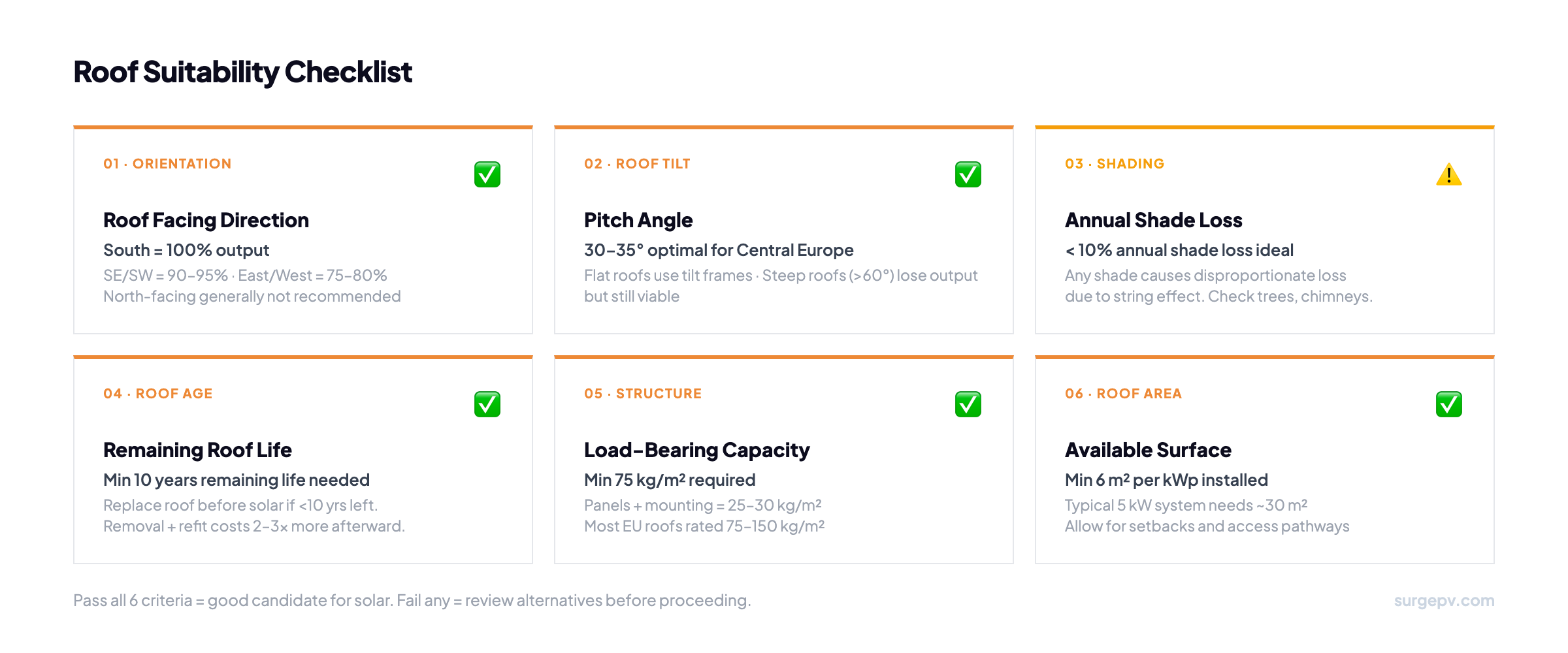
Most roofs in Europe are suitable for solar — but not all of them are ideal. The difference between a good solar roof and a poor one comes down to five criteria: orientation, tilt, shading, age, and structural capacity. Get these right and a solar installation will perform as designed for 25+ years. Get them wrong and you end up with an underperforming system, a warranty dispute, or a roof that needs replacing with panels already attached.
This chapter gives you specific numbers for each criterion — not vague guidance, but actual pass/fail thresholds. By the end, you'll know whether your roof is a strong candidate, a marginal case, or a situation where alternatives are worth exploring.
What you'll learn in this chapter
- Which roof orientation gives the best output — and by how much
- Optimal tilt angles for Europe and how to compensate for flat roofs
- How shading affects output and when it makes a system uneconomical
- Structural load requirements and when to get a survey
- How roof age affects the decision to install solar
- What to do if your roof fails one or more criteria
Roof Orientation: Which Direction Is Best?
In the northern hemisphere, solar panels produce the most electricity when facing south. A south-facing roof at a 30–35° pitch in Central Europe captures the maximum available solar irradiance throughout the year. Every other orientation produces less.
| Roof Facing | Annual Output (% of optimum) | Assessment |
|---|---|---|
| South | 100% | Excellent |
| South-East / South-West | 90–95% | Very good |
| East / West | 75–80% | Acceptable |
| North-East / North-West | 55–65% | Marginal |
| North | 40–50% | Not recommended |
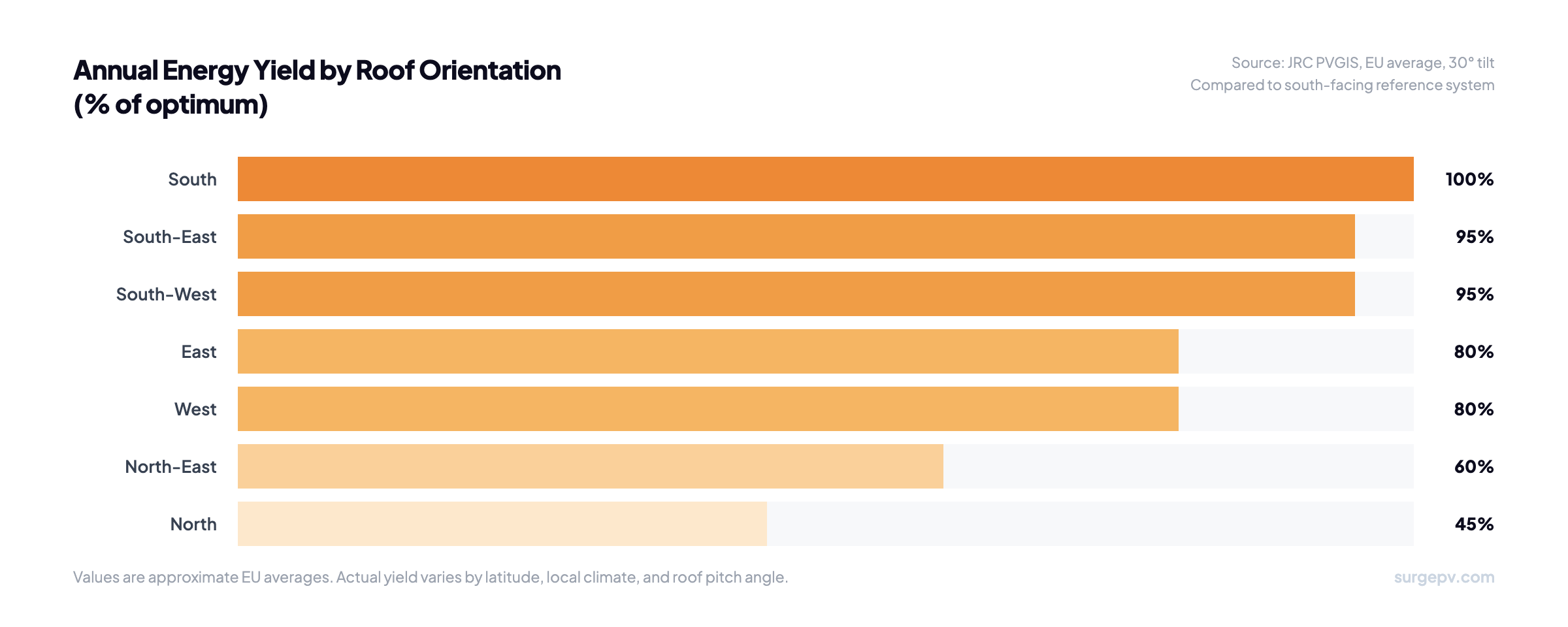
Source: JRC PVGIS, EU average at 30° tilt.
East and west-facing roofs are perfectly viable for solar at current electricity prices in most of Europe. You'll lose 20–25% of output versus a south-facing roof, but the system can still achieve a 7–10 year payback. East/west splits are sometimes preferred on flat commercial roofs because they allow denser panel packing with lower inter-row shading.
North-facing roofs are a different matter. At 40–50% of optimal output, the economics become very tight. At current installation costs and electricity prices, a north-facing system typically takes 12–18 years to pay back — at the edge of what most financial models support. North-facing installs are rarely recommended unless the system is heavily incentivized or the available south-facing area is too small.
Professional solar design software like SurgePV calculates orientation impact automatically during the design phase, so you get accurate yield estimates without manual calculations.
Optimal Roof Tilt Angle for Solar
The tilt angle of your roof affects how directly panels face the sun throughout the year. The optimal angle varies by latitude:
- Northern Europe (50–55°N): Optimal tilt is around 35–40°
- Central Europe (45–50°N): Optimal tilt is around 30–35°
- Southern Europe (37–45°N): Optimal tilt is around 25–32°
A simple rule of thumb: multiply your latitude by 0.75 to get the approximate optimal tilt angle. For Berlin (52°N), that's about 39°. For Rome (42°N), that's about 31°.
| Roof Pitch | Approximate Tilt | Annual Output vs Optimal |
|---|---|---|
| Flat (0°) | 0° | ~85% (use tilt frames) |
| Shallow (15°) | ~15° | ~95% |
| Standard (30–40°) | ~30–40° | 100% (near-optimal) |
| Steep (50°) | ~50° | ~95% |
| Very steep (60°+) | ~60°+ | ~85–90% |
The good news: the output curve around optimal tilt is relatively flat. A roof that's 10° off optimal loses only 2–5% of annual output. This is why the vast majority of roof pitches found on European housing are suitable for solar without modification.
Flat Roofs
Flat commercial or residential roofs need tilt frames to position panels at an effective angle. Ballasted tilt frames (weighted down, no roof penetrations) are common on flat commercial roofs. They add cost but solve the orientation problem entirely — you can face panels in any direction at any angle. The trade-off is that panels on tilt frames require more roof area per kWp due to inter-row spacing needed to prevent self-shading.
Very Steep Roofs
Roofs steeper than 50–60° still produce acceptable output — only 10–15% below optimal — and may actually perform better in winter when the sun is low. Installation is more challenging and expensive due to safety requirements on steep surfaces, but it's not a disqualifying factor.
How Shading Affects Solar Output
Shading is the most damaging factor for solar performance — and the one most commonly underestimated during a roof assessment.
The String Effect
In a standard string-wired system, panels connected in series behave like links in a chain. When one panel is shaded, it restricts current flow for the entire string — not just itself. A single panel with 50% shade can reduce string output by 30–40% or more. This is why even small, partial shading sources (a chimney shadow for two hours on winter mornings) have a larger-than-expected impact on annual output.
Key Takeaway
Any shade on a solar array causes disproportionate losses due to the string effect. The threshold that makes a roof-mounted system uneconomical is roughly 20–30% annual shading loss. Beyond that, the economics rarely work without microinverters or optimizers — and even those have limits.
Common Shading Sources to Check
- Trees (including seasonal growth — check summer canopy, not winter)
- Chimneys and roof vents
- Satellite dishes and aerials
- Dormer windows and skylights
- Neighboring buildings and walls
- Roof parapets on flat buildings
How to Assess Shading Accurately
Walk the roof or use a drone at solar noon on a clear day and observe shadows. Better: use a solar shading analysis tool that simulates shadows throughout the entire year using sun-path data for your location. Tools like SurgePV's shading analysis calculate the exact shadow cast by every obstruction on every panel for every hour of the year.
A manual inspection at one point in time will miss obstructions that only shade the roof in winter (when the sun is low) or in morning/afternoon hours. Annual shading loss is the only metric that matters — hourly spot-checks are not sufficient for a professional assessment.
Microinverters and Power Optimizers
These technologies mitigate (but do not eliminate) the impact of partial shading. Microinverters and power optimizers allow each panel to operate independently, so a shaded panel doesn't drag down its neighbors. If annual shading loss is under 15–20%, these technologies can make a previously marginal roof viable.
If annual shading loss is over 30%, even microinverters won't save the economics. The energy was never captured by the panel in the first place — no inverter technology can recover it.
Structural Load Requirements
Solar panels add weight to a roof. Knowing whether your roof can handle that load is a safety and regulatory requirement, not an optional check.
How Much Do Solar Panels Weigh?
A standard residential solar panel weighs 18–22 kg. The mounting hardware adds another 3–5 kg per panel. In total, a complete roof-mounted solar system (panels plus racking) typically adds 25–30 kg/m² to the roof surface.
What Most Roofs Can Handle
European residential roofs are generally designed to support:
- Typical load rating: 75–150 kg/m²
- Solar panel load: 25–30 kg/m²
- Headroom: 45–120 kg/m² remaining after panels
For most residential buildings constructed in the last 30 years, a solar installation is well within structural capacity. You don't need a structural survey for a standard new-build or recently renovated home.
When to Get a Structural Survey
A professional structural survey is worth commissioning if any of the following apply:
- The building is over 25 years old and the roof has not been inspected recently
- There is visible sagging, dipping, or cracking in the roof structure
- The roof uses non-standard construction (e.g., lightweight steel frame, prefab panels)
- The system is large (over 20 kWp) and load concentration is significant
- Local planning authorities require it as a permit condition
A structural survey typically costs €200–500 and takes 1–2 weeks. It's cheap insurance against installing a system that damages the roof or requires costly reinforcement work later.
Pro Tip
If a structural survey is needed, get it done before finalizing the system design. The surveyor may recommend distributing weight differently across the roof — which affects where mounting points go and therefore how the panels are laid out.
Roof Age and Condition
This is the factor most homeowners overlook — and it's the one most likely to cause expensive problems after installation.
The Core Problem
Removing and refitting solar panels when a roof needs replacing costs 2–3 times more than if the roof were replaced before installation. Scaffolding must go up again, panels must be removed and stored, the roof is replaced, then the system is reinstalled and recommissioned. For a 5 kWp system, that process typically costs €1,500–3,000 in additional labor on top of the roof replacement cost.
The rule is straightforward: if the roof has less than 10 years of useful life remaining, replace the roof before installing solar. A quality solar installation lasts 25–30 years. Your roof needs to match that timeline.
How to Assess Roof Remaining Life
| Roof Type | Typical Total Lifespan | Warning Signs |
|---|---|---|
| Concrete tiles | 30–50 years | Cracking, moss, loose tiles |
| Clay/terracotta tiles | 50–100 years | Cracked or slipped tiles, failed flashing |
| Slate | 75–150 years | Delamination, nail fatigue (nail sickness) |
| Metal (steel/aluminium) | 40–70 years | Corrosion, failed seams |
| Flat (EPDM/TPO membrane) | 15–25 years | Bubbling, cracking, ponding water |
| Flat (felt/bitumen) | 10–20 years | Cracking, blistering, moss |
Tile Types and Solar Compatibility
All standard roof tile types are compatible with solar installation. Concrete tiles, clay tiles, slate, and metal roofing all have established mounting solutions. Flat roofs with EPDM or TPO membranes typically use ballasted (non-penetrating) mounts to avoid puncturing the membrane.
Older flat roofs with felt/bitumen membranes approaching end of life should be replaced with a modern single-ply membrane before solar is installed. Penetrating mounts into deteriorating felt create leak points; ballasted mounts are too heavy for many older flat-roof structures.
Get an Accurate Roof Assessment with SurgePV
Upload your address. SurgePV models the roof in 3D, calculates shading, and generates your yield estimate automatically.
Book Free Demo20 minutes · Live walkthrough · No commitment
What If My Roof Isn't Ideal?
A roof that fails one or more criteria doesn't necessarily mean solar is off the table. It means the standard roof-mount approach needs reconsidering. Here are the main alternatives.
Ground-Mount Systems
If you have land available, a ground-mount system sidesteps most roof constraints. You choose the orientation and tilt angle, there are no structural concerns, and shading from roof obstructions is irrelevant. Ground-mount systems cost roughly 10–20% more than equivalent roof-mount systems due to post installation and additional cabling, but they often outperform roof systems because they can be positioned optimally.
Solar Carports
A solar carport installs panels over a parking area on a purpose-built canopy structure. The panels provide both electricity generation and covered parking. Popular for commercial properties, increasingly available as residential options in markets like Germany and France. Good solar software can model carport layouts and yield the same way as roof systems.
Awnings and Pergolas
Building-integrated photovoltaic (BIPV) products include solar awnings, pergola roofs, and terrace covers. These are niche and more expensive per watt than standard panels, but work well where a structural roof installation isn't practical.
Community Solar
If your building genuinely can't support solar, community solar schemes let you subscribe to a share of a solar project elsewhere — typically a ground-mount or commercial installation — and receive credits on your electricity bill as if the panels were on your roof. Availability varies by country and utility.
Key Takeaway
A north-facing roof, excessive shading, or a roof nearing end of life are not dead ends. They're constraints that shift the conversation toward alternatives. A ground-mount system often produces more electricity at lower cost per kWh than a compromised roof installation.
Frequently Asked Questions
Can you put solar panels on a north-facing roof?
Technically yes, but output is 40–55% lower than a south-facing roof of the same size. At that reduction in output, the system rarely achieves a reasonable payback period at current installation costs and electricity prices. North-facing installations are not generally recommended unless the site has no usable south, east, or west-facing surfaces, and the economics are evaluated carefully on their own terms. A ground-mount system is usually the better choice in this scenario.
How much weight can a roof hold for solar panels?
Solar panels and mounting hardware add approximately 25–30 kg/m² to a roof. Most European residential roofs are rated for 75–150 kg/m², leaving ample headroom for a solar installation. The structural check becomes relevant for buildings over 25 years old, roofs with visible damage or unusual construction, and large commercial systems. In those cases, a structural survey costing €200–500 is worthwhile before design begins.
What if my roof has too much shade?
If annual shading losses exceed 20–30%, microinverters or power optimizers help but cannot fully overcome the economic impact. They prevent shade on one panel from harming neighboring panels, but they cannot recover energy that was never captured. If shading loss is above 30%, a ground-mount system away from the obstructions, or a community solar subscription, will give better value than a compromised roof installation.
Ready to Check Your Roof?
SurgePV models your roof in 3D from satellite imagery, calculates annual shading loss for every panel position, and shows you exactly what output to expect.
Book Free DemoNo credit card · Full access · Unlimited projects
About the Contributors

CEO & Co-Founder · SurgePV
Keyur Rakholiya is CEO & Co-Founder of SurgePV and Founder of Heaven Green Energy Limited, where he has delivered over 1 GW of solar projects across commercial, utility, and rooftop sectors in India. With 10+ years in the solar industry, he has managed 800+ project deliveries, evaluated 20+ solar design platforms firsthand, and led engineering teams of 50+ people.