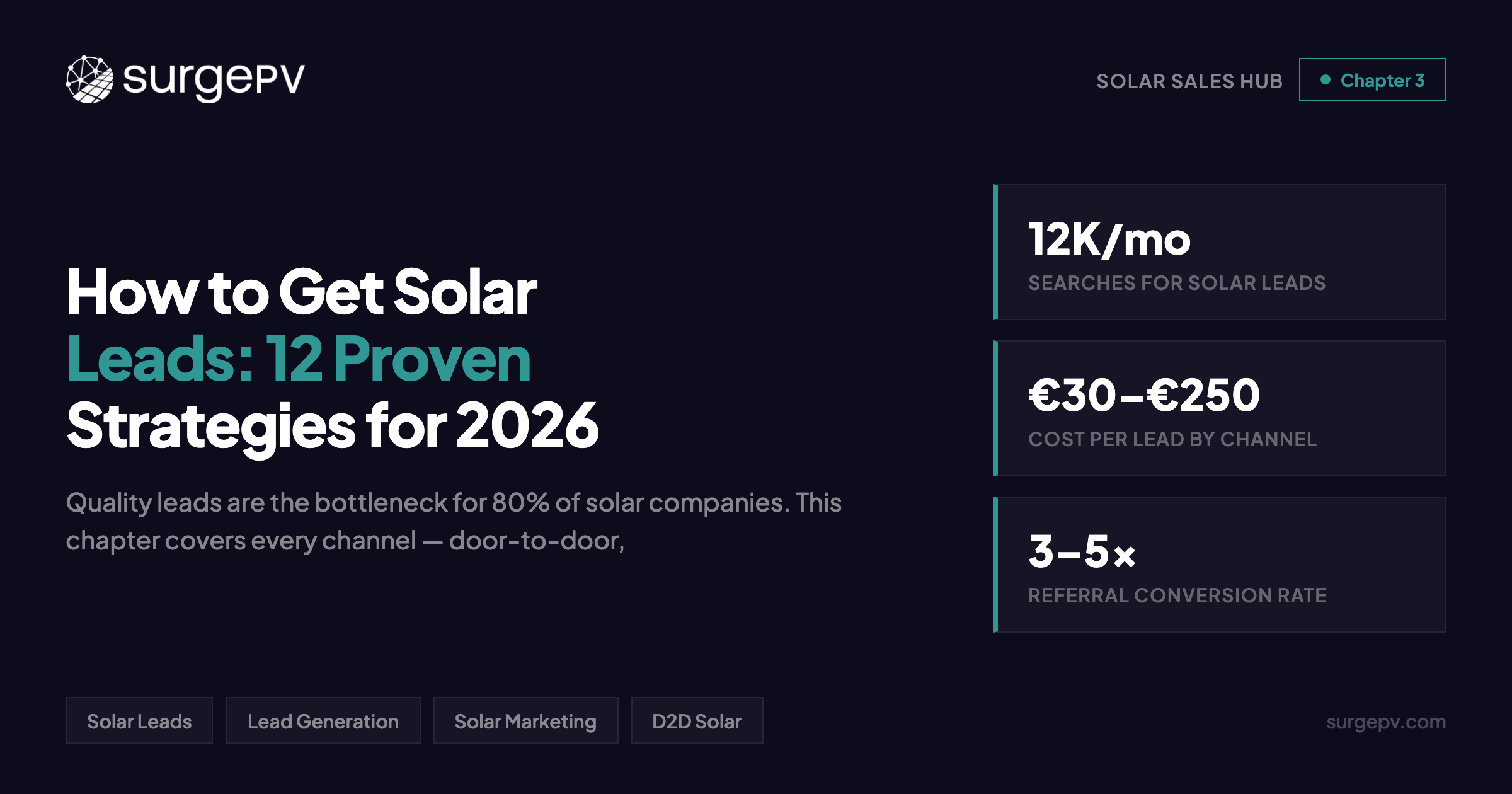
Most solar companies don't have a closing problem. They have a lead problem. When you ask installers what's holding back growth, the answer is almost always the same: not enough people in the pipeline. This chapter runs through every lead generation channel available to solar companies in 2026 — with real cost-per-lead data so you can decide where to put your budget. For the full marketing playbook, see our solar marketing guide.
What you'll learn in this chapter
- Inbound vs outbound trade-offs with a side-by-side comparison table
- How to run door-to-door canvassing profitably in 2026
- Google Ads keywords by intent tier and what CPCs to expect
- Facebook targeting for solar homeowners
- Referral program structures that convert at 3–5x paid rates
- When to use lead aggregators and how to win on them
- Partnership channels and commercial solar lead strategies
- How to build a systematic lead generation calendar
Inbound vs Outbound Solar Leads: The Fundamental Trade-off
Every solar lead generation channel falls into one of two categories: inbound (the prospect comes to you) or outbound (you go to the prospect). Both work. Neither works alone. The trade-off between them shapes how you build your pipeline.
| Factor | Inbound | Outbound |
|---|---|---|
| Cost per lead | €80–€250 | €30–€120 |
| Lead quality | High (already interested) | Variable |
| Lead velocity | Slow to scale | Fast to scale |
| Sales cycle | Shorter | Longer |
| Scalability | Limited by content/SEO | Scales with budget |
Inbound leads cost more per lead but convert faster because the prospect already has intent. Outbound leads are cheaper to acquire but require more nurturing. The best strategy is to blend both: use outbound to fill the pipeline while inbound builds your brand and long-term pipeline quality.
Pro Tip
A professional solar proposal is one of the best conversion tools you have once a lead is in the pipeline. See solar proposal software to understand how the right tool turns more leads into signed contracts.
Door-to-Door Solar Canvassing: What Still Works in 2026
Door-to-door gets a bad reputation. It's physically demanding, rejection-heavy, and weather-dependent. It also remains the highest-converting lead channel for residential solar when executed well. No other outbound method puts a solar professional face-to-face with a homeowner at their own property.
Conversion rates
Expect 1–3 qualified appointments per 100 doors knocked. A well-trained rep working a targeted neighborhood can set 2–4 appointments per half-day shift. At a 20–30% close rate from appointment to contract, that's roughly 1 deal per 150–200 doors — which translates to a cost per acquisition of €80–€200 in rep time.
The 60-second script
Problem-agitate-solve in under a minute. Open with something specific to their situation: "I noticed you have a south-facing roof — have you looked at what solar would do to your electricity bill?" Don't pitch. Ask. The goal of the door conversation is a scheduled appointment, not a sale.
Timing and territory
Evenings (6–8pm) and weekend mornings outperform weekday daytime by a significant margin — that's when homeowners are actually home and not rushed. Territory planning matters: prioritize neighborhoods where solar panels are already visible on roofs. A street with three visible systems means the social proof is already there. Your pitch is shorter because the objection ("does this actually work?") is already answered before you knock.
Digital tools for D2D
Route optimization apps reduce drive time between addresses. Mobile CRM logging means every prospect is captured during the conversation, not reconstructed from memory at the end of the day. Teams that log D2D activity in real time see significantly better follow-up rates.
Compliance
GDPR (EU) requires a legal basis for processing any personal data collected during canvassing. Do Not Knock registries exist in several European countries — check local regulations before deploying a D2D team in a new market. In Germany, Austria, and the Netherlands, cold door-to-door selling for utilities faces increasing regulation.
Google Ads for Solar: CPCs, Keywords, and What Converts
Google Ads is the highest-intent paid channel available to solar companies. A homeowner typing "solar panel installation Munich" into Google is actively looking to buy — not passively scrolling. The trade-off is cost: solar is one of the most competitive verticals in Google Ads, and CPCs reflect that.
Keywords by intent tier
| Intent Level | Example Keywords | Typical CPC |
|---|---|---|
| High intent | "solar installation [city]", "[brand] solar quote" | €25–€60 |
| Medium intent | "solar panels cost", "solar panel savings" | €15–€35 |
| Lower intent | "how does solar work", "solar panel guide" | €5–€20 |
Budget toward high-intent keywords first. The volume is lower but the conversion rate is higher. Lower-intent keywords work for brand awareness and retargeting lists, not direct lead generation.
Landing page requirements
A solar Google Ads campaign is only as good as the landing page it leads to. Phone number must be prominent — above the fold, clickable on mobile. The page should be geographically specific (mention the city or region). Page load speed directly affects Quality Score: aim for under 2 seconds on mobile.
Call extensions and call-only ads
Call-only ads bypass the landing page entirely and send the click directly to a phone call. For solar, these typically outperform standard text ads because the prospect intent is already high and the fastest path to a sale is a phone conversation. Call extensions on standard ads achieve similar results without abandoning the landing page entirely.
Google Local Services Ads
Google LSAs are solar-specific, pay-per-lead (not per click), and include a background-check badge that increases credibility. Leads from LSAs are typically phone calls from verified local homeowners. Cost per lead runs €40–€90 depending on market, which is lower than standard Google Ads for comparable intent.
Facebook and Meta Solar Ads: Targeting Strategies
Facebook's advantage over Google Ads is targeting precision. Google finds people actively searching; Facebook finds people who match the profile of a likely solar buyer even before they've started searching. The lead quality gap is real — Facebook leads tend to need more nurturing — but the volume and cost-per-lead are better.
The right audience
Start with homeowners aged 35–65, household income above €60K, interested in home improvement and energy efficiency. Layer in eco-interest signals if you're in a market where that resonates. Exclude renters explicitly using housing type targeting where available.
Custom and lookalike audiences
Website visitors, email list uploads, and video viewers become the foundation for custom audiences. From any custom audience with 1,000+ people, build a 1–3% lookalike to find similar profiles in your market. Lookalike audiences built from closed customers (not just leads) consistently outperform those built from broader prospect lists.
Ad formats that work
Video testimonials from real customers perform best — they carry social proof and show an actual result ("my bill went from €180 to €12"). Carousel ads work well for showing system-plus-savings ("Your system. Your savings. Your roof."). Lead form ads reduce friction by keeping the prospect inside Facebook — but lead quality tends to be lower than landing page leads because the commitment barrier is lower.
Typical CPL and quality trade-off
Facebook leads run €30–€90 CPL vs €80–€250 on Google. The lower cost comes with lower intent — Facebook prospects weren't searching for solar, they were scrolling. Plan for a longer nurture cycle: multiple follow-up calls, educational sequences, and re-engagement campaigns for prospects who didn't convert immediately.
Key Takeaway
Facebook gives you volume at lower cost. Google gives you intent at higher cost. Use Facebook to build a large top-of-funnel at scale; use Google to capture buyers who are actively ready to move.
Referral Programs: The Highest-Converting Lead Source
Referral leads convert at 3–5 times the rate of paid leads. The economics are compelling: a referral program that pays €300 per closed deal produces leads at a fraction of the effective cost of any paid channel once you account for close rates.
Program structure
Most successful solar referral programs pay €200–€500 per closed and installed deal. Some pay on lead submission (lower per-lead cost, but you pay for bad leads too). Paying on installation aligns incentives: the referrer only gets paid when the deal is real. The gift can be cash, gift cards, or account credit — cash outperforms in most markets.
When to ask
The best referral ask happens at post-installation when satisfaction is highest. An NPS score of 8 or above is a reliable indicator of referral willingness. Ask directly: "Who do you know who might be interested in doing what you just did?" is more effective than a generic "refer a friend" request. Repeat the ask at first monitoring report (typically 30–60 days after commissioning) when the customer sees real savings for the first time.
Digital referral automation
An automated email sequence triggered by installation completion can systematize the referral ask at scale. Sequence: immediate thank-you email → 30-day "here are your first results" email with referral link → 90-day follow-up. Many CRMs support this workflow without custom development.
Community referral programs
Neighborhood WhatsApp groups and local community forums are underused channels. When one homeowner posts their solar results in a neighborhood group, it drives organic inquiries. Some installers formalize this by offering group discounts when three or more neighbors install together — this creates a natural incentive for satisfied customers to recruit their neighbors.
Lead Aggregators: EnergySage, Solar.com, and European Equivalents
Lead aggregators collect consumer inquiries and sell them to multiple installers. They're a fast way to get pipeline volume without building your own marketing infrastructure. The trade-off is significant: you're competing directly against other installers on the same lead, and that competition drives margin compression.
How they work
You pay €50–€150 per lead. The same lead typically goes to 3–5 competing installers simultaneously. The prospect gets multiple quotes and compares them. Price becomes the primary differentiator unless you differentiate on proposal quality, response speed, or reputation.
How to win on aggregators
Response time is the single biggest differentiator. Studies of aggregator platforms consistently show that the first installer to call (within 5 minutes of lead submission) wins the appointment at dramatically higher rates. Reviews matter too: prospects on platforms like EnergySage explicitly read and compare installer reviews before responding. Proposal quality — a professional, site-specific proposal using solar proposal software — closes the deal once you're in the conversation.
European equivalents
Check24 dominates in Germany, with a solar comparison product that drives significant volume. Italy has Helios and several regional platforms. France has Comparateur Energie. The Netherlands has Zonnepanelen-weetjes and similar sites. Each operates slightly differently in terms of lead exclusivity and pricing model — evaluate on a per-market basis.
When to use aggregators
Early-stage company that needs pipeline immediately: aggregators make sense. Established company with a strong referral base and inbound engine: aggregators are likely ROI-negative compared to doubling down on owned channels. Always calculate your true cost per installation (not just cost per lead) to make the comparison fair.
Referral Partnerships with Related Businesses
One good referral partner can generate 5–20 qualified leads per month with zero marketing spend. The key is finding businesses whose customers naturally overlap with yours.
Best partner types
- Mortgage brokers: Home buyers are solar buyers. A homeowner who just bought a house and is thinking about upgrades is a warm prospect. Mortgage brokers talk to hundreds of new homeowners per year.
- Roofers: A roof replacement customer is immediately qualified (new roof, owns property). Roofers who refer solar leads save their customers a second sales cycle — the roofing work and the solar installation can be coordinated.
- HVAC contractors: Customers thinking about heat pumps are thinking about energy costs. Heat pump + solar is a natural upsell conversation.
- Real estate agents: Particularly useful for commercial properties where energy costs affect asset value and yield.
Partnership structure
A mutual referral fee of €200–€400 per closed installation is standard. Co-marketing materials (a one-page explainer the partner can hand to their customers) reduce friction. The best partnerships are reciprocal: the solar company refers roofing, HVAC, or mortgage business back to the partner.
How to approach
Lead with the customer benefit: "Every homeowner who gets a new roof from you is leaving money on the table if they don't install solar at the same time. I'll pay you €300 for every deal we close together." Frame the partnership in terms of value delivered to their customers, not just the referral fee.
LinkedIn and Social Selling for Commercial Solar
Commercial solar leads don't come from door-to-door canvassing. They come from relationships. LinkedIn is the most direct route to the decision-makers who sign commercial solar contracts.
Target job titles
Commercial property managers, facility directors, CFOs of energy-intensive businesses (manufacturing, logistics, food processing, retail), and sustainability managers at companies with ESG commitments. LinkedIn Sales Navigator allows filtering by title, company size, industry, geography, and recent activity — combining these filters produces targeted prospect lists in an hour.
The warm approach
Cold LinkedIn pitches have low response rates. The approach that works is building familiarity before pitching. Comment thoughtfully on a prospect's posts for 2–4 weeks before sending a connection request. When you do connect, share a relevant insight — an electricity price update affecting their sector, a new commercial solar incentive in their market — before any mention of your service.
Outreach template
First message: problem-specific, no pitch. "Hi [Name], I work with manufacturing companies in [region] that have seen their grid electricity costs increase significantly over the past 18 months. Curious whether this has been a concern for your operations." If they engage, you're in a conversation. The pitch follows naturally from the conversation, not from the initial outreach.
Content Marketing and SEO for Solar Companies
Seventy percent of solar buyers research online before contacting any installer. A solar company with strong organic content captures that research traffic; one without it is invisible for the majority of its potential customers' decision-making process.
What to create
- "Solar in [city]" pages targeting local search intent
- Solar cost guides for your specific market (actual local prices, not generic estimates)
- Incentive explainers — updated annually as schemes change
- ROI calculators that let visitors estimate their own payback
- FAQ pages targeting question keywords ("How long do solar panels last?", "What happens on cloudy days?")
Local SEO
Google Business Profile is free and often the first result for local solar queries. Keep it current: post photos of completed installations (with customer permission), respond to all reviews, and update your service area. Local citation consistency (same name, address, phone number across all directories) matters for local ranking.
Timeline
Content marketing and SEO take 6–18 months to produce meaningful organic traffic. They are not a replacement for outbound in the short term. They are the best long-term investment a solar company can make in lead generation — organic traffic has no per-lead cost once it's ranking.
Pro Tip
When a content-generated lead comes in, your proposal quality is what closes them. A prospect who spent 30 minutes reading your solar guide before calling expects a professional, thorough proposal — not a generic template. See solar proposal software for how to meet that expectation consistently.
Community Solar and Group Buying Schemes
Group buying programs aggregate multiple homeowners to negotiate bulk pricing from a single installer. They're less common in Europe than in North America, but growing — particularly in Germany, the Netherlands, and the UK through local energy cooperatives.
How group buying works
A community group (neighborhood association, environmental group, local government initiative) organizes residents to collectively request quotes from solar installers. The installer offers a discount in exchange for volume and predictable scheduling. For the installer, the cost of acquisition per installation drops significantly because one sales effort produces multiple contracts.
How to initiate
Partner with local environmental groups, community councils, and civic organizations that already have engaged membership lists. Propose a group solar program: the organization gets to offer its members a discount, and you get a warm pipeline with built-in social proof. Offer a small kickback to the organizing group (or donate to a local cause in their name) to make the partnership valuable for them.
Building a Lead Generation System (Not Just Tactics)
Most solar companies use tactics reactively — they run ads when pipeline is low, do D2D pushes when sales are slow. That approach produces feast-or-famine cycles. A systematic lead generation calendar smooths the pipeline and makes growth predictable.
Monthly lead gen calendar
- Door-to-door: Weekly cadence with defined territory rotation. Log all contacts in CRM by end of shift.
- Digital ads: Running continuously with weekly performance review. Pause underperforming ad sets; increase budget on converting ones.
- Referral asks: Automated post-installation sequence handles the initial ask. Manual follow-up for any high-NPS customers at 90 days.
- Partner follow-up: Monthly check-in with each referral partner. Share results. Strengthen the relationship.
Lead tracking requirements
Every lead should be entered into CRM within 24 hours with source attribution. Without source tracking, you can't know which channels are producing ROI. Track: lead source, lead date, appointment set (yes/no), proposal sent (yes/no), closed (yes/no), contract value. Monthly CPL by channel is the number that tells you where to invest next.
Budget allocation model
A starting framework for a residential solar company at growth stage: 40% D2D (rep time and territory planning), 30% digital advertising, 20% referral program payouts, 10% partner relationship management. Adjust based on your actual CPL data — the best channel for your market may differ from this baseline.
Close More of the Leads You Generate
Getting leads is half the battle. Closing them requires a proposal that builds trust immediately. SurgePV generates client-ready proposals from your design — financial tables, system layout, and incentives included.
Book a DemoNo commitment required · 20 minutes · Live project walkthrough
CPL by Channel: What to Track Monthly
Cost per lead is a useful metric but it's incomplete. What you actually need to track is cost per installation — because lead quality varies dramatically by channel. A Facebook lead at €40 CPL that closes at 5% is more expensive per installed system than a Google lead at €150 CPL that closes at 25%.
| Channel | Typical CPL | Typical Close Rate | Effective Cost per Install |
|---|---|---|---|
| Referrals | €0 + €300 on close | 40–60% | €300–€500 |
| Door-to-door | €30–€80 | 15–25% | €200–€400 |
| Google Ads | €80–€250 | 20–30% | €400–€800 |
| Facebook Ads | €30–€90 | 5–15% | €400–€900 |
| Lead aggregators | €50–€150 | 10–20% | €400–€900 |
| Organic / SEO | €0 (post-ranking) | 20–35% | €0 marginal |
Referrals and organic consistently produce the best economics. Door-to-door is competitive with Google Ads at lower CPL. Facebook requires excellent nurturing to make the economics work. Build your lead tracking to measure all the way through to installed system, not just to lead submission.
Frequently Asked Questions
How do I get solar leads for free?
The most effective free solar lead channels are referrals from existing customers, organic content (blog posts, local SEO, Google Business Profile), and partnerships with related businesses like roofers and mortgage brokers. Door-to-door canvassing is also low-cost if you already have staff. Free channels take longer to scale than paid channels but produce higher-quality leads — referrals in particular convert at 3–5x the rate of paid leads.
What is the best solar lead generation strategy?
No single channel outperforms a blend. The best-performing solar companies use door-to-door for fast pipeline building, Google Ads for high-intent buyers actively searching, referral programs for conversion quality, and content marketing for long-term brand visibility. The right mix depends on your stage: early-stage companies benefit most from D2D and lead aggregators for volume; established companies should invest heavily in referral systems and inbound.
How much do solar leads cost?
Cost per solar lead varies by channel: Facebook Ads typically run €30–€90, Google Ads €80–€250, lead aggregators €50–€150, and door-to-door €30–€80 when accounting for rep time. Referral leads are effectively free apart from the referral fee paid on close (typically €200–€500), making them the lowest true cost-per-acquisition channel.
Should I buy solar leads or generate my own?
Buying leads from aggregators makes sense when you need immediate pipeline and are in an early growth phase. The downsides are significant: you share leads with 3–5 competing installers, quality is inconsistent, and margins erode. Generating your own leads costs more time upfront but produces exclusive, higher-converting leads. The ideal approach is to buy leads short-term while building your own inbound and referral engine for the long term.
How do I generate commercial solar leads?
Commercial solar leads come from different channels than residential. LinkedIn Sales Navigator targeting facility managers, CFOs, and commercial property owners is the most direct route. Commercial installers also win through referral partnerships with commercial real estate brokers and energy consultants, attending industry conferences, and targeting businesses with high electricity bills through cold outreach. Solar design software that can handle commercial roof complexity — multiple roof planes, large string configurations — is a credibility signal in commercial sales conversations.
Turn Your Leads Into Closed Deals
Once you have leads in the pipeline, a professional proposal is what converts them. SurgePV connects your solar software design workflow directly to a branded, client-ready proposal — no re-entry, no manual math.
Book Free DemoNo credit card · Full access · Unlimited projects
About the Contributors

Co-Founder · SurgePV
Nirav Dhanani is Co-Founder of SurgePV and Chief Marketing Officer at Heaven Green Energy Limited, where he oversees marketing, customer success, and strategic partnerships for a 1+ GW solar portfolio. With 10+ years in commercial solar project development, he has been directly involved in 300+ commercial and industrial installations and led market expansion into five new regions, improving win rates from 18% to 31%.