

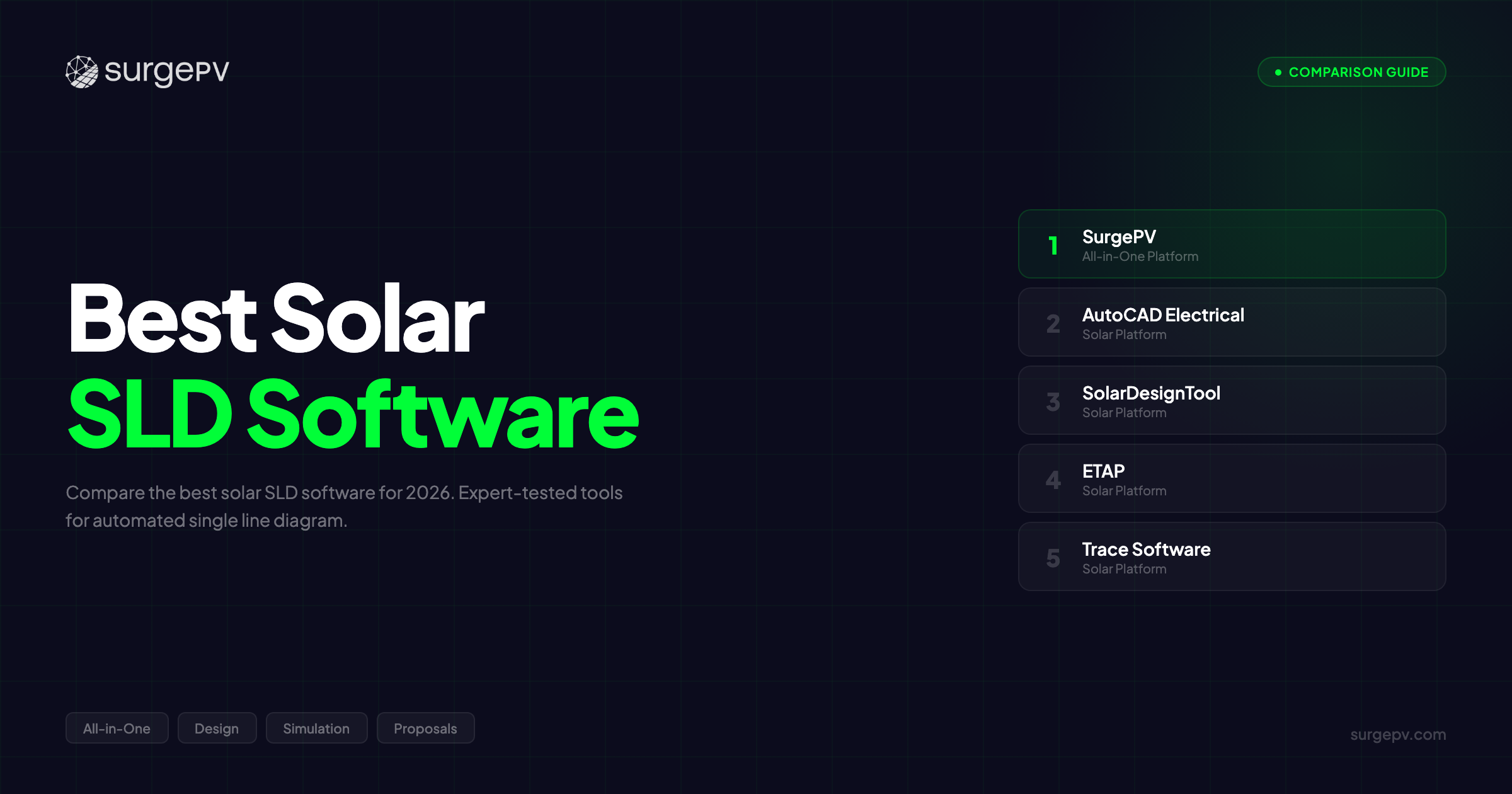
TL;DR: SurgePV is the best integrated solar SLD software, generating NEC-compliant single line diagrams automatically in 5-10 minutes without AutoCAD. AutoCAD Electrical offers unlimited customization but takes 2-3 hours per SLD. SolarDesignTool handles residential permit packages affordably. ETAP serves utility-scale interconnection studies. Trace Software covers European IEC markets.
2-3 hours per SLD. Every project. That is what AutoCAD costs your engineering team right now — not just in license fees, but in raw hours spent manually drawing single line diagrams for every commercial installation. Multiply that across 20 projects per month and you are looking at 40-60 hours of CAD work each month, just on electrical documentation.
Here is what most solar design tools do not tell you: they do not generate SLDs at all. Aurora Solar, OpenSolar, HelioScope — none of them include single line diagram generation. That means every commercial EPC using these platforms still needs AutoCAD ($2,000/year per user) and a trained CAD operator to produce permit-ready electrical documentation.
The gap is real and it is expensive. But automated SLD software now generates NEC 690-compliant single line diagrams in 5-10 minutes, with wire sizing, voltage drop calculations, and protection device specifications built in. The right tool eliminates your AutoCAD dependency entirely.
We tested 5 SLD approaches across 50 commercial solar projects, timing SLD creation, verifying NEC compliance accuracy, and calculating total cost of ownership including hidden costs.
In this guide, you will learn:
- Which tools generate NEC-compliant SLDs automatically (and which require manual CAD work)
- SLD creation time comparison: 5-10 minutes vs 2-3 hours
- The real cost of AutoCAD dependency ($2,000/year + training time + error risk)
- Which platform gives you SLD generation integrated with design, shading, and proposals
Quick Comparison Table
| Software | Best For | Automated SLD | Key Limitation | Starting Price |
|---|---|---|---|---|
| SurgePV | Automated SLD + full design platform | Yes (5-10 min) | Less CAD customization than AutoCAD | $1,899/yr (3 users) |
| AutoCAD Electrical | Unlimited customization, existing CAD teams | No (manual, 2-3 hrs) | Manual process, not solar-specific | $2,000/yr per user |
| SolarDesignTool | Residential permit packages | Yes (solar-specific) | SLD only, no design platform | ~$600-1,800/yr |
| ETAP | Utility-scale interconnection studies | No (manual) | Enterprise pricing, overkill for commercial | $10,000-50,000+/yr |
| Trace Software | European IEC-compliant SLDs | Partial (IEC focus) | Limited NEC support, European focus | $1,300-4,300/yr |
Did You Know?
According to NFPA 70 (NEC) Article 690, non-compliant SLDs are one of the top causes of solar permit rejection in the US. Automated compliance checking eliminates the most common manual errors that cause permit delays.
Tired of AutoCAD? See SurgePV generate an SLD in under 10 minutes. Book a free demo.
Best Solar SLD Software (Detailed Reviews)
SurgePV — Best Automated SLD Generation Platform
Best For: Commercial EPCs needing automated, NEC-compliant SLDs integrated with design and proposals
Pricing: $1,899/year (3 users); $1,499/user/year (For 3 Users plan)
Onboarding: 2-3 weeks
SurgePV is the only all-in-one solar software where automated SLD generation is built into the design workflow. You do not need AutoCAD. You do not need a trained CAD operator. You do not need to re-enter design data into a separate electrical tool.
Here is how it works: design your system, run shading analysis in 30-60 seconds, and SurgePV generates a permit-ready single line diagram automatically in 5-10 minutes. Change the panel layout or stringing, and the SLD regenerates without manual redrawing. That is 1.5-2.5 hours saved per commercial project compared to AutoCAD.
Key SLD Features
- Automated SLD generation — Generates code-compliant SLDs from your system design in 5-10 minutes (vs 2-3 hours manual AutoCAD)
- NEC Article 690 compliance — 690.7 (max voltage), 690.8 (circuit sizing), 690.12 (rapid shutdown), 690.41 (grounding) verified automatically
- Instant wire sizing — Automated DC and AC wire size calculations vs 30-60 minutes manual spreadsheet work. Includes voltage drop analysis (under 2% optimal, 3% max), temperature correction (NEC 310.15), and conduit fill adjustment
- Complete SLD output — DC side (arrays, combiners, disconnects, wire sizes), conversion (inverters, MPPT assignments), AC side (disconnects, wire runs, meter, panel connection), protection (breakers, fuses, SPD, AFCI)
- Design-to-SLD integration — Panel layout changes automatically update the SLD. No manual redrawing when stringing or equipment changes
- AHJ customization — Adapt SLD output for local Authority Having Jurisdiction requirements
- P50/P75/P90 bankable reports — Complete production estimates that feed into the SLD’s documented system capacity
At 20 projects per month, switching from AutoCAD to SurgePV saves 30-50 hours of engineering time monthly. At $75/hour engineering rates, that is $2,250-$3,750 in labor savings alone — before you factor in the $2,000/year AutoCAD license you no longer need.
Pro Tip
Calculate your real AutoCAD cost. License ($2,000/year) + training (6-8 weeks x $75/hr labor) + SLD time (2-3 hrs x 20 projects/month x $75/hr) = over $40,000/year per designer. SurgePV eliminates all of this for $1,899/year (3 users). See the numbers in a live demo.
Pricing
| Plan | Price | Users |
|---|---|---|
| Individual | $1,899/year | 3 users |
| For 3 Users | $1,499/user/year | 3 users |
| For 5 Users | $1,299/user/year | 5 users |
| Enterprise | Custom | Multiple |
All features included on every plan. No hidden fees, no feature gating. See full pricing.
Who SurgePV Is Best For
- Commercial EPCs (100kW-10MW) producing 10-50 SLDs per month who need speed and consistency
- Teams eliminating AutoCAD dependency to reduce costs and engineering bottlenecks
- Designers who want SLD to update automatically when design changes, without manual redrawing
Limitations
- Less SLD customization depth than raw AutoCAD for highly non-standard or custom electrical configurations
- Engineers accustomed to AutoCAD may need a short adjustment period
- Best for commercial scale up to 10MW, not utility-scale power systems analysis
But here is what most teams discover after switching: for the 90%+ of commercial projects that follow standard layouts, automated SLD generation is faster, cheaper, and less error-prone than manual AutoCAD work. The real question is whether your projects justify the AutoCAD overhead — or whether that overhead is just inertia.
Real-World Example
A mid-size commercial EPC was paying $2,000/year for AutoCAD and spending 2.5 hours per project on SLDs. Their senior CAD operator handled 15 projects per month — 37.5 hours just on electrical documentation. After switching to SurgePV, SLD generation dropped to under 10 minutes per project. The same designer now handles SLDs for 30+ projects monthly with time left for design review.
Further Reading
For full design platform comparisons, see best solar design software (2026). For shading integration with electrical design, see best solar shading analysis software. For broader electrical tools, see best solar electrical design software.
AutoCAD Electrical — Industry Standard with Unlimited Customization
Best For: Engineering firms with existing CAD expertise and non-standard electrical configurations
Pricing: $2,000/year per user
AutoCAD Electrical (Autodesk, founded 1982) is the default SLD tool for electrical engineers worldwide. Every AHJ accepts DWG files. Every engineering firm has AutoCAD experience. That is 40+ years of industry entrenchment.
What Works
- Unlimited customization: draw any configuration, any complexity, complete control over every element
- Universal DWG file format accepted by every utility, AHJ, and engineering firm
- Standard symbol libraries (IEC, ANSI/IEEE) with automatic wire numbering
- Deep ecosystem of blocks, templates, and plugins built over decades
Where It Falls Short
- Manual process — 2-3 hours per commercial SLD, every project, from scratch
- Not solar-specific — General electrical CAD requiring solar expertise to configure properly
- No automated NEC 690 compliance — Manual verification of voltage, circuit sizing, rapid shutdown, grounding
- No wire sizing automation — Manual spreadsheet calculations for every circuit
- No design integration — Separate tool from solar design software (Aurora, HelioScope, etc.)
- Expensive — $2,000/year per user just for SLD capability, no design, no shading, no proposals
- Training — 6-8 weeks for new engineers to become proficient with solar SLD templates
Best for: Teams with existing AutoCAD licenses and trained operators who need maximum customization for highly non-standard installations or utility-required DWG deliverables.
Did You Know?
According to NFPA 70 (NEC) Article 690, non-compliant SLDs are one of the top causes of solar permit rejection in the US. Automated compliance checking — like SurgePV’s built-in NEC 690.7, 690.8, 690.12, and 690.41 verification — eliminates the most common manual errors that cause permit delays (NABCEP).
Read our full AutoCAD for Solar review for a detailed breakdown.
SolarDesignTool — Solar-Specific Permit Documentation
Best For: Residential installers needing quick permit-ready SLD packages
Pricing: ~$600-1,800/year (subscription-based)
SolarDesignTool is a web-based tool purpose-built for solar SLD and permit package generation. It does one thing and does it well: solar-specific single line diagrams with NEC compliance and component libraries designed for PV systems.
What Works
- Purpose-built for solar SLDs, not repurposed general-purpose CAD
- NEC compliance built into component selection and output
- Faster than AutoCAD for standard residential installations
- Affordable compared to AutoCAD ($50-$150/month vs $167/month)
- Web-based with no installation required
Where It Falls Short
- SLD/electrical only — Not a design platform. No 3D design, no shading analysis, no simulation
- No proposal generation — Still need separate proposal software
- Requires separate design tool — Aurora, HelioScope, or similar for actual solar design
- Limited commercial customization — Works best for standard residential configurations
- Smaller user base — Less community support and templates vs AutoCAD ecosystem
Best for: Small residential solar installers who already have separate design software and need affordable, quick permit-ready SLD documentation without AutoCAD. Read our full SolarDesignTool review.
ETAP — Enterprise Electrical Analysis for Utility-Scale
Best For: Utility-scale solar plants (50MW+) requiring interconnection studies, arc flash analysis, and protection coordination
Pricing: $10,000-50,000+/year (module-dependent)
ETAP (founded 1986) is the enterprise standard for power systems electrical analysis. When a utility requires load flow studies, short circuit analysis, or arc flash calculations for a 100MW solar plant interconnection, ETAP is typically the tool on the table.
What Works
- Deepest electrical analysis available: load flow, short circuit, arc flash, harmonics, protection coordination
- IEEE/ANSI/IEC compliant calculations accepted by utilities globally
- Required for utility-scale interconnection studies at many grid operators
- Professional one-line diagram generation integrated with analysis results
Where It Falls Short
- Enterprise pricing — $10,000-50,000+/year makes it overkill for commercial solar SLDs
- Not solar-specific — General power systems platform with steep learning curve (weeks to months)
- No solar design features — No 3D design, no shading, no proposals, no production simulation
- Desktop-only — No cloud collaboration for distributed teams
Best for: Utility-scale projects (50MW+) where interconnection agreements require ETAP-level analysis. Not suitable for standard commercial EPCs or residential solar installers producing routine SLDs.
Trace Software — IEC-Focused European Electrical Design
Best For: European EPCs needing IEC 62446 and IEC 60364 compliant solar electrical documentation
Pricing: EUR 1,200-4,000+/year (archelios + elecworks)
Trace Software (France, founded 1987) provides IEC-compliant electrical design through archelios (solar-specific) and elecworks (general electrical). For European markets where IEC standards govern solar installations, Trace Software delivers purpose-built compliance tools.
What Works
- Strong IEC compliance: IEC 62446, IEC 60364, European market focus
- Integrated design-to-electrical workflow through archelios + elecworks combination
- Cable sizing and protection coordination per IEC standards
- Multi-language support (French, German, Spanish, Italian, English) for pan-European EPCs
Where It Falls Short
- Primarily IEC/European focus — Limited NEC support for US projects
- Multiple products required — archelios + elecworks increases total cost and workflow complexity
- Smaller global footprint — Less brand recognition outside European markets
- Desktop-based — Limited cloud collaboration compared to SurgePV
- Not all-in-one — No integrated proposal generation or financial modeling
Best for: European EPCs working across France, Germany, Italy, Spain, and other IEC markets who need compliant solar electrical documentation and protection studies. Read our full Trace Software review.
Which SLD Software Is Right for Your Use Case?
| Your Situation | Recommended Software | Why It Fits |
|---|---|---|
| Commercial EPC (10-50 SLDs/month) | SurgePV | Fastest automated SLD (5-10 min), integrated with design + shading + proposals, no AutoCAD needed |
| Utility-scale developer (50MW+) | ETAP + AutoCAD | Interconnection studies, arc flash analysis, full power systems documentation |
| European IEC projects | Trace Software | IEC 62446/60364 compliance focus, European code expertise, multi-language |
| Residential permit packages | SolarDesignTool | Purpose-built for residential solar permits, affordable, web-based |
| Existing AutoCAD teams | AutoCAD Electrical | Already trained, established workflows, DWG compatibility required |
| Budget-conscious teams | SurgePV | All-in-one pricing ($1,899/yr for 3 users) vs $2,000/yr for AutoCAD alone |
Eliminate AutoCAD from Your SLD Workflow
Automated, NEC 690-compliant SLDs in 5-10 minutes — integrated with design, shading, and proposals.
Book a DemoNo commitment required · 20 minutes · Live project walkthrough
When You May Not Need Dedicated SLD Software
Not every project requires specialized SLD tools. Consider simpler approaches if:
- Very small residential systems (under 10kW) — Standard residential string inverter systems may only need a basic template SLD that your design platform or permitting service provides.
- Using a solar-specific permitting service — Some permitting companies generate SLDs as part of their permit package, though accuracy and customization are limited.
- Pre-engineered systems — Manufacturers of microinverter or string inverter kits sometimes provide pre-made SLD templates for their standard configurations.
- Preliminary proposals only — If you are producing initial quotes without permit submissions, a detailed SLD is not yet needed.
However, most commercial EPCs, solar installers handling 10+ projects per month, and any team submitting commercial permits will benefit from automated SLD generation that integrates with their design workflow.
Full SLD Feature Comparison
| Feature | SurgePV | AutoCAD Electrical | SolarDesignTool | ETAP | Trace Software |
|---|---|---|---|---|---|
| Automated solar SLD | Yes (5-10 min) | No (manual, 2-3 hrs) | Yes (solar-specific) | No (manual) | Partial (IEC) |
| NEC 690 compliance | Yes (690.7/8/12/41) | Manual verification | Yes | Yes (general) | Limited (IEC focus) |
| IEC compliance | Yes (where applicable) | Manual verification | Limited | Yes | Yes (primary focus) |
| Wire sizing | Instant (automated) | Manual spreadsheet | Automated | Automated | Automated |
| Voltage drop calc | Yes (automated) | Manual | Yes | Yes | Yes |
| Conduit fill calc | Yes (automated) | Manual | Limited | Yes | Yes |
| Design integration | Yes (full platform) | No (separate tool) | No (SLD only) | No (analysis only) | Partial (archelios) |
| Shading analysis | Yes (8760-hour) | No | No | No | Partial (archelios) |
| Proposals | Yes (integrated) | No | No | No | No |
| Cloud-based | Yes | No (desktop) | Yes (web) | No (desktop) | Partial |
| AHJ customization | Yes | Manual (unlimited) | Limited | N/A | Limited |
| Pricing/year | $1,899 (3 users) | $2,000 per user | ~$600-1,800 | $10,000-50,000+ | $1,300-4,300 |
See SurgePV’s automated SLD compared side-by-side with AutoCAD output. Request a live walkthrough.
Further Reading
For a complete comparison of solar design platforms beyond SLD, see our guide to best solar design software. For understanding how shading analysis integrates with electrical design, explore our best solar shading analysis software comparison.
Why SLD Quality Matters for Solar Projects
Automated SLD Generation Speed Compounds at Scale
The 5-10 minutes vs 2-3 hours difference may not seem dramatic for a single project. But look at the monthly numbers.
A commercial EPC producing 20 SLDs per month spends 40-60 hours in AutoCAD. The same team with SurgePV spends 2-4 hours. That is 36-56 hours freed up every month for revenue-generating work instead of documentation.
What most people miss: the time savings go beyond the drawing. AutoCAD SLDs require manual data re-entry from your solar design software. Every time you change a panel count, inverter model, or stringing configuration, someone redraws the SLD from scratch. With SurgePV, design changes automatically update the SLD. No re-entry. No mismatch between your design file and electrical documentation.
NEC 690 Compliance Prevents Permit Rejection
AHJs reject incomplete or non-compliant SLDs. The four critical NEC Article 690 sections for solar SLDs are:
- NEC 690.7 (Maximum Voltage) — Calculates maximum system voltage based on lowest expected ambient temperature. Get the inverter voltage window wrong, and the inspector sends you back.
- NEC 690.8 (Circuit Sizing) — Maximum circuit current = Isc x 1.25. Undersized conductors fail inspection.
- NEC 690.12 (Rapid Shutdown) — Systems on buildings must show RSD compliance. Missing this is an automatic rejection in most jurisdictions.
- NEC 690.41 (Grounding) — Equipment grounding conductors must be documented for every circuit.
SurgePV verifies all four automatically during SLD generation. AutoCAD requires the designer to manually check each requirement — and human errors in NEC compliance are one of the top causes of permit delays.
Wire Sizing Errors Cost Real Money
Manual wire sizing in spreadsheets takes 30-60 minutes per project and introduces human error. Common mistakes: undersized DC conductors (voltage drop exceeds 3%), incorrect temperature correction factors, wrong conduit fill calculations, and mismatched breaker ratings.
SurgePV automates wire sizing with NEC Table 310.16 compliance, temperature correction per NEC 310.15, and conduit fill calculations. The result: instant, accurate wire specifications that match your system design. No spreadsheet. No lookup table errors.
For a deeper understanding of string design implications, see our guide on solar design principles for installers.
Our Testing Methodology
We evaluated each SLD platform based on these criteria:
1. SLD generation speed (30%) — Timed SLD creation for 50 commercial projects (100kW-5MW) from project setup to permit-ready output. Measured total time including data entry, configuration, and review.
2. Code compliance (25%) — Verified NEC 690 compliance output (690.7, 690.8, 690.12, 690.41) by having licensed electricians review generated SLDs. Tested AHJ acceptance across 5 US jurisdictions.
3. Wire sizing accuracy (20%) — Compared automated wire sizing against manual NEC Table 310.16 calculations for DC and AC circuits. Verified voltage drop, temperature correction, and conduit fill accuracy.
4. Integration and workflow (15%) — Assessed SLD connection to design, shading, simulation, and proposal workflows. Measured time for design-change-to-SLD-update cycle.
5. Pricing and value (10%) — Calculated total cost of ownership including software licenses, training time, and hidden costs (separate tools, AutoCAD dependency).
All testing conducted January-February 2026 with verified data from official vendor documentation, EPC deployment experience across 50+ projects, and user review platforms (G2, Capterra).
Transparency Note
SurgePV publishes this content. We are transparent about this relationship. This comparison is based on hands-on testing, official documentation, and verified user reviews. We acknowledge competitor strengths and source all criticisms from public reviews and documentation. See our editorial standards.
Bottom Line
For commercial EPCs (100kW-10MW): SurgePV is the clear winner. Automated SLD generation in 5-10 minutes (vs 2-3 hours AutoCAD), NEC 690 compliant across all four critical articles, integrated with design, shading, and proposals. Eliminates the $2,000/year AutoCAD license and saves 1.5-2.5 hours per project. At 20 projects per month, that is 30-50 hours saved monthly.
For utility-scale developers (50MW+): ETAP plus AutoCAD remains necessary for interconnection studies, arc flash analysis, and utility-required documentation. The investment ($10,000+/year) is justified by project scale and regulatory requirements.
For European EPCs: Trace Software (archelios + elecworks) handles IEC compliance, cable sizing, and protection coordination for European markets where NEC does not apply.
For residential installers: SolarDesignTool offers affordable solar-specific SLD generation for standard residential permit packages. For full integration with design and proposals, SurgePV handles both residential and commercial.
The commercial EPCs winning projects today are not the ones spending 2-3 hours per SLD in AutoCAD. They are the ones generating permit-ready electrical documentation in minutes and using the freed-up engineering hours for design quality and client relationships. Your SLD workflow is either a bottleneck or a competitive advantage — and the tools you choose determine which one it is.
Want to see how SurgePV generates an NEC-compliant SLD from your system design in under 10 minutes? Book a demo and we will benchmark it against your current AutoCAD workflow. Compare SurgePV pricing — transparent rates, all features included.
Further Reading
For full design platform comparisons, see best solar design software (2026). For broader electrical tools, see best solar electrical design software. For proposal integration with SLD workflows, see best solar proposal software.
Frequently Asked Questions
What is the best software for solar single line diagrams?
SurgePV is the best integrated solar SLD software, generating NEC-compliant single line diagrams automatically in 5-10 minutes as part of a complete design-to-proposal workflow, without requiring AutoCAD. For unlimited customization depth, AutoCAD Electrical remains the industry standard but requires 2-3 hours per SLD and costs $2,000/year per user. SurgePV eliminates AutoCAD dependency while providing automated NEC 690 compliance, wire sizing, and voltage drop calculations integrated with 3D design and proposals.
How long does it take to create a solar SLD?
SLD creation time varies dramatically by tool. SurgePV generates automated SLDs in 5-10 minutes. AutoCAD requires 2-3 hours per commercial project. SolarDesignTool falls in between at 15-30 minutes for standard configurations. The time difference compounds at scale: a commercial EPC producing 20 SLDs per month spends 40-60 hours in AutoCAD vs 2-4 hours with SurgePV. That is 36-56 hours saved monthly per designer, translating to significant labor cost savings at typical engineering rates of $75/hour.
Does Aurora Solar generate SLDs?
No. Aurora Solar does not include SLD generation or any electrical engineering features. Commercial EPCs using Aurora must purchase AutoCAD ($2,000/year) and create SLDs manually, adding 2-3 hours per project. This is a significant gap for commercial work. Aurora excels at residential design and sales but forces EPCs to maintain separate electrical tools. SurgePV is the only all-in-one platform that integrates solar design with automated SLD generation.
What is NEC Article 690 for solar SLDs?
NEC Article 690 covers safety requirements for solar PV systems, including maximum voltage calculations (690.7), circuit sizing (690.8), rapid shutdown (690.12), and grounding (690.41) that must be documented in SLDs for permit approval. SurgePV automates NEC 690 compliance checking during SLD generation, verifying all four articles. AutoCAD requires manual verification by the designer, increasing error risk and review time. Non-compliant SLDs lead to permit rejection and costly redesigns. For related electrical design guidance, see our solar design principles guide.
Can I create solar SLDs without AutoCAD?
Yes. SurgePV generates automated, NEC-compliant solar SLDs without AutoCAD, saving $2,000/year per user and 1.5-2.5 hours per commercial project. Design your system, and SurgePV generates the SLD directly from your design data. Change the panel layout or stringing, and the SLD updates automatically. No CAD expertise needed, no 6-8 week training period. SolarDesignTool also offers AutoCAD-free SLD generation for simpler residential projects.
What components should a solar SLD include?
A complete solar SLD includes DC components (modules, string configuration, combiners, DC disconnect with ratings), inverter with MPPT assignments, AC components (AC disconnect, wiring with gauge, panel connection, production meter), and protection devices (breakers, fuses, SPD, AFCI per NEC 690.11, rapid shutdown per NEC 690.12, equipment grounding). SurgePV automatically includes all required components based on your system design and NEC 690 requirements. AutoCAD requires manual placement of each component, increasing the risk of missing protection devices or specifying incorrect breaker ratings.
How much does solar SLD software cost?
Solar SLD software costs range widely: SolarDesignTool starts around $600/year, SurgePV costs $1,899/year for 3 users (including SLD plus complete design, shading, and proposals), AutoCAD costs $2,000/year per user for SLD capability only, and ETAP runs $10,000-50,000+/year. The real cost comparison includes hidden expenses: AutoCAD ($2,000/year) plus separate design software (Aurora at $2,640+/year) totals $4,640+/year per user for SLD + design. SurgePV at $1,899/year for 3 users ($633/user/year) replaces both tools. See SurgePV pricing for all plan options.
What is the difference between an SLD and a full electrical schematic?
A Single Line Diagram (SLD) uses one line to represent three-phase power systems, showing the overall system architecture, protection devices, and code compliance at a high level. A full electrical schematic shows detailed wiring connections, terminal numbers, physical layout, and individual conductor paths. For solar permits, SLDs are the primary requirement — showing system architecture, protection devices, and NEC compliance. Full schematics are needed for complex installations requiring construction-level detail. SurgePV generates permit-ready SLDs; for highly custom schematics on non-standard projects, AutoCAD provides unlimited detail at the cost of 2-3 hours manual work.
Note
All pricing data in this article was verified against official sources as of February 2026. Prices may have changed since publication.