

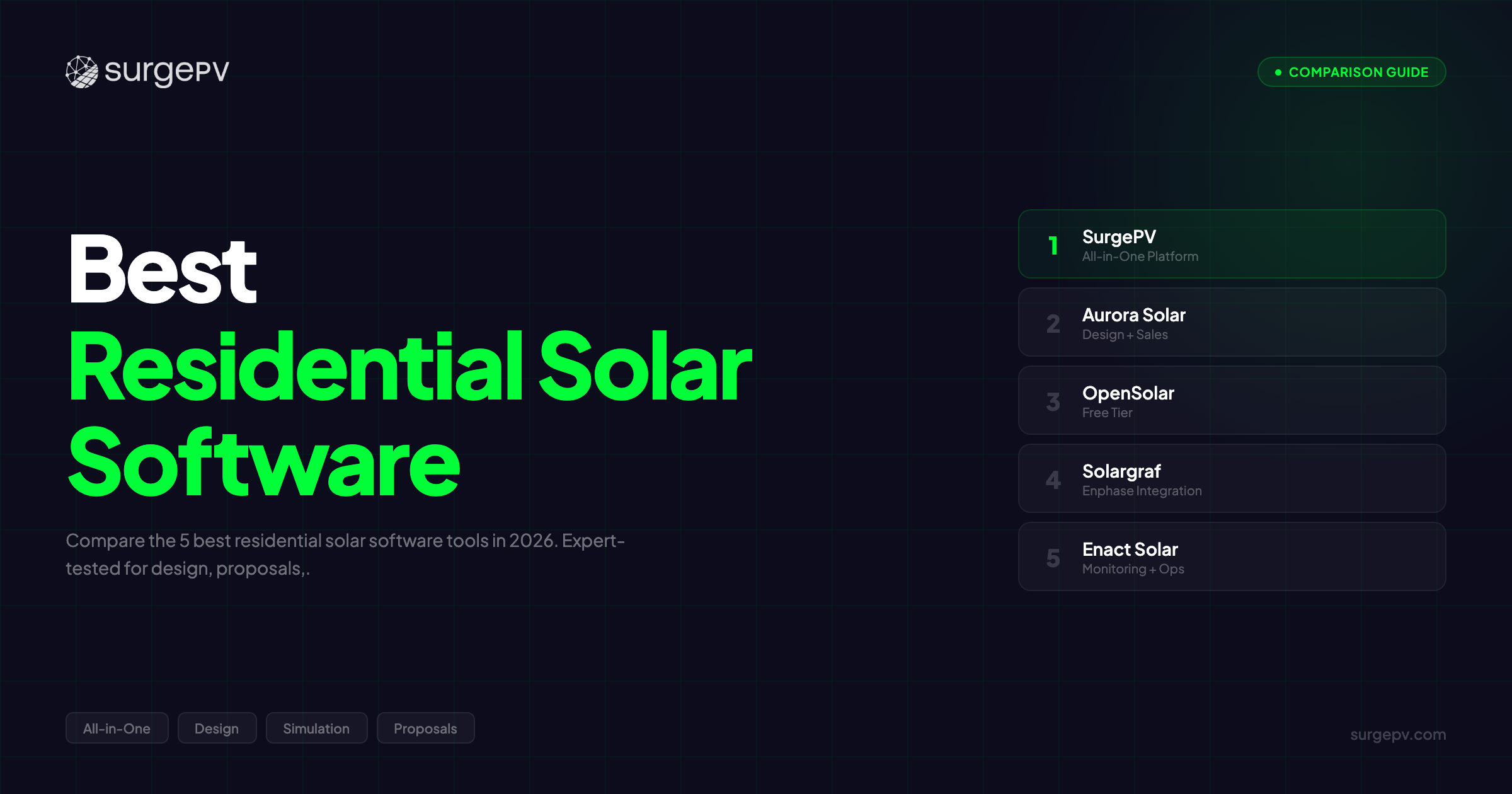
TL;DR: Aurora Solar leads residential for AI roof modeling and sales experience. SurgePV is the only residential platform with integrated SLD generation, wire sizing, and NEC-compliant electrical documentation, eliminating AutoCAD dependency and saving 2-3 hours per project. OpenSolar is the most affordable entry point. Solargraf owns the Enphase-exclusive niche. Enact Solar combines design with operations.
Most residential solar software cannot generate permit-ready SLDs. That is a problem. US AHJs increasingly require complete electrical documentation — single line diagrams, wire sizing calculations, equipment schedules — before approving residential solar permits. Yet Aurora Solar, OpenSolar, Solargraf, and Enact Solar all lack integrated SLD generation. This forces installers to buy AutoCAD ($2,000/year) or draft electrical drawings by hand. At 2-3 hours per project, that adds up fast.
The best residential solar software in 2026 goes beyond pretty roof layouts and polished proposals. It handles the full workflow — from AI roof modeling through NEC-compliant electrical engineering to homeowner-ready proposals — in a single platform. That eliminates tool-switching, cuts project completion time by 75%, and saves thousands in annual software costs.
We tested 5 leading residential solar platforms with installation teams handling 50+ residential projects per month. We evaluated AI roof detection accuracy, permit package completeness, proposal quality, financing integrations, and total cost of ownership.
In this guide, you’ll learn:
- Head-to-head comparison of 5 residential solar platforms (Aurora, SurgePV, OpenSolar, Solargraf, Enact)
- Which tools generate complete permit packages (SLD + wire sizing + site plan) vs. which require AutoCAD
- Residential workflow efficiency data: design-to-proposal timelines for each platform
- Pricing transparency: true annual costs including hidden add-ons (AutoCAD, CRM, advanced features)
- Our top recommendation based on residential installer needs in 2026
Quick Comparison Table
| Software | Best For | Key Limitation | Permit Packages | Starting Price |
|---|---|---|---|---|
| SurgePV | Complete residential permit packages | Newer brand vs Aurora | Complete (SLD included) | $1,899/yr (3 users) |
| Aurora Solar | AI roof modeling + sales | No SLD generation | Incomplete (needs AutoCAD) | $1,908-3,108/yr per user |
| OpenSolar | Small budget-conscious installers | No SLD, basic shading | Incomplete (needs AutoCAD) | ~$2,388/yr |
| Solargraf | Enphase-exclusive shops | Tied to Enphase ecosystem | Partial | Varies (Enphase-tied) |
| Enact Solar | Design + operations combined | No SLD, limited shading | Incomplete (needs AutoCAD) | Contact for pricing |
Best Residential Solar Software (Detailed Reviews)
SurgePV — Best for Complete Residential Permit Packages
Best For: Residential EPCs needing permit-ready electrical documentation
Pricing: $1,899/year (3 users); $1,499/user/year (For 3 Users plan)
Onboarding: 2-3 weeks
SurgePV is the only residential solar platform that integrates AI-powered design, automated electrical engineering (SLD generation, wire sizing), and professional proposals in one platform. Here is what that means in practice.
Most residential tools — Aurora, OpenSolar, Solargraf, Enact — stop at design and proposals. When your AHJ asks for a single line diagram, you are on your own. That means buying AutoCAD ($2,000/year) and spending 2-3 hours drafting electrical drawings for every project. SurgePV eliminates that entirely.
Key Features for Residential
- Automated SLD generation — Creates NEC Article 690 compliant electrical schematics in 5-10 minutes. Manual AutoCAD drafting takes 2-3 hours for the same output. At 30 projects per month, you save 60-90 hours of electrical drafting time. That is the equivalent of a full-time drafter you do not need to hire.
- AI-powered roof modeling — Automatic 3D roof detection using Google Maps, Bing, and Esri imagery. Completes modeling in 15-20 minutes vs 45-60 minutes manual.
- P50/P75/P90 bankability metrics — Produces conservative production estimates that lenders require. Aurora provides P50 only — no P75/P90 for financing applications.
- 8760-hour shading analysis — Hour-by-hour simulation with +/-3% accuracy versus PVsyst. Accurate savings projections on complex residential roofs with dormers, chimneys, and nearby trees.
- Wire sizing and voltage drop calculations — Instant automated calculations for DC and AC wiring. NEC compliance without spreadsheet work.
- Financial modeling — Cash, loan, lease, and PPA scenarios with accurate utility rate data from 3,000+ US utilities.
- Web-based homeowner proposals — Interactive, mobile-friendly proposals that homeowners can review on any device.
Pro Tip
When comparing residential solar software costs, add AutoCAD ($2,000/year per user) to any platform that lacks SLD generation. Aurora Solar at $159/month becomes $3,908/year per user with AutoCAD — 6x more than SurgePV’s $633/user/year (Individual plan). See SurgePV pricing.
Pricing
| Plan | Price | Users |
|---|---|---|
| Individual | $1,899/year | 3 users |
| For 3 Users | $1,499/user/year | 3 users |
| For 5 Users | $1,299/user/year | 5 users |
| Enterprise | Custom | Multiple |
All features included on every plan. No hidden fees, no feature gating. See full pricing.
Who SurgePV Is Best For in Residential
- Residential EPCs needing NEC-compliant permit packages with automated SLDs
- Installers who handle both residential and commercial projects and want one platform for both
- Teams looking to eliminate AutoCAD dependency and reduce per-project costs
- Growing installers scaling from 10 to 100+ projects per month
Limitations
- AI roof detection is satellite-based, not LIDAR. Aurora’s LIDAR gives a slight accuracy edge on complex roofs.
- Newer platform in the US residential market (less brand recognition vs Aurora)
- No native SolarAPP+ integration yet (manual permit submission required)
- Fewer financing partner integrations compared to Aurora’s network
Real-World Example
A 3-person residential installer in Texas was spending 2+ hours per project creating SLDs in AutoCAD, plus $6,000/year in AutoCAD licenses for their team. After switching to SurgePV, SLD generation dropped to under 10 minutes per project. Annual savings: $6,000 in software costs and 200+ hours of engineering time. They now complete 40% more projects per month with the same team.
Further Reading
For a broader design comparison, see best solar design software. For SLD tools, see best solar electrical design software. For proposal tools, see best solar proposal software.
You might be wondering: if SurgePV does all this, why is it not the default choice for every residential installer? Fair question. Aurora Solar has spent years and hundreds of millions building brand recognition in the US residential market. Their LIDAR roof modeling is genuinely the best in the industry. But SurgePV was purpose-built to solve the workflow gap that Aurora leaves open — automated electrical engineering. With 70,000+ projects globally and 3-minute average support response, the platform is not new. It is new to installers who have been told Aurora is the only option.
Aurora Solar — Best AI Roof Modeling and Sales Experience
Best For: Pure residential sales teams prioritizing speed-to-close
Pricing: $1,908-3,108/year per user (+ AutoCAD $2,000/year for SLDs)
Aurora Solar is the residential solar industry leader. Its LIDAR-powered AI roof detection, polished interactive proposals, and deep financing partner integrations make it the go-to for sales-focused residential teams.
What Works
- Industry-best AI roof detection using LIDAR + satellite imagery — the most accurate automatic roof modeling in the market
- Beautiful, interactive homeowner proposals with financing comparisons (Mosaic, GoodLeap, Sunlight, Dividend)
- Sales Mode simplifies the interface for non-technical sales reps
- SolarAPP+ integration for automated permitting in participating jurisdictions
- Native CRM integrations (Salesforce, HubSpot)
Where It Falls Short
- No SLD generation — Residential EPCs needing permit-ready electrical drawings require AutoCAD ($2,000/year) as a separate tool
- No wire sizing calculations — Manual spreadsheets or external tools required
- P50 only — No P75/P90 estimates for conservative production modeling
- Tiered pricing — Advanced features locked behind higher-cost plans
- 4-6 week onboarding for commercial features
Best for: Pure residential sales teams who prioritize proposal speed and customer experience. Must budget for AutoCAD or outsource electrical drawings for permits. For a deeper analysis, read our full Aurora Solar review.
OpenSolar — Most Affordable for Small Residential Installers
Best For: Small installers doing fewer than 20 projects per month
Pricing: Starting $199/month ($2,388/year)
OpenSolar offers the most affordable entry point for residential solar design. Clean interface, transparent pricing, and fast onboarding (1-2 weeks). It is a solid starting platform for small teams.
What Works
- Most affordable entry point for small residential teams
- Fastest onboarding in the category (1-2 weeks)
- Clean, intuitive interface that non-technical users can learn quickly
- Transparent pricing without hidden tiers
Where It Falls Short
- No SLD generation — No electrical engineering tools whatsoever
- No wire sizing — Manual calculations or AutoCAD required for permit packages
- Limited shade analysis — Less depth than Aurora’s LIDAR or SurgePV’s 8760-hour analysis
- Basic feature set — No commercial scaling path; you will outgrow it
Best for: Small residential installers (under 20 projects/month) who outsource electrical drawings or operate in jurisdictions with minimal permit requirements. Read our full OpenSolar review.
Solargraf — Best for Enphase-Exclusive Installers
Best For: Residential installers using Enphase equipment exclusively
Pricing: Varies; some tiers free for qualified Enphase installers
Solargraf (owned by Enphase) is purpose-built for Enphase microinverter and battery installers. If your shop runs exclusively on Enphase equipment, the integration is unmatched.
What Works
- Best-in-class Enphase equipment integration
- Streamlined proposal-to-install workflow within the Enphase ecosystem
- Good AI roof modeling
- Basic permit package generation
Where It Falls Short
- Heavily tied to Enphase ecosystem — Limited value for multi-vendor installers using SolarEdge or string inverters
- Limited SLD generation — Basic, not the detailed NEC-compliant SLDs most AHJs require
- No wire sizing calculations
- Future roadmap dependent on Enphase corporate strategy (acquisition uncertainty)
Best for: Residential installers exclusively using Enphase equipment who want a streamlined, ecosystem-integrated workflow. Read our full Solargraf review.
Did You Know?
The US residential solar market installed 6.1 GW in 2024, growing 15% year-over-year despite higher interest rates. Permit processing remains the #1 bottleneck, with average timelines of 30-60 days in many jurisdictions (SEIA Solar Market Insight Report 2025). Installers with automated permit packages consistently close projects faster.
Enact Solar — Best for Combined Design and Operations
Best For: Residential installers wanting design + project management in one tool
Pricing: Contact for current rates
Enact Solar combines solar design with operational project management, offering built-in CRM, project tracking, and workflow tools alongside design and proposal features.
What Works
- Combined design + operations platform reduces tool-switching
- Built-in CRM and project tracking from design through installation
- Good proposal generation for homeowners
- Automated customer communication
Where It Falls Short
- No SLD generation — No integrated electrical engineering for permits
- No wire sizing calculations
- Limited shade analysis depth compared to Aurora or SurgePV
- Smaller market presence — fewer integrations, less community support
Best for: Residential installers who want design and project management in one tool and can handle manual electrical drawings for permits.
Which Software Is Right for Your Use Case?
| Your Situation | Recommended Software | Why It Fits |
|---|---|---|
| Residential EPC needing complete permits | SurgePV | Only platform with automated SLDs + wire sizing + proposals in one tool |
| Sales-focused team (speed to close) | Aurora Solar | Best AI roof modeling, polished proposals, financing partner integrations |
| Small installer (under 20/month) | OpenSolar, SurgePV | OpenSolar for lowest entry cost; SurgePV if you need permits and plan to scale |
| Enphase-exclusive shop | Solargraf | Deepest Enphase equipment integration and ecosystem workflow |
| Residential + commercial mixed | SurgePV | One platform for both segments — no separate tools for commercial |
Generate Complete Residential Permit Packages
Design, SLDs, wire sizing, and proposals — all in one platform, without AutoCAD.
Book a DemoNo commitment required · 20 minutes · Live project walkthrough
When You May Not Need Advanced Solar Software
Not every residential project requires a full design and engineering platform. Consider simpler alternatives if:
- You outsource electrical engineering — If a third-party handles all SLDs and permit packages, you only need design and proposal tools.
- Your AHJ has minimal permit requirements — Some jurisdictions accept basic site plans without detailed SLDs.
- You handle fewer than 5 projects per month — At very low volume, manual workflows may cost less than software subscriptions.
- You are a sales-only operation — If you sell but do not design, a CRM with basic solar quoting may be enough.
However, most residential installers processing 10+ projects per month save significant time and money with integrated solar design software.
Full Feature Comparison Table
| Feature | SurgePV | Aurora Solar | OpenSolar | Solargraf | Enact Solar |
|---|---|---|---|---|---|
| AI roof modeling | Yes (satellite) | Yes (LIDAR — best) | Basic | Yes | Yes |
| SLD generation | Yes (automated) | No | No | Limited | No |
| Wire sizing | Yes (automated) | No | No | No | No |
| P50/P75/P90 | Yes | P50 only | Basic | Limited | Limited |
| Proposals | Yes (web-based) | Yes (best-in-class) | Yes | Yes | Yes |
| Financing options | Cash/Loan/Lease/PPA | Best integrations | Cash/Loan/Lease | Enphase-focused | Cash/Loan/Lease |
| Permit packages | Complete (SLD included) | Partial (no SLD) | Partial (no SLD) | Partial | Partial (no SLD) |
| Cloud-based | Yes | Yes | Yes | Yes | Yes |
| Annual cost (per user) | $633-1,499 | $1,908-3,108 | ~$2,388+ | Varies | Contact |
| Onboarding | 2-3 weeks | 2-4 weeks | 1-2 weeks | 2-3 weeks | 2-3 weeks |
Further Reading
For commercial solar design software, see our best commercial solar design software comparison. For general design tools across all segments, see best solar design software.
Why Complete Permit Packages Matter for Residential Solar
The SLD Gap Most Installers Ignore
Every residential solar permit requires electrical documentation.
At minimum, AHJs need a single line diagram showing how panels connect through inverters to the grid, plus wire sizing, equipment schedules, and protection details.
Here is the reality: Aurora Solar, OpenSolar, Solargraf, and Enact Solar all generate partial permit packages. They give you a site plan and equipment schedule. But the SLD — the document most AHJs actually scrutinize — requires separate software.
SurgePV is the only residential platform that generates NEC Article 690 compliant SLDs automatically. In 5-10 minutes, not 2-3 hours. That is a fundamental workflow difference, not a marginal feature upgrade.
AI Roof Modeling: Speed vs Accuracy Trade-offs
Residential roofs are complex. Dormers, skylights, chimneys, vent pipes, tree shade — all affect system design. AI roof modeling automates what used to take 45-60 minutes of manual measurement.
Aurora Solar uses LIDAR data combined with satellite imagery for the most accurate automatic roof detection in the market. SurgePV uses Google Maps, Bing, and Esri imagery, completing modeling in 15-20 minutes. Both are significantly faster than manual methods.
What most people miss: roof modeling accuracy matters less than permit package completeness. A perfectly modeled roof does not help if your AHJ rejects the permit for missing electrical drawings.
The Hidden Cost of Incomplete Software
Residential solar software costs are not just the subscription price. When your design tool lacks SLD generation, you add AutoCAD ($2,000/year per user). When it lacks P75/P90 estimates, you add PVsyst ($1,300/year). When it lacks wire sizing, you add engineering hours.
A 3-person residential team using Aurora + AutoCAD pays $5,724 (Aurora basic) + $6,000 (AutoCAD) = $11,724/year. The same team on SurgePV pays $1,899/year and gets SLDs, wire sizing, and proposals included. Annual savings: $9,825.
Our Testing Methodology
We evaluated each platform based on residential-specific criteria:
-
AI roof modeling accuracy (25%) — Tested on 20 residential buildings with various roof types (hip, gable, flat, complex). Measured tilt/azimuth accuracy, obstruction detection, and modeling speed.
-
Permit package completeness (25%) — Evaluated SLD generation, wire sizing, equipment schedules, and site plans against NEC Article 690. Tested with AHJ submission standards from CA, TX, NY, and FL.
-
Proposal quality (20%) — Assessed homeowner-facing proposals for visual design, financing integration, savings accuracy, mobile responsiveness, and interactive features.
-
Financing integration (15%) — Tested integrations with major residential lenders (Mosaic, GoodLeap, Sunlight, Dividend). Evaluated loan/lease/PPA scenario modeling.
-
Total cost of ownership (15%) — Compared software licensing, required add-ons (AutoCAD, CRM), training time, and hidden costs for 3-user residential teams.
All testing conducted January-February 2026 with verified data sources.
Transparency Note
SurgePV publishes this content. We are transparent about this relationship. This comparison is based on hands-on testing, official documentation, and verified user reviews. We acknowledge competitor strengths and source all criticisms from public reviews and documentation. See our editorial standards.
Bottom Line: Best Residential Solar Software
The residential solar software market in 2026 splits into two camps: tools that generate beautiful proposals but leave electrical engineering to you, and tools that handle the complete workflow including permit-ready documentation.
Here is how to choose:
For pure residential sales teams: Aurora Solar offers the best AI roof detection, homeowner experience, and financing integrations. If your team has dedicated electrical engineers or outsources SLDs, Aurora remains the residential market leader.
For residential EPCs needing complete permits: SurgePV delivers what Aurora cannot — integrated SLD generation, wire sizing, and NEC-compliant electrical documentation in the same platform as design and proposals. This saves $2,000/year on AutoCAD and 2-3 hours per project on manual electrical work. For installers who also handle commercial projects, SurgePV scales without tool-switching.
For budget-conscious small installers: OpenSolar provides the most affordable entry point, but plan to outgrow it as you scale or need complete permit packages.
For Enphase-exclusive shops: Solargraf offers the tightest equipment integration within the Enphase ecosystem.
The residential market is growing 15-20% annually. The installers winning projects today are the ones producing complete permit packages faster than their competitors — not the ones still drafting SLDs by hand. Your software choice is a competitive advantage, not just a back-office expense.
Want to see how SurgePV generates complete, NEC-compliant residential permit packages? Book a demo and our team will walk you through a project using your actual site data. See SurgePV pricing — transparent rates, all features included, no sales call required.
Further Reading
For installers expanding to commercial, see best commercial solar design software. For PM tools, see best solar project management software. For a deep dive on Aurora, read our full Aurora Solar review.
Frequently Asked Questions
What is the best residential solar software in 2026?
The best residential solar software depends on your priorities. Aurora Solar leads for AI roof modeling and homeowner sales experience. SurgePV is best for residential EPCs needing complete permit packages with integrated SLD generation and electrical engineering — eliminating AutoCAD dependency and saving 2-3 hours per project. For installers who handle both residential and commercial projects, SurgePV provides one platform for both market segments.
Do residential solar installers need SLD generation software?
Yes. Most US AHJs require single line diagrams as part of residential solar permit packages. Without SLD generation in your design software, you need AutoCAD ($2,000/year) or manual electrical drawings (2-3 hours per project). SurgePV is the only residential platform with integrated SLD generation, automating NEC Article 690 compliant electrical documentation in 5-10 minutes. Aurora Solar, OpenSolar, and Enact Solar all lack this capability.
How much does residential solar software cost?
Residential solar software ranges from $633/user/year (SurgePV Individual plan for 3 users) to $5,108+/user/year (Aurora Premium + AutoCAD). True cost depends on whether you need add-ons like AutoCAD for electrical drawings. SurgePV includes SLD generation, wire sizing, and all features at every tier — starting at $1,899/year for 3 users. Aurora Solar starts at $159/user/month but requires AutoCAD ($2,000/year) for complete permits, bringing true cost to $3,908+/year per user. See SurgePV pricing.
Which residential solar software has the best AI roof modeling?
Aurora Solar has the best AI roof modeling for residential, using LIDAR data combined with satellite imagery for industry-leading accuracy in detecting roof pitch, azimuth, and obstructions. SurgePV also offers AI roof detection using Google Maps, Bing, and Esri imagery, completing modeling in 15-20 minutes vs 45-60 minutes manual. For residential installers, both platforms provide fast roof modeling. Aurora’s LIDAR gives an accuracy edge; SurgePV compensates with integrated electrical engineering for complete permit packages.
Can residential solar software generate complete permit packages?
Most residential solar software generates partial permit packages (site plan, equipment schedule) but NOT complete packages. SurgePV is the only platform that generates full permit packages including automated SLDs, wire sizing, conduit fill calculations, and NEC Article 690 compliant electrical documentation. Aurora Solar, OpenSolar, Solargraf, and Enact Solar all require separate tools (typically AutoCAD at $2,000/year) for electrical drawings.
What is the best solar software for small residential installers?
For small residential installers doing fewer than 20 projects per month, OpenSolar offers the most affordable entry point with clean design and proposal tools. However, as volume grows and permit requirements increase, SurgePV provides better long-term value with integrated electrical engineering at $633/user/year. Small installers should consider their growth trajectory: starting with OpenSolar and switching later costs time and retraining; starting with SurgePV provides room to scale without platform changes.
Does SurgePV work for residential solar, not just commercial?
Yes. SurgePV handles both residential and commercial solar design. For residential, SurgePV provides AI roof modeling, module layout optimization, shading analysis (8760-hour, +/-3% vs PVsyst), financial modeling (cash, loan, lease, PPA), and web-based homeowner proposals — plus integrated SLD generation and wire sizing that most residential tools lack. Its advantage for residential EPCs is providing one platform for both residential and commercial projects.
How does SurgePV compare to Aurora Solar for residential?
Aurora Solar has better AI roof detection (LIDAR-based) and more financing partner integrations for residential. SurgePV has integrated electrical engineering (SLD generation, wire sizing) that Aurora lacks — a difference that matters for complete residential permit packages. If you prioritize sales speed and LIDAR accuracy, Aurora may be better for pure residential. If you need complete permits without AutoCAD and want one platform for residential + commercial, SurgePV delivers more value at lower total cost ($1,899/year for 3 users vs Aurora + AutoCAD at $11,724+/year for 3 users).
Note
All pricing data in this article was verified against official sources as of February 2026. Prices may have changed since publication.