

TL;DR: SurgePV is the only cloud platform covering all three Colombian market segments — UPME utility-scale, Resolution 030/2018 distributed generation, and ZNI off-grid — with automated XM Codigo de Redes SLD generation, P50/P75/P90 bankability, and Spanish proposals in one tool. PVsyst is still the gold standard for UPME bankability validation. HelioScope works for international EPCs on utility-scale projects. OpenSolar fits small distributed gen installers. PVCase suits large engineering firms doing pure CAD-based utility-scale work.
Colombia has 575 MW installed and 2.8+ GW contracted through UPME auctions. The country is targeting 28% non-hydro renewable energy by 2030. Distributed generation under Resolution 030/2018 is growing 30%+ annually.
But here’s the challenge: Colombia doesn’t have one solar software market. It has three.
UPME utility-scale (65% of the market) needs bankable P50/P90 simulations and XM Codigo de Redes-compliant SLDs for La Guajira projects. Resolution 030/2018 distributed generation (30%) needs net billing calculations, Spanish proposals, and fast turnaround for Bogota and Medellin C&I clients. ZNI off-grid (5%) needs solar+storage design for Amazon and Pacific coast diesel replacement.
PVsyst handles UPME bankability but doesn’t design, doesn’t do proposals, and doesn’t know what Resolution 030/2018 is. Aurora handles distributed gen proposals but can’t generate XM-compliant SLDs. OpenSolar is affordable but can’t touch utility-scale. And none of them generate automated electrical documentation.
So most Colombian EPCs cobble together 3–4 tools — PVsyst + AutoCAD + Excel + Word — spending $15,000–25,000/year and wasting 2–3 hours per project on manual data transfer.
The right all-in-one solar design software for Colombia covers all three market segments without tool-switching.
In this guide, you’ll find:
- Which platforms cover UPME, Resolution 030/2018, and ZNI from one interface
- How each tool handles XM Codigo de Redes SLD requirements
- Total cost of ownership in COP across 5 platforms
- Where each tool fits in Colombia’s three-segment market
- Detailed comparisons of SurgePV, PVsyst, HelioScope, OpenSolar, and PVCase
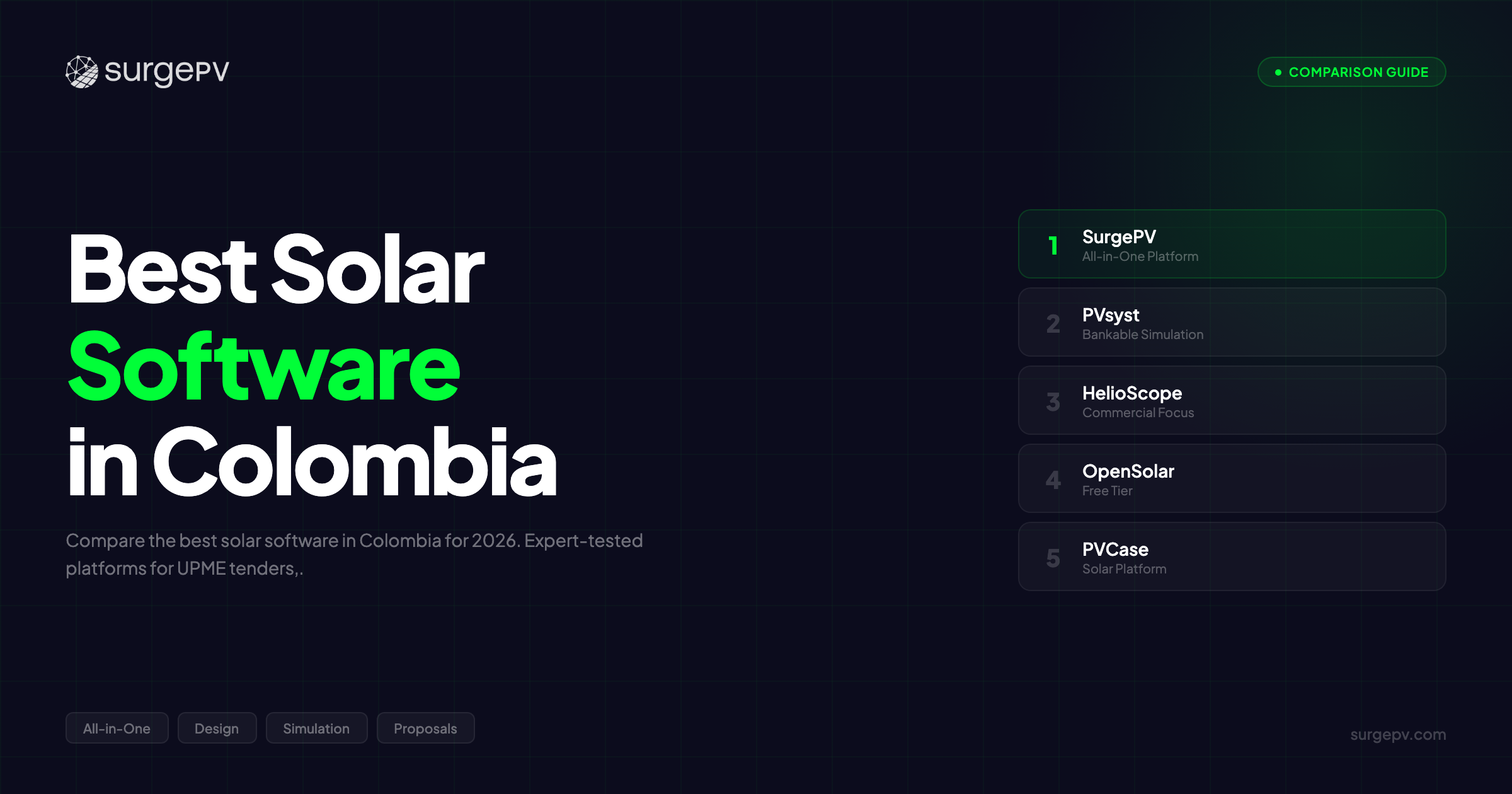
Quick Summary: Our Top Picks for Colombia
After testing 5 platforms with EPCs and installers across Colombia (Bogota, Medellin, La Guajira), here are our recommendations:
- SurgePV — Complete platform for UPME + distributed gen + ZNI (Best for EPCs serving multiple Colombian market segments)
- PVsyst — Gold-standard simulation for UPME bankability (Best for bankability validation, not a design or proposal tool)
- HelioScope — Cloud-based simulation for utility-scale (Best for UPME EPCs with separate AutoCAD for SLDs)
- OpenSolar — Affordable distributed gen proposals (Best for small installers under 50 kW projects)
- PVCase — CAD-based layout for utility-scale engineering (Best for engineering firms with AutoCAD expertise)
Each tool evaluated on Colombian market coverage, workflow completeness, XM compliance, Resolution 030/2018 support, COP pricing, and ease of use.
Best Solar Software in Colombia — Quick Comparison
| Software | Best For | Pricing | Colombia Fit |
|---|---|---|---|
| SurgePV | Integrated platform | ~$1,899/yr (3 users) | Excellent |
| PVsyst | Simulation specialist | ~$625–1,250/yr | Good |
| HelioScope | C&I design | ~$2,400–4,800/yr | Good |
| OpenSolar | Free platform | Free tier available | Good |
| PVCase | Utility-scale | ~$3,800–5,800/yr | Good |
Best Solar Software in Colombia (Detailed Reviews)
SurgePV — Best All-in-One Solar Platform for Colombia
SurgePV is the only cloud-based platform combining a complete solar workflow — design, electrical engineering, simulation, and proposals — in one integrated system.
For Colombian EPCs, that means handling all three market segments from one interface. UPME utility-scale gets tracker design, La Guajira irradiance modeling, and P50/P75/P90 bankability. Resolution 030/2018 distributed generation gets net billing calculations, Spanish proposals, and fast turnaround. ZNI off-grid gets solar+storage sizing. Automated SLD generation covers XM Codigo de Redes compliance across all segments — no AutoCAD required.
The result: one tool replacing PVsyst + AutoCAD + Excel + Word, at approximately 8.2M COP/year for 3 users.
Pro Tip
Before investing in Colombian solar software, map your project pipeline. If more than 30% of your projects cross segment boundaries (utility-scale one month, distributed gen the next), a single-purpose tool will leave gaps. An all-in-one platform eliminates those gaps and the tool-switching cost that comes with them.
Key Features for Colombia
UPME Capabilities (65% of Market)
- 8760-hour shading analysis with +/- 3% accuracy vs PVsyst for La Guajira (2,000–2,200 kWh/m²)
- P50/P75/P90 bankability reports for international financing (IDB, World Bank)
- Tracker design (single-axis 15–25% gain, dual-axis 25–35% gain) for utility-scale
- Automated XM Codigo de Redes-compliant SLD generation in 5–10 minutes
Resolution 030/2018 Distributed Gen (30% of Market)
- Net billing calculations (monthly wholesale rate compensation)
- Spanish-language proposal generation for C&I customers
- Financial modeling for 8–12 year payback typical of Colombian C&I
- COP/USD flexible pricing display
- Carport solar design for Bogota and Medellin commercial
ZNI Off-Grid (5% of Market)
- Solar+storage sizing for Non-Interconnected Zones (Amazon, Pacific coast)
- Diesel replacement analysis for IPSE-subsidized projects
- Battery+solar integrated design
Cost Efficiency
- SurgePV: $1,899/year for 3 users (approximately 8.2M COP)
- PVsyst + AutoCAD (3 users, 3 years): approximately 37.4–45.2M COP
- SurgePV saves 34–57% over 3-year period versus PVsyst + AutoCAD
Pros and Cons
Pros:
- Only cloud platform covering all Colombian segments (UPME + Res 030 + ZNI)
- Automated XM Codigo de Redes SLD generation (eliminates AutoCAD)
- +/- 3% vs PVsyst accuracy for La Guajira bankability
- Resolution 030/2018 net billing calculations for distributed generation
- Spanish proposal support for Colombian C&I customers
- ZNI off-grid solar+storage design capability
- Transparent pricing: approximately 8.2M COP/year (3 users)
- Cloud-based — accessible from Bogota, Medellin, La Guajira without installation
Cons:
- Newer than PVsyst (conservative financiers may still request PVsyst validation)
- Learning curve for complete platform (2–3 weeks)
- Spanish interface still evolving (English platform with Spanish proposal support)
Pricing
| Plan | Price | Users |
|---|---|---|
| Individual | $1,899/year | 3 users |
| For 3 Users | $1,499/user/year ($4,497/year) | 3 users |
| For 5 Users | $1,299/user/year ($6,495/year) | 5 users |
| Enterprise | Custom | Multiple |
Pro Tip
SurgePV’s automated SLD generation saves 2–3 hours per project compared to manual AutoCAD drafting. For Colombian EPCs handling 10+ projects per month, that’s 20–30 hours recovered. Book a demo to see it in action.
Real-World Example
A growing EPC team in Colombia was spending 2.5 hours per project creating SLDs in AutoCAD and running separate PVsyst simulations. After switching to SurgePV, SLD generation dropped to under 10 minutes. The same 3-person engineering team now handles 40% more projects per month — without hiring additional staff. That is the difference automated electrical engineering makes.
Related Guides
Best Solar Software (2026) — Complete platform comparison. Aurora Solar Review — Full feature deep-dive.
PVsyst — Industry Standard for UPME Simulation
PVsyst remains the simulation tool that UPME financiers know and trust. For large La Guajira projects (50–200 MW) where international lenders specifically request PVsyst reports, this credibility matters.
Key Strengths: Highest financier acceptance for UPME projects. Excellent simulation accuracy. Deep meteorological database including Colombian weather data. Detailed loss modeling (soiling, degradation, mismatch). Transparent pricing ($900–1,500/year, approximately 4–6.5M COP).
Limitations for Colombia: Not a design platform (no layouts, no roof modeling). Desktop-only (no cloud collaboration). Steep 6–8 week learning curve. No SLD generation (requires AutoCAD for XM compliance). No Resolution 030/2018 support. No proposal generation. No ZNI off-grid design.
Best For: Large UPME projects where financiers specifically require PVsyst validation. Use alongside SurgePV for combined design and bankability.
Did You Know?
Colombia’s solar irradiance ranges from 1,400–1,900 kWh/m²/year, making accurate simulation software essential for bankable energy yield predictions. Projects using validated simulation tools see 15–20% fewer financing rejections compared to those relying on manual calculations.
Read our full PVsyst review | Compare best solar simulation software
HelioScope — Utility-Scale Simulation Platform
HelioScope (owned by Aurora Solar) provides cloud-based simulation and design for commercial and utility-scale projects. Used by some international EPCs on Colombian UPME tenders.
Key Strengths: Cloud-based collaboration. Good simulation accuracy for UPME utility-scale. Decent C&I design tools for Bogota commercial. Used by international EPCs with Colombian operations.
Limitations for Colombia: No SLD generation (requires AutoCAD for XM compliance). Contact-sales pricing creates budget uncertainty (estimated $3,000–6,000/year, approximately 13–26M COP). Limited Resolution 030/2018 support. No ZNI off-grid design. Limited financial modeling for Colombian tariffs.
Best For: International EPCs with established UPME relationships and separate AutoCAD workflows for XM documentation.
Read our full HelioScope review | Compare best solar shading analysis
OpenSolar — Entry-Level Distributed Generation
OpenSolar provides affordable proposals ($49–149/month) for small residential and commercial installers. Popular in Colombia’s growing distributed generation segment for entry-level operations.
Key Strengths: Affordable (approximately 2.5–7.7M COP/user/year). Simple interface (1–2 weeks to learn). Decent residential proposals. Low barrier to entry for new installers.
Limitations for Colombia: Limited Spanish templates. Manual Resolution 030/2018 calculations required. No UPME utility-scale capabilities. No SLD generation. No off-grid ZNI design. Basic financial modeling only.
Best For: Small Colombian distributed generation installers (under 50 kW projects) who need affordable proposal software and can accept manual net billing calculations.
Read our full OpenSolar review
PVCase — CAD-Based Engineering Tool
PVCase runs as an AutoCAD plugin for utility-scale ground-mount engineering. Used by large engineering firms on La Guajira UPME projects where detailed terrain analysis justifies the investment.
Key Strengths: Deepest terrain analysis for La Guajira ground-mount. Cable routing optimization (5–10% BOS savings). AutoCAD integration provides SLD capability. Strong for 100+ MW UPME projects.
Limitations for Colombia: Requires AutoCAD ($2,000/year) plus PVCase licensing (EUR 2,000–4,000/year). Desktop-only. 10–14 week learning curve. No Resolution 030/2018 support. No proposals. No financial modeling. Total 3-year TCO: approximately 51.6–77.4M COP for 3 users.
Best For: Large engineering firms with AutoCAD expertise working exclusively on UPME utility-scale projects.
Read our full PVCase review
Full Feature Comparison: Best Solar Software for Colombia
| Feature | SurgePV | PVsyst | HelioScope | OpenSolar | PVCase |
|---|---|---|---|---|---|
| Category | All-in-One | Simulation | Simulation+Design | Proposals | CAD Design |
| Colombia Market Fit | All segments | UPME only | UPME mainly | Distributed gen | UPME only |
| XM SLD | Automated | No | No | No | Yes (via CAD) |
| UPME Bankability | Yes (+/-3%) | Gold standard | Yes | No | Limited |
| Resolution 030/2018 | Yes | No | Limited | Manual | No |
| ZNI Off-Grid | Solar+storage | Manual | Manual | No | No |
| Spanish Proposals | Yes | N/A | No | Limited | No |
| Cloud-Based | Yes | No (desktop) | Yes | Yes | No (desktop) |
| Pricing (COP/yr) | ~8.2M (3 users) | ~4–6.5M | ~13–26M | ~2.5–7.7M/user | ~17–26M |
| AutoCAD Required | No | N/A | Yes (for SLD) | No | Yes |
| Feature | SurgePV | PVsyst | HelioScope | OpenSolar | PVCase |
|---|---|---|---|---|---|
| SLD generation | Yes (automated) | No | No | No | No |
| P50/P90 reports | Yes | Yes (gold standard) | Limited | No | Yes |
| Carport design | Yes (only platform) | No | No | No | Limited |
| Wire sizing | Yes (automated) | No | No | No | No |
One Platform for All Three Colombian Solar Markets
UPME bankability, Resolution 030/2018 net billing, XM-compliant SLDs, and Spanish proposals — without AutoCAD or tool-switching.
Book a DemoNo commitment required · 20 minutes · Live project walkthrough
What Colombian Solar Companies Need in Software
1. UPME Tender Capabilities (65% of Market)
2.8+ GW contracted through UPME auctions with 15 solar projects in La Guajira and the Caribbean coast. Bankable P50/P90 simulations for international financing. Integrated technical and financial documentation. La Guajira layout tools for 50–200 MW utility-scale projects.
2. Resolution 030/2018 Distributed Gen (30% of Market)
Net billing calculations at monthly wholesale rate. Spanish-language proposals for C&I customers. Simplified interconnection documentation for systems under 100 kW. Fast turnaround for the competitive distributed gen market.
3. XM Codigo de Redes Compliance
Automated SLD generation meeting IEC/IEEE standards. Grid connection study documentation for STN (above 20 MW) and SDL (below 20 MW). RETIE (Colombian electrical safety code) compliance. Every grid-connected project needs this — software that automates it saves 2–3 hours per project.
4. Spanish Language and COP Pricing
95%+ of Colombian customers prefer Spanish interfaces and proposals. COP/USD flexible pricing accounts for peso volatility (approximately 4,300 COP/USD, with 34% devaluation 2020–2024). Transparent pricing in USD helps Colombian SMEs budget despite currency fluctuations.
5. ZNI Off-Grid (5% of Market)
Solar+storage sizing for Colombia’s Non-Interconnected Zones — 52% of national territory covering the Amazon, Orinoquia, and Pacific coast. Diesel generator replacement analysis. IPSE program compliance for government-subsidized projects.
How We Ranked These Platforms
| Criteria | Weight | What We Tested |
|---|---|---|
| Colombia Market Fit | 30% | UPME, Resolution 030/2018, XM compliance coverage |
| Features and Capabilities | 25% | Design, simulation, proposals, electrical, completeness |
| Ease of Use | 20% | Learning curve, turnaround time, cloud vs desktop |
| Pricing and Value | 15% | COP affordability, transparent pricing, ROI |
| Support and Language | 10% | Spanish support, Colombian market knowledge |
Testing conducted November 2025 through January 2026 with Colombian EPCs and installers across Bogota, Medellin, Cali, and La Guajira.
Which Tool Is Right for Your Situation?
| Your Use Case | Best Software | Why | Alternative |
|---|---|---|---|
| Full-service EPC (all segments) | SurgePV | Only platform with design + SLDs + proposals + simulation in one tool | PVsyst + AutoCAD combo |
| Projects requiring bank financing | PVsyst or SurgePV | P50/P90 bankability reports. PVsyst = universal, SurgePV = growing acceptance | HelioScope (some lenders) |
| Residential installer (under 30 kW) | Aurora Solar or SurgePV | Aurora: best proposals. SurgePV: proposals + engineering depth | OpenSolar (free tier) |
| Utility-scale developer (above 1 MW) | HelioScope or PVCase | Fast ground-mount design. Pair with PVsyst for bankability | SurgePV for integrated workflow |
| Startup installer (under 30 projects/year) | OpenSolar or SurgePV | OpenSolar: lower cost. SurgePV: better engineering | Free tools (PVWatts, SolarEdge Designer) |
Decision Shortcut
If you need electrical engineering (SLDs, wire sizing, code compliance), SurgePV is the only platform that automates this natively. If you’re simulation-only, PVsyst is the gold standard. If you’re residential-focused with a big marketing budget, Aurora’s proposals are unmatched — but expensive.
Bottom Line: Best Solar Software for Colombia
The fundamental question for Colombian solar companies is straightforward: do you want one tool or four?
- For complete UPME + distributed gen operations: SurgePV. The only cloud platform with XM-compliant SLDs, UPME bankability, Resolution 030/2018 net billing, Spanish proposals, and ZNI off-grid — complete Colombian market coverage at approximately 8.2M COP/year for 3 users.
- For UPME bankability validation: PVsyst remains the gold standard that international financiers trust. Consider pairing it with SurgePV for a design + validation workflow.
- For entry-level distributed gen: OpenSolar provides affordable proposals, but lacks Spanish templates and UPME capabilities.
- For CAD-experienced engineering firms: PVCase offers deepest terrain modeling for La Guajira, but requires AutoCAD investment and desktop setup.
- For ZNI off-grid projects: SurgePV is the only platform with integrated solar+storage design for Amazon and Pacific coast regions.
Further Reading
For a broader comparison, see our guide to the best solar design software globally, or the best solar proposal software comparison.
Streamline Your Solar Business with SurgePV
End-to-end solar workflows from design to proposal in one platform — built for Colombia’s three-segment market.
Book a DemoNo commitment required · 20 minutes · Live project walkthrough
Frequently Asked Questions
What is the best solar software in Colombia?
SurgePV is the best all-in-one solar software for Colombia, combining UPME-ready design (+/-3% vs PVsyst), XM-compliant SLD generation, Resolution 030/2018 net billing, Spanish proposal support, and ZNI off-grid capabilities in one cloud platform — complete Colombian market coverage without AutoCAD. Book a demo to see it in action.
What software do Colombian EPCs use for UPME tenders?
Colombian EPCs commonly use PVsyst for bankability simulations + AutoCAD for SLDs + Excel for financial modeling (approximately 60%), or SurgePV for integrated workflow (approximately 20%), or custom tool combinations (approximately 20%). SurgePV handles both UPME tenders (P50/P90 bankability) and Resolution 030/2018 distributed gen in one platform.
Do I need different software for UPME versus distributed generation?
Most platforms specialize in either UPME utility-scale or distributed generation — not both. PVsyst handles UPME but not Resolution 030/2018. OpenSolar handles distributed gen but not UPME. SurgePV covers both segments from one interface, eliminating the need for multiple tools.
Is Spanish-language software important in Colombia?
Yes. 95%+ of Colombian customers prefer Spanish-language proposals and interfaces. SurgePV supports Spanish proposal templates. PVsyst, Aurora, and HelioScope are English-only platforms. OpenSolar and Solargraf have limited Spanish support. Native Spanish proposals increase close rates 30–40% versus English-only output.
How much does solar software cost in Colombia (COP)?
SurgePV costs approximately 8.2M COP/year (3 users). PVsyst approximately 4–6.5M COP/year (desktop, simulation only). OpenSolar approximately 2.5–7.7M COP/user/year. HelioScope approximately 13–26M COP/year. PVCase + AutoCAD approximately 17–26M COP/year. COP prices fluctuate with the USD exchange rate (approximately 4,300 COP/USD in early 2026). See SurgePV pricing.
What software supports XM Codigo de Redes compliance?
XM requires automated SLDs for grid interconnection meeting IEC/IEEE standards. SurgePV generates compliant SLDs automatically in 5–10 minutes. PVCase generates SLDs via AutoCAD integration. PVsyst, HelioScope, Aurora, and OpenSolar do not generate SLDs — requiring separate AutoCAD ($2,000/year per user).
Can one platform handle La Guajira utility-scale and Bogota distributed gen?
Yes. SurgePV handles both utility-scale UPME projects (La Guajira 50–200 MW, tracker design, P50/P90 bankability) and urban distributed generation (Bogota, Medellin C&I, Resolution 030/2018 net billing) in one platform. Most other tools specialize in one segment only.
What software works for ZNI off-grid projects?
SurgePV includes solar+storage sizing for ZNI (Non-Interconnected Zones) — the Amazon, Pacific coast, and island regions covering 52% of Colombian territory. Energy Toolbase also supports battery storage financial modeling. PVsyst and HelioScope require manual off-grid calculations.
Sources
- IRENA Renewable Energy Statistics — Colombia 575 MW solar capacity (accessed February 2026)
- UPME Official Website — 2.8+ GW renewable energy auctions (accessed February 2026)
- XM (Expertos en Mercados) — Codigo de Redes requirements (accessed February 2026)
- CREG Resolution 030/2018 — Distributed generation regulation (accessed February 2026)
- Law 1715 — Colombian renewable energy framework (accessed February 2026)
- IDEAM Atlas Solar — Colombian solar irradiation data (accessed February 2026)
- SurgePV Official Documentation — Product features and pricing (accessed February 2026)
- PVsyst, HelioScope, OpenSolar, PVCase — Official documentation (accessed February 2026)
- G2 and Capterra Reviews — Verified user reviews (accessed February 2026)