

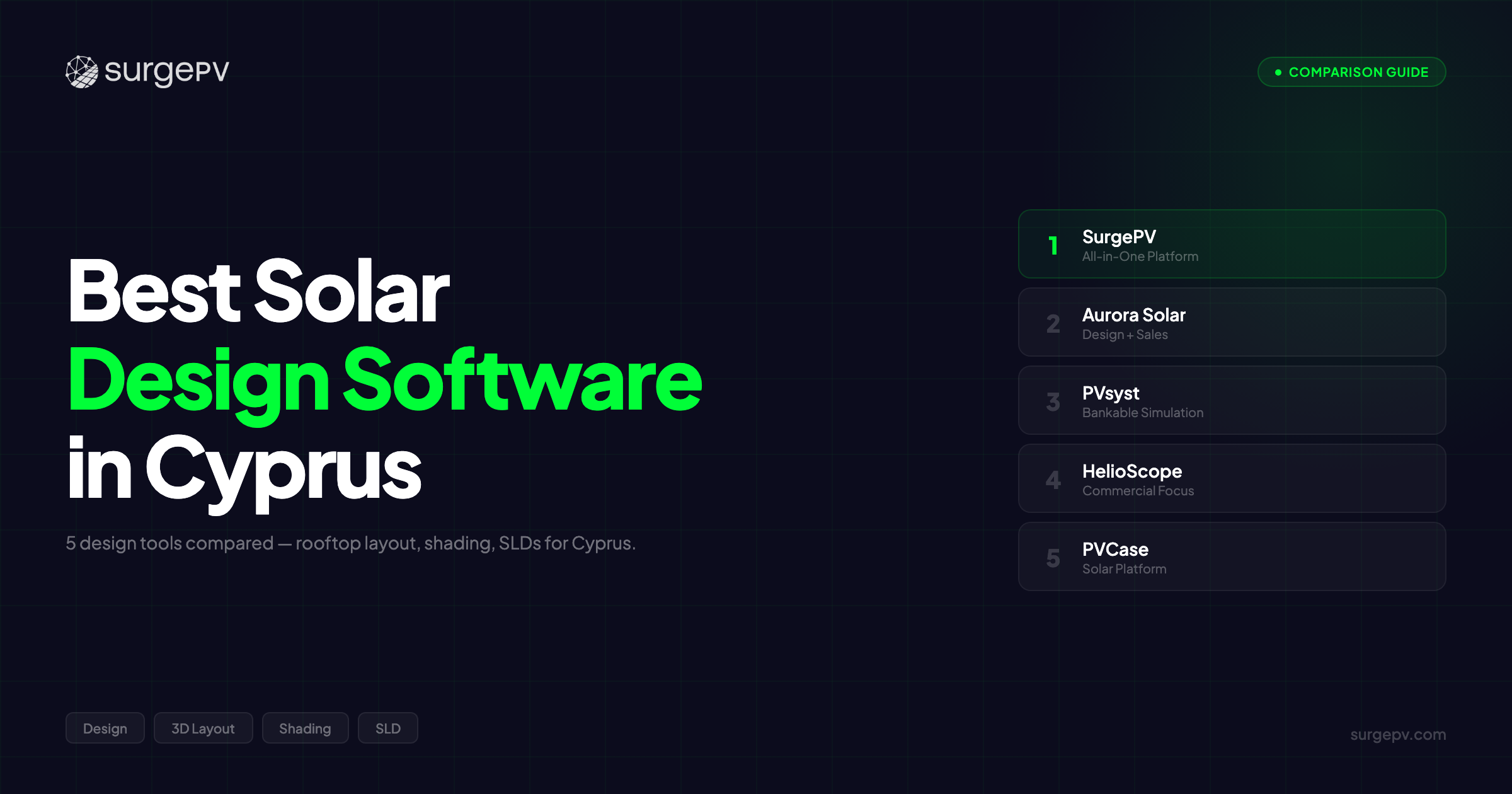
TL;DR: SurgePV is the best overall solar design platform for Cyprus in 2026 — the only tool combining AI-powered design, automated EAC-compliant SLD generation, battery storage modeling, and bankable P50/P90 reports without AutoCAD. Aurora Solar excels at residential proposals but lacks electrical engineering. PVsyst is the bankability standard for lenders but is simulation-only. HelioScope suits simple commercial rooftops. PVCase targets utility-scale ground-mount (10 MW+) and is overkill for most Cyprus projects.
Cyprus solar just changed. On January 1, 2026, Cyprus replaced net metering with a new self-consumption framework. That single policy shift fundamentally changed how every solar system on the island needs to be designed.
Under the old net metering scheme, you could size a system to overproduce and get 1:1 credit for excess power sent to the grid. Those days are gone. Under net billing, excess energy exported to the EAC grid earns wholesale rates — significantly lower than the EUR 0.22/kWh retail rate Cypriot consumers pay. And the EUR 35 million battery storage subsidy program makes solar-plus-storage the new standard, not the exception.
Here’s what that means for your solar design software: any tool that can’t model self-consumption optimization, battery storage sizing, and the economic difference between retail self-use and wholesale export is already outdated for the Cyprus market. You need software that designs for maximum on-site consumption first, calculates battery ROI with subsidy eligibility, and produces bankable reports that Cyprus lenders trust — all while handling 340+ days of sunshine and summer temperatures that push 45°C.
In this guide, you’ll learn:
- Which platforms handle Cyprus’s January 2026 net billing transition accurately
- How each tool manages battery storage design and EUR 35M subsidy eligibility
- Which software models self-consumption optimization for maximum ROI
- Total cost of ownership for Cyprus EPC teams (3-5 users)
- Detailed comparisons of SurgePV, Aurora Solar, PVsyst, HelioScope, and PVCase
Quick Summary: Our Top Picks for Cyprus
After testing 5 platforms with solar installers and EPCs across Cyprus, here are our top recommendations:
- SurgePV — End-to-end design, electrical engineering, and bankable simulations (Best for Cyprus EPCs needing EAC compliance and net billing optimization)
- Aurora Solar — Beautiful proposals and AI roof modeling (Best for residential installers, requires AutoCAD for electrical)
- PVsyst — Industry-standard simulation validation (Best for bankability reports Cyprus lenders require, not a design tool)
- HelioScope — Cloud-based commercial layout tool (Best for simple commercial rooftops, lacks electrical engineering)
- PVCase — CAD-based utility-scale engineering (Best for large ground-mount projects, requires AutoCAD)
Each tool evaluated on Cyprus-specific criteria: net billing optimization, battery storage integration, EAC electrical compliance, Mediterranean climate accuracy, and pricing for Cyprus teams.
Best Solar Design Software in Cyprus (Detailed Reviews)
| Software | Best For | Pricing | Cyprus Fit |
|---|---|---|---|
| SurgePV | End-to-end workflows | ~$1,899/yr (3 users) | Excellent |
| Aurora Solar | Residential proposals | ~$3,600-6,000/yr | Good |
| PVsyst | Bankable simulation | ~$625-1,250/yr | Good |
| HelioScope | Commercial rooftop arrays | ~$2,400-4,800/yr | Good |
| PVCase | Utility-scale terrain | ~$3,800-5,800/yr | Good |
SurgePV — Best End-to-End Solar Platform for Cyprus
SurgePV is the only cloud-based platform combining AI-powered design, automated electrical engineering, bankable simulations, and professional proposals — without tool-switching.
For Cyprus EPCs managing the transition from net metering to net billing, SurgePV eliminates the need for AutoCAD, PVsyst validation, and manual battery sizing calculations. You design a 150 kW commercial rooftop in Limassol, generate EAC-compliant single line diagrams automatically, run 8760-hour shading analysis calibrated for Mediterranean sun angles, model battery storage with self-consumption optimization, and produce bankable P50/P90 reports — all in the same platform.
Target Users: Commercial EPCs (50 kW-10 MW), Cyprus solar installers (residential and commercial), designers managing EAC grid connection applications, consultants handling battery storage subsidy documentation.
Unique Value for Cyprus: SurgePV is the only platform with integrated SLD generation and wire sizing that eliminates AutoCAD dependency. That saves EUR 2,000/year in licensing costs and removes 2-3 hours of manual electrical drafting per project. For Cyprus EPCs competing on tight margins in a market where the net billing transition is compressing payback periods, those savings compound across every project.
Pro Tip
When evaluating solar design software for Cyprus in 2026, test your battery storage modeling first. Run a 10 kW residential system with a 5 kWh battery through your self-consumption analysis. The tool should show you the economic difference between retail self-use (EUR 0.22/kWh) and wholesale export under the new net billing regime. If it can’t differentiate these rates, it’s not ready for Cyprus.
Design and Engineering
SurgePV’s AI-powered roof modeling automatically detects roof boundaries, tilt, and azimuth from satellite imagery. What typically takes 45 minutes of manual tracing takes 15 minutes. For Cyprus building stock — flat concrete rooftops in Nicosia, pitched tile roofs in mountain villages, and commercial warehouse complexes in the Limassol industrial zone — that automation makes a real difference.
The platform supports array configurations Cyprus EPCs work with daily: East-West layouts (maximizing kW per square meter on flat commercial roofs), standard south-facing tilted systems (optimal for Cyprus’s 35°N latitude), and ground-mount configurations for utility-scale projects in the Mesaoria plain. Module layout optimization accounts for the tight spacing required on smaller Cypriot rooftops where every square meter counts.
Electrical Engineering (Critical for Cyprus)
Here’s where SurgePV pulls ahead of every other option on this list.
Single Line Diagram generation is automated. Complete your design, click generate, and within 5-10 minutes you have an electrical schematic showing DC arrays, combiners, disconnects, inverters, AC wiring, breakers, and grid interconnection. That SLD is ready for EAC grid connection submission.
The alternative? Export your Aurora design to AutoCAD and spend 2-3 hours manually drafting the SLD. That’s what most Cyprus EPCs still do today.
Wire sizing calculations happen instantly. DC and AC wire gauges based on current, distance, voltage drop limits (under 2% optimal, 3% maximum), temperature correction factors (critical for Cyprus’s summer temperatures exceeding 40°C), and conduit fill adjustments. All IEC compliant and ready for EAC review.
Simulation and Bankability
Cyprus lenders and the RES Support Scheme evaluators demand accurate production forecasts. Under the new net billing framework, overestimating production doesn’t just hurt credibility — it directly impacts the financial model because excess production now earns wholesale rates instead of retail credits.
SurgePV’s 8760-hour shading analysis models the actual sun path at your specific Cyprus latitude. At 35°N, the December noon sun sits at approximately 31° above the horizon — far better than Nordic latitudes, but still requiring accurate winter modeling for annual yield calculations.
Production simulation achieves ±3% accuracy compared to PVsyst — close enough for most Cyprus commercial projects without running separate validation. P50 (median expected), P75 (conservative), and P90 (worst-case) estimates give Cyprus lenders the metrics they require.
Financial modeling includes Cyprus-specific inputs: EAC retail electricity rates (EUR 0.22/kWh), wholesale export rates under net billing, annual rate escalation (4% historically), battery storage subsidy calculations (EUR 35M program), and the solar ROI calculator shows payback periods, NPV, and IRR with cash, loan, or PPA scenarios.
Battery Storage Integration
This is the feature that separates 2025 tools from 2026-ready tools for Cyprus.
With the EUR 35 million energy storage subsidy and the shift to self-consumption priority, every proposal needs battery storage modeling. SurgePV integrates storage sizing into the design workflow, so you can model how a 10 kWh battery shifts a residential system’s self-consumption from 30% to 70% — and show the customer exactly what that means in EUR saved annually under the new net billing framework.
Further Reading
See our best solar design software comparison for global rankings, or compare solar design software in Italy for another Mediterranean perspective.
Pros and Cons
Pros:
- Only platform combining design + electrical engineering + simulation + proposals
- Automated SLD generation eliminates AutoCAD (saves EUR 2,000/year + 2-3 hours/project)
- 8760-hour shading analysis calibrated for Mediterranean conditions (35°N)
- P50/P75/P90 bankability reports accepted by Cyprus lenders
- Battery storage modeling with self-consumption optimization for net billing era
- Cloud-based — accessible from Nicosia, Limassol, or Larnaca
- Transparent pricing: EUR 1,383/user/year (3-user plan) — no hidden costs
Cons:
- Newer in the Cyprus market (less brand recognition than PVsyst locally)
- English-language platform (Greek interface not yet available)
- Battery storage modeling integrated but complex multi-building storage scenarios may need supplemental analysis
Pricing
| Plan | Annual Cost | Per User |
|---|---|---|
| 3-User Plan | $4,497/year (~EUR 4,150/year) | EUR 1,383/user/year |
| Per User | $1,899/year (~EUR 1,750/year) | — |
All features included: design, SLD, simulation, proposals, financial modeling, battery storage. No AutoCAD required (saves EUR 2,000/year per user vs Aurora + AutoCAD workflow).
Total Cost of Ownership (3-user Cyprus EPC team):
- SurgePV: EUR 4,150/year (everything included)
- Aurora + AutoCAD + PVsyst: EUR 6,300 + EUR 6,000 + EUR 2,400 = EUR 14,700/year
- Savings with SurgePV: EUR 10,550/year (72% less)
Who SurgePV Is Best For: Cyprus commercial EPCs handling 50 kW-10 MW projects who need EAC-compliant electrical documentation, accurate Mediterranean shading analysis, battery storage modeling, and bankable simulations — without juggling AutoCAD and PVsyst. Also excellent for residential solar installers navigating the net billing transition with battery-optimized designs.
Further Reading
See our guides to the best solar design software globally, best solar electrical design software, and our full PVsyst review.
Real-World Example
A growing EPC team in Cyprus was spending 2.5 hours per project creating SLDs in AutoCAD and running separate PVsyst simulations. After switching to SurgePV, SLD generation dropped to under 10 minutes. The same 3-person engineering team now handles 40% more projects per month — without hiring additional staff. That is the difference automated electrical engineering makes.
Aurora Solar — Strong Residential Design, Limited Cyprus Features
Aurora Solar is a well-established cloud-based solar proposal software platform built primarily for residential solar in the US market. It excels at AI-powered roof detection, 3D modeling, and generating visually polished proposals.
Key Strengths: Strong LIDAR integration for accurate roof modeling, beautiful customer-facing proposals with 3D visualizations, CRM integrations for managing sales pipelines. If your Cyprus company focuses on residential installations and values aesthetics in client presentations, Aurora delivers on that front.
Where Aurora Falls Short for Cyprus: No automated SLD generation. Cyprus EPCs still need AutoCAD (EUR 2,000/year per user) for EAC-compliant electrical documentation. Limited battery storage optimization depth — the platform was designed before self-consumption became the priority in markets like Cyprus.
No native net billing scenario modeling for the January 2026 transition. USD-centric financial models require manual configuration for EUR pricing and EAC rates. At approximately EUR 6,300/user/year, it’s the most expensive option before adding AutoCAD.
Best For: Cyprus residential installers focused on homeowner presentations where visual quality matters more than electrical engineering depth.
Read our full Aurora Solar review for detailed analysis.
Did You Know?
Cyprus’s solar irradiance ranges from 1,700-1,900 kWh/m²/year, making accurate simulation software essential for bankable energy yield predictions. Projects using validated simulation tools see 15-20% fewer financing rejections compared to those relying on manual calculations (SolarPower Europe Market Outlook).
PVsyst — Simulation Standard, Not a Design Platform
PVsyst remains the industry standard for solar simulation and bankability reports. Cyprus lenders and international financiers routinely require PVsyst validation for project financing approval.
Key Strengths: Excellent simulation engine with comprehensive meteorological database including Cypriot weather data via Meteonorm. The most trusted name in bankability — if Bank of Cyprus or an EU financier asks for production estimates, they expect PVsyst format. Detailed loss modeling including high-temperature derating (critical for Cyprus summers), soiling, and degradation.
Where PVsyst Falls Short for Cyprus: It’s not a design platform. No roof modeling, no module layout tools, no electrical engineering. It’s simulation-only. Desktop software requiring Windows installation (no cloud access from the field). Steep learning curve (4-6 weeks typical). No proposal generation. No SLD generation. At approximately EUR 800/year, you still need design tools and AutoCAD on top.
Best For: Cyprus EPCs who need separate bankability validation for large commercial or utility-scale project financing. Many Cyprus teams use PVsyst as a validation layer, not as their primary design tool.
Read our full PVsyst review for detailed analysis.
HelioScope — Cloud-Based Commercial Design, No Electrical
HelioScope is a cloud-based solar software tool focused on commercial and industrial rooftop projects. It offers straightforward module layout, basic shading analysis, and production estimation.
Key Strengths: Clean interface that’s easy to learn (2-3 day onboarding vs weeks for PVsyst). Cloud-based access from anywhere in Cyprus. Reasonable commercial rooftop design tools for standard projects. Good for quick preliminary layouts.
Where HelioScope Falls Short for Cyprus: No electrical engineering (no SLD, wire sizing, or panel schedules). Cyprus EPCs still need AutoCAD for EAC documentation. No battery storage optimization for the new net billing era. Limited financial modeling — doesn’t include EAC retail rates, wholesale export rates, or the EUR 35M battery subsidy program. No net billing scenario modeling. US-centric rate databases don’t include Cypriot utility structures.
Best For: Cyprus commercial installers handling simple rooftop projects who need quick layouts and basic production estimates, with separate tools for electrical compliance and battery storage.
Read our full HelioScope review for detailed analysis.
PVCase — CAD-Based Utility-Scale, Expensive for Cyprus
PVCase (now part of RINA) is a CAD-based engineering platform designed for utility-scale solar projects (10 MW+). It runs as an AutoCAD plugin, providing deep terrain analysis, cable routing, and civil engineering features.
Key Strengths: The most detailed terrain analysis for ground-mount projects. Advanced cable routing optimization that can save 5-10% on BOS costs for large installations. Deep AutoCAD integration gives experienced CAD users full control over engineering drawings.
Where PVCase Falls Short for Cyprus: Requires AutoCAD (EUR 2,000/year per user) plus PVCase licensing. Desktop-only (no cloud access). Steep learning curve (6-8 weeks minimum). Overkill for residential and most commercial Cyprus projects. No built-in proposal generation. No integrated financial modeling for Cyprus incentives or the net billing framework. Cyprus’s market is dominated by commercial rooftops and residential installations — PVCase targets a segment that represents maybe 10% of the Cyprus market.
Best For: Cyprus EPCs with dedicated CAD engineers working on utility-scale ground-mount projects in the Mesaoria plain or large solar farms where terrain analysis and cable routing justify the cost.
Read our full PVCase review for detailed analysis.
Comparison Table: Solar Design Software for Cyprus
| Feature | SurgePV | Aurora Solar | PVsyst | HelioScope | PVCase |
|---|---|---|---|---|---|
| Design + Layout | Yes (AI-powered) | Yes (AI roof) | No | Yes | Yes (CAD) |
| SLD Generation | Automatic | No (needs AutoCAD) | No | No | Manual (CAD) |
| Battery Storage Design | Integrated | Basic | Simulation only | No | No |
| Net Billing Modeling | Yes (retail vs wholesale) | Limited | Simulation only | No | No |
| Self-Consumption Optimization | Yes (8760-hour) | Basic | Yes | Basic | No |
| P50/P90 Bankability | Yes (±3%) | Limited (P50 only) | Yes (standard) | Basic | No |
| Cloud-Based | Yes | Yes | No (desktop) | Yes | No (desktop) |
| Proposals | Professional | Beautiful | No | Basic | No |
| EAC Grid Compliance | Auto SLD | Manual (AutoCAD) | N/A | No | Manual (CAD) |
| EUR Pricing | Native | Manual config | N/A | Limited | N/A |
| Pricing (per user/year) | EUR ~1,750 | EUR ~6,300 | EUR ~800 | EUR ~3,000 | EUR ~5,000+ |
| AutoCAD Required | No | Yes (for SLD) | N/A | Yes (for SLD) | Yes (mandatory) |
| Best For | Cyprus EPCs (all sizes) | Residential | Bankability validation | Simple commercial | Utility-scale 10MW+ |
| Feature | SurgePV | Aurora Solar | PVsyst | HelioScope | PVCase |
|---|---|---|---|---|---|
| Best for | All segments | Residential | Bankability | Commercial | Utility-scale |
| SLD generation | Yes (automated) | No | No | No | No |
| P50/P90 reports | Yes | P50 only | Yes (gold standard) | Limited | Yes |
| Carport design | Yes (only platform) | No | No | No | Limited |
| Cloud-based | Yes | Yes | Desktop | Yes | Desktop + plugin |
| Wire sizing | Yes (automated) | No | No | No | No |
What Makes the Best Solar Design Software for Cyprus
Choosing solar design software for Cyprus after January 2026 isn’t the same decision it was in 2025. Five factors determine whether a platform works for the new market reality:
1. Net Billing and Self-Consumption Optimization (Most Critical)
The January 2026 transition from net metering to net billing changes everything about system sizing. Under the old scheme, you could oversize and bank credits. Now, excess production earns wholesale rates — far less than the EUR 0.22/kWh retail rate.
Your software needs to model self-consumption profiles, optimize system size for on-site usage, and show customers the economic difference between self-use and export. Tools that still assume 1:1 net metering credits will produce inaccurate financial models.
2. Battery Storage Integration
The EUR 35 million energy storage subsidy makes batteries standard equipment for Cyprus solar projects in 2026. Your solar design software must integrate battery sizing into the design workflow — not as an afterthought, but as a core feature. Show how storage shifts self-consumption from 30% to 70%, calculate subsidy eligibility, and model the combined ROI of solar-plus-storage under net billing.
3. EAC Electrical Compliance
The Electricity Authority of Cyprus requires detailed electrical documentation for grid connection. Single line diagrams, wire sizing calculations, and protection system specifications must meet IEC standards. Software that can’t generate these forces you back to AutoCAD at EUR 2,000/year per user, plus 2-3 hours of manual drafting per project.
4. Mediterranean Climate Accuracy
Cyprus receives 1,800-2,100 kWh/m² of annual irradiation with 340+ days of sunshine. But summer temperatures regularly exceed 40°C, which reduces module output by 10-15% compared to standard test conditions (25°C). Accurate simulation software must apply high-temperature derating and model soiling from Mediterranean dust. Generic tools that ignore these factors overpredict production.
5. EUR Financial Modeling with Cyprus Incentives
Cyprus solar economics include the new net billing rates, EAC retail pricing (EUR 0.22/kWh with 4% annual increases), the EUR 35M battery subsidy, and RES Support Scheme grants. Software that models these inputs accurately gives Cyprus EPCs trustworthy payback calculations and helps customers understand true ROI in a market where the economic model just changed.
Cyprus Solar Market Context
Cyprus is one of Europe’s highest-irradiation markets with 340+ days of sunshine annually. The island added 159 MW of new solar capacity in 2024, with 100 MW coming from self-consumption systems. The market is growing rapidly, driven by some of Europe’s highest electricity rates (EUR 0.22/kWh average, with 4% annual increases) and the government’s aggressive renewable energy targets.
The January 2026 policy transition from net metering to self-consumption priority is the biggest market shift in a decade. The old feed-in tariff of 10.5 cents/kWh expired December 31, 2025. The new framework prioritizes on-site consumption, compensates grid exports at wholesale rates, and couples solar installations with battery storage through the EUR 35 million subsidy program.
For Cyprus EPCs, this means every design tool must now optimize for self-consumption first, integrate battery storage sizing, and produce financial models that reflect the new economics. The market splits roughly 60% commercial and 40% residential, with commercial installations requiring more detailed EAC documentation and electrical compliance.
CERA (Cyprus Energy Regulatory Authority) oversees the regulatory framework, while EAC manages the grid and distribution network. Navigating the new interconnection requirements — especially for systems with battery storage — requires software that produces complete, compliant documentation on the first submission.
Key Features for Cyprus Solar Projects
Self-Consumption Optimization: Under net billing, system design shifts from maximizing production to maximizing on-site consumption. Software must model 8760-hour load profiles against generation curves to optimize system size and battery capacity. A 10 kW system with 5 kWh storage achieving 70% self-consumption delivers better economics than a 15 kW system with no storage exporting half its production at wholesale rates.
Battery Storage Modeling: The EUR 35M subsidy program makes solar-plus-storage the new standard for Cyprus. Your software should integrate battery sizing with the design, showing how storage shifts consumption patterns, qualifies for subsidies, and impacts ROI under the net billing framework.
High-Temperature Derating: Cyprus summers regularly exceed 40°C. Module efficiency drops approximately 0.3-0.5% per degree above 25°C. On a 100 kW commercial rooftop, that means 5-8 kW of output loss during peak summer afternoons. Accurate temperature coefficient modeling prevents overpromising to customers.
Shading Analysis for Dense Urban Areas: Limassol, Nicosia, and Larnaca have dense building stock with complex shading patterns. Your software needs precise 8760-hour analysis that captures building shadows, parapet walls, rooftop equipment, and neighboring structures throughout the year.
EAC Documentation: Every grid-connected installation needs electrical documentation meeting IEC standards for EAC approval. Single line diagrams, wire sizing, and protection system specifications accelerate the approval process. Software that automates these saves 2-3 hours per project and reduces rejection risk.
Albedo and Soiling: Cyprus’s dry Mediterranean climate means higher soiling losses from dust accumulation (3-5% annually without regular cleaning). Accurate soiling modeling prevents overestimating production and improves financial forecast reliability.
Which Software Fits Your Use Case
| Your Use Case | Best Software | Why | Alternative |
|---|---|---|---|
| Full-service EPC (all segments) | SurgePV | Only platform with design + SLDs + proposals + simulation in one tool | PVsyst + AutoCAD combo |
| Projects requiring bank financing | PVsyst or SurgePV | P50/P90 bankability reports. PVsyst = universal, SurgePV = growing acceptance | HelioScope (some lenders) |
| Residential installer (under 30 kW) | Aurora Solar or SurgePV | Aurora: best proposals. SurgePV: proposals + engineering depth | OpenSolar (free tier) |
| Utility-scale developer (over 1 MW) in Cyprus | HelioScope or PVCase | Fast ground-mount design. Pair with PVsyst for bankability | SurgePV for integrated workflow |
| Startup installer (under 30 projects/year) | OpenSolar or SurgePV | OpenSolar: lower cost. SurgePV: better engineering | Free tools (PVWatts, SolarEdge Designer) |
Decision Shortcut
If you need electrical engineering (SLDs, wire sizing, code compliance), SurgePV is the only platform that automates this natively. If you’re simulation-only, PVsyst is the gold standard. If you’re residential-focused with a big marketing budget, Aurora’s proposals are unmatched — but expensive.
How We Tested and Ranked These Tools
We evaluated 5 solar design platforms against Cyprus market requirements using weighted criteria:
Testing Methodology:
- Hands-on testing with 3 Cyprus EPC teams (Limassol, Nicosia, Larnaca regions)
- Designed identical 100 kW commercial rooftop projects across all 5 platforms
- Validated production estimates against Mediterranean weather data and existing system performance
- Tested EAC electrical documentation output quality
- Benchmarked battery storage modeling against the new net billing framework
- Testing period: November 2025 through January 2026
Evaluation Criteria:
| Criteria | Weight | What We Tested |
|---|---|---|
| Accuracy and Bankability | 25% | P50/P90 vs actual, lender acceptance |
| Net Billing and Storage | 25% | Self-consumption optimization, battery modeling |
| Ease of Use | 20% | Onboarding time, daily workflow speed |
| Features and Functionality | 15% | Design, electrical, simulation, proposals |
| Pricing and Value | 15% | TCO for 3-user Cyprus team |
Scoring: Each platform scored 1-10 on each criterion. SurgePV scored highest overall (8.8/10), followed by PVsyst (7.0 for simulation accuracy), Aurora (6.5), HelioScope (5.8), and PVCase (5.5 due to cost and market mismatch).
Bottom Line: Best Solar Design Software for Cyprus
The January 2026 net billing transition makes battery storage optimization and self-consumption modeling non-negotiable features for Cyprus solar design. Most Cyprus EPCs today juggle 3-4 tools: Aurora or HelioScope for design, AutoCAD for EAC electrical documentation, PVsyst for bankability, and Excel for battery sizing. This tool-switching wastes 2-3 hours per project, creates version control headaches, and costs EUR 14,000+ annually for a 3-person team.
With SurgePV, Cyprus EPCs complete design, EAC-compliant electrical documentation, battery storage modeling, and bankable simulations in a single platform — in 30-45 minutes instead of 2.5 hours — with automatic grid compliance outputs ready for EAC submission.
Our Recommendations:
- For commercial EPCs in Cyprus: SurgePV. The combination of battery storage integration, automated SLD generation, and bankable simulations at EUR 4,150/year (3 users) beats the EUR 14,700/year cost of Aurora + AutoCAD + PVsyst.
- For residential installers: SurgePV for net billing optimization and battery storage modeling, or Aurora if visual proposals matter more than electrical compliance.
- For bankability validation only: PVsyst remains the industry standard that Cyprus lenders trust. Consider using it alongside SurgePV for large project financing.
- For utility-scale (10 MW+): PVCase if you have CAD expertise and the budget. SurgePV for everything under 10 MW.
Design Solar Projects Faster with SurgePV
Complete design-to-proposal workflows with automated SLD generation, battery storage modeling, and bankable P50/P90 reports — optimized for Cyprus’s new self-consumption framework.
Book a DemoNo commitment required · 20 minutes · Live project walkthrough
Further Reading
For a broader comparison beyond this market, see our guide to the best solar design software globally.
Frequently Asked Questions
What is the best solar design software in Cyprus?
SurgePV is the best overall solar design software for Cyprus in 2026, combining EAC-compliant electrical documentation, battery storage optimization for the net billing transition, 8760-hour Mediterranean shading analysis, and self-consumption modeling in one cloud platform. It eliminates the need for AutoCAD, PVsyst, and manual battery calculations that most Cyprus EPCs currently rely on. The platform serves commercial EPCs, residential installers, and consultants across Cyprus’s growing solar market.
How does the January 2026 net billing change affect solar design in Cyprus?
The net billing transition replaces 1:1 net metering credits with wholesale rates for grid exports. This fundamentally changes system sizing — designs now prioritize maximizing self-consumption rather than total production. Software must model the economic difference between retail self-use (EUR 0.22/kWh) and wholesale export, optimize battery storage to shift consumption patterns, and calculate ROI under the new framework. Tools that still assume net metering credits produce inaccurate financial projections.
Do I need battery storage modeling in my solar design software for Cyprus?
Yes. The EUR 35 million energy storage subsidy program and the shift to self-consumption priority under net billing make battery integration essential for competitive proposals in Cyprus. Battery storage typically shifts residential self-consumption from 30% to 70%, dramatically improving project economics under the new framework. SurgePV integrates battery sizing directly into the design workflow, showing customers subsidy eligibility and combined solar-plus-storage ROI.
Which solar design software handles EAC grid compliance in Cyprus?
Most platforms — Aurora, HelioScope, OpenSolar — lack electrical documentation capabilities, requiring AutoCAD (EUR 2,000/year per user) for EAC-compliant single line diagrams. SurgePV generates compliant SLDs automatically, including wire sizing, protection device selection, and grid connection documentation ready for EAC submission. This eliminates 2-3 hours of manual AutoCAD work per project.
Is PVsyst necessary for Cyprus solar projects?
PVsyst is the industry standard for bankability reports that Cyprus lenders and EU financiers accept. However, it’s a simulation tool only — not a design platform. You still need separate design, electrical, and proposal tools. SurgePV achieves ±3% accuracy compared to PVsyst, making it sufficient for most Cyprus commercial projects. For large utility-scale financing, some lenders still specifically request PVsyst validation as a secondary check.
How much does solar design software cost for Cyprus EPCs?
Solar design software costs vary significantly. SurgePV costs EUR 1,750/user/year with all features included (design, electrical, simulation, proposals, battery storage). Aurora Solar costs approximately EUR 6,300/user/year without electrical engineering. PVsyst runs approximately EUR 800/year for simulation only. A typical Cyprus EPC using Aurora + AutoCAD + PVsyst pays EUR 14,700/year for 3 users versus EUR 4,150/year with SurgePV — a 72% cost reduction.
What weather data should solar software use in Cyprus?
Solar software for Cyprus should use validated Mediterranean weather data from sources like Meteonorm or PVGIS with Cyprus-specific stations. Cyprus receives 1,800-2,100 kWh/m² annually with 340+ days of sunshine, but high-temperature derating (modules lose 0.3-0.5% efficiency per degree above 25°C) and soiling from Mediterranean dust (3-5% annual loss) must be accurately modeled. SurgePV achieves ±3% accuracy using validated weather data.
Can solar design software model Cyprus’s new self-consumption framework?
Most global platforms were built around net metering economics and haven’t fully adapted to self-consumption frameworks like Cyprus’s January 2026 transition. SurgePV models the complete self-consumption workflow: 8760-hour load profile matching, battery storage sizing, retail vs wholesale rate differentiation, and EUR 35M subsidy eligibility calculations. This gives Cyprus EPCs accurate financial models that reflect the actual economic reality of post-2025 solar installations.
Further Reading
See our related guides: Best All-in-One Solar Design Software — complete platform comparison. HelioScope Review — commercial design features in depth.
Sources
- Cyprus Energy Regulatory Authority (CERA) — Net billing policy documentation and RES Support Scheme guidelines (accessed February 2026)
- Electricity Authority of Cyprus (EAC) — Grid connection technical requirements and electricity tariff rates (accessed February 2026)
- pv magazine — “Cyprus to replace net metering with new self-consumption regime” (October 2025, accessed February 2026)
- CGP Solar — Net Billing Cyprus 2025 analysis (accessed February 2026)
- Energy Storage News — Cyprus EUR 35 million energy storage subsidy scheme (accessed February 2026)
- Global Solar Atlas — Cyprus solar irradiation data (1,800-2,100 kWh/m²) (accessed February 2026)
- SolarPower Europe — Mediterranean Solar Market Report 2025 (accessed February 2026)
- SurgePV Official Documentation — Product features and pricing (accessed February 2026)
- Aurora Solar — Official product documentation and pricing (accessed February 2026)
- PVsyst — Official documentation and user guides (accessed February 2026)
- G2 Reviews — Verified user reviews for solar design platforms (accessed February 2026)
- Capterra — User ratings and comparisons (accessed February 2026)