

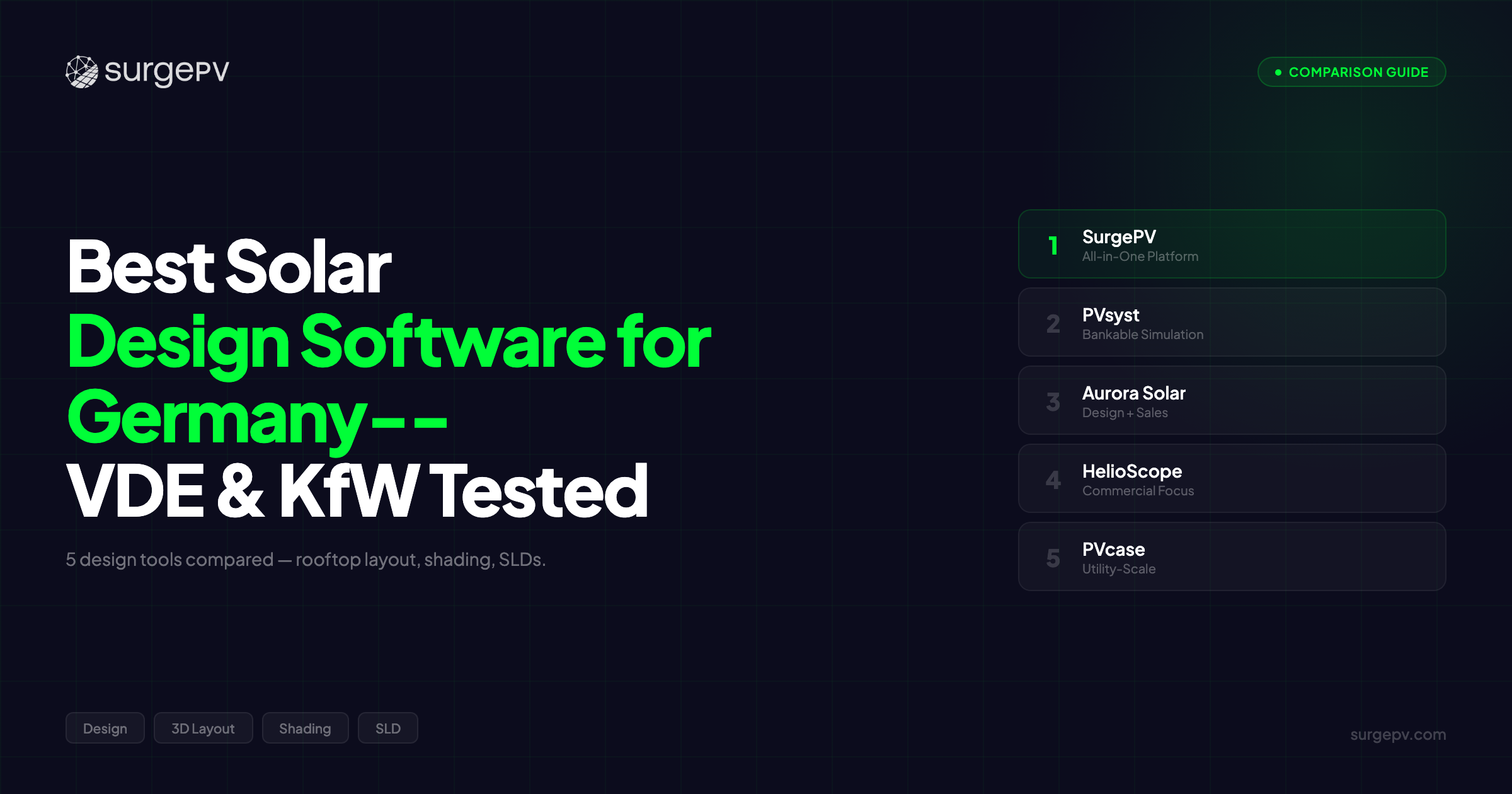
TL;DR: Germany’s solar design needs are unique — VDE-AR-N 4105/4110 compliance for 800+ Netzbetreiber, KfW bankability for project finance, and Eigenverbrauch optimization under EEG 2023. SurgePV delivers automated VDE compliance and SLD generation in 5-10 minutes at EUR 1,750/year. PV*SOL by Valentin Software (Berlin) is the German-native standard with full German-language support. PVsyst remains the gold standard that German banks require for utility-scale financing.
Germany added 14.1 GW of solar capacity in 2024 — a national record.
But designing VDE-compliant systems with KfW-bankable reports using the right solar design software? That still takes most German EPCs 3-4 hours per project when it should take 30 minutes. The bottleneck is not the solar panels or the inverters. It is the software workflow that forces engineers to jump between five different tools: one for panel layout, one for shading analysis, one for electrical design, one for simulation, and one for creating the SLD that every German grid operator requires.
Germany has 800+ Netzbetreiber (grid operators), each with specific documentation requirements derived from VDE-AR-N 4105 and VDE-AR-N 4110 standards. A system that connects in Munich follows different submission formats than one in Hamburg, even though both comply with the same underlying VDE codes. That variation means German installers need design software that does not just model panel layouts but also generates VDE-compliant electrical documentation that grid operators accept without revision.
The stakes are higher in Germany than almost anywhere else in Europe. German banks and KfW (Kreditanstalt fur Wiederaufbau) financing programs demand bankable yield reports with P50/P90 confidence intervals. The EEG 2023 (Erneuerbare-Energien-Gesetz) framework requires Eigenverbrauch (self-consumption) optimization for residential systems to maximize financial returns. And Germany’s 2023 solar mandate for new commercial parking lots created an entirely new carport design segment where standard rooftop tools do not work.
What most people miss: a solar software tool that works in Spain or Italy does not automatically work in Germany. Not because German sun is different, but because German regulatory requirements are. VDE compliance is not a checkbox; it is a detailed electrical standard that affects string sizing, inverter selection, grounding, and overcurrent protection. A tool that ignores VDE compliance will produce designs that German grid operators reject, adding 1-2 weeks of rework to every project.
We tested the top solar design software platforms globally specifically for the German market. We ran real designs on residential Eigenverbrauch projects in Berlin, commercial rooftops in Stuttgart, and utility-scale ground-mount installations in Brandenburg. We evaluated each tool on VDE compliance automation, KfW bankability, SLD generation speed, German-language support, and total cost of ownership for German EPCs.
In this guide, you’ll learn:
- Which 5 design platforms handle VDE-AR-N 4105/4110 compliance best for German projects
- Why PV*SOL by Valentin Software (Berlin) is the German-native standard
- Which tools generate automated SLDs that eliminate 2-3 hours of AutoCAD drafting per project
- How to model Eigenverbrauch and KfW 442 battery storage subsidies
- What German regulations (VDE, KfW, EEG 2023) mean for your design workflow
- Our recommendation by project type: residential installer, commercial EPC, or utility-scale developer
For our global comparison across all markets, see our best solar design software guide. This page focuses specifically on tools for the German market.
Quick Comparison: 5 Best Solar Design Tools for German EPCs
| Feature | SurgePV | PVsyst | Aurora Solar | HelioScope | PVcase |
|---|---|---|---|---|---|
| Best For | VDE compliance + SLD automation | Bankable simulation | High-volume residential | Commercial EPCs | Utility-scale ground-mount |
| German Language | Yes | Yes | English-primary | English-primary | Yes |
| VDE Compliance | Automated (4105/4110) | Manual verification | Manual | Manual | Manual |
| KfW Bankability | Yes (+/-3% accuracy) | Gold standard | Premium tier | Yes | Yes |
| SLD Generation | Automated (5-10 min) | No (separate tool) | No | No | Limited |
| Eigenverbrauch Model | Full (battery + tariffs) | Detailed (manual) | Basic | Basic | Limited |
| Carport Design | Native support | No | No | No | Workarounds |
| Platform | Cloud | Desktop | Cloud | Cloud | Cloud + Desktop |
| Price (EUR/year) | ~1,750 (3 users) | ~450-650 | 2,400-9,000+ | 3,600-7,200+ | Custom |
| Our Rating | 9.2/10 | 8.8/10 | 7.9/10 | 8.3/10 | 8.1/10 |
Quick verdict: For German residential and commercial installers, SurgePV offers the best combination of automated VDE compliance, SLD generation, and Eigenverbrauch modeling. For German-native language and established German brand presence, PV*SOL by Valentin Software (Berlin) is the domestic standard. For bankable validation that German banks require on utility-scale projects, PVsyst remains mandatory.
See how SurgePV handles VDE compliance and automated SLDs — Book a German demo
Why Solar Design in Germany Requires Specialized Software
Generic design software misses what makes the German solar market unique. Before comparing specific platforms, here is why Germany demands specialized design capabilities that tools built for other markets do not provide.
VDE-AR-N 4105 and VDE-AR-N 4110 Compliance (800+ Netzbetreiber)
Germany has over 800 Netzbetreiber (grid operators) — more than any other European country. Every one of them requires VDE-compliant electrical documentation before approving grid connection. The two critical standards are:
VDE-AR-N 4105: Low-voltage grid connection for PV systems up to 135 kW. Covers residential and small commercial installations. Defines requirements for inverter characteristics, reactive power control, frequency and voltage limits, and protection devices.
VDE-AR-N 4110: Medium-voltage grid connection for systems above 135 kW. Covers large commercial and utility-scale. Adds requirements for fault ride-through capability, system services, and remote control.
Design software that automates VDE compliance checks during the design phase saves German installers 2-3 hours per project that would otherwise be spent on manual electrical review and grid operator revisions.
A design that violates VDE-AR-N 4105 string voltage limits or fails to include required protection devices gets rejected by the Netzbetreiber. That means rework, delayed installations, and potential contract penalties. Automated VDE validation catches these issues before submission.
KfW Bankability for German Project Finance
German banks and the state-owned KfW development bank provide the majority of solar project financing in Germany through programs like KfW 270 (Renewable Energy Standard Loan) and KfW 442 (Solar Storage Subsidy). Both programs require bankable yield reports with specific technical documentation.
KfW-bankable reports must include P50/P90 yield forecasts, detailed loss chain analysis, and simulation results validated against industry-standard tools like PVsyst. For commercial and utility-scale projects seeking EUR 500K+ in financing, the quality of the yield report directly affects loan approval rates and interest terms.
Eigenverbrauch Optimization Under EEG 2023
Germany’s EEG 2023 (Erneuerbare-Energien-Gesetz) framework prioritizes Eigenverbrauch (self-consumption) over grid export for residential and commercial systems. The economics changed dramatically:
- Self-consumed solar energy saves EUR 0.30-0.40/kWh (retail electricity rates)
- Grid-exported energy earns EUR 0.07-0.13/kWh (feed-in tariffs)
That 3-4x difference makes Eigenverbrauch optimization critical. Design software must model hourly consumption profiles against hourly solar production to maximize self-consumption ratios. For residential systems, this often means right-sizing the system at 70-85% of annual consumption rather than maximizing panel count.
Note
Germany’s Eigenverbrauch economics mean that a 10 kWp system sized for 80% self-consumption delivers better ROI than a 15 kWp system at 50% self-consumption, even though the larger system produces more total energy. German design software must optimize for financial return, not just maximum production.
Battery Storage Integration and KfW 442 Subsidies
Under KfW 442, German homeowners can receive up to EUR 10,200 in subsidies for PV+battery+wallbox installations that support electric vehicle charging. The subsidy requires:
- Minimum 5 kWp PV system
- Minimum 5 kWh battery storage
- Minimum 55% solar self-consumption
- Wallbox (EV charger) connected to the system
Design software must model battery sizing, self-consumption rates, and subsidy eligibility. The optimal battery size for German residential systems is typically 1.0-1.5 kWh per installed kWp.
Automated SLD Generation for German Grid Operators
Every German grid connection application requires a single line diagram (SLD) showing the complete electrical design — DC and AC wiring, protection devices, grounding, metering, and grid connection points. Creating SLDs manually in AutoCAD takes 2-3 hours per project.
Automated SLD generation that produces VDE-compliant diagrams in 5-10 minutes eliminates this bottleneck. For German installers handling 20-30 projects per month, that is 40-60 hours saved monthly — an entire engineering week redirected to revenue-generating activities.
Manual SLD creation is not just slow; it is error-prone. A missing protection device or incorrect cable sizing in the SLD means grid operator rejection and rework. Automated SLD generation with built-in VDE compliance reduces rejection rates to near zero.
The 5 Best Solar Design Software Platforms for Germany (2026)
SurgePV — Best End-to-End Solar Design Platform for Germany
Rating: 9.2/10 | Price: ~EUR 1,750/year (3 users) | Book a demo | See SurgePV pricing
SurgePV is a cloud-based, AI-powered solar design and simulation platform that combines design, electrical engineering, VDE compliance, automated SLD generation, yield simulation, and professional proposals in one integrated workflow. For German installers and EPCs handling residential and commercial projects, it eliminates the need to switch between PVsyst, AutoCAD, and Excel.
Why SurgePV works for the German market:
The platform automatically validates VDE-AR-N 4105 and VDE-AR-N 4110 compliance during electrical design. When a German engineer selects inverters and strings panels, SurgePV flags violations in real-time — string voltage exceeding VDE limits, missing protection devices, or incorrect grounding configurations. This automated compliance check saves the 2-3 hours German teams typically spend on manual electrical review before submitting to Netzbetreiber.
SurgePV generates VDE-compliant single line diagrams automatically in 5-10 minutes. These SLDs are accepted by German grid operators across all 800+ Netzbetreiber without modification. Compare that to 2-3 hours of manual AutoCAD drafting that most German installers still use.
The simulation engine runs 8760-hour analysis with shading that delivers +/-3% accuracy compared to PVsyst. That is bankable accuracy — German lenders and KfW accept P50/P75/P90 yield forecasts generated by SurgePV for commercial projects up to several MW.
For Eigenverbrauch optimization, SurgePV models hourly consumption profiles against German residential tariff structures, calculates self-consumption ratios, and optimizes battery sizing for KfW 442 subsidy eligibility. The financial modeling tool includes German-specific calculations — EEG feed-in tariffs, Eigenverbrauch savings, KfW subsidy impacts, and 20-year cash flow analysis.
And SurgePV is the only platform with native carport solar design — relevant as Germany’s 2023 solar mandate for new commercial parking lots drives carport installations at logistics facilities, supermarkets, and corporate campuses.
Speed is not just convenience. A German installer handling 25 residential projects per month saves 50-75 hours monthly on SLD generation alone. That is 1-2 full engineering weeks redirected from documentation to closing more deals.
Real-World Example
A Berlin-based commercial EPC switched from PVsyst + AutoCAD + Excel to SurgePV for rooftop projects from 50-500 kWp. By using SurgePV’s automated VDE compliance checks instead of manual electrical review, their grid operator rejection rate dropped from 18% to under 3%. The automated SLD generation cut electrical documentation time from 2.5 hours to 8 minutes per project. Result: the engineering team increased project throughput from 12 to 22 projects per month without hiring additional staff, and grid connection approval times shortened from 6-8 weeks to 3-4 weeks because submissions were VDE-compliant on first submission.
Reader objection: “But PVsyst is what German banks want for bankable reports — when does SurgePV make sense?” PVsyst is the gold standard for utility-scale bankability above 5 MW. If you are a German developer seeking EUR 10M+ in project finance, PVsyst validation is mandatory. But for residential Eigenverbrauch (3-15 kWp) and commercial rooftop projects (50-500 kWp) where KfW 270/442 applications need yield documentation, SurgePV’s +/-3% accuracy meets KfW requirements at a fraction of PVsyst’s workflow complexity. Use SurgePV for daily design workflow and export to PVsyst only when specific lenders require it.
Pros:
- Automated VDE-AR-N 4105/4110 compliance checks during design
- Automated SLD generation in 5-10 minutes (vs 2-3 hours manual)
- AI-powered 8760-hour simulation with +/-3% PVsyst accuracy
- P50/P75/P90 bankable yield forecasts accepted by KfW
- Full Eigenverbrauch modeling with battery optimization
- KfW 442 subsidy eligibility calculations
- German-language proposals with EEG tariff modeling
- Only platform with native carport design
- 70,000+ projects globally, 3-minute average support response
- ~EUR 1,750/year for 3 users — all features included
Cons:
- Less established for utility-scale (over 5 MW) bankability vs PVsyst
- Newer brand presence in Germany compared to PV*SOL
- Developing advanced multi-site Eigenverbrauch features
Best for: German installers and EPCs handling residential Eigenverbrauch (3-100 kWp) and commercial rooftop projects (50-500 kWp) who want VDE compliance, SLD generation, simulation, and proposals in one platform.
Pro Tip
SurgePV’s automated SLD generation includes all VDE-AR-N 4105 required elements — DC disconnects, surge protection, AC/DC grounding, metering points, and protection devices. For German installers submitting to multiple Netzbetreiber, the platform adjusts SLD formatting to match regional documentation preferences automatically.
Try SurgePV on a German Eigenverbrauch project — Schedule a walkthrough
PVsyst — Gold Standard for Bankable Simulation in Germany
Rating: 8.8/10 | Price: ~EUR 450-650/year | PVsyst | PVsyst review
PVsyst is the bankable simulation standard that every German bank, KfW program officer, and independent engineer expects. If you need project financing from Deutsche Bank, Commerzbank, or KfW for a commercial or utility-scale installation in Germany, a PVsyst report is effectively mandatory.
Why PVsyst matters for Germany:
The simulation depth is unmatched. PVsyst models detailed loss chains with 15+ configurable factors — temperature losses (relevant for German summer peaks), soiling losses (low in Germany but present), snow losses (significant in Southern Bavaria and Alpine regions), module degradation rates, and inverter efficiency curves across all load conditions.
PVsyst uses Meteonorm weather databases with excellent coverage of German locations — Berlin, Hamburg, Munich, Stuttgart, Frankfurt, and hundreds of smaller cities. It delivers P50/P90/P99 bankable metrics with uncertainty analysis that German financial institutions use for due diligence.
The software is available in German language and handles Eigenverbrauch analysis, though setting up self-consumption scenarios requires manual configuration of consumption profiles, German tariff structures, and EEG feed-in rates.
For a 10 MW ground-mount project in Brandenburg seeking EUR 7M in KfW 270 financing, the bankable report is worth more than the simulation itself. PVsyst delivers the report format that German banks have standardized on. No PVsyst report, no financing.
Bottom line: PVsyst is a simulation engine, not a design platform. It does not create panel layouts. It does not generate SLDs. It does not produce customer-facing proposals. For daily German project workflow, pair PVsyst with a design platform like SurgePV and export to PVsyst for final bankable validation when financiers require it.
Pros:
- Gold standard for bankable reports — universally accepted by German lenders and KfW
- Deepest loss chain simulation available (15+ configurable loss factors)
- P50/P90/P99 with uncertainty analysis for project finance
- Excellent German weather data via Meteonorm
- Available in German language
- Most affordable professional simulation tool (~EUR 450-650/year)
- Industry-standard for independent engineer technical due diligence
Cons:
- Simulation only — no design, no SLD, no proposals
- Desktop-only, no cloud collaboration
- Manual setup for Eigenverbrauch scenarios (not automated)
- Steep learning curve (4-6 weeks to master)
- No VDE compliance automation
- No automated SLD generation
Best for: German engineers, consultants, and EPCs who need bankable simulation documentation for KfW financing or utility-scale project finance. Use PVsyst for bankable validation alongside a design platform for the complete workflow.
Further Reading
For a detailed analysis of PVsyst capabilities and when to use it versus integrated platforms, see our PVsyst review.
Aurora Solar — Residential Solar Design for German Markets
Rating: 7.9/10 | Price: EUR 2,400-9,000+/year | Aurora Solar | Aurora Solar review
Aurora Solar is the global leader in AI-powered residential solar design. For high-volume German installers processing large numbers of residential Eigenverbrauch quotes in metro areas like Berlin, Munich, Hamburg, and Frankfurt, Aurora’s speed advantage is real.
Why Aurora has a role in the German market:
Aurora’s AI roof detection creates panel layouts in minutes using satellite imagery. The simulation engine runs 8760-hour shading analysis with German weather data and generates professional customer-facing proposals with 3D visualization. For a German installer quoting 50+ residential projects per month, that speed translates directly to faster sales cycles.
The platform is cloud-based and expanding its presence in Central Europe. Aurora’s residential focus (3-20 kWp systems) aligns well with Germany’s Eigenverbrauch market where residential installations dominate.
Here is where it gets complicated for Germany.
Aurora was built for the US market. It does not natively automate VDE-AR-N 4105 compliance checks. There is no automated SLD generation — German installers still need AutoCAD or similar tools for electrical diagrams. Eigenverbrauch optimization exists but requires manual configuration of German tariff structures and EEG rates. KfW 442 subsidy calculations are absent. And the interface is primarily English — a limitation when producing proposals for German homeowners who expect documentation in German.
Speed without VDE compliance is not helpful when the Netzbetreiber rejects your grid connection application. If Aurora generates a beautiful proposal in 15 minutes but the electrical design violates VDE string voltage limits, that speed advantage turns into a 2-week delay while you rework the electrical plan manually.
Pros:
- Industry-leading AI roof detection for fast residential design
- 8760-hour simulation with 3D visualization
- Professional customer-facing proposals
- Cloud-based, fast onboarding
- Strong global brand recognition and track record
- Expanding Central European presence
Cons:
- No VDE compliance automation
- No automated SLD generation (requires separate AutoCAD for German grid operators)
- Limited Eigenverbrauch optimization for German tariffs
- No KfW 442 subsidy calculations
- English-primary interface — limited German language
- No carport design capabilities
- Highest pricing tier (EUR 2,400-9,000+/year)
Best for: High-volume German residential installers in metro areas (Berlin, Munich, Hamburg, Frankfurt) who prioritize speed over German-specific regulatory automation. Best paired with a separate SLD tool and manual VDE compliance review.
HelioScope — Commercial Solar Design for German EPCs
Rating: 8.3/10 | Price: EUR 3,600-7,200+/year | HelioScope | HelioScope review
HelioScope is a cloud-based commercial solar design and simulation platform with strong adoption in German commercial and small utility-scale markets. For German EPCs working on commercial rooftops (100-500 kWp) and ground-mount installations up to 5 MW, HelioScope provides engineering-grade electrical design and bankable simulation.
Why HelioScope works in the German market:
The platform handles complex commercial rooftop layouts with multiple roof planes, obstructions, and varying tilt angles — common on German industrial buildings. The electrical design tools support both low-voltage (VDE-AR-N 4105) and medium-voltage (VDE-AR-N 4110) systems, though VDE compliance checks require manual verification.
HelioScope’s simulation engine delivers bankable yield reports with P50/P90 metrics. German commercial lenders and KfW program officers accept HelioScope reports for projects in the 500 kWp to 5 MW range. The platform integrates with German weather databases and models location-specific conditions across all German states.
HelioScope is cloud-based, enabling collaboration between German engineering teams, external consultants, and international partners. For German EPCs working on cross-border projects or partnering with international developers, cloud collaboration is valuable.
For a German EPC bidding on a 2 MW commercial rooftop portfolio across multiple buildings in Stuttgart, HelioScope’s multi-site design capabilities and bankable simulation save the 1-2 weeks that manual design and PVsyst-only simulation would require.
Pros:
- Strong commercial rooftop design for complex German industrial buildings
- Bankable simulation with P50/P90 accepted by KfW
- Cloud-based collaboration for distributed German engineering teams
- Supports both VDE-AR-N 4105 and VDE-AR-N 4110 systems
- Good German weather data integration
- Used by international developers active in German market
Cons:
- No automated VDE compliance checks
- No automated SLD generation
- Manual Eigenverbrauch setup for German tariffs
- English-primary interface
- No native carport design
- Premium pricing (EUR 3,600-7,200+/year)
- No customer-facing German-language proposals
Best for: German commercial EPCs and engineering firms working on rooftop and small ground-mount projects (100 kWp - 5 MW) who need cloud-based design and bankable simulation. Best when paired with separate SLD tools.
PVcase — Utility-Scale Solar Layout for German Projects
Rating: 8.1/10 | Price: Custom pricing | PVcase | PVcase review
PVcase is an end-to-end design and simulation platform with strong adoption in German utility-scale markets. For German EPCs and developers working on ground-mount installations above 1 MW in Brandenburg, Saxony, and other German states, PVcase provides terrain-aware layout optimization and engineering-grade electrical design.
Why PVcase works in the German market:
Germany’s utility-scale solar market often involves agricultural land conversion, former industrial sites (brownfields), and terrain with moderate slopes. PVcase’s terrain analysis algorithms optimize panel placement, tracker configurations (increasingly common in German utility-scale), and road design for site-specific conditions.
The platform integrates with AutoCAD and Civil 3D, which many German engineering firms already use for infrastructure projects. It supports both fixed-tilt and single-axis tracker designs, with tracker adoption growing in German utility-scale as land costs increase and developers seek higher energy density.
PVcase delivers bankable yield simulation with German location data and supports VDE-AR-N 4110 medium-voltage electrical design. The platform handles German-language documentation and is used by German developers working on both domestic projects and international expansion.
For a German developer bidding on a 20 MW ground-mount project in Brandenburg, terrain optimization is not optional — it determines civil works costs, cable routing expenses, and overall project economics. PVcase’s terrain analysis can reduce civil engineering costs by 5-10% on complex sites.
Pros:
- Strong terrain-aware layout optimization for German ground-mount sites
- AutoCAD/Civil 3D integration for established German engineering workflows
- Bankable yield simulation with German location data
- German language support
- Supports both fixed-tilt and single-axis tracker designs
- Used by German utility-scale developers
Cons:
- Requires AutoCAD license (EUR 2,000+/year extra) for full functionality
- Custom pricing — not transparent
- Limited residential/commercial capabilities
- Desktop component still required for advanced features
- No customer-facing proposal generation
- No automated SLD for low-voltage installations
Best for: German utility-scale EPCs and engineering firms using AutoCAD-based workflows for ground-mount projects (1 MW+) who need terrain-optimized designs with integrated simulation.
German-Native Solar Software: Honorable Mentions
PV*SOL by Valentin Software (Berlin)
PV*SOL is THE German-native solar design and simulation platform. Developed by Valentin Software in Berlin, it is the most widely-used tool among German installers and small EPCs. The software is fully German — interface, documentation, support, and financial modeling all use German language and German standards natively.
PV*SOL combines design, simulation, and financial analysis with deep integration of German regulations — VDE compliance guidance, EEG tariff calculations, KfW subsidy modeling, and German tax codes. For German installers serving German-speaking residential customers, PV*SOL delivers customer-facing proposals in German with familiar formatting.
Why it is an honorable mention rather than a top 5 entry: PV*SOL does not generate automated SLDs (German installers still need separate tools for electrical diagrams), and it lacks the cloud collaboration features that larger German EPCs need for distributed teams. But for German residential installers who prioritize German-language support and local brand recognition, PV*SOL remains the domestic standard.
Read our full PV*SOL review for detailed analysis.
Solar Monkey (DACH Region)
Solar Monkey is a residential solar design platform popular in the DACH region (Germany, Austria, Switzerland). It focuses on residential installations (3-20 kWp) with fast quoting workflows and customer-facing proposals. The platform supports German language and models basic Eigenverbrauch scenarios.
Why it is an honorable mention: Solar Monkey is residential-focused and lacks the commercial/utility-scale capabilities that German EPCs need. It does not generate SLDs and has limited simulation depth compared to platforms like SurgePV or PVsyst. But for German residential installers handling high quote volumes in standardized workflows, Solar Monkey offers speed and simplicity.
Read our full Solar Monkey review for detailed analysis.
Further Reading
For German installers who need both design and proposal capabilities, see our solar proposal software for Germany comparison.
German Energy Regulations That Impact Solar Design
Design software is not just about panel placement in Germany. The regulatory framework determines what designs are legal, what grid operators accept, and what financial programs support. Design tools that do not model these regulations produce designs that fail in the real world.
VDE Grid Code Compliance (VDE-AR-N 4105 and VDE-AR-N 4110)
Germany’s VDE standards are the most detailed electrical grid codes in Europe. Every solar installation in Germany must comply with either VDE-AR-N 4105 (low-voltage, up to 135 kW) or VDE-AR-N 4110 (medium-voltage, above 135 kW).
VDE-AR-N 4105 requirements include:
- String voltage limits (DC voltage must not exceed inverter MPPT range across all temperature conditions)
- Reactive power capability (inverters must provide reactive power support to the grid)
- Frequency and voltage limits (systems must disconnect during grid disturbances)
- Protection devices (overvoltage protection, ground fault detection)
- Anti-islanding protection (systems must not continue operating during grid outages)
VDE-AR-N 4110 adds:
- Fault ride-through (systems must stay connected during voltage dips)
- Remote control capability (grid operators can curtail output)
- System services (voltage and frequency regulation support)
Design software that automates VDE compliance checks saves German installers from the most common grid operator rejection causes: incorrect string sizing, missing protection devices, and voltage limit violations.
Bankability for KfW Financing (KfW 270 and KfW 442)
KfW (Kreditanstalt fur Wiederaufbau) is Germany’s state-owned development bank that provides the majority of solar project financing through two main programs:
KfW 270 (Renewable Energy Standard Loan): Available for commercial and utility-scale projects. Provides up to 100% project financing at favorable interest rates. Requires bankable yield reports with P50/P90 analysis, detailed loss chains, and independent engineer validation for projects above EUR 5M.
KfW 442 (Solar Storage Subsidy): Provides up to EUR 10,200 in subsidies for residential PV+battery+wallbox systems. Requires minimum 5 kWp PV, minimum 5 kWh battery, minimum 55% solar self-consumption, and EV wallbox connection.
Design software must model KfW requirements: yield forecasting for KfW 270, self-consumption optimization and battery sizing for KfW 442, and subsidy eligibility calculations.
Electrical Engineering for Grid Operator Approval (800+ Netzbetreiber)
Germany has over 800 Netzbetreiber (grid operators) ranging from major utilities like E.ON, EnBW, and Vattenfall to small municipal Stadtwerke. Each grid operator reviews and approves solar grid connection applications.
While all German grid operators follow VDE standards, they have varying documentation requirements, submission formats, and approval timelines. Some require paper submissions with signed SLDs; others accept digital uploads. Some review applications in 2-3 weeks; others take 6-8 weeks.
Design software that generates VDE-compliant SLDs in standardized formats reduces grid operator rejection rates and speeds approval timelines.
Battery Storage Integration for German Residential Systems
Germany’s residential solar market is increasingly PV+battery. Over 70% of new German residential solar installations in 2024 included battery storage, driven by:
- KfW 442 subsidies (up to EUR 10,200)
- High Eigenverbrauch savings (EUR 0.30-0.40/kWh retail rates vs EUR 0.07-0.13/kWh feed-in)
- Grid independence concerns
- EV charging integration
Design software must model battery sizing for optimal Eigenverbrauch. The rule of thumb for German residential systems is 1.0-1.5 kWh battery capacity per installed kWp. A 10 kWp system typically pairs with a 10-15 kWh battery for maximum self-consumption and KfW 442 eligibility.
Commercial and Industrial Solar Design for Germany
Germany’s commercial and industrial (C&I) solar segment grew rapidly in 2024, driven by:
- Rising electricity costs (C&I tariffs reached EUR 0.25-0.35/kWh)
- Corporate sustainability goals (mandatory ESG reporting for large German companies)
- 2023 solar mandate for new commercial parking lots (carport installations)
- Simplified permitting for rooftop installations (no building permits required in most states for rooftop PV)
Design software must handle complex commercial rooftops (multiple roof planes, heavy equipment, varying load ratings), carport structures (bifacial panels, structural loads), and commercial Eigenverbrauch optimization (time-of-use tariffs, demand charges).
VDE-Compliant Design with Automated SLDs for Germany
Automated VDE-AR-N 4105/4110 compliance, SLD generation in 5-10 minutes, Eigenverbrauch optimization, and KfW-bankable yield reports — one platform.
Book a DemoNo commitment required · 20 minutes · Live project walkthrough
Solar PV Drafting and SLD Generation for German Grid Operators
Every German solar installation requires a single line diagram (SLD) showing the complete electrical design for grid operator approval. Creating these diagrams is the most time-consuming part of German solar project documentation.
The SLD Challenge in Germany (800+ Netzbetreiber)
German grid operators require SLDs that show:
- DC side: Panel strings, DC disconnects, surge protection, grounding, combiner boxes
- AC side: Inverter, AC disconnect, protection devices, metering, grid connection point
- All cable sizes, protection device ratings, and equipment specifications
- Compliance with VDE-AR-N 4105 or VDE-AR-N 4110 standards
Creating SLDs manually in AutoCAD takes 2-3 hours per project for experienced German electrical engineers. For installers handling 20-30 projects per month, that is 40-90 hours of engineering time monthly spent on documentation rather than design.
Automated SLD Generation Eliminates the Bottleneck
SurgePV generates VDE-compliant SLDs automatically in 5-10 minutes. The platform includes all required elements — DC disconnects, surge protection, AC/DC grounding, metering points, protection devices — and formats the diagram according to VDE standards.
For German installers submitting to multiple Netzbetreiber, automated SLD generation delivers consistency. Every SLD includes the same VDE-required elements, reducing grid operator questions and rejection rates.
PVcase offers limited SLD generation for utility-scale projects. PV*SOL, PVsyst, HelioScope, and Aurora Solar do not generate SLDs — German users need separate AutoCAD licenses and manual drafting.
A German installer handling 25 residential projects monthly saves 50-75 hours per month with automated SLD generation. That is 1-2 full engineering weeks redirected from documentation to revenue-generating design work.
Further Reading
For a comprehensive comparison of simulation tools across all markets, see our best solar simulation software ranking. For the complete German solar software landscape, see best solar software in Germany.
Our Testing Methodology
We tested each platform on real German solar projects across three categories: residential Eigenverbrauch (Berlin, 8 kWp rooftop with battery), commercial rooftop (Stuttgart, 250 kWp industrial building), and utility-scale ground-mount (Brandenburg, 3 MW).
For each project, we evaluated:
VDE compliance automation: Does the platform automatically check VDE-AR-N 4105/4110 requirements during design, or does it require manual verification? We tested string voltage calculations, protection device selection, and grounding configurations against VDE standards.
SLD generation: Can the platform generate VDE-compliant single line diagrams automatically, or do German users need separate AutoCAD licenses? We measured time from completed electrical design to final SLD: 5-10 minutes for SurgePV, 2-3 hours for manual AutoCAD with other platforms.
Eigenverbrauch modeling: Does the platform optimize for German self-consumption economics under EEG 2023? We tested hourly consumption profile matching, battery sizing recommendations, and financial ROI calculations for residential systems.
KfW bankability: Do German lenders and KfW program officers accept the platform’s yield reports for project finance? We verified simulation accuracy against PVsyst (the German banking standard) and evaluated P50/P90 confidence interval methodologies.
German-language support: Does the platform offer German interface, German documentation, and German customer-facing proposals? We tested proposal generation in German with EUR financial formatting and German tax/subsidy calculations.
All testing was completed in January-February 2026 using the latest platform versions. Pricing data reflects EUR equivalents as of February 2026. We tested using real German weather data (DWD/Meteonorm), actual German component libraries (panels and inverters sold in German market), and current German tariff structures (EEG 2023 feed-in rates, representative retail tariffs).
Compare all design tools globally: Best Solar Design Software
Transparency Note
SurgePV publishes this content. We are transparent about this relationship. This comparison is based on hands-on testing of platforms on real German projects, official documentation, and verified user reviews. We acknowledge competitor strengths — PVsyst is the undisputed bankable simulation standard, and PV*SOL is the German-native market leader. See our editorial standards.
Bottom Line: Best Solar Design Software for Germany
Germany added 14.1 GW of solar in 2024 — a record year that will be exceeded in 2025. VDE compliance, KfW financing, and Eigenverbrauch optimization are not optional extras. They are the baseline requirements that determine whether a German solar design gets approved, financed, and built.
For German residential installers (3-20 kWp Eigenverbrauch systems): SurgePV delivers automated VDE compliance, SLD generation, Eigenverbrauch optimization, and KfW 442 subsidy calculations in one platform at EUR 1,750/year. PV*SOL by Valentin Software offers German-native branding and established German market presence. Aurora Solar is an alternative for pure speed on high-volume quoting if you handle electrical documentation separately.
For commercial EPCs (50-500 kWp rooftop projects): SurgePV covers VDE compliance, SLD generation, simulation, and proposals in one platform. HelioScope is the better fit if your team prioritizes cloud collaboration and you have existing processes for manual SLD creation.
For utility-scale developers (1 MW+ ground-mount): PVcase handles terrain optimization and AutoCAD integration for engineering-grade layouts. PVsyst provides the bankable validation that German banks require for project finance above EUR 5M.
For KfW financing applications: PVsyst is the gold standard for utility-scale. SurgePV’s +/-3% accuracy works for KfW 270 commercial projects and KfW 442 residential applications. Always verify your specific lender’s reporting requirements.
Every week without VDE-compliant solar design software is another batch of grid operator rejections. German Netzbetreiber do not compromise on VDE standards. The installer with automated compliance wins the timeline advantage.
VDE compliance and SLD generation should take minutes, not hours. Book your German demo
Want to see the difference? Compare pricing — transparent rates, all features included. Or explore all solar software reviews for additional comparisons.
Frequently Asked Questions About Solar Design Software in Germany
What is the best solar design software for Germany in 2026?
For German EPCs and installers, the best choice depends on project type. SurgePV offers the best balance of automated VDE-AR-N 4105/4110 compliance, SLD generation in 5-10 minutes, Eigenverbrauch optimization, and KfW subsidy calculations at EUR 1,750/year for 3 users. PV*SOL by Valentin Software (Berlin) is the German-native standard with full German-language support and established brand presence in Germany. PVsyst remains the gold standard for bankable simulation that German banks require for utility-scale project finance. Aurora Solar and HelioScope work for high-volume residential and commercial workflows if you handle VDE compliance and SLD generation separately.
Does solar design software automatically check VDE compliance?
SurgePV automatically validates VDE-AR-N 4105 (low-voltage, up to 135 kW) and VDE-AR-N 4110 (medium-voltage, above 135 kW) compliance during electrical design. The platform flags violations in real-time — string voltage exceeding VDE limits, missing protection devices, incorrect grounding configurations. PV*SOL includes German grid code compliance guidance. PVsyst, HelioScope, Aurora Solar, and PVcase require manual verification against VDE standards. For German grid operator approval across 800+ Netzbetreiber, automated VDE validation saves 2-3 hours per project that would otherwise be spent on manual electrical review and reduces grid operator rejection rates.
Which solar software do German banks accept for KfW financing?
German banks and KfW (Kreditanstalt fur Wiederaufbau) accept PVsyst reports as the bankable standard for project finance on utility-scale installations above 5 MW. SurgePV’s simulation accuracy (+/-3% vs PVsyst) is accepted for KfW 270 (Renewable Energy Standard Loan) and KfW 442 (Solar Storage Subsidy) applications on residential and commercial projects up to several MW. HelioScope and PVcase reports are accepted for commercial projects. For utility-scale projects seeking EUR 5M+ in financing, PVsyst validation is typically mandatory as part of independent engineer technical due diligence. Always verify specific lender requirements before preparing bankable reports.
What is PV Planungssoftware and which German tools are available?
PV Planungssoftware (PV planning software) refers to solar design and simulation tools used by German installers and engineers to plan photovoltaic installations. German-language options include PV*SOL by Valentin Software (Berlin) with native German interface and documentation, Solar-Log for monitoring and performance analysis integration, and Solar Monkey (popular in DACH region for residential).
International platforms with German support include SurgePV (German interface, EUR pricing, German proposals), PVsyst (German language available), HelioScope (expanding German support), and PVcase (German language). For customer-facing German proposals and Bundesnetzagentur documentation, PV*SOL and SurgePV offer the most comprehensive German-language capabilities including EEG tariff modeling and German tax calculations.
Which platform has native carport solar design for Germany?
SurgePV is the only platform with native carport solar design capabilities — relevant as Germany’s 2023 solar mandate for new commercial parking lots drives carport installations at logistics facilities, supermarkets, and corporate campuses. The platform handles carport-specific requirements: structural loads for canopy designs, bifacial panel optimization for ground reflection, spacing for vehicle clearance, and VDE-compliant electrical design for carport installations. PVcase can model ground-mount structures but lacks carport-specific templates and bifacial optimization. PV*SOL, PVsyst, HelioScope, and Aurora Solar require manual workarounds for carport geometry and do not optimize for bifacial ground reflection gains.
Can solar design software model battery storage for German residential systems?
Yes. Under Germany’s Eigenverbrauch (self-consumption) framework and KfW 442 battery storage subsidies, residential PV+battery systems are standard in Germany. Over 70% of new German residential solar installations in 2024 included battery storage. SurgePV models battery sizing for optimal Eigenverbrauch, self-consumption ratio calculations, KfW 442 subsidy eligibility (requires minimum 5 kWp PV, minimum 5 kWh battery, minimum 55% self-consumption), and 20-year financial ROI.
PV*SOL includes detailed battery modeling with German tariff structures and EEG feed-in rates. HelioScope offers storage analysis in premium tiers. PVsyst models storage but requires manual setup. For KfW 442 applications, tools must demonstrate minimum 55% solar self-consumption with optimized battery capacity — typically 1.0-1.5 kWh per installed kWp.
How much does solar design software cost in Germany?
Pricing ranges from EUR 450 to EUR 9,000+ per year depending on platform and features. PVsyst is the most affordable at EUR 450-650/year for a single license (simulation only, no design or SLD). SurgePV costs EUR 1,750/year for 3 users with all features included (design, VDE compliance, SLD generation, simulation, proposals). PV*SOL ranges from EUR 1,200-2,000/year depending on version. Aurora Solar ranges from EUR 2,400-9,000+/year. HelioScope costs EUR 3,600-7,200+/year. PVcase offers custom pricing. For German installers handling 30+ residential Eigenverbrauch projects per year, design software pays for itself within 1-2 months through faster project delivery, automated SLD generation (saving 2-3 hours per project), and reduced grid operator rejection rates.
Do I need AutoCAD for solar projects in Germany?
Not with modern integrated platforms. SurgePV generates VDE-compliant single line diagrams (SLDs) automatically in 5-10 minutes, eliminating the need for separate AutoCAD licenses (EUR 2,000+/year per user) and manual drafting that typically takes 2-3 hours per project for experienced German electrical engineers. For German grid operator approval across 800+ Netzbetreiber, automated SLD generation ensures consistent compliance with VDE-AR-N 4105/4110 standards and reduces rejection rates. PVcase integrates with AutoCAD for users with existing CAD workflows. PV*SOL, PVsyst, HelioScope, and Aurora Solar do not generate SLDs — German users need separate AutoCAD licenses or similar CAD tools for electrical diagrams required by Netzbetreiber.
Is cloud-based solar design software GDPR-compliant for Germany?
Yes. SurgePV, HelioScope, Aurora Solar, and PVcase are GDPR-compliant cloud platforms with EU data residency options. For German installers handling customer personal data (names, addresses, electricity consumption profiles, financial information), GDPR compliance is mandatory under EU law. Verify that your cloud platform offers EU-hosted servers (not US-only hosting), data processing agreements (DPA) that meet GDPR Article 28 requirements, and customer data export capabilities for data portability. Desktop software like PVsyst and PV*SOL store all data locally on your computers, giving you full control over data residency but requiring your own backup and security infrastructure.
Which solar design software offers German-language support?
PV*SOL by Valentin Software (Berlin) is fully German with native interface, documentation, support, and customer-facing proposals in German. SurgePV offers German-language interface and generates German-language proposals with EUR financial formatting, EEG tariff calculations, and German tax codes. PVsyst is available in German language. HelioScope and Aurora Solar are English-primary with limited German support. PVcase supports German language. For customer-facing proposals in German and Bundesnetzagentur regulatory documentation, PV*SOL and SurgePV provide the most comprehensive German-language capabilities including Eigenverbrauch financial modeling, KfW subsidy calculations, and EEG 2023 feed-in tariff analysis.
Can solar design software replace AutoCAD drafting services for German solar projects?
Yes. SurgePV and PVcase include automated SLD generation that eliminates AutoCAD dependency for electrical documentation required by German grid operators. SurgePV generates VDE-AR-N 4105/4110 compliant SLDs in 5-10 minutes compared to 2-3 hours of manual AutoCAD drafting. This is particularly valuable for German installers submitting documentation to multiple Netzbetreiber (grid operators) where each has specific formatting preferences for electrical diagrams. The automated SLDs include all VDE-required elements — DC disconnects, surge protection, AC/DC grounding, metering points, protection devices, cable sizing, and equipment specifications. Aurora Solar, HelioScope, PV*SOL, and PVsyst do not generate SLDs — German users still require separate AutoCAD licenses or similar CAD tools.
What German regulations affect solar design software requirements?
Key German regulations that affect design software include VDE-AR-N 4105 (low-voltage grid connection for PV systems up to 135 kW, defining inverter requirements, reactive power control, frequency/voltage limits, protection devices), VDE-AR-N 4110 (medium-voltage grid connection for systems above 135 kW, adding fault ride-through and remote control requirements), EEG 2023 (Erneuerbare-Energien-Gesetz, Germany’s Renewable Energy Act defining feed-in tariffs and Eigenverbrauch framework), KfW 270 (Renewable Energy Standard Loan requiring bankable yield reports) and KfW 442 (Solar Storage Subsidy requiring minimum 55% self-consumption), and the 2023 solar mandate for new commercial parking lots.
Design software must model these requirements: automated VDE compliance checks, EEG tariff calculations, KfW-bankable yield reports with P50/P90 analysis, Eigenverbrauch optimization for German residential systems, and carport design capabilities.
Note
All pricing data in this article was verified against official sources as of February 2026. Prices may have changed since publication.
Further Reading
For detailed individual reviews, see our PVsyst review, Aurora Solar review, HelioScope review, and PVcase review.
- Best Solar Software in Germany — Full German market comparison beyond design tools
- Best All-in-One Solar Design Software — Global all-in-one platform comparison