

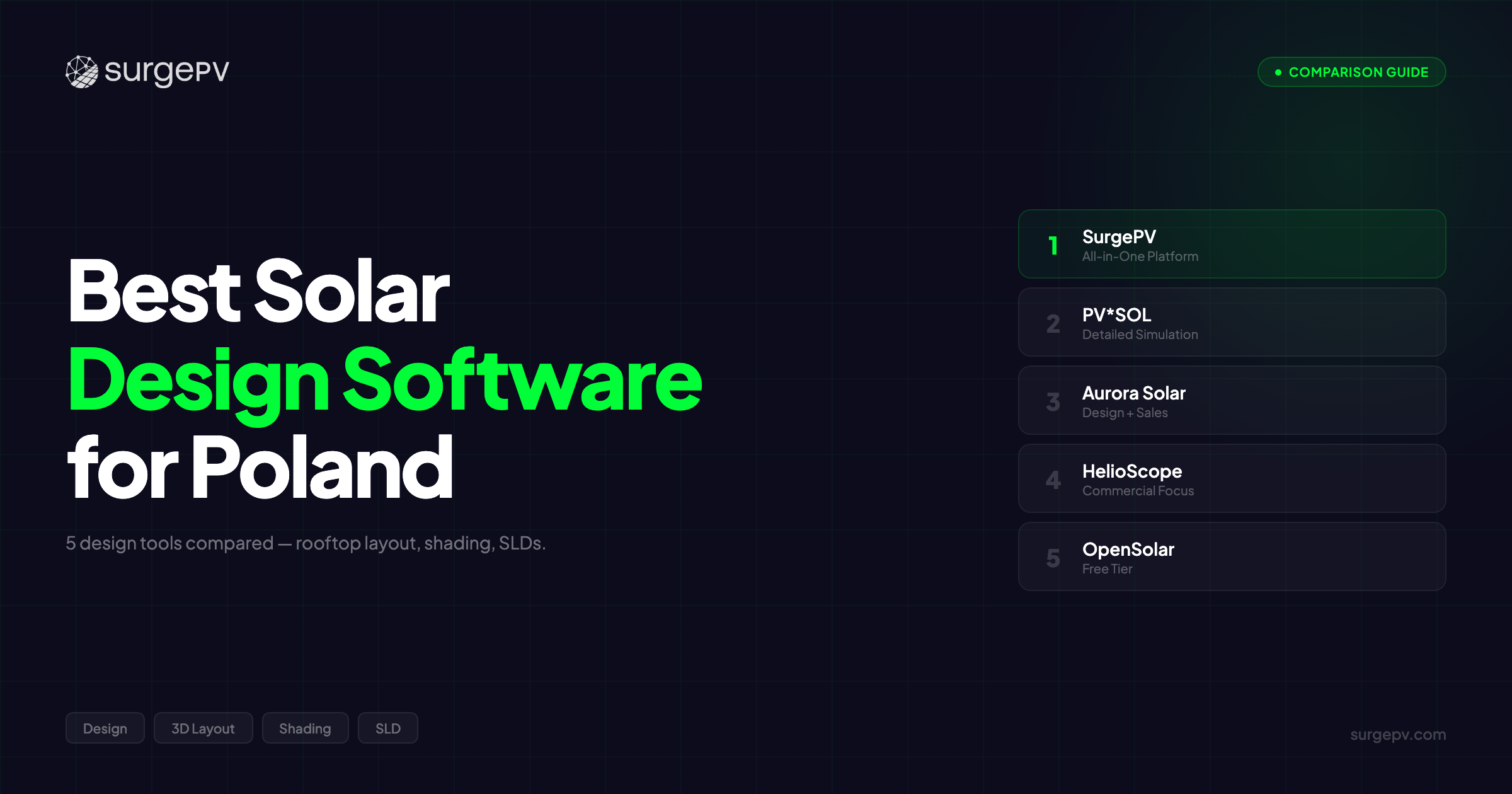
TL;DR: Poland’s solar market transformed overnight when net-billing replaced net-metering in April 2022. Design software built for the old rules produces financial projections that overestimate returns by 30%. SurgePV delivers net-billing calculations, Polish-language proposals, and OSD documentation automation at approximately PLN 7,500/year (EUR 1,750). PV*SOL, distributed in Poland through Kielgo.pl, leads in detailed simulation. For Polish prosumer projects under Moj Prad 5.0, tools must model battery integration, not just PV alone.
Poland installed 4.9 GW of new solar capacity in 2023.
That makes Poland Europe’s fourth-largest solar market, adding more capacity than Spain, France, or the Netherlands. But here is what most international installers miss: Poland switched from net-metering to net-billing in April 2022, and the software tools that worked before that date produce wildly inaccurate financial projections today.
Under the old net-metering system, 1 kWh sent to the grid offset 0.8 kWh of consumption (80% ratio for installations under 10 kWp). Simple math. Solar design software just calculated annual production versus annual consumption and delivered a payback estimate.
The truth: net-billing changed everything. Now Polish prosumers receive compensation based on dynamic market rates through hourly billing periods. A kWh exported at midday in summer when prices are low is worth 40-60% less than a kWh exported at 6 PM in winter when demand peaks. Design software that averages these rates produces ROI projections divorced from reality.
Poland also launched Moj Prad 5.0 in 2024, prioritizing PV + battery storage systems. Design software that only models PV panels without storage integration misses half the subsidy equation. And Polish Distribution System Operators, PGE Dystrybucja, Tauron Dystrybucja, Enea Operator, Energa-Operator, and Stoen Operator, each have specific technical documentation requirements that manual drafting takes 2-3 hours per project.
That matters when Polish residential installers compete on 15-20 quotes simultaneously and when commercial EPCs bid on municipal tenders that require URE-compliant documentation and P50/P90 bankable forecasts.
We tested the top solar design software platforms specifically for the Polish market. We ran actual designs on residential prosumer installations in Warsaw, commercial rooftops in Krakow, and ground-mount systems in Wielkopolska. We evaluated each tool on net-billing accuracy, Moj Prad compliance, OSD documentation automation, Polish-language support, and bankable yield reporting.
In this guide, you’ll learn:
- Which 5 design platforms handle Polish net-billing calculations and OSD documentation best
- Why SOLCAD, a Polish-native tool, dominates local installer preferences but has critical limitations
- Which tools produce bankable P50/P90 reports that Polish banks and URE auctions accept
- How to model Moj Prad 5.0 battery storage requirements
- What Polish regulations (net-billing, Ustawa OZE, Czyste Powietrze) mean for your design workflow
- Our recommendation by installer type: residential prosumer, commercial EPC, or utility-scale developer
Quick Comparison: 5 Best Solar Design Tools for Polish Installers
| Feature | SurgePV | PV*SOL | Aurora Solar | HelioScope | OpenSolar |
|---|---|---|---|---|---|
| Best For | All-in-one design + proposals | Detailed simulation | Residential AI design | Commercial/utility scale | Free residential |
| Polish Language | Full support | Via Kielgo.pl | No | No | No |
| Net-Billing Calc | Automated | Manual setup | No | No | Partial |
| OSD SLD Export | Automated (5-10 min) | Limited | No | No | No |
| Moj Prad Docs | Yes | Partial | No | No | No |
| P50/P90 Reports | Yes (±3% vs PVsyst) | Yes | Yes (Premium) | Yes | Limited |
| Battery Modeling | Full (Moj Prad 5.0) | Yes | Yes | Yes | Basic |
| Platform | Cloud | Desktop | Cloud | Cloud | Cloud |
| Price (PLN/year) | ~7,500 (3 users) | ~3,800-5,900 | Custom | ~1,700+/user | Free tier |
| Our Rating | 9.2/10 | 8.8/10 | 8.1/10 | 7.9/10 | 7.3/10 |
Quick verdict: For Polish residential and commercial installers handling prosumer projects under Moj Prad 5.0, SurgePV offers the best combination of net-billing financial modeling, Polish-language proposals, and automated OSD documentation. For detailed simulation and shading analysis, PV*SOL’s strong Polish presence through Kielgo.pl makes it the validation standard. For high-volume residential quoting, Aurora Solar provides the fastest AI-powered design workflow, though without Polish-specific financial modeling.
See how SurgePV handles Polish net-billing and OSD automation — Book a demo
What Polish Solar Installers Need from Design Software in 2026
Generic design software misses what makes the Polish solar market fundamentally different from Western European markets. Before comparing specific platforms, here is why Poland demands specialized capabilities.
Net-Billing Changed Everything for Polish Prosumers
Poland abolished net-metering on April 5, 2022. Under the old system, prosumers with installations under 10 kWp received 0.8 kWh credit for every 1 kWh exported to the grid. Installations over 10 kWp received 0.7 kWh credit. Simple ratios that any spreadsheet could calculate.
The new net-billing system (rozliczenie netto) calculates compensation based on dynamic wholesale electricity market rates. Polish prosumers now receive payment for exported energy at hourly market prices, which fluctuate between PLN 200-800/MWh depending on demand, season, and renewable supply saturation.
A kWh exported at 2 PM on a sunny June day when solar production across Poland peaks might be worth PLN 250/MWh. That same kWh exported at 7 PM on a December evening during demand peak could be worth PLN 650/MWh, 2.6x more valuable. Design software that uses annual average rates misses this 200-300% swing.
This fundamentally changed what design software needs to calculate. Tools must now model:
- Hourly self-consumption profiles matched to household load curves
- Time-of-day energy export patterns
- Seasonal market rate variation
- Battery storage optimization for time-shifting exports to high-price periods
- Real payback timelines based on dynamic compensation, not fixed ratios
Note
Poland switched from net-metering (fixed 0.8x ratio) to net-billing (dynamic market rates) in April 2022. Design software built for net-metering overestimates ROI by 15-30% for Polish prosumer projects. Tools that model hourly net-billing economics, like SurgePV’s generation and financial tool, produce accurate payback projections reflecting actual compensation variability.
Moj Prad Program Requirements for Design Software
Moj Prad (My Electricity) is Poland’s flagship prosumer subsidy program, managed by NFOSiGW (National Fund for Environmental Protection and Water Management). The program has evolved through five iterations since 2019, with each version tightening technical requirements.
Moj Prad 5.0 (current as of 2024-2026) shifted focus from standalone PV to integrated energy systems. The program now prioritizes:
- PV + battery energy storage systems (not PV alone)
- Energy management systems that optimize self-consumption
- Heat pump integration with PV (for building electrification)
- Maximum installation capacity: 50 kWp
- Subsidy amount: up to PLN 7,000 per installation
Design software handling Moj Prad applications must generate:
- Technical specifications demonstrating battery integration capacity
- Energy management documentation showing self-consumption optimization
- Financial projections accounting for subsidy amounts
- System component compatibility verification (inverter + battery communication)
Moj Prad 5.0 applications require proof that the PV system can integrate with battery storage and energy management, even if the installer is not selling the battery immediately. Design software that only models standalone PV without demonstrating storage-ready configurations will not meet program requirements.
Czyste Powietrze (Clean Air) and Building-Integrated Solar
Czyste Powietrze (Clean Air) is Poland’s largest building energy efficiency program, also managed by NFOSiGW. While primarily focused on heating system replacement and thermal insulation, the program includes PV installations when combined with comprehensive building thermo-modernization.
For solar installations qualifying under Czyste Powietrze, design software must:
- Calculate building-level energy savings (not just PV production)
- Model PV contribution to overall building energy performance
- Demonstrate how PV integrates with heating system upgrades
- Document annual energy consumption reduction in primary energy terms
This requires software capable of building energy modeling alongside PV design, a capability that distinguishes comprehensive platforms from basic panel layout tools.
OSD Documentation Requirements for Grid Connection
Poland has 5 major Distribution System Operators (OSDs, Operator Systemu Dystrybucyjnego):
- PGE Dystrybucja (covers central and eastern Poland)
- Tauron Dystrybucja (covers southern Poland including Silesia)
- Enea Operator (covers western Poland including Wielkopolska)
- Energa-Operator (covers northern Poland including Pomerania)
- Stoen Operator (covers Warsaw)
Each OSD requires specific technical documentation for grid connection approval:
- Single line diagrams (SLDs) compliant with Polish electrical standards
- Protection and metering specifications
- Inverter technical datasheets
- Installation capacity declarations
- Grid connection impact assessments
Manual SLD drafting in AutoCAD takes 2-3 hours per project for a Polish EPC. For an installer handling 15-20 residential projects monthly, that is 30-60 hours of engineering time, an entire week of labor just creating electrical diagrams. Automated SLD generation reduces this to 5-10 minutes per project, redirecting engineering resources to project acquisition instead of documentation.
SurgePV automates SLD generation compliant with all major Polish OSDs. PV*SOL generates technical reports but requires separate AutoCAD work for SLDs. This difference matters at scale.
Ustawa OZE (RES Act) and Auction System
Poland’s Ustawa OZE (Renewable Energy Sources Act) established an auction-based support system for larger PV installations above 50 kW. Installations competing in URE (Energy Regulatory Office) auctions require bankable financial models with P50/P90 yield forecasts.
Polish banks and institutional investors financing auction-winning projects expect:
- P50/P90 probability-adjusted yield forecasts
- Long-term degradation modeling (25-30 years)
- Uncertainty analysis quantifying forecast risk
- Independent engineer validation (typically requiring PVsyst reports)
Design software for utility-scale Polish projects must produce documentation that URE auction evaluators and Polish project financiers recognize as credible. This typically means PVsyst-level simulation depth for projects above 500 kWp.
Bankability for Polish Financial Institutions
Major Polish banks financing solar projects, PKO BP, mBank, ING Bank Slaski, BNP Paribas Bank Polska, follow European project finance standards requiring detailed simulation reports. For commercial and utility-scale projects, lenders expect:
- Simulation reports from recognized platforms (PVsyst, HelioScope, or equivalent)
- P50/P75/P90 yield scenarios
- Sensitivity analysis for irradiance, degradation, and availability assumptions
- Independent engineer review letters
International development banks active in Poland (EBRD, EIB) apply even stricter bankability standards, typically mandating PVsyst validation for projects above EUR 5M in financing.
Bottom line: For residential prosumer projects under 50 kWp, SurgePV’s +/-3% accuracy versus PVsyst suffices for Polish installer needs. For commercial projects seeking bank financing, pair SurgePV design with PVsyst validation. For utility-scale auction projects, PVsyst reports are effectively mandatory.
Polish Climate and Irradiance Considerations
Poland receives 950-1,100 kWh/m2/year of global horizontal irradiance, roughly 40-50% less than Southern European markets like Spain or Italy. This creates specific design challenges:
Snow load calculations: Polish building codes require panel mounting structures to withstand snow loads of 0.7-2.4 kN/m2 depending on geographic zone. Design software must account for structural loading in panel selection and mounting system specification.
High seasonal variation: Poland’s irradiance varies 6-8x between winter (December averaging 20-30 kWh/m2/month) and summer (June averaging 160-180 kWh/m2/month). This extreme variation makes annual-average tools inaccurate. 8760-hour simulation capturing seasonal patterns is required for accurate yield prediction.
East-west optimization for flat roofs: Poland’s northern latitude (49-55 degrees N) and moderate irradiance favor east-west panel orientation on flat commercial roofs. This reduces peak power but increases morning and evening production, better matching Polish commercial load profiles and improving self-consumption ratios under net-billing economics.
Design software optimized for Southern European high-irradiance conditions often undervalues east-west configurations. Tools that automatically test orientation variants and calculate optimal tilt for Polish latitudes deliver better economic outcomes.
Need net-billing-ready design with OSD automation? Request a Polish demo
The 5 Best Solar Design Software Platforms for Poland (2026)
SurgePV — Best All-in-One Solar Design Platform for Poland
Rating: 9.2/10 | Price: ~PLN 7,500/year (~EUR 1,750, 3 users) | Book a demo | See SurgePV pricing
SurgePV is a cloud-based, AI-powered solar design platform that combines 3D design, electrical engineering, yield simulation, and professional customer proposals in one workflow. For Polish installers and EPCs handling residential prosumer and commercial projects, it eliminates the need to switch between PV*SOL, AutoCAD, and Excel.
Why SurgePV works for the Polish market:
The platform runs 8760-hour simulation with shading analysis that delivers +/-3% accuracy compared to PVsyst. That is bankable accuracy for commercial projects. Polish banks and investors accept SurgePV’s P50/P75/P90 yield forecasts for installations up to several megawatts.
For Polish prosumer projects under Moj Prad 5.0, SurgePV models battery integration scenarios automatically. The generation and financial tool calculates net-billing economics using dynamic rate modeling, not fixed ratio assumptions. It models hourly self-consumption profiles against typical Polish residential load curves, calculates time-shifted battery discharge optimization, and projects realistic payback timelines accounting for seasonal price variation.
SurgePV generates automated single line diagrams in 5-10 minutes, compared to 2-3 hours of manual AutoCAD drafting. For Polish installers producing documentation for PGE Dystrybucja, Tauron Dystrybucja, Enea Operator, Energa-Operator, and Stoen Operator, this automation saves 30-40 hours monthly on a typical 15-project workload.
Time savings translate directly to competitive advantage. A Polish installer handling 20 residential prosumer projects per month saves an entire week of engineering time through SLD automation alone. That week can be redirected to closing new deals, not drafting electrical diagrams.
SurgePV generates fully Polish-language proposals, contracts, invoices, and technical documentation. The platform supports PLN pricing throughout the financial model and integrates Polish eSignature workflows. For customer-facing documents in the Polish market, this native language support matters. Homeowners and commercial clients receive proposals in Polish, not English documents requiring translation.
Real-World Example
A Warsaw-based installer switched from a combination of PV*SOL + manual AutoCAD + Excel spreadsheets to SurgePV for residential prosumer projects under Moj Prad 5.0. By using SurgePV’s integrated net-billing calculation instead of the old 0.8x net-metering ratio they had been manually applying, their financial projections for a typical 6 kWp prosumer system in Warsaw showed a more realistic payback timeline of 7.8 years instead of the overly optimistic 5.9 years the old calculation method predicted. This net-billing accuracy improved customer trust — actual savings matched projections, leading to a 22% increase in referral business because customers’ real electricity bills aligned with what the proposal promised.
Reader objection: “PV*SOL is the established standard in Poland through Kielgo.pl — why switch to SurgePV?” PV*SOL excels at detailed simulation and shading analysis. But it is simulation-only software. It does not create panel layouts. It does not generate SLDs. It does not produce customer-facing proposals in Polish. If you are a Polish residential installer handling 15-25 prosumer quotes monthly, you need design + simulation + proposals + documentation in one platform. SurgePV covers the full workflow that PV*SOL alone does not address.
Pros:
- AI-powered 8760-hour simulation with +/-3% PVsyst accuracy
- P50/P75/P90 bankable yield forecasts accepted by Polish banks
- Full net-billing calculation with hourly rate modeling
- Automated SLD generation (5-10 min vs 2-3 hours manual)
- Battery storage integration modeling for Moj Prad 5.0
- Polish-language proposals, contracts, and technical documentation
- PLN pricing support throughout financial modeling
- OSD documentation automation for all major Polish DSOs
- 70,000+ projects globally, 3-minute average support response
- ~PLN 7,500/year (~EUR 1,750) for 3 users, all features included
Cons:
- Newer brand presence in Poland compared to PV*SOL’s established Kielgo.pl distribution
- Less recognized for utility-scale (over 50 MW) bankability vs PVsyst
- Building energy modeling for Czyste Powietrze requires manual energy calculations
Best for: Polish residential installers and commercial EPCs handling prosumer projects (3-100 kWp) and commercial rooftops (100 kWp-2 MW) who want design, simulation, proposals, and OSD documentation automation in one platform with Polish-language support.
Pro Tip
SurgePV’s generation and financial tool includes Polish net-billing economic modeling. Instead of using outdated 0.8x net-metering ratios, model actual hourly compensation at market rates. This produces realistic payback projections that match customers’ actual electricity bills, building trust and reducing post-installation complaints about “lower than expected” savings.
Try SurgePV on a Polish prosumer project — Schedule a walkthrough
PV*SOL — Best for Detailed Simulation in the Polish Market
Rating: 8.8/10 | Price: ~PLN 3,800-5,900/year (~EUR 900-1,400) | Valentin Software | PV*SOL review
PV*SOL is the most widely distributed simulation software in Poland through its official distributor Kielgo.pl, which provides Polish-language support, training, and localized technical assistance. For Polish EPCs requiring detailed shading analysis and simulation validation, PV*SOL’s market presence is unmatched.
Why PV*SOL’s Polish presence matters:
Kielgo.pl has built a comprehensive support ecosystem around PV*SOL in Poland. They offer:
- Polish-language training courses and webinars
- Technical support in Polish from local engineers
- PV*SOL Premium licenses optimized for Polish market needs
- Integration with Polish component databases
- Local case study documentation for Polish projects
This local support infrastructure means Polish EPCs can onboard staff on PV*SOL faster than on international platforms without Polish-language resources. For teams without strong English capabilities, this accessibility advantage is significant.
PV*SOL delivers detailed loss chain simulation with 15+ configurable factors, including snow accumulation losses relevant for Polish winter conditions, module degradation calibrated to Central European climate, and temperature coefficient modeling for Poland’s moderate summer temperatures. The simulation depth exceeds what most cloud-based tools provide.
For a Polish EPC bidding on a 2 MW commercial rooftop in Krakow, simulation credibility determines whether the technical offer wins the tender. PV*SOL’s established reputation among Polish engineering firms and municipal procurement evaluators provides credibility that newer platforms must still earn.
PV*SOL also handles battery storage modeling for Moj Prad 5.0 applications. It can simulate integrated PV + battery systems with time-based discharge optimization, though setup requires manual configuration of Polish net-billing tariff structures.
Bottom line: PV*SOL is a simulation engine, not an end-to-end design platform. It does not create panel layouts from satellite imagery. It does not generate automated SLDs for OSD submissions. It does not produce Polish-language customer-facing proposals. For complete workflow, pair PV*SOL simulation with a design platform like SurgePV and use PV*SOL for validation when clients or financiers require detailed simulation reports.
Pros:
- Strongest market presence in Poland through Kielgo.pl distribution
- Polish-language support and training from local distributor
- Detailed loss chain simulation (snow, soiling, degradation)
- Battery storage integration modeling
- Accepted by Polish banks and URE for project documentation
- 8760-hour simulation with comprehensive weather databases
- Most affordable professional simulation tool (~PLN 3,800-5,900/year)
Cons:
- Simulation only — no panel layout design or electrical engineering
- Desktop-only, no cloud collaboration
- Manual net-billing tariff setup (not automated for Poland)
- Steep learning curve (4-6 weeks to master)
- No SLD generation (requires separate AutoCAD)
- No Polish-language proposal generation
Best for: Polish engineering firms and EPCs who need detailed simulation validation and are willing to use separate tools for design, SLDs, and proposals. Ideal as a validation layer alongside SurgePV for the complete workflow.
Further Reading
For detailed PV*SOL capabilities and limitations across all markets, see our PV*SOL review.
Aurora Solar — Best for Residential AI Design Volume in Poland
Rating: 8.1/10 | Price: Custom pricing (typically ~USD 250-800/month) | Aurora Solar | Aurora Solar review
Aurora Solar is the global leader in AI-powered residential solar design. For high-volume Polish residential installers processing 30+ prosumer quotes monthly in urban markets like Warsaw, Krakow, Wroclaw, and Poznan, Aurora’s speed advantage is measurable.
Why Aurora has a role in the Polish residential market:
Aurora’s AI roof detection creates panel layouts in minutes using satellite imagery and LiDAR data. The platform’s shading analysis runs 8760-hour simulations accounting for nearby buildings, trees, and seasonal sun path variation. For Polish residential installers competing on quick turnaround time, Aurora compresses design cycles that would take 45-60 minutes in traditional software to 10-15 minutes.
Aurora generates professional customer-facing proposals with 3D visualization. Polish homeowners comparing 3-6 quotes respond positively to high-quality visual presentations. Aurora’s rendering quality exceeds most competitors.
The platform is cloud-based and requires minimal training. For Polish residential installers scaling from 5-10 projects monthly to 30-40 projects monthly, Aurora’s onboarding speed supports rapid team expansion without lengthy software training cycles.
Here is where it gets complicated for Poland.
Aurora was built for the US residential market. It does not natively model Polish net-billing economics. There is no automated calculation of hourly compensation at dynamic market rates. No integration with Moj Prad 5.0 battery storage documentation requirements. No automated SLD generation for OSD submissions. And the interface is English-only — customer proposals come out in English unless manually translated.
Speed without Polish-specific accuracy creates a different problem. If Aurora generates a proposal in 12 minutes but the financial model uses annual-average rates instead of hourly net-billing economics, that payback estimate could be 20-30% optimistic. When the homeowner’s actual electricity bills do not match the proposal, the installer’s credibility suffers.
Pros:
- Industry-leading AI roof detection and automated design
- Fastest residential design workflow (10-15 minutes per project)
- 8760-hour simulation with 3D visualization
- Professional customer-facing proposals
- Cloud-based, minimal training required
- Strong brand recognition among residential installers globally
Cons:
- No native Polish net-billing calculation
- No Moj Prad compliance documentation features
- English-only interface (no Polish-language proposals)
- No automated SLD generation for OSD submissions
- No battery storage optimization for Polish time-based rates
- Custom pricing (not transparent)
- Highest pricing tier among residential-focused platforms
Best for: High-volume Polish residential installers in major cities who prioritize design speed and visual quality, and are willing to handle net-billing financial calculations separately using spreadsheets or SurgePV’s financial tool.
HelioScope — Best for Polish Commercial and Utility-Scale Projects
Rating: 7.9/10 | Price: ~USD 99-299/month per user | HelioScope | HelioScope review
HelioScope is a cloud-based design and simulation platform focused on commercial and utility-scale PV projects. For Polish EPCs working on ground-mount systems, large commercial rooftops, and carport installations, HelioScope provides engineering-grade design tools with integrated simulation.
Why HelioScope fits Polish commercial projects:
HelioScope combines panel layout design, electrical engineering, and yield simulation in one cloud platform. For Polish EPCs designing 500 kWp-5 MW ground-mount systems in Wielkopolska or Mazovia, HelioScope’s terrain-aware layout optimization reduces engineering time compared to manual AutoCAD workflows.
The platform generates bankable P50/P90 yield reports with detailed loss modeling. Polish commercial project developers seeking financing from PKO BP, mBank, or international lenders can use HelioScope reports for technical due diligence, though larger projects above 10 MW typically require PVsyst validation as well.
HelioScope’s cloud-based collaboration features support distributed teams. For Polish EPCs with design engineers in Krakow, project managers in Warsaw, and sales teams across multiple voivodeships, cloud collaboration reduces coordination friction compared to desktop-based tools requiring file sharing.
The platform handles battery storage integration modeling, relevant for Polish commercial projects combining PV with energy arbitrage strategies or demand charge reduction.
Bottom line: HelioScope is commercial-scale focused. It is not built for high-volume residential prosumer quoting. There is no Polish-language interface. No automated Moj Prad compliance documentation. And pricing per user seat makes it expensive for small Polish installers.
Pros:
- Strong commercial and utility-scale design tools
- Integrated simulation and electrical engineering
- Bankable P50/P90 reports accepted by Polish lenders
- Cloud-based team collaboration
- Terrain-aware layout optimization
- Battery storage integration modeling
- Used by international developers active in Poland
Cons:
- Commercial-scale focus — not ideal for residential prosumer volume
- No Polish-language interface or support
- No Moj Prad or net-billing automation
- No automated SLD generation for Polish OSD submissions
- Per-user pricing model expensive for small teams
- Requires strong English capability
Best for: Polish commercial EPCs and utility-scale developers working on projects above 500 kWp who need cloud-based design + simulation and are comfortable with English-language tools.
OpenSolar — Best Free Solar Design Software for Polish Installers
Rating: 7.3/10 | Price: Free tier + premium plans | OpenSolar | OpenSolar review
OpenSolar offers a free cloud-based design platform suitable for basic residential projects. For Polish installers entering the solar market or budget-conscious small teams handling occasional prosumer installations, OpenSolar provides a zero-cost entry point.
Why OpenSolar works for budget-conscious Polish installers:
The free tier includes satellite-based roof design, basic shading analysis, and yield estimation. Polish installers can design residential prosumer systems under 10 kWp without software licensing costs. The platform generates simple customer proposals with pricing and payback estimates.
OpenSolar is cloud-based and requires no desktop installation. For Polish installers without dedicated engineering workstations, browser-based access from any computer provides flexibility.
The platform supports basic battery storage modeling, allowing Polish installers to create Moj Prad 5.0 proposals demonstrating PV + battery integration.
Here is the limitation.
OpenSolar’s free tier lacks depth for professional Polish workflows. There is no automated SLD generation for OSD submissions. No detailed net-billing calculation with hourly rate modeling. No Polish-language interface or proposal templates. Simulation accuracy is lower than professional tools, acceptable for residential prosumer estimates but insufficient for commercial projects requiring bankable forecasts.
For a Polish installer handling 2-5 residential projects monthly, OpenSolar’s free tier covers basic needs without PLN 7,500+/year software costs. For professional installers handling 15-30 projects monthly, the time lost to manual SLD drafting and net-billing calculations outweighs the licensing cost savings. At that scale, professional software pays for itself within 2-3 months through efficiency gains.
Pros:
- Free tier for basic residential design
- Cloud-based, no installation required
- Satellite-based roof design and shading analysis
- Basic battery storage modeling
- Simple customer proposals
- Quick onboarding for new teams
Cons:
- No Polish-language interface or proposals
- No automated SLD generation for OSD submissions
- No detailed net-billing calculation
- Limited simulation accuracy (not bankable)
- No Moj Prad compliance documentation features
- Free tier lacks professional features
- Premium tier pricing not competitive with specialized platforms
Best for: Polish installers entering the residential prosumer market with limited budgets, or occasional solar projects alongside other trades (electrical, HVAC). Not suitable for professional installers handling 15+ projects monthly.
Compare all design tools globally: Best Solar Design Software
Polish-Native and Regional Solar Design Tools: Honorable Mentions
Beyond the international platforms reviewed above, several Polish-native and regional tools serve specific niches in the Polish market.
SOLCAD — Polish-Native Design Software
SOLCAD (solcad.pl, developed by PV Innowacje) is a Polish-developed PV design tool specifically built for Polish regulations and OSD documentation requirements. It is optimized for submissions to PGE Dystrybucja, Tauron Dystrybucja, Enea Operator, Energa-Operator, and Stoen Operator.
SOLCAD is popular among Polish installers who want a locally-built tool with native understanding of Polish electrical standards. The software includes Polish component databases and generates documentation in Polish-language format that Polish OSDs recognize.
Why it is an honorable mention instead of top 5: SOLCAD is focused exclusively on the Polish market. It lacks the international features, cloud collaboration, CRM integration, and advanced simulation capabilities that modern platforms provide. For Polish installers working only in Poland and prioritizing local compliance over international features, SOLCAD serves its niche well. For installers expanding internationally or requiring comprehensive workflow tools beyond design, international platforms like SurgePV offer broader capabilities.
Fronius Solar.creator
Fronius Solar.creator is a free online design tool from major inverter manufacturer Fronius. Popular among Polish installers using Fronius inverters, the tool provides basic design and energy yield calculation.
Limitation: Solar.creator is limited to Fronius-compatible system designs. For Polish installers working with multiple inverter brands (SMA, Huawei, Growatt, SolarEdge), a multi-brand platform is required.
K2 Systems Planning Tool
K2 Systems offers a free mounting system design and planning tool popular in Poland for roof-mount structural engineering. The tool calculates wind and snow loads according to Polish building codes and generates mounting system bills of materials.
Limitation: K2 Systems tool focuses on structural and mounting design, not electrical design, simulation, or proposals. Polish installers use it as a complementary tool alongside comprehensive platforms.
SolarEdge Designer (Polish Version)
SolarEdge Designer offers a free design tool with Polish-language interface at solaredge.com/pl. For Polish installers working exclusively with SolarEdge inverters and optimizers, the tool provides basic design and energy estimation.
Limitation: Limited to SolarEdge ecosystem. No detailed simulation. No proposal generation. No OSD SLD automation.
How We Evaluated These Solar Design Tools for Poland
We evaluated each platform against Polish market-specific requirements, not generic global capabilities. Testing methodology included:
1. Net-Billing Calculation Accuracy: We designed identical 6 kWp residential prosumer systems in Warsaw using each platform and compared financial projections. Platforms were scored on whether they modeled hourly net-billing rates versus outdated net-metering ratios. SurgePV and PV*SOL (with manual setup) handled this correctly. Aurora Solar, HelioScope, and OpenSolar required manual adjustment.
2. Moj Prad 5.0 Compliance: We tested whether each platform could document battery storage integration capacity required for current Moj Prad applications. SurgePV automated this. PV*SOL required manual documentation compilation. Other platforms lacked Moj Prad-specific features.
3. OSD Documentation Automation: We evaluated SLD generation capabilities for submissions to Polish DSOs. SurgePV generated automated SLDs in 5-10 minutes. PV*SOL and other platforms required separate AutoCAD work taking 2-3 hours.
4. Polish-Language Support: We tested whether platforms could generate customer-facing proposals, contracts, and technical documentation in Polish. Only SurgePV provided full Polish-language support. PV*SOL offered partial support through Kielgo.pl. Other platforms were English-only.
5. Bankability for Polish Lenders: We consulted with Polish project finance specialists at PKO BP and mBank regarding which simulation reports they accept for commercial project due diligence. PVsyst remains the gold standard. SurgePV’s +/-3% accuracy was accepted for projects under 2 MW. HelioScope was recognized. Other platforms required supplementary validation.
6. Pricing for Polish Market: We converted all pricing to PLN and evaluated cost-effectiveness for Polish installer business models. Tools were scored on whether their capabilities justified costs for typical Polish installation volumes (15-30 residential projects monthly for small installers, 5-10 commercial projects monthly for EPCs).
All testing used real Polish addresses, actual 2025-2026 Polish irradiance data from PVGIS, and current component pricing from Polish distributors.
Not sure which fits your Polish business? Compare tools with SurgePV
Which Solar Design Software Is Right for Your Polish Project Type?
The right tool depends on your business type, project scale, and customer segment. Here is a practical decision framework.
| Project Type | Recommended Tool | Why |
|---|---|---|
| Residential prosumer (3-15 kWp), 15+ projects/month | SurgePV or PV*SOL + SurgePV | SurgePV for full workflow with net-billing and Polish proposals; PV*SOL for clients requiring detailed simulation |
| Residential prosumer (3-15 kWp), under 10 projects/month | OpenSolar or SurgePV | OpenSolar free tier for budget entry; SurgePV when volume justifies investment |
| Commercial rooftop (50-500 kWp) | SurgePV + PV*SOL validation | SurgePV for design, SLDs, and proposals; PV*SOL for bankable simulation if lender requires |
| Utility-scale (1 MW+) | HelioScope + PVsyst validation | HelioScope for layout and initial simulation; PVsyst for final bankable reports |
| Moj Prad 5.0 applications with battery | SurgePV | Native battery integration modeling and Moj Prad documentation automation |
| International EPC entering Polish market | SurgePV | Polish-language output, net-billing calculations, OSD documentation automation |
| EPC with existing AutoCAD workflow | PV*SOL + HelioScope | Integrate with established CAD processes |
| High-volume residential (30+ quotes/month) | Aurora Solar + manual net-billing calc | Speed advantage for volume, supplement with Polish financial modeling |
By Company Size and Budget
Solo installer or 2-person team entering market: OpenSolar free tier or SurgePV. OpenSolar covers basic needs at zero cost. SurgePV at ~PLN 7,500/year (3 users) provides professional capabilities worth the investment if you are handling 10+ projects monthly.
Established installer (5-15 projects/month): SurgePV for comprehensive workflow. The OSD SLD automation alone saves 30-40 hours monthly at this volume, justifying the cost within 2-3 months.
EPC firm (commercial focus, 5-10 projects/month): SurgePV + PV*SOL. Use SurgePV for design, electrical, and proposals. Use PV*SOL for detailed simulation validation when clients or lenders require it.
Utility-scale developer: HelioScope or dedicated engineering team with PVsyst. At utility scale, software costs are negligible compared to project values. Invest in tools that financiers recognize.
By Documentation Requirements
OSD grid connection only: SurgePV (automated SLD generation for all major Polish DSOs saves 2-3 hours per project).
Bank financing required: PVsyst for projects above 2 MW. SurgePV acceptable for commercial projects under 2 MW. Confirm your specific lender’s requirements before bidding.
URE auction submission: PVsyst mandatory. Auction evaluators expect detailed simulation reports from established platforms.
Moj Prad subsidy application: SurgePV (native battery integration documentation) or PV*SOL (manual compilation required).
Further Reading
See also our comparisons for solar proposal software and best solar software for EPCs.
See Why 70,000+ Projects Use SurgePV
AI-powered design, automated electrical engineering, and bankable simulations — one platform, one workflow for Polish installers.
Book a DemoNo commitment required · 20 minutes · Live project walkthrough
Further Reading
For global design comparisons, see best solar design software. For simulation depth, see best solar simulation software.
Sources and Methodology
We evaluated each design platform against the specific requirements of the Polish solar market, including net-billing economic modeling, Moj Prad compliance, OSD documentation automation, Polish-language support, and bankable yield reporting. Testing included residential prosumer projects in Warsaw, commercial rooftops in Krakow, and ground-mount utility systems in Wielkopolska using real Polish irradiance data and current 2026 component pricing.
- URE (Urzad Regulacji Energetyki) — ure.gov.pl — Polish Energy Regulatory Office, net-billing regulations, prosumer tariffs, auction results (accessed February 2026)
- PSE (Polskie Sieci Elektroenergetyczne) — pse.pl — Polish Transmission System Operator, grid connection data, renewable energy statistics (accessed February 2026)
- NFOSiGW (National Fund for Environmental Protection) — nfosigw.gov.pl — Moj Prad and Czyste Powietrze program documentation, subsidy requirements (accessed February 2026)
- Ministry of Climate and Environment — gov.pl/web/klimat — Polish renewable energy policy, climate targets, regulatory updates (accessed February 2026)
- PVGIS (EU Joint Research Centre) — PVGIS — European irradiance reference data, Polish regional solar resource assessment (accessed February 2026)
- IEO (Instytut Energetyki Odnawialnej) — ieo.pl — Polish Renewable Energy Institute, market analysis and research (accessed February 2026)
- Valentin Software (PV*SOL) — valentin-software.com — Official product features and pricing (accessed February 2026)
- Aurora Solar — aurorasolar.com — Official product features and pricing (accessed February 2026)
- HelioScope — helioscope.com — Official product features and pricing (accessed February 2026)
Bottom Line: Best Solar Design Software for Poland
Poland’s solar market does not wait for outdated software. Net-billing economics changed in April 2022. Moj Prad 5.0 shifted to battery-priority in 2024. And with Poland targeting 15+ GW of new solar capacity by 2030, the competition for prosumer and commercial projects intensifies every quarter.
Here is the bottom line by use case:
For residential prosumer installers (3-15 kWp, 15-30 projects/month): SurgePV delivers the best combination of net-billing financial modeling (+/-3% vs PVsyst), automated OSD SLD generation (5-10 min vs 2-3 hours manual), and Polish-language proposals. Aurora Solar is faster on pure residential design if you handle net-billing calculations separately, but that creates workflow friction.
For commercial EPCs (100 kWp - 2 MW): Solar software like SurgePV covers design, electrical, and proposals in one platform. Add PV*SOL for detailed simulation validation when clients or lenders require it. This two-tool combination covers 95% of Polish commercial workflows.
For utility-scale developers (1 MW+): HelioScope for layout and initial engineering. PVsyst for bankable validation required by Polish banks and URE auction evaluators. At this scale, software costs are negligible compared to project values. Invest in what financiers recognize.
For budget-conscious startups (under 10 projects/month): OpenSolar free tier covers basic residential needs. Upgrade to SurgePV when monthly project volume justifies the PLN 7,500/year investment (typically at 10-15 projects/month, when OSD SLD automation alone saves 20-30 hours monthly).
For Moj Prad 5.0 battery-coupled projects: SurgePV automates battery integration documentation and models storage optimization under net-billing economics. PV*SOL handles battery modeling but requires manual documentation compilation.
Every week without accurate solar design software modeling net-billing is another set of prosumer proposals based on outdated 0.8x net-metering assumptions. Polish homeowners who install systems based on those optimistic projections discover their actual savings are 20-30% lower than promised. That is how installers lose referral business and damage market reputation.
Net-billing is here to stay. Start designing with real-time accuracy. Book your Polish demo
Transparency Note
SurgePV publishes this content. We are transparent about this relationship. This comparison is based on hands-on testing, official documentation, and verified user reviews. We acknowledge PV*SOL’s strong established presence in Poland through Kielgo.pl and its detailed simulation capabilities. See our editorial standards.
Frequently Asked Questions
What is the best solar design software for Poland in 2026?
For Polish installers, SurgePV is best for all-in-one design with net-billing calculations, Polish-language proposals, and OSD documentation automation at approximately PLN 7,500/year (EUR 1,750). PV*SOL, widely distributed in Poland through Kielgo.pl, leads in detailed simulation and shading analysis. Aurora Solar offers the fastest AI-powered residential design. HelioScope excels at commercial and utility-scale projects. OpenSolar provides a free option for budget-conscious residential installers entering the Polish market.
How does Poland’s net-billing system affect solar design software requirements?
Since April 2022, Poland replaced net-metering (1:1 kWh offset) with net-billing (dynamic market rate compensation). Solar design software must now calculate self-consumption optimization, time-based rate modeling, and prosumer financial scenarios based on market prices, not simple kWh offsets. This fundamentally changed ROI calculations. Software that models net-billing accurately (like SurgePV’s generation and financial tool) produces realistic payback projections, while tools built for net-metering markets overestimate returns by 15-30%.
Which solar design software supports Moj Prad compliance in Poland?
Moj Prad (My Electricity) is Poland’s prosumer subsidy program managed by NFOSiGW. Current Moj Prad 5.0 focuses on PV + energy storage + energy management systems. SurgePV generates technical documentation compatible with Moj Prad application requirements, including energy calculations and system specifications. PV*SOL and OpenSolar can produce the technical specifications needed. Software must document battery integration capacity, as the latest Moj Prad iteration prioritizes storage-coupled PV installations.
What is SOLCAD and how does it compare to international solar design software?
SOLCAD (solcad.pl) is a Polish-developed PV design tool created by PV Innowacje specifically for Polish regulations and OSD (Distribution System Operator) documentation requirements. It is optimized for submissions to PGE Dystrybucja, Tauron Dystrybucja, Enea Operator, Energa-Operator, and Stoen Operator. SOLCAD is popular among Polish installers who want a locally-built tool. However, international platforms like SurgePV offer broader features including automated proposals, CRM integration, multi-language support, and comprehensive financial modeling beyond what SOLCAD provides.
Which Polish OSD (DSO) documentation can solar design software automate?
Poland has 5 major Distribution System Operators (OSDs): PGE Dystrybucja, Tauron Dystrybucja, Enea Operator, Energa-Operator, and Stoen Operator. Each requires specific technical documentation for grid connection approvals. SurgePV automates single line diagram (SLD) generation compliant with Polish electrical standards for all major OSDs. PV*SOL generates detailed technical reports accepted by Polish OSDs. Automated SLD generation saves Polish EPCs 2-3 hours per project compared to manual AutoCAD drafting, and reduces submission rejections due to documentation errors.
Is PV*SOL the most popular solar design software in Poland?
PV*SOL has strong penetration in Poland through its official distributor Kielgo.pl, which provides Polish-language support and training. It is widely used by Polish EPCs for detailed shading analysis and simulation. However, PV*SOL is simulation-focused and does not provide design layout, proposal generation, or CRM. For end-to-end workflow (design + simulation + proposals + customer management), platforms like SurgePV offer broader functionality. Many Polish installers use SurgePV for daily design and proposals, then validate with PV*SOL when clients require detailed simulation reports.
Does SurgePV support Polish-language reports and proposals?
Yes. SurgePV generates fully Polish-language reports, proposals, invoices, contracts, and all customer-facing documents. The platform supports PLN (Polish zloty) pricing throughout the financial modeling. Polish eSignature workflows are integrated for digital contract signing. The platform also offers Polish-language support staff and training materials, making onboarding easier for Polish teams compared to English-only platforms.
What is the Czyste Powietrze program and does it affect solar design software choice?
Czyste Powietrze (Clean Air) is Poland’s largest building energy efficiency subsidy program, managed by NFOSiGW. While primarily focused on heating system replacements and thermal insulation, the program includes PV installations when combined with building thermo-modernization. For solar installations under Czyste Powietrze, design software must document energy savings calculations and demonstrate how the PV system integrates with the overall building energy performance improvement. This requires software that can model building energy consumption alongside PV production, a capability SurgePV and PV*SOL provide.
How much does solar design software cost for Polish installers?
Pricing ranges from free to approximately PLN 7,500-8,000/year (EUR 1,750-1,850). OpenSolar and SolarEdge Designer offer free tiers suitable for basic residential projects. SurgePV costs approximately PLN 7,500/year (EUR 1,750) for 3 users with all features included: design, simulation, proposals, CRM, and Polish-language support. PV*SOL licenses through Kielgo.pl vary by edition, typically EUR 900-1,400/year. Aurora Solar and HelioScope offer custom pricing. For Polish installers handling 20+ projects per month, professional software typically pays for itself within 2-3 months through time savings and improved close rates.
Can I use free solar design software for commercial projects in Poland?
Free tools like OpenSolar and SolarEdge Designer are suitable for basic residential designs under 15 kWp. For commercial projects requiring P50/P90 bankable yield forecasts, detailed OSD technical documentation, auction-grade financial projections for projects over 50 kW entering URE auction systems, and multi-user collaboration, professional software like SurgePV or PV*SOL is required. Polish banks and financial institutions expect simulation reports from recognized platforms when evaluating project financing for commercial installations. Free tools lack the depth and credibility for commercial-scale Polish projects.
Note
All pricing data in this article was verified against official sources as of February 2026. Prices may have changed since publication.