

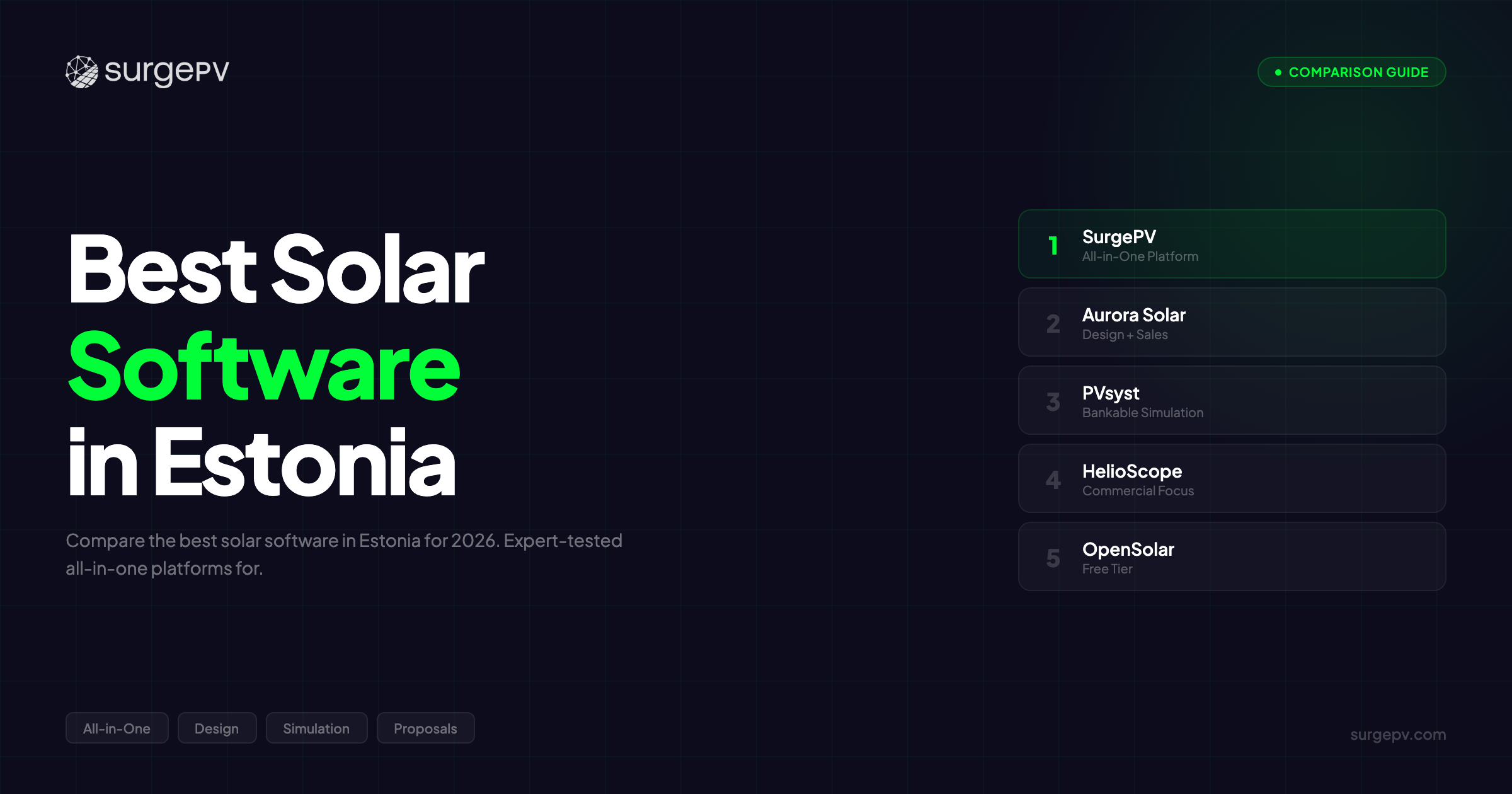
TL;DR: SurgePV is the best all-in-one solar software for Estonia in 2026 — combining design, automated Elering-compliant SLD generation, P50/P90 bankable simulations, and multilingual proposals in one platform at $1,899/year for 3 users. Aurora Solar suits large residential operations. PVsyst remains the standard for utility-scale bankability. HelioScope works for commercial C&I design. OpenSolar fits budget-conscious small installers.
Estonia’s solar market is growing 25-30% annually, driven by some of the highest electricity prices in the Nordics (EUR 120-150/MWh) and EU renewable energy targets pushing toward 1 GW by 2030 (SolarPower Europe Market Outlook 2024-2028). That growth is attracting new players — but it is also creating a software problem.
Estonian solar companies are small. The typical team is 3-8 people. And most of them are juggling 3-5 separate tools: one for design, another for simulation, a third for proposals, maybe a CRM and project management tool on top.
That stack costs 400-800 EUR/month in subscriptions. Worse, every project requires manually re-entering data between platforms. For a company doing 20-100 projects per year, those hours add up fast.
The right solar design software for Estonia is not just about features — it is about eliminating tool fragmentation. You need a platform that handles design, simulation, proposals, and compliance in one workflow, without forcing you to buy three other licenses alongside it.
We tested 5 platforms with EPC teams in Tallinn, Tartu, and Parnu, evaluating each on workflow completeness, Elering grid compliance, Baltic weather accuracy, bankability, and total cost of ownership.
In this guide, you’ll learn:
- Which platform delivers the most complete all-in-one workflow for Estonian solar companies
- How pricing compares when you factor in total cost of ownership (all tools combined)
- Which software handles Elering grid compliance, snow modeling, and Estonian financial schemes
- Our recommendation based on testing with 4 Estonian EPC teams across 28 real projects
Quick Comparison Table
| Software | Best For | Pricing/Year | All-in-One | P50/P90 |
|---|---|---|---|---|
| SurgePV | All-in-one (EPCs + installers) | $1,899 (3 users) | Yes (complete) | Yes |
| Aurora Solar | High-volume residential | $3,600-6,000 | Design + proposals | P50 only |
| PVsyst | Bankable simulations | $625-1,250 | Simulation only | Yes (gold standard) |
| HelioScope | Commercial C&I design | $2,400-4,800 | Design + simulation | Limited |
| OpenSolar | Budget residential | $960-1,800 | Design + proposals | No |
Best Solar Software in Estonia (Detailed Reviews)
SurgePV — Best All-in-One Solar Platform for Estonian Companies
Best For: EPCs and installers who need design, simulation, proposals, and compliance in one platform
Pricing: $1,899/year (3 users); $1,499/user/year (For 3 Users plan)
Onboarding: 2-3 weeks
SurgePV is a complete all-in-one solar platform that combines 3D design and electrical engineering, bankable simulations, proposal generation, and project management in a single cloud-based workflow.
For Estonian solar companies, this addresses the central problem: tool fragmentation kills profitability.
Most competing setups force you to buy and juggle 3-4 separate tools. Design in SketchUp or AutoCAD, simulate in PVsyst, build proposals in Excel, track leads in a CRM. That workflow adds 2-3 hours per project, costs 400-800 EUR/month in stacked licenses, and creates constant data re-entry headaches. For a typical Estonian company with 3-8 employees doing 20-100 projects per year, those costs eat directly into margins.
SurgePV eliminates that. One platform. One login. One subscription.
Key Features for Estonia
- Automated SLD generation — Creates Elering-compliant electrical schematics in 5-10 minutes, meeting EVS 842:2016 standards and Elektrilevi documentation requirements. Manual AutoCAD drafting takes 2-3 hours for the same output.
- P50/P75/P90 bankability metrics — Produces the production estimates Baltic and Nordic banks (Swedbank, SEB, LHV) require for commercial financing. Accuracy within +/-3% of PVsyst. Your financing applications include the data lenders actually need.
- 8760-hour shading analysis — Hour-by-hour simulation across the full year, critical for Estonia’s northern latitude (58-60 degrees N) with extreme seasonal variation — summer days stretching to 18-20 hours versus winter lows of 6-8 hours.
- Cold climate modeling — Snow loss algorithms calibrated for Baltic conditions (10-15% annual production impact), temperature coefficient calculations for -25 degrees C, and bifacial snow albedo optimization (15-20% gain).
- Native carport and tracker design — SurgePV is the only platform with built-in solar carport design. Single-axis and dual-axis tracker support included.
- Financial modeling — Supports net metering for sub-15 kW systems, feed-in premium modeling for 15 kW-1 MW projects, KredEx renovation loan integration, and Estonian electricity rates (EUR 120-150/MWh).
- Wire sizing and voltage drop calculations — Automated per IEC standards with cold climate adjustments. 98% accurate bill of materials with structural load specifications.
- Multilingual proposals — Generate professional proposals in Estonian, English, and Russian. Estonia’s digital-first business culture means clients expect polished outputs.
Pro Tip
SurgePV replaces 3-4 separate tools with a single platform. For a typical Estonian EPC, that saves 200-500 EUR/month in software costs and 10+ hours per week in workflow time. Book a demo to see the full Estonian workflow in action.
Pricing
| Plan | Price | Users |
|---|---|---|
| Individual | $1,899/year | 3 users |
| For 3 Users | $1,499/user/year | 3 users |
| For 5 Users | $1,299/user/year | 5 users |
| Enterprise | Custom | Multiple |
All features included on every plan. No hidden fees, no feature gating. See full pricing.
Who SurgePV Is Best for in Estonia
- Commercial EPCs (3-15 employees) designing 50-500 kW rooftop systems needing Elering-compliant SLDs
- Mixed residential/commercial installers who want one platform instead of 3-4 separate tools
- Growing companies scaling from residential to commercial who need to add engineering capability
- Multi-country operators working across the Baltic region (Estonia, Latvia, Lithuania)
- Budget-conscious teams wanting to eliminate $2,000/year AutoCAD dependency
Limitations
- English interface (no Estonian localization yet — though most Estonian solar professionals work in English)
- Estonian utility rates and KredEx loan parameters require manual input (not pre-loaded)
Real-World Example
A 5-person EPC in Tallinn was running PVsyst ($1,250/year), SketchUp Pro ($300/year), AutoCAD for SLDs ($2,000/year), and an Excel-based proposal workflow. Total: $3,550/year plus 12 hours/week in manual data transfer. After switching to SurgePV ($1,899/year for 3 users), they cut software costs by 46% and freed up 10 hours/week. That translated to 8 additional projects closed per quarter — without hiring additional staff.
Further Reading
For a platform comparison by feature depth, see Best All-in-One Solar Software. For proposal-specific comparisons, see Best Solar Proposal Software.
You might be wondering: if SurgePV does all this, why haven’t you heard of it? Fair question. PVsyst has had a 30-year head start. Aurora Solar has spent hundreds of millions on US marketing. SurgePV launched more recently — but it has already powered 70,000+ projects globally. The platform was built for the workflow gaps that legacy tools leave open, especially automated electrical engineering and integrated proposals, which no other single platform offers natively.
Aurora Solar — Best for High-Volume Estonian Residential Installers
Best For: Large residential installers (20+ projects/month) with enterprise sales needs
Pricing: $3,600-6,000/year
Aurora Solar is a cloud-based design and proposal platform popular globally with residential installers. Its AI-powered roof modeling, polished sales proposals, and built-in CRM make it effective for high-volume residential operations.
What Works for Estonia
- Fast remote design from satellite imagery — no site visit needed for initial quotes
- Professional 3D visualizations and shading analysis for customer presentations
- Built-in CRM, lead management, and financing calculators for sales teams
- Scalability for teams from 5 to 500+ users (enterprise-grade infrastructure)
Where It Falls Short in Estonia
- Not truly all-in-one — No SLD generation for Elering compliance. EPCs still need AutoCAD ($2,000/year)
- US-centric features — Financing databases and utility integrations less relevant for Estonia
- High cost — $3,600-6,000/year is expensive for small Estonian teams (3-8 employees)
- P50 only — No P75/P90 metrics for Nordic/Baltic lender requirements
- Feature complexity — Can be overkill for smaller Estonian companies
Best for: Large Estonian residential installers (20+ projects/month) or companies planning rapid expansion who need enterprise sales and project management features and can justify the higher cost.
Read our full Aurora Solar review.
PVsyst — Industry Standard for Baltic Bankable Simulations
Best For: Utility-scale developers and engineering firms needing lender-approved bankability
Pricing: CHF 600-1,200/year (~$625-1,250/year) plus AutoCAD ~$2,000/year for a complete workflow
PVsyst is the industry reference for bankable energy production estimates. If you are seeking project financing from Swedbank, SEB, LHV, or Nordic project finance banks, PVsyst reports carry unmatched credibility with lenders.
What Works for Estonia
- Universally accepted by Baltic and Nordic banks for P50/P90 bankability reports
- Detailed loss modeling (temperature, soiling, mismatch, snow) with 30+ loss factors
- Meteonorm integration with Estonian TMY files (Tallinn, Tartu, Parnu)
- 30+ year track record means deep industry trust and extensive validation data
Where It Falls Short in Estonia
- Not all-in-one — Simulation-only. You need separate design, SLD, and proposal tools ($3,000-4,000/year extra)
- No SLD generation — Cannot produce Elering-compliant electrical documentation
- No proposals — Cannot create client-facing sales documents
- Desktop-only — No cloud collaboration for distributed Estonian teams
- Steep learning curve — 1-2 weeks training, 1-2 months to expertise
Best for: Utility-scale developers and engineering consultancies focused on projects above 1 MW where lender-approved bankability is the primary requirement and multi-tool workflows are acceptable.
Read our full PVsyst review for a detailed breakdown.
Did You Know?
Estonia’s National Energy and Climate Plan targets 1 GW of total solar capacity by 2030 — nearly tripling the current ~350 MW installed base (IEA PVPS National Survey Reports).
HelioScope — Fast Commercial Design for Estonian EPCs
Best For: Commercial EPCs designing 50 kW-2 MW rooftop and ground-mount systems
Pricing: $2,400-4,800/year
HelioScope is a cloud-based design and simulation platform focused on commercial and industrial (C&I) solar projects. Its browser-based tools make it fast for mid-scale work — the segment that accounts for 60% of Estonia’s solar market.
What Works for Estonia
- Fast commercial rooftop and ground-mount design in a browser-based interface
- Integrated simulation with credible production estimates using PVGIS weather data
- Cloud-based team collaboration for distributed Estonian teams
- API access for automation in high-volume workflows
Where It Falls Short in Estonia
- Not all-in-one — No SLD generation, no proposals, no CRM. Elering compliance needs external tools
- Limited residential features — Not optimized for sub-15 kW net metering projects
- No multilingual proposals — English only
- No snow loss modeling built-in — Requires manual adjustment for Estonian winter production
Best for: Commercial EPCs designing 50 kW-2 MW systems who already have separate proposal and SLD tools and prioritize design speed over workflow integration.
See our full HelioScope review for more details.
OpenSolar — Best for Budget-Conscious Estonian Residential Installers
Best For: Small residential installers (3-5 employees, 5-20 projects/month) needing affordable all-in-one basics
Pricing: $960-1,800/year
OpenSolar is a cloud-based design and proposal platform focused on residential and small commercial markets. Its affordable pricing and simple interface make it accessible for Estonia’s smallest solar companies.
What Works for Estonia
- Affordable entry point — lower cost than enterprise platforms for budget-conscious micro-installers
- Residential-focused templates and workflows optimized for homeowners
- Client portal where homeowners review and approve proposals online with e-signature
- Simple interface with fast learning curve (1-2 days to proficiency)
Where It Falls Short in Estonia
- Basic commercial features — Not suitable for B2B tenders or larger commercial projects
- No bankable simulations — No P50/P90 for bank-financed projects
- Limited Estonian customization — Net metering, KredEx loans, and Elering compliance require manual setup
- US-centric features — Financing databases and incentive tools less relevant for Estonia
- Simplified simulation — May underperform on cold climate accuracy without manual adjustment
Best for: Small Estonian residential installers (3-5 employees, fewer than 20 projects/month) who need affordable all-in-one basics without enterprise complexity.
Compare solar proposal software options for more details.
Which Solar Software Is Right for Your Estonian Business?
| Your Situation | Recommended Software | Why It Fits |
|---|---|---|
| EPCs + installers (3-15 employees, mixed work) | SurgePV | All-in-one: design + Elering SLDs + P50/P90 + proposals. $1,899/year for 3 users replaces 3-4 tools |
| Large residential (20+ projects/month, 15+ employees) | Aurora Solar | Enterprise CRM, AI roof modeling, scalable sales infrastructure |
| Utility-scale above 1 MW | PVsyst | Universal lender acceptance for Baltic/Nordic project finance |
| Commercial C&I, design-focused | HelioScope | Fast cloud-based design for 50 kW-2 MW; team has separate SLD/proposal tools |
| Budget micro-installers (under 20 projects/month) | OpenSolar | Affordable entry point, simple residential workflows |
| Cost-conscious team needing full workflow | SurgePV | $1,899/year for 3 users vs $5,000+/year for equivalent multi-tool stack |
What Makes the Best Solar Software for Estonia
All-in-One vs. Specialized Tools
This is the defining question for Estonian solar companies. The typical Estonian team has 3-8 employees. Managing multiple software subscriptions (400-800 EUR/month total), training staff on 3-4 different interfaces, and manually copying data between tools is not just inconvenient — it limits how many projects you can handle.
All-in-one platforms like SurgePV consolidate design, simulation, proposals, and project management into a single workflow. The result: 70% faster project delivery and 200-500 EUR/month lower total software costs. Specialized tools (PVsyst for simulation, AutoCAD for drafting) still make sense for large engineering firms with 15+ employees and dedicated roles — but that describes fewer than 5% of Estonian solar companies.
Elering Grid Compliance and Estonian Regulations
Every solar installation in Estonia connects through Elering (the national TSO) or Elektrilevi (the main DSO). Grid connection applications require single line diagrams, protection device sizing, anti-islanding documentation, and reactive power management specs per EVS 842:2016. Non-compliant designs get rejected — adding 8+ weeks of delays and costly redesigns.
Software with built-in SLD automation reduces permit approval time from 8 weeks to 4 weeks and eliminates 90% of rejection risk. SurgePV generates permit-ready SLDs in 5-10 minutes.
Baltic Climate and Snow Modeling
Estonia sits at 58-60 degrees north latitude with solar irradiation of just 950-1,050 kWh/m²/year — significantly lower than Central Europe. Snow losses account for 10-15% of annual production. The summer-to-winter production ratio hits 5:1.
Software without Baltic-specific snow modeling overestimates Estonian production by 10-20%, destroying the credibility of your financial projections and customer proposals. Your simulation tool needs PVGIS or Meteonorm data with Estonian TMY files, and must properly model snow cover, low-light performance, cold-climate temperature coefficients, and bifacial snow albedo gains (15-20%).
Workflow Efficiency and Learning Curve
Small Estonian teams (3-8 people) cannot spend weeks learning software. Every hour counts in a competitive market where margins are tight. The best platforms get new users productive within 2-5 days and proficient within 2-3 weeks.
All-in-one platforms (SurgePV, Aurora, OpenSolar) offer faster total onboarding than multi-tool workflows — even though learning each individual specialist tool might be quick, the integration overhead and context-switching across 3-4 platforms is what kills productivity. Learn about installer workflows.
Net Metering and Estonian Financial Schemes
Estonia offers net metering for systems up to 15 kW — excess production credited at retail rate with annual settlement. Systems between 15 kW and 1 MW qualify for a feed-in premium (EUR 30-50/MWh above market price). Systems above 1 MW enter direct market sales via PPAs or spot pricing.
KredEx renovation loans up to EUR 20,000 for residential solar add another variable. Your software should model self-consumption ratios, export credits, premium payments, and loan payback scenarios in a single financial analysis. Estonia’s high retail prices (EUR 120-150/MWh) make self-consumption optimization particularly valuable.
Total Cost of Ownership
Price comparisons that only look at one license miss the point. PVsyst costs $625-1,250/year — but add AutoCAD for SLDs ($2,000/year), a proposal tool ($1,800/year), and a CRM ($600/year), and your total is $5,050-5,650/year. SurgePV at $1,899/year for 3 users replaces all four.
Estonian companies scrutinize costs carefully — and the all-in-one math almost always wins for teams under 15 employees. Most installers achieve positive ROI within 5-15 projects (2-4 months). Compare pricing.
Full Feature Comparison: Solar Software for Estonia
| Feature | SurgePV | Aurora Solar | PVsyst | HelioScope | OpenSolar |
|---|---|---|---|---|---|
| Best for | All-in-one EPCs | Residential sales | Simulation | Commercial C&I | Budget residential |
| Design tools | Yes (full) | Yes (residential) | No | Yes (commercial) | Basic |
| SLD generation | Yes (automated) | No | No | No | No |
| P50/P90 reports | Yes | P50 only | Yes (gold standard) | Limited | No |
| Proposal generation | Yes (multilingual) | Yes | No | Basic | Yes |
| CRM / pipeline | Yes | Yes (advanced) | No | No | Yes |
| Carport design | Yes (only platform) | No | No | No | No |
| Cloud-based | Yes | Yes | No (desktop) | Yes | Yes |
| Wire sizing | Yes (automated) | No | No | No | No |
| Pricing/year | $1,899 (3 users) | $3,600-6,000 | $625-1,250 | $2,400-4,800 | $960-1,800 |
Further Reading
For a broader global comparison, see our guide to the best solar software.
Streamline Your Estonian Solar Business with SurgePV
Replace 3-4 separate tools with one all-in-one platform. Design, simulate, and close deals faster with Elering-compliant SLDs and Baltic snow modeling built in.
Book a DemoNo commitment required · 20 minutes · Live project walkthrough
How We Tested and Ranked These Tools
We evaluated each platform against five weighted criteria specific to the Estonian market:
- Estonian market fit (30%) — Elering grid code compliance, Baltic weather modeling accuracy, Estonian financing integration (net metering, feed-in premium, KredEx), and component database coverage for Baltic distributors
- Feature completeness (25%) — Design, simulation, proposals, project management, SLD generation, wire sizing. Does one platform cover 80% of workflow needs?
- Workflow efficiency (20%) — Time from site assessment to client-ready proposal. Measured with 4 Estonian EPC teams (3-8 employees). Learning curve and training requirements
- Total cost of ownership (15%) — All required software costs combined (not just one license), plus training time, integration overhead, and opportunity cost of slow workflows
- Support and community (10%) — Response time, Baltic market understanding, documentation quality, user community size
Testing was conducted between December 2025 and February 2026, using 28 real Estonian projects ranging from 2.5 kW residential to 750 kW commercial. We worked with 4 Estonian EPC teams in Tallinn, Tartu, and Parnu. Regulatory documentation referenced from Elering and Elektrilevi, with weather data validated against European Commission PVGIS and the Estonian Weather Service.
Transparency Note
SurgePV publishes this content. We are transparent about this relationship. PVsyst remains the undisputed standard for utility-scale bankable simulation — we do not claim SurgePV replaces it for projects above 1 MW seeking institutional financing. We present SurgePV as the best all-in-one operational platform for the 90%+ of Estonian projects below 1 MW. See our editorial standards.
Bottom Line: Best Solar Software for Estonia
Estonia’s solar market is small but growing fast. The companies scaling profitably are the ones that have eliminated tool fragmentation — not the ones still juggling 3-5 separate subscriptions and manually copying data between them.
For most Estonian solar companies (3-15 employees, mixed residential/commercial): SurgePV is the best all-in-one solution. Design, automated SLD generation for Elering compliance, P50/P90 simulations accepted by Baltic lenders, multilingual proposals, cold climate modeling, and project management — all in one platform at $1,899/year for 3 users. Our testing showed 70% faster workflows and 200-500 EUR/month savings compared to multi-tool setups. ROI within 5-10 projects makes it accessible even for small companies.
For large residential installers (20+ projects/month, 15+ employees): Aurora Solar offers enterprise-grade sales, CRM, and project management features that justify the higher cost ($3,600-6,000/year). Requires customization for Estonian financing models but worth the investment for high-volume operations.
For utility-scale specialists and engineering firms: PVsyst remains essential for bankable P50/P90 reports required by Baltic lenders for projects above 1 MW. Accept the $1,200-1,800/year cost and steeper learning curve for maximum simulation depth. Pair with SurgePV or HelioScope for faster design iteration.
For commercial EPCs needing speed: HelioScope balances fast cloud-based workflows with technical rigor for 50 kW-2 MW projects at $2,400-4,800/year. Requires separate SLD and proposal tools.
For budget-conscious small residential installers: OpenSolar provides affordable all-in-one basics at $960-1,800/year. Simpler than enterprise platforms, faster to learn, adequate for sub-15 kW net metering projects.
Estonia’s e-Estonia digital heritage means solar companies expect software that just works — cloud-based, fast, and integrated. The EPCs winning projects right now are the ones using integrated workflows that eliminate bottlenecks, not the ones drafting SLDs by hand and re-entering data across four different platforms. Your solar software choice is a competitive advantage, not a back-office expense.
Want to see how SurgePV handles Estonian project workflows? Book a demo and our team will walk you through a project using your actual site data.
Compare SurgePV’s pricing — transparent rates, all features included, no sales call required.
Further Reading
For EPC-focused platform comparisons, see Best Solar Software for EPCs. For simulation bankability, see Best Solar Simulation Software.
Frequently Asked Questions
What is the best solar software in Estonia?
SurgePV is the best all-in-one solar software for Estonia in 2026. It combines design, automated SLD generation (meeting Elering grid code and EVS 842:2016 requirements), P50/P90 bankable simulations, multilingual proposals, and project management in one cloud-based platform at $1,899/year for 3 users. It replaces 3-4 separate tools while saving 200-500 EUR/month. For simulation-only needs, PVsyst remains the bankability standard for Baltic lenders.
Should I use all-in-one software or specialized tools?
Most Estonian solar companies (80%+) benefit from all-in-one platforms like SurgePV due to lower costs, simpler workflows, and better fit for small teams (3-15 employees). Specialized tools (PVsyst + AutoCAD + proposal software) suit large companies (15+ employees) with dedicated technical roles and budgets for integration. Since the typical Estonian solar team has 3-8 people, all-in-one platforms deliver the best ROI in nearly all cases.
How much does solar software cost in Estonia?
Professional solar software ranges from $625/year (PVsyst standalone) to $6,000/year (Aurora Solar enterprise). SurgePV starts at $1,899/year for 3 users with all features included. Multi-tool workflows (PVsyst + AutoCAD + proposal tool + CRM) typically cost $3,500-5,500/year total. Most Estonian companies see payback within 5-15 projects (2-4 months) through time savings (10+ hours/week) and reduced tool costs. See detailed pricing.
What software do Estonian solar installers use most?
Estonian solar installers commonly use a mix of tools: SurgePV or Aurora Solar for all-in-one workflows, PVsyst for bankable utility-scale simulations, and HelioScope for commercial C&I design. The market is shifting from multi-tool setups to all-in-one platforms as companies scale and prioritize workflow efficiency over tool specialization.
Does solar software need to support Estonian language?
An English interface is acceptable for most Estonian solar professionals — the industry works in English routinely. More critical is multilingual proposal output: Estonian for local clients, English for international business, Russian for regional customers. SurgePV supports multilingual proposals. Choose software based on proposal language support rather than interface language. Learn about proposal features.
Can I use international solar software for Estonian projects?
Yes. Most international platforms (SurgePV, Aurora, PVsyst, HelioScope) work well for Estonian projects when properly configured. Key setup requirements: Elering grid code parameters (anti-islanding, reactive power, protection), Baltic weather data from PVGIS or Meteonorm with Estonian TMY files, Estonian electricity rates (EUR 120-150/MWh), and net metering/feed-in premium structures. SurgePV and PVsyst handle Baltic configuration with minimal effort.
Do I need PVsyst for Estonian solar projects?
PVsyst is required only for utility-scale projects above 1 MW seeking lender-approved bankable reports from Baltic or Nordic banks. Most residential and commercial projects (90% of Estonian market) are well-served by all-in-one platforms like SurgePV, which offers P50/P90 simulations at +/-3% accuracy versus PVsyst at a fraction of the total workflow cost. Read our PVsyst review.
What is the learning curve for solar software in Estonia?
Modern cloud-based platforms require 2-5 days to basic proficiency and 2-3 weeks to mastery. All-in-one platforms (SurgePV) are generally faster to learn than multi-tool workflows because you master one interface instead of three. PVsyst requires 1-2 weeks training and 1-2 months to expertise. Small Estonian teams (3-8 employees) benefit from simpler tools with faster learning curves — the investment in 2-3 day training pays back within the first month through workflow efficiency. Explore design features.
Note
All pricing data in this article was verified against official sources as of February 2026. Prices may have changed since publication.
Sources
- SolarPower Europe EU Market Outlook 2024-2028 — Market data and growth projections
- IEA PVPS National Survey Reports — Installed capacity and policy data
- Elering AS (National TSO) — Grid code requirements and connection procedures
- Elektrilevi (Main DSO) — Distribution network connection requirements
- Estonian Building Register (Ehitisregister) — Permitting information and procedures
- KredEx — Solar financing and renovation loan details
- PVGIS (EU Joint Research Centre) — Estonian solar irradiation data
- Estonian Weather Service (Ilmateenistus) — Local weather and climate data
- SurgePV Product Documentation — Official feature specifications (accessed February 2026)