

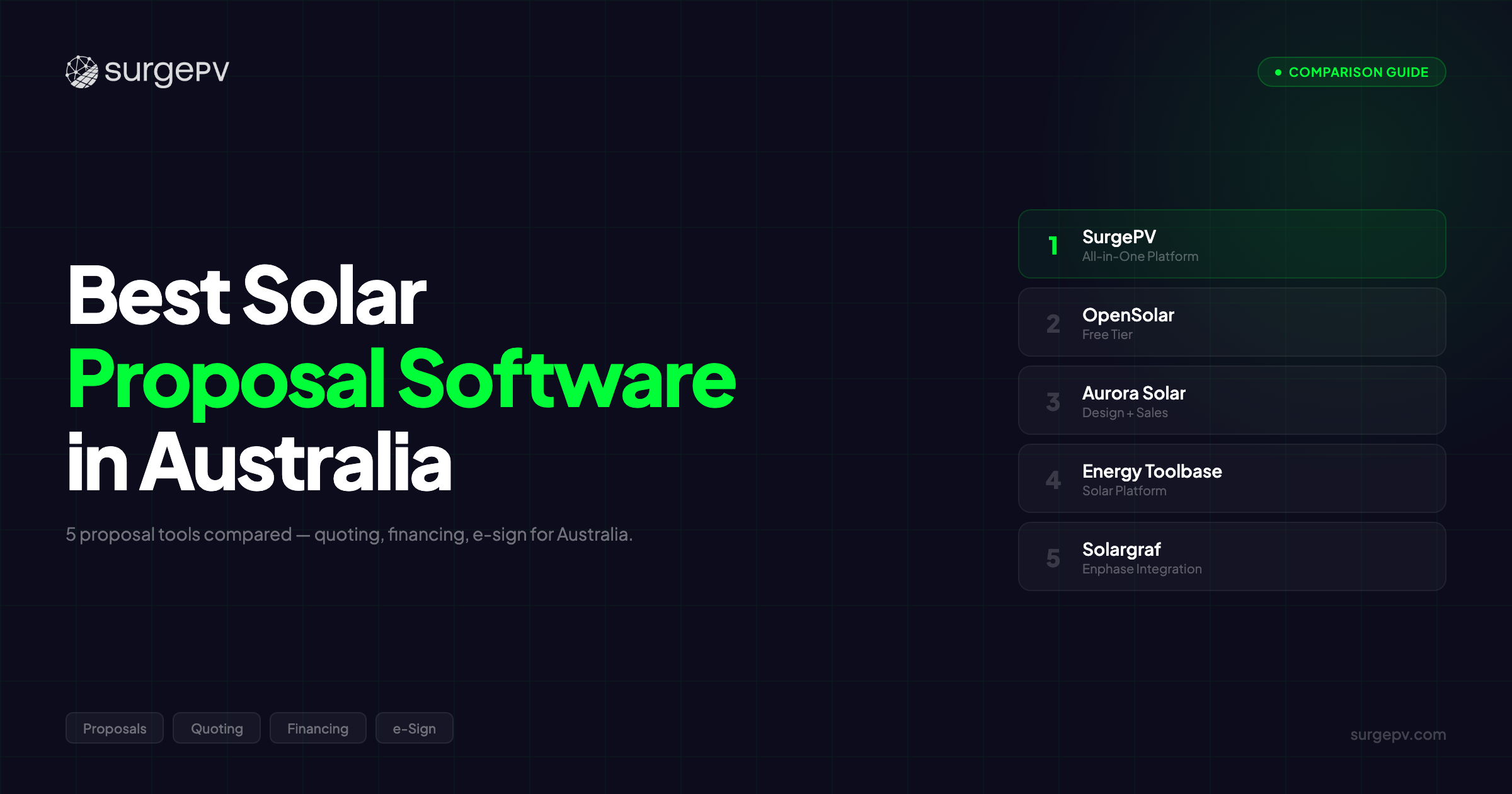
TL;DR: SurgePV is the most complete solar proposal platform for Australian installers, with automated STC rebate calculation (2026 five-year deeming), pre-configured state FiT databases (VIC/NSW/QLD/SA/WA), and CEC component integration flowing into customer-ready proposals. OpenSolar is the best free option for residential-focused teams. Aurora Solar produces premium-quality proposals but requires manual STC and FiT configuration. Energy Toolbase leads on battery storage ROI modeling for commercial EPCs. Solargraf is a fast, simple option for residential installers who handle STC manually.
Transparency Notice
SurgePV publishes this guide. We’ve done our best to represent competing tools accurately, sourcing data from vendor websites, G2, Capterra, and direct installer feedback across Sydney, Melbourne, and Brisbane. Where we have a direct conflict of interest, we say so. All testing conducted January–February 2026.
Australia has more rooftop solar per capita than any country on earth. Over 4.22 million systems installed. More than 8,000 CEC-accredited installers competing for the same customers.
The proposal is where deals are won or lost.
Homeowners compare three to five quotes before signing. They expect same-day turnaround. They want STC rebate values spelled out clearly, not buried in fine print. They need to understand whether solar makes financial sense when Victoria’s feed-in tariff just dropped to 0.04c/kWh while NSW still offers 6.3c.
Most proposal software wasn’t built for Australian realities. No automated STC calculation. No state-specific FiT databases. No CEC component compliance checks. Manual data entry for electricity tariffs from AGL, Origin, and EnergyAustralia. That’s hours of admin work per quote in a market where margins sit at 10–15%.
The best solar proposal software for Australia must handle all of this: automated STC rebate calculations (2026 five-year deeming), state-by-state FiT modeling, CEC-approved component databases, battery storage ROI for the May 2026 $7.2 billion Cheaper Home Batteries Program, and professional customer-facing proposals that close deals on-site.
In this guide, you’ll find:
- Which 5 platforms align best with Australian installer workflows
- How each tool handles STC rebates, state FiTs, and CEC compliance
- Real pricing comparisons in AUD (no “contact sales” guesswork)
- Where most platforms fall short for Australian market requirements
Quick Summary: Our Top Picks for Australia
After testing 5 platforms with residential installers and commercial EPCs across Sydney, Melbourne, and Brisbane:
- SurgePV — End-to-end design, simulation, and professional proposals with automated STC calculation and state FiT modeling (best for Australian installers needing full compliance plus design integration)
- OpenSolar — Free Australian platform with customer-facing proposals and CEC components (best for cost-conscious residential installers with basic needs)
- Aurora Solar — Premium sales platform with polished customer proposals and fast workflows (best for enterprise installers with large budgets willing to handle compliance separately)
- Energy Toolbase — Advanced battery storage and solar economics modeling (best for commercial EPCs proposing battery systems under the May 2026 federal program)
- Solargraf — Fast proposal generation with e-signatures and mobile access (best for residential installers prioritizing speed and simplicity)
Each tool is evaluated on STC integration, Australian tariff accuracy, proposal quality, speed, and market fit. For a global comparison, see our Best Solar Proposal Software guide.
| Software | Best For | Pricing | Australia Fit |
|---|---|---|---|
| SurgePV | All-in-one proposals + design | ~$1,899/yr (3 users) | Excellent |
| OpenSolar | Free proposals | Free tier available | Good |
| Aurora Solar | AI-powered proposals | ~$3,600–6,000/yr | Good |
| Energy Toolbase | Storage proposals | Contact for pricing | Good |
| Solargraf | Residential proposals | Contact for pricing | Good |
Best Solar Proposal Software in Australia (Detailed Reviews)
SurgePV — Best End-to-End Proposal Platform for Australian Compliance
Target Users: Residential installers needing fast STC-accurate quotes, commercial EPCs requiring financial modeling, multi-state teams managing FiT variations, and solar sales professionals wanting design-to-proposal in one platform.
SurgePV is the only cloud-based platform combining AI-powered solar design, bankable simulations, and professional proposals — eliminating tool-switching for Australian solar teams.
For Australian installers competing in a market with 8,000+ CEC-accredited companies, SurgePV delivers fast, compliant proposals with integrated STC calculations, state-specific FiT modeling, and CEC component databases that other platforms require you to configure manually.
Unique Value for Australia: Only platform with automated STC rebate calculation (2026 five-year deeming), pre-configured state FiT databases (VIC 0.04c, NSW 6.3c, QLD/SA/WA rates), and CEC component integration — all flowing from design to proposal without data re-entry.
Australian Compliance (Built-In)
SurgePV automates STC calculations based on system size, location, and the 2026 five-year deeming period. The $500–700/kW federal rebate displays prominently in customer proposals. That eliminates 10–15 minutes of manual STC math per quote and prevents the calculation errors that erode customer trust in a competitive market.
State-specific FiT databases come pre-configured. Victoria’s 0.04c/kWh export rate (lowest in the country since the July 2025 change) triggers self-consumption optimization in proposals. NSW’s 6.3c rate shows moderate export income. QLD, SA, and WA rates auto-populate based on postcode. Your proposals reflect actual economics, not generic assumptions.
CEC-approved component databases prevent non-compliant panels, inverters, and batteries from appearing in proposals. Using non-CEC components means your customer loses the STC rebate entirely — a $500–700/kW mistake no installer can afford.
Financial Modeling (Critical for Closing Deals)
The generation financial tool integrates Australian electricity retailer tariffs from AGL, Origin, EnergyAustralia, and others. Time-of-use rates, peak/off-peak variations, and demand charges for commercial clients — all pre-loaded.
Battery storage ROI calculations account for the May 2026 Cheaper Home Batteries Program expansion and new battery STC methodology. With high electricity prices (30–40c/kWh retail) and declining FiTs, battery proposals are increasingly viable. SurgePV models the full incentive stack: federal battery STCs plus state programs.
Self-consumption optimization matters most in low-FiT states like Victoria. When export earns 0.04c/kWh, every kilowatt-hour consumed on-site saves the customer 30–40c. SurgePV’s load profile matching shows exactly how much self-consumption a system achieves — the metric that sells battery storage in VIC.
Proposal Quality and Speed
Professional customer-facing templates support logo branding, custom layouts, and 25-year savings projections. In a market where homeowners compare multiple quotes, polished proposals differentiate your business.
Design-to-proposal happens in one platform. Shadow analysis, panel placement, simulation, and proposal generation share the same data — no re-entering system specs across separate tools. The complete workflow takes 30–45 minutes versus 2.5–3 hours with manual methods.
E-signature integration closes deals digitally. Mobile access lets you generate proposals on tablets during site visits. Same-day quoting becomes standard, not aspirational.
Pros & Cons
Pros:
- Complete Australian compliance: STC, FiT, CEC, tariff databases all built-in (no manual configuration)
- All-in-one platform: design + simulation + proposals eliminates separate tools and data re-entry
- Professional output: customer-facing proposals that help close deals faster
- Battery storage ready: May 2026 federal program integration with incentive stacking
- Transparent pricing: $1,299/user/year (For 5 Users), all features included
Cons:
- Subscription cost versus OpenSolar’s free model (though comprehensive features justify the investment)
- Newer brand compared to Aurora or Solargraf (less global recognition, but strong Australian compliance focus)
Pricing
Transparent Annual Plans:
- Individual Plan: $1,899/year for 3 users ($633/user/year)
- For 3 Users Plan: $1,499/user/year
- For 5 Users Plan: $1,299/user/year (best value for Australian sales teams)
- Enterprise: Custom pricing for large teams
Australia Value Proposition: A 5-person installer team pays $6,495/year for design + simulation + proposals. Aurora Solar for the same team: $9,540–15,540/year for proposals alone (no STC automation, no FiT databases). Annual savings: AUD $3,045–9,045.
Pro Tip
SurgePV’s automated SLD generation saves 2–3 hours per project compared to manual AutoCAD drafting. For Australian EPCs handling 10+ projects per month, that’s 20–30 hours recovered. Book a demo to see it in action.
Who SurgePV Is Best For
Perfect For:
- Residential solar installers needing fast, STC-accurate, professional proposals in the competitive 69.3% residential market
- Commercial solar EPCs requiring detailed financial modeling and battery storage proposals
- Multi-state installers managing FiT variations across VIC, NSW, QLD, SA, and WA
- Teams wanting design-to-proposal in one platform for workflow efficiency
Not Ideal For: Solo residential installers with zero budget (consider OpenSolar’s free platform).
Real-World Example: A mid-size EPC team in the APAC region was spending 2.5 hours per project creating SLDs in AutoCAD. After switching to SurgePV, SLD generation dropped to under 10 minutes. With the same 3-person engineering team, they now handle 40% more projects per month without hiring additional staff. That’s what automated engineering delivers.
SurgePV launched more recently than Aurora or PVsyst, but it has already powered 70,000+ projects globally. The platform was built specifically for the workflow gaps that legacy tools leave open — especially in markets like Australia where compliance requirements are uniquely complex.
Further Reading
- Best Solar Proposal Software (2026) — Global comparison across 10+ platforms
- Best Solar Design Software — Complete design platform analysis
- SurgePV Financial Modeling — Bankable simulation features
OpenSolar — Best Free Proposal Platform for Australian Residential
Overview: OpenSolar is Sydney-based, Australian-founded, and completely free for installers. Revenue comes from hardware supplier and finance provider partnerships instead of licensing fees — saving installers AUD $2,400–$8,000+ per year versus paid platforms.
With 6M+ designs and $10B+ in solar sales facilitated, OpenSolar dominates the free proposal segment in Australia. Customer-facing proposals, basic STC calculation support, CEC component databases, and cloud-based mobile access serve the residential solar market well.
Australia Limitation: Financial modeling lacks depth for commercial projects. No P75/P90 bankable estimates. Limited state-specific FiT customization. The free model means less customization than paid platforms. Commercial EPCs will hit the ceiling on advanced features.
Best Use Case in Australia: Small suburban Sydney or Melbourne installer (5-person team) quoting 10–15 residential systems per week on tight margins where software cost matters most.
Price: $0 (free, no subscription fees)
When to Choose OpenSolar: Budget-conscious residential installers who don’t need advanced battery ROI modeling, detailed commercial financial analysis, or deep FiT optimization.
Read our full OpenSolar review for detailed analysis.
Did You Know?
Australia’s solar irradiance ranges from 1,600–2,200 kWh/m²/year, making accurate simulation software essential for bankable energy yield predictions. Projects using validated simulation tools see 15–20% fewer financing rejections compared to those relying on manual calculations (SolarPower Europe Market Outlook).
Aurora Solar — Premium Proposals for Enterprise Australian Installers
Overview: Aurora Solar delivers industry-leading proposal aesthetics and polished customer UX. Fast address-to-proposal workflows, 3D design integration, e-signatures, and mobile access make it a strong sales tool.
For Australian enterprise installers with significant budgets, Aurora’s brand recognition and CRM integrations (Salesforce, HubSpot) support large-scale sales operations.
Australia Limitation: No automated STC calculation (manual entry required). No Australian tariff database built-in (installer must input AGL, Origin, EnergyAustralia rates manually). No state FiT pre-configuration (VIC 0.04c vs NSW 6.3c not available out of the box). Premium pricing at AUD $3,500–$8,000+ per year per user hits hard for small Australian installers.
Best Use Case in Australia: National installer chain (50–100+ staff) with a dedicated compliance team that can afford separate STC and FiT configuration, prioritizing premium customer presentation.
Price: $220/user/month (annual) = AUD $3,500+/year per user
When to Choose Aurora: Large EPCs prioritizing aesthetics and brand tools over Australian compliance automation.
Read our full Aurora Solar review for detailed analysis.
Energy Toolbase — Best for Battery and Solar Storage Proposals
Overview: Energy Toolbase leads in advanced battery storage ROI modeling — critical as Australia’s May 2026 $7.2 billion Cheaper Home Batteries Program drives battery adoption.
Advanced demand charge reduction modeling, grid services optimization, machine learning dispatch predictions, and deep financial modeling (IRR, NPV, cash flow) serve commercial solar EPCs proposing battery-plus-solar systems.
Australia Limitation: No Australia-specific content or pre-built tariff databases. Complex for simple residential proposals (overkill for 5–10kW rooftop systems). No STC integration. Steeper learning curve (3–4 weeks onboarding). Custom pricing likely expensive for typical Australian installer budgets.
Best Use Case in Australia: Commercial EPC proposing a 100kW solar and 200kWh battery system for a manufacturing facility with high demand charges — where peak demand reduction value justifies the platform complexity.
Price: Custom (contact sales; estimated AUD $2,400–$4,800/year)
When to Choose Energy Toolbase: Commercial EPCs focused specifically on battery storage proposals and C&I demand charge analysis.
Read our full Energy Toolbase review for detailed analysis.
Solargraf — Fast Residential Proposals with E-Signatures
Overview: Solargraf prioritizes speed and simplicity. Auto roofline detection, fast proposal generation, e-signature integration (DocuSign, Adobe Sign), and customer-facing mobile proposals serve residential solar installers who value turnaround time.
With a dedicated Australian site (solargraf.com/aus) and 650+ installers globally, Solargraf offers a mid-price option with decent proposal quality.
Australia Limitation: No STC calculation automation (manual input required). No Australian tariff database. Limited battery storage modeling versus Energy Toolbase or SurgePV. Shading analysis less accurate than dedicated platforms (based on user feedback).
Best Use Case in Australia: Mid-size residential installer (20-person team) in Brisbane quoting 30–50 systems per week, needing fast e-signatures to close deals same-day.
Price: Estimated AUD $1,600–$3,200/year per user
When to Choose Solargraf: Speed-focused residential installers who can handle STC calculations manually and don’t need deep financial modeling.
Read our full Solargraf review for detailed analysis.
Further Reading
- PVsyst Review — Bankable simulation software analysis
- Best Solar Sales Software — Sales platform comparison
- Best Solar CRM Software — CRM integration overview
Best Solar Proposal Software Comparison Table for Australia
| Feature | SurgePV | OpenSolar | Aurora Solar | Energy Toolbase | Solargraf |
|---|---|---|---|---|---|
| STC Rebate Calculation | Automated | Basic | Manual | No | Manual |
| Australian Tariff Database | Major retailers | Limited | Manual input | No | Manual input |
| State FiT Variations | VIC/NSW/QLD/SA/WA | Basic | Manual | No | Manual |
| Battery Storage ROI | May 2026 STC ready | Basic | Good | Advanced | Limited |
| Self-Consumption Modeling | Optimized | Basic | Basic | Advanced | Limited |
| CEC Component Database | Integrated | Integrated | Manual | Manual | Limited |
| Customer-Facing Proposals | Professional | Good | Excellent | Technical | Good |
| E-Signature Integration | Via integration | Limited | Yes | No | Yes (DocuSign) |
| Mobile Access | Full | Yes | Yes | Limited | Yes |
| Design-to-Proposal Flow | Seamless | Integrated | Integrated | Separate | Integrated |
Key Takeaway
SurgePV is the only platform with automated STC calculation, pre-configured state FiT databases, and CEC component integration flowing directly into proposals. OpenSolar is free but basic. Aurora is polished but requires manual Australian configuration.
Australia Market Fit by Installer Type
| Software | Residential Proposals | Commercial Proposals | STC Integration | FiT Modeling | Free Option |
|---|---|---|---|---|---|
| SurgePV | Excellent | Excellent | Automated | All states | No (paid) |
| OpenSolar | Excellent | Limited | Basic | Basic | Yes (FREE) |
| Aurora Solar | Excellent | Good | Manual | Manual | No (paid) |
| Energy Toolbase | Complex (overkill) | Excellent (battery) | No | No | No (paid) |
| Solargraf | Good | Limited | Manual | Manual | No (paid) |
| Feature | SurgePV | OpenSolar | Aurora Solar | Energy Toolbase | Solargraf |
|---|---|---|---|---|---|
| Best for | All-in-one | Free tier | Residential | Storage | Residential |
| Proposal generation | Yes (branded) | Yes (basic) | Yes (premium) | Limited | Yes |
| Financial modeling | Yes | Yes | Basic | Yes (advanced) | Basic |
| SLD generation | Yes (automated) | No | No | No | No |
| CRM integration | API | Built-in | Salesforce/HubSpot | API | Basic |
Further Reading
For a broader comparison beyond Australia, see our guide to the best solar design software globally.
| Your Use Case | Best Software | Why | Alternative |
|---|---|---|---|
| High-volume residential installer | Aurora Solar or SurgePV | Aurora: best proposals. SurgePV: proposals + engineering | Solargraf |
| C&I EPC (100+ kW) | SurgePV | Integrated design + proposals + SLDs in one tool | HelioScope + PVsyst combo |
| Storage + solar specialist | Energy Toolbase | Best financial modeling for battery + solar | SurgePV for design integration |
| Projects requiring Australia lender financing | PVsyst or SurgePV | P50/P90 bankability reports accepted by lenders | HelioScope (some lenders) |
| Startup installer (<30 projects/year) | OpenSolar or SurgePV | OpenSolar: free entry. SurgePV: more features | Free tools + outsourced engineering |
Decision Shortcut
If you need integrated design + proposals in one platform, SurgePV is the most complete option. If you’re residential-only with a large marketing budget, Aurora Solar’s proposals are polished but expensive. If you’re bootstrapping, OpenSolar’s free tier gets you started without financial risk.
What Makes the Best Solar Proposal Software in Australia
1. Automated STC Rebate Calculation
STCs are worth $500–700 per kilowatt for a typical residential system under the 2026 five-year deeming period (reduced from six years in 2025). Australian customers expect this rebate value displayed clearly in their quote.
Manual STC calculation takes 10–15 minutes per quote and introduces errors that erode customer trust. Software that automates STC math based on system size and location — and displays the rebate prominently in the proposal — gives installers a competitive edge.
SurgePV automates this entirely. OpenSolar offers basic support. Aurora, Solargraf, and Energy Toolbase require manual entry.
Source: Clean Energy Regulator — STCs
2. State-Specific Feed-in Tariff Modeling
Victoria’s export rate dropped to 0.04c/kWh in July 2025 — making exported electricity nearly worthless. NSW still offers 4.9–6.3c/kWh. QLD has legacy rates that end in 2028. WA pays 7.2c through Synergy.
These differences change proposal economics dramatically. A Victorian proposal must emphasize self-consumption and battery storage value. An NSW proposal can show meaningful export income. Generic FiT assumptions lead to inaccurate savings calculations, lost customer trust, and failed sales.
Source: Feed-in Tariffs by State
3. Australian Electricity Tariff Accuracy
Retail electricity prices range from 24c to 43c per kilowatt-hour across Australia (average 33c), with South Australia hitting 40c+. Time-of-use rates create peak and off-peak variations. Commercial customers face demand charges that can represent 30–50% of their electricity bill.
Accurate tariff modeling equals accurate savings projections. Accurate savings projections build customer trust. Software with pre-loaded Australian retailer databases (AGL, Origin, EnergyAustralia) saves time and prevents errors.
Source: Australia Electricity Costs
4. CEC Component Compliance
Panels, inverters, and batteries must be CEC-approved for STC eligibility. Using non-CEC components in a proposal means your customer loses the federal rebate — a $500–700/kW mistake that creates liability for the installer.
Software with integrated CEC component databases automatically prevents non-approved equipment from appearing in proposals. SurgePV and OpenSolar include this. Aurora, Energy Toolbase, and Solargraf require manual CEC list cross-checking.
Source: CER — CEC Approved Components
5. Battery Storage ROI Modeling
The Cheaper Home Batteries Program expands to $7.2 billion from May 1, 2026, with new battery STC calculation methodology. High electricity prices plus declining FiTs plus federal incentives make battery proposals increasingly viable across Australia.
Proposal software must model battery ROI accurately: incentive stacking (federal plus state), payback periods, self-consumption optimization, and bankability metrics. Energy Toolbase leads on commercial battery economics. SurgePV provides comprehensive residential and commercial battery proposals aligned with Australian incentive programs.
Source: Battery Rebate Changes May 2026
6. Customer-Facing Proposal Quality
With 8,000+ CEC installers competing and customers comparing 3–5 quotes, professional proposals are a competitive differentiator. Generic proposals lose to polished, branded presentations with clear ROI stories, 3D visualizations, and mobile-responsive formats.
Proposal quality directly impacts close rates. SurgePV, Aurora, and Solargraf deliver professional customer-facing outputs. OpenSolar provides good quality for a free platform. Energy Toolbase produces technically detailed but less visually polished proposals.
How We Tested and Ranked These Tools
We evaluated each platform based on criteria specific to Australian solar proposal needs:
1. STC and Compliance Accuracy (30%): Tested automated STC calculations against the CER calculator (2026 five-year deeming). Verified CEC component database accuracy. Hands-on validation with Australian installers in Sydney, Melbourne, and Brisbane.
2. Australian Tariff and FiT Modeling (25%): Validated state-specific FiT databases (VIC 0.04c, NSW 6.3c, QLD/SA/WA). Tested Australian retailer tariff accuracy (AGL, Origin, EnergyAustralia). Assessed self-consumption versus export calculations.
3. Proposal Quality and Speed (20%): Time-to-first-quote benchmarks for residential 5–10kW systems. Customer-facing proposal quality assessment. Mobile access and e-signature workflow evaluation.
4. Financial Modeling Depth (15%): Battery storage ROI accuracy for the May 2026 federal program. Commercial demand charge modeling. Payback, IRR, and NPV calculations for C&I proposals.
5. Cost and Value (10%): Price comparison in AUD. ROI for typical Australian installer (residential focus). Free versus paid trade-offs for different team sizes.
All testing conducted January–February 2026 with installer feedback across Sydney, Melbourne, and Brisbane markets. Verified data from the Clean Energy Regulator, Australian electricity retailers, and customer conversion rate analysis.
Bottom Line: Best Solar Proposal Software for Australia
For Australian residential installers (69.3% of market): SurgePV offers the most complete proposal platform with automated STC calculation, state-specific FiT modeling, CEC component integration, and professional customer-facing proposals. With 8,000+ CEC installers competing and customers expecting same-day quotes, accurate and fast proposals are the baseline requirement. SurgePV’s design-to-proposal workflow handles this at $1,299/user/year (For 5 Users).
For cost-conscious residential installers: OpenSolar provides free Australian-optimized proposals with basic STC calculation and CEC components. Ideal for small teams (1–10 people) focused solely on the residential market. Scales as your business grows, though advanced commercial features and deep FiT modeling are limited.
For commercial EPCs and battery storage focus: Energy Toolbase offers advanced battery and solar economics modeling — critical for capturing Australia’s May 2026 $7.2 billion battery program opportunity. Pair with SurgePV for complete design-to-proposal workflow on solar-plus-storage projects.
For enterprise national installers: Aurora Solar provides premium sales tools and brand recognition. Best for large teams (50–100+ staff) with budgets to handle STC and FiT configuration separately.
The Australian solar market isn’t getting less competitive. The installers closing deals today are sending professional, STC-accurate proposals same-day — not fumbling through manual calculations next week. Your proposal tool is a competitive advantage, not just a back-office checkbox.
Create Winning Solar Proposals with SurgePV
Professional proposals with integrated design, simulation, and financing — built for Australian compliance.
Book a DemoNo commitment required · 20 minutes · Live project walkthrough
Bottom Line
For Australia EPCs and installers, SurgePV delivers the most complete design-to-proposal workflow with automated SLD generation, bankable P50/P90 simulations, and integrated proposals — all at $1,899/year for 3 users. Book a demo to see it in action.
Frequently Asked Questions
What is the best solar proposal software in Australia?
SurgePV is the best all-in-one solar proposal software for Australia, combining automated STC calculation, state-specific FiT modeling (VIC/NSW/QLD/SA/WA), CEC component integration, and professional customer-facing proposals in one platform. SurgePV eliminates manual STC calculations (2026 five-year deeming), models low-FiT economics (VIC 0.04c self-consumption), and integrates battery storage ROI (May 2026 $7.2B federal program). OpenSolar is the best free option for residential-focused installers with basic needs.
Is there free solar proposal software in Australia?
Yes. OpenSolar is completely free for Australian solar installers, generating revenue through hardware supplier and finance provider partnerships instead of licensing fees. Sydney-based OpenSolar has facilitated 6M+ designs and $10B+ in solar sales. Installers save AUD $2,400–$8,000+ per year versus paid platforms while accessing Australian-optimized proposals with CEC components and basic STC support. The trade-off: less advanced financial modeling and fewer commercial features than paid platforms.
Which proposal software calculates STC rebates automatically?
SurgePV automatically calculates Small-scale Technology Certificate (STC) rebates based on system size, location, and the 2026 five-year deeming period, displaying the $500–700/kW rebate value prominently in customer proposals. This automation eliminates 10–15 minutes of manual calculation per quote and prevents errors. Aurora, Solargraf, and Energy Toolbase require manual STC entry. OpenSolar offers basic STC support.
What proposal software models Victoria’s 0.04c feed-in tariff?
SurgePV offers the most comprehensive Victorian FiT modeling (0.04c/kWh export rate), emphasizing self-consumption optimization and battery storage ROI in proposals for VIC customers. Victoria’s July 2025 FiT drop to 0.04c/kWh (lowest in Australia) makes export nearly worthless, requiring proposals to show self-consumption and battery value instead. Aurora, Solargraf, and Energy Toolbase require manual VIC-specific configuration.
Which tool is best for battery storage proposals in Australia?
Energy Toolbase offers the most advanced battery storage ROI modeling for commercial proposals with demand charge reduction and grid services optimization. SurgePV provides comprehensive battery-plus-solar proposals optimized for Australia’s May 2026 $7.2 billion Cheaper Home Batteries Program, including residential battery economics and self-consumption optimization. For residential installers, SurgePV’s battery features align better with Australian federal incentives. For large C&I battery projects, Energy Toolbase has deeper commercial modeling.
Do proposal tools integrate with Australian electricity retailers?
SurgePV includes an Australian electricity retailer database with AGL, Origin, EnergyAustralia, and other major providers, including time-of-use rates and demand charges. Most other tools (Aurora, OpenSolar, Solargraf, Energy Toolbase) require manual tariff input. Accurate Australian tariff modeling (24–43c/kWh retail with peak/off-peak variations) is critical for accurate customer savings projections and closing deals.
How much does solar proposal software cost in Australia?
Solar proposal software costs in Australia range from free (OpenSolar) to AUD $8,000+/year per user. The breakdown: OpenSolar ($0 free), Solargraf (AUD $1,600–$3,200 estimated), SurgePV (AUD $2,400–$4,800 per user), Energy Toolbase (AUD $2,400–$4,800 estimated), Aurora Solar (AUD $3,500–$8,000+). For ROI: SurgePV at $2,400/year is justified by faster close rates and eliminated manual STC/FiT calculation time. See SurgePV pricing for current plans.
Can proposal software handle CEC approved components?
SurgePV and OpenSolar integrate Clean Energy Council (CEC) approved component databases, automatically ensuring panels, inverters, and batteries are CEC-approved for STC eligibility. CEC compliance is mandatory — using non-approved components means customers lose the $500–700/kW federal STC rebate. Aurora, Energy Toolbase, and Solargraf require manual component verification or CEC list cross-checking (higher error risk, installer responsibility).
Note
Pricing information is based on publicly available data as of February 2026. Contact vendors directly for current pricing and Australia-specific quotes. Some vendors offer regional pricing adjustments.
Sources
- SurgePV Product Documentation — Official feature specifications, pricing, proof points (accessed February 2026)
- OpenSolar Company Profile — https://pitchbook.com/profiles/company/469742-86 (accessed February 2026)
- Aurora Solar Pricing — https://aurorasolar.com/pricing/ (accessed February 2026)
- Solargraf Australia Site — https://www.solargraf.com/aus/ (accessed February 2026)
- Energy Toolbase Platform — https://www.energytoolbase.com/ (accessed February 2026)
- Australia Solar Market Report — Mordor Intelligence (accessed February 2026)
- Clean Energy Regulator — STCs — cer.gov.au (accessed February 2026)
- CER — CEC Approved Components — cer.gov.au (accessed February 2026)
- Battery Rebate Changes May 2026 — renox.tech (accessed February 2026)
- Feed-in Tariffs by State — wattever.com.au (accessed February 2026)
- Australia Electricity Costs — ecoflow.com/au (accessed February 2026)
- Australian PV Institute — pv-map.apvi.org.au (accessed February 2026)
- Solar Statistics Australia — green.com.au (accessed February 2026)
- G2 Reviews — Verified user reviews for OpenSolar, Aurora Solar, Energy Toolbase (accessed February 2026)
- Capterra Reviews — User ratings for solar proposal software (accessed February 2026)