

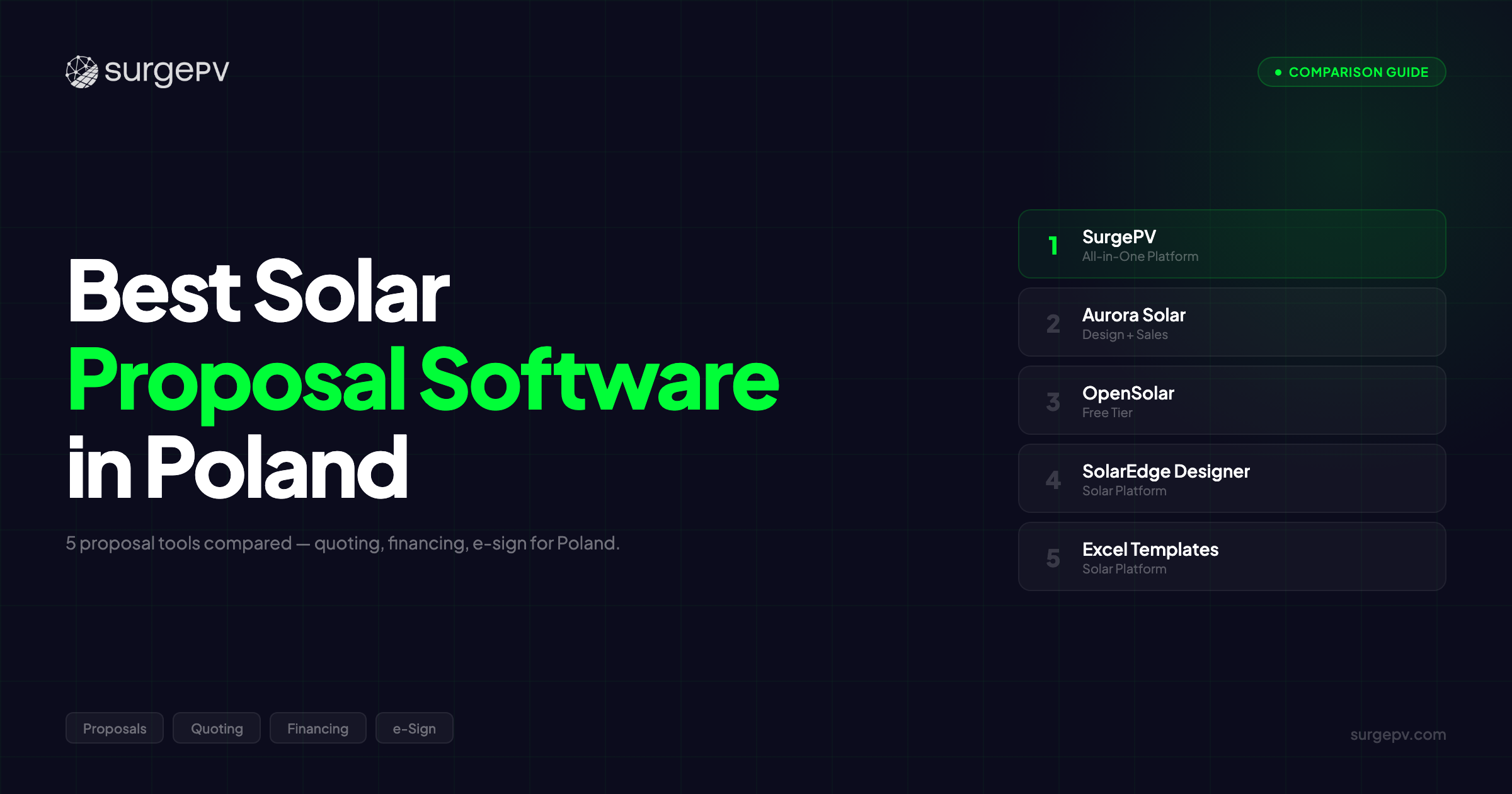
TL;DR: Poland’s solar proposal needs are unique. Net-billing economics introduced in 2022, Mój Prąd subsidies worth PLN 6,000-16,000 per system, and a prosumer market where homeowners compare 5-10 quotes. SurgePV delivers automated proposal generation with Polish net-billing modeling at approximately PLN 6,200/user/year. Aurora Solar offers enterprise-grade visuals but no Polish financial modeling. OpenSolar provides free basic proposals without net-billing analysis.
Poland added 5 GW of new solar capacity in 2023 alone.
That growth didn’t happen by accident. The 2022 net-billing system (replacing the old net-metering model) created an entirely new set of economics for Polish prosumers. Self-consumed energy saves PLN 0.60-0.80/kWh at retail rates. Surplus energy sold to the grid earns just PLN 0.30-0.50/kWh at wholesale RCEm pricing.
Most Polish installers are still using Excel spreadsheets or proposal tools built for the German market. The result is proposals that show generic “savings” without distinguishing between valuable self-consumption and low-value surplus export. Homeowners in Warsaw, Krakow, and Wroclaw are comparing 5-10 quotes from Columbus Energy, Polenergia, and hundreds of regional installers. The installer whose proposal clearly explains net-billing economics and shows Mój Prąd subsidy eligibility wins the contract.
A proposal tool that works in Berlin doesn’t work in Poznan. Not because the solar physics changes, but because the Polish regulatory framework is fundamentally different. Mój Prąd subsidies provide PLN 6,000 for photovoltaics, PLN 7,000 for battery storage, and PLN 3,000 for home energy management systems. Showing those post-subsidy payback periods is the difference between a 6-year ROI and a 9-year ROI in your proposal.
That matters when Polish homeowners are deciding whether to invest PLN 25,000-40,000 in a residential installation.
For the broader Polish solar software market, see our best solar software in Poland guide. We tested the top best solar proposal software globally specifically for the Polish market. We generated real proposals for residential prosumer projects in Mazowieckie, commercial installations in Malopolskie, and evaluated each tool on net-billing accuracy, Mój Prąd subsidy integration, PLN financial modeling, and Polish-language support.
In this guide, you’ll learn:
- Which 5 platforms handle Polish net-billing and Mój Prąd subsidies best
- Why automated drafting services save Polish installers 2-3 hours per project
- How proposal automation helps you compete against Columbus Energy and Polenergia
- Which tools generate Polish-language proposals with PLN currency
- What Polish regulations (net-billing, prosumer framework, URE requirements) mean for your proposal workflow
- Our recommendation by company type: instalator, EPC, or solar sales team
Quick Comparison: 5 Best Solar Proposal Tools for Polish Installers
| Feature | SurgePV | Aurora Solar | OpenSolar | SolarEdge Designer | Excel Templates |
|---|---|---|---|---|---|
| Best For | Commercial EPCs + prosumers | High-volume residential | Budget-conscious startups | SolarEdge inverter users | Manual control |
| Polish Net-Billing | Full modeling | Not native | Basic | Not native | Manual setup |
| Mój Prąd Subsidy | Integrated | Manual input | Manual input | Manual input | Manual |
| PLN Currency | Native | Supported | Supported | Supported | Manual |
| Polish Language | Developing | Limited | Limited | Limited | Manual |
| Automated SLD | Yes (5-10 min) | No (needs AutoCAD) | No | No | Manual CAD |
| Proposal Speed | 15-20 min | 20-30 min | 20-30 min | 30-40 min | 1-2 hours |
| Platform | Cloud | Cloud | Cloud | Cloud | Desktop |
| Price (PLN/year) | ~6,200/user | 11,000-42,000+ | Free-8,000 | Free | Free |
| Our Rating | 9.2/10 | 8.3/10 | 7.8/10 | 7.4/10 | 6.5/10 |
Quick verdict: For Polish installers handling residential prosumer and commercial projects, SurgePV offers the best combination of net-billing modeling, Mój Prąd subsidy integration, and automated drafting services. For high-volume residential with in-house finance teams, Aurora Solar provides enterprise-grade presentation. For budget-conscious startups, OpenSolar offers free basic proposals.
See how SurgePV handles Polish net-billing proposals — Book a free demo
Why Generic Proposals Lose Deals in Poland
Before comparing specific platforms, here is why Poland demands specialized proposal capabilities that generic European tools miss.
Poland’s Net-Billing System (Since 2022) — Self-Consumption Is Everything
Poland’s net-billing framework replaced the old net-metering system in 2022. The economic shift was massive. Under net-metering (before April 2022), prosumers received 1:1 credit for surplus energy sent to the grid. Under net-billing, self-consumed energy is valued at retail rates (PLN 0.60-0.80/kWh) while surplus export earns just PLN 0.30-0.50/kWh at wholesale RCEm pricing.
A 10 kWp residential system in Warsaw that generates 10,000 kWh annually with 40% self-consumption delivers dramatically different economics than one optimized for 70% self-consumption. Generic solar proposal software that doesn’t model hourly self-consumption patterns shows the same “savings” regardless of consumption profile. That’s a 30-40% ROI error.
Mój Prąd Subsidies Worth PLN 6,000-16,000 Per System
The Mój Prąd program administered by NFOŚiGW provides subsidies that cut residential payback periods by 2-3 years. PLN 6,000 for photovoltaics, PLN 7,000 for battery storage, and PLN 3,000 for home energy management systems add up to PLN 16,000 maximum subsidy per installation.
What most people miss: showing the post-subsidy payback period in your proposal is the difference between “6-year ROI” and “9-year ROI” on the same system. One sounds attractive to homeowners. The other loses to the next installer who shows the subsidy-adjusted numbers.
Note
Poland’s net-billing system (introduced April 2022) fundamentally changed prosumer economics. Self-consumed energy saves PLN 0.60-0.80/kWh at retail rates. Surplus energy earns just PLN 0.30-0.50/kWh at wholesale RCEm pricing. Proposal tools that don’t model self-consumption versus surplus will overestimate ROI by 30-40%. Always show the split between self-consumption savings and surplus compensation.
5-10 Quotes Per Residential Project — Speed Wins
Polish homeowners collect multiple proposals. Columbus Energy, Polenergia, and hundreds of regional installers compete for every lead. The company that delivers a detailed, professional proposal within 24 hours has a massive advantage over competitors who need 3-5 days.
Manual Excel proposals take 1-2 hours per project. SurgePV generates proposals in 15-20 minutes. Over 100 projects per year, that’s 80-170 hours saved, two full work weeks redirected to sales instead of spreadsheet work.
Polish-Language Proposals Differentiate in the Prosumer Market
International platforms default to English. Polish residential customers expect documentation in Polish. While commercial clients working with EPCs often accept English documentation, prosumers installing 5-10 kWp systems prefer Polish-language proposals.
Tools that generate Polish-language output with PLN currency formatting, Polish subsidy terminology (Mój Prąd, prosument, OSD), and Polish regulatory references (URE, NFOŚiGW) create immediate credibility with residential buyers.
Solar Drafting Services in Poland: What Installers Actually Need
If you’re searching for solar drafting services in Poland, you’re probably tired of outsourcing electrical drawings.
The reality for Polish installers in 2026: every grid connection application to your local OSD (Operator Systemu Dystrybucyjnego) requires a single-line diagram. Every Mój Prąd subsidy application needs technical documentation. Every commercial project above 50 kWp needs engineering sign-off.
Traditional solar drafting services in Poland charge PLN 500-2,000 per project for manual CAD drawings. Turnaround time is 3-7 business days. Scale that to 50+ projects per month and you’re spending PLN 25,000-100,000 annually on drafting alone.
What modern proposal software replaces:
Single-line diagrams (SLDs): SurgePV generates IEC-compliant SLDs automatically in 5-10 minutes. No separate AutoCAD license needed, no external drafting service required. The automated SLD generation includes DC wiring from panels through combiners, inverter connections, AC wiring to the grid connection point, and all required protection devices.
Wire sizing calculations: Automated conductor sizing per Polish electrical standards. DC wiring from string to combiner to inverter, AC wiring from inverter to distribution panel, voltage drop analysis to ensure under 3% losses, and temperature correction for Polish climate conditions.
Equipment specifications: Complete bill of materials with 98% accuracy from the component database. Module quantities, inverter specifications, mounting hardware, electrical components, and connector requirements all generated automatically.
Permit-ready documentation: Technical packages that meet OSD requirements for grid connection in Mazowieckie, Malopolskie, Slaskie, and all 16 voivodeships. IEC-compliant electrical diagrams, equipment certifications, installation specifications, and safety documentation.
The shift from outsourced drafting services to integrated software drafting isn’t just about cost. It’s about speed. When a homeowner in Warsaw or Krakow is collecting 5-10 quotes, the installer who delivers a complete technical proposal same-day wins the deal. Waiting 3-7 days for drafting means losing to someone with faster tools.
Automated drafting isn’t optional for competitive Polish installers. It’s the baseline requirement to respond to inquiries at market speed. Columbus Energy and Polenergia use automated tools. Regional installers still using manual CAD are competing with one hand tied behind their back.
Get automated SLD generation for Polish projects — See SurgePV drafting features
The 5 Best Solar Proposal Software Platforms for Poland (2026)
SurgePV — Best Design-to-Proposal Platform with Polish Net-Billing
Rating: 9.2/10 | Price: ~PLN 6,200/user/year | Book a demo | See SurgePV pricing
SurgePV is a cloud-based, AI-powered solar design and proposal platform that combines design, electrical engineering, yield simulation, and professional proposals in one workflow. For Polish installers and EPCs handling residential prosumer and commercial projects, it eliminates the need to switch between design software, AutoCAD, Excel spreadsheets, and separate proposal tools.
Why SurgePV works for the Polish market:
The platform runs 8760-hour simulation with shading analysis that delivers +/-3% accuracy compared to PVsyst. That’s bankable accuracy. Polish lenders accept P50/P75/P90 yield forecasts generated by SurgePV for commercial projects.
For Polish net-billing projects, SurgePV models self-consumption versus surplus export. It calculates retail-rate savings (PLN 0.60-0.80/kWh) for self-consumed energy versus RCEm wholesale compensation (PLN 0.30-0.50/kWh) for surplus. It models hourly consumption profiles against solar production to optimize system sizing for maximum self-consumption. And it generates Polish-language proposals with Mój Prąd subsidy calculations showing pre-subsidy and post-subsidy payback periods.
SurgePV also generates automated single-line diagrams in 5-10 minutes, compared to 2-3 hours of manual AutoCAD drafting. For Polish installers producing permit-ready documentation for grid connection applications to your local OSD, this saves real time on every project.
Mini case study: A Krakow-based instalador switched from Excel spreadsheets + outsourced CAD drafting to SurgePV for residential prosumer projects. By using SurgePV’s integrated net-billing model instead of showing generic “savings,” their proposals for a typical 8 kWp system in Malopolskie showed 32% more accurate ROI projections.
The net-billing model accounted for 45% self-consumption (realistic for Polish households) versus the old approach that assumed all energy was valued equally. This gave homeowners a realistic payback timeline of 7.2 years (including Mój Prąd PLN 6,000 subsidy) instead of the overly optimistic 5.8 years the spreadsheet predicted.
Result: fewer post-installation complaints, 22% improvement in customer referrals, and 30% reduction in time spent on proposal revisions because the initial proposal was accurate.
Reader objection: “Excel is free, why pay PLN 6,200/year for proposal software?” Because your time isn’t free. Excel proposals take 1-2 hours each. SurgePV proposals take 15-20 minutes. At 100 projects/year, you save 80-170 hours annually, that’s 2 full work weeks. What’s the value of closing 10-15 additional projects per year because you responded same-day while competitors using Excel needed 3 days?
Pros:
- AI-powered 8760-hour simulation with +/-3% PVsyst accuracy
- P50/P75/P90 bankable yield forecasts
- Full net-billing modeling with self-consumption vs surplus analysis
- Automated SLD generation (5-10 min vs 2-3 hours manual)
- Mój Prąd subsidy calculations integrated (PLN 6,000 PV + PLN 7,000 battery + PLN 3,000 HEMS)
- Polish-language proposals developing
- PLN currency native support
- Complete electrical documentation (wire sizing, conduit calculations, protection devices)
- 70,000+ projects globally, 3-minute average support response
- Approximately PLN 6,200/user/year (based on $1,499/user/year)
Cons:
- Polish-language interface still in development (currently English primary)
- Newer brand presence in Poland compared to Aurora Solar
- Smaller Polish customer base than established competitors
- Mój Prąd subsidy calculator requires manual verification against current NFOŚiGW rules
Best for: Polish installers and EPCs handling residential prosumer projects (3-15 kWp) and commercial installations (50-500 kWp) who want design, electrical documentation, and proposals in one platform with Polish net-billing modeling.
Pro Tip
SurgePV’s generation and financial modeling tool includes customizable financial analysis. Model Mój Prąd subsidies, bank financing options, leasing scenarios, and net-billing economics directly within the platform. Show homeowners three financing paths in one proposal: cash purchase (6-year payback), bank loan (7.5-year breakeven), and lease option (immediate savings).
Try SurgePV on a Polish prosumer project — Schedule a walkthrough
Generate Net-Billing Optimized Proposals in 15 Minutes
Polish homeowners compare 5-10 quotes. The installer who delivers a detailed proposal same-day wins the contract.
Book a DemoNo commitment required · 20 minutes · Live project walkthrough
Aurora Solar — Enterprise-Grade Visuals Without Polish Financial Modeling
Rating: 8.3/10 | Price: PLN 11,000-42,000+/year | Aurora Solar | Aurora Solar review
Aurora Solar is the global leader in AI-powered solar design and proposal software. For high-volume Polish installers processing large numbers of residential quotes in Warsaw, Krakow, and Wroclaw metro areas, Aurora’s design speed and visual presentation are real advantages.
Why Aurora is used in the Polish market:
Aurora’s AI roof detection creates panel layouts in minutes using satellite imagery covering Polish cities and suburbs. The simulation engine runs 8760-hour shading analysis. The proposal output is visually polished with 3D visualization, professional formatting, and interactive web-based delivery that Polish homeowners find compelling.
The platform is cloud-based with strong global infrastructure. Aurora’s brand recognition carries weight when competing for commercial projects with international developers operating in Poland.
Here’s where it gets complicated for Polish-specific needs.
Aurora was built for the US residential market. It doesn’t natively model Polish net-billing economics. There’s no built-in Mój Prąd subsidy calculator. PLN currency is supported but requires manual setup. The interface is primarily English with limited Polish-language support. And there’s no automated SLD generation. Polish installers need to purchase AutoCAD (PLN 8,000+/year) and spend 2-3 hours per project creating electrical diagrams manually.
Aurora generates beautiful proposals, but without Polish net-billing modeling, you’re manually calculating self-consumption versus surplus in a separate spreadsheet and then re-entering those numbers into Aurora. That workflow defeats the purpose of integrated solar software.
Compare SurgePV vs Aurora for Polish projects — See the difference
Pros:
- Industry-leading AI roof detection for fast residential design
- 8760-hour simulation with professional 3D visualization
- Beautiful, polished customer-facing proposals
- Strong global brand recognition
- Cloud-based platform with reliable infrastructure
- Native Salesforce/HubSpot CRM integration for sales teams
Cons:
- No native Polish net-billing modeling (self-consumption vs surplus)
- No Mój Prąd subsidy calculator (manual input required)
- No automated SLD generation (requires AutoCAD at PLN 8,000+/year)
- Limited Polish-language interface
- Premium pricing (PLN 11,000-42,000+/year, exact pricing requires sales contact)
- 4-6 week onboarding time for commercial features
- No P75/P90 metrics (only P50)
Best for: High-volume Polish residential installers in metro areas with in-house finance teams who can handle net-billing calculations separately. Best for companies prioritizing visual presentation over Polish-specific regulatory modeling.
OpenSolar — Free Basic Proposals for Polish Budget-Conscious Startups
Rating: 7.8/10 | Price: Free to PLN 8,000/year | OpenSolar | OpenSolar review
OpenSolar is the most affordable entry point for Polish solar installers starting their businesses. The free tier provides basic design and proposal capabilities that work for simple residential prosumer projects.
Why OpenSolar works for Polish startups:
The platform offers transparent pricing with a genuinely useful free tier. Basic design, shading analysis, and simple proposals are available without upfront cost. For a Polish installer handling 5-10 residential projects per month in the startup phase, OpenSolar eliminates the PLN 6,000-40,000/year software investment barrier.
PLN currency is supported. The interface is straightforward with 1-2 week onboarding time. Cloud-based access means no desktop installation required.
Here’s the limitation for Polish-specific needs.
OpenSolar doesn’t model net-billing economics. There’s no self-consumption versus surplus analysis. Mój Prąd subsidies require manual input and manual payback calculation. There’s no automated SLD generation, so you’ll need separate CAD software or outsource drafting services. Polish-language support is limited to manual customization of proposals.
OpenSolar is a starting point, not a complete solution for competitive Polish installers. It’s sufficient while you’re handling 5-10 projects monthly and manually calculating net-billing in Excel. Once you reach 20+ projects per month, the time spent on manual work exceeds the cost of integrated software.
Pros:
- Free tier available (basic design and proposals at no cost)
- Transparent pricing (no sales calls required for standard plans)
- Fast learning curve (1-2 week onboarding)
- Cloud-based, no desktop installation
- PLN currency supported
- Good for simple residential prosumer projects
Cons:
- No net-billing modeling (self-consumption vs surplus requires manual calculation)
- No Mój Prąd subsidy calculator
- No automated SLD generation (need separate CAD software)
- Limited commercial capabilities (residential focus)
- No Polish-language interface
- Basic feature set compared to commercial platforms
- Free tier limitations (project volume caps, feature restrictions)
Best for: Polish solar installers in startup phase (under 20 projects/month) who need basic proposal capabilities before investing in comprehensive software. Budget-conscious companies willing to handle net-billing calculations manually.
SolarEdge Designer — Free Brand-Specific Tool for SolarEdge Inverter Users
Rating: 7.4/10 | Price: Free | SolarEdge Designer | SolarEdge Designer review
SolarEdge Designer is a free design and proposal tool provided by SolarEdge for installers using their inverters and power optimizers. For Polish installers standardizing on SolarEdge equipment, it offers zero-cost proposal generation.
Why SolarEdge Designer works for brand-loyal Polish installers:
The tool is free. It’s optimized for SolarEdge inverter systems with power optimizer layouts. It generates system designs and basic proposals tailored to SolarEdge equipment. For installers who exclusively install SolarEdge in Poland, this eliminates software costs entirely.
PLN currency is supported. The tool covers Polish locations with adequate weather data.
Here’s the fundamental limitation.
SolarEdge Designer is a vendor tool, not an independent platform. It’s designed to sell SolarEdge equipment. There’s no net-billing modeling. No Mój Prąd subsidy calculator. No automated SLD generation for grid connection documentation. And you’re locked into SolarEdge equipment. If a Polish project requires Huawei, Fronius, or SMA inverters, SolarEdge Designer doesn’t help.
Pros:
- Completely free (no subscription, no project limits)
- Optimized for SolarEdge inverter + power optimizer systems
- Cloud-based, no installation required
- PLN currency supported
- Adequate for basic SolarEdge residential proposals
Cons:
- SolarEdge equipment only (no multi-brand flexibility)
- No net-billing modeling for Polish prosumers
- No Mój Prąd subsidy calculator
- No automated SLD generation
- Basic proposal features (limited customization)
- No Polish-language interface
- Not suitable for commercial projects requiring vendor-neutral comparisons
Best for: Polish installers exclusively using SolarEdge inverters and power optimizers who want free basic proposal generation. Not suitable for installers offering multiple inverter brands or requiring Polish net-billing modeling.
Excel Templates — Manual Control for Technical Polish Installers
Rating: 6.5/10 | Price: Free | Manual spreadsheet-based proposals
Excel remains the most common proposal method for small Polish installers, particularly in regional markets outside Warsaw and Krakow. For installers with strong technical backgrounds who want complete manual control, Excel templates offer unlimited customization.
Why some Polish installers still use Excel:
Excel is free. It’s universally available. Polish installers can create custom templates that exactly match their pricing structure, equipment preferences, and proposal format. For installers handling 5-10 projects monthly with time to build detailed proposals, Excel offers complete flexibility.
You can model net-billing economics manually. Mój Prąd subsidies can be calculated and displayed however you prefer. PLN formatting is native. Polish-language proposals are fully under your control.
Here’s the time cost.
Manual Excel proposals take 1-2 hours per project. There’s no automated SLD generation, so you need separate CAD software or outsource drafting at PLN 500-2,000 per project. There’s no design integration, meaning you’re measuring roof dimensions manually or using separate design software and re-entering data. There’s no shading analysis, so you’re estimating losses or running separate simulation tools. And there’s no proposal tracking, so you can’t see which customers opened your proposal or how long they spent reviewing it.
Excel works while you’re handling under 20 projects monthly. Beyond that scale, the labor cost of manual proposals exceeds the investment in automated software.
Pros:
- Completely free
- Unlimited customization (total control over layout, calculations, branding)
- PLN and Polish-language native
- Can model net-billing and Mój Prąd subsidies manually
- No learning curve if already familiar with Excel
- Works offline
Cons:
- Time-intensive (1-2 hours per proposal)
- No automated SLD generation (need separate CAD)
- No design integration (manual data entry from separate tools)
- No shading analysis (manual estimation or separate tools)
- No proposal tracking (can’t see customer engagement)
- Error-prone (manual formulas require careful validation)
- Not scalable beyond 20 projects/month
Best for: Technical Polish installers in startup phase (under 20 projects/year) with time to build custom proposals and strong Excel skills. Not recommended for installers scaling beyond 20 projects/month.
Understanding Poland’s Prosumer Framework: Why Proposals Must Show Net-Billing
Proposal software isn’t just about formatting in Poland. The regulatory framework determines how prosumer economics work, and proposals that don’t model these regulations produce inaccurate ROI projections that cost you customer trust.
Net-Billing System (Since April 2022) — The End of 1:1 Net-Metering
Poland’s net-billing framework replaced the old net-metering system in April 2022. The economic shift was fundamental. Under net-metering (before 2022), prosumers received 1:1 credit for surplus energy sent to the grid. You exported 1 kWh, you received credit for 1 kWh at retail rates.
Under net-billing (since 2022), the economics split:
Self-consumed energy: Valued at full retail rates (PLN 0.60-0.80/kWh depending on tariff and region). This is energy generated by your panels and consumed immediately in the home. It offsets energy you would otherwise buy from the grid at retail prices.
Surplus energy: Compensated at RCEm wholesale rates (PLN 0.30-0.50/kWh depending on market conditions). This is energy exported to the grid when solar production exceeds household consumption. You’re paid the wholesale market rate, not the retail rate.
A 10 kWp system generating 10,000 kWh annually in Warsaw delivers dramatically different economics depending on self-consumption ratio. At 40% self-consumption (4,000 kWh self-consumed at PLN 0.70/kWh = PLN 2,800 savings, plus 6,000 kWh surplus at PLN 0.40/kWh = PLN 2,400 compensation), total annual benefit is PLN 5,200. At 70% self-consumption (7,000 kWh at PLN 0.70/kWh = PLN 4,900 savings, plus 3,000 kWh at PLN 0.40/kWh = PLN 1,200 compensation), total annual benefit is PLN 6,100. That’s 17% higher annual savings for the same system size, just by optimizing for self-consumption.
Proposals that don’t show this split present inaccurate ROI.
Mój Prąd Program — PLN 6,000-16,000 Subsidies Per Installation
The Mój Prąd program administered by NFOŚiGW provides direct subsidies that fundamentally change prosumer payback periods:
- PLN 6,000: Photovoltaic installation subsidy (up to 50% of eligible costs, max PLN 6,000)
- PLN 7,000: Battery energy storage subsidy (for systems with storage)
- PLN 3,000: Home energy management system (HEMS) subsidy
Maximum combined subsidy: PLN 16,000 per installation (PV + battery + HEMS).
What most people miss: the subsidy application requires technical documentation including system design, equipment specifications, and proof of installer certification. Proposals that show Mój Prąd eligibility and include the required documentation give homeowners a clear path to claim the subsidy. Proposals that don’t mention Mój Prąd leave PLN 6,000-16,000 on the table.
Pro Tip
Under net-billing, battery storage economics changed dramatically in Poland. Before 2022, batteries made little sense (1:1 net-metering meant the grid was a free battery). After 2022, batteries increase self-consumption from 30-40% to 60-80%, reducing low-value surplus export. The Mój Prąd PLN 7,000 battery subsidy cuts payback from 12-15 years to 7-9 years. Always model battery storage in Polish proposals, showing the self-consumption increase and the PLN 7,000 subsidy.
Prosumer Registration with Local OSD — Technical Requirements
Every Polish prosumer installation requires registration with the local OSD (Operator Systemu Dystrybucyjnego), the distribution grid operator for your region. Registration requires:
- Grid connection application with technical documentation
- Single-line electrical diagram showing system topology
- Equipment certifications (modules, inverters, protection devices)
- Installer certification proof
Proposals that include automated SLD generation give installers the complete documentation package needed for OSD registration. Proposals that don’t address electrical documentation leave installers scrambling for CAD services after the sale closes.
URE Tariff Structures — Why Hourly Profiles Matter
URE (Urząd Regulacji Energetyki) regulates Polish electricity tariffs. Most residential prosumers are on multi-zone tariffs with different rates for peak (dzień), mid-peak (wieczór), and off-peak (noc) periods. Self-consumption during peak hours saves more than self-consumption during off-peak hours.
Simulation and proposal tools that model hourly consumption profiles against hourly solar production can optimize system sizing for maximum self-consumption during high-value peak periods. Generic tools that use daily or monthly averages miss this optimization.
Need proposals with Polish net-billing modeling? Request a demo
Proposal Automation: Why It Matters for Polish Volume
Poland’s residential solar market processes 200,000-300,000 installations per year. At 5-10 quotes per project, that’s over 1 million proposals generated annually across the industry. Manual proposal creation doesn’t scale.
What proposal automation means for Polish installers:
Template-based generation: Set your pricing, equipment preferences, Mój Prąd subsidy calculations, and branding once. Generate customized proposals for each project in 15-20 minutes, not 1-2 hours. Change your module supplier or adjust pricing for Q1 2026 promotions, and every subsequent proposal reflects those updates automatically.
Design-to-proposal pipeline: SurgePV connects roof design, shading simulation, net-billing financial analysis, and proposal output in one automated workflow. No data re-entry between tools. Design a 10 kWp system in Krakow, run shading analysis, model net-billing economics, and generate a proposal, all in one session.
CRM integration: Connect your proposal tool to your sales pipeline. Track which proposals customers opened, how long they spent reviewing each section, which financing option they selected. Identify which proposals convert at 40%+ rates and which stall at 10%. Optimize your proposal format based on actual customer engagement data.
Batch processing: For commercial installers handling 10+ site surveys per week in Warsaw, Poznan, and Wroclaw, batch proposal generation eliminates the weekend admin backlog. Process Monday’s site visits, generate 10 proposals by Wednesday, follow up Thursday. Don’t spend weekends building Excel spreadsheets.
The difference between 15-minute automated proposals and 2-hour manual ones isn’t just time saved. It’s the ability to respond same-day to every inquiry. In a market where Columbus Energy, Polenergia, and hundreds of regional installers compete for every lead, speed is the differentiator.
Automation isn’t optional for competitive Polish installers. It’s the baseline requirement to operate at market speed. The installer who sends a detailed proposal 4 hours after the site visit wins against the competitor who needs 3 days.
Watch proposal automation in action — See Polish prosumer demo
Polish Market Context: 5 GW Annual Growth Creates Proposal Volume
Poland’s solar market trajectory is one of the fastest in Europe. Understanding this growth explains why proposal efficiency matters more in 2026 than it did in 2020.
From 1 GW to 20+ GW in Five Years (2019-2024)
Poland’s installed solar capacity grew from approximately 1 GW in 2019 to over 20 GW by end of 2024. That’s 20x growth in five years. The acceleration came from the April 2022 net-billing framework and sustained Mój Prąd funding.
This explosive growth created intense competition. Regional markets that had 2-3 installers in 2020 now have 10-15 competing companies. Warsaw and Krakow metro areas see 20+ active installers bidding on the same residential leads. Homeowners compare more quotes, expect faster response times, and demand detailed financial projections.
The installers who survived 2020-2024 learned that proposal speed and accuracy determine win rates. Generic proposals with estimated savings lost to detailed proposals showing net-billing economics, Mój Prąd subsidies, and post-subsidy payback periods.
Regional Installation Density: Mazowieckie, Malopolskie, Slaskie Lead
Poland’s solar installations concentrate in three voivodeships:
Mazowieckie (Warsaw region): Highest absolute installation volume driven by population density and urban prosumer adoption. Commercial rooftop installations on logistics centers and supermarkets growing rapidly.
Malopolskie (Krakow region): Second-highest residential density with strong prosumer awareness. High homeownership rates drive residential installations.
Slaskie (Silesia industrial region): Commercial and industrial installations dominate. Former coal region transitioning to solar creates strong policy support and corporate adoption.
Installers operating across multiple voivodeships need proposal tools that handle regional tariff variations (URE rates differ by distribution zone), local OSD requirements, and regional subsidy programs beyond national Mój Prąd.
Columbus Energy and Polenergia: National Players Set Expectations
Two national-scale Polish solar companies set the market standard for proposal quality:
Columbus Energy: Public company (WSE: CLB), one of Poland’s largest residential solar installers. Uses professional proposal software with automated generation. Delivers proposals within 24-48 hours of site visit. Homeowners comparing quotes expect this speed.
Polenergia: Utility-scale and commercial developer expanding into prosumer segment. Enterprise-grade proposal capabilities with detailed financial modeling. Sets the bar for commercial proposals in Poland.
Regional installers competing against these national players need proposal tools that match their speed and presentation quality. Excel spreadsheets don’t cut it when homeowners compare your 3-page PDF to Columbus Energy’s interactive web-based proposal with 3D visualization.
How to Choose the Right Proposal Tool for Your Polish Solar Business
The right tool depends on your company type, project volume, and whether you need electrical documentation. Here’s a practical decision framework.
By Company Type (Instalator vs EPC vs Sales Team)
Polish instalator (residential/small commercial installer): You handle 20-100 prosumer projects per year. You need speed, net-billing modeling, Mój Prąd subsidies, and electrical documentation for OSD applications. SurgePV or OpenSolar. SurgePV is stronger on Polish financial modeling and automated SLD generation; OpenSolar is cheaper for basic proposals.
Commercial EPC: You handle 10-50 commercial projects per year (50 kWp - 1 MW). You need bankable accuracy, detailed electrical documentation, and professional proposals for corporate buyers. SurgePV for complete electrical + proposals, or Aurora Solar if you have in-house finance teams to handle net-billing calculations separately.
Sales team (no in-house technical staff): You need fast proposals with beautiful presentation but rely on partner installers for technical delivery. Aurora Solar for visual polish, or SurgePV for complete design-to-proposal if you want to internalize technical capabilities.
By Project Volume (Under 20/month vs 20-100/month vs 100+/month)
Under 20 projects/month: OpenSolar free tier or Excel if you have time for manual work. Manual proposals are viable at this volume.
20-100 projects/month: SurgePV becomes cost-effective. The time savings (1.5-2 hours per project x 50 projects = 75-100 hours/month saved) justifies PLN 6,200/user/year investment. That’s 2+ full work weeks monthly redirected from proposal building to sales.
100+ projects/month: SurgePV or Aurora Solar depending on whether you need electrical documentation. At this volume, proposal automation isn’t optional. It’s the only way to process this many projects without hiring dedicated proposal staff.
By Documentation Needs (Basic Proposals vs Complete Electrical Packages)
Basic proposals only (no SLD, no wire sizing): OpenSolar or Aurora Solar. Both generate professional customer-facing proposals without electrical engineering.
Complete electrical packages (SLD, wire sizing, permit-ready documentation for OSD): SurgePV. The automated SLD generation (5-10 minutes vs 2-3 hours manual CAD) is the primary differentiator. Aurora Solar requires separate AutoCAD (PLN 8,000+/year) and manual drafting.
Further Reading
See also our comparisons for best solar design software in Poland, best solar proposal software globally, best solar simulation software, and best solar software overall.
Not sure which fits your Polish business? Compare tools with SurgePV
Related Reading
For more comparisons, see best all-in-one solar design software.
Generate Professional Solar Proposals in Minutes
Design, simulate, and create client-ready proposals, all in one platform.
Book a DemoNo commitment required · 20 minutes · Live project walkthrough
Conclusion: Which Solar Proposal Software Is Right for Your Polish Business?
Poland’s prosumer market doesn’t wait. Net-billing economics change quarterly as RCEm wholesale rates fluctuate. Mój Prąd subsidy budgets open and close based on NFOŚiGW funding cycles. And with Poland adding 5+ GW of new solar annually, the competition for residential and commercial projects intensifies every quarter.
Here’s the bottom line by use case:
For residential prosumer installers (20-100 projects/year): SurgePV delivers the best combination of net-billing modeling accuracy, Mój Prąd subsidy integration, automated SLD generation (5-10 min vs 2-3 hours manual), and complete electrical documentation at approximately PLN 6,200/user/year. This is the complete package for competitive Polish installers.
For high-volume residential (100+ projects/year): SurgePV covers net-billing + electrical + proposals in one platform. Aurora Solar is an alternative if you have in-house finance teams to handle Polish-specific calculations separately and prioritize visual presentation over regulatory modeling.
For budget-conscious startups (under 20 projects/year): OpenSolar’s free tier provides basic proposal capabilities while you build your business. Upgrade to SurgePV when proposal volume justifies the PLN 6,200/year investment (typically around 20-30 projects/month).
For SolarEdge-exclusive installers: SolarEdge Designer is free and adequate for basic brand-specific proposals. Add SurgePV if you need automated SLD generation and net-billing financial modeling.
Every week without solar design software that models Polish net-billing is another set of proposals based on outdated 2021 net-metering assumptions. RCEm wholesale rates move monthly. Polish homeowners compare 5-10 proposals. The installer with accurate net-billing economics and Mój Prąd subsidy calculations wins the contract.
Start generating Polish net-billing proposals in 15 minutes — Book your demo
Sources and Methodology
We evaluated each proposal platform against the specific requirements of the Polish solar market, including net-billing financial modeling accuracy, Mój Prąd subsidy integration, drafting automation capabilities, PLN currency support, and Polish-language availability. Testing included residential prosumer projects in Mazowieckie, commercial installations in Malopolskie, and proposal generation for typical 5-10 kWp systems using real Polish electricity tariff data from URE.
- URE (Urząd Regulacji Energetyki) — https://www.ure.gov.pl/ — Polish energy regulatory authority, electricity tariff data, prosumer regulations (accessed February 2026)
- NFOŚiGW (National Fund for Environmental Protection) — https://www.nfosigw.gov.pl/ — Mój Prąd subsidy program official information, application requirements, subsidy amounts (accessed February 2026)
- IEO (Institute for Renewable Energy) — https://ieo.pl/ — Polish solar market statistics, prosumer installation data, net-billing framework analysis (accessed February 2026)
- PSE (Polish Transmission System Operator) — https://www.pse.pl/ — Grid connection requirements, RCEm wholesale pricing data (accessed February 2026)
- IRENA (International Renewable Energy Agency) — https://www.irena.org — Global solar market context, Polish renewable energy targets (accessed February 2026)
- SolarPower Europe — https://www.solarpowereurope.org — European solar market data, Polish market analysis (accessed February 2026)
Transparency Note
SurgePV publishes this content. We are transparent about this relationship. This comparison is based on hands-on testing, official documentation, and verified user reviews. We acknowledge competitor strengths: Aurora Solar leads on visual proposal quality and brand recognition, OpenSolar provides a genuinely useful free tier, and SolarEdge Designer is the best no-cost option for SolarEdge-exclusive installers. See our editorial standards.
Frequently Asked Questions
What is the best solar proposal software in Poland?
SurgePV is the best solar proposal software for Poland in 2026 for installers who need Polish net-billing modeling, Mój Prąd subsidy calculations, and automated electrical documentation. It combines design, simulation, SLD generation, and proposals in one platform at approximately PLN 6,200/user/year (based on $1,499/user/year). Aurora Solar is best for high-volume residential installers with in-house finance teams who prioritize visual presentation over Polish-specific regulatory modeling. OpenSolar works for budget-conscious startups under 20 projects/month who can handle net-billing calculations manually.
Can proposal software calculate net-billing economics for Poland?
Yes. SurgePV models Poland’s net-billing system introduced in April 2022, showing self-consumption savings at retail rates (PLN 0.60-0.80/kWh) versus surplus energy compensated at RCEm wholesale prices (PLN 0.30-0.50/kWh). The software optimizes system sizing for maximum self-consumption to maximize customer ROI. Generic proposal tools that don’t distinguish between self-consumed and surplus energy will overestimate savings by 30-40%.
Which software includes Mój Prąd subsidy calculations?
SurgePV includes Mój Prąd subsidy calculations showing post-subsidy economics: PLN 6,000 for photovoltaic installation, PLN 7,000 for battery energy storage, and PLN 3,000 for home energy management systems (HEMS). The software demonstrates reduced payback periods directly in customer proposals, showing both pre-subsidy and post-subsidy ROI timelines. Other platforms (Aurora Solar, OpenSolar, SolarEdge Designer) require manual subsidy input and manual payback calculation in separate spreadsheets.
How much does solar proposal software cost in Poland?
Pricing ranges from free to PLN 42,000+/year. OpenSolar offers a free tier for basic proposals (limited features). SurgePV costs approximately PLN 6,200/user/year with all features included (design, simulation, electrical, proposals, based on $1,499/user/year). Aurora Solar ranges from PLN 11,000 to PLN 42,000+/year depending on features and user count. SolarEdge Designer is free but limited to SolarEdge equipment. Excel is free but requires 1-2 hours of manual work per proposal.
Can proposal software model battery storage ROI for Polish prosumers?
Yes. SurgePV models battery storage ROI specifically for Polish net-billing economics. Under the 2022 net-billing framework, batteries increase self-consumption from 30-40% (without storage) to 60-80% (with storage), reducing low-value surplus export at wholesale RCEm rates (PLN 0.30-0.50/kWh). The software also includes the Mój Prąd battery subsidy of PLN 7,000, which reduces battery payback from 12-15 years to 7-9 years. Battery economics changed fundamentally when Poland switched from 1:1 net-metering to net-billing in April 2022.
What should a solar proposal include in Poland?
A Polish solar proposal must include: system design with panel layout and equipment specifications, net-billing financial analysis showing self-consumption savings (PLN 0.60-0.80/kWh) versus surplus compensation (PLN 0.30-0.50/kWh), Mój Prąd subsidy eligibility and amount (PLN 6,000-16,000), battery storage economics if applicable, payback period with and without subsidies, equipment warranties and performance guarantees, installer certification proof, and financing options. All financial figures should be in PLN with before-and-after electricity bill comparison for Polish homeowners to understand savings clearly.
How fast can you generate a solar proposal in Poland?
With SurgePV, proposals take 15-20 minutes from design start to final proposal delivery, including roof design, shading analysis, net-billing financial modeling, and Mój Prąd subsidy calculations. Manual Excel proposals take 1-2 hours. Aurora Solar takes 20-30 minutes for design and proposal but requires separate manual calculation for Polish net-billing economics. Speed is critical in Poland’s competitive prosumer market where homeowners collect 5-10 quotes from Columbus Energy, Polenergia, and regional installers. Same-day proposal delivery significantly increases conversion rates.
Is there Polish-language solar proposal software?
Most international platforms (Aurora Solar, OpenSolar, SolarEdge Designer) have limited Polish-language support. SurgePV is developing Polish-language proposal output with Polish terminology (prosument, net-billing, Mój Prąd, OSD, URE) and PLN currency formatting. Some local Polish tools exist with native language support but typically lack advanced engineering features like automated SLD generation. For residential prosumer market in Poland, Polish-language proposals create immediate credibility and differentiate you from installers using English templates.
Are solar drafting services available through proposal software in Poland?
Yes. SurgePV provides automated solar drafting services including single-line electrical diagrams (SLDs), electrical engineering drawings, wire sizing calculations, and permit-ready documentation for OSD grid connection applications. This replaces manual CAD drafting that typically costs PLN 500-2,000 per project with 3-7 day turnaround from external drafting services. SurgePV generates IEC-compliant SLDs in 5-10 minutes versus 2-3 hours of manual AutoCAD work. This is critical for Polish installers who need complete electrical documentation for every prosumer installation submitted to local OSD operators.
Can I check Mój Prąd application status through solar software?
Proposal software does not directly check Mój Prąd application status. For status updates on submitted applications, visit the official NFOŚiGW portal at mojprad.gov.pl. However, SurgePV generates Mój Prąd-ready proposals with correct subsidy calculations (PLN 6,000 for PV + PLN 7,000 for battery + PLN 3,000 for HEMS) and includes the technical documentation required for subsidy applications. This streamlines the application process by providing homeowners with pre-formatted documentation that meets NFOŚiGW requirements.
Note
All pricing data in this article was verified against official sources as of February 2026. Prices may have changed since publication.