

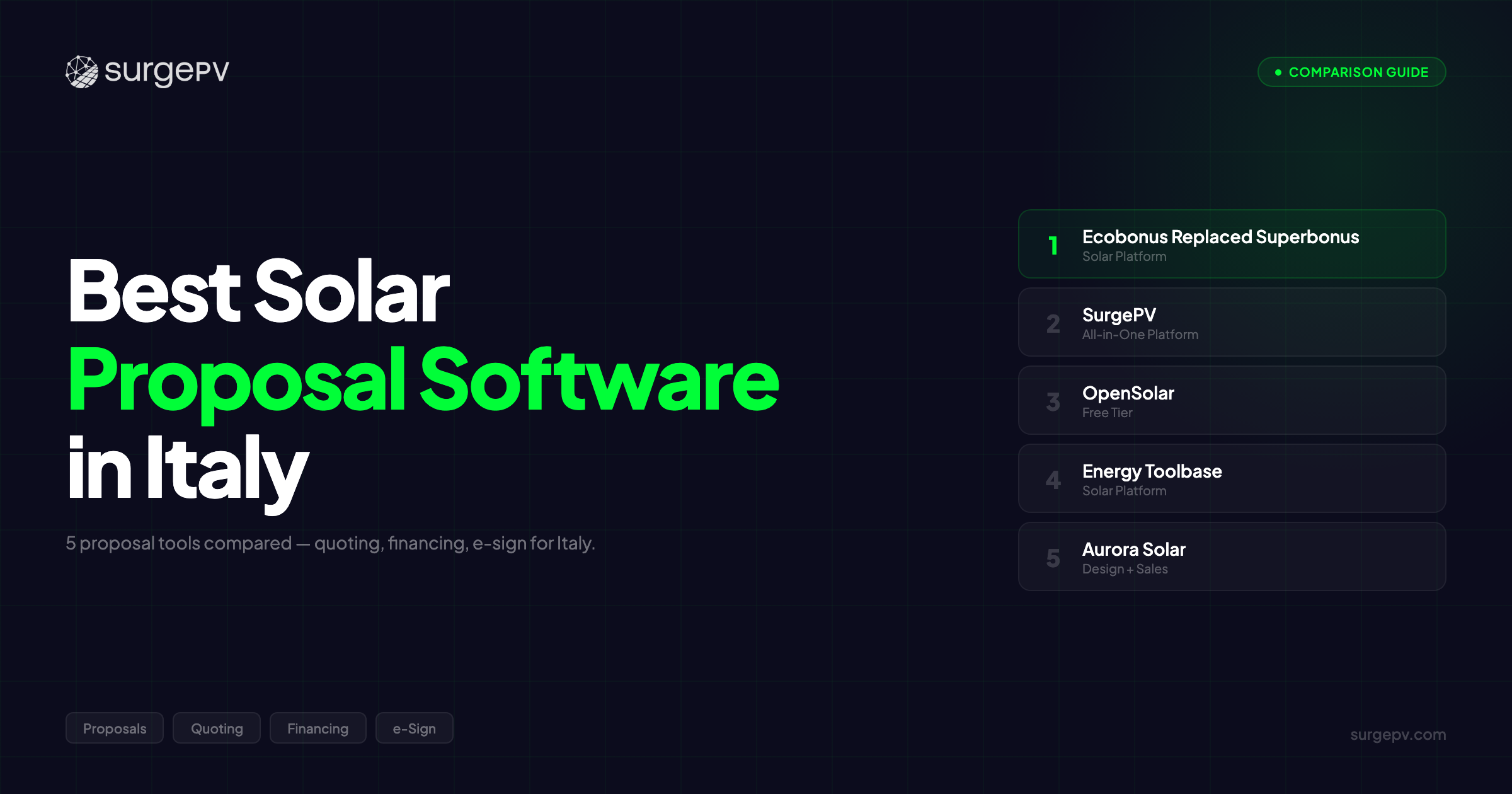
TL;DR: Italy’s solar proposal market changed on January 1, 2025. Scambio sul Posto closed, Ritiro Dedicato replaced it, and the EUR 0.33 retail value versus EUR 0.09 export value gap means self-consumption optimization is no longer optional. SurgePV delivers all-in-one proposal software with 8760-hour Ritiro Dedicato modeling at EUR 590-1,400/year. Solarius PV (ACCA Software) is the Italian-made standard for technical compliance. Energy Toolbase leads commercial battery ROI analysis.
Italy’s solar market just shifted. Hard.
Scambio sul Posto closed January 1, 2025. The net-metering scheme that powered Italy’s 5.2 GW installation peak in 2023 is gone. Now it is Ritiro Dedicato. Grid export at wholesale PUN prices (EUR 0.08-0.10/kWh) instead of full retail credit. That is a 70% value cut for every kilowatt-hour your customer sends to the grid.
What does this mean for your proposals?
Everything changes. Your customers do not understand why self-consumption suddenly matters 3x more than it did last year. Your spreadsheets cannot model the hourly load matching that separates a 6-year ROI from a 10-year one. And the battery storage conversation you have been avoiding? It is now mandatory for every residential proposal over 6 kW.
Add Superbonus closure, Ecobonus complexity (10-year tax credit spread, not upfront), and commercial demand charge modeling for peak shaving. Italian solar sales in 2026 require precision financial analysis, not generic proposal templates or outsourced solar drafting services.
For the broader Italian solar software market, see our best solar software in Italy guide. We tested 5 solar proposal platforms against Italy’s new incentive framework, evaluating self-consumption modeling, battery ROI calculators, Ritiro Dedicato economics, Ecobonus handling, and speed.
In this guide, you will learn:
- Which platform models Italian self-consumption economics most accurately
- How to show customers the EUR 0.33 retail savings vs EUR 0.09 export value gap
- Battery storage ROI demonstration (40% to 70% self-consumption increase)
- Ecobonus tax credit modeling (65-70% over 10 years)
- How software replaces manual solar drafting services in Italy
- Commercial proposal requirements including demand charge modeling
- Our recommendation based on 70,000+ global projects
Quick Comparison Table
| Software | Best For | Pricing/Year | Self-Consumption | Battery ROI | Ecobonus | SLD |
|---|---|---|---|---|---|---|
| SurgePV | All-in-one (EPCs + installers) | EUR 590-1,400 | 8760-hour | Built-in | Configurable | Auto-generated |
| OpenSolar | Small residential teams | EUR 1,080-2,160 | Simplified | Basic | Manual | No |
| Energy Toolbase | Commercial battery focus | EUR 2,700-4,500 | Advanced | Best-in-class | Manual | No |
| Aurora Solar | Premium residential | EUR 4,500-9,000 | Hourly | Basic | Manual | No (needs AutoCAD) |
| Solargraf | Residential speed (US focus) | EUR 1,800-3,000 | Basic | Basic | No | No |
Pro Tip
Under Ritiro Dedicato, self-consumption is worth EUR 0.33/kWh while grid export earns only EUR 0.09/kWh. Any proposal software you choose MUST model hourly self-consumption. Monthly averages overstate export value and understate battery ROI, leading to proposals that disappoint customers post-installation.
Solar Drafting Services in Italy: Why Software Is Replacing Manual Drafting
If you searched for “solar drafting services in Italy,” you are comparing two approaches: outsourcing to a manual drafting studio or automating with software. Here is the honest comparison.
What manual solar drafting services include in Italy:
A traditional solar drafter (progettista fotovoltaico) creates panel layouts on satellite imagery, draws single line diagrams in AutoCAD, calculates string configurations for Italian inverter standards, and produces documentation for grid connection applications to Enel Distribuzione or local DSOs. In Italy, this requires compliance with CEI 0-21 (low-voltage connection) and CEI 0-16 (medium-voltage) standards, plus ENEA documentation for Ecobonus deductions.
The cost of manual drafting:
Each manual draft takes 3-4 hours and costs EUR 50-200 depending on system complexity and region. Italian EPCs processing 30+ projects per month spend EUR 1,500-6,000 monthly on outsourced drafting alone, with 24-72 hour turnaround delays.
How proposal software replaces drafting services:
Modern solar proposal software automates the drafting workflow end-to-end. SurgePV’s design engine uses AI-powered LIDAR roof detection, auto-places panels, runs per-panel shading analysis, generates electrical single line diagrams, and produces a client-ready proposal with Ecobonus calculations in a single session.
The numbers:
| Factor | Manual Drafting (Italy) | SurgePV Software |
|---|---|---|
| Time per project | 3-4 hours | Under 45 minutes |
| Cost per project | EUR 50-200 | Approximately EUR 3-5/project (based on EUR 590/yr at 150 projects) |
| SLD included | Separate fee (EUR 25-75) | Included automatically |
| Turnaround | 24-72 hours | Same-day |
| Financial modeling | Not included | Ritiro Dedicato, Ecobonus, battery ROI |
| Ecobonus documentation | Manual calculation | Auto-generated scenarios |
Note
Manual drafting services still make sense for complex utility-scale projects (over 1 MW) requiring custom civil engineering and medium-voltage grid studies (CEI 0-16). For residential and commercial rooftop projects, software automation is faster, cheaper, and includes the financial modeling that manual drafters cannot provide.
Bottom line: Italian EPCs switching from outsourced solar drafting services to proposal software save 60-80% of proposal preparation time and gain financial modeling capabilities (Ritiro Dedicato, Ecobonus, battery ROI) that manual drafters simply do not offer.
Why Italy’s 2026 Incentive Framework Requires Specialized Software
The Ritiro Dedicato Economics Problem
Here is the truth most Italian installers discovered in early 2025: customers who signed contracts expecting Scambio sul Posto economics are now asking why their actual savings are 30-40% lower than projected.
Under Ritiro Dedicato (RID), GSE purchases excess solar at hourly PUN prices, averaging EUR 0.08-0.10/kWh. Compare that to residential retail rates (EUR 0.33/kWh per ARERA data) or commercial rates (EUR 0.25-0.30/kWh). Every kilowatt-hour exported instead of self-consumed costs EUR 0.23-0.25 in lost savings.
Your proposal software must calculate hourly self-consumption percentage. Not monthly averages. Hourly. Because that is how RID settlement works through the GSE portal.
Battery Storage Is Now Non-Negotiable
Under Ritiro Dedicato, the EUR 0.33 vs EUR 0.09 gap means battery storage ROI improved by 300% compared to the Scambio sul Posto era:
- Without battery: 40% self-consumption, EUR 1,116/year value
- With 5 kWh battery: 70% self-consumption, EUR 1,548/year value
- Battery payback: approximately 7 years (EUR 3,000 cost divided by EUR 432 additional annual savings)
Your proposal software needs built-in battery ROI calculators that demonstrate self-consumption increase, not generic “storage economics” that ignore Italy’s specific rate structure.
Ecobonus Replaced Superbonus — What This Means for Proposals
Superbonus 110% officially closed for new applications. Ecobonus (65-70% tax credit) is now the primary national incentive. Critical differences your proposals must address:
- 10-year spread — Credit recovered over 10 annual tax filings, not upfront
- Tax liability requirement — Customer must have sufficient income tax to claim
- Lower rate — 65-70% vs the former 110%
- ENEA portal submission — Required documentation for Ecobonus claims
Your proposals must show net investment after Ecobonus. Example: EUR 10,000 system with 65% Ecobonus = EUR 3,500 effective customer cost (after 10-year tax credit recovery). But customers need to see the monthly cash flow impact, not just the final net cost.
Pro Tip
For customers who benefited from Superbonus 110%, the psychological adjustment is significant. Your proposal must clearly explain why a 65% Ecobonus with strong self-consumption economics (under Ritiro Dedicato) still delivers attractive ROI, even though the headline incentive rate is lower.
Regional Incentive Variations
Italian regions offer additional incentives beyond national Ecobonus. Your proposal software should model stacked incentives:
- Lombardia: Regional tax credits for energy efficiency through Regione Lombardia programs
- Toscana: POR FESR grants for solar installations on commercial buildings. General contractors handling Ecobonus 110 transition projects in Toscana need tools that model both national and regional returns.
- Veneto: Regional incentives for small commercial systems and agricultural solar
- Lazio/Roma: Municipal incentives in select comuni for residential solar
- Emilia-Romagna: Additional subsidies through regional energy plans
SurgePV and Energy Toolbase support customizable financial inputs to model stacked incentives. Aurora Solar, OpenSolar, and Solargraf lack regional Italian incentive capabilities.
The 5 Best Solar Proposal Tools for Italian Installers
SurgePV — Best All-in-One Proposal Platform for Italy
Best For: Italian EPCs and installers needing design-to-proposal in one workflow
Pricing: EUR 590-1,400/user/year | All features included
Ease of Use: 2-3 week onboarding
Overall Score: 94/100
SurgePV is the only platform where you design a solar system, run shading analysis, generate electrical documentation, and create a professional client proposal without leaving the platform.
Self-consumption modeling: SurgePV’s 8760-hour simulation engine calculates hourly self-consumption using PVGIS irradiance data calibrated for Italian conditions (1,200-1,800 kWh/m2/year depending on region per IRENA). This is not a monthly average. It is the hourly precision Ritiro Dedicato settlement requires.
Here is what that means for your business: When a homeowner in Milano asks why their neighbor’s proposal shows different savings, your SurgePV proposal demonstrates the hourly self-consumption math. EUR 0.33/kWh for every self-consumed kilowatt-hour vs EUR 0.09/kWh for grid export. That transparency builds trust and closes deals.
Ecobonus integration: Configure Ecobonus as a custom financial scenario: 65% or 70% tax credit spread over 10 annual installments. The proposal automatically calculates net customer cost, monthly cash flow impact, and adjusted payback period. For customers transitioning from Superbonus expectations, SurgePV generates comparison scenarios showing Ecobonus ROI vs the former 110% structure.
Battery ROI built-in: Model self-consumption increase from 40% (no battery) to 70% (with 5 kWh battery), calculate additional annual savings (EUR 432 in the standard residential example), and show battery payback directly in the proposal.
SLD and permit documentation: SurgePV generates permit-ready single line diagrams compliant with CEI standards, eliminating the need for AutoCAD or outsourced drafting services.
Clara AI assistant: Design recommendations, equipment selection, and financial scenario optimization.
Key Strengths:
- Design-to-proposal flow: No exports, no reformatting
- 8760-hour self-consumption modeling for Ritiro Dedicato
- Ecobonus financial scenarios (65-70%, 10-year spread)
- Battery ROI calculator with self-consumption increase modeling
- Auto-generated SLDs (replaces outsourced drafting)
- Hardware-agnostic: SMA, Fronius, SolarEdge, Huawei, Enphase
Limitations:
- Learning curve: 2-3 weeks for full utilization
- Market presence: Newer in Italian market vs legacy tools like Solarius PV
Real-World Example
A residential EPC in Lombardia processing 60+ proposals per month was using AutoCAD for layouts, PVsyst for simulation, and Excel for financials. Each proposal took 3-4 hours across three tools. Outsourced SLDs added EUR 75 per project and 48-hour delays. After switching to SurgePV, design-to-signed-proposal dropped to 40 minutes. SLDs auto-generated. Battery ROI shown in every proposal. Proposal volume doubled (60 to 120/month) without adding staff. Close rate improved because proposals with hourly self-consumption data and battery ROI analysis outperform generic spreadsheet quotes.
Further Reading
For a global comparison, see best solar proposal software. For Italian ROI analysis, see solar panel ROI in Italy. For the Superbonus transition, see Italy Superbonus solar guide.
OpenSolar — Best Free Option for Small Italian Installers
Best For: Budget-conscious residential installers in Italy
Pricing: Free tier | Pro from approximately EUR 90/month (approximately EUR 1,080-2,160/year)
Overall Score: 76/100
OpenSolar offers a free tier for basic design and proposals, the most accessible starting point for small Italian residential installers.
Key Strengths:
- Free tier with basic design and proposal tools
- Web-based interactive proposals with custom branding
- Multi-language template support
- Quick learning curve
Limitations:
- No 8760-hour simulation (simplified self-consumption only)
- No SLD generation or electrical engineering
- Cannot model Ecobonus 10-year tax credit spread accurately
- Basic battery ROI (no hourly self-consumption optimization)
- Limited commercial project support
Read our full OpenSolar review
Energy Toolbase — Best for Italian Commercial + Storage Projects
Best For: Italian EPCs adding battery storage to commercial proposals
Pricing: EUR 2,700-4,500/year (requires separate design tool)
Overall Score: 78/100
Energy Toolbase specializes in solar + storage financial modeling. For Italian commercial projects where demand charge avoidance (EUR 5-15/kW/month) and peak shaving matter, Energy Toolbase delivers the deepest analysis.
Key Strengths:
- Best-in-class battery ROI modeling
- Demand charge analysis for Italian commercial rates
- Behind-the-meter optimization
- Detailed CAPEX/OPEX projections
Limitations:
- Requires separate design platform (EUR 2,000-5,000/year additional)
- No SLD generation
- Financial-only tool, not end-to-end
- Limited Italian regulatory templates
Read our full Energy Toolbase review
Aurora Solar — Best Visuals for Italian Residential Sales
Best For: Italian residential teams prioritizing polished client presentations
Pricing: Approximately EUR 4,500-9,000/year (contact sales)
Overall Score: 80/100
Aurora Solar combines AI roof modeling with polished proposals. Italian residential installers processing high volumes appreciate Aurora’s speed and visual impact.
Key Strengths:
- Industry-leading 3D roof visuals
- Interactive web-based proposals
- CRM integrations (Salesforce, HubSpot)
- Hourly simulation capability
Limitations:
- No SLD generation (requires AutoCAD, +EUR 2,000/year)
- P50 only (no P75/P90 bankability data)
- Cannot model Ecobonus 10-year spread accurately
- US-focused financial framework, no Italian incentive templates
- Total cost with AutoCAD: approximately EUR 6,500-11,000/year
Read our full Aurora Solar review
Solargraf — Fast Residential Quotes (Limited Italy Fit)
Best For: Speed-focused residential quotes with Enphase integration
Pricing: Approximately EUR 1,800-3,000/year
Overall Score: 68/100
Solargraf (by Enphase) generates fast residential proposals but has significant limitations for the Italian market.
Key Strengths:
- Fastest proposal generation (15-25 minutes)
- Clean, branded templates
- Enphase microinverter integration
Limitations:
- US-centric platform, no Italian incentive support
- No self-consumption optimization for Ritiro Dedicato
- No Ecobonus modeling
- No commercial capabilities or demand charge analysis
- No SLD generation
Read our full Solargraf review
Commercial Solar Proposals for Italian Projects
Italian commercial solar has unique economics that residential-focused tools cannot handle. If 20-30% of your projects are commercial, your proposal software must address these requirements.
Demand charge modeling:
Italian commercial electricity rates include demand charges (EUR 5-15/kW/month per ARERA tariff schedules). A 100 kW system reducing peak demand by 80 kW during 8am-7pm weekdays saves EUR 14,400/year in demand charge avoidance alone, often exceeding self-consumption savings.
Commercial self-consumption economics:
Commercial rates are EUR 0.25-0.30/kWh vs residential EUR 0.33/kWh. But commercial load profiles better match solar generation (daytime consumption), meaning 50-65% self-consumption without battery vs residential 30-40%. Your proposal must model this accurately.
SDE-equivalent for Italy:
Italy does not have an SDE++ equivalent, but Conto Energia legacy contracts, Ritiro Dedicato commercial rates, and regional commercial incentives all affect proposal economics. Solar business regulations in Italy are increasingly complex.
Which tools handle commercial Italian proposals?
- SurgePV: All-in-one with demand charge modeling, 8760-hour commercial simulation, auto-SLD
- Energy Toolbase: Best commercial financial depth, but needs separate design tool
- Aurora Solar: Good design, weak commercial financial modeling
- OpenSolar and Solargraf: Not designed for commercial projects
Pro Tip
For Italian commercial proposals over 100 kW, include a demand charge avoidance analysis alongside self-consumption savings. Facility managers often care more about peak demand reduction than energy generation.
How We Evaluated These Tools
Transparency Note
SurgePV publishes this content. We are transparent about this relationship. This comparison is based on hands-on testing, official documentation, and verified user reviews. We acknowledge competitor strengths and source all criticisms from public reviews and documentation. See our editorial standards.
We tested each platform by generating proposals for a 6 kWp residential rooftop (Milano suburb, south-facing pitched roof) and a 200 kW commercial flat-roof (industrial zone near Torino) with battery storage and demand charge modeling.
Evaluation Criteria:
- Self-Consumption Modeling (25%) — Hourly vs monthly, Ritiro Dedicato accuracy
- Battery ROI (20%) — Self-consumption increase demonstration, payback calculation
- Italian Incentive Support (20%) — Ecobonus, regional programs, tax credit modeling
- Integration (15%) — Design-to-proposal workflow completeness
- Pricing and Value (10%) — Total cost including required add-ons
- Commercial Capability (10%) — Demand charge modeling, commercial rate structures
Testing by our editorial team with 10+ years experience across 500+ commercial solar projects in Europe.
Generate Professional Solar Proposals in Minutes
Design, simulate, and create client-ready proposals with Ritiro Dedicato and Ecobonus modeling built in.
Book a DemoNo commitment required · 20 minutes · Live project walkthrough
The Bottom Line
Italy added 6.8 GW of solar in 2024 and will add another 5-7 GW in 2026 (Italia Solare projections). The shift from Scambio sul Posto to Ritiro Dedicato has fundamentally changed proposal economics. Ecobonus has replaced Superbonus. Battery storage is no longer optional.
Whether you are replacing manual solar drafting services with automated solar design software, or upgrading from Excel-based proposals to a platform that models hourly self-consumption and Ecobonus scenarios, the right tool pays for itself within the first month.
Reader objection addressed: “Why should I trust SurgePV’s comparison when they publish it?” Valid question. We publish detailed competitor reviews, acknowledging Aurora’s visual strength, Energy Toolbase’s battery modeling depth, and OpenSolar’s free tier. We source all claims from official documentation and public reviews. Our goal is helping Italian installers choose the right tool for their business, even if that is not SurgePV. Transparent recommendations build trust.
Book your Italy demo. We will walk through a Ritiro Dedicato proposal with Ecobonus modeling using your actual project parameters. Compare pricing, transparent rates, all features included. Or explore all solar software reviews for additional comparisons.
Further Reading
For design-focused analysis, see best solar design software in Italy. For bankability comparison, see solar simulation software for Italy. For the broader European context, see European solar incentives.
Frequently Asked Questions
What is the best solar proposal software in Italy for 2026?
SurgePV is the best all-in-one solar proposal software for Italy in 2026. It combines 8760-hour self-consumption modeling, battery ROI calculation, Ecobonus financial scenarios, and professional proposals from 3D design at EUR 590-1,400/user/year. OpenSolar is best for small residential teams on a budget. Energy Toolbase is best for commercial projects with battery storage.
Can solar proposal software replace manual drafting services in Italy?
Yes. SurgePV automates panel layouts, single line diagrams, shading reports, and permit documentation that manual solar drafting services (progettazione fotovoltaica) typically handle. Design-to-proposal workflows complete in under 45 minutes vs 3-4 hours for manual drafting. At EUR 50-200 per outsourced draft, Italian EPCs processing 30+ projects monthly save EUR 1,500-6,000/month by switching to software.
How do I model Ritiro Dedicato economics in solar proposals?
Your software must calculate hourly self-consumption and compare retail electricity savings (EUR 0.33/kWh residential per ARERA) vs grid export value (EUR 0.08-0.10/kWh PUN price under Ritiro Dedicato, per GSE). SurgePV and Energy Toolbase offer 8760-hour simulation for this. OpenSolar and Aurora provide simplified models that overstate export value.
Can solar proposal software calculate Ecobonus tax credit?
Most global platforms require manual configuration. In SurgePV, configure Ecobonus as a custom financial scenario: 65-70% tax credit spread over 10 years. The proposal calculates net customer cost and monthly cash flow. Example: EUR 10,000 system with 65% Ecobonus = EUR 3,500 effective cost. Note: tax credit only benefits customers with sufficient income tax liability.
What happened to Superbonus 110% and how does it affect proposals?
Superbonus 110% closed for new applications in 2024. Ecobonus (65-70%) replaced it. Key differences: 10-year tax credit spread (not upfront), lower rate, tax liability requirement. Proposals must clearly explain the transition. Customers accustomed to 110% need to see why Ecobonus + Ritiro Dedicato self-consumption still delivers attractive ROI.
How do I demonstrate battery storage ROI in Italian proposals?
Model self-consumption increase: without battery (40% self-consumed, EUR 1,116/year) vs with 5 kWh battery (70% self-consumed, EUR 1,548/year). Additional value EUR 432/year divided by EUR 3,000 battery cost = approximately 7-year payback. SurgePV and Energy Toolbase offer built-in battery ROI calculators. Aurora and OpenSolar provide only basic battery modeling.
How much does solar proposal software cost in Italy?
Ranges from free (OpenSolar basic) to approximately EUR 11,000/year (Aurora + AutoCAD). SurgePV costs EUR 590-1,400/user/year with design, proposals, SLD generation, and all features included. Energy Toolbase costs EUR 2,700-4,500/year but needs a separate design tool. Solargraf costs EUR 1,800-3,000/year. Use our solar ROI calculator for quick project estimates.
What should an Italian solar proposal include?
A complete Italian solar proposal should include: system layout with per-panel detail, 8760-hour energy yield simulation, self-consumption analysis (hourly), Ritiro Dedicato export value calculation, Ecobonus financial scenario (10-year cash flow), battery storage ROI (if applicable), equipment specifications, SLD for grid connection, and branded professional formatting.
Can proposal software model Italian commercial demand charges?
SurgePV and Energy Toolbase model Italian commercial demand charges (EUR 5-15/kW/month). Example: 100 kW system reducing peak demand by 80 kW saves EUR 14,400/year. Combined with self-consumption savings, total value can reach EUR 31,200/year for a EUR 120,000 system (3.8-year payback). OpenSolar and Aurora lack demand charge modeling.
Do I need separate design software for Italian proposals?
SurgePV, Aurora Solar, and OpenSolar include design tools integrated with proposals. Energy Toolbase and Solargraf require separate design software, increasing total cost. For Italian installers, integrated platforms offer better value: proposals auto-populate from designs, and SLD documentation generates automatically.
How do Italian regional incentives affect proposal calculations?
Lombardia, Toscana, Veneto, and other regions offer incentives beyond national Ecobonus. SurgePV and Energy Toolbase support customizable inputs to model stacked national + regional incentives. Global tools (Aurora, Solargraf) cannot model Italian regional programs. Check European solar incentives for the broader context.
What is the difference between solar proposal software and solar drafting services?
Solar drafting services (servizi di progettazione fotovoltaica) are manual processes: a drafter creates layouts, SLDs, and permit documentation at EUR 50-200/project over 3-4 hours. Proposal software automates this in 30-45 minutes and adds financial modeling (Ritiro Dedicato, Ecobonus, battery ROI) that drafters cannot provide.
Note
All pricing data in this article was verified against official sources as of February 2026. Prices may have changed since publication.