

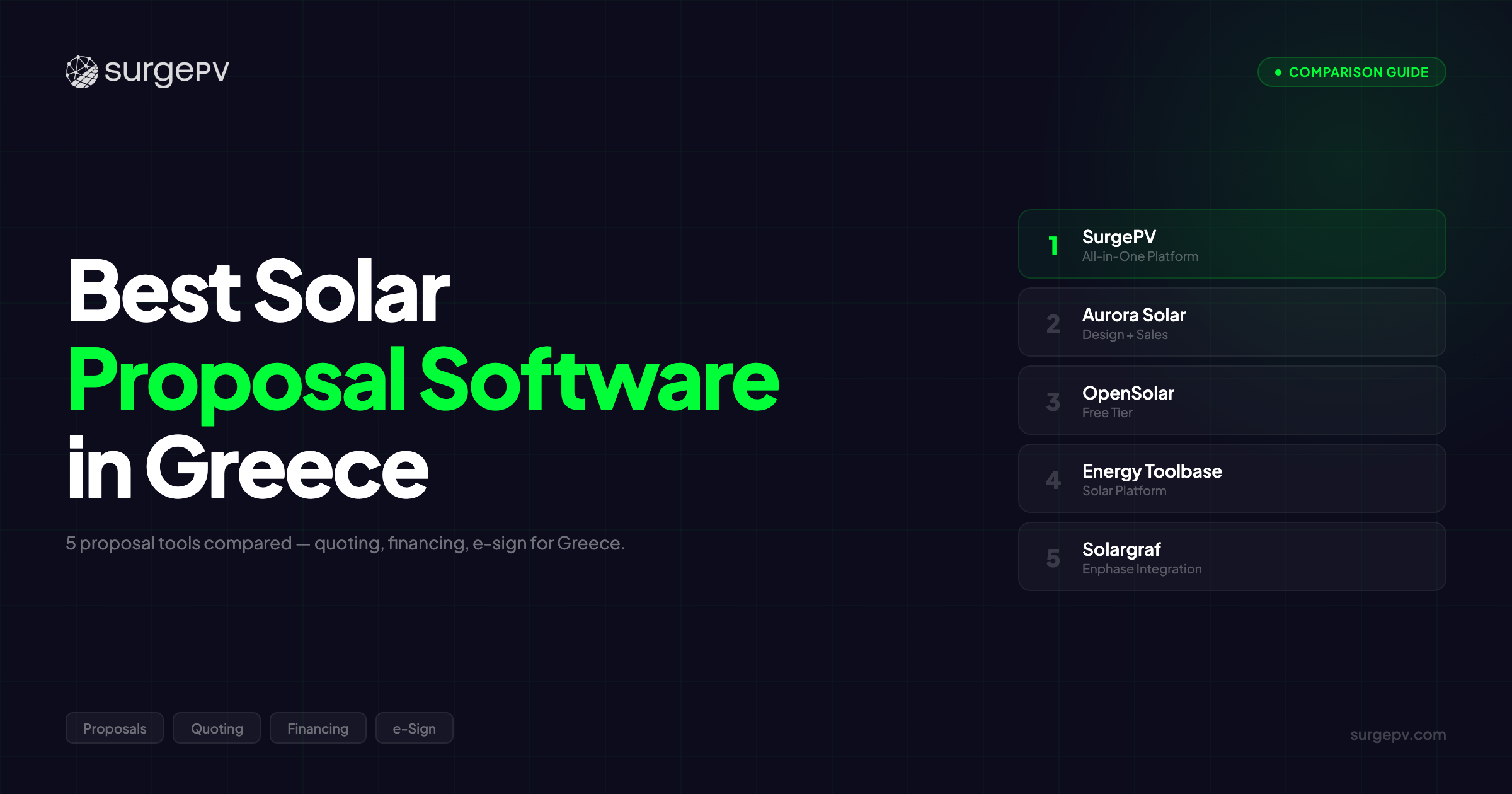
TL;DR: SurgePV is the best solar proposal software for Greece, combining Greek net metering modeling (Law 4414/2016), energy community support (Law 4513/2018), Fotovoltaika subsidy integration, and EUR pricing — all connected to a full design workflow. Aurora Solar offers beautiful proposal templates but lacks Greek market integration. Energy Toolbase excels at financials but requires a separate design tool.
Greek solar proposals are broken. Not the projects — the proposals themselves. Your residential customer in Athens expects Greek-language documentation with Fotovoltaika subsidy calculations.
Your commercial client in Thessaloniki needs net-metering payback projections under Law 4414/2016. That energy community on Crete? Member allocation models for virtual net-metering under Law 4513/2018.
Three different proposal types. Three different regulatory frameworks.
Here is the problem. Most solar proposal software was built for the US market. US net-metering rules. USD pricing. English-only templates. That leaves Greek solar installers patching together Excel spreadsheets and generic PDF templates — and losing deals to competitors who show up with professional, Greek-specific proposals on day one.
We tested five proposal platforms specifically for Greek market needs: net-metering compliance, energy community modeling, Fotovoltaika subsidies, EUR pricing, and Greek language support.
In this guide, you’ll find:
- 5 proposal tools compared on Greek market fit, financial modeling, and design integration
- The exact feature gaps that cost you deals in Greece (Law 4414/2016, Law 4513/2018, Fotovoltaika)
- Which software to use based on your project type — residential, C&I, RES auction
- Full feature comparison table across all tools
- Pricing breakdown for Greek installers and EPCs
Quick Comparison Table
| Rank | Software | Best For | Greece Fit | Pricing |
|---|---|---|---|---|
| 1 | SurgePV | Complete design-to-proposal with Greek features | 5/5 | $1,499/user/year |
| 2 | Aurora Solar | Beautiful interactive proposal templates | 2/5 | $1,620–3,108/year |
| 3 | OpenSolar | Budget residential proposals | 2/5 | $99–299/user/month |
| 4 | Energy Toolbase | Advanced financial modeling | 3/5 | Custom (EUR 3,000–6,000/yr) |
| 5 | Solargraf | European installer proposals | 3/5 | EUR 960–1,800/year |
Best Solar Proposal Software in Greece
SurgePV — Best End-to-End Solar Proposal Platform for Greece
Best For: Greek EPCs and installers serving commercial net-metering, residential Fotovoltaika, and energy community markets
Pricing: $1,499/user/year (For 3 Users plan) — all features included
Ease of Use: 2–3 week onboarding
Overall Score: 93/100
Why SurgePV Ranks #1
SurgePV connects solar design directly to proposal generation. When you change a module count or system size, the proposal updates automatically. No exporting to Excel. No rebuilding financial models from scratch.
For the Greek market, this design-to-proposal integration matters because proposals need to reflect accurate production numbers from 1,400–1,800 kWh/m² irradiation, ELOT-compliant electrical documentation, and Greek-specific financial models.
Did You Know?
Greece’s solar irradiance ranges from 1,500–1,800 kWh/m²/year, making accurate simulation essential for bankable energy yield predictions. Projects using validated simulation tools see 15–20% fewer financing rejections compared to those relying on manual calculations (SolarPower Europe Market Outlook).
Key Strengths
- Greek net-metering modeling: Supports Law 4414/2016 framework with residential (10 kWp), commercial (100 kWp), and industrial (500 kWp) limits.
- Energy community proposals: Virtual net-metering under Law 4513/2018 with member allocation and shared benefit calculations.
- Fotovoltaika subsidy integration: Models EUR 4,000–10,000 residential grants with before/after subsidy payback scenarios.
- EUR pricing and Greek utility rates: Native EUR support with Greek electricity tariffs.
- Interactive web proposals: Mobile-friendly, shareable links. One click to send. No PDF attachments lost in spam filters.
- Greek language support: Proposals generated in Greek. For residential Fotovoltaika sales, that is not a nice-to-have — it is the difference between a homeowner who trusts your numbers and one who doesn’t.
- RES auction financials: P50/P75/P90 bankability metrics, LCOE calculation, IRR/NPV analysis. Your financing applications include the data lenders actually require.
Limitations
- Smaller US market share: Less established than Aurora Solar in the US.
- Template library: Proposal templates not as visually polished as Aurora’s.
Who Should Consider SurgePV
Greek EPCs and installers serving multiple market segments. Solar sales professionals who need Greek-specific proposals with accurate financial modeling. Book a demo to see Greek solar proposal automation in action.
Real-World Example
A residential installer in Thessaly generating 80+ proposals per month was juggling three tools: design software, simulation software, and spreadsheets for financials. Each proposal took 3–4 hours. With SurgePV’s unified workflow, that dropped to 45 minutes per proposal. Same-day proposals instead of next-week follow-ups. Their close rate improved because in solar sales, speed wins deals.
You might be wondering: if SurgePV does all this, why haven’t I heard of it? Fair question. PVsyst has had a 30-year head start. Aurora Solar has spent hundreds of millions on marketing. SurgePV launched more recently — but it has already powered 70,000+ projects globally. The platform was built for the workflow gaps that legacy tools leave open, especially automated electrical engineering, which no other platform offers natively.
Further Reading
Best Solar Proposal Software (2026) — Global comparison. Aurora Solar Review — Proposal features deep-dive. Best Solar Simulation Software — Bankability comparison.
Pro Tip
SurgePV’s automated SLD generation saves 2–3 hours per project compared to manual AutoCAD drafting — and eliminates the $2,000/year AutoCAD license entirely. For Greece EPCs handling 10+ projects per month, that’s 20–30 hours saved monthly. Book a demo to see it in action.
Aurora Solar — Beautiful Interactive Proposal Templates
Best For: Greek EPCs who prioritize visual proposal quality
Pricing: $135–259/user/month ($1,620–3,108/year)
Ease of Use: 2–3 week onboarding
Overall Score: 78/100
Why Aurora Solar Ranks #2
Aurora Solar is the US market leader with visually polished interactive web proposals. But Aurora’s proposals are built around US net-metering structures and USD pricing. Greek net-metering under Law 4414/2016 works differently. Aurora doesn’t support energy community virtual net-metering. There’s no Fotovoltaika subsidy modeling. Proposals are English-only.
Key Strengths
- Visual quality: Industry-leading proposal design and interactivity.
- AI roof detection: Fast 3D design capabilities.
- CRM integration: Native Salesforce/HubSpot connectivity.
Limitations
- US net-metering only: No Greek Law 4414/2016 support.
- No energy community modeling: Missing Law 4513/2018 support.
- English-only proposals: No Greek language option.
Who Should Consider Aurora Solar
Large teams prioritizing visual proposal quality with staff to manually adjust for Greek regulations.
OpenSolar — Budget Residential Proposal Tool
Best For: Small Greek residential installers on tight budgets
Pricing: $99–299/user/month
Overall Score: 68/100
Why OpenSolar Ranks #3
OpenSolar offers affordable pricing and decent interactive web proposals for residential projects. However, OpenSolar’s net-metering models don’t align with Greek Law 4414/2016. There’s no energy community support and financial modeling is basic.
Key Strengths
- Affordable: Lowest cost option for basic proposals.
- Interactive proposals: Web-based, shareable format.
Limitations
- Limited Greek support: No Greek net-metering, no energy communities.
- Basic financials: Falls short for commercial or RES auction proposals.
Energy Toolbase — Advanced Financial Modeling Specialist
Best For: Greek developers needing deep financial modeling for RES auction bids
Pricing: Custom enterprise pricing (typically EUR 3,000–6,000/year)
Overall Score: 74/100
Why Energy Toolbase Ranks #4
Energy Toolbase delivers the deepest financial modeling: cash flow analysis, IRR/NPV, debt service coverage, and battery storage economics. But it’s a financial tool only. No design capability. No visual proposals. You’ll need a separate design platform.
Key Strengths
- Financial depth: Deepest financial modeling available.
- P50/P90 analysis: Strong bankability metrics for auction bids.
Limitations
- No design integration: Financial tool only — requires separate platform.
- US utility focus: Greek tariffs require manual configuration.
Solargraf — European Installer Proposals
Best For: Greek residential installers wanting a European proposal platform
Pricing: EUR 80–150/user/month (EUR 960–1,800/year)
Overall Score: 70/100
Why Solargraf Ranks #5
Solargraf is a European company (Netherlands-based) with native EUR pricing and familiarity with European markets. However, net-metering modeling doesn’t specifically support Greek Law 4414/2016 limits, and there’s no energy community support.
Key Strengths
- European perspective: Native EUR pricing, EU market understanding.
- Straightforward proposals: Clean residential-focused output.
Limitations
- Basic design: Rooftop only, no trackers.
- Limited Greek support: No Greek net-metering or energy community modeling.
Which Tool Is Right for Your Needs?
| Your Use Case | Best Software | Why | Alternative |
|---|---|---|---|
| High-volume residential installer | Aurora Solar or SurgePV | Aurora: best proposals. SurgePV: proposals + engineering | Solargraf |
| C&I EPC (100+ kW) | SurgePV | Integrated design + proposals + SLDs in one tool | HelioScope + PVsyst combo |
| Storage + solar specialist | Energy Toolbase | Best financial modeling for battery + solar | SurgePV for design integration |
| Projects requiring Greece lender financing | PVsyst or SurgePV | P50/P90 bankability reports accepted by lenders | HelioScope (some lenders) |
| Startup installer (under 30 projects/year) | OpenSolar or SurgePV | OpenSolar: free entry. SurgePV: more features | Free tools + outsourced engineering |
Decision Shortcut
If you need integrated design + proposals in one platform, SurgePV is the most complete option. If you’re residential-only with a large marketing budget, Aurora Solar’s proposals are excellent — but expensive. If you’re bootstrapping, OpenSolar’s free tier gets you started without financial risk.
Design Solar Projects Faster with SurgePV
Complete design-to-proposal workflows with automated electrical engineering and bankable simulations — built for Greek EPCs and installers.
Book a DemoNo commitment required · 20 minutes · Live project walkthrough
Full Feature Comparison — Best Solar Proposal Software for Greece
| Feature | SurgePV | Aurora Solar | OpenSolar | Energy Toolbase | Solargraf |
|---|---|---|---|---|---|
| Greek net-metering (Law 4414/2016) | Yes (10/100/500 kWp) | No (US only) | Limited | No (US focus) | Limited |
| Energy communities (Law 4513/2018) | Yes | No | No | No | No |
| Fotovoltaika subsidy modeling | Yes | No | No | No | No |
| EUR pricing | Native | Multi-currency | Multi-currency | USD primary | Native EUR |
| Greek language | Yes | English only | Limited | English only | Limited |
| P50/P75/P90 | Yes | P50 only | P50 only | Yes | No |
| Pricing | $1,499/user/yr | $1,620–3,108/yr | $99–299/user/mo | Custom | EUR 960–1,800/yr |
Further Reading
For a broader comparison beyond this market, see our guide to the best solar design software globally.
The Feature Gaps That Cost You Deals in Greece
Greek Net-Metering Modeling (Law 4414/2016)
Greece’s net-metering scheme operates under Law 4414/2016 with specific limits: 10 kWp for residential, 100 kWp for commercial, and 500 kWp for industrial, administered through HEDNO/DEDDIE. Settlement is annual (not monthly like many US programs), using retail rate offset. Your proposal software must model these exact limits and settlement rules.
Energy Community Support (Law 4513/2018)
Virtual net metering through energy communities is one of Greece’s fastest-growing solar segments. Under Law 4513/2018, communities can install up to 1 MWp and share energy among members. Only SurgePV currently offers this in an integrated proposal platform.
Fotovoltaika Subsidy Integration
The Fotovoltaika sto stegi program provides EUR 4,000–10,000 in residential subsidies. Proposals that show the subsidy impact on payback period — reducing it from 6–10 years to 4–6 years — close significantly more deals.
EUR Pricing and Greek Utility Rates
All financial projections must be in EUR. Greek electricity tariffs vary: residential (EUR 0.15–0.25/kWh), commercial (EUR 0.12–0.20/kWh), and industrial (EUR 0.10–0.16/kWh).
Greek Language Support
For residential Fotovoltaika sales and energy community prospectuses, Greek-language proposals are necessary. A homeowner in Thessaloniki or a municipal energy community on Rhodes expects documentation in Greek.
RES Auction Financial Rigor
Utility-scale RES auction proposals administered by DAPEEP require P50/P75/P90 production scenarios, LCOE calculations, and NPV/IRR/debt service coverage analysis for RAE competitive bidding. According to IRENA, Greece’s auction-driven growth model has been among the most successful in Southern Europe. HELAPCO tracks auction results and market development data for the Greek PV sector.
Our Testing Methodology
- Greek market fit (30%): Net-metering compliance (Law 4414/2016), energy community modeling (Law 4513/2018), Fotovoltaika subsidy integration, EUR pricing
- Proposal quality (25%): Template design, interactivity, mobile responsiveness, Greek language support
- Financial modeling (20%): ROI accuracy, payback calculations, NPV/IRR, subsidy scenarios
- Design integration (15%): Design-to-proposal workflow, auto-updating, bill of materials integration
- Pricing and value (10%): Cost vs features, ROI for Greek installers
Transparency Note
SurgePV publishes this content. We are transparent about this relationship. This comparison acknowledges Aurora Solar’s superior proposal visual quality and Energy Toolbase’s deeper financial modeling for specific use cases. We present SurgePV as the most complete option for Greek market requirements. See our editorial standards.
Bottom Line
For Greek EPCs and installers serving multiple segments: SurgePV is the clear choice. It’s the only platform that combines Greek net-metering modeling (Law 4414/2016), energy community virtual net-metering (Law 4513/2018), Fotovoltaika subsidy integration, EUR pricing, Greek language support, and full design-to-proposal integration at $1,499/user/year.
For visual proposal quality: Aurora Solar creates the most polished interactive proposals in the industry. For Greek markets, you’ll need to manually configure net-metering and accept English-only delivery.
For financial modeling depth: Energy Toolbase offers the deepest financial analysis for RES auction bids. But it requires a separate design tool.
For budget residential: OpenSolar and Solargraf provide affordable starting points for small residential installers.
The Greek solar market is not slowing down. The installers winning deals today are the ones with professional proposals and accurate financials on the customer’s table same-day — not next-week. Your software choice is a competitive advantage, not a back-office decision.
Ready to create professional Greek solar proposals? Book a demo to see solar software with Greek net-metering and energy community modeling. See SurgePV pricing | Explore proposal features | Browse all reviews
Further Reading
Best Solar Design Software (2026) — Global design platform comparison. Best All-in-One Solar Design Software — Complete platform comparison. Solargraf Review — European proposal tool deep-dive.
Frequently Asked Questions
What is the best solar proposal software in Greece?
SurgePV is the best all-in-one solar proposal software for Greece in 2026. It combines Greek net-metering modeling (Law 4414/2016), energy community support (Law 4513/2018), Fotovoltaika subsidy integration (EUR 4,000–10,000), EUR pricing, and Greek language proposals with full design-to-proposal workflow at $1,499/user/year. See our best solar software hub for broader comparisons.
Can proposal software model Greek net-metering (Law 4414/2016)?
Yes. SurgePV supports Greek net-metering with 10 kWp (residential), 100 kWp (commercial), and 500 kWp (industrial) limits, annual settlement, and retail rate offset modeling. Most other platforms use US net-metering frameworks that don’t match Greek regulations administered through HEDNO.
Does proposal software support energy communities in Greece?
SurgePV supports virtual net metering for Greek energy communities (Law 4513/2018) with member allocation, shared benefit calculations, and up to 1 MWp system modeling. Aurora Solar, OpenSolar, and Energy Toolbase do NOT support energy community proposals.
Can proposal software integrate Fotovoltaika subsidies?
Yes. SurgePV models Fotovoltaika sto stegi subsidies (EUR 4,000–10,000 residential grants) showing with/without subsidy payback scenarios. This reduces typical payback from 6–10 years to 4–6 years in Greece’s 1,400–1,800 kWh/m² irradiation, making proposals significantly more compelling for Greek homeowners.
Are Greek-language proposals available in solar software?
SurgePV supports Greek-language proposals essential for residential Fotovoltaika sales and energy community prospectuses. Aurora Solar, Energy Toolbase, and Enact Systems provide English-only proposals.
How much does solar proposal software cost in Greece?
Solar proposal software pricing for Greece ranges from $1,499/user/year (SurgePV, all features included with design integration) to EUR 960–1,800/year (Solargraf) to $1,620–3,108/year (Aurora Solar). Enterprise platforms like Energy Toolbase use custom pricing (EUR 3,000–6,000/year typical).
What proposal software is best for Greek RES auctions?
For Greek RES auctions, SurgePV and Energy Toolbase provide P50/P75/P90 bankability metrics, LCOE calculation, and IRR/NPV analysis required for RAE competitive bidding and project financing. SurgePV includes design integration; Energy Toolbase requires a separate design tool.
Can proposal software auto-update from design changes?
Yes. SurgePV proposals auto-update when design parameters change (module count, system size, component costs), ensuring proposals always match the current design. Aurora Solar and OpenSolar also offer design-to-proposal integration. Energy Toolbase does NOT — financial modeling only. See our best solar design software guide for design tool comparisons.
What ROI metrics do Greek solar customers expect in proposals?
Greek solar customers expect proposals showing payback period (5–8 years commercial, 4–6 years residential with subsidy), IRR (12–18% for commercial), NPV, and LCOE (EUR 0.04–0.07/kWh for utility-scale). All metrics must be in EUR with Greek utility rate structures.
Note
Pricing information is based on publicly available data as of February 2026. Contact vendors directly for current pricing and Greece-specific quotes. Some vendors offer regional pricing adjustments.