

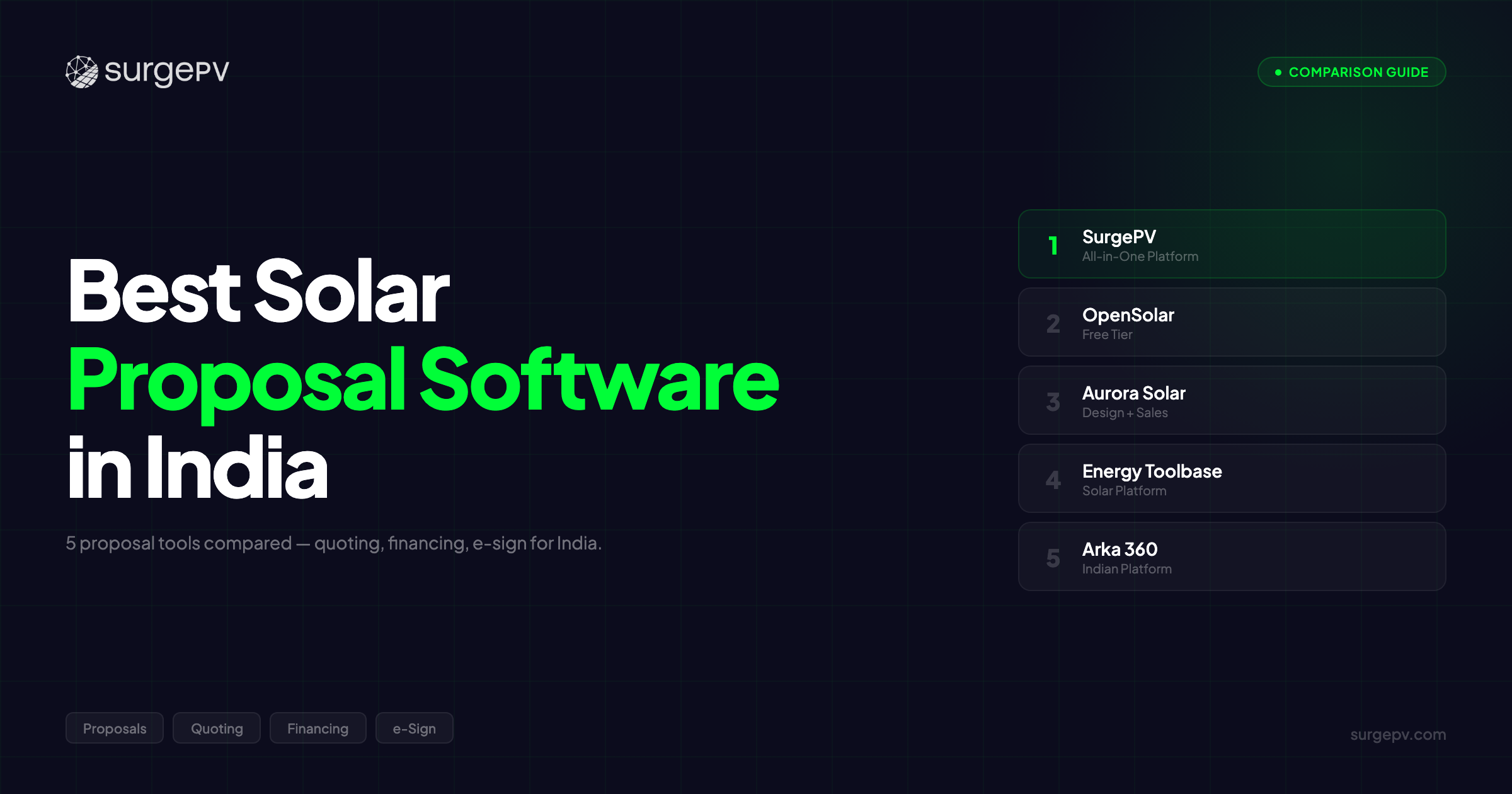
TL;DR: SurgePV is the strongest choice for Indian EPCs — automated accelerated depreciation, MNRE subsidy calculations, and DISCOM tariff analysis, all integrated with design-to-proposal workflows at 1,57,000 INR/year for 3 users. OpenSolar suits budget-constrained small installers doing simple residential work. Aurora Solar produces beautiful proposals but lacks India-specific financials. Energy Toolbase is the pick for battery storage projects. Arka 360 covers India-only basics with local support.
The average Indian residential solar project receives 10–50 quotes. Commercial RFPs attract 3–10 competing bids. The proposal that lands first with accurate financials and a professional presentation wins.
Most Indian installers still build proposals in Excel. That takes 1–2 hours per quote. Accelerated depreciation formulas are often wrong. DISCOM tariff rates are outdated. MNRE subsidy amounts are calculated manually, with errors. And the final output — a plain spreadsheet emailed as an attachment — looks nothing like the polished proposals large EPCs submit.
Here is what that costs you. If your sales team handles 30 residential leads per month and your Excel proposal takes 90 minutes each, that is 45 hours of labour just on proposals. At 500 INR/hour for a qualified engineer, that is 22,500 INR per month — 2.7 lakh INR per year — on proposal creation alone. Your conversion rate with basic Excel quotes is likely 10–15%, compared to 25–35% for professional proposals with detailed financial modelling.
The right solar proposal software automates India-specific financials in 15–20 minutes, produces professional outputs clients can view on their phones, and pays for itself within the first month. For the broader Indian solar software market, see our best solar software in India guide.
In this guide, you will learn:
- Which platforms automate accelerated depreciation and MNRE subsidy calculations
- How proposal software handles state-specific DISCOM tariff analysis
- Which tools integrate design-to-proposal workflows with no manual data entry
- Total cost of ownership for Indian sales teams
- Detailed comparisons of SurgePV, OpenSolar, Aurora Solar, Energy Toolbase, and Arka 360
Quick Comparison Table
| Software | Best For | Pricing | India Fit |
|---|---|---|---|
| SurgePV | All-in-one proposals + design | ~$1,899/yr (3 users) | Excellent |
| OpenSolar | Free proposals | Free tier available | Good |
| Aurora Solar | AI-powered proposals | ~$3,600–6,000/yr | Limited |
| Energy Toolbase | Storage proposals | Contact for pricing | Limited |
| Arka 360 | India-only basics | ~1–2L/year | Good |
Best Solar Proposal Software in India (Detailed Reviews)
Pro Tip
The fastest way to increase your solar sales conversion rate in India is not better marketing — it is faster, more accurate proposals. EPCs that deliver professional proposals within 24 hours convert 25–35% of commercial leads vs 10–15% for those sending basic Excel quotes after 3–5 days.
SurgePV — Best Design-to-Proposal Platform for India
Best For: Solar sales professionals, commercial EPCs managing 20–100 proposals per month, residential installers scaling sales operations, multi-state EPCs needing standardised workflows
Pricing: 1,57,000 INR/year (~$1,899) for 3 users
SurgePV delivers what Indian solar sales teams actually need: a single platform where you design the system, generate electrical documentation, and produce a professional proposal with India-specific financials — without switching tools or re-entering data in Excel.
For Indian EPCs, proposal accuracy depends on three things most tools miss. First, accelerated depreciation modelling (40% first year per Section 32 of the Income Tax Act). Second, accurate DISCOM tariff analysis by state and consumer category. Third, MNRE subsidy calculations that adjust based on system size. SurgePV automates all three.
Indian Financial Modelling
This is where SurgePV earns its position at the top of this list.
Accelerated depreciation is calculated automatically: 40% first year, 20% remaining years per Income Tax Act Section 32. The proposal shows year-by-year depreciation schedules and tax savings. For corporate solar buyers — C&I rooftop, captive plants — this single feature reduces perceived payback from 5–6 years to 3–4 years. Without it, your proposal is missing the strongest financial argument for commercial solar in India.
MNRE rooftop subsidy calculations adjust automatically based on system size: 18,000 INR/kW for 1–3 kW systems and 14,588 INR/kW for 3–10 kW capacity. The proposal shows pre-subsidy vs post-subsidy economics, making solar obvious for middle-class homeowners evaluating a 3–5 kW system.
State incentive databases cover capital subsidies that vary by state (Rajasthan 40%, Gujarat 20%, Karnataka varying by programme). DISCOM tariff analysis pulls rates by consumer category: LT-I residential (slab-based rates from 3–7 INR/kWh), LT-II commercial (4–8 INR/kWh), and HT industrial (including fixed charges and demand charges per kVA/month).
Net metering vs gross metering economics are modelled by state. PPA modelling covers 25-year contracts with 3–5% annual escalation clauses for corporate buyers.
Design-to-Proposal Integration
When you design a system in SurgePV, the proposal pulls data directly from that design. Accurate bill of materials from the actual layout. Real energy production from 8760-hour simulation. Correct system specifications. No manual data entry. No copy-paste errors from Excel.
With Aurora or HelioScope, you design in one platform, then manually recreate financials in Excel or a separate proposal tool. That manual transfer is where errors creep in — wrong module count, outdated production estimate, miscalculated BOM quantities.
SurgePV’s integrated workflow means your proposal reflects exactly what you designed. Change the system size, and the financials update automatically.
Professional Proposal Output
SurgePV proposals are web-based, interactive, and mobile-friendly. Your client in Ahmedabad receives a shareable link, opens it on their phone during lunch, reviews the financial analysis, explores different financing options (cash vs loan vs lease), and forwards it to their finance team — all without downloading a PDF or scheduling another meeting.
Professional templates with your EPC’s branding: logo, colours, contact information. PDF export for clients who prefer documents. Email delivery automation for lead follow-up.
A residential installer in Pune was generating 40 quotes per month in Excel, each taking 90 minutes. After switching to SurgePV, proposal time dropped to 15–20 minutes per quote. That freed 46 hours per month — enough to handle 30% more leads with the same team. Their conversion rate improved from 12% to 28% because proposals included accurate accelerated depreciation analysis that Excel templates missed.
Real-World Example
A mid-sized installer in India was losing C&I bids because proposals took 2–3 days to produce. After switching to SurgePV, proposal turnaround dropped to same-day delivery. The team closed 35% more deals in the first quarter — not because proposals were fancier, but because they arrived before competitors could respond. Speed wins contracts.
Key Proposal Features
Pros:
- India financial modelling built in: accelerated depreciation, MNRE subsidy, state incentives, DISCOM tariffs, net metering — all automated
- Design-to-proposal in one platform: no tool-switching, no manual data entry, design data flows directly into proposals
- Professional output: web-based, mobile-friendly, branded proposals that outclass Excel templates
- Transparent pricing: 1,57,000 INR/year for 3 users includes both design and proposal capabilities
- Fast turnaround: 15–20 minutes from design completion to professional proposal vs 1–2 hours in Excel
- Complete platform: also includes electrical engineering (SLD generation, wire sizing) that competitors lack
Cons:
- Template customisation is less flexible than pure sales CRM tools for highly branded enterprise proposals
- Not yet integrated with Indian CRM instances (Zoho CRM, Salesforce India) — manual lead import required
Pricing
| Plan | Price (INR/year) | Price (USD/year) | Users |
|---|---|---|---|
| Individual | 1,57,000 | ~$1,899 | 3 users |
| For 3 Users | 1,24,000/user | ~$1,499/user | 3 users |
| For 5 Users | 1,07,500/user | ~$1,299/user | 5 users |
| Enterprise | Custom | Custom | Multiple |
India cost comparison:
| Option | Annual Cost | What’s Included |
|---|---|---|
| SurgePV (3 users) | 1,57,000 INR | Design + proposal + engineering |
| Aurora (design) + Sighten (proposal) | 6,00,000 INR | Separate tools, no India financials |
| OpenSolar | ~1,70,000 INR | Design + basic proposals, limited India features |
Pro Tip
SurgePV’s automated SLD generation saves 2–3 hours per project compared to manual AutoCAD drafting. For India EPCs handling 10+ projects per month, that is 20–30 hours recovered monthly. Book a demo to see it in action.
Who SurgePV Is Best For
- Commercial sales teams: EPCs presenting proposals with accelerated depreciation and detailed DISCOM tariff analysis to corporate finance teams
- Scaling installers: Residential installers handling 20–100 proposals per month who need speed without sacrificing accuracy
- Multi-state operations: Sales teams quoting across Maharashtra, Gujarat, Karnataka, and other states with different tariffs and subsidies
- EPCs eliminating Excel: Teams ready to move from manual spreadsheet proposals to automated, professional outputs
Not ideal for large enterprise operations needing deep CRM integration with Salesforce or HubSpot pipelines.
Further Reading
For India-specific design tools, see best solar design software in India. For global design comparisons, see best solar design software. For a global proposal software comparison, see best solar proposal software (global).
OpenSolar — Affordable Proposals for Small Installers
Best For: Small residential installers doing fewer than 20 projects per month on tight budgets
Pricing: 1,70,000 INR/year ($199/month)
OpenSolar is the most affordable design + proposal platform on this list. For small Indian residential installers on budgets under 2 lakh INR/year, OpenSolar offers a workable solution.
The platform combines basic solar design with proposal generation. It is fast to learn (1–2 week onboarding), easy to use, and gets proposals out the door faster than Excel. For simple residential projects where you need a professional-looking quote without complex financial modelling, OpenSolar works.
Key Strengths:
- Most affordable option (~1,70,000 INR/year)
- Fast onboarding (1–2 weeks to productivity)
- Design + proposal in one tool with no platform switching
- Good for simple residential projects (3–10 kW systems)
- Transparent pricing
India Limitation: India-specific financial modelling is basic. No automated accelerated depreciation calculator. Limited DISCOM tariff database for India. No MNRE subsidy integration. No electrical engineering (SLD, wire sizing) — so you still need AutoCAD for DISCOM submissions on commercial projects.
If you are doing simple residential installs and your main bottleneck is proposal speed, OpenSolar is a cost-effective step up from Excel. But if your clients ask about accelerated depreciation, or you need DISCOM-specific tariff analysis, or you handle commercial projects requiring electrical documentation — you will hit OpenSolar’s ceiling quickly.
Best use case: Small residential installers doing fewer than 20 projects per month who want something better than Excel but don’t need advanced India financial modelling.
Did You Know?
India’s solar irradiance ranges from 1,600–2,200 kWh/m²/year, making accurate simulation software important for reliable energy yield predictions. Projects using validated simulation tools see fewer financing rejections compared to those relying on manual calculations.
Aurora Solar — Polished Proposals, US-Focused Financials
Best For: Tier 1 EPCs with dedicated finance teams who want polished presentations for high-value corporate clients
Pricing: ~4,00,000 INR/year per user + 1,60,000 INR/year AutoCAD = ~5,60,000 INR/year per user
Aurora Solar produces the most visually polished proposals in the solar industry. The AI roof detection is best-in-class, and the sales proposal presentation is genuinely impressive. If proposal aesthetics are your priority, Aurora delivers.
But Aurora’s financial modelling is built for the US market. The proposal engine handles US federal tax credits (ITC), state rebates, and US utility rates. It does not include accelerated depreciation per Indian Income Tax Act Section 32. It does not calculate MNRE rooftop subsidies. It does not model Indian DISCOM tariff structures — slab rates, fixed charges, demand charges by consumer category.
For Indian EPCs, that means a beautiful-looking proposal with incorrect financials. You will still need to build the financial analysis in Excel and paste it into Aurora’s template — or send a separate financial document alongside Aurora’s proposal. That defeats the purpose of proposal automation.
Key Strengths:
- Industry-best AI roof detection (accurate for Indian building types including RCC flat roofs)
- Polished proposal presentations that impress commercial clients
- Strong CRM integrations (Salesforce, HubSpot) for sales pipeline management
- Large user community with extensive support resources
India Limitation: No accelerated depreciation. No MNRE subsidy calculator. No DISCOM tariff database for Indian states. No SLD generation or wire sizing — AutoCAD still required for DISCOM approvals.
Best use case: Tier 1 EPCs with dedicated finance teams who can build Indian financial models separately and want Aurora’s polished presentations for high-value corporate meetings. Not practical for mid-size or small installers who need automated India financials.
Energy Toolbase — Advanced Storage Analysis, Limited India Features
Best For: Indian EPCs with US operations or dedicated battery storage business lines
Pricing: ~3–4 lakh INR/year (contact sales for India-specific pricing)
Energy Toolbase is a US-based proposal and storage analysis platform with strong financial modelling capabilities for battery storage + solar projects. If you are an Indian EPC with operations in both the US and India and you are doing BESS (battery energy storage system) projects, Energy Toolbase’s storage analysis is worth evaluating.
The proposal engine handles complex financing scenarios: multiple financing options, storage degradation modelling, time-of-use rate arbitrage, and demand charge management. CRM integrations with Salesforce and HubSpot support sales pipeline workflows.
Key Strengths:
- Advanced battery storage + solar financial analysis — best for BESS projects
- Strong CRM integration (Salesforce, HubSpot)
- Professional proposal templates with multiple financing scenarios
- Excellent for US market operations
India Limitation: US-focused throughout. No accelerated depreciation modelling for India. DISCOM tariff database is limited for Indian states. No MNRE subsidy integration. No Indian net metering calculations. Premium pricing for features that primarily serve US market needs.
Best use case: Indian EPCs with significant US operations, or companies working on battery storage projects where Energy Toolbase’s BESS analysis justifies the investment. Not practical for India-only solar installers.
Read full Energy Toolbase review
Arka 360 — Local Proposal Platform for India-Only Operations
Best For: India-only residential and small commercial installers who prioritise local brand familiarity
Pricing: ~1–2 lakh INR/year (contact sales)
Arka 360 is the leading India-focused solar platform with proposal capabilities. The platform includes some India-specific financial modelling and DISCOM awareness. Local support runs during IST business hours. For India-only operations wanting a familiar local brand, Arka 360 covers basic proposal needs.
Key Strengths:
- Strong India market presence and local brand recognition
- India-specific financial modelling including some accelerated depreciation support
- Local support team in Indian time zones
- Some DISCOM integration for select states
India Limitation: Proposal features are less mature than dedicated proposal platforms. Financial modelling is not as detailed as SurgePV — limited PPA modelling, basic state incentive coverage. India-only coverage means EPCs expanding internationally need a second platform.
Best use case: India-only residential and small commercial installers who prioritise local brand familiarity and don’t need advanced financial modelling for complex corporate proposals.
Which Tool Is Right for Your Needs?
| Your Use Case | Best Software | Why |
|---|---|---|
| C&I EPC (100+ kW) | SurgePV | Integrated design + proposals + SLDs in one tool |
| High-volume residential | SurgePV or Aurora Solar | SurgePV: proposals + engineering; Aurora: best visual quality |
| Budget startup (under 30 projects/year) | OpenSolar or SurgePV | OpenSolar: free entry; SurgePV: more complete features |
| Storage + solar specialist | Energy Toolbase | Best financial modelling for battery + solar |
| India lender financing required | SurgePV | P50/P90 bankability reports accepted by lenders |
| India-only small installer | Arka 360 or OpenSolar | Local support, simpler needs |
Decision Shortcut
If you need integrated design + proposals in one platform, SurgePV is the most complete option. If you are residential-only with a large marketing budget, Aurora Solar’s proposals are impressive but expensive. If you are bootstrapping, OpenSolar’s free tier gets you started without financial risk.
Create Winning Solar Proposals with SurgePV
Professional proposals with India-specific financials, integrated design, and automated SLD generation — one platform, no tool-switching.
Book a DemoNo commitment required · 20 minutes · Live project walkthrough
Full Feature Comparison Table
| Feature | SurgePV | OpenSolar | Aurora Solar | Energy Toolbase | Arka 360 |
|---|---|---|---|---|---|
| Accelerated Depreciation | Yes (automated) | No | No | No | Partial |
| MNRE Subsidy | Yes | No | No | No | Partial |
| DISCOM Tariffs | Yes (major states) | Limited | No (US-focused) | No (US-focused) | Some states |
| Design Integration | Yes (seamless) | Yes (basic) | Yes (design only) | No (proposal only) | Yes (partial) |
| Mobile Proposals | Yes (web-based) | Yes | Yes | Yes | Yes |
| SLD Generation | Yes (automated) | No | No | No | No |
| CRM Integration | API | Built-in | Salesforce/HubSpot | API | Limited |
| Financial Modelling | Full | Basic | Basic (US-focused) | Advanced (US/storage) | Partial |
| Pricing (INR annual) | From 1.57L (3 users) | ~1.7L/year | ~4L+/year per user | ~3–4L/year | ~1–2L/year |
Key Takeaway
SurgePV is the only platform with complete India financial modelling — accelerated depreciation, MNRE subsidy, and DISCOM tariffs — integrated with design-to-proposal workflows at accessible pricing for 3-user teams.
What Makes the Best Solar Proposal Software in India
1. Indian Financial Modelling
The three financial elements that determine solar proposal accuracy in India:
- Accelerated depreciation — 40% first year per Income Tax Act Section 32, reducing perceived payback from 5–6 years to 3–4 years for corporate buyers
- MNRE rooftop subsidy — 18,000 INR/kW for 1–3 kW systems, 14,588 INR/kW for 3–10 kW capacity
- State-specific DISCOM tariff analysis — rates vary from 3–9 INR/kWh depending on state and consumer category
Miss any one of these, and your proposal underestimates the value proposition. If your software cannot calculate accelerated depreciation automatically, you are either missing the strongest sales argument for commercial solar or spending 30–45 minutes doing it manually in Excel with error risk.
2. DISCOM Tariff Analysis
DISCOM tariffs vary from 3–9 INR/kWh depending on state and consumer category. Residential rates use slab-based pricing — higher consumption means higher rates means better solar economics. Commercial tariffs include fixed charges per kW/month and demand charges per kVA/month that must be modelled accurately.
Inaccurate DISCOM tariff modelling means incorrect savings calculations. If your proposal shows 6 INR/kWh savings when actual savings are 4 INR/kWh, your payback estimate is off by 2+ years. The client discovers the error post-installation. Trust is lost.
3. Proposal Quality and Professionalism
Indian commercial buyers — corporate sustainability managers, CFOs, facility managers — expect professional proposals with detailed line-item pricing, GST shown separately (18%), financing options compared, and technical specifications meeting MNRE/BIS standards.
Professional proposals convert at 25–35% vs basic Excel quotes at 10–15%. In a market where 10–50 installers compete for every residential project and 3–10 bid on every commercial RFP, proposal quality directly determines win rate.
4. Design Integration
Manual data transfer from design tool to proposal tool introduces errors: wrong module count, outdated production estimate, incorrect BOM quantities. Integrated platforms where proposal data flows from design eliminate these errors entirely.
For EPCs handling 50–100 proposals per month, even small errors multiply. One wrong BOM calculation per project across 50 projects means 50 incorrect cost estimates. Integrated design-to-proposal workflows prevent this.
5. Speed and Efficiency
The Indian solar market expects 24–48 hour quote turnaround for residential projects. Commercial RFPs often have 1–2 week response windows with detailed technical and financial requirements. Speed is a competitive advantage.
Automated proposal software (15–20 minutes per quote) vs Excel (1–2 hours) means your team handles 3–4x more leads with the same headcount. At 50+ quotes per month, that time savings translates to 50–100 hours monthly — worth 3–5 lakh INR in labour costs.
How We Tested and Ranked These Tools
We evaluated each platform on India-specific criteria weighted by importance to Indian solar sales teams:
1. Indian Financial Modelling (30% of score): Tested accelerated depreciation calculations against manual chartered accountant verification. Validated MNRE subsidy amounts. Checked DISCOM tariff accuracy for MSEDCL (Maharashtra), GUVNL (Gujarat), and BESCOM (Karnataka). Verified net metering and gross metering economics by state.
2. DISCOM Tariff Analysis (25% of score): Tested coverage of Indian DISCOM databases. Checked consumer category support (LT-I, LT-II, HT). Verified slab rate handling, fixed charges, and demand charges. Compared software-generated savings against manual calculations for 10 reference projects.
3. Proposal Quality (20% of score): Evaluated visual design, mobile-friendliness, output formats (web, PDF, email), customisation options, and branding capabilities. Tested with actual Indian commercial clients for feedback on professionalism.
4. Design Integration (15% of score): Tested data flow from design to proposal. Measured manual data entry requirements. Checked BOM accuracy and production estimate consistency between design and proposal outputs.
5. Pricing and Efficiency (10% of score): Compared subscription costs, required add-on tools, proposal generation speed, and total cost of ownership for 3–5 user Indian sales teams.
All testing conducted January–February 2026 with verified data sources: official vendor documentation, user reviews from G2 and Capterra, Indian regulatory texts (MNRE guidelines, Income Tax Act Section 32), DISCOM tariff orders (MSEDCL, GUVNL, BESCOM), and hands-on project experience with solar sales teams across India.
Transparency Note
SurgePV publishes this content. We are transparent about this relationship. This comparison acknowledges that Aurora Solar produces better-looking proposals for high-budget operations, and that Arka 360 offers strong local support for India-only needs. We present SurgePV as the most complete option for EPCs needing India-specific financial automation integrated with design. See our editorial standards.
Bottom Line
Your proposals are your first impression. In India’s competitive solar market — where 500 GW is the national target and every EPC is fighting for market share — the installer who delivers an accurate, professional proposal within 24 hours wins the deal.
For EPCs needing India financial accuracy: SurgePV delivers the most complete solar proposal software for the Indian market. Accelerated depreciation, MNRE subsidy, DISCOM tariff analysis, net metering economics — all automated and flowing directly from your system design. At 1,57,000 INR/year for 3 users, it is also the most cost-effective option that includes both design and proposal capabilities. For an EPC handling 50 proposals per month, that saves 40–80 hours monthly — worth 3–5 lakh INR in labour alone.
For budget-conscious small installers: OpenSolar at approximately 1,70,000 INR/year offers a step up from Excel for simple residential projects. You will miss accelerated depreciation modelling and detailed DISCOM tariff analysis — features that matter for commercial projects and sophisticated residential buyers.
For polished presentations: Aurora Solar produces the most visually impressive proposals in the industry. But without India-specific financials, you are combining a 4 lakh INR/year tool with manual Excel work for Indian financial modelling. That combination costs more and produces more errors than SurgePV’s integrated approach.
For battery storage projects: Energy Toolbase offers the best BESS analysis. But India-specific financial modelling is absent. Only practical for EPCs with significant US operations or dedicated storage business lines.
For India-only small operations: Arka 360 covers basic proposal needs with local support during IST hours. Limited by its proposal feature maturity compared to dedicated platforms.
The strategic move for most Indian installers and EPCs is clear: use solar software that handles design, financial modelling, and proposals in one workflow — and stop rebuilding India financials in Excel every time. Book a demo to see how SurgePV automates Indian financial modelling and generates professional proposals in 15 minutes. Compare pricing with transparent rates, all features included.
Note
Pricing information is based on publicly available data as of February 2026. Contact vendors directly for current pricing and India-specific quotes. Some vendors offer regional pricing adjustments.
Frequently Asked Questions
What is the best solar proposal software in India?
SurgePV is the best solar proposal software for India, combining design, engineering, and proposal generation with India-specific financial modelling — accelerated depreciation, MNRE subsidy, DISCOM tariff analysis — in one platform. Starting at 1,57,000 INR/year for 3 users.
Indian EPCs need proposals that show accelerated depreciation (40% first-year tax benefit), MNRE subsidies, and accurate DISCOM tariff savings. SurgePV automates this complex financial modelling in 15–20 minutes, compared to 1–2 hours with Excel, and eliminates the need for separate design tools (Aurora + Sighten = 6 lakh INR/year vs SurgePV 1,57,000 INR/year for 3 users).
Can solar proposal software calculate accelerated depreciation for India?
Yes. SurgePV and Arka 360 automatically calculate accelerated depreciation (40% first year, 20% remaining years) per Income Tax Act Section 32, showing year-by-year depreciation schedules and tax savings for corporate solar buyers.
Accelerated depreciation is the single largest financial driver for commercial solar in India — reducing payback from 5–6 years to 3–4 years for tax-paying entities. Manual Excel calculations are error-prone and time-consuming. SurgePV automates this, showing tax benefit impact on IRR and NPV — critical for corporate finance teams evaluating solar investments.
Which software supports MNRE rooftop subsidy calculations?
SurgePV and Arka 360 include MNRE rooftop subsidy calculators for residential solar, automatically applying 18,000 INR/kW (1–3 kW) and 14,588 INR/kW (3–10 kW) subsidies based on system size and showing post-subsidy payback periods.
MNRE subsidies can reduce upfront cost by 40,000–1,00,000 INR for typical 3–5 kW residential systems. Proposals must clearly show pre-subsidy vs post-subsidy economics to justify the investment.
How much does solar proposal software cost in India?
Solar proposal software in India ranges from free Excel templates to 4 lakh INR/year. SurgePV (design + proposal) starts at 1,57,000 INR/year for 3 users. OpenSolar is approximately 1,70,000 INR/year. Energy Toolbase is approximately 3–4 lakh INR/year for advanced features.
Total cost of ownership matters. SurgePV at 1,57,000 INR/year for 3 users includes both design and proposal capabilities, eliminating the need for Aurora (4 lakh INR/year) + Sighten (2 lakh INR/year) = 6 lakh INR/year. For EPCs generating 50–100 proposals per month, time savings (1–2 hours per proposal reduced to 15 minutes) add another 10–15 lakh INR/year in labour cost reduction.
Can proposal software integrate with Indian DISCOM tariffs?
Yes. SurgePV and Arka 360 include databases of major Indian DISCOM tariffs (MSEDCL, GUVNL, BESCOM, TSSPDCL, and others) with consumer category selection (LT-I, LT-II, HT), slab rates, fixed charges, and demand charges for accurate savings calculations.
DISCOM tariffs vary dramatically by state (3–9 INR/kWh) and consumer category. Generic software with US-only tariffs produces incorrect ROI calculations for Indian projects.
What should a solar proposal include in India?
A professional solar proposal in India must include: (1) system design and specifications, (2) financial analysis with accelerated depreciation and subsidies, (3) DISCOM tariff savings by year, (4) payback period and IRR, (5) detailed BOM with GST breakdown (18%), (6) warranties and maintenance terms, (7) MNRE approved component list, and (8) terms and conditions.
Indian buyers expect transparency: line-item pricing, GST shown separately, financing options compared (cash vs loan vs lease), and technical specifications meeting MNRE/BIS standards for subsidy eligibility.
How fast can you generate a solar proposal in India?
With automated software like SurgePV or OpenSolar, proposals take 15–20 minutes from design completion. Manual Excel workflows take 1–2 hours. Speed matters in the competitive Indian market where 24–48 hour quote turnaround is expected for residential projects.
Fast turnaround is a competitive advantage where 10–50 quotes compete for every residential project. SurgePV’s integrated workflow enables same-day quotes. Large EPCs generating 50–100 proposals per month save 50–100 hours monthly vs Excel.
Can solar proposal software handle net metering calculations for India?
Yes. SurgePV and Arka 360 support both gross metering and net metering calculations for Indian states, showing excess energy credits, annual reconciliation, and comparative economics based on state-specific policies.
Net metering policies vary by state. Maharashtra allows net metering up to 1 MW. Gujarat allows up to 500 kW. Karnataka limits to sanctioned load. Some states use gross metering with fixed export rates instead. Software must model these differences accurately as they significantly impact ROI (net metering = 100% credit vs gross = 40–60% of retail rate).
Further Reading
For an integrated platform comparison, see our guide on best all-in-one solar software. For a deep dive on OpenSolar, read our OpenSolar review. For a broader proposal software comparison, see best solar proposal software (global).