

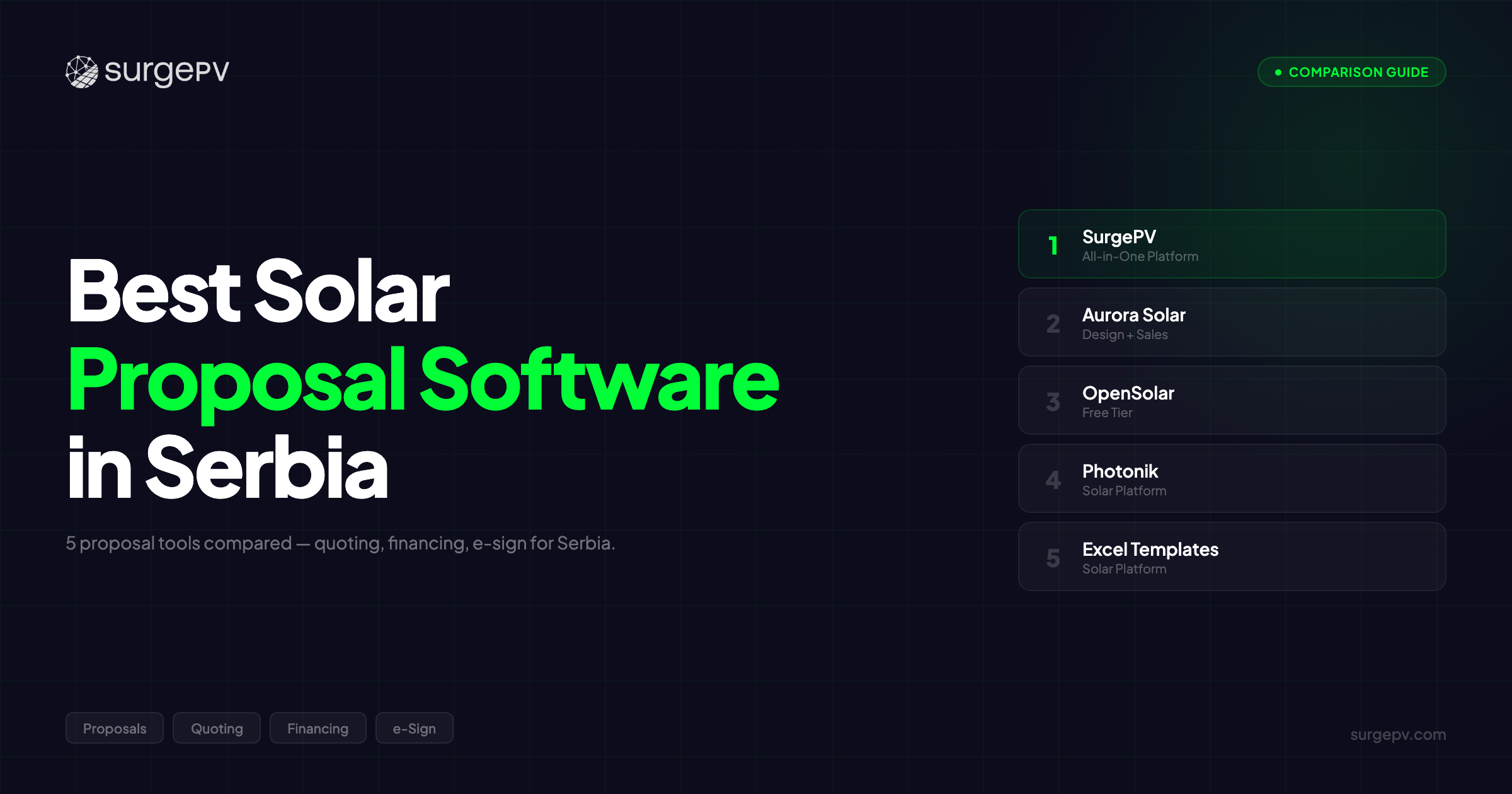
TL;DR: SurgePV is the best solar proposal software for Serbia in 2026 — combining integrated design-to-proposal workflows with Serbian net metering calculations, payback analysis, and professional proposals in 15–20 minutes at $1,899/year for 3 users. Aurora Solar offers the most visually polished templates but lacks Serbian net metering support. OpenSolar is the best budget option for smaller operations.
Serbia’s prosumer boom created a problem nobody talks about: 300–500 installers are now competing for the same residential projects, and the company that delivers a professional, accurate proposal first usually wins the deal (Balkan Green Energy News). Serbian residential buyers compare 3–10 quotes before choosing. Speed and credibility are everything.
But here’s what most Serbian installers are actually doing: building proposals in Excel. One spreadsheet for energy yield. Another for net metering calculations. A third for pricing. Each proposal takes 1–2 hours. The numbers are often inconsistent. The output looks unprofessional compared to what international competitors deliver.
The real cost isn’t just the hours. Serbian prosumer buyers are price-sensitive and cautious — this is still a relatively new market. A professional proposal with accurate net metering savings, clear payback timelines, and detailed bill of materials doesn’t just close deals faster. It builds the trust that turns one installation into five referrals.
We tested and compared the top 5 solar proposal tools for the Serbian market, evaluating each on financial modeling accuracy, proposal speed, Serbian net metering support, and cost.
In this guide, you’ll learn:
- Which platform generates Serbian prosumer proposals fastest (15–20 minutes vs 1–2 hours)
- How each tool handles Serbia’s annual net metering calculations
- Real pricing comparisons (from free to EUR 2,900/year)
- Which software pays for itself in time savings within the first month
Quick Comparison Table
| Software | Best For | Pricing/Year | Proposal Speed | Net Metering |
|---|---|---|---|---|
| SurgePV | Design-to-proposal (all-in-one) | $1,899 (3 users) | 15–20 min | Yes (Serbian) |
| Aurora Solar | Visual proposal design | $3,600–6,000 | 20–30 min | No (US-centric) |
| OpenSolar | Budget-friendly proposals | ~$2,200–2,600 | 20–30 min | Basic |
| Photonik | Balkan-focused tools | Custom | 30+ min | Basic |
| Excel Templates | Lowest cost | Free | 1–2 hours | Manual |
Best Solar Proposal Software in Serbia (Detailed Reviews)
SurgePV — Best Integrated Design and Proposal Platform for Serbia
Best For: Serbian installers handling 10+ prosumer/commercial projects per month
Pricing: $1,899/year (3 users); $1,499/user/year (For 3 Users plan)
Proposal Speed: 15–20 minutes from completed design
SurgePV is the only platform that integrates solar design, electrical engineering, bankable simulations, and proposal generation in a single workflow. For Serbian installers, that means no more switching between design software, Excel spreadsheets, and Word documents to create a single proposal.
Here’s what that looks like in practice: you complete the system design, and SurgePV auto-populates the proposal with energy yield data, net metering savings, payback calculations, equipment BOM, and EPS Distribucija grid connection documentation. One platform. One workflow. 15–20 minutes.
Key Proposal Features for Serbia
- Design-to-proposal workflow — Proposals auto-populated from the actual system design. No manual data entry, no copy-paste errors between tools.
- Net metering calculator — Models Serbia’s annual netting system for prosumers (up to 10.8 kW residential, 150 kW commercial), calculating self-consumption versus grid export with current Serbian tariffs.
- Financial modeling — Automated payback period, savings projections, and electricity price escalation. Shows how rising Serbian electricity prices (20–30% since 2022) improve long-term ROI.
- 98% accurate BOM — Bill of materials generated directly from the design, not estimated. Accurate equipment lists reduce scope disputes and change orders.
- Professional PDF and web proposals — Branded, shareable documents that build trust with cautious Serbian prosumer buyers.
- VAT exemption modeling — Shows prosumer savings from Serbia’s 2023 VAT exemption on solar equipment directly in the proposal.
- Automated SLD generation — Includes EPS Distribucija-ready electrical schematics in 5–10 minutes, eliminating separate AutoCAD work.
Pro Tip
Serbian prosumer buyers compare 3–10 quotes before deciding. SurgePV’s 15–20 minute proposal workflow means you can respond to leads the same day — while competitors are still building spreadsheets. Book a demo to see the full design-to-proposal workflow.
Pricing
| Plan | Price | Users |
|---|---|---|
| Individual | $1,899/year | 3 users |
| For 3 Users | $1,499/user/year | 3 users |
| For 5 Users | $1,299/user/year | 5 users |
| Enterprise | Custom | Multiple |
All features included on every plan. No hidden fees, no feature gating. See full pricing.
Who SurgePV Is Best for in Serbia
- Prosumer installers doing 10+ residential projects per month who need speed
- Commercial EPCs needing proposals with bankable P50/P90 data for financing
- Growing teams that want design, engineering, and sales in one platform
- Companies tired of switching between 3–4 tools for every project
Limitations
- Proposal templates less customizable than pure sales tools like Aurora
- EUR pricing may feel significant for the smallest Serbian installers
- English interface (no Serbian localization yet)
Real-World Example
A 5-person installer in Novi Sad was spending 1.5 hours per prosumer proposal — design in one tool, financials in Excel, formatting in Word. After switching to SurgePV, proposals take 18 minutes. With 25 proposals per month, that’s saving 30+ hours monthly. At their billing rate, the software paid for itself in the first 3 weeks.
Further Reading
- Best Solar Proposal Software (2026) — Global comparison across platforms
- Best Solar Design Software in Serbia — Design-focused comparison
- Aurora Solar Review — Proposal features deep-dive
You might be wondering: can a design-focused platform really compete with Aurora Solar on proposals? It’s a fair question. Aurora’s proposal templates are genuinely the most visually polished in the industry. But here’s the trade-off: Aurora doesn’t model Serbian net metering, doesn’t generate SLDs for EPS Distribucija, and costs 2–3x more. For Serbian installers, the integrated workflow — where the proposal is automatically accurate because it pulls from the actual design — beats visual polish every time.
Aurora Solar — Best Visual Proposal Templates
Best For: Larger Serbian installers who prioritize proposal aesthetics
Pricing: $3,600–6,000/year
Proposal Speed: 20–30 minutes
Aurora Solar produces the most visually polished solar proposals in the industry. Its interactive web-based proposals, 3D roof visualizations, and professional templates set the standard for client-facing sales documents.
What Works for Serbia
- Industry-leading proposal visual design and interactivity
- Beautiful 3D roof renderings help Serbian buyers visualize the installation
- CRM integrations (Salesforce, HubSpot) for sales workflow automation
- Strong brand recognition with international solar buyers
Where It Falls Short in Serbia
- No Serbian net metering modeling — Financial calculations are US-centric and don’t support Serbia’s annual netting system
- No SLD generation — Cannot produce EPS Distribucija grid connection documentation
- US-centric pricing — $3,600–6,000/year is 2–3x the cost of SurgePV for Serbian installer budgets
- USD financial modeling — Requires manual workarounds for EUR-denominated Serbian proposals
Best for: Larger Serbian installers with international operations who prioritize proposal aesthetics and have the budget for premium tools.
Read our full Aurora Solar review for a detailed analysis.
OpenSolar — Budget-Friendly Proposals for Small Installers
Best For: Small prosumer-focused installers on tight budgets
Pricing: ~$2,200–2,600/year
Proposal Speed: 20–30 minutes
OpenSolar offers affordable design and proposal tools with a fast learning curve. It’s a solid entry point for smaller Serbian installers moving beyond Excel workflows.
What Works for Serbia
- Lower price point than Aurora Solar or HelioScope
- Fast learning curve — teams can be productive within days
- Basic proposal generation with energy yield data
- EUR currency support for Serbian market
Where It Falls Short in Serbia
- Limited Serbian financial modeling — Basic net metering calculations, not optimized for Serbia’s annual netting system
- No SLD generation — Grid connection documentation requires separate tools
- Basic bankability — Not suitable for financed commercial projects
- Limited customization — Proposal templates less flexible than Aurora or SurgePV
Best for: Small prosumer installers doing fewer than 10 projects per month who need an affordable step up from Excel.
See our full OpenSolar review.
Did You Know?
Serbian electricity prices have increased 20–30% since 2022 as the country reduces subsidies and aligns with EU energy market pricing (AERS). That means solar payback periods are dropping — making accurate financial modeling in your proposals more compelling than ever.
Photonik — Balkan-Focused Proposal Tools
Best For: Serbian installers preferring local Balkan-focused platforms
Pricing: Custom (contact for quote)
Proposal Speed: 30+ minutes
Photonik is a regional solar platform with some presence in the Balkan market. It offers basic design and proposal features with some awareness of Southeast European regulatory environments.
What Works for Serbia
- Regional support team familiar with Balkan installer needs
- Some awareness of Serbian prosumer regulations
- Lower learning curve for basic functions
Where It Falls Short in Serbia
- Proposal features less mature — Templates and financial modeling not at the level of SurgePV or Aurora
- No SLD generation — Like most competitors, electrical documentation requires separate tools
- Limited financial depth — Basic savings calculations, no electricity price escalation modeling
- Smaller development team — Feature updates and improvements arrive more slowly
Best for: Small Serbian installers who prefer local support and handle simple prosumer projects only.
Excel Templates — The Baseline (And Why You Should Move Beyond It)
Best For: Very small installers with fewer than 5 proposals per month
Pricing: Free
Proposal Speed: 1–2 hours
Most Serbian installers started with Excel. It’s free, customizable, and familiar. But as the market gets competitive, Excel proposals increasingly cost more than they save.
Where Excel Falls Short
- 1–2 hours per proposal — At 20+ projects per month, that’s 40–80 hours of manual work
- Error-prone — Manual data entry between design, financial, and pricing sheets creates calculation inconsistencies
- Unprofessional output — Serbian prosumer buyers increasingly expect visual, branded proposals
- No design integration — Energy yield data must be manually entered from a separate tool
- Not scalable — Adding team members means sharing and version-controlling spreadsheets
Best for: Solo installers doing fewer than 5 prosumer projects per month where software cost is the primary concern.
Solar Proposal Software Comparison Table for Serbia
| Feature | SurgePV | Aurora Solar | OpenSolar | Photonik | Excel |
|---|---|---|---|---|---|
| Net metering calculator | Yes (Serbian) | No | Basic | Basic | Manual |
| Payback analysis | Automated | Basic | Basic | Basic | Manual |
| Professional templates | Yes | Yes (best) | Yes | Basic | No |
| Design integration | Full | Full | Full | Basic | None |
| SLD generation | Yes (automated) | No | No | No | No |
| Proposal speed | 15–20 min | 20–30 min | 20–30 min | 30+ min | 1–2 hours |
| EUR currency | Yes | USD | Yes | Yes | Manual |
| BOM accuracy | 98% | Basic | Basic | Basic | Manual |
| Pricing/year | $1,899 (3 users) | $3,600–6,000 | ~$2,200–2,600 | Custom | Free |
Further Reading
For a broader comparison beyond the Serbian market, see our guide to the best solar proposal software globally.
What Makes the Best Solar Proposal Software in Serbia
Net Metering Financial Modeling
Serbia’s 2021 prosumer legislation established annual net metering at the retail electricity rate for systems up to 10.8 kW (residential) and 150 kW (commercial) (Ministry of Mining and Energy). Your proposal software needs to model self-consumption versus grid export accurately, calculate annual netting credits, and show customers exactly how much they’ll save. Generic tools that don’t support Serbian netting rules produce inaccurate payback projections — and inaccurate projections destroy trust.
Professional Proposals for Trust Building
Serbia’s solar market is still relatively new. Many prosumer buyers are making their first major energy investment and approach it with caution. A professional, branded proposal with clear visualizations, accurate financial data, and detailed equipment specifications builds credibility that an Excel spreadsheet never will. In a market where buyers compare 3–10 quotes, presentation quality differentiates.
Speed in the Competitive Prosumer Market
With 300–500 installers competing for prosumer projects, first-mover advantage is real. Serbian residential sales cycles run 1–3 weeks. The installer who responds with a professional, accurate proposal within 24 hours of a site visit has a measurable advantage over the one who takes 3–5 days. Software that generates proposals in 15–20 minutes versus 1–2 hours makes that difference.
Accurate Serbian Electricity Tariff Analysis
Serbian electricity prices have risen 20–30% since 2022 as the country reduces subsidies and aligns with EU energy market pricing (AERS). Residential rates currently run EUR 0.07–0.10/kWh, commercial EUR 0.08–0.13/kWh. Proposal software needs to model these rates accurately and project how future price increases improve solar ROI over 10–25 year horizons. Rising prices are your strongest selling point — but only if you can show the math.
Design-to-Proposal Integration
The most error-prone step in the proposal workflow is transferring data between tools. When you design in one platform, run financials in Excel, and format in Word, every handoff introduces potential errors. Integrated design-to-proposal platforms like SurgePV eliminate this entirely — the proposal is auto-populated from the actual system design, ensuring energy yield, equipment lists, and financial projections are all consistent.
Our Testing Methodology (And Why It Matters)
We evaluated each platform against five weighted criteria specific to the Serbian proposal market:
- Serbian financial modeling (30%) — Net metering calculations, payback period accuracy, electricity price escalation, VAT exemption support
- Proposal quality and speed (25%) — Professional templates, visual design, generation speed for the competitive prosumer market
- Design integration (20%) — Single-platform workflow, accurate BOM, energy yield pulled from simulation
- Affordability (15%) — Total cost versus Serbian installer margins, ROI on software investment
- Ease of use (10%) — Learning curve, onboarding time, team training requirements
Testing was conducted between January and February 2026, using real Serbian prosumer and commercial project data with current electricity tariffs from AERS.
Close More Serbian Solar Deals with SurgePV
Design-to-proposal workflows with Serbian net metering calculations and professional output in 15–20 minutes.
Book a DemoNo commitment required · 20 minutes · Live project walkthrough
Bottom Line: Best Solar Proposal Software for Serbia
Serbia’s prosumer market is competitive and growing fast. The installers closing deals today aren’t the cheapest — they’re the ones delivering professional, accurate proposals faster than their competitors.
Here’s how to choose:
For most Serbian installers: SurgePV delivers the best value. Integrated design-to-proposal workflows with Serbian net metering calculations, automated SLD generation for EPS Distribucija, and professional output in 15–20 minutes — all at $1,899/year for 3 users. It pays for itself in time savings within the first month for teams doing 10+ projects.
For larger installers prioritizing visual polish: Aurora Solar produces the most visually striking proposals in the industry. But at $3,600–6,000/year with no Serbian net metering and no SLD generation, it’s a premium choice best suited for companies with international operations and larger budgets.
For budget-conscious small installers: OpenSolar offers a solid step up from Excel at a lower price point, though the limited Serbian financial modeling means you’ll still need workarounds for accurate net metering projections.
For the smallest operations: Excel works for solo installers doing fewer than 5 proposals per month. But the moment your volume increases, the 1–2 hours per proposal becomes an expensive bottleneck that dedicated software eliminates.
The math is simple: if you’re doing 15+ proposals per month and each one takes 1–2 hours in Excel, you’re spending 15–30 hours on proposal generation alone. SurgePV cuts that to 4–5 hours total. That’s 10–25 hours per month you can spend on sales calls, site visits, or installations. At any reasonable billing rate, the $1,899/year investment pays for itself many times over.
Want to see how SurgePV handles Serbian proposal workflows? Book a demo and we’ll walk you through a real prosumer project using your site data.
Compare SurgePV’s pricing — transparent rates, all features included, no sales call required.
Further Reading
- Best Solar Software for EPCs — EPC-focused platform comparison
- Best All-in-One Solar Software — Integrated platform comparison
- Solar ROI Calculator — Free payback calculation tool
- Best Solar Simulation Software — Bankability-focused comparison
When You May Not Need Solar Proposal Software
Purpose-built proposal software isn’t the right fit for every Serbian solar business.
Very small operations (fewer than 5 proposals per month): If you’re a solo installer handling only a few prosumer projects monthly, Excel templates may still be adequate. The 1–2 hours per proposal isn’t efficient, but at this volume, the EUR 1,750+ annual cost of professional software may not yet justify itself. Focus your capital on tools and equipment instead.
Projects outsourcing engineering and design: If you’re primarily a sales organization that contracts out all technical design and engineering work, you may not need integrated design-to-proposal platforms like SurgePV. A simpler CRM with basic proposal templates might be sufficient for your workflow.
Large EPCs with custom internal systems: Some established Serbian EPCs have invested heavily in custom-built proposal and project management systems. If your internal tools already automate Serbian net metering calculations, subsidy modeling, and financial projections effectively, migrating to third-party software may not offer meaningful benefits.
Installers focusing only on the simplest residential projects: If your business model is strictly limited to small, standard prosumer installations (3–5 kW systems with no battery, no complex financing), and you’re competing primarily on price rather than proposal quality, basic spreadsheet workflows may be sufficient.
Bottom Line
The inflection point where proposal software pays for itself is typically 8–12 proposals per month. Below that threshold, the time savings may not justify the cost. Above it, professional software becomes essential for competitive speed and accuracy.
Frequently Asked Questions
What is the best solar proposal software in Serbia?
SurgePV is the best solar proposal software for Serbia in 2026, combining integrated design-to-proposal workflows with Serbian net metering calculations, payback analysis with rising electricity prices, and professional proposals in 15–20 minutes at $1,899/year for 3 users.
Can proposal software calculate Serbian net metering savings?
Yes. SurgePV models Serbia’s annual net metering system for prosumers, calculating self-consumption versus grid export, annual netting credits, and financial savings based on current Serbian electricity tariffs (EUR 0.07–0.13/kWh). Aurora Solar does not support Serbian net metering natively.
How fast can you generate a solar proposal in Serbia?
With SurgePV, proposals with net metering analysis and professional formatting take 15–20 minutes from a completed design. Aurora Solar takes 20–30 minutes. OpenSolar is similar at 20–30 minutes. Manual Excel proposals typically require 1–2 hours per project.
How much does solar proposal software cost for Serbian installers?
Costs range from free (Excel templates) to $3,600–6,000/year (Aurora Solar). SurgePV starts at $1,899/year for 3 users with all features included — design, simulation, SLD generation, and proposal tools. OpenSolar costs approximately $2,200–2,600/year.
What should a Serbian solar proposal include?
A professional solar proposal in Serbia must include system design with panel layout, net metering savings analysis, payback period calculation, detailed bill of materials, EPS Distribucija grid connection requirements, VAT exemption details, and financing options from Serbian banks like Komercijalna Banka and OTP.
Can proposal software handle Serbian electricity tariff increases?
Yes. SurgePV models electricity price escalation in payback calculations, showing how rising Serbian electricity prices (20–30% increases since 2022) improve solar ROI over 10–25 year horizons. This is a key selling point for prosumer customers considering their first solar investment.
Is there free solar proposal software for Serbia?
Excel templates are free but require 1–2 hours per proposal and produce less professional output. OpenSolar offers an affordable tier with basic proposal features but lacks Serbian-specific net metering and financial modeling. For competitive prosumer sales, purpose-built software pays for itself in time savings within weeks.
Which software handles prosumer proposals in Serbia?
SurgePV best handles Serbian prosumer proposals (3–10.8 kW systems) with automated net metering calculations, VAT exemption modeling, and professional templates designed to win in Serbia’s competitive prosumer market where buyers compare 3–10 quotes before deciding.
Important
All pricing data in this article was verified against official sources as of February 2026. Prices may have changed since publication.
Sources
- EPS Distribucija — Grid connection standards and prosumer process
- Serbian Energy Agency (AERS) — Energy regulations, tariffs, and market data
- Ministry of Mining and Energy — Prosumer legislation and energy policy
- IRENA — Serbia renewable energy statistics
- Global Solar Atlas — GHI and solar resource data for Serbia
- Energy Community Secretariat — EU energy alignment for Serbia
- Balkan Green Energy News — Serbian solar market news and installer data
- EBRD Serbia — Green energy financing programs
- SurgePV Product Documentation — Official feature specifications (accessed February 2026)