

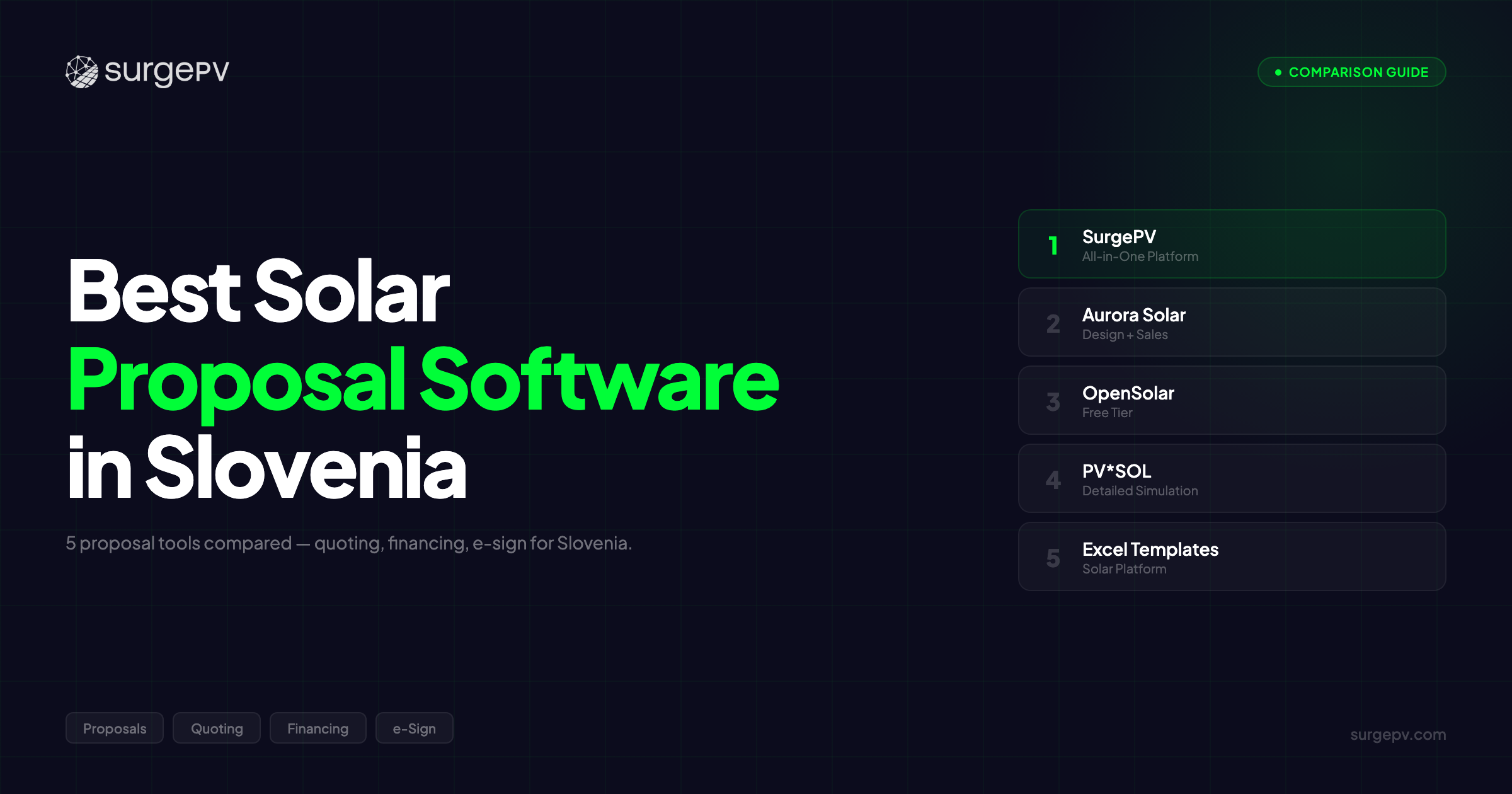
TL;DR: SurgePV is the best solar proposal software for Slovenia in 2026 — generating professional EUR proposals in 15-20 minutes with samooskrba self-supply sizing, Eco Fund subsidy calculations, and battery storage economics built in. Aurora Solar leads on visual quality but lacks all Slovenian financial specifics. OpenSolar is the strongest free option for micro installers.
Somewhere between 200 and 350 solar installers are fighting for the same customers in a country of 2 million people. That is Slovenia’s solar market right now. And with samooskrba self-supply installations making up 50% of new capacity (Agencija za energijo), every residential quote has to be fast, accurate, and persuasive.
Here is the problem most Slovenian installers run into: homeowners compare 3 to 6 quotes before signing. They want to see their exact savings under the self-supply scheme. They want the Eco Fund subsidy (EUR 180/kW, up to EUR 3,000) reflected in the payback period. They want battery storage economics modeled clearly. And they want all of this in EUR — not converted from a USD tool built for Arizona.
Most solar proposal software was built for the American market. Self-supply sizing? Not supported. Eco Fund calculations? Manual spreadsheet work. Net metering at Slovenian retail rates? You are on your own.
We tested and compared 5 solar proposal platforms for the Slovenian market, evaluating each on self-supply accuracy, subsidy integration, proposal speed, battery modeling, and pricing.
In this guide, you’ll learn:
- Which platform automates samooskrba self-supply sizing and Eco Fund subsidy calculations
- How proposal generation speed compares (from 15 minutes to 2 hours)
- Which tools support EUR natively and model Slovenian electricity rates
- Our recommendation based on testing real Slovenian project scenarios
Quick Comparison Table
| Software | Best For | Pricing/Year | Self-Supply | Eco Fund |
|---|---|---|---|---|
| SurgePV | Complete proposal workflows | $1,899 (3 users) | Yes (samooskrba) | Yes |
| Aurora Solar | Polished residential proposals | ~EUR 2,900/yr | No | No |
| OpenSolar | Budget-friendly proposals | Free-~EUR 2,200/yr | No | No |
| PV*SOL | European residential + battery | EUR 950-1,900 | Basic | No |
| Excel Templates | Micro installers (<5/month) | Free | Manual | Manual |
Best Solar Proposal Software in Slovenia (Detailed Reviews)
SurgePV — Best End-to-End Proposal Platform for Slovenian Installers
Best For: Installers and EPCs handling 10+ self-supply and commercial proposals per month
Pricing: $1,899/year (3 users); $1,499/user/year (For 3 Users plan)
Proposal Speed: 15-20 minutes (design to final PDF)
SurgePV is an end-to-end solar platform that combines design, simulation, electrical engineering, and proposal generation in a single cloud-based tool.
For Slovenian proposal workflows, the integrated approach solves a very specific problem.
Most competing tools treat proposals as an afterthought. You design in one application, then manually transfer data into a proposal builder or spreadsheet. System sizing, production estimates, financial calculations, subsidy impacts — all re-entered by hand. That is where errors creep in, and where an hour of your day disappears on every single project.
SurgePV generates proposals directly from your design. Size the system, run the simulation, and the proposal populates automatically — including samooskrba self-supply calculations, Eco Fund subsidy impacts, and net metering savings at Slovenian retail rates.
Key Proposal Features for Slovenia
- Self-supply (samooskrba) calculator — Sizes systems to match annual electricity consumption, meeting Slovenia’s self-supply scheme requirements. Oversizing beyond consumption reduces the customer’s financial return — this tool prevents that mistake automatically.
- Eco Fund subsidy integration — Applies Eco Fund subsidies (EUR 180/kW, up to EUR 3,000) directly into financial projections, showing pre- and post-subsidy payback periods. Customers see the exact financial picture before signing.
- Battery storage proposals — Models self-consumption improvement (30-40% without storage to 60-80% with storage), battery sizing, and economics at current Slovenian electricity prices (EUR 0.16-0.22/kWh). With 30-40% of buyers asking about storage, this is no longer optional.
- Multi-scenario proposals — Generates with/without battery, with/without Eco Fund subsidy, and multiple system sizes in a single document. When homeowners compare 3-6 quotes, the installer who shows options wins.
- Regional performance modeling — Different yield projections for coastal Primorska (1,300-1,400 kWh/m2) versus alpine Gorenjska (1,100-1,200 kWh/m2). Accurate local data builds trust.
- P50/P90 bankability metrics — Accuracy within +/-3% of PVsyst, producing the estimates Slovenian banks (NLB, Nova KBM) require for commercial project financing.
- Automated SLD generation — Creates electrical schematics for all five Slovenian DSOs in 5-10 minutes, included as proposal attachments for grid connection applications.
Pro Tip
SurgePV’s design-to-proposal workflow eliminates manual data transfer entirely. Design, simulate, and generate a professional EUR proposal in 15-20 minutes. Book a demo to see it on a real Slovenian project.
Pricing
| Plan | Price | Users |
|---|---|---|
| Individual | $1,899/year | 3 users |
| For 3 Users | $1,499/user/year | 3 users |
| For 5 Users | $1,299/user/year | 5 users |
| Enterprise | Custom | Multiple |
All features included on every plan — design, simulation, SLDs, proposals. No hidden fees, no feature gating. See full pricing.
Who SurgePV Is Best for in Slovenia
- Self-supply (samooskrba) installers needing fast sizing and Eco Fund calculations in every proposal
- Commercial EPCs needing integrated design-to-proposal workflows with SLD attachments
- Teams sending 10+ proposals per month who cannot afford 1-2 hours of manual work per quote
- Installers wanting to show battery storage options alongside standard self-supply scenarios
Limitations
- English interface (no Slovenian localization yet)
- Proposal templates are professional but less visually flashy than Aurora Solar’s interactive web proposals
Real-World Example
A 5-person installer in Maribor was losing 30% of residential bids to competitors with faster turnaround. Their manual workflow — design in PV*SOL, SLDs in AutoCAD, proposals in Excel — took 3 hours per quote. After switching to SurgePV, proposal time dropped to 18 minutes. They now respond to every inquiry within 24 hours. Win rate increased from 22% to 34% in the first quarter.
Further Reading
- Best Solar Proposal Software (2026) — Global comparison across 10+ platforms
- Best Solar Design Software in Slovenia — Design platform comparison for the Slovenian market
- Best All-in-One Solar Software — Complete platform reviews
Aurora Solar produces beautiful proposals that miss Slovenian financial specifics entirely. SurgePV produces accurate proposals with every Slovenian financial variable built in. In a market where customers compare quotes on payback period accuracy, the tool that gets the numbers right wins more deals than the tool with the prettier PDF.
Aurora Solar — Best-Looking Proposals (But Missing Slovenian Specifics)
Best For: Larger installers with international operations who prioritize visual presentation
Pricing: ~EUR 2,900/year ($3,108/year)
Aurora Solar is the industry leader in proposal design. Its interactive web-based proposals are genuinely impressive — homeowners can explore their roof in 3D, toggle system sizes, and see financial impacts in real time. For the US market, it is the gold standard.
What Works for Slovenia
- Industry-leading visual proposal quality — interactive 3D roof models
- Strong AI-powered roof detection for fast residential design
- CRM integrations (Salesforce, HubSpot) for larger sales operations
- E-signature integration for faster contract signing
Where It Falls Short in Slovenia
- No samooskrba modeling — Cannot size systems to match annual consumption per Slovenia’s self-supply requirements
- No Eco Fund integration — EUR 180/kW subsidies must be calculated and added manually to every proposal
- USD-first proposals — Generates in USD by default, requiring manual EUR conversion
- No SLD generation — DSO grid connection documentation needs separate tools
- US-centric electricity rates — Slovenian tariff structures (EUR 0.16-0.22/kWh) require manual configuration
Best for: Larger Slovenian companies with international operations where visual proposal quality matters more than local financial accuracy.
For a deeper analysis, read our full Aurora Solar review.
OpenSolar — Budget-Friendly Proposals for Small Slovenian Installers
Best For: Budget-conscious small installers starting with digital proposals
Pricing: Free tier available; paid plans ~EUR 2,200/year
OpenSolar offers a free tier that makes it attractive for small Slovenian installers transitioning from manual Excel workflows. The platform combines basic design, simulation, and proposal generation in a cloud-based interface.
What Works for Slovenia
- Free tier available — zero barrier to entry for micro installers
- Basic design-to-proposal workflow in a single platform
- International location support including Slovenian addresses
- EUR support in proposals
Where It Falls Short in Slovenia
- No self-supply sizing — Cannot match system to annual consumption per samooskrba rules
- No Eco Fund calculations — Subsidy impact must be added manually
- Limited financial modeling — Basic savings calculations without Slovenian tariff structure support
- No SLD generation — DSO documentation requires external tools
- Free tier limitations — Restricted features, branding limitations
Best for: Micro installers handling under 5 proposals per month who need a free starting point. Upgrade to SurgePV when volume or accuracy requirements increase.
PV*SOL — European Residential Design with Manual Proposals
Best For: European-market installers who want strong battery modeling
Pricing: EUR 950-1,900/license
PV*SOL is a German-developed desktop tool built for European markets. Its strength lies in detailed residential design with excellent battery storage modeling — important as 30-40% of Slovenian residential buyers now ask about storage options.
What Works for Slovenia
- European-focused with some Slovenian climate data included
- Excellent battery storage modeling and self-consumption analysis
- Good residential 3D visualization for tile rooftops
- IEC-standard electrical calculations
- One-time license option (no recurring subscription)
Where It Falls Short in Slovenia
- Limited proposal output — Technical reports rather than professional customer-facing proposals
- No Eco Fund integration — Subsidy calculations require manual work
- No samooskrba sizing — Cannot automatically match system to annual consumption
- Desktop-only — No cloud collaboration, no remote proposal sharing
- No SLD generation — DSO grid documentation requires separate AutoCAD (~EUR 2,000/year)
Best for: Slovenian residential installers already using PV*SOL for design who are comfortable generating proposals manually or through separate tools.
Excel Templates — Manual Baseline for Micro Installers
Best For: Very small installers handling fewer than 5 proposals per month
Pricing: Free
Custom Excel spreadsheets remain the starting point for many Slovenian micro installers. Full customization is the only real advantage — you control every calculation, every layout, every line item.
What Works for Slovenia
- Free — zero software cost
- Fully customizable for Slovenian regulations
- Can model any financial scenario manually
Where It Falls Short
- 1-2 hours per proposal — Versus 15-20 minutes in SurgePV
- Error-prone — Manual data entry introduces calculation mistakes
- Unprofessional appearance — Spreadsheets lose against polished PDF or web proposals
- No design integration — Production estimates entered manually from separate tools
- No version control — Difficult to track changes or manage multiple scenarios
Best for: Sole traders handling fewer than 5 proposals per month where software cost is the primary constraint.
Solar Proposal Software Comparison Table for Slovenia
| Feature | SurgePV | Aurora Solar | OpenSolar | PV*SOL | Excel |
|---|---|---|---|---|---|
| Best for | Complete workflows | Visual proposals | Budget option | EU residential | Micro installers |
| Self-supply sizing | Yes (samooskrba) | No | No | Basic | Manual |
| Eco Fund subsidy | Yes | No | No | No | Manual |
| Net metering | Yes (Slovenian) | Basic | Basic | Basic | Manual |
| Battery economics | Full | Good | Basic | Excellent | Manual |
| Proposal templates | Professional | Best-in-class | Good | Basic | None |
| Design integration | Full (end-to-end) | Full | Full | Full (desktop) | None |
| SLD generation | Yes (automated) | No | No | No | No |
| Proposal speed | 15-20 min | 20-30 min | 20-30 min | 30+ min | 1-2 hours |
| EUR support | Yes | USD default | Yes | Yes | Yes |
| Pricing/year | $1,899 (3 users) | ~EUR 2,900 | Free-~EUR 2,200 | EUR 950-1,900 | Free |
Further Reading
For a broader comparison beyond the Slovenian market, see our guide to the best solar proposal software globally.
What the Best Solar Proposal Software in Slovenia Actually Needs to Do
Self-Supply (Samooskrba) Sizing and Financial Modeling
Half of Slovenia’s solar market operates under the samooskrba self-supply scheme. The rules are specific: system capacity must be sized to match annual electricity consumption, with annual net metering at the retail rate (EUR 0.16-0.22/kWh). Oversizing beyond consumption means excess energy is either compensated at a lower rate or donated to the grid (Agencija za energijo).
Every quote must demonstrate that the proposed system matches the customer’s actual consumption pattern — not just a generic “10 kW system” that may over- or under-produce. SurgePV automates this sizing. Most competitors require manual calculations.
Eco Fund Subsidy Integration
Eco Fund (Eko sklad) provides EUR 180/kW subsidies for residential solar installations, capped at EUR 3,000 per system. These subsidies open in periodic application windows and significantly impact payback calculations — reducing a typical 8-year payback to 5-6 years. Proposal software that integrates subsidy calculations into financial projections automatically eliminates manual spreadsheet work and produces accurate, persuasive proposals that reflect the customer’s actual costs.
Battery Storage Economics
30-40% of Slovenian residential solar buyers now ask about battery storage. The economics are straightforward: self-consumption increases from 30-40% without storage to 60-80% with a properly sized battery. But the upfront cost (EUR 4,000-8,000 for 5-10 kWh) means the financial case only works with accurate modeling. Proposal software must show clear side-by-side comparisons — system with and without battery, showing payback impact, self-consumption improvement, and lifetime savings at current Slovenian electricity rates.
Speed in a Competitive Market
200-350 installers competing for every customer. Homeowners comparing 3-6 quotes. Sales cycles of 1-3 weeks for residential. In this environment, proposal speed is a competitive weapon. An installer using SurgePV sends a professional proposal in 15-20 minutes. An installer using Excel sends one in 1-2 hours. The fast installer responds the same day. The slow installer responds in 3 days. The customer has already signed with someone else.
Regional Performance Accuracy
Slovenia’s geography is unusually diverse. Coastal Primorska receives 1,300-1,400 kWh/m2/year of solar irradiance. Alpine Gorenjska drops to 1,100-1,200 kWh/m2/year with significant mountain shading. Continental Pomurje sits somewhere in between. Proposal software with accurate regional weather data produces credible production estimates. Generic tools using national averages over- or under-promise — both of which erode customer trust.
Our Testing Methodology (And Why It Matters)
We evaluated each platform against five weighted criteria specific to the Slovenian proposal market:
- Self-supply and Eco Fund modeling (30%) — Samooskrba sizing accuracy, net metering calculations, subsidy integration, financial projections
- Proposal quality and speed (25%) — Professional output, visual design, generation speed, EUR support, multi-scenario capabilities
- Battery storage proposals (20%) — Storage sizing, self-consumption modeling, economics, side-by-side comparisons
- Design integration (15%) — Single-platform workflow, accurate BOM, regional yield data, SLD attachments
- Cost-effectiveness (10%) — Annual cost relative to Slovenian installer margins and team size scalability
Testing was conducted between January and February 2026, using real Slovenian residential and commercial project scenarios with consumption data and current Gen-I electricity tariffs.
Close More Solar Deals in Slovenia with SurgePV
Professional proposals with self-supply sizing, Eco Fund subsidies, and battery economics — generated in 15-20 minutes from your design.
Book a DemoNo commitment required · 20 minutes · Live project walkthrough
Bottom Line: Best Solar Proposal Software for Slovenia
Slovenia’s solar proposal market comes down to one question: can your tool model the financials Slovenian customers actually need to see?
For installers who want everything in one platform: SurgePV is the clear choice. Samooskrba self-supply sizing, Eco Fund subsidy integration, battery economics, professional EUR proposals, and automated SLD generation for all five DSOs — all from a single design. 15-20 minutes per proposal. $1,899/year for 3 users.
For visual presentation priority: Aurora Solar produces the best-looking proposals in the industry. But at ~EUR 2,900/year with no self-supply sizing, no Eco Fund calculations, and USD-first pricing, it is a hard sell for most Slovenian installers.
For budget-conscious starters: OpenSolar’s free tier is a viable starting point for micro installers, though you will outgrow it quickly once Slovenian financial modeling becomes important.
For battery-focused residential design: PV*SOL offers the deepest battery modeling, but desktop-only limitations and basic proposal output mean you still need manual work to produce customer-facing documents.
The Slovenian solar market is not getting less competitive. With 250-400 MW of new capacity added annually and hundreds of installers fighting for market share, the companies closing deals are the ones sending accurate, professional proposals the fastest — not the ones spending 2 hours per quote in Excel.
Want to see how SurgePV generates Slovenian solar proposals? Book a demo and our team will walk you through a real self-supply scenario with Eco Fund subsidies.
Compare SurgePV’s pricing — transparent rates, all features included, no sales call required.
Further Reading
- Best Solar Software for EPCs — EPC-focused platform comparison
- Best Solar Simulation Software — Bankability comparison
- Self-Consumption in Solar — Understanding samooskrba systems
When You May Not Need Solar Proposal Software
Micro installers (fewer than 5 proposals per month): If you are a one-person operation handling only occasional residential projects, the cost of professional software (EUR 1,750-2,900 annually) may exceed the time-saving benefits. At this volume, Excel templates with manual subsidy calculations, while slower, may be economically justifiable.
Sales-only organizations outsourcing design: If your business model is purely lead generation and sales, with all technical design and engineering contracted to third-party EPCs, integrated design-to-proposal platforms like SurgePV may be unnecessary. A lightweight CRM with basic proposal templates might serve your needs better.
Established companies with custom internal systems: Some larger Slovenian EPCs and installers have invested in proprietary software that already handles samooskrba sizing, Eco Fund calculations, and proposal generation. If your internal tools are working efficiently and are well-maintained, migrating to third-party platforms may not provide meaningful advantages.
Projects with highly standardized specifications: If you focus exclusively on identical, repeatable installations with no customization or battery options, and compete primarily on price rather than proposal quality, basic spreadsheet workflows may still be adequate — though you will sacrifice response speed.
Bottom Line
The economic inflection point for most Slovenian installers is 8-12 proposals monthly. Below that threshold, software investment may not pay for itself immediately. Above it, professional automation becomes essential for competitive speed and accuracy.
Frequently Asked Questions
What is the best solar proposal software in Slovenia?
SurgePV is the best solar proposal software for Slovenia in 2026. It combines self-supply (samooskrba) sizing, Eco Fund subsidy calculations (EUR 180/kW), net metering modeling, and battery economics in professional EUR proposals — all integrated with design and simulation at $1,899/year for 3 users. For visual proposal quality alone, Aurora Solar leads but lacks Slovenian financial features.
Can proposal software calculate Slovenian self-supply sizing?
Yes. SurgePV sizes systems to match annual electricity consumption per Slovenia’s samooskrba self-supply scheme, ensuring proposals meet regulatory requirements while maximizing customer financial benefit. Most other platforms — including Aurora Solar and OpenSolar — require manual sizing calculations.
Does proposal software include Eco Fund calculations?
SurgePV integrates Eco Fund (Eko sklad) subsidies — EUR 180/kW, up to EUR 3,000 per system — into financial projections, showing pre- and post-subsidy payback periods in customer proposals automatically. No other platform tested includes this feature natively.
How fast can you create a solar proposal in Slovenia?
With SurgePV, proposals including self-supply sizing, subsidy calculations, and battery storage options take 15-20 minutes from completed design. Aurora Solar takes 20-30 minutes. OpenSolar takes 20-30 minutes. Manual Excel workflows require 1-2 hours per project.
How much does solar proposal software cost in Slovenia?
Costs range from free (Excel templates or OpenSolar’s free tier) to approximately EUR 2,900/year (Aurora Solar). SurgePV starts at $1,899/year for 3 users with integrated design, simulation, SLD generation, and proposal generation. PV*SOL costs EUR 950-1,900 as a one-time license but offers limited proposal output.
Can proposal software model battery storage for Slovenia?
Yes. SurgePV and PV*SOL model battery sizing, self-consumption improvement (from 30-40% without storage to 60-80% with storage), and storage economics at current Slovenian electricity prices (EUR 0.16-0.22/kWh). Aurora Solar offers good battery modeling but without Slovenian-specific rate structures.
What should a Slovenian solar proposal include?
A complete Slovenian solar proposal must include self-supply system sizing matched to annual consumption, Eco Fund subsidy impact (EUR 180/kW), net metering savings at retail rate, payback period (target 5-8 years with subsidy), battery storage options, equipment BOM, DSO grid connection requirements, and warranty details.
Which proposal software supports EUR for Slovenia?
SurgePV, OpenSolar, and PV*SOL natively support EUR in proposals. Aurora Solar generates USD proposals by default, requiring manual conversion for Slovenian customers — an unnecessary friction point in the sales process.
Important
All pricing data in this article was verified against official sources as of February 2026. Prices may have changed since publication.
Sources
- Agencija za energijo (Energy Agency of Slovenia) — Self-supply regulations and net metering rules
- Eco Fund (Eko sklad) — Residential solar subsidies and application guidelines
- ELES (Slovenian Transmission System Operator) — Grid codes and connection standards
- Ministry of Infrastructure of Slovenia — Energy policy and NECP targets
- IRENA — Slovenia Renewable Energy Profile — Installed capacity and growth data
- Global Solar Atlas — GHI data for Slovenian regions
- Gen-I — Slovenian electricity tariff data
- European Commission — Slovenia NECP — National Energy and Climate Plan
- G2 Aurora Solar Reviews — User reviews and ratings
- SurgePV Product Documentation — Official feature specifications (accessed February 2026)