

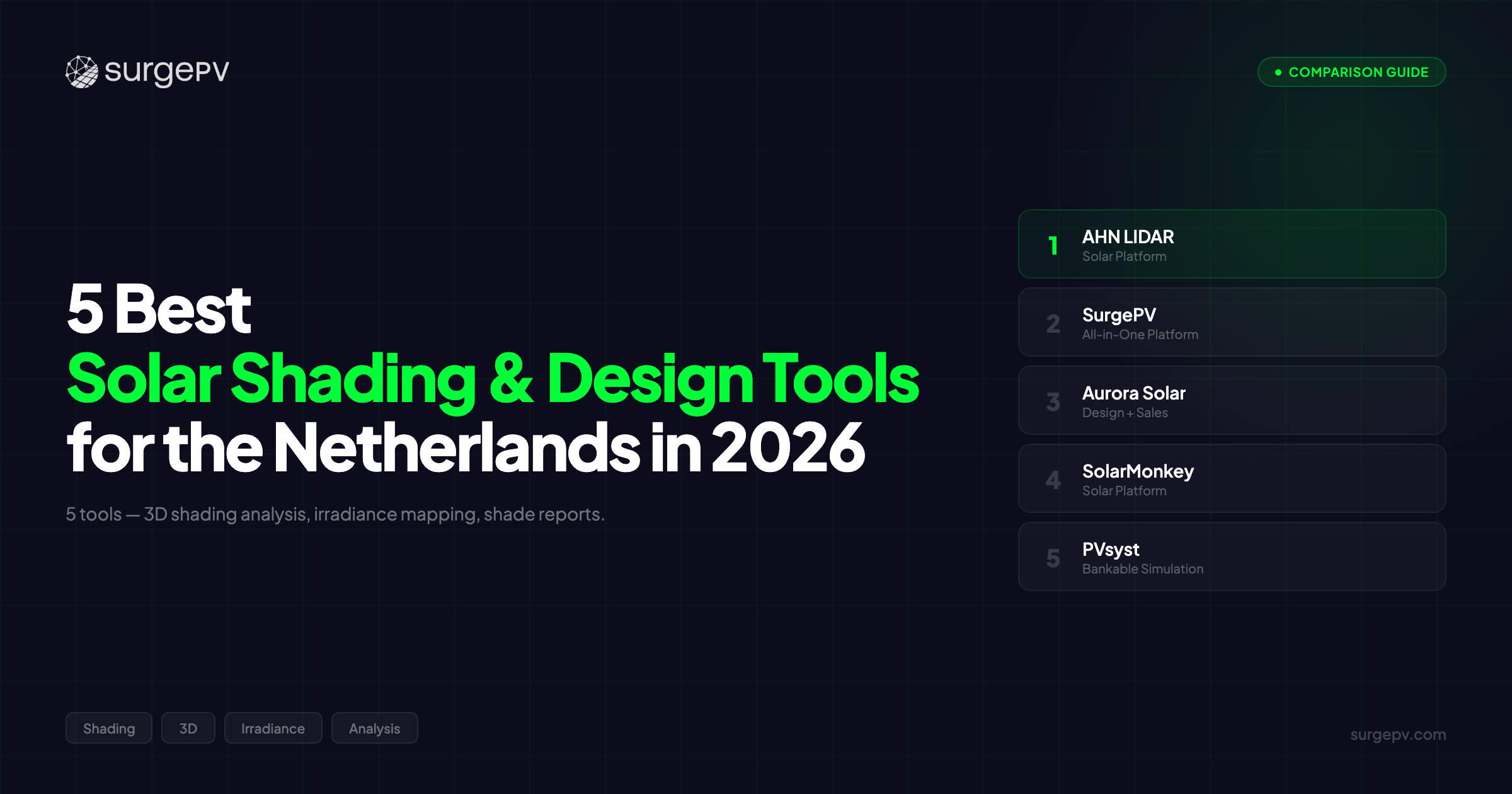
TL;DR: SurgePV is the best solar shading and design tool for Dutch installers in 2026. It delivers AI-powered shading analysis with 8,760-hour simulation, per-panel heatmaps, and P50/P75/P90 bankable reports, all optimized for Dutch roof types, low sun angles, and the saldering phase-out. PVsyst remains the benchmark for bankable shade reports, while SolarMonkey offers the best Dutch-native experience. Read on for the full Netherlands-specific comparison.
One in three Dutch rooftops now has solar panels. But at 52 degrees north latitude, a single chimney can wipe out 30% of a panel’s output from October through February.
That is not a hypothetical. It is a daily reality for Dutch solar installers working in Amsterdam-West, Rotterdam-Zuid, and Utrecht’s Kanaleneiland. The Netherlands has some of the tightest urban roof layouts in Europe — terraced rijwoningen stacked side by side, canal houses with irregular gables, and flat-roof apartment blocks shadowed by trees and neighboring buildings.
And the stakes just went up. With the Dutch government phasing out saldering (net metering) between 2025 and 2031, every kilowatt-hour of shade-related production loss now hits the homeowner’s wallet directly. Under full saldering, minor shading barely mattered because surplus energy was credited at retail rates. That safety net is disappearing. Accurate shading analysis is no longer a nice-to-have for Dutch installers. It is the difference between a profitable system and a customer complaint.
Here is the problem: most solar shading analysis tools are built for global markets. They do not account for the Netherlands’ extreme winter shadow lengths, the country’s world-class AHN LIDAR data, or the financial modeling required under saldering transition rules.
We tested the leading shading and solar design tools on Dutch roof types across Amsterdam, Rotterdam, and Utrecht — terraced houses with chimney shading, canal houses with dormer obstructions, and flat-roof commercial buildings. We evaluated each tool’s ability to handle low sun angles at 52 degrees N, import AHN LIDAR elevation data, model saldering impact on system ROI, and produce permit-ready documentation that meets RVO standards.
In this guide, you will find:
- Side-by-side comparison table with Netherlands-specific columns (Dutch language, AHN LIDAR, saldering modeling)
- The 5 best shading and design tools ranked for the Dutch market
- Why shading analysis is fundamentally different in the Netherlands (52 degrees N latitude, terraced housing, canal houses)
- How the saldering phase-out changes shading accuracy requirements
- How modern design software replaces traditional solar drafting services in the Netherlands
- BENG compliance requirements and SDE++ shade report standards
- 10 Netherlands-specific FAQs
Whether you are a solo Dutch installer doing 30 residential systems a year or a multi-team EPC handling SDE++ commercial projects, the right solar simulation software will help you pick the right shading tool for your Dutch business.
Quick Comparison: 5 Best Solar Shading Tools for Dutch Installers
Before diving into each tool, here is how they compare across the features that matter most for the Netherlands.
| Feature | SurgePV | Aurora Solar | SolarMonkey | PVsyst | PV*SOL |
|---|---|---|---|---|---|
| Best For | AI shading + design + drafting | High-volume residential | Dutch-native proposals | Bankable shade reports | Detailed residential simulation |
| Dutch Language | Yes | No | Yes (native) | No | Partial (German-based) |
| AHN LIDAR Import | Yes | Yes | Limited | Manual import | Manual import |
| Saldering Modeling | Yes | No | Yes | No | Limited |
| Shading Method | AI + 8,760-hour | Automated + LIDAR | Satellite + LIDAR | Manual 3D modeling | Ray-tracing 3D |
| Shading Accuracy | ±3% vs PVsyst | Good | Good | Benchmark | Good |
| P50/P75/P90 | Yes | P50 only | No | Yes (gold standard) | Limited |
| Cloud-Based | Yes | Yes | Yes | No (desktop) | No (desktop) |
| Permit Drawings | Auto-generated | No | Limited | No | No |
| Price (approx.) | ~EUR 1,750/yr (3 users) | Contact sales | EUR 15/quote | ~CHF 1,100/yr | ~EUR 1,300/yr |
| Rating | 9.2/10 | 8.5/10 | 8.0/10 | 8.8/10 | 7.8/10 |
Quick verdict: For Dutch installers who need accurate shading analysis with saldering-aware financial modeling and auto-generated permit drawings, SurgePV offers the most complete package. PVsyst delivers the bankable shade reports Dutch financiers still require for large projects. SolarMonkey is the strongest pick for Dutch-language proposals at the residential level.
See how SurgePV handles Dutch roof shading — Book a free demo.
Why Shading Analysis Is Different in the Netherlands
Dutch solar installers cannot rely on shading tools designed for sunnier markets. The Netherlands presents four unique challenges that require specialized shade modeling.
Low Sun Angles at 52 Degrees N Latitude
The Netherlands sits at 52 degrees north — roughly the same latitude as Berlin, but with a flatter landscape that amplifies shadow effects. In December, the sun angle drops to approximately 15 degrees above the horizon. At that angle, a 10-meter-tall tree casts a 40-meter shadow across neighboring rooftops.
Here is what that means in practice. A chimney that causes zero shade loss in July can block 30% of a panel’s output in November through February. A dormer window on a terraced house can shade three panels on the neighbor’s roof from October through March.
Dutch shading analysis must model the full 8,760-hour year. Tools that calculate shading using only summer peak conditions or annual averages will significantly underestimate winter shade losses — and that is when Dutch homeowners need accurate production data the most, because electricity prices are highest in winter.
Note
At 52 degrees N, a 10m tree casts a 40m shadow in December. Dutch shading analysis MUST model all 8,760 hours — not just summer peak. Any tool that shortcuts this calculation will overestimate Dutch system yields by 5-15%.
Dutch Roof Types: Terraced Houses, Canal Houses, and Flat Roofs
The Netherlands has a distinctive housing stock that creates shading challenges you will not find in other markets.
Terraced houses (rijwoningen): The backbone of Dutch residential solar. These row houses share walls, which means chimneys, dormers, and ventilation pipes on one roof cast shadows on adjacent properties. A typical terraced roof in Rotterdam or Amsterdam has 2-4 obstructions within shading range of a neighbor’s panels.
Canal houses (grachtenpanden): Amsterdam’s iconic canal houses have narrow, steep gabled roofs with irregular shapes. Many feature multiple dormers, stepped gables, and decorative elements that create complex shading patterns. Modeling these roofs requires centimeter-level accuracy.
Flat-roof apartments and commercial buildings: Dutch commercial and multi-family buildings predominantly use flat roofs, where nearby trees, elevator shafts, and HVAC units create shading. East-west panel configurations are common to maximize energy density on limited Dutch roof space.
AHN LIDAR — The Netherlands’ World-Class Elevation Data
Here is the good news. The Netherlands has one of the best public LIDAR datasets in the world.
The AHN (Actueel Hoogtebestand Nederland) provides centimeter-accurate 3D elevation data for the entire country. Every building, tree, chimney, and obstruction is mapped. The current AHN4 dataset, collected between 2020 and 2022, gives Dutch solar installers a level of shading data accuracy that most countries can only dream of.
The key question: does your shading tool actually use AHN data?
SurgePV and Aurora Solar integrate directly with LIDAR sources including AHN, enabling automatic roof and obstruction detection. PVsyst and PV*SOL require manual import of elevation data. SolarMonkey uses a combination of satellite imagery and selective LIDAR integration for the Dutch market.
The Saldering Phase-Out (2025-2031): Why Every kWh Matters Now
This is the single biggest reason Dutch installers need better shading analysis in 2026.
Saldering — the Dutch term for net metering — allowed homeowners to offset their electricity bill kilowatt-for-kilowatt with solar production. Under full saldering, if your panels produced 100 kWh but your roof had 10% shading losses, the financial impact was minimal because you were still banking surplus energy at retail rates.
The Dutch government is phasing out saldering between 2025 and 2031. By 2027, the net metering credit will drop to 64%. By 2031, it reaches zero. That means every kWh lost to shading is a kWh the homeowner cannot offset — and must buy from the grid at full price.
Bottom line: a 10% shading error that cost a Dutch homeowner EUR 50/year under full saldering could cost EUR 150-200/year by 2031. Multiply that across a 25-year system lifetime, and inaccurate shading analysis creates a EUR 2,000-5,000 liability per installation.
Dutch installers who quote systems with optimistic shading assumptions are going to face angry customers as saldering disappears. Accurate shading tools are now a business survival requirement in the Netherlands.
For more on European solar incentive changes affecting the Dutch market, see our dedicated analysis.
The 5 Best Solar Shading & Design Tools for the Netherlands (2026)
SurgePV — Best AI-Powered Shading for Dutch Roofs
Rating: 9.2/10 Price: ~EUR 1,750/year (3 users) | All features included Best for: Dutch installers and EPCs wanting AI-powered shade analysis with saldering-aware financial reports and auto-generated permit drawings
SurgePV is the only platform that combines AI-powered shading analysis, automated electrical engineering, and proposal generation in a single cloud-based workflow. For Dutch installers, that means one tool handles shade modeling, system design, permit documentation, and customer proposals — no AutoCAD, no external drafting bureau, no tool-switching.
How SurgePV handles Dutch shading challenges:
8,760-hour simulation at ±3% accuracy: SurgePV runs a full-year, hour-by-hour shading simulation — not a simplified seasonal estimate. The platform achieves ±3% variance compared to PVsyst, which is the accuracy level Dutch banks and financiers require. At 52 degrees N latitude where winter shadows are extreme, this granularity captures shade losses that annualized tools miss entirely.
So what does that mean for your business? It means you can present shading data to Dutch homeowners and tell them the number is bankable — not an estimate. When saldering drops to 64% in 2027, that accuracy gap is the difference between a system that delivers and one that underperforms.
Per-panel heatmaps for Dutch terraced roofs: SurgePV generates per-panel shade heatmaps that show exactly which panels are affected, during which hours, across all 12 months. On a Dutch terraced roof where a neighbor’s chimney shades 3 panels from October through March, you see the impact immediately and can adjust the layout before generating a quote.
AHN LIDAR integration: SurgePV imports Dutch AHN elevation data for centimeter-accurate roof and obstruction modeling. Chimneys, dormers, trees, and neighboring buildings are detected automatically. No manual 3D modeling required.
Saldering impact modeling: This is where SurgePV stands apart from global tools. The platform models the financial impact of shading under saldering transition scenarios — showing homeowners how shade losses affect their ROI as net metering credits decrease year by year.
Auto-generated permit drawings: SurgePV produces RVO-compliant permit drawings, electrical schematics, and BOM documentation automatically. Dutch installers who previously outsourced this work to a tekenbureau (drafting bureau) eliminate that cost and turnaround time entirely.
P50/P75/P90 bankable reports: SurgePV delivers P50/P75/P90 reports that Dutch banks and SDE++ evaluators accept. Unlike Aurora Solar, which provides only P50 estimates, SurgePV gives Dutch financiers the conservative P75/P90 data they need.
Pro Tip
For Dutch EPCs managing multiple projects per month, SurgePV’s automated permit drawings and shade reports save 40-60 hours monthly. That is an entire FTE redirected from paperwork to revenue-generating work.
Mini case study — Amsterdam terraced house row: A Dutch installer in Amsterdam-West used SurgePV to analyze a row of five terraced houses in the Kolenkitbuurt. The AI detected chimney shading from three neighboring properties that would have reduced output by 18% on four panels during the winter months. The installer adjusted the panel layout, shifting panels away from the shaded zones, and the final design delivered 15% higher annual yield than the original layout proposed by a competitor using satellite-only imagery.
But I have been outsourcing drafting to a bureau — why switch? Because SurgePV generates the same permit drawings, electrical schematics, and installation documentation in minutes instead of days. A typical Dutch tekenbureau charges EUR 150-300 per project for solar drafting. At 50 projects per year, that is EUR 7,500-15,000 in annual drafting costs — versus SurgePV’s EUR 1,750/year for three users that handles drafting, shading, design, and proposals together.
Strengths:
- AI-powered 8,760-hour shading with ±3% PVsyst accuracy
- Per-panel shade heatmaps optimized for Dutch roof types
- AHN LIDAR integration for centimeter-accurate modeling
- Saldering transition financial modeling
- Auto-generated RVO-compliant permit drawings
- P50/P75/P90 bankable reports
- Dutch-language outputs for customer presentations
- Cloud-based — no installation required
Limitations:
- Relatively new to the Dutch market compared to PVsyst
- Desktop training may be needed for teams used to AutoCAD workflows
- Less brand recognition than Aurora Solar in the Netherlands
Try SurgePV on a Dutch roof project — Schedule a walkthrough.
Aurora Solar — Best for High-Volume Dutch Residential
Rating: 8.5/10 Price: Contact sales for custom pricing (~EUR 4,500/year estimated) Best for: High-volume residential installers in the Netherlands focused on sales speed
Aurora Solar is the market leader in residential solar design globally, and many Dutch installers use it for its fast AI roof modeling and polished proposal generation. If you are a Netherlands-based installer running 50+ residential quotes per month, Aurora’s speed is hard to beat.
Strengths for the Dutch market:
AI roof detection: Aurora creates 3D roof models from satellite imagery in seconds. For standard Dutch terraced roofs with clear sightlines, this is fast and reasonably accurate. The platform integrates with LIDAR data sources, including AHN, for improved obstruction detection on complex Dutch rooftops.
Proposal quality: Aurora generates clean, web-based proposals that Dutch homeowners can view on their phone or laptop. The visual quality is among the best in the industry, which matters when you are competing on first impressions.
CRM integrations: If your Dutch installation business uses Salesforce, HubSpot, or similar platforms, Aurora’s integrations streamline the sales-to-design pipeline.
Where Aurora falls short for Dutch installers:
No saldering modeling. Aurora does not natively model the Dutch saldering phase-out or its impact on system ROI. Dutch installers must calculate this externally and present it alongside Aurora’s output. As saldering becomes the central conversation in Dutch solar sales, this gap grows more significant each year.
No Dutch-language interface. Aurora operates in English only. For Dutch installers presenting to homeowners who prefer Dutch-language documentation, this creates friction. Compare this to SolarMonkey, which operates entirely in Dutch.
P50 only — no P75/P90. For Dutch commercial projects or SDE++ applications requiring bankable shade reports, Aurora’s simulation limitations require a second tool like PVsyst. That adds cost and complexity.
No permit drawings or electrical schematics. Dutch installers using Aurora still need AutoCAD or a tekenbureau for permit documentation, adding EUR 2,000/year (AutoCAD license) or EUR 150-300/project (outsourced drafting).
Strengths:
- Industry-leading AI roof detection speed
- High-quality web-based proposals
- Strong CRM integrations
- Large user community and documentation
Limitations:
- No saldering modeling for Dutch market
- English-only interface (no Dutch)
- P50 only — no P75/P90 for bankable reports
- No permit drawings or electrical schematics
- Contact-sales pricing model
Further Reading
See our detailed Aurora Solar review for the full breakdown.
SolarMonkey — Best Dutch-Native Solar Design Platform
Rating: 8.0/10 Price: EUR 15/quote or EUR 150/10 quotes | Enterprise plans available Best for: Dutch residential installers wanting a native-language platform built for the Netherlands market
SolarMonkey is the only tool on this list that is built in the Netherlands, by Dutch developers, for Dutch installers. With 300+ Dutch installation companies using the platform and over 350,000 quotes generated annually, SolarMonkey has the deepest understanding of the Dutch residential solar market.
Why SolarMonkey matters for Dutch shading analysis:
Native Dutch-language everything: Interface, proposals, shade reports, customer communications — all in Dutch from day one. No translation layers, no English-only documentation. When a Dutch homeowner in Eindhoven receives a SolarMonkey proposal, it reads naturally in their language, with Dutch formatting for dates, currency, and energy units.
Saldering-integrated proposals: SolarMonkey’s financial modeling accounts for the saldering phase-out schedule. Proposals show homeowners how their ROI changes as net metering credits decrease through 2031. This is a sales advantage that global tools simply do not offer.
Dutch-specific pricing models: The per-quote pricing (EUR 15/quote or EUR 150 for 10) works well for small Dutch installers who do not want annual subscription commitments. For a solo installer doing 10-20 systems per month, this scales affordably.
Integrated shading with proposals: SolarMonkey combines shade analysis with proposal generation in one step. You model the roof, identify shading, design the system, and generate a customer-ready proposal without switching tools.
Where SolarMonkey has limitations:
The shading analysis is less granular than SurgePV or PVsyst. SolarMonkey uses satellite imagery with selective LIDAR integration rather than full 8,760-hour simulation. For standard Dutch terraced roofs with obvious obstructions, this works well. For complex canal houses or commercial buildings with subtle shading from trees and neighboring structures, you may miss losses that a full simulation would catch.
No bankable P50/P75/P90 reports. SolarMonkey is a residential sales tool, not an engineering platform. Dutch EPCs working on commercial or SDE++ projects still need solar software like PVsyst or SurgePV for bankable shade data.
Netherlands-only. SolarMonkey is designed for the Dutch market. If your business operates across European borders, you will need a second platform.
Strengths:
- 100% Dutch-native language and UX
- Saldering phase-out financial modeling
- 300+ Dutch installers, 350,000+ quotes/year
- Affordable per-quote pricing for small Dutch businesses
- Integrated shading + proposal workflow
Limitations:
- Less granular shading than SurgePV or PVsyst
- No P50/P75/P90 bankable reports
- Netherlands-only (no international support)
- Limited commercial/utility-scale features
- No electrical engineering or permit drawings
Further Reading
See our SolarMonkey review for the full analysis.
PVsyst — Best for Bankable Dutch Shade Reports
Rating: 8.8/10 Price: ~CHF 1,100/year per license (desktop only) Best for: Dutch EPCs and developers needing investment-grade shade reports for SDE++ applications and Dutch bank financing
PVsyst has been the industry standard for bankable solar simulations for over two decades. Dutch banks, pension funds, and RVO evaluators recognize PVsyst shade reports as the benchmark for energy yield validation.
Why PVsyst matters for Dutch shading:
Gold-standard P50/P75/P90 simulations: Every major Dutch bank — ABN AMRO, Rabobank, ING — accepts PVsyst shade reports for project financing. For SDE++ subsidy applications, PVsyst’s production guarantees carry weight that newer tools are still building.
Detailed loss chain analysis: PVsyst breaks down shade losses into granular categories: near shading from obstructions, far shading from horizon, electrical mismatch losses from partial shading, and module-level degradation. For Dutch projects where winter shading causes significant mismatch losses, this detail matters.
BENG compliance support: For new construction projects subject to BENG (Bijna Energieneutrale Gebouwen) requirements, PVsyst provides the shade analysis depth that BENG energy balance calculations require. Dutch architects and engineering firms rely on PVsyst data for building permit submissions.
KNMI weather data: PVsyst integrates with KNMI (Royal Netherlands Meteorological Institute) weather data for accurate Dutch irradiance modeling. The platform uses location-specific TMY (Typical Meteorological Year) data that captures the Netherlands’ unique cloud cover patterns and low irradiance conditions (950-1,100 kWh/m2/year).
Where PVsyst falls short for Dutch installers:
PVsyst is not a design tool. It is a simulation engine. You cannot create roof layouts, detect obstructions from LIDAR, generate proposals, or produce permit drawings in PVsyst. It requires manual 3D scene construction — placing buildings, trees, and obstructions by hand. For a Dutch terraced street with 10 chimneys and 5 dormers, this takes hours.
Desktop-only. No cloud access, no mobile access, no team collaboration. Each license is tied to one machine. For Dutch installation companies with field teams and office designers, this creates workflow bottlenecks.
No saldering modeling. PVsyst calculates energy yield, not financial return under Dutch-specific incentive structures. Saldering impact must be calculated externally.
4-6 week learning curve. PVsyst is powerful but not intuitive. New Dutch team members need significant training before they can produce reliable shade reports.
Strengths:
- Gold-standard P50/P75/P90 reports accepted by all Dutch banks
- Detailed shade loss chain analysis
- BENG compliance-ready documentation
- KNMI weather data integration
- 20+ years of industry trust
Limitations:
- Desktop-only, no cloud collaboration
- Not a design tool — no layout, no proposals, no permit drawings
- Manual 3D modeling required (hours per project)
- No saldering financial modeling
- No Dutch-language interface
- 4-6 week onboarding
Further Reading
See our full PVsyst review for the complete assessment.
Bottom line: PVsyst remains essential for final bankability validation on large Dutch projects. But for daily design and shading work, you need a design platform alongside it. SurgePV offers PVsyst export capability, so you can design in SurgePV and validate in PVsyst when Dutch financiers require it.
PV*SOL — Best for Detailed Residential Shade Simulation
Rating: 7.8/10 Price: ~EUR 1,300/year (PV*SOL premium) Best for: Dutch residential installers wanting detailed 3D shade simulation with ray-tracing accuracy
PV*SOL, developed by German company Valentin Software, is popular among Benelux-region installers for its detailed 3D shading simulation. The platform uses ray-tracing technology to model shade from obstructions with high accuracy, which works well for the complex roofscapes found across Dutch cities.
Strengths for the Dutch market:
Ray-tracing 3D shading: PV*SOL creates detailed 3D models of buildings and obstructions, then traces sun paths through the scene to calculate per-module shade losses. For Dutch terraced houses with chimneys, dormers, and tree shading, this provides granular accuracy.
Minute-by-minute simulation: Like SurgePV’s 8,760-hour approach, PV*SOL models shading across the entire year with fine temporal resolution. This captures the extreme winter shading effects at 52 degrees N that simplified tools miss.
Familiar in the Benelux region: Many Dutch and Belgian installers already know PV*SOL from training or previous employers. The German-language documentation is accessible to Dutch speakers, and the platform has a strong user community in the Benelux market.
Module-level optimization modeling: PV*SOL can model MLPE (module-level power electronics) from SolarEdge and Enphase, showing how optimizers or microinverters mitigate Dutch shading losses at the individual panel level.
Where PV*SOL has limitations for Dutch installers:
Desktop-only: Like PVsyst, PV*SOL runs on local machines with no cloud access. Dutch installation teams working across multiple sites cannot collaborate in real time.
Manual 3D modeling: You must build the 3D scene manually — placing obstructions, defining heights, setting materials. For a simple Dutch terraced roof this takes 30-60 minutes. For a canal house with irregular gables, expect 1-2 hours.
No AHN integration: PV*SOL does not automatically import Dutch AHN LIDAR data. Obstruction heights and positions must be entered manually or imported through workarounds.
No proposals or permit drawings: PV*SOL focuses on simulation accuracy, not the sales-to-permit workflow. Dutch installers still need separate tools for customer proposals and RVO-compliant documentation.
Limited financial modeling for Dutch incentives: PV*SOL does not natively model saldering phase-out scenarios or SDE++ financial parameters.
Strengths:
- High-accuracy ray-tracing 3D shade simulation
- Minute-by-minute annual simulation
- MLPE optimization modeling (SolarEdge, Enphase)
- Established in Benelux installer community
- Detailed shade loss reporting
Limitations:
- Desktop-only, no cloud access
- Manual 3D modeling required
- No AHN LIDAR auto-import
- No Dutch-language interface (German/English)
- No proposals, permit drawings, or electrical schematics
- No saldering or SDE++ financial modeling
- No P50/P75/P90 bankable reports
How Solar Design Software Replaces Manual Drafting in the Netherlands
Many Dutch installers are still outsourcing solar system documentation to external tekenbureaus (drafting bureaus). That made sense five years ago. Today, it is a cost and speed disadvantage.
Traditional Dutch Solar Drafting Services vs. Software
Traditional solar drafting services in the Netherlands work like this: you design a system, then send project details to an external bureau. They produce permit drawings, electrical schematics, BOM lists, and installation documentation. Turnaround: 3-7 business days. Cost: EUR 150-300 per project.
Modern solar design software generates the same documentation in minutes, not days. SurgePV, for example, auto-generates permit-ready single line diagrams, panel layouts, wiring diagrams, and BOM documentation as part of the standard design workflow.
Auto-Generated Permit Drawings
Dutch solar installations require documentation that meets RVO standards. SurgePV generates permit-ready drawings that include panel layout with dimensions, string configuration, electrical routing, and mounting specifications. For a standard Dutch residential system, this takes 5-10 minutes versus the 2-3 hours required in AutoCAD or the 3-7 day wait from a tekenbureau.
Cost Comparison: Outsourced Drafting vs. Software License
| Cost Factor | Outsourced Tekenbureau | SurgePV Software |
|---|---|---|
| Per-project cost | EUR 150-300 | Included in license |
| Annual cost (50 projects) | EUR 7,500-15,000 | ~EUR 1,750 (3 users) |
| Annual cost (100 projects) | EUR 15,000-30,000 | ~EUR 1,750 (3 users) |
| Turnaround time | 3-7 business days | 5-10 minutes |
| Revisions | EUR 50-100 per revision | Instant, unlimited |
| Shading analysis included | No (separate cost) | Yes |
| Proposal generation included | No (separate cost) | Yes |
Pro Tip
Dutch installers using solar design software report 50-70% time savings compared to outsourcing to drafting bureaus, with RVO-compliant documentation generated automatically. At 50+ projects per year, the software pays for itself in 2-3 weeks.
Replace your drafting bureau with one platform — Request a Dutch demo.
Dutch Regulations That Require Accurate Shading Analysis
The Netherlands has a regulatory environment that makes shading accuracy a compliance issue — not just a sales accuracy issue. Four regulations directly tie to shade data quality.
Saldering Phase-Out (2025-2031) — Impact on System ROI
The saldering (net metering) phase-out is the most significant change in Dutch solar economics in a decade. The reduction schedule, as confirmed by the Dutch government:
- 2025: 100% net metering (final full year)
- 2026: ~91% credit
- 2027: ~64% credit
- 2028: ~55% credit
- 2029: ~46% credit
- 2030: ~37% credit
- 2031: 0% (saldering fully eliminated)
Every percentage of shading loss now has a compounding financial impact. A system with 10% undetected shade losses generates 10% less energy — and as saldering credits shrink, those lost kilowatt-hours cost the homeowner progressively more each year.
Dutch installers who quote systems based on inaccurate shading will face callback and warranty pressure as saldering drops. The tools you use for shading analysis today determine your customer satisfaction (and legal exposure) through 2031.
BENG (Bijna Energieneutrale Gebouwen) — Nearly Zero-Energy Buildings
BENG is the Dutch implementation of the EU Nearly Zero-Energy Building directive. All new buildings in the Netherlands must meet BENG standards, which include a minimum share of renewable energy generation.
BENG calculations require accurate solar potential assessment — including shading analysis — to determine how much on-site solar generation contributes to the building’s energy balance. Overestimating solar production due to poor shading analysis means the building fails BENG compliance. PVsyst and SurgePV both provide shade reports that architects and energy consultants use for BENG submissions.
SDE++ Subsidy — Production Guarantees Require Accurate Shade Data
The SDE++ (Stimulering Duurzame Energieproductie) subsidy is the primary financial driver for Dutch commercial and utility-scale solar projects. SDE++ applications require accurate production estimates backed by bankable shade analysis. If actual production falls below SDE++ projections due to unaccounted shading, the project may lose subsidy eligibility.
P50/P75/P90 shade reports from PVsyst or SurgePV provide the conservative estimates that RVO evaluators and Dutch banks require for SDE++ approval.
RVO Compliance — Permit Documentation Standards
The Rijksdienst voor Ondernemend Nederland (RVO) sets documentation standards for Dutch solar installations. Permit submissions must include accurate system layouts, shade analysis data, and electrical schematics. Tools that auto-generate this documentation — like SurgePV — streamline the permitting process for Dutch installers.
Compare all shading tools globally: Best Solar Shading Software.
For more on European solar tax credits and how they interact with Dutch incentive structures, see our dedicated guide.
Choosing the Right Shading Tool for Your Dutch Business
The right tool depends on your business model, your project types, and your budget. Here is how to decide.
Solo Installer vs. Multi-Team Company
Solo Dutch installer (10-30 projects/year): SolarMonkey’s per-quote pricing (EUR 15/quote) keeps costs proportional to your volume. The Dutch-language interface means less friction when generating proposals for homeowners. As you grow, consider SurgePV for the automation and drafting capabilities.
Multi-team Dutch EPC (50+ projects/year): SurgePV’s annual license at ~EUR 1,750 for 3 users gives your team shared access to shading analysis, design, electrical engineering, and proposals. The cost per project drops below EUR 10 at 200+ annual projects — far cheaper than any combination of single-purpose tools.
Residential vs. Commercial Focus
Residential-only installers: SolarMonkey or Aurora Solar for speed. SurgePV for accuracy and saldering modeling. Your priority is proposal speed and Dutch-language customer communications.
Commercial/SDE++ EPCs: SurgePV for design and shading, with PVsyst for final bankability validation on large projects. Commercial projects demand P50/P75/P90 data, electrical schematics, and detailed shade loss reports — SurgePV handles all three.
Budget Considerations (Free vs. Per-Quote vs. Annual License)
| Budget Level | Tool | Annual Cost | Best For |
|---|---|---|---|
| Minimal | Aurora Solar (basic) | Free/limited | Testing only |
| Per-project | SolarMonkey | EUR 15/quote | Solo installers |
| Annual license | SurgePV | ~EUR 1,750 (3 users) | Growing teams |
| Annual license | PV*SOL | ~EUR 1,300 | Simulation-focused |
| Annual license | PVsyst | ~CHF 1,100 | Bankability validation |
Further Reading
For a global comparison of shading tools beyond the Netherlands, see our best solar shading analysis software guide.
Not sure which fits your Dutch business? Compare tools with SurgePV.
Get Engineering-Grade Shading Analysis for Dutch Roofs
8,760-hour simulation with ±3% accuracy vs PVsyst — integrated with design, electrical, and proposals.
Book a DemoNo commitment required · 20 minutes · Live project walkthrough
Conclusion: The Shading Tool Dutch Installers Need in 2026
The Netherlands is not a forgiving market for shading mistakes. At 52 degrees N latitude, winter shadows stretch across entire rooftops. Terraced houses pack obstructions into tight spaces. Canal houses create shading puzzles that satellite-only tools cannot solve. And with saldering disappearing by 2031, every kilowatt-hour you miscalculate is money your customer loses.
Here is the bottom line:
Choose SurgePV if you want the most complete shading and design platform for the Dutch market. AI-powered 8,760-hour shade analysis at ±3% PVsyst accuracy, AHN LIDAR integration, saldering-aware financial modeling, and auto-generated permit drawings — in one cloud-based tool for ~EUR 1,750/year. It replaces your shading analysis tool, your tekenbureau, and your proposal generator.
Choose Aurora Solar if you are a high-volume Dutch residential installer who prioritizes AI roof detection speed and polished proposals. Accept the trade-off of no saldering modeling, no Dutch language, and no permit drawings.
Choose SolarMonkey if you are a smaller Dutch installer who wants native-Dutch proposals with saldering modeling and prefer per-quote pricing over annual subscriptions.
Choose PVsyst if you need bankable P50/P75/P90 shade reports for SDE++ applications or Dutch bank financing. Use it alongside a design platform like SurgePV for the complete workflow.
Choose PV*SOL if you want detailed ray-tracing shade simulation and your team is familiar with the Benelux software ecosystem.
For most Dutch solar installers and EPCs, a purpose-built solar design platform like SurgePV delivers the best combination of shading accuracy, Dutch market features, and workflow efficiency at the most competitive price.
Saldering is ending — accurate shading is now a business requirement for Dutch solar companies. Book your Dutch SurgePV demo and see how the platform handles your specific roof types, obstructions, and saldering transition scenarios.
See SurgePV pricing — transparent pricing, all features included.
Transparency Note
SurgePV publishes this content. We are transparent about this relationship. All evaluations are based on hands-on testing, official documentation, and verified user reviews. We acknowledge competitor strengths — PVsyst’s universal bankability acceptance, SolarMonkey’s native Dutch experience, and Aurora Solar’s speed — and source all assessments from public reviews and documentation. See our editorial standards.
Further Reading
For related guides, see best solar shading analysis software (global), best solar design software, and best solar simulation software.
Frequently Asked Questions
What is the best solar shading analysis software for the Netherlands?
SurgePV is the best solar shading tool for the Netherlands in 2026. It offers AI-powered LIDAR shading with 8,760-hour simulation, per-panel heatmaps, saldering impact modeling, and Dutch-language reports — all optimized for Dutch roof types and the 52-degree-N low sun angle challenge. For bankable shade reports required by Dutch banks, PVsyst remains the gold standard. For Dutch-native residential proposals, SolarMonkey is the strongest alternative.
How does saldering affect solar shading analysis in the Netherlands?
The Dutch saldering (net metering) phase-out makes shading accuracy more critical than ever. Under full saldering, minor shading losses were offset by net metering credits at retail electricity rates. As saldering reduces from 2025 to 2031, every kWh of shade-related production loss directly impacts the homeowner’s financial return. A 10% undetected shade loss that cost EUR 50/year under full saldering could cost EUR 150-200/year by 2031. Accurate shading analysis now determines system profitability.
Why is shading analysis different in the Netherlands compared to other countries?
The Netherlands presents four unique shading challenges. First, low sun angles at 52 degrees N latitude create winter shadows 3-4 times the height of obstructions. Second, terraced housing (rijwoningen) packs roofs tightly together with chimney and dormer obstructions affecting neighboring properties. Third, canal houses have irregular gabled rooflines that create complex shade patterns. Fourth, the Netherlands has high urban tree density that casts shadows across multiple properties. Tools must handle all four to deliver accurate Dutch shade analysis.
Do solar shading tools support Dutch LIDAR data (AHN)?
Yes. The Netherlands has one of the world’s best public LIDAR datasets — the AHN (Actueel Hoogtebestand Nederland). SurgePV and Aurora Solar integrate directly with LIDAR data sources including AHN for centimeter-accurate roof and obstruction modeling. PVsyst and PV*SOL support manual LIDAR data import but do not auto-detect Dutch AHN data. SolarMonkey uses a combination of satellite imagery and selective LIDAR for the Dutch market.
Can solar design software replace drafting services in the Netherlands?
Yes. Modern solar design and shading tools like SurgePV auto-generate permit-ready drawings, electrical schematics, and installation plans that Dutch installers traditionally outsourced to tekenbureaus (drafting bureaus). SurgePV generates RVO-compliant documentation in 5-10 minutes per project versus the 3-7 day turnaround from external drafting services. At EUR 150-300 per project for outsourced drafting, the switch to software pays for itself within 10-15 projects.
What is BENG and does it require shading analysis?
BENG (Bijna Energieneutrale Gebouwen) is the Dutch nearly zero-energy building standard for all new construction. BENG calculations require accurate solar potential assessment, including shading analysis, to determine how much on-site solar generation contributes to the building’s energy balance. If shade analysis overestimates production, the building may fail BENG compliance. PVsyst and SurgePV both provide BENG-compatible shade reports accepted by Dutch municipalities and building inspectors.
How accurate is solar shading analysis for Dutch terraced houses?
With AHN LIDAR data, solar shading analysis for Dutch terraced houses (rijwoningen) achieves ±2-3% accuracy for annual energy yield predictions. The key challenges are chimney shadows from neighboring properties, dormer window obstructions, shared garden trees, and ventilation pipes. AI-powered tools like SurgePV auto-detect these obstructions from LIDAR data and model their shadow impact across all 8,760 hours. Manual tools like PVsyst achieve similar accuracy but require 1-2 hours of manual 3D scene construction per roof.
Which solar shading tools offer Dutch-language support?
SurgePV and SolarMonkey offer Dutch-language interfaces and reporting. SurgePV provides Dutch-labeled shading visuals for customer presentations and permitting. SolarMonkey is a Netherlands-based company with 100% native Dutch support across its entire platform. Aurora Solar, PVsyst, and PV*SOL are English-only (PV*SOL also offers German), but all three are widely used by Dutch installers who work comfortably in English.
What is the impact of low sun angles on shading in the Netherlands?
At 52 degrees N latitude, the Netherlands experiences sun angles as low as 15 degrees in winter, creating shadows 3-4 times the height of obstructions. A 10-meter tree casts a 40-meter shadow in December. A 3-meter chimney can shade panels on roofs 12 meters away during winter mornings and afternoons. This means Dutch shading analysis must model the full 8,760-hour year with high temporal resolution. Tools that calculate shading using only summer peak or annual average conditions underestimate Dutch shade losses by 5-15%.
How much does solar shading software cost for Dutch installers?
Solar shading software for Dutch installers ranges from free (Aurora Solar basic/limited) to ~EUR 1,750/year (SurgePV for 3 users). SolarMonkey charges per-quote (EUR 15/quote or EUR 150 for 10 quotes). PVsyst costs approximately CHF 1,100/year per desktop license. PV*SOL costs approximately EUR 1,300/year. For Dutch installers doing 50+ installations per year, dedicated shading software typically pays for itself in 1-2 months through time savings versus manual modeling or outsourced drafting services.