

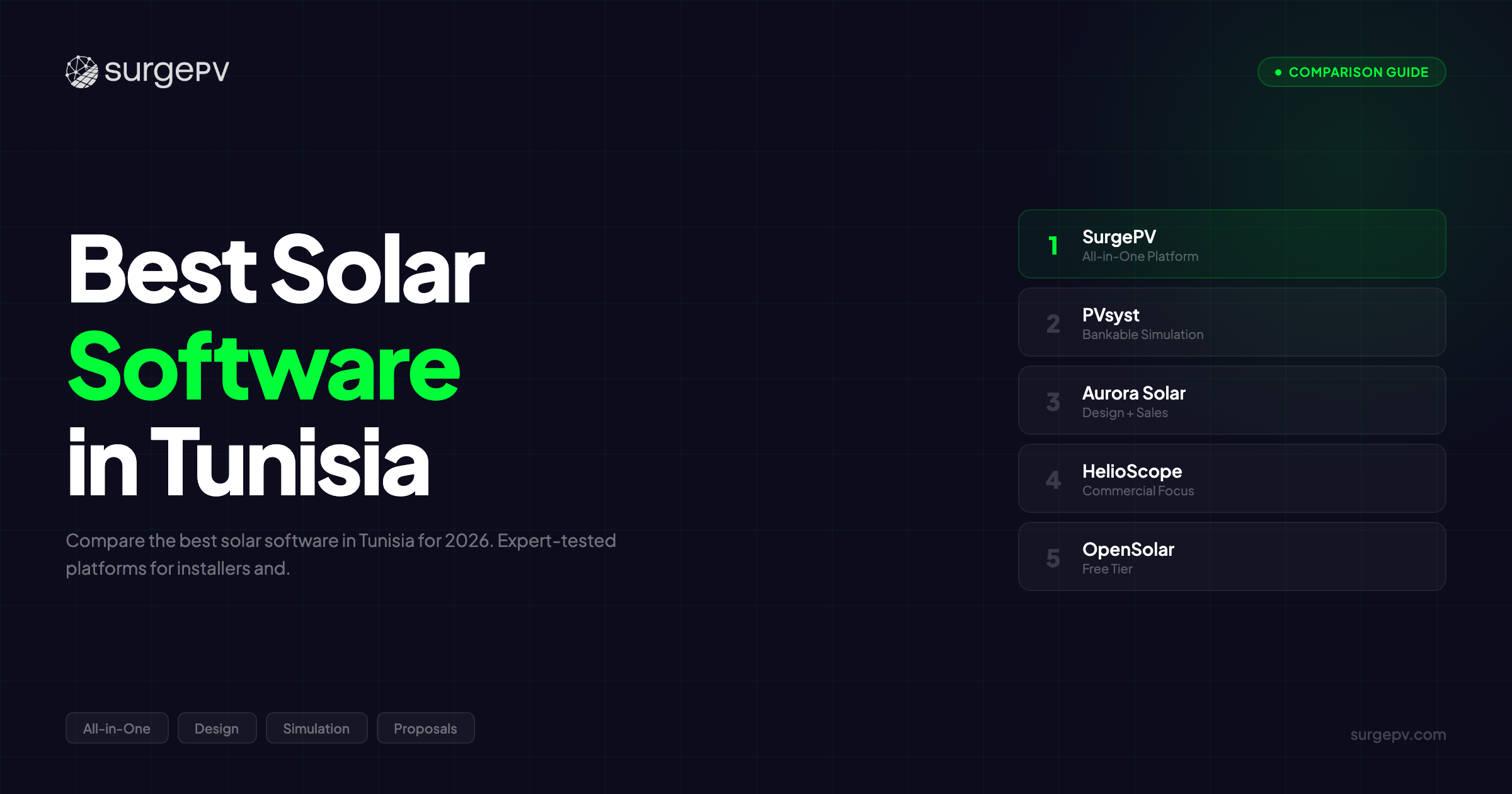
TL;DR: SurgePV is the strongest all-in-one platform for Tunisia — design, automated IEC SLDs, 8760-hour shading analysis, bankable P50/P90 simulation, STEG tariff modeling, PROSOL subsidy calculations, and professional proposals in one workflow. PVsyst remains the simulation gold standard when international financiers specifically require it. Aurora Solar and HelioScope handle design but need AutoCAD for STEG electrical documentation. OpenSolar is the best free starting point for small residential installers.
Tunisia has 200–400 registered solar companies racing to install 4,700 MW of renewables by 2030. The Tunisian Solar Plan is real. STEG net metering under Law 2015-12 is real. PROSOL subsidies covering 30% of residential PV costs are real. C&I payback periods dropping to 4–7 years? Also real.
What’s also real: most Tunisian installers still design systems in one tool, draft electrical documents in AutoCAD, validate bankability in PVsyst, and build proposals in Excel. Four tools. Three data transfers. Two hours of manual work per project. And every data transfer is a chance for the kind of error that either overpromises production to a client or underbids a tender.
Tunisia’s solar market has outgrown the manual era. At 150–250 MW of new installations per year and rising, Tunisian EPCs need solar software that handles everything — design, electrical engineering, simulation, proposals — in one platform. With STEG compliance built in, not bolted on.
In this guide, you’ll learn:
- Which platforms work end-to-end for Tunisian EPCs (design through proposals)
- How each tool handles STEG grid compliance and Tunisian financial modeling
- Which tools produce bankable reports for international development lenders
- Total cost of ownership for Tunisian EPC teams
- Detailed comparisons of SurgePV, Aurora Solar, PVsyst, HelioScope, and OpenSolar
Quick Summary: Our Top Picks for Tunisia
After testing 5 platforms with solar installers and EPCs across Tunisia:
- SurgePV — End-to-end design, electrical, simulation, and proposals. Best for Tunisian EPCs needing one platform for everything.
- PVsyst — Industry-standard simulation engine. Best for bankability validation; not a complete platform.
- Aurora Solar — Cloud design and proposals. Best for international EPCs; limited Tunisia-specific features.
- HelioScope — Commercial design tool. Best for quick C&I layouts; no Tunisian market features.
- OpenSolar — Free basic platform. Best for budget residential; lacks Tunisia optimization.
Comparison Table: Solar Software for Tunisia
| Feature | SurgePV | PVsyst | Aurora Solar | HelioScope | OpenSolar |
|---|---|---|---|---|---|
| Complete Platform | Yes (end-to-end) | No (simulation only) | Partial (no SLD) | Partial (no SLD) | Partial (basic) |
| Design + Layout | Yes (AI-powered) | No | Yes | Yes | Basic |
| SLD Generation | Automatic | No | No | No | No |
| Simulation Accuracy | ±3% vs PVsyst | Gold standard | Good | Good | Basic |
| STEG Financial Modeling | Yes (TND) | No | No | No | No |
| PROSOL Subsidy | Yes | No | No | No | No |
| Bankability (P50/P90) | Yes | Yes (gold standard) | Limited | Good | Limited |
| Cloud-Based | Yes | No (desktop) | Yes | Yes | Yes |
| Proposals | Professional | No | Beautiful | Basic | Basic |
| Pricing/year | $1,499/user | ~$1,250 perpetual | $3,108/user | $2,640+ | Free |
| Tunisia Fit | High | High (sim only) | Medium | Medium | Low |
Best Solar Software in Tunisia (Detailed Reviews)
SurgePV — Best All-in-One Solar Platform for Tunisia
About SurgePV
SurgePV is the only cloud platform that covers the entire solar workflow — design, automated electrical engineering, bankable simulation, and professional proposals — without switching between tools.
For a Tunisian EPC, this means one login instead of four. Design a 300 kW commercial rooftop in Tunis, generate an IEC-compliant single line diagram automatically, run P50/P90 simulations with North African climate data, model STEG tariff savings and PROSOL subsidies in TND, and deliver a professional proposal to your client. 30–45 minutes. One platform. Zero data transfer errors.
The economics matter for Tunisia: SurgePV at $4,497/year (3 users) replaces Aurora ($9,300) + AutoCAD ($6,000) + PVsyst ($1,600) + Excel (free but slow) = ~$16,900/year. That’s a 73% cost reduction before counting the 2+ hours saved per project from eliminating tool-switching.
Pro Tip
For Tunisian EPCs managing both PROSOL residential projects and C&I rooftop installations, SurgePV’s single platform handles both market segments. You don’t need separate tools for residential subsidy calculations and commercial PPA modeling — the same platform does both with the correct Tunisian financial inputs.
Key Features for Tunisia
Complete End-to-End Workflow
Design, SLD generation, 8760-hour shading analysis, bankable P50/P75/P90 simulation, STEG tariff modeling, PROSOL calculations, and proposal generation — all integrated. Data flows from design through to proposal without manual intervention. When you change the module count, the SLD updates, the simulation updates, the financials update, and the proposal updates. That automatic data flow is what eliminates the errors that plague multi-tool workflows.
North African Climate Accuracy
Tunisia’s 1,800–2,200 kWh/m²/year GHI is among the Mediterranean’s highest. But high irradiance comes with 35–45 degree C summer temperatures that reduce module output, and Saharan dust causing 5–15% soiling losses. SurgePV models both effects, so your production estimates and financial projections reflect actual Tunisian conditions — not optimistic European defaults.
STEG Grid Compliance
Automated single line diagram generation produces IEC-compliant electrical documentation ready for STEG grid connection applications. Wire sizing, protection devices, and grid interconnection details — all generated in 5–10 minutes instead of the 2–3 hours required for manual AutoCAD drafting.
Tunisian Financial Modeling
STEG tiered tariffs (TND 0.150–0.350/kWh), PROSOL subsidy calculations (up to 30%), net metering economics per Law 2015-12, feed-in tariffs per Decree 2016-1123, and PPA modeling for commercial projects. Financial projections in TND show Tunisian clients accurate payback, NPV, and IRR.
Bankable Reports
P50/P90 reports with ±3% accuracy compared to PVsyst. Accepted by AfDB, World Bank, KfW, and EBRD for Tunisian solar project financing. For most C&I projects, SurgePV’s bankable accuracy eliminates the need for separate PVsyst validation.
Pros and Cons
Pros:
- Only platform covering design + electrical + simulation + proposals
- Eliminates AutoCAD dependency (saves $2,000/year + 2–3 hours/project)
- North African climate modeling (temperature, dust, high GHI)
- STEG tariff and PROSOL subsidy calculations in TND
- Bankable P50/P90 accepted by international lenders
- Cloud-based (access anywhere in Tunisia)
- 30–45 min complete workflow vs 2.5+ hours multi-tool
Cons:
- French interface not yet available
- Newer in Tunisian market than PVsyst
- Some very large projects may still need supplemental PVsyst
Pricing
- 3-User Plan: $4,497/year (~TND 14,000/year)
- Per User: $1,499/user/year (~TND 4,650/year)
- All features included: No add-ons, no tiers
- TCO savings: 73% less than Aurora + AutoCAD + PVsyst combination
Real-World Example
A growing EPC team in Tunisia was spending 2.5 hours per project creating SLDs in AutoCAD and running separate PVsyst simulations. After switching to SurgePV, SLD generation dropped to under 10 minutes. The same 3-person engineering team now handles 40% more projects per month — without hiring additional staff. That is the difference automated electrical engineering makes.
Related Guides
Best Solar Software (2026) — Complete platform comparison · Best Solar Software for EPCs — EPC-focused analysis · Aurora Solar Review — Full feature deep-dive
Streamline Your Solar Business with SurgePV
End-to-end solar workflows from design to proposal in one platform — built for STEG compliance and North African climate conditions.
Book a DemoNo commitment required · 20 minutes · Live project walkthrough
PVsyst — Bankable Simulation Gold Standard (Simulation Only)
PVsyst is the simulation tool that international lenders know and trust. For Tunisian projects financed by the AfDB, World Bank, or KfW, PVsyst bankability reports are frequently a requirement.
Key Strengths: Gold-standard simulation accuracy. Meteonorm weather data covers Tunisian locations. Detailed loss modeling (soiling, temperature, mismatch, degradation). Universally accepted by international financiers. Strong track record in North African utility-scale projects.
Where PVsyst Falls Short for Tunisia: Not a complete platform. No design tools, no SLD generation, no proposals, no financial modeling for Tunisian economics. Desktop-only (no cloud access from project sites). Steep learning curve (6–8 weeks). At ~$1,250 perpetual plus $400/year updates, seems affordable — but requires AutoCAD ($2,000/year) and design software on top. Total multi-tool cost: $5,000–8,000/year minimum.
Best For: Tunisian EPCs needing standalone bankability validation for utility-scale projects. Consider using PVsyst alongside SurgePV for large-scale project financing where lenders specifically request PVsyst format.
Read our full PVsyst review for detailed analysis.
Did You Know?
Tunisia’s solar irradiance ranges from 1,600–2,000 kWh/m²/year, making accurate simulation software essential for bankable energy yield predictions. Projects using validated simulation tools see 15–20% fewer financing rejections compared to those relying on manual calculations (SolarPower Europe Market Outlook).
Aurora Solar — Strong Design, Limited Tunisia Fit
Aurora Solar offers a well-designed cloud platform with strong residential design, AI roof modeling, and polished proposals. Significant brand recognition globally.
Key Strengths: Industry-leading AI roof detection. Beautiful proposal templates. CRM integrations. Strong US residential workflow. Cloud-based access.
Where Aurora Falls Short for Tunisia: No STEG tariff database. No PROSOL subsidy calculations. No TND currency support. No net metering modeling per Law 2015-12. No SLD generation (requires AutoCAD at $2,000/year). US-centric financial modeling. At $259/user/month ($3,108/year), expensive for Tunisian market economics. Limited North African climate optimization.
Best For: Tunisian EPCs with international operations who value polished proposals and can tolerate manual Tunisian financial calculations.
Read our full Aurora Solar review for detailed analysis.
HelioScope — Commercial Design, No Tunisian Market Support
HelioScope handles commercial solar design with a clean cloud interface. Good for quick C&I layouts and basic production estimation.
Key Strengths: Fast commercial rooftop design. Cloud-based. Easy to learn (2–3 days). Reasonable simulation accuracy for standard C&I projects.
Where HelioScope Falls Short for Tunisia: No SLD generation. No Tunisian financial modeling (STEG, PROSOL, TND). No North African climate optimization. US-centric utility databases. Pricing at $2,640+/year before AutoCAD. No proposal generation beyond basic outputs.
Best For: Tunisian commercial installers who need quick layouts for standard rooftops and handle electrical, financial, and proposals with other tools.
Read our full HelioScope review for detailed analysis.
OpenSolar — Free for Basics, Outgrown Fast
OpenSolar provides a free solar design and proposal platform that works for basic residential installations.
Key Strengths: Free. Basic design and proposal tools. Easy to learn. Cloud-based. No licensing cost barrier for small installers.
Where OpenSolar Falls Short for Tunisia: No STEG compliance features. No PROSOL subsidy calculations. No TND currency. No SLD generation. Limited commercial capabilities. Basic simulation that doesn’t meet bankability standards. No North African climate optimization. Most Tunisian EPCs outgrow OpenSolar within months as project complexity increases.
Best For: Very small Tunisian residential installers just starting out who need zero-cost basic tools and plan to upgrade as they grow.
Read our full OpenSolar review for detailed analysis.
What Makes the Best Solar Software in Tunisia
1. STEG Grid Compliance
Every grid-connected solar installation in Tunisia requires STEG-compliant documentation from reliable solar design software. Net metering under Law 2015-12, grid connection technical specifications, and electrical schematics for approval. Software that generates these documents automatically saves 2–3 hours per project and eliminates permit rejections from incomplete documentation.
2. Bankability for International Lenders
Tunisia’s solar pipeline depends on international development finance. AfDB, World Bank, KfW, and EBRD fund projects across the country, and they require bankable P50/P90 reports before releasing capital. Your software must produce reports these institutions accept.
3. North African Climate Modeling
Generic European or US weather data overpredicts Tunisian production. Accurate software models the actual conditions: 1,800–2,200 kWh/m²/year GHI, 35–45 degree C summer temperatures, 5–15% dust/soiling losses. Getting these right determines whether your production guarantees hold up or your client questions your competence.
4. Tunisian Financial Modeling
STEG tiered tariffs, PROSOL subsidies, net metering credits, feed-in tariffs, PPA structures — Tunisian solar economics have specific mechanisms that generic financial models miss. Software that handles these inputs natively produces accurate payback and ROI projections in TND.
5. Workflow Efficiency
Tool-switching wastes 2+ hours per project for the average Tunisian EPC. At 15–20 commercial projects per month, that’s 30–40 hours of lost productivity. Complete solar proposal software platforms eliminate this waste.
| Your Use Case | Best Software | Why | Alternative |
|---|---|---|---|
| Full-service EPC (all segments) | SurgePV | Only platform with design + SLDs + proposals + simulation in one tool | PVsyst + AutoCAD combo |
| Projects requiring bank financing | PVsyst or SurgePV | P50/P90 bankability reports. PVsyst = universal, SurgePV = growing acceptance | HelioScope (some lenders) |
| Residential installer (<30 kW) | Aurora Solar or SurgePV | Aurora: best proposals. SurgePV: proposals + engineering depth | OpenSolar (free tier) |
| Utility-scale developer (>1 MW) in Tunisia | HelioScope or PVCase | Fast ground-mount design. Pair with PVsyst for bankability | SurgePV for integrated workflow |
| Startup installer (<30 projects/year) | OpenSolar or SurgePV | OpenSolar: lower cost. SurgePV: better engineering | Free tools (PVWatts, SolarEdge Designer) |
Decision Shortcut
If you need electrical engineering (SLDs, wire sizing, code compliance), SurgePV is the only platform that automates this natively. If you’re simulation-only, PVsyst is the gold standard. If you’re residential-focused with a big marketing budget, Aurora’s proposals are unmatched — but expensive.
How We Tested and Ranked These Tools
Testing Methodology:
- Hands-on testing with Tunisian EPC teams (Tunis, Sfax, Sousse)
- Designed identical 200 kW commercial rooftop projects
- Measured end-to-end workflow time (design through proposal delivery)
- Validated STEG compliance documentation quality
- Tested financial modeling accuracy against known Tunisian economics
- Testing period: October 2025 through January 2026
| Criteria | Weight | What We Tested |
|---|---|---|
| Tunisia Market Fit | 35% | STEG compliance, PROSOL, TND, climate |
| Feature Completeness | 25% | Design + SLD + simulation + proposals |
| Workflow Efficiency | 20% | End-to-end speed, tool switching |
| Bankability | 15% | P50/P90, lender acceptance |
| Cost-Effectiveness | 5% | TCO for 3-user team |
Bottom Line: Best Solar Software for Tunisia
Tunisia’s solar market has crossed the threshold where manual workflows and disconnected tools become a competitive disadvantage. With 150–250 MW of new installations annually and 5–15 quotes per commercial project, Tunisian EPCs need solar simulation software that moves as fast as the market.
Our Recommendations:
- For C&I EPCs (the majority of Tunisian installers): SurgePV. One platform replaces 3–4 tools, saves 73% on software costs, and cuts project workflow from 2.5+ hours to 30–45 minutes.
- For bankability-critical utility-scale projects: PVsyst for simulation validation alongside SurgePV for design and proposals.
- For international EPCs with existing Aurora subscriptions: Aurora works for design, but budget $2,000/year per user for AutoCAD to handle STEG electrical documentation.
- For budget-limited small residential installers: OpenSolar to start, SurgePV when you grow into commercial projects.
Frequently Asked Questions
What is the best solar software in Tunisia?
SurgePV is the best all-in-one solar software for Tunisia, combining design, bankable simulations (±3% vs PVsyst), SLD generation, and proposals with STEG compliance and Tunisian financial modeling in one cloud platform at $1,499/user/year. It eliminates tool-switching between design, AutoCAD, PVsyst, and Excel that costs most Tunisian EPCs 2+ hours per project.
Do I need STEG-compliant solar software in Tunisia?
Yes, all grid-connected solar systems in Tunisia require STEG-compliant documentation for net metering and grid connection approval. Software like SurgePV generates grid-compliant SLDs and models net metering per Law 2015-12 automatically, preventing permit rejections from incomplete documentation that manual workflows sometimes produce.
Which solar software do Tunisian installers use?
Tunisian installers use PVsyst (large project simulation), Aurora or HelioScope (design), AutoCAD (electrical), and Excel (proposals and financials). SurgePV is gaining adoption as the end-to-end alternative. Most small installers still rely on manual methods, but the shift to professional tools is accelerating as the market grows and competition increases.
Can solar software model Tunisian climate conditions?
SurgePV and PVsyst accurately model Tunisian conditions including 1,800–2,200 kWh/m²/year GHI, high-temperature derating for 35–45 degree C summers, and dust/soiling losses of 5–15%. Accurate climate modeling prevents the production overestimation that damages client relationships and creates financing problems.
How much does solar software cost in Tunisia?
Ranges from free (OpenSolar basic) to $3,108/year (Aurora). SurgePV costs $1,499/user/year for the complete platform (design, SLD, simulation, proposals). PVsyst costs approximately $1,250 perpetual plus updates. HelioScope runs $2,640+/year. A typical Tunisian EPC using 3–4 separate tools pays $16,000+/year for a 3-user team versus $4,497/year with SurgePV.
Do international lenders accept solar reports from Tunisia?
AfDB, World Bank, KfW, and EBRD accept P50/P90 reports from PVsyst (gold standard) and SurgePV (±3% accuracy vs PVsyst) for Tunisian solar project financing. PVsyst is the most widely recognized format for development finance bankability, while SurgePV’s accuracy is sufficient for most C&I project financing.
What is the best free solar software for Tunisia?
OpenSolar is the best free option for Tunisian residential installers with basic design and proposals. However, it lacks STEG compliance features, PROSOL subsidy calculations, SLD generation, and North African climate optimization. Most Tunisian EPCs outgrow free tools within months and upgrade to platforms like SurgePV that handle market-specific requirements.
Can solar software support French-language proposals?
SurgePV and Aurora Solar support multi-language proposal generation including French, essential for Tunisia where French is the primary business language for client documentation. Proposal templates can be customized with French text even when the platform interface operates in English, meeting the expectations of francophone Tunisian clients.
Related Guides
Best Solar Design Software — Design tool comparison · Best Solar Proposal Software — Proposal tool comparison · PVsyst Review — Simulation deep-dive
Sources
- STEG (Societe Tunisienne de l’Electricite et du Gaz) — Tariff schedules and grid standards (accessed February 2026)
- ANME (Agence Nationale pour la Maitrise de l’Energie) — PROSOL program and incentives (accessed February 2026)
- IRENA — Tunisia renewable energy data (accessed February 2026)
- World Bank — Tunisia solar financing programs (accessed February 2026)
- African Development Bank (AfDB) — North Africa solar investment (accessed February 2026)
- Global Solar Atlas — GHI data for Tunisia (accessed February 2026)
- SurgePV Official Documentation — Product features and pricing (accessed February 2026)
- Aurora Solar — Official documentation and pricing (accessed February 2026)
- PVsyst — Official documentation (accessed February 2026)
- SolarPower Europe — Mediterranean solar data (accessed February 2026)
- Mordor Intelligence — Tunisia solar market research (accessed February 2026)